• 검색 결과가 없습니다.

Correlation between Appearance Management Behaviors and Mental Health Level of Female University Students for U-mental Healthcare

N/A
N/A
Protected

Academic year: 2021

Share "Correlation between Appearance Management Behaviors and Mental Health Level of Female University Students for U-mental Healthcare"

Copied!
8
0
0

로드 중.... (전체 텍스트 보기)

전체 글

(1)

Correlation between Appearance Management Behaviors and Mental Health Level of Female University Students for U-mental Healthcare

1)

Hye-Jung Choi*, Hee-Sun Woo**

Abstract

It is a descriptive study for the relationship between appearance management behaviors and mental health of some female college students. We analyzes 433 self-administered questionnaires from March to June 2017 for female students who enrolled in three-year colleges in Seoul and Gyeonggi province, South Korea. The conclusion is as follows. We used IBM SPSS Statistics 22.0(SPSS Inc., Chicago, IL, USA) for the analysis by person’s characteristics, t-test and one way ANOVA, multiple regression analyses.

The second-year grade shows higher points than the first-year grade in appearance management behaviors and mental health level(p<0.001, p<0.05). In addition, when students has the higher level of the household as the humanities students, they have higher level of mental health level(p<0.001).

The most influential factors affecting the mental health level of female college students are domestic economic level and cosmetic management behavioral factors. The level of mental health was higher in the middle and upper group of the domestic economic level. When they do more cosmetic management behavior, they have lower the mental health level.

In conclusion, it is deemed necessary for students to attend intensive and sufficient counseling with an academic advisor. The continuous attention through school counseling management services depending on grade, domestic economy level, and cosmetic management behavior is necessary in order to enhance the level of mental health for female students. In addition to that, the college needs to develop individual customized psychology counseling and educational programs through U-mental healthcare service in order to lessen the great pressure of sensitive information and provide mental consultation. The college needs to consider students’ characteristics and needs from the results of this study. It is considered that a smart mental healthcare program will be needed to identify mental health of the individual through the systematic approach.

▸Keyword: Appearance Management Behaviors, Mental Health Level, Mobile Mental Health Care, U-mental Healthcare Service

I. Introduction

Health care paradigm is changing from treatment-oriented to prevention-oriented to improve the quality of life through extending healthy span. With epoch-marking advances in

mobile technology, mobile/smart healthcare technology has begun to develop, and the related markets are growing rapidly[1]. Countries around the world are developing into

∙First Author: Hye-Jung Choi, Corresponding Author: Hee-Sun Woo

*Hye-Jung Choi ([email protected]), Dept. of Dental Hygiene, Daegu Health College

**Hee-Sun Woo ([email protected]), Dept. of Dental Hygiene, Suwon Women’s University

∙Received: 2019. 01. 21, Revised: 2019. 02. 22, Accepted: 2019. 02. 25.

(2)

diverse service industries through medical-ICT convergence technology, which is the essential to mobile health care technology. This convergence technology has made it possible to provide intelligent medical services that are composed of medical care, welfare, and safety whenever and wherever. In addition, the quantified self trend has been established to record and manage health conditions based on quantitative records of their workout time, food calories, and sports activities[2]. Accordingly, the scope of the mobile health care service provider and the users are expanding.

The proliferation of these trends is transforming the health care paradigm toward prevention healthcare(consumers) from treatment healthcare(medical institutions)[3]. Recently, Koreans are growing increasingly concerned about their looks, especially in regard to the appearance among female college students. Currently, the nation has become increasingly concerned about cosmetic surgery with the advancement of technique of medical treatment and recognition of the importance of appearance, resulting in a serious level of risk[4]. In particular, the reckless beauty of female college students tends to emerge as a serious problem in our society because it tends to be fashionable in pursuit of beauty[5].

In particular, the phenomenon of female students’

attention on appearance is increasing, and the phenomenon of objectifying superiority or obsession with looks is often observed. In their 20s with sensitivity to the change of media and society, each of them was deemed important to maintain the ideal appearance of the body, therefore, the appearance management behavior become important[6]. Physical satisfaction is reduced in proportion to alienation from the ideal appearance required socio-culturally. The dissatisfaction is resulting from the differences between ideal appearance and their appearance; therefore, they focus on the appearance management behaviors such as clothing, diet, cosmetics, cosmetic surgery, and etc to reduce the dissatisfaction[7].

College students are used to neglect their mental health in order to study, pursue academic research, search for truth, and the perfection of self with endless challenge and creativity. The health problems of female college students cannot be overlooked as the mental health problems of female university students are formed during a critical transition from adolescence to adulthood, which makes them difficult to correct after adulthood.

Their mental health problems are even more important,

especially since they are in a position to play a role as future mothers and important health care providers in the home[8]. However, some of students stay in the environment where they can’t receive appropriate counseling and treatment. It is especially important to make them get counseling with professional consultants about mental health, particularly those with sensitive information.

As a way to achieve this goal, it is to overcome the limitations of time and place by providing video therapy and counseling using smart phones so that many mentally challenged college students can benefit from the development of a more stable school life and positive friendships. By making application, they identify the operation and check smooth transmission and reception of mental health information in a smart phone that are used in everyday life. Individualized psychological counseling and education through the U-Mental Health Service is also required in the near future universities considering the characteristics and needs of students' demand. The academic advisor or counselor of the school is required to develop a program that students can manage their mental health by themselves sending medical information based on mental health measurement data. Based on the records of students using smartphones and receiving prescriptions from psychological counseling and health care professionals through these devices, it is necessary to design and implement the u-health care system through Wi-Fi communication.

Therefore, the research was conducted to provide the basic information of u-health care technologies program to enhance mental health and tutor students through understanding appearance management behavior and mental health level of some female students, which is intended for building mobile healthcare platform.

II. Background

1. Overview

1.1. Mental Health Level

According to Keyes(2002), mental well-being refers to

an individual's perception and evaluation of one’s life in

terms of his emotional state and psychological and social

functioning. Mental well-being includes emotional

well-being, psychological well-being and social

(3)

well-being. People with high mental well-being are more satisfied with their lives, experience more positive emotions such as happiness and joy, and feel less negative emotions such as anxiety and anger. It also includes social well-being, which is a subjective assessment of the function of the society in which an individual belongs and psychological well-being that is a subjective evaluation of the function of an individual[9].

People with high mental well-being are those who have high emotional well-being, psychological and social well-being. People with high emotional well-being are those who have high satisfaction, less negative emotions, and feel a lot of positive emotions. A person with high psychological well-being is a person who is skilled in dealing with difficult and complex situations, makes independent judgments based on internal standards, and evaluates himself that he or she has the ability to interact with others while feeling close. He is also a person who has a positive and receptive attitude toward himself and his life, the recognition that he is always growing, the goals or beliefs that guide his or her life. A person with high social well-being is a person who believes that he belongs to a society with a positive attitude and positive progress, and who contributes positively to the society and is supported by others[10].

1. 2. Appearance Management Behaviors

Appearance refers to the overall appearance of the body from head to toe including face, makeup, hairstyle, body shape, and clothing[11]. Appearance management behavior refers to the appearance of the body such as clothing and makeup[12] or improvement of physical condition such as skin care and body shape management[13].

Kaiser[14] defined appearance management as the process of self-presentation by acting on one's own roles through interaction with others. He attributed his appearance management behavior to a positive mindset that his natural appearance can change sufficiently, and he describes various appearance management behaviors as a means of body satisfaction by assessing his body and improving his satisfaction with his body through active appearance management behaviors such as weight control, skin care, and plastic surgery to overcome differences between his ideal body and his appearance.

There are various appearance management behaviors as a means for body satisfaction.

Ruddand Lennon[15] reported that people conduct appearance management behaviors such as clothing or makeup to meet the ideal appearance standard. He also reported that when ideal standards and their aesthetic standards are not consistent, they develop false body perception, negative self, and stress, leading to excessive appearance management behavior.

1.2.1. Skin Care

The face is the first part of the body that is seen when facing the other person, and the condition of the skin as the base of the face is an important factor that determines the impression of the other person[11]. The skin is a membrane that surrounds the outside of the body, protects the body and organs from the outside environment, secretes sweat and sebum, and regulates body temperature[16]. It is the largest organ that protects against various external harms and is always in contact with changes in daylight, temperature, moisture, dust, various microorganisms, other artificial and irresistible stress[17]. Healthy and beautiful skin is the most basic element that can express healthy and natural beauty externally. Healthy skin has the proper sebum and moisture. Skin care is called skin beauty, esthetic, skin care, etc. It means a technology that stimulates skin's physiologic functions by using physical or chemical methods on face and body skin to maintain healthy and beautiful skin[18].

1.2.2. Weight and body shape management

The meaning of weight management includes both increasing and decreasing weight, but among modern people it is commonly used to refer to interest in weight reduction, behavior, and so on, and it is also called 'Diet'[19]. Diet means 'food therapy' in nature, but in Korean society, the meaning has changed, meaning that weight and fat loss, including dietary control[11].

1.2.3. Cosmetic Surgery

Cosmetic surgery refers to the operation of a part of

the face or body for the purpose of beauty in a dictionary

meaning. As a surgical field that improves the function

and shape of the body when there are changes in the

body, it is defined as a surgical operation performed

mainly for correction of partial damage or deformities, or

beauty treatment of the human body[20].

(4)

2. Research design and statistical methods 2.1 Research Design

From March 13, 2017 to June 2, 2017, the study was conducted to students of dental hygiene course by means of a sampling method and self-administered questionnaires in areas of Seoul and Gyeonggi Province. A total of 445 copies were collected, except for 12 copies. We made use of 433 questionnaires for final analysis.

The number of participants was calculated using the G

* power program. We obtained 172 persons to maintain the significance level of α = 0.05, moderate effect 0.15, power 1- β=0.95 in the multiple regression analysis.

The general characteristics of this study consisted of four questions: academic grade, high school type, cohabitation of parents, and economic level of the household. To measure mental well-being, the Korean Mental Health Continuum Short-Form:K-MHC-SF) is used, developed by Keyes (2008) and validated by Lim Young-jin and others[9]. This measure is designed to separate mental well-being into emotional well-being, psychological well-being and social well-being. The survey consists of totally 14 questions, which is three questions of emotional well-being, six questions of psychological well-being, and five questions of social well-being. The survey questions were designed by Likert 6 point scale and indicate that the higher the score, the higher the mental health level is. In this study, the coefficient of internal conformity of this measure (Cronbach s α), which was calculated for female college students, was .91. We used the survey tool that had used in the prior study of appearance management behavior[10]. The survey consisted of 18 questions of appearance management activities(skin care 6 questions, weight management 6 questions, cosmetic surgery 6 questions). The questionnaire is written on a Likert 5 point scale, meaning that the higher the score, the more the appearance management activities. The reliability among questions was 0.79 in Cronbach’s α value of each category.

2.2 Data Analysis

We used IBM SPSS Statistics 22.0(SPSS Inc., Chicago, IL, USA) program for the analysis. For the analysis of differences between appearance management behaviors and mental health level based on the person’s characteristics, t-test and one way ANOVA were used.

We conducted Tukey’s post-test.

The relationship between appearance management behavior and mental health level items was analysed by Pearson's correlation analysis. For the analysis of factors affecting the mental health of female college students, we used multiple regression analyses.

III. Results and discussion

1. Level of appearance management behaviors and mental health of the target

The level of appearance management behaviors and mental health of the target(Fig 1,2). Overall average of appearance management behaviors of the target is 2.54 points, followed by 3.32 points(skin care behavior), followed by 1.64 points(weight management behavior), and 2.66 points(cosmetic surgery behavior).

Overall average of mental health level of the target is 2.25 points, followed by 2.46 points(emotional well-being), followed by 1.88 points(social well-being), and 2.45 points(psychological well-being).

Fig. 1. Level of Appearance Management Behaviors of General Subjects.

Fig. 2. Level of Mental Health Level of General Subjects.

(5)

2. Appearance management behaviors and mental health level based on the characteristics of the target

The level of appearance management behaviors and mental health based on the characteristics of the target(Table 1). In appearance management behaviors of the target, the 2nd grader showed 2.63 points, 2.60 points in the third grade, and scored 2.40 points in the first grade(p<0.001).

In particular, Tukey's findings showed that the second-year and third-year graders have different appearance management behaviors than the first-year graders. The mental health level based on the characteristics of the target was higher(2.38 points) in the 2 nd grade than 2.38 points in the first grade(p<0.05). Also, the high school classification was higher (2.29 points) in a academic high school than 2.06 points in vocational high school(p<0.05).

In particular, the mental health level was higher in the upper domestic economic level group of 2.53 points than 1.90 in the lower domestic economic level group.

Therefore, the higher the domestic economic level, the higher the mental health level(p<0.001). The study of Bae[21] shows that the higher the standard of living, the higher the level of social and psychological health.

Variables

Appearance Management

Behaviors

Mental Health Level

N Mean± SD t/F(p*) Mean± SD t/F(p*) Grade

1 154 2.40±0.49a

8,475 (0.000)

2.13±0.78a 3.592 (0.028)

2 163 2.63±0.53b 2.38±0.87b

3 116 2.60±0.56b 2.20±0.89a,b

High school Humanitie

s course 352 2.55±0.53 .586 (0.56)

2.29±0.86 2.157 (0.032) Vocational

course 81 2.50±0.56 2.06±0.79

Domestic Economic Level

Top 25 2.73±0.54 1.780

(0.170)

2.53±0.83b 6.936 (0.001)

Medium 348 2.53±0.53 2.29±0.84a,b

Low 60 2.54±0.53 1.90±0.86a

a,b denotes the same subgroup by Tukey test

*by one-way ANOVA ort-test

Table 1. Appearance Management Behaviors and Mental Health Level to General subjects (N=433)

3. The correlation between appearance

management behaviors and mental health level The results of the correlation between appearance management behaviors and mental health level(Table 2).

Skin care behavior has been linked to weight management

behavior, cosmetic surgery management behavior, social well-being, and psychological well-being in mutual positive correlation. In addition, there was a strong positive correlation between cosmetic surgery management behavior and weight management behavior, but a negative correlation between cosmetic surgery management behavior and emotional well-being was observed. There was a strong positive correlation among emotional well-being, social well-being, and psychological well-being.

Analysis of differences in psychological well-being according to appearance management behavior among college students showed that groups that perform routine appearance management activities such as hair care and skin care are more likely to have psychological well-being than those that manage their appearance through extreme weight control or clothing. The above studies of Hwang and others support our study results[22].

Variables ① ② ③ ④

①Skin Care Mgt. 1

②Weight Mgt. .208** 1

③Cosmetic Surgery Mgt. .245** .296** 1

④Emotional well-being .069 -.048 -.123* 1

⑤Social well-being .097* .076 -.010 0.576**

⑥Psychological well-being .099* .077 -.052 0.630**

by Pearson‘s correlation analysis *p<0.05,**p<0.01

Table 2. Correlation between Appearance Management Behaviors and Mental Health Level (N=433)

4. The Analysis of factors affecting mental health level

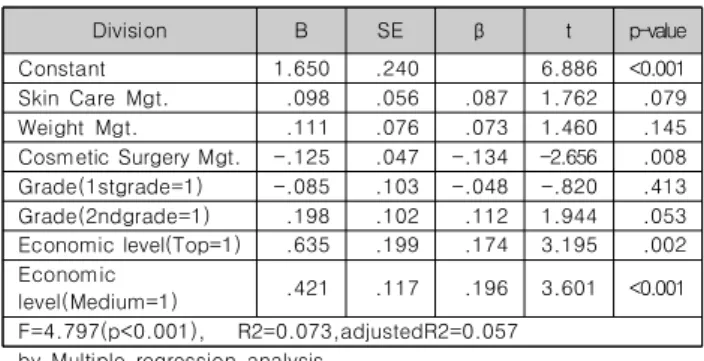
To find out the factors affecting mental health level, we conducted multiple regression analysis by treating general characteristics of the target(school grade, domestic economic level) as variable number, appearance management behavior(followed by skin care, weight control, and cosmetic surgery) as an independent variable, mental health level as a dependent variable.

The appropriate regression model was statistically

significant(F7=4.797, p<0.000.1). Factors affecting mental

health level were the household economic level(p<0.01,

p<0.01) and cosmetic surgery management behavior

(p<0.01). The level of mental health was high in the

middle and upper group of the domestic economy. The

more the cosmetic surgery management behavior, the

lower the mental health level. On the other hand, the

studies by Lim and others showed that the higher the

appearance satisfaction and evaluation of a college

(6)

student's self, the higher the appearance-oriented behavior, the higher the psychological stability[23-24].

These studies showed a different result from a study[25], which found that people who perceive one's body to be more attractive are more likely to develop psychological health. This is believed to be a difference in the parameters of mental health level and psychological well-being, requiring further study. And rather than looking for satisfaction in one's appearance only in one's appearance, one needs a sense of psychological stability, a positive college life that can raise one's mental health level, and an effort to help improve the quality of one's social life.

Division B SE β t p-value

Constant 1.650 .240 6.886 <0.001

Skin Care Mgt. .098 .056 .087 1.762 .079

Weight Mgt. .111 .076 .073 1.460 .145

Cosmetic Surgery Mgt. -.125 .047 -.134 -2.656 .008 Grade(1stgrade=1) -.085 .103 -.048 -.820 .413 Grade(2ndgrade=1) .198 .102 .112 1.944 .053 Economic level(Top=1) .635 .199 .174 3.195 .002 Economic

level(Medium=1) .421 .117 .196 3.601 <0.001 F=4.797(p<0.001), R2=0.073,adjustedR2=0.057

by Multiple regression analysis

Table 3. Factors of Mental Health Level

IV. Conclusions

This study is a descriptive research study to clarify the relationship between appearance management behaviors and mental health of some female college students. A total of 433 questionnaires were analyzed for female college students of dental hygiene curriculum from third-year colleges in Seoul and Gyeonggi province from March to June 2017. The conclusions are as follows.

1) The total average of appearance management behaviors was 2.54 points, and the scores of skin care and cosmetic surgery management behavior were high by the sub-factors. The overall average of mental health level was 2.25, the emotional well-being score by sub-factor was high, and the social well-being average score was low.

2) In the appearance management behaviors and mental health level, the second grade showed higher score than the first grade(p<0.001, p<0.05). Also, the higher the family economic level, the higher the level of mental

health. In case they were students in humanities course, the level of mental health was high(p<0.001).

3) Factors influencing the level of mental health were family economic level and cosmetic surgery management behavior factors. The mental health level was high in the middle and upper group of the domestic economic level, and the more the plastic surgery management behavior, the lower the mental health level.

These results suggest that intensive psychological counseling programs should be provided to first year students who are freshman in order to improve mental health level of female college students. Also, considering the low level of mental health as the family economic level is low, the more the public assistance should be expanded. Also, it is expected that there should be continuous attention through consultation with the professor who fully reflects the basic research of the students and through the school counseling management service. As the mental health is low, it is necessary to identify the tendency of female college students to replace the appearance management behaviors to the cosmetic surgery management behaviors, and to improve the satisfaction of life by linking social relations, not management of appearance.

In the near future, it is necessary to develop personalized psychological counseling and education program through U-Mental Health Service considering the characteristics and needs of students, reflecting the results of this study. The school's advisor or counselor will send health information text and health information based on mental health measurement data, and students will use their smartphone whenever they want. Based on the records of receiving prescriptions from psychological counseling and health care professionals through these devices, u-mental health care should be provided through Wi-Fi communication. We need a systematic approach and a smart mental health management program that can identify the mental health of individual students.

REFERENCES

[1] Y. I. Gwon, D. G. Choe, "U-Health The Necessity and Proportion of the Health Service", Journal of the Korean Hospital association, Vol. 36, No. 2, pp. 68-78, 2007.

[2] Y. H. Cho, D. H. Kim, "Growth and Opportunities of Smart

(7)

Healthcare Market", ISSUE CRUNCH. Kt, Institute for Economic Management, 2016.

[3] S. W. Park, "Global Health Care Technology Global Market Trend", 2017 Small Business Menting Report, Korea Institute of Science and Technology Information, 2017.

[4] I. G. Ryu, "Impacton college women student's diet,cosmetic surgery and healthstatus", Department of Health and Human Services, 2003.

[5] K. Lee, H. S. Lim, K. S. Chang, "Status of perceptions for appearance and cosmetic surgery among university freshmen", Journal of Medicine, Vol. 13, No. 1, pp. 27-36, 2006.

[6] S. W. Lee, "Body Image and Appearance Management Behaviors according to Public-Private Self Consciousness", Univ. of Sung shin Women’s, Seoul, 2004.

[7] S. B. Kaiser, " The social psychology of clothing : Symbolic apprearances incon text(2nd ed) ", Macmillan Publishers, New York, 1997.

[8] D. J. Jung, "Influence of weight control behavior, body image, self-esteem, health promotion behabior in university female students by BMI", Exerc Scri, Vol. 15, No. 4, pp. 365-376, 2005.

[9] Y. J. Lim, H. C. Shin, Y. R. Cho, “Psychometric Evaluation of the Mental Health Continuum-Short Form (MHC-SF) in South Koreans”. Journal of Psychology, Vol. 31, No.

2, pp. 369-386, 2012.

[10] Y. J. Lim, "Mental Health of Koreans", Korean Psychologycal Association, Annual Conference Catalog, pp. 223-257, 2010.

[11] H. S. Kim, “A Study on the Effect of Body Image-induced Appearance Management Behavior on Health Life Habits, Graduated School of Distance learning”, Univ. of Sookmyung Women’s, Seoul, 2015.

[12] H. J. Shin, "(A)qualitative study of beautiful appearance in modern women : makeup,hair style, body image, cosmetic surgery, and clothing", Kon-Kuk University, Seoul, pp. 135, 2002.

[13] B. S. Hong, Y. H. Cho, "Use and Satisfaction on Cosmetics of Middle- and Old-Aged Women with Well-being Pursuit Disposition", Family and Environment Research, Vol. 44, No. 11, pp. 43-50, 2006.

[14] Kaiser, S. B., "The Social Psychology of Clothing Appearances in Context", New York, Macmillan Publishing Co, 1990.

[15] Rudd, N. A.,and S. J. Lennon,"In Body image: linking aesthetics and social psychology of apprearance", Clothing and Textiles Research, Vol. 19, pp. 120-133, 2001.

[16] S. A. Kim, "Knowledge and Attitude towards Skin Health

Care Based on the Lifestyle of Women", Master of Cosmetology Graduate School of Engineering, Konkuk University, 2008.

[17] M. S. Kim, " (The)theory and practice of esthetics ", Seoul, Hyunmoonsa, 2009.

[18] C. J. Han, H. Y. Gwon, S. O. Kim, Y. S. Jeon, M. J. Jang,

"Esthetics", Seoul, Hyunmoonsa, 2010.

[19] S. J. Cho, C. K. Kim, "The Effect of Female Students' Obese Level and Weight Control Behavior and Attitudes on Stress" , Korean Journal of Health Education and Promotion, Vol. 14, No. 2, pp. 1-16, 1997.

[20] J. S. Kang, " Plastic Surgery ", Daegu, Keimyung University Press, 1988.

[21] S. H. Bae, "A Study on the Relationship between Skin Health Behavior and Psychosocial Health of University Women's", Univ. of Ewha Womans, Seoul, 2003.

[22] J. S. Hwang, Y. H. Kim, "The Effect of Appearance Management on Body Image and Psychological Well-Being", Journal of the Korean Society of Costume, Vol. 56, No. 3, pp. 143-155, 2006.

[23] E. J. Im, J. H. Ha, G. J. Lee. "The Effects of University Students’ Body Image on Diet Behavior and Appearance Management Behavior", Journal of the Korean Society of Design Culture, Vol. 23, No. 1 pp. 501-511, 2017.

[24] H. W. Park, M. S. Chung, “The effects of self-assertiveness and appearance satisfaction on psychological well-being”, The Research Journal of the Costume Culture, Vol. 22, No. 5, pp. 728-742, 2014.

[25] E. S. Lee, “The Influence of Perception of Physical

Attractiveness on Health Promoting Behavior and

Appearance Management Behavior ”, Family and

Environment Research, Vol. 49, No. 6, pp. 47-56, 2011.

(8)

Authors

Hye-Jung Choi received the Ph. D. degrees in Health from Ewha-Woman's University, Korea, in 2014, respectively. She is currently an assistant professor in the Dental Hygiene at Daegu Health College.

Her teaching and research specialties are in the fields dental implantology.

Hee-Sun Woo received the M.S. and Ph. D.

degrees in Health from Chosun University,

Korea, in 2004, 2011, respectively. She is

currently an assistant professor in the

Dental Hygiene at Suwon Women’s

University. Her teaching and research

specialties are in the fields oral health

education.

수치

Fig.  1.  Level  of  Appearance  Management  Behaviors  of  General  Subjects.
Table  2.  Correlation  between  Appearance  Management  Behaviors  and  Mental  Health  Level  (N=433)
Table  3.  Factors  of  Mental  Health  Level

참조

관련 문서

Relationship between Metabolic Syndrome and Mental Health in Korean adults; Using the 7th Korea National.. Health and

Objectives : The purpose of this study was to investigate the effects of general characteristics, health characteristics, mental health characteristics, suicidal

difference depending upon health state of the family (p=.000). In conclusion, the family's depression had positive correlation with burden as well as physical and

In gi ngi va,LCs are found i n oralepi thel i um ofnormalgi ngi va and i n smal l er amountsi nthesul cul arepi thel i um,buttheyareprobabl yabsentfrom thejuncti onal epi thel

First, the level of career barriers of visually impaired university students showed statistically significant differences only in their majors, but the level

Results: The results demonstrated a significant positive correlation between the muscle atrophy and the tendon tear.(p&lt;0.05) And there was statistically

Objectives: The purpose of this study was to investigate the relationship between mental health and experience of falling in some local elderly people using the 2013

Third, the difference of perceived performance according to sports self - confidence showed significant difference, and coach leadership and physical /