• 검색 결과가 없습니다.

How Resilience Affects Post-Traumatic Stress Symptoms:

N/A
N/A
Protected

Academic year: 2021

Share "How Resilience Affects Post-Traumatic Stress Symptoms: "

Copied!
10
0
0

로드 중.... (전체 텍스트 보기)

전체 글

(1)

How Resilience Affects Post-Traumatic Stress Symptoms:

The Mediating Role of Acceptance

Yookyung Eoh 1 Ansuk Jeong 2† Sung-Yi Cha 3 Nam Hee Kim 3,4†

1

Department of Counseling Psychology, Yongmoon Graduate School of Counseling Psychology, Seoul;

2

Department of Psychology, University of Utah Asia Campus, Incheon;

3

Suwon Smile Center for Criminal Victims, Suwon;

4

Maumtodac Psychiatric Clinic, Ansan, Korea

Not every individual who experiences a traumatic event is diagnosed with post-traumatic stress disorder (PTSD) or shows its symptoms. Resilience has been understood to be a key factor that helps individuals adapt successfully following an adversity.

Acceptance has also been considered a therapeutic factor for such individuals. However, there are few studies that investi- gated the relationship between resilience and acceptance, and their impacts on post-traumatic stress symptoms. The current study examined the effect of resilience on post-traumatic stress symptoms and the mediating role of acceptance in the rela- tionship. A total of 140 participants who experienced trauma (80 females and 60 males) were included in the analyses. Resil- ience was found to be negatively correlated with post-traumatic stress symptoms and acceptance was found to mediate the relationship between the two. This study provides an understanding of the mechanism underpinning the effect of resilience on post-traumatic stress symptoms. Study limitations and suggestions for future research are also discussed.

Keywords: resilience, acceptance, post-traumatic stress symptoms, mediating effect

Introduction

More than half of adult populations are reported to have experi- enced at least one traumatic event in their lifetime (Kessler et al., 2005). These traumatic events include direct exposure to life- threatening accidents, sexual crimes, domestic violence, physical attacks, or indirect witnessing others experience traumatic events.

In the Diagnostic and Statistical Manual of Mental Disorders, Fifth Edition (DSM-5; American Psychiatric Association [APA], 2013), there is the prerequisite condition of exposure to life-threat- ening events indirectly as well as directly for diagnosis of post-

traumatic stress disorder (PTSD). PTSD consists of four additional symptoms: intrusive symptoms (ex., intrusive thought and memo- ries about the adverse events, nightmares, or flashbacks), avoid- ance symptoms (ex., trying to avoid stimuli that reminiscent tragic events), negative mood and cognitions (ex., negative beliefs about the world, others and self, or blame of self or others), and altera- tions in reactivity and arousal (ex., inability to feel interests in what were used to be interesting). Usually, individuals with PTSD suffer from negative changes of not only their cognition but the mood in various forms after exposure to the traumatic events, and sometimes they may experience personality changes (APA, 2013).

All these symptoms, consequently, interfere with individuals’ bet- ter levels of functioning in their everyday lives.

However, some people adapt successfully after all traumatic and tragic experiences, and to them, the responses to traumatic events seem to be rather temporary (Bryant, 2003). Even though more than 50% of the population reported to have traumatic events, the life-time prevalence of PTSD was estimated to be less than 9%,

eISSN 2733-4538

Correspondence to Ansuk Jeong, Department of Psychology, University of Utah Asia Campus, 119 Songdomoonwha-ro, Yeonsu-gu, Incheon, Korea;

E-mail: [email protected]

Correspondence to Nam Hee Kim, Maumtodac Psychiatric Clinic, 174 Gwang- deok-daero, Danwon-gu, Ansan, Korea; E-mail: [email protected] Received Apr 19, 2019; Revised Aug 21, 2019; Accepted Aug 21, 2019 This study was supported by a grant from the Korean Mental Health Technology R&D Project, Ministry of Health & Welfare, Republic of Korea (HM15C1058).

The two authors contributed equally as corresponding authors.

(2)

which suggests not all trauma-exposed individuals develop PTSD.

This also suggests that there be protective factors that keep them from developing the symptoms of PTSD after experiencing trau- matic events (APA, 2013). In regards to the preventative potential, it will be beneficial to identify the factors that influence the devel- opment of PTSD symptoms.

Resilience

Regarding the critical factors that distinguish people who develop PTSD from those who do not, resilience takes the front (Bonanno

& Mancini, 2012). Resilience is a personal trait defined as the ability to adapt effectively and successfully after the individual experi- ences adversity, trauma, severe stress, or tragic life events (Char- ney, 2004; Connor & Davidson, 2003). Although the operational definition of resilience might vary from study to study, the cur- rently agreed definition of resilience consists of three orientations:

trait, outcome, and process (Hu, Zhang, & Wang, 2015). First, re- silience is a personality that vaccinates people from the impact of negative experiences (Connor & Davidson, 2003; Hu et al., 2015).

In the outcome orientation, secondly, resilience is considered as the behavioral outcome derived from the individual’s inclination to do something after experiencing traumas (Harvey & Delfabbro, 2004). The process orientation regards resilience as a process in which good adaptation is accomplished dynamically (Fergus &

Zimmerman, 2005). According to this perspective, resilience is built up over a long time rather dynamically.

Resilience was found to play a protective role in post-traumatic stress symptoms. In general, resilient individuals tend to monitor their thoughts, regulate their emotions, and replace them in more adaptive ways (McRae, Ciesielski, & Gross, 2012). Resilience also has a positive correlation with both positive emotion and overall life satisfaction (Hu et al., 2015; Mak, Ng, & Wong, 2011) and with post-traumatic growth which represents the positive transforming impact of trauma on individuals’ personality (Arabaci, Dikec, Buyukbayram, Uzunoglu, & Ozan, 2018; Yoo, Choi, Han, Seo, &

Noh, 2015).

A rich body of studies has verified that resilient individuals are healthier physically as well as psychologically than non-resilient individuals because resilience buffer negative effects of stressors (Connor & Davidson, 2003; Kim & Byeon, 2013). More specifically,

in the studies with veterans of combat in Iraq and Afghanistan or with patients of back injuries, resilience was the construct that showed significantly negative relationship with PTSD symptoms or negative psychological symptoms including intrusive thinking and negative alterations both in cognition and in emotion (Black- burn & Owens, 2016; Min et al., 2014).

Resilient individuals appear to confront their fears and anxiety and restructure their adverse experiences cognitively (Foa et al., 2005; Horn, Charney, & Feder, 2016) so that they can overcome the negative effect of adverse experiences and achieve adaptive changes later on. Multiple variables such as positive emotion, characteristics, social supports, cognitive flexibility, and religious belief have been found to be associated with resilience (Hoge, Aus- tin, & Pollack, 2007; King, King, Fairbank, Keane, & Adams, 1998). Specifically, resilience that is based on flexibility was re- ported to be associated with the prevention and alleviation of post- traumatic stress symptoms even if the participants were exposed to the repeated traumatic stimuli (Song, 2017). In a previous study, the specific mechanism of the effect of resilience on individuals’

well-being was examined and post-traumatic growth and post- traumatic negative cognition were found to have mediating roles (Cho, 2014). However, more research needs to be conducted to in- vestigate the specific mechanism of resilience for individuals’ re- adjustment after traumatic events.

Acceptance

Acceptance is a non-judgmental attitude toward what the individ- uals experience and “being fully present” (Hayes, Strosahl, &

Wilson, 1999). Acceptance involves three processes: observing what individuals experience, letting the desire to change situations go, and differentiating actual experiences from psychological ex- periences (Follette, Palm, & Hall, 2004). Individuals with accep- tance try to understand their psychological state and do not avoid fixing their own experiences in non-judgmental manners (Hayes, 2004; Orsillo, Roemer, Lerner, & Tull, 2004). Acceptance helps people to view their psychological state as transient responses to unchangeable and unavoidable external experiences (Orsillo et al., 2004).

More specifically, in the context of post-traumatic stress symp-

toms, avoidance plays an important role in a dysfunctional way

(3)

when negative emotion needs to be regulated (Ruiz-Párraga &

López-Martínez, 2014). Moreover, avoidance was considered to be one of the key factors among those involved in both etiology and maintenance of post-traumatic stress symptoms and diagnosis of PTSD (Morina, Stangier, & Risch, 2008; Orsillo & Batten, 2005).

By the same token, acceptance can be viewed on the other side of avoidance (Orsillo, Roemer, & Barlow, 2003).

Recently, as the point of view on acceptance has developed, ac- ceptance has been considered to imply a cognitive flexibility in various situations individuals go through (Heo, Choi, & Jin, 2009).

Acceptance can be understood as psychological flexibility (Bond et al., 2011), and it helps individuals to stop having ruminative and intrusive thoughts, which can be a risk for psychopathologies such as depression, anxiety, and trauma-related disorders. Consequently, acceptance also promotes psychological stability after trauma (Abe- la & Hankin, 2011; Spasojević & Alloy, 2001; Thompson, Arnkoff,

& Glass, 2011).

Researchers and practitioners have regarded acceptance as a pro- tective factor of post-traumatic stress symptoms, explaining that individuals with the acceptant perspective take their trauma-relat- ed experiences with no judgment and regulate their internal emo- tion better (Follette, Pal, & Pearson, 2006; Orsillo & Batten, 2005).

Moreover, acceptance was found to facilitate individuals diagnosed with PTSD to recover from post-traumatic stress symptoms (Or- sillo & Batten, 2005; Silver, Holman, McIntosh, Poulin, & Gil-Ri- vas, 2002). Conversely, individuals who lack acceptance after trau- matic events reported to have more PTSD diagnosis and other negative symptoms (Tull, Barrett, McMillan, & Roemer, 2007).

Resilience and acceptance

As reviewed above, some studies examined the effects of resilience and acceptance on PTSD patients or individuals with traumatic symptoms: both high resilience and high acceptance were proved to be protective and therapeutic, and accepting attitude conferred individuals’ resilience after trauma (Bajaj & Pande, 2016; Thomp- son et al., 2011). Taking all these studies into account, resilience and acceptance are related to each other, and they both are crucial variables to understanding post-traumatic stress symptoms (Ruiz- Párraga & López-Martínez, 2014). However, few studies were con- ducted to examine specific underpinning processes of these vari-

ables for victims of trauma.

Resilience was considered as a trait-like or diathesis variable so that it played a significant role in explaining the difference in ad- justment of individuals with physical pain (Ramírez-Maestre &

Esteve, 2014; Sturgeon & Zautra, 2010). Because resilience includes diverse psychometric aspects (Hu et al., 2015), it might be less clear to make interventions for post-traumatic stress symptoms specifi- cally focused on individuals’ resilience. Therefore, it would be helpful for the practical therapeutic interventions to examine the impact of another variable such as acceptance on the effect of re- silience on individuals’ post-traumatic stress symptoms or the re- lationship among these variables.

More specifically, high resilience could be considered as the pre- requisite condition of the positive result after traumatic events, and seemed to trigger high confrontation that led to positive adap- tation. As the matters of acceptance, it has been considered as a cognitive variable (Heo et al., 2009), so it usually is targeted to be promoted in various therapeutic settings. According to this, it can be postulated that high resilience may lead to high acceptance that result in positive outcome.

Study objectives and hypotheses

The current study focuses on the relationship among resilience, acceptance, and post-traumatic stress symptoms for victims of traumatic experiences in Korea. The primary objective of this study is to verify the relationship between these variables with ac- tual victims of various traumatic events.

First, as Ramírez-Maestre and Esteve (2014) did, we hypothesize

resilience as a trait-like variable that can predict individuals’ ad-

justment. Second, the current study examines the mediating role

of acceptance on the relationship between resilience and PTSD

symptoms. That is to say that the higher resilience individuals

show, the more acceptance they have, and consequently, they will

have fewer symptoms of PTSD. Most people experience adverse

events in their lives, but the impact of traumatic experiences such

as accidents or crimes on individuals’ lives could be destructive or

fatal. Therefore, it is meaningful to examine the factors of the ad-

justments of victims of various traumatic experiences.

(4)

Methods

Participants

Data were collected from 140 participants in Korea (80 females, 60 males) who were the victims of one of the various kinds of accidents or crimes. More specifically, accidents include car accidents, fall- ing accidents, workplace accidents, and crimes include sexual vio- lence, general violence, domestic violence or other violent crimes.

Life Events Checklist of the Diagnostic and Statistical Manual of Mental Disorder-Fifth Edition (Weathers et al., 2013) was consid- ered when accidental or criminal trauma was defined (APA, 2013).

Participants did not have any of the following conditions: primary psychotic diagnoses such as schizophrenia, schizoaffective disor- der, and schizophreniform disorder, serious medical condition sufficient to interfere with their participation in this study, intel- lectual disabilities, or neuro-cognitive impairment. Mean age for participants was 37.82 years (SD =12.14); 37.16 years for females (SD =12.08) and 38.70 years for males (SD =12.26). The demo- graphic characteristics of participants are presented in Table 1.

Measures

Connor-Davidson Resilience Scale (CD-RISC)

The resilience of participants was measured using the 25-item CD- RISC (Connor & Davidson, 2003). Total scores for CD-RISC range from 0 to 100, with items (ex., “See the humorous side of things.”) rated on a 5-point Likert scale (from 0 “rarely true” through 4

“true nearly all of the time”). This scale consists of items about controllability, responsibility, sense of humor, adaptation, among others, and is validated by studies aimed at various population such as general population, patients in primary health care centers, and psychiatric patients (Horowitz, Wilner, & Alvarez, 1979; Lim et al., 2009; Wilson & Keane, 2004). Resilience in this scale refers to positive sides of individuals’ differences in the responses of traumatic or adverse experiences (Min et al., 2013). Higher scores correspond to more resilience. Cronbach’s alpha in the present study was .94.

Acceptance and Action Questionnaire-II (AAQ-II)

Acceptance of participants was measured using the AAQ-II (Bond et al., 2011). Specifically, psychological acceptance or flexibility to

experience unwanted private experiences is measured by this scale (McCracken & Gutiérrez-Martínez, 2011). In a validation study with Koreans, two items were deleted (Heo et al., 2009), so the sum scores of 8 items were analyzed. Total scores for AAQ-II range from 8 to 56, rated on a 7-point Likert scale (from 0 “never true”

through 7 “always true”; “When I feel depressed or anxious, I am unable to take care of my responsibilities.”) Higher scores indicate more acceptance. Cronbach’s alpha in the present study was .91.

Impact of Event Scale-Revised (IES-R)

Post-traumatic stress symptoms of participants were measured using IES-R (Weiss & Marmar, 1997). This scale consists of 22 items using 5-point Likert scale (from 0 “not at all” through 4 “ex- Table 1. Demographic Characteristics of Participants (N=140)

Variables Female (n=80) Male (n=60) Gender Total Age (yr)

10’s 2 1 3

20’s 25 15 40

30’s 21 18 39

40’s 15 12 27

50’s 15 12 27

60’s 2 2 4

Marital status

Single 34 26 60

Married 33 26 59

Remarried 2 4 6

Divorced 9 4 13

Bereaved 2 0 2

Occupation

Company exployee 19 24 43

Self-employed 4 7 11

Student 7 3 10

Professional 12 7 19

Housemaker 11 0 11

Other 14 17 31

Unemployed 13 2 15

Type of trauma

Traffic accident 25 35 60

Fall accident 3 3 6

Injuries with machine 1 4 5

Sexual violence 20 3 23

Physical violence 15 9 24

Domestic violence 7 0 11

Robbery/Attemped murder 3 4 5

Other 6 2 8

(5)

tremely”), and represents post-traumatic stress disorder-related symptoms (“I had trouble falling asleep.”) when the scores are greater than 22 (Lim et al., 2009). It has four subscales: arousal, avoidance, intrusiveness, and dissociation. In the present study, Cronbach’s alpha was .96.

Procedures

This study was approved by the Institutional Review Board (IRB) (approval number: 116271-2018-13). An advertisement was posted on two recruiting sites: a university medical center where victims of accidents were recruited, and Smile Center, a one-stop support center founded by the Korean Ministry of Justice, for victims of various crimes. All participants signed the informed consent and completed the questionnaire by him/herself.

Statistical analysis

Data were analyzed using SPSS 23.0 and SPSS Macro PROCESS.

First, descriptive analysis for all variables and Pearson correlation analysis between variables were performed. Second, to test the ef- fect of resilience on individuals’ PTSD symptoms and the media- tion effect of acceptance, multiple regressions were conducted us- ing SPSS Macro PROCESS (Hayes, 2013). SPSS Macro PROCESS made all variables centered to alleviate the problems of multicol- linearity. Moreover, it performed ordinary least squares (OLS) re- gression with bootstrapping analysis with 5,000 samples. When the effect of resilience on PTSD symptoms was analyzed, demo- graphic variables that were confirmed to have a significant corre- lation with predictor and outcome variables were controlled. All variables were centered to mean to alleviate the potential multicol- linearity.

Results

Descriptive statistics

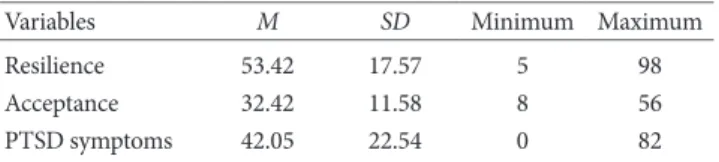
Prior to the main analysis, means, standard deviations, and mini- mum and maximum values of all variables were analyzed (Table 2).

Correlation between variables

To explore the relationship between the main variables as well as gender and age of participants, correlation analysis was performed

(Table 3). Resilience showed a significant relationship with accep- tance, γ=.538, p=.000, and PTSD symptoms, γ=-.354, p=.000:

the more resilience participants reported, more acceptance and less post-traumatic stress symptoms were reported. Acceptance demonstrated a significant negative correlation with PTSD symp- toms, γ =-.704, p=.000: participants who reported high accep- tance tended to report less post-traumatic stress symptoms. In ad- dition, gender of participants was significantly correlated with re- silience, γ=.185, p=.029, and with acceptance, γ=.308, p=.000, which means males reported higher resilience and acceptance than females. Moreover, age of participants was correlated with acceptance significantly, γ=.219, p=.009, implying that the older the participants were, the higher acceptance they reported. Thus, gender and age of participants were controlled in the following analyses.

The effect of resilience and acceptance Direct effect of resilience on PTSD symptoms

As a result of regression, resilience significantly predicted PTSD symptoms, R

2

= .135, β=-.334, F(3, 136)=7.082, p=.000. In other words, the more participants had resilience, less post-traumatic stress symptoms were reported.

Mediating effect of acceptance

The mediating effect of acceptance was analyzed with regression, using SPSS Macro PROCESS (Table 4). Gender and age were con- Table 2. Descriptive Analysis of Variables (N=140)

Variables M SD Minimum Maximum

Resilience 53.42 17.57 5 98

Acceptance 32.42 11.58 8 56

PTSD symptoms 42.05 22.54 0 82

Table 3. Correlation between Variables (N=140) Variables Resilience Acceptance PTSD

symptoms Gender Age

Resilience 1

Acceptance .54*** 1

PTSD symptoms -.35*** -.70*** 1

Gender .19* .31*** -.16 1

Age .11 .22** -.06 .06 1

*p<.05, **p<.01, ***p<.001.

(6)

trolled in this analysis. Multicollinearities of variables were checked, and VIF of the variables were acceptable (1.407 for resil- ience, 1.555 for acceptance).

The research model was significant, R

2

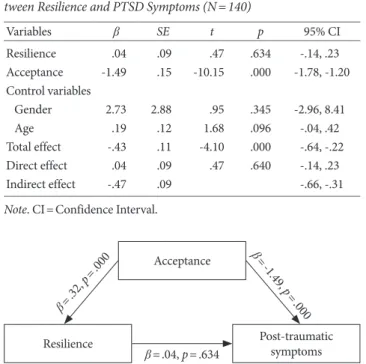
= .368, F(3, 136)=7.082, p=.000. The direct effect of resilience on post-traumatic stress symptoms was not significant when acceptance was included in the model as a mediating variable, β=.043, SE=.092, t =.470, 95%

CI [-.138, .225]. However, the total indirect effect of resilience on post-traumatic stress symptoms was significant, having accep- tance as a mediation variable, β=-.471, 95% CI [-.660, -.312], which means complete mediating effect of acceptance in the impact of resilience on PTSD symptoms (Figure 1).

Discussion

The aim of the current study was to examine the effect of resil- ience on post-traumatic stress symptoms of individuals with trau- matic experiences and to examine the mediating effect of accep- tance on the impact of resilience. As a result of the primary analy- sis, resilience and acceptance were positively correlated with each other, and PTSD symptoms were negatively correlated with resil-

ience and acceptance. Moreover, gender was examined to see its effect on resilience and acceptance, and age on acceptance. Conse- quently, gender and age were controlled in the following analyses.

Consistently with previous studies, resilience and acceptance were correlated negatively with post-traumatic stress symptoms (Blackburn & Owens, 2016; Bonanno & Mancini, 2012; Connor &

Davidson, 2003; Orsillo & Batten, 2005; Silver et al., 2002). In this study, resilience had a significant effect on individuals’ post-trau- matic stress symptoms, indicating that individuals with high resil- ience had fewer post-traumatic stress symptoms even if they expe- rienced traumatic events, consistently with previous studies (Blackburn & Owens, 2016; Horn et al., 2016; Min et al., 2014).

Also, the significant mediating effect of acceptance on the rela- tionship between resilience and post-traumatic stress symptoms was found. In summary, the more resilient the individuals were, the more they accepted their experiences, and consequently, the fewer post-traumatic stress symptoms they were experiencing.

Our findings suggest that resilience should be focused on when the victims of accidents or crimes are assigned for mental health services. Mental health specialists should evaluate the level of vic- tims’ resilience first, and help them strengthen their resilience with diverse strategies. Like in the current study model, resilience can be considered as a trait variable that is developed over the course of a long time. Even though it will not be easy to improve individuals’ resilience within a few sessions of psychological ther- apy, it is not impossible to make certain changes. For example, one of the Cognitive Behavioral Therapy techniques, cognitive re- structuring reference, might be beneficial to the victims of trauma in the way that the newly restructured cognition could help em- power the victims (Padesky & Mooney, 2012). In the process, making the best use of the victims’ existing social support net- work is recommended as well. Moreover, activities such as finding individuals’ strengths and applying these strengths and assets to specific strategies can be helpful to build up their resilience (Padesky & Mooney, 2012). Also, in a previous study, it was sug- gested that raising resilience might be helpful to prevent individu- als from experiencing adverse impacts of traumatic events (Noh &

Hong, 2017), which is consistent with the results of the current study.

It is noteworthy that we found acceptance completely mediated Table 4. The Mediating Effect of Acceptance on The Relationship Be-

tween Resilience and PTSD Symptoms (N=140)

Variables β SE t p 95% CI

Resilience .04 .09 .47 .634 -.14, .23

Acceptance -1.49 .15 -10.15 .000 -1.78, -1.20 Control variables

Gender 2.73 2.88 .95 .345 -2.96, 8.41

Age .19 .12 1.68 .096 -.04, .42

Total effect -.43 .11 -4.10 .000 -.64, -.22

Direct effect .04 .09 .47 .640 -.14, .23

Indirect effect -.47 .09 -.66, -.31

Note. CI=Confidence Interval.

Figure 1. The mediating effect of acceptance on the relationship be- tween resilience and post-traumatic stress symptoms.

Resilience Post-traumatic

symptoms Acceptance

β= .32, p= .000 β= -1.49,

p= .000

β=.04, p=.634

(7)

resilience and post-traumatic stress symptoms. The results of the current study indicate the mechanism behind why resilient indi- viduals are protected from the manifestation of post-traumatic stress symptoms. As acceptance can be considered as a psycholog- ical flexibility and a core factor of resilient adjustment for individ- uals with traumatic events, some researchers discuss acceptance as one of the factors consisting resilience (Thompson et al., 2011).

However, other researchers regard resilience as a trait-like psycho- logical factor and acceptance as a cognitive and behavioral factor, which leads to resilience and acceptance being independent from each other, even though they could correlate very significantly (Benetti & Kambouropoulos, 2006; Tugade, Fredrickson, & Feld- man Barrett, 2004).

In this regard, the current study is meaningful to make the un- derpinning process of resilience, acceptance, and individuals’ ad- justment (e.g., post-traumatic stress symptoms) clear: individuals’

acceptance mediates the impact of resilience on their adjustment.

It can be very helpful to emphasize the attitude to accept the inter- nal or external environments, that is, to view their psychological state as temporary status in response to unavoidable experiences.

That way, clinical practitioners help clients’ traits such as resilience and acceptance significantly contribute to the lower post-traumat- ic stress symptoms even when they encounter traumatic events.

Even though resilience and acceptance were considered as trait- like variables, many empirical studies have supported the effect of treatment that focuses on improving individuals’ resilience or ac- ceptance (Back, Dansky, Carroll, Foa, & Brady, 2001; Padesky &

Mooney, 2012). This can be the rationale of various therapies such as exposure therapy and Acceptance Commitment Therapy, which have been proven effective for the patients with PTSD (Back et al., 2001; King et al., 2013; Taylor et al., 2003).

The current study has several limitations to mention. The study relied on self-report from the individuals with trauma exposure. It can be a very effective way to meausre the distress of the affected individuals. At the same time, self-report data can be biased, par- ticularly due to the nature of the trauma, and it is probable that so- cial desirability factored in the reports of the crime victims in the current study.

From a cross-sectional study, which is the case with the current study, we have to be cautious in drawing causal inferences. If pos-

sible, future studies should employ various methodologies to strengthen the validity. For example, longitudinal study could add the predicting nature in the investigation of the relationships amongst variables. To better understand the mechanism of resil- ience and acceptance in regards to post-traumatic symptom expe- rience, homogenizing the type of trauma could enable to compare different relationships according to the traumatic events.

This study aimed to understand the experience of the individu- als who had traumatic events such as car accidents, sexual crimes, or attempted murder. The mediating effect of acceptance on the relationship between resilience and adaptation cannot tell us about treatment implications even though we can have an idea about the underpinning process among the related variables.

Therefore, future research about the treatment factors or pro- grams that deal with resilience or acceptance can be helpful in providing psychological services for the victims.

Another limitation regards the use of AAQ-II. We used AAQ-II to measure the participants’ acceptance, but the construct mea- sured by this questionnaire was related with cognitive flexbility/

inflexibility toward the surrounding environment (Bond et al., 2011). That was taken into account in this study, but cautious in- terpretation of the results is required because there exists a subtle difference between the actual construct that was measured and the conventionally regarded concept of “acceptance.” Moreover, because the validation study of Korean version of AAQ-II was not conducted with victim of traumatic events, it leaves a question on the appropriateness of its use with the participants of the current study.

Not all individuals who experience traumatic events are diag-

nosed with PTSD (APA, 2013; Bryant, 2003). Thus, it is suggested

that future studies on the patients with PTSD examine the under-

pinning mechanisms between resilience and acceptance and how

the patients’ adaptation differs depending on the resilience and

acceptance. Also, the results might be not applicable to the indi-

viduals with multiple or chronic traumas, nor with individuals

with other psychlogical pathologies. According to previous stud-

ies, individuals with repeated or long-term traumatic exposure re-

port more impaired outcomes compared to the individuals with a

single trauma (Lang & McTeague, 2011; Streeck-Fischer & van der

Kolk, 2000). That suggests the presence of other mental disorders

(8)

can affect the role of trauma and re-adjustment after trauma (Held et al., 2017). Therefore, it will be helpful to investigate the role of resilience and acceptance for the long-term adjustment of individ- uals with chronic or repeated traumas, as well as individuals with other mental pathologies.

The current study investigated 140 victims of various kinds of traumas, both accidents and crimes in Korea. We found the fol- lowing: resilience had positive effect on individuals’ PTSD symp- toms, and acceptance mediated the effect of resilience completely.

Resilience as a psychological characteristic plays an important role in individuals’ adjustment, and thus it is important to evaluate in- dividuals’ resilience in helping their adjustment after the adverse events. To help individuals with resilience improve their adjust- ment even after adverse or traumatic experiences, it is critical to help them accept their circumstance and actual situations flexibly.

References

Abela, J. R., & Hankin, B. L. (2011). Rumination as a vulnerability factor to depression during the transition from early to middle adolescence: A multiwave longitudinal study. Journal of Abnor- mal Psychology, 120, 259-271.

American Psychiatric Association. (2013). Diagnostic and statistical manual of mental disorders (DSM-5). Arlington, VA: American Psychiatric Pub.

Arabaci, L. B., Dikec, G., Buyukbayram, A., Uzunoglu, G., & Ozan, E. (2018). Traumatic growth and psychological resilience status of female victims of violence inpatients in a district psychiatric hospital. Archives of Psychiatric Nursing, 32, 568-573.

Back, S. E., Dansky, B. S., Carroll, K. M., Foa, E. B., & Brady, K. T.

(2001). Exposure therapy in the treatment of PTSD among co- caine-dependent individuals: Description of procedures. Journal of Substance Abuse Treatment, 21, 35-45.

Bajaj, B., & Pande, N. (2016). Mediating role of resilience in the im- pact of mindfulness on life satisfaction and affect as indices of subjective well-being. Personality and Individual Differences, 93, 63-67.

Benetti, C., & Kambouropoulos, N. (2006). Affect-regulated indi- rect effects of trait anxiety and trait resilience on self-esteem.

Personality and Individual Differences, 41, 341-352.

Blackburn, L., & Owens, G. P. (2016). Rumination, resilience, and posttraumatic stress disorder symptom severity among veterans of Iraq and Afghanistan. Journal of Aggression, Maltreatment and Trauma, 25, 197-209.

Bonanno, G. A., & Mancini, A. D. (2012). Beyond resilience and

PTSD: Mapping the heterogeneity of responses to potential trau- ma. Psychological Trauma: Theory, Research, Practice, and Policy, 4, 74-83.

Bond, F. W., Hayes, S. C., Baer, R. A., Carpenter, K. M., Guenole, N., Orcutt, H. K., . . . Zettle, R. D. (2011). Preliminary psychometric properties of the Acceptance and Action Questionnaire–II: A revised measure of psychological inflexibility and experiential avoidance. Behavior Therapy, 42, 676-688.

Bryant, R. A. (2003). Early predictors of posttraumatic stress disor- der. Biological Psychiatry, 53, 789-795.

Charney, D. S. (2004). Psychobiological mechanisms of resilience and vulnerability: Implications for successful adaptation to ex- treme stress. American Journal of Psychiatry, 161, 195-391.

Cho, Y. R. (2014). The influence of resilience on mental well-being and post-traumatic stress symptoms of trauma-exposed individ- uals: Mediating effects of post-traumatic growth and post-trau- matic negative cognitions. Cognitive Behavior Therapy in Korea, 14, 359-386.

Connor, K. M., & Davidson, J. R. (2003). Development of a new resilience scale: The Connor‐Davidson resilience scale (CD‐RISC).

Depression and Anxiety, 18, 76-82.

Fergus, S., & Zimmerman, M. A. (2005). Adolescent resilience: A framework for understanding healthy development in the face of risk. Annual Review of Public Health, 26, 399-419.

Foa, E. B., Hembree, E. A., Cahill, S. P., Rauch, S. A., Riggs, D. S., Feeny, N. C., & Yadin, E. (2005). Randomized trial of prolonged exposure for posttraumatic stress disorder with and without cognitive restructuring: Outcome at academic and community clinics. Journal of Consulting and Clinical Psychology, 73, 953-964.

Follette, V. M., Palm, K. M., & Hall, M. L. R. (2004). Acceptance, mindfulness, and trauma. In S. C. Hayes, V. M. Follette, & M. M.

Linehan (Eds.), Mindfulness and acceptance: Expanding the cog- nitive-behavioral tradition (pp. 192-208). New York, NY: Guilford.

Follette, V. M., Pal, K. M., & Pearson, A. N. (2006). Mindfulness and trauma: Implications for treatment. Journal of Rational-Emotive and Cognitive Behavior Therapy, 24, 45-61.

Harvey, J., & Delfabbro, P. H. (2004). Psychological resilience in disadvantaged youth: A critical overview. Australian Psycholo- gist, 39, 3-13.

Hayes, A. (2013). Introduction to mediation, moderation, and con- ditional process analysis. New York, NY: Guilford Press.

Hayes, S. C. (2004). Acceptance and commitment therapy and the new behavior therapies: Mindfulness, acceptance, and relation- ship. In S. C. Hayes, V. M. Follette, & M. M. Linehan (Eds.), Mind- fulness and acceptance: Expanding the cognitive-behavioral tradi- tion (pp. 1-29). New York, NY: Guilford.

Hayes, S. C., Strosahl, K. D., & Wilson, K. G. (1999). Acceptance and commitment therapy: An experiential approach to behavior change.

New York, NY: Guilford.

(9)

Held, P., Klassen, B. J., Zou, D. S., Schroedter, B. S., Karnik, N. S., Pollack, M. H., & Zalta, A. K. (2017). Negative posttrauma cog- nitions mediate the association between morally injurious events and trauma‐related psychopathology in treatment‐seeking vet- erans. Journal of Traumatic Stress, 30, 698-703.

Heo, J. H., Choi, M. S., & Jin, H. J. (2009). Study on the reliability and validity of Korean translated acceptance-action question- naire-II. The Korean Journal of Counseling and Psychotherapy, 21, 861-878.

Hoge, E. A., Austin, E. D., & Pollack, M. H. (2007). Resilience: Re- search evidence and conceptual considerations for posttraumatic stress disorder. Depression and Anxiety, 24(2), 139-152.

Horn, S. R., Charney, D. S., & Feder, A. (2016). Understanding re- silience: New approaches for preventing and treating PTSD. Ex- perimental Neurology, 284, 119-132.

Horowitz, M., Wilner, N., & Alvarez, W. (1979). Impact of Event Scale: A measure of subjective stress. Psychosomatic Medicine, 41, 209-218.

Hu, T., Zhang, D., & Wang, J. (2015). A meta-analysis of the trait resilience and mental health. Personality and Individual Differ- ences, 76, 18-27.

Kessler, R. C., Berglund, P., Demler, O., Jin, R., Merikangas, K. R.,

& Walters, E. E. (2005). Lifetime prevalence and age-of-onset distributions of DSM-IV disorders in the National Comorbidity Survey Replication. Archives of General Psychiatry, 62, 593-602.

King, A. P., Erickson, T. M., Giardino, N. D., Favorite, T., Rauch, S.

A., Robinson, E., . . . Liberzon, I. (2013). A pilot study of group mindfulness‐based cognitive therapy (MBCT) for combat veter- ans with posttraumatic stress disorder (PTSD). Depression and Anxiety, 30, 638-645.

King, L. A., King, D. W., Fairbank, J. A., Keane, T. M., & Adams, G.

A. (1998). Resilience–recovery factors in post-traumatic stress disorder among female and male Vietnam veterans: Hardiness, postwar social support, and additional stressful life events. Jour- nal of Personality and Social Psychology, 74, 420-434.

Kim, J. I., & Byeon, Y. S. (2013). A study on the factors affecting re- silience in parients with colon cancer. Asian Oncology Nursing, 13, 256-264.

Lang, P. J., & McTeague, L. M. (2011). Discrete and recurrent trau- matization in PTSD: Fear vs. anxious misery. Journal of Clinical Psychology in Medical Settings, 18, 207-209.

Lim, H. K., Woo, J. M., Kim, T. S., Kim, T. H., Choi, K. S., Chung, S.

K., . . . Chae, J. H. (2009). Reliability and validity of the Korean version of the Impact of Event Scale-Revised. Comprehensive Psychiatry, 50, 385-390.

Mak, W. W., Ng, I. S., & Wong, C. C. (2011). Resilience: Enhancing well-being through the positive cognitive triad. Journal of Coun- seling Psychology, 58, 610-617.

McCracken, L. M., & Gutiérrez-Martínez, O. (2011). Processes of

change in psychological flexibility in an interdisciplinary group- based treatment for chronic pain based on acceptance and com- mitment therapy. Behaviour Research and Therapy, 49, 267-274.

McRae, K., Ciesielski, B., & Gross, J. J. (2012). Unpacking cognitive reappraisal: Goals, tactics, and outcomes. Emotion, 12, 250-255.

Min, J. A., Jung, Y. E., Kim, D. J., Yim, H. W., Kim, J. J., Kim, T. S., . . .

& Chae, J. H. (2013). Characteristics associated with low resil- ience in patients with depression and/or anxiety disorders. Qual- ity of Life Research, 22, 231-241.

Min, J. A., Lee, C. U., Hwang, S. I., Shin, J. I., Lee, B. S., Han, S. H., . . . Chae, J. H. (2014). The moderation of resilience on the nega- tive effect of pain on depression and post-traumatic growth in individuals with spinal cord injury. Disability and Rehabilitation, 36, 1196-1202.

Morina, N., Stangier, U., & Risch, A. K. (2008). Experiential avoid- ance in civilian war survivors with current versus recovered post- traumatic stress disorder: A pilot study. Behaviour Change, 25, 15-22.

Noh, N. N., & Hong, C. H. (2017). The moderating effect of ego- resilience and the mediating effect of social support in the real- tionship between abuse experience and complex PTSD. The Ko- rean Journal of Developmental Psychology, 30, 1-19.

Orsillo, S. M., & Batten, S. V. (2005). Acceptance and commitment therapy in the treatment of posttraumatic stress disorder. Behav- ior Modification, 29, 95-129.

Orsillo, S. M., Roemer, L., & Barlow, D. H. (2003). Integrating ac- ceptance and mindfulness into existing cognitive-behavioral treatment for GAD: A case study. Cognitive and Behavioral Prac- tice, 10, 222-230.

Orsillo, S. M., Roemer, L., Lerner, J. B., & Tull, M. T. (2004). Accep- tance, mindfulness, and cognitive-behavioral therapy: Compari- sons, contrasts, and application to anxiety. In S. C. Hayes, V. M.

Follette, & M. M. Linehan (Eds.), Mindfulness and acceptance:

Expanding the cognitive-behavioral tradition (pp. 66-95). New York, NY: Guilford.

Padesky, C. A., & Mooney, K. A. (2012). Strengths-based cogni- tive–behavioural therapy: A four-step model to build resilience.

Clinical Psychology and Psychotherapy, 19, 283-290.

Ramírez-Maestre, C., & Esteve, R. (2014). The role of sex/gender in the experience of pain: Resilience, fear, and acceptance as cen- tral variables in the adjustment of men and women with chronic pain. The Journal of Pain, 15, 608-618.

Ruiz-Párraga, G. T., & López-Martínez, A. E. (2014). The role of experiential avoidance, resilience and pain acceptance in the ad- justment of chronic back pain patients who have experienced a traumatic event: A path analysis. Annals of Behavioral Medicine, 49, 247-257.

Silver, R. C., Holman, E. A., McIntosh, D. N., Poulin, M., & Gil-Ri-

vas, V. (2002). Nationwide longitudinal study of psychological

(10)

responses to September 11. Jama, 288, 1235-1244.

Song, Y. S. (2017). The relationship between fire-fighter’s resilience and PTSD. Fire Science and Engineering, 31, 119-126.

Spasojević, J., & Alloy, L. B. (2001). Rumination as a common mech- anism relating depressive risk factors to depression. Emotion, 1, 25-37.

Streeck-Fischer, A., & van der Kolk, B. A. (2000). Down will come baby, cradle and all: Diagnostic and therapeutic implications of chronic trauma on child development. Australian and New Zea- land Journal of Psychiatry, 34, 903-918.

Sturgeon, J. A., & Zautra, A. J. (2010). Resilience: A new paradigm for adaptation to chronic pain. Current Pain and Headache Re- ports, 14, 105-112.

Taylor, S., Thordarson, D. S., Maxfield, L., Fedoroff, I. C., Lovell, K.,

& Ogrodniczuk, J. (2003). Comparative efficacy, speed, and ad- verse effects of three PTSD treatments: exposure therapy, EMDR, and relaxation training. Journal of Consulting and Clinical Psy- chology, 71, 330-338.

Thompson, R. W., Arnkoff, D. B., & Glass, C. R. (2011). Conceptu- alizing mindfulness and acceptance as components of psycho- logical resilience to trauma. Trauma, Violence, and Abuse, 12, 220-235.

Tugade, M. M., Fredrickson, B. L., & Feldman Barrett, L. (2004).

Psychological resilience and positive emotional granularity: Ex- amining the benefits of positive emotions on coping and health.

Journal of Personality, 72, 1161-1190.

Tull, M. T., Barrett, H. M., McMillan, E. S., & Roemer, L. (2007). A preliminary investigation of the relationship between emotion regulation difficulties and posttraumatic stress symptoms. Be- havior Therapy, 38, 303-313.

Weathers, F. W., Blake, D. D., Schnurr, P. P., Kaloupek, D. G., Marx, B. P., & Keane, T. M. (2013). The Life Events Checklist for DSM-5 (LEC-5). Instrument available from the National Center for PTSD.

Retrieved from www.ptsd.va.gov

Weiss, D., & Marmar, C. (1997). The Impact of Event Scale-Re- vised. In J. P. Wilson & T. M. Keane (Eds.), Assessing Psychologi- cal Trauma and PTSD (pp. 399-411). New York, NY: Guliford.

Wilson, J. P., & Keane, T. M. (2004). Assessing Psychological Trauma and PTSD. New York, NY: Guilford Press.

Yoo, M. R., Choi, S. Y., Han, H. L., Seo, Y. M., & Noh. M. I. (2015).

The effect of post-traumatic growth, resilience, and optimism on

quality of life among the disaster victims. Journal of Military

Nursing Research, 33, 1-14.

수치

Table 3. Correlation between Variables (N=140) Variables Resilience Acceptance PTSD
Figure 1. The mediating effect of acceptance on the relationship be- be-tween resilience and post-traumatic stress symptoms.

참조

관련 문서

Within the limitation of this study, it can be concluded that pretreatment with EDTA or phosphoric acid have negative effect in apical part on push out bond strength of fiber

Factors affecting post-traumatic stress of general hospital nurses after the epidemic of Middle East respiratory syndrome infection: Journal of Korean Clinical

The purpose of this study was to investigate how the Da Vinci body board exercise program affects the body balance and physical stress of women with body imbalance.. For

In this study, we investigated how the Korean-Chinese cultural differences and cognitive emotion regulation influence the spirituality and stress coping

This study was conducted under the hypothesis that a group art therapy program may increase emotional expression and decrease life event stress in patients with

1) Transition boundary between Newtonian and non‐Newtonian flow behavior 2) Iso‐viscosity contours representing stress and temperature effect on viscosity 3)

The purpose of this study was to investigate how the 8-week aerobic exercise program affects the physical strength and stress of obese women in the

The effect of the stress management program on the stress coping and perceived stress of the patients with finger replantation. Unpublished master's