의:학회지 제
25
권 제4
호153〜 160 (1981)
Yakhak Hoeji, Vol. 25, No. 4
人裹이 肝
Glutathione S-Transferase
活性에 미치는 効果金 洛 斗 • 金 承 禮 • 金 信 根
서 울 *學 校 藥學ᄎ學
(Received November 18, 1981)
Nak Doo Kim, Seoung Hee Kim and Sin Keun Kim
College o f Pharmacy
,
Seoul National University, Seoul 151,KoreaThe Effect of Ginseng on the Hepatic Glutathione S-Transferase Activity
Abstract—The investigation aimed to study the effect of ginseng on the hepatic glutathion S-transferase activity. The ginseng methanol extract was administered to rats and mice for 10 days and their hepatic gluthatione S-transferase activities were measured by the method of Habig
et al.• Glutathione S-transferase
•activities in the rat treated with 100 and 500mg/kg ginseng methanol extract were increased by 13.4% and 17.10%, respectively and their increases were statistically significant. Similar results were also found in the mouse treated with ginseng 100mg/kg methanol extract. To investigate components of the extract which induce the enzyme, the methanol extract was fractionated into ether and butanol fraction and their effect on the enzyme was compared. Glutathione S-transferase activities in the rat treated with ether fraction were increased by 13.1%, similar to that obtained with ginseng methanol extract, whereas, butanol fraction did not show any increase in the enzyme activities. In the rats treated with maltol, one of the components in ether fraction, 5mg/kg for 10 days, activity of glutathione S-transferase was increased by 7.89%, but its increase was not significantly different from control group. Therefore, it may be concluded that ginseng methanol extract and its ether soluble fraction had effect on the elevation of glutathione S-transferase acti
vities, whereas, butanol fraction of ginseng methanol extract had no effect on the enzyme.
ᄉ参의 抗癌効果에 對한 보고는
Lazarev
” 가 ᄉ參엑기스를Ehrlich
씨 腹水腫瘍을 가진 흰쥐에 투여하여 腫瘍의 成長이 抑制됨을 보고한 이래 이에 대한 硏究가 많이 이루어졌다2~3).
最近
Hwang4)
等도 마우스 백혈병 임파모세포(L5178Y
) 에 대해 ᄉ参의 석유에텔추출물을 添SB
할 때 암세포 증식시간이2
배로 길어졌으며Hela
세포나 腹水肉腫細胞(Sarcoma
) 에 대해서도
L5178Y
세포에 비해 각각 ᄉ參을8
배, 6 .5
배 量을 투여時 비슷한 効果를 나타낸다고 하여 ᄉ参추출물엔 癌세포에 대해서 直接的인 成長抑制 내지 사멸시키는 成分이 含有되어 있으며 그 成分은 사포닌이 아닌 脂肪溶解性 成分이라고 하였다
.
그러나 그 作用機轉에 대해 밝혀진 報告는 많지 않다.
한편 化學的 發癌物質55에 의한 發癌機轉을 보면 化學的 發癌物質 * 部分이 體內에서 代謝되 어 活性化 形態인 親電子化合物
(electrophilic compound
) 6~9)를 形成하며,이것은 세포내D N A 10' 111, RNA, protein
等과 같은macromolecule
의nucleophilic site
에 共有 結合하여 發癌또는 돌연변이 등을 일으킨다
12).
체내대사물인 親電子化合物들은 또한glutathione S-transferase
에 의해 抱合體를 形成하며 이는 mercapturic acid 로 되어 신속하게 체내에서 배설된다
.
즉 glutathione S-transferase는 細胞構成成分을 保護하는 作用이 있으며13’14)
發癌의 防止作用과 관 련이 있음이 보고되고 있다1 5
Glutathione S-transferase는 生體에 對한 異物質 즉 약물학적활 성물질이나 또는 특히 强力한 alkyl化劑 등 xenobiotics의生體內 代謝에 重要役割을 하고있다.
Glutathione S-transferase은 많은 조직의 細胞質에 存在하고있으며 이 enzyme은 glutathione 의 核親和性를 增加시키고 mercapturic acid 形成의 첫단계를 促進한다
16~18).
Glutathione S-transferase는 等電點에 따라 여러가지 種類로 나뉘어지며 이들 enzyme의 分子 量은 약48, 500 정도이
4 19~21).
抗酸化性 物質들이 glutathione S-transferase 活性을 增加시킴으로써 化學的 發癌物質에 의한
■
체내 대사물의 生化學的 代謝를 增加시켜 防癌作用을 나타낸다는 報告가 있다.
Wattenberg22~25)는 抗酸化劑가 化學的 發癌物質에 의한 腫瘍生成을 감소시킨다고 報告하였으 며 이에 대해 Weisburger 等
26),
Grantham 等27),
Ulland 等28>도 抗酸化性 物質이 glutathione S-transferase 活性을 增加시킴으로써 腫瘍生成이 감소됨을 발표하였다.
또한 Benson29~31)等은 抗酸化性 物質인 BH A에 의해서 glutathione S-transferase 活性이 增加되었으며 benzopyrene의 變異誘發代謝物質이 감소됨을 測定하였다.
최근에 Han 等32)은ᄉ蓉의 ether 추출물에 抗酸化性 物質이 存在하고 있으며 그 成分은 maltol일 것이라고 시사한 바 있다.
이에 著者는 ᄉ參이 腫瘍生成防禁에 관여하는 作用機轉을 硏究할 目的으로 ᄉ蓉에서 얻은 备 分劃이 肝glutathione S-transferase 活性에 미치는 効果를 硏究하였다
.
實 驗 方 法
實驗材料一1) ᄉ参 methanol 엑기스
:
市中에서 구입한 4 年根 白暮의 中細尾를 使用하였다.
粗末로한 白参을 methanol 로 8 時間씩 3 回 抽出하여 그 抽出液을 蒸發濃縮乾燥하였다.
抽出 된 methanol 엑기스를 0.9% 생리적 식염수로 희석하여 試料로 使用하였다.
2) 人參의 butanol 및 ether 分劃
:
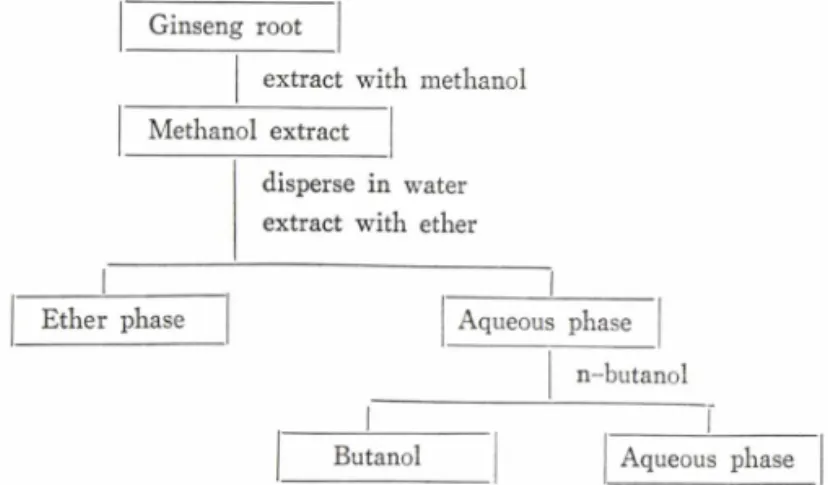
人參 methanol 엑기스를 Fig. 1 과 같이 分劃化하여 蒸發 濃縮시킨 후 減歷乾燥시켰다32).
Butanol 分劃은 0.9% 생리식염수에 녹여 試料로 使用하였고 ether 分劃은 乳化劑로 Tween.
80을 試料量의 0 .0 1 %로 하여 生理食鹽水로 희석하여 使用하였다(Fig. 1 ) .
Fig: . 1— —Fractionation of ginseng ether and butanol fraction.
.3) Maltol : Maltol을 0.9% 생리식염수로 희석하여 試料로 使用하였다.
4) 實驗動物 : ⑴ 흰 뒤一同一條件에서 飼育한 200g 內外의 健康한 雄性 Sprague-Dawley系 흰 쥐를 使用하였다.
(2) 마우스ᅳ同一條件에서 飼育한 20g 內外의 건강한 雌性마우스(Aᅳstrain) 을 使用하였다.
(3) 飼 料一本 實驗또에서 製造한 飼料를 使用하였으며 成分 및 含S (% )은 다음과 같다.
(밀 46.2,옥수수 2 3 .1,콩 14 .1, 멸치 8.3, 전지분유 4 .2 , 미강유 3.0, 원기소 0 .4 ,칼슘 0 .1 ,철분 0 . 1 ,마그네숨 0 . 1 ,소금 0.4)
實驗方法一1) 實驗操作 : (1) 肝 細胞質分劃의 分離一흰 쥐 : 200g 內外의 흰쥐 에 試料를 투여 한 후 마지 막 투여 로부터 24時間 絕食시 킨 後 頭部에 타격 을 加하여 致死시키고 목을 切開하여
■피 를 一部 除去한 다음 신속하게 腹腔을 切開한다. 0 .15M KC1 (containing 2 mM tris-EDTA, pH 7.5) 液으로 肝을 관류하여 혈액을 除去한 後 肝을 적출하였다. 적출한 肝을 細切하고 肝重 量의 3 배의 0.25M sucrose 용액 을 加하여 potter type homogenizer 를 使用하여 20초간 2 회 homogenize 시 켰다. 이상의 操作을 4°C 低溫室에서 하였다. Homogenate 는 2°C 에서 9,OOOXg 로 15分間 원심분리 하여 그 상등액 을 gauze 여 과하고 지 방층과 非分散 結合組織殘解 (undisper- sed connective tissue reside) 를 제 거 하였다. 여 과액 에 0 .1 M CaC^ 溶液 0 .2 volume 을 加한早 .2°C 에서 37,
OOOXg
로 15分間 centrifuge시 킨다. 상등액 을 取하여 10배 희 석 하여 enzyme solu- tion 으로 使用하였으며 이 는 Schenkmann and Cinti 方法331 에 依存하였다(Fig. 2) • Enzyme solution 은 當日 제 조하였 다.
Fig. 2
ᅳPreparation of hepatic cytosol fraction for enzyme studies.
마우스 : 20g 內外의 마우스에 試料를 투여 하고 마지 막 투여 로부터 6 時間 絕食시 킨 후 목을 切開하여 피 를 제거 하여 致死시 킨 다음 신속하게 開腹하여 肝 重量 20배 의 0.25M sucrose 溶液 을 加하여 Potter type homogenizer로 homogenize시 킨 두 흰쥐 와 같은 조작으로 enzyme solution 을 만든다.
(2) Glutathione S-transferase 活性 測定ᅳIncubation mixture 의 組成34〉은 3,4-dichloronitro- Vol. 25
,
No. 4, 1981.benzene Im M , glutathione 5 mM, enzyme solution 0. lM , potassium phosphate buffer solution (pH 7.5)
를 加하여 최종volume
이6mZ
가 되게 하였다.
反應은
250C
에서5
分間preincubation
시킨後enzyme solution
을 加하는 것을 反應의 始作으 로 하여250C
에서 正確히10
分間incubation
시키고cold-10 % TCA solution 1 mZ
를加한 後 즉 시reaction flask
를ice bath
에넣음으로써 反應을 終了시켰다.
이때enzyme solution
대신0.25M sucrose solution
을 加한 反應液을blank
로 하였다.
Habig
35)等의 方法을 利用하여 反應生成product
의 농도를345nm
에서spectrophotometer
로 測 定하였으며molar extinction coefficient
를8 .5mM_1 cm-1
로 하여glutathione S-transferase
活性 을 計算하였다.
以上의 操作을 重複實施하였다.
蛋 白 質 은 Lowry法에 의해 測定하여 glutathione S-transferase 活 性 을 nm ol/m in/m g protein
으로 表示하였다.
(3) 蛋白 質 定量 (Lowry法) 36스試料 1 mZ 를 取하여 0. 25M sucrose 용액 9mZ 를 加하여 ■희 석 하고 이 중 1 mZ 를 取하였 다. 사용직 전 에 alkali 性 Na2C0 3 液과 sodium potassium tartrate- CuS04 液을 50 : 1 의 容量化로 混合하고 이 混合液 5mZ 롤 各 시 험 관에 加한 後 10分 방치 한 다음 Folin 시약 0.5mZ룰 加하여 발색시켜 30分後 750nm에서 吸光度를 測定하여 蛋白質을 定 量하였다.
2)
人參methanol
엑기스가 肝glutathione S-transferase
活性에 미치는 効果에 관한 實驗:
(1) 흰쥐에 對한 實驗一實驗群에는 ᄉ参 methanol 엑기스 100mg/kg, 500mg/kg을 각각 10日 間 경구투여하고 對照群에는 0.996 生理食鹽水를 투여하였다.1)
의 實驗操作에 의해glutathione S-transferase
活性을 對照群과 比較 測定하였다.
(2)
마우스에 對한 實驗ᅳ實驗群에는 ᄉ參methanol
엑기스100mg/kg
을10
日間 경구투여하 고1)
의 實驗操作에 의해glutathione S-transferase
活性을 對照群과 比較 測定하였다.
3) Butanol
分劃과ether
分劃이 肝glutathione S-transferase
活性에 미치는 効果에 관한 實 驗: Butanol
分劃80mg/kg, ether
分劃1.83mg/kg
을각각10
日間 경구투여한 후1)
의 實驗操 作에 의해glutathione S-transferase
活性을 對照群과 比較 測定하였다.
4) M alt
이이 肝glutathions S-transferase
活性에 미치는 効果에 관한 實驗: Moltol 5 mg/kg 을 10 日間 경 구투여 한 後 1) 의 實 驗 操 作 을 하여 glutathione S-transferase 活 性 을 對 照 群 과 比
較 酒定하였다.
實 驗 結 果
ᄉ暮
methanol
엑기스가 肝glutathione S-transferase
活性에 미치는 効果ᅳ1)
횐쥐에 對 한 實驗:
ᄉ參methan
이엑기스100mg/kg
,500mg/kg
각각을 흰쥐에10
日間 경구투여한 후glutathione S-transferase
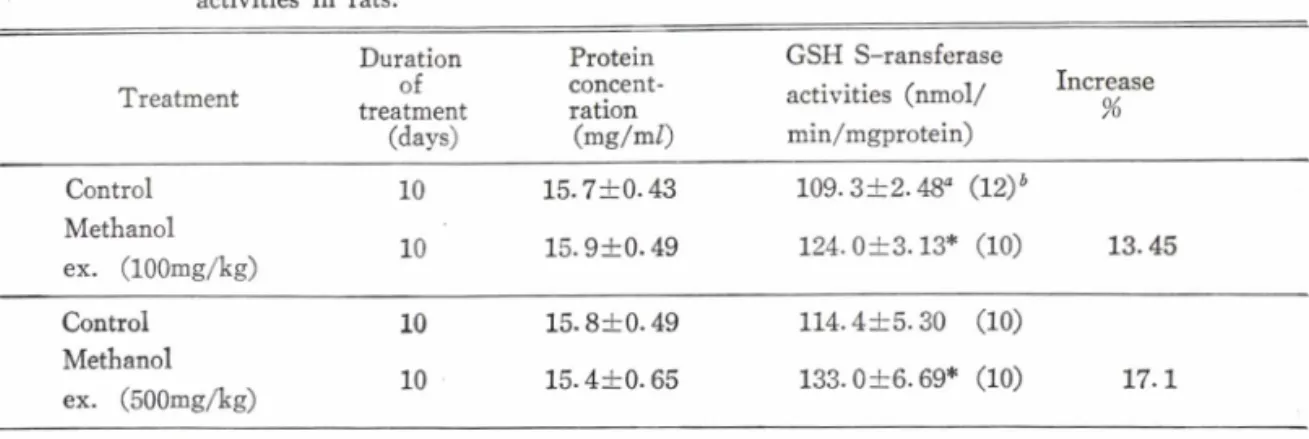
活性을測定한結果,投與群이 각각124.0 ± 3 .1 nmol/min/mg protein, 133.0 ± 6 .7 nmol/min/mg protein 이 고 對照群은 109.3± 2 .5 nmol/min/mg protein, 114.4士 5.3 nmol/min/mg protein
으로 對照群에 비해 각각13.45%, 17.1
%의增加를보였다(Table I )•
2)
마우스에 對한 實驗:
人參methanol
엑기스100mg/kg
을 마우스에10
日경구투여한 후glutathione S-transferase
活性을 測定하였더니89.17±3.1 nmol/min/mg protein
이고, 對照群 은77.4±2. 2 nmol/min/mg protein
으로 對照群에 비해15.3
%의 增加를 나타내었으며 마우스도 흰쥐와 비슷한 增加率을 보였다
(Table
표).
Table I
一Effect of ginseng methanol extract (lOOmg/kg, 500mg/kg) on GSH S-transferase activities in rats.
Treatment
Duration of treatment
(days)
Protein concent
ration (mg/m/)
GSH S-ransferase activities (nmol/
min/mgprotein)
Increase
%
Control
1 015.7±0.43 109.3
士2.48“ (12
) 6Methanol
ex. (lOOmg/kg)
1 015.9
士0.49 124.0
士3.13* (10) 13.45
Control
1 015.8 ±0.49 114.4±5.30 (10)
Methanol
ex. (500mg/kg)
1 015.4
士0.65 133.0±6.69* (10) 17.1
a : Mean
士S. E.
b
:The numbers in parentheses indicate numbers of animals.
* : Statistically significant (p
〈0.05).
Table.
표一Effect of ginseng methanol extract (lOOmg/kg) on GSH S-transferase activities in mice.
Treatment Duration of treatment
GSH S-transferase activities (nmol/
min/mg protein)
Increase
%
Control
1 077.35
士2 .2a (5
) 6Methanol ex.
1 089.17
士3.12*(9) 15.27%
a : Mean
士S. E.
b : The number in parenthesis indicate the number of animals.
* : Statistically significant (p
〈0.05).
Butanol
分劃과Ether
分劃이 肝G lutathione S-transferase
活性에 미치는 効果ᅳ人參methanol
엑기스의butanol
分 劃80mg/kg
과ether
分 劃1.83m g/kg
을 각 각: 1 0日間 경구투여한Table.
瓜ᅳEffect of ginseng butanol fraction, ether fraction on GSH S-transferase activities in rats.
Treatment Duration of treatment
(days)
Protein concen
tration (mg/ml)
GSH S-transferase activities (nmol/
min/mg protein) Increase
%
Control
Butanol
1 0
14.6
土0.94 111.9±2.18a (
6) J
fraction
1 015.0
士0.76 112.8±2.58 (9) 0.80
Control Ether
1 0
13.1
士0.57 98.2
士3.16 (
8)
fraction
1 015.9±0.57 111.0
士1.94* (
8) 13.1
a : Mean
士S. E.
b : The numbers in parentheses indicate the numbers of animals.
*
iStatistically significant (p < 0 .05) •
後
glutathione S-transferase
活性을測定하였더
니,112.8 ± 2 .6 nmol/rain/mg protein
과111.0
± 1 . 9 nmol/min/mg protein
을 나타내었고 對照群은
1 1 1 . 9士
2 .2 nmol/min/mg protein과
98.2± 3.2 nmol/min/mg protein
으로 對照群에 비해butanol
分劃은0 .8
%의 增加로 나타내었으나 有意性은 없었고ether
分劃은13.1
%의 有意性 있는 增加를 나타내었다(Table I ) .
M alt
이이 肝GlutathioneS-transferase
活性에 미치는 効果ᅳMaltol 5 m g /k g
을10
日間 횐 쥐에 경구투여하여 g l u t a t h i o n eS-transferase
活性을測定하였더니121.7
士3 .9 nmol/min/mg protein
이고 對照群은112.8±3.4 nmol/min/mg protein
으로 對照群에 비해7.89
%의 增加를 나타내었으나 有意性은 없었다(Table W).
Table.
IfᅳEffect of maltol (5mg/kg) on GSH S-transferase activities in rats.
丁
reatment
Duration of treatment
(days)
Protein concent
ration (mg/m/)
GSH S-transferase activities (nmol/
min/mg protein)
Increase
%
Control
Maltol
1 0 1 0
14.7
士0.83 13.9
士0.73
112
. 8士3 .36fl(6)4
121.7
士3
. 8 8(9) 7.89 a : Mean
士S. E.
b : The numbers in parenthesis indicate the numbers of animals.
以上으로 本 實驗의 結果를 綜合해 보면 흰쥐의 경우 ᄉ參
methanol
엑기스 投與群이 對照群에 비해
13.45%, 17.1%
의 有意性있는 增加를 나타내었고butanol
分劃은0 .8 %
의 增加를 나타내었으나 有意性이 없었다
. Ether
分劃은13.1%
의 有意性있는 增加를 나타내었고maltol
投與群은
7 .89%
의 增加를 나타내었으나 有意性은 없었다.
마우스에서는 ᄉ蓉
methanol
엑기스100mg/kg
을 경구 투여한 結果15.3 %
의 有意性있는 增 加를 나타내었으며 이는 흰쥐의 境遇와 비슷한 增加率을 나타내었다.
考 察
ᄉ參의 각 分劃이 肝
glutathione S-transferase
活性에 미치는 影響을 觀察한 結果 ᄉ參methanol
엑기스와 이 엑기스에서 얻은ether
分劃을10
日경구 투여할 때glutathione S-trans
ferase
活性이 增加하였으며 엑기스의butanol
分劃은glutathione S-transferase
活性의 增加가 거의 없었다.
그러므로 人藝의methanol
엑기스와ether
分劃에는glutathione S-transferase
活 性을 增加시키는 物質이 存在할 것으로 推定된다.
이 結果는 ᄉ參의 防癌作用과 關聯하여 대단히 흥미있는 結果로서 ᄉ募의 制癌作用은 肝의
glutathione S-transferase
活性 증가에 기인되는 것으로 추측이 된다.
金
2>
等은흰쥐의 骨體에W alker
씨 癌肉腫256
을 이식후 ᄉ参엑기스를 투여時 ᄉ参엑기스는 腫瘍에 直接的인 作用은 없지만 腫瘍의 成長에 間接的인 作用이 있을 것이라고 보고하였다.
Lee3)
等은 人蓉의 에탄을,
에테르 및 수침엑기스를 각각Sarcoma 180, Adenocarcinoma 755,
Leukemia 1210
을가진 흰쥐에 투여하고 그 齡響을 觀察한 結果 에테르 엑기스는Sarcoma 180,
Adenocarcinoma 755
에 대해 抑制効果를 나타내었고에탄올 엑기스는Sarcoma 180
에 현저한 抑制効果를 나타내었지만 그 効果는 투여한 ᄉ参엑기스의 量에는 비례하지 않았다고 보고하였다
.
韓
32
〉等은 ᄉ參의 ether 추출물에 항산화성 物質이 存在하고 그 成分이 maltol 이라 보고하였 다.
그리고 Benson29) 等은 항산화성 物質이 肝 glutathione S-transferase 活性을 增加시킨다고 보고하였다.
本 實驗에서 maltol 을 投與한 後 肝 glutathione S-transferase 活性을 S 1 淀 한 結果 그 活性의 增加가 有意性은 없었으나 증가하는 경향은 있었다.
따라서 ᄉ藝에서 glutathione S-transferase 活性을 增加시키는 物質은 maltol 보다는 ether 抽出物中의 다른 脂溶性物質인 것 으로 推定된다.
또한 glutathione S-transferase 活性을 測定할 때 Habig et a l. 方法으로 spectrophotometer를 使用하여 測定하였으나 最近 Canfort37) 等에 의 해 Liquid Scintillation Spectrophotometry 로 測 定하는 方法도 報告되었다
.
肝外의 다른 장기에서도glutathione S-transferase
活性이 增加되며 substrate 로 3, 4-dichloronitrobenzeoe °1 使用되 었으나 l-chloro-2,4-dinitrobenzene, p-nitro- phenyl chloride 等 여러가지 substrate14’35)들도 그 活性을 나타내므로 많이 使用되고 있다. 最 近 benzopyrene 의 K-region epoxide가 glutathione S-transferase 의 substrate 로 使用되 고 흰쥐肝에 서 分離한 transferase A, B, C, E 와 人體 肝에 서 分離한 transferase /3,d 등이 benzopyrene
-4
,5-oxide
와GSH
가conjugation
하는데 많은 活性을 가지고 있다는 것이 報告된 바가 있다17\
Benzopyrene의 non-K region metabolite나 diol-epoxide의 解毒作用에 대 한 glutathione S-trans
ferase 役割은 아직 確實하지 않으나 benzopyrene 의 benzo ring epoxide나 dihydrodiol 의
bay-region epoxide
가GSH
와conjugation
됨으로써 解毒作用을 나타낸다고 발표되었다38〜40).
Benson29>
等은0
,75% BHA
롤 함유한 飼料로 飼肉한 마우스의 경우 對照群에 비해 活性이10
〜11
배 增加되었으며 횐쥐는2
배의 活性이 增加하였으나 本 實驗에서는 마우스와 흰쥐에서glutathione S-transferase
活性의 增加가 거의 비슷하였다.
이것은female CD-I mice
가 아닌A-strain
을 使用하였기 때문으로 推定된다. 0.75% BH A
를 加한 飼料로 飼肉할 때 상용량에 비해
1
,500
배에 해당되는 농도를 投與한 것이 된다.
또한 방향제로 많이 使用되고 있는maltol
은 상용량에 비해30
,000
배 정도인5 mg/kg
을 經口投與하였다.
그리고 ᄉ參의 각 分劃들을
15
日投與等 더 長期間 投與에 의한glutathione S-transferase
活 性의 變化를 觀察해 야 할 것으로 推定되 며 microsomal fraction 에 存在하는 epoxide hydratase 나 UDP-glucuronyl transferase 活性에 관한 實驗도 계속해 야 할 것으로 思料된다.人參
methanol
엑기스,butanol
分 亂ether
分劃 및maltol
을 投與한 後 흰쥐 및 마우스의 肝glutathione S-transferase
活性에 미치는 効果를 觀察하였다.
1.
人募methanol
엑기스100mg/kg
과500mg/kg
을10
日동안경구투여한 흰쥐 및 마우스에서 유의성 있는glutathione S-transferase
活性의 增加를 나타내었다.
2.
人參methanol
엑기스의ether
分劃을 투여한 흰쥐는 효소의 活性에 有意性있는 增加를나타내었으나 反面에
butanol
分劃에서는 影響이 거의 없었다.
3. maltol (5 m g /k g
) 을 경구투여한 흰쥐에서 효소의 活性이 증가하였으나 有意性이 없었다.
以上의 結果로 보아 人參 methanol 엑기스 및 이 엑기스에서 얻은 ether 分劃은 mercapturic
acid conjugation
에 관여하는glutathione S-transferase
의 活性을 增加하는 作用이 있을 것으로 思料 된다.
本 硏究는
1981
年度 文敎部 學術硏究 助成費의 補助로 이루어졌으며 感謝의 뜻을 表한다.
文 獻
N .Y . Lazarev,
Mezhdunam Protivorkovyi Kongress,1962.
I. J. Kim and H. H. Kim,
Katorik Uihakpu Nonmun Jip,16,161 (1969).
K. D. Lee and R. P. Huemer,
Jap. J. Pharmacol., 21,299 (1971).
W .I. Hwang, 硏報(전매기술연구소) 16, 17,165 (1976)
W. Haenzel, M. Kurihara,
J. Nat. Cancer Inst., 40,43 (1968).
D. M. Jerina and H. Yagi
et al.J. F. Waterfall and P. Sims,
Biochem. J.,128, 265 (1972) P. Sims and P. L. Grover,
Advan. Cancer Res., 20,165 (1974).
D .J. Jollow, J. R. Mitchell, N. Zampaglione and J.R . Gillethe,
Pharmacology,11, 151 (1974).
C. Heidelberger,
Ann. Rev. Biochem., 44,79 (1975).
H. C. Pitot,
Progress in Liver Diseases,Vol. 3, edited by P. H. Popper and F. Schaffner. pp. 77.
1970.
E. K. Weisburger,
Ann. Rev. Pharmacol. Toxicol.,18, 395 (1978).
E. Boyland and L. F. Chasseaud,
Adv. Enzymol. t32,173 (1969).
J.R . Bend and Z. Ben-Zyi
et a l.’ Carcinogenesis,Vol. 1.
Polynuclear Aromatic Hydrocarbonsedited by P. W. Jones. Raven Press, New York, 1976.
G. J. Smith, V. sapico-Ohl G. Litwack, A. Review.
Cancer Res.,37,8 (1977).
W. B. Jakoby,
Advan. Enzymol., 46, 381 (1977).
L. M. Pinkus, J. N. Ketley and W. B. J akoby,
Biochem. Pharmacol., 26,2359 (1977).
J. L. Wood,
Metabolic Conjugation and Metabolic HydrolysisVol. 2. pp. 261 Academic Press, New York, 1970.
N. Nemot
ᄋ,H. V. Gel, W. M. Habig, J. N. Ketley, and W. B. Jakoby,
Nature,255,512 (1975).
H. Metzger, M. B. Shapiro, J. E. Mosimann and J.E . Vinton,
Nature,219,1166 (1958).
W. H. Habig, K. Kamisaka and W. B. Jakoby,
Eur. J. Biochem., 60, 153 (1975).
L. W. Wattenberg,
J. Natl. Cancer Inst.,48, 1425 (1972).
L .W . Wattenberg,
Federation Proc., 31
,633 (1972).
L.W . Wattenberg,
J. Natl. Cancer Inst.,52, 1583 (1974).
L.W . Wattenberg
et al., Origin of Human Canceredited by H.M. Hiatt, J. D. Watson and J. A.
Winsten, Book B, pp. 785,Cold spring Harbor, N. Y, 1977
E. K. Weisburger, R. P. Evarts and M. L. Wenk,
Food Cosmet. Toxicol.,15,139 (1977).
P. H. Grantham, J .H . Weisburger and E. K . Weisburger, Food Cosmet. Toxicol
, 11,
209 ;(1973). B.M. Ulland, J.H . Weisburger, R.S. Yamamoto and E.K. Weisburger,
Food Cosmet. Toxicol.,11.
1 9 9 ( 1 9 7 3 ) .
A. M. Benson, R. P. Batzinger, Y. N. Cha,
Cancer Res., In Press, 1978 A .M . Benson, R. P. Batzinger
et al.,Federation Proc., 37, 596 (1978).
Y.N . Cha, F. Mantz and E. Bueding,
Cancer Res.,38,4494 (1978).
B.H. Han, M.H. Park, L. K. Woo and W.S. Woo, Studies on the Antioxidant Compounds "of Korean Ginseng,
The 2nd International Ginseng Symposium,1978.
J.B . Schenkmann, D .L. Cinti,
Life Sci.Part I.
Physiol. Pharmacol., 11,247 (1972) J. Booth, E. Boyland and p. sims,
Biochem.«7.
,79,516 (1961).
W .H . Habig, M. J. Pabst, W. B. J akoby,
J . Biol. Chem., 249,7130 (1974).
O.H. Lowry, N .J. Rosebrough
et al.,
J . Biol. Chem., 193,265 (1951).
J. V, Cantfort. L. Manil and J.E . Gielen,
Biochem. Pharmacol., 28,455 (1979) J. Kapitulnik
et al., Cancer Res.’38,354 (1978)
T. Hayakawa, S. Udenfriend
et al., Arcli. Biochem. Biophys., 170, 438 (1975).
J.F . Waterfall, P. Sims,
Biochem.J., 128,265 (1972).
J. Booth, E. Boyland, P. Sims,
Biochem.J., 74,117 (1960).
2. 3.
4 . 5 .
6.
7 .
8. 9 . 1 0.
2.
3.
4.
5.
6.
70.
6
9.
0.
1.
2.
3.
4.
5.
6.
70.
6
9.
0.
1.
2.
3.
4.
5.
6.
7.
8.
9.
0.
1.
I l l
1 1 1 1
1 2 2
^ 2 0^- 2
2 2 2
2 3 3 3
3 3 3 3 3 3 3 4 4