
Soybean [Glycine max (L.) Merrill] is one of the major crops widely cultivated around the world, with high levels of protein and oil in seed, so it is highly useful as a feed for livestock as well as a food source for human. In addition, Global warming appears in abnormal weather forms such as weather changes and is expected to continue. Due to abnormal weather conditions caused by climate change, natural disasters and damages are gradually increasing around the world. According to the IPCC (Intergovern- mental Panel on Climate Change) Climate Change Report, the global average surface temperature increased by about 0.85°C from 1880 to 2012, and the average surface temperature is projected to rise about 3.7°C by the end of this century, under RCP 8.5 scenario. From 1912 to 2017, the average annual temperature in Korea was 13.2°C, and the average annual temperature change was 0.18°C per every 10 years (NIMS, 2018).
Korean peninsula has experienced warming about twice as fast as the average rate of global warming and is expected to experience continued warming in the future (Korea Meteorological Administration, 2015). Temperature is one of the important environmental factors affecting growth, development and seed yield of soybean (Norman, 1979). An increase in temperature decreased the seed size of soybean by decreasing the cell number and seed growth rate (Tacarindua et al., 2012). Also, elevated temperature significantly reduced the pod number and seed number associated with the reduction in dry matter production total dry matter, seed yield and harvest index were consistently reduced by increased temperature (Tacarindua et al., 2013).
In soybean, it is well known that abortion of flowers and young pods is one of the important factors, reducing seed yield due to low pod setting ratio (20% to 60%) (Yoshida et al., 1983).
Yield Response of Soybean [Glycine max (L.) Merrill] to High Temperature Condition in a Temperature Gradient Chamber
Jae-Kyeong Baek 1,† , Wan-Gyu Sang 1 , Jun-Hwan Kim 1 , Pyong Shin 1 , Jung-Il Cho 2 , and Myung-Chul Seo 2
ABSTRACT Recently, abnormal weather conditions, such as extreme high temperatures and droughts, have increased in frequency due to climate change, there has accordingly been growing concern regarding the detrimental effects on field crop, including soybean. Therefore, this study was conducted to examine the effects of increased temperatures on soybean growth and yield using a temperature gradient chamber (TGC). Two major types of soybean cultivar, a medium- seed cultivar such as Daepung-2 and a large-seed cultivar such as Daechan, were used and four temperature treatments, aT+1°C (ambient temperature+
1°C), aT+2°C (ambient temperature+2°C), aT+3°C (ambient temperature+3°C) and aT+4°C (ambient temperature+4°C) were established to examine the growth response and seed yield of each cultivar. Seed yield showed a higher correlation with seed weight (r=0.713***) and an increase in temperature affected seed yield by reducing the single seed weight. In particular, the seed growth rate of the large-seed cultivar (Daechan) increased at high temperature, resulting in a reduction in the number of days for full maturity. Our results accordingly indicate that large-seed cultivar, such as Daechan, is potentially vulnerable to high temperature stress. The results of this study can be used as basic data in the development of cultivation technology to reduce the damage caused by elevated temperatures. Also, further research is required to evaluate the response of each process contributing to seed yield production under high temperatures.
Keywords : climate change, high temperature, seed yield, soybean, temperature gradient chamber Original Research Article
ⓒ 본 학회지의 저작권은 한국작물학회지에 있으며, 이의 무단전재나 복제를 금합니다.
This is an Open-Access article distributed under the terms of the Creative Commons Attribution Non-Commercial License (http://creativecommons.org/licenses/by-nc/3.0) which permits unrestricted non-commercial use, distribution, and reproduction in any medium, provided the original work is properly cited.
1)
Junior Scientist, National Institute of Crop Science, RDA, Wanju 55365, Korea
2)
Senior Scientist, National Institute of Crop Science, RDA, Wanju 55365, Korea
†
Corresponding author: Jae-Kyeong Baek; (Phone) +82-63-238-5287; (E-mail) [email protected]
<Received 10 September, 2020; Revised 10 November, 2020; Accepted 12 November, 2020>
Soybean has very low pod set ratio, and which differs depending on the photosynthesis rate during the pod setting period and is closely related to the seed yield (Ferris et al., 1998). Thus, it is important to have a stable pod number under high temperature conditions, which is determined by the number of abscised flowers and pods during the early stages of reproductive stages, from beginning bloom (R1) to beginning seed (R5) (Puteh et al., 2013). The pod set ratio is high at the daily average temperature of 25°C (Lawn & Hume, 1985) and high temperature above 30°C causes a decrease in pod numbers (Gibson & Mullen, 1996). In addition, reduction in soil moisture content caused by high temperature will increase fertility rates and decrease the pod number, resulting in reduced seed weight and seed size (Thomas et al., 2010). In addition, high temperature at night stimulates flower opening and pod setting in the secondary and tertiary racemes, and the increases in the number of flowers and pods result in a decrease in seed yield by reducing the seed number (Zheng et al., 2002). Meanwhile, temperature fluctuations during seed filling seriously reduce yield in legumes (Rainey &
Griffiths, 2005) due to poor seed development (Hall, 2004).
High temperature reduces the time for seed to fully develop before maturity, reducing the seed size (Duthion & Pigeaire, 1991). Also, high temperature during maturity period reduces the amount of photosynthesis, reducing seed yield, germination and vitality of seeds (Ashely & Boerma, 1989; Egli et al., 2005).
Soybean has long reproductive stages and high temperature stress during this period negatively affects seed yield and yield components in soybean (Egli et al., 2005). Seed yield components are affected slightly by 30°C and severely affected by high temperature above 35°C (Puteh et al., 2013). Many studies have shown the effects of high temperature on the production of soybean. seed yield was reduced due to reduction of yield components such as fertile pods, seed number and seed weight.
The number of seeds per pod was reduced by the failure of seed set because of the unfertilized ovules and the abortion of fertilized ovules high temperature stress during flowering (Tischner et al., 2003). In addition, Seed number and seed size are two main factors related to seed yield, and seed number is determined by the pod number and seed number per pod (Woodworth, 2013).
The maximum seed size is genetically determined, but the actual size depends on the number of seeds and environmental factors during the seed filling period (Sadras & Egli, 2008). An
increase in mean temperature from 25 to 30°C during R1-R5 reduced the single seed weight (Zheng et al., 2002). Similar study performed by Gibson & Mullen (1996) also showed that increase in mean temperature from 30.5 to 32.5°C after flowering reduced single seed weight.
In other words, the rise in temperature is known to have a significant impact on the growth and development of many crops, including soybean (Hatfield & Walthall, 2014). In addition, temperature gradient chamber is a structure in which the internal temperature rises depending on the ambient tem- perature, so can be tested under field-like conditions (Horie et al., 1995). Nevertheless, there are few experiments conducted to evaluate the effects of elevated temperature on soybean growth and yield response using temperature gradient chamber. Therefore, this study was conducted to examine the effect of increased temperature on soybean growth and yield using temperature gradient chamber (TGC).
MATERIAL AND METHODS
Plant Materials and High Temperature Treatment This study was conducted in a temperature gradient chamber (TGC) set 1~4°C higher than the ambient temperature to investigate the growth and yield response of soybean cultivar under elevated temperature. The TGC, which is 2.5 m in width and 25 m in length, is a semi-closed structure and is set to create a constant temperature gradient by ventilation fans and heaters installed inside chamber. Four temperature treatments, aT+1°C (ambient temperature+1°C), aT+2°C (ambient temperature+
2°C), aT+3°C (ambient temperature+3°C) and aT+4°C (ambient
temperature+4°C), were established and temperatures were
measured by installing a temperature sensor at a height of about
1.2 m for each temperature treatment. The temperature inside the
chamber changed according to the daily change of the ambient
temperature. The two major types of soybean cultivar, Daepung-2
and Daechan, which are medium-seed cultivar and large-seed
cultivar, respectively, were planted on June 21, 2019, with a
range of 60*15 cm. The TGC was equipped with a drip irrigation
system and the water was supplied once or twice a week to
maintain the proper moisture content, depending on the plant
and soil water conditions. The basal fertilizer of N-P
2O
5-K
2O =
3-3-3.4 kg/10a applied at planting and other required cultivation
management was in accordance with the soybean standard
cultivation method of Rural Development Administration (RDA) in Korea.
Seed Growth Characteristics and Yield Components The characteristics related to seed filling such as seed growth rate (SGR) and seed filling period were investigated, which were in accordance with the Egli & Wadlaw (1980) method. After seed filling period (R5), seed dry weight was measured in an approximate interval of 7-10 days. Seed growth rate was deter- mined as the linear coefficient of the single seed weight, as based on the seed dry weight measured during the seed filling period and R
2means coefficient of determination. Also, seed filling period was calculated by dividing the final single seed weight by the seed growth rate. At harvest, dry weight of each plant component and yield components were measured (3 repetition for 4 plants) and seed yield was expressed in terms of yield per m
2.
Analysis of Nitrogen Content
The component analysis was performed to analyze the changes in nitrogen (N) of seed for soybean cultivar under high temperature conditions. The samples were prepared by grinding to a fine powder, three replicates from each cultivar and temperature treat- ment. The ground seed samples of 0.2 g were used to determine nitrogen content in soybean seeds. Analysis was carried out by Elementary analyzer (Vario MAX cube, Semany), based on the Dumas combustion reaction (Jung et al., 2003).
Statistical Analysis
Statistical analysis was conducted using R packages (version 3.4.3). To evaluate the effect of elevated temperature on growth characteristics and yield components, analysis of variance (ANOVA) was performed and Duncan’s multiple range test for significant differences between treatments were conducted, when the P-value is significant at 5% significance level. A correlation analysis was carried out to evaluate relationship of seed yield and yield components, and to determine the contribution of each component to yield.
RESULTS AND DISCUSSION
Environmental Conditions in TGC during Temperature Treatment
For the treatment of high temperature during the whole growth
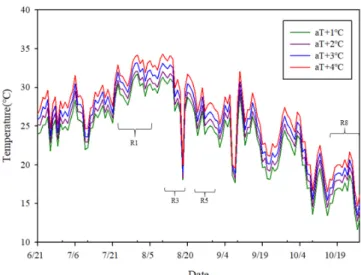
period, temperature gradient that was +1 to +4°C higher than ambient air temperature in the temperature gradient chamber (TGC) was placed. TGC is a semi-closed structure that can be tested under field-like condition, but it is characterized by temperature increase in the chamber based on external air temperature, making it impossible to control the temperature (Horie et al., 1995). So, temperatures inside the chamber changed according to the daily changes of the ambient temperature. The daily average temperature changes for each section are shown in Fig. 1. Because the temperature gradient for each facility was not constant due to the nature of the facility, there was a slight difference between planned temperature and actual temperature of each treatment section (Table 1). In the case of Daepung-2 and Daechan, a temperature gradient of aT+4°C was formed with 3.6 and 3.8°C, respectively, during the entire period of growth.
However, the temperature of the aT+4°C from R1 (beginning bloom) to R5 (beginning seed) rose only 2.6, 2.7°C compared to aT+1°C in Daepung-2 and Daechan, respectively. Also, temperature gradient in Daepung-2 from VE (emergence) to R1 (beginning bloom) was formed only 2.1°C, showing the lowest rise.
Seed Growth Characteristics
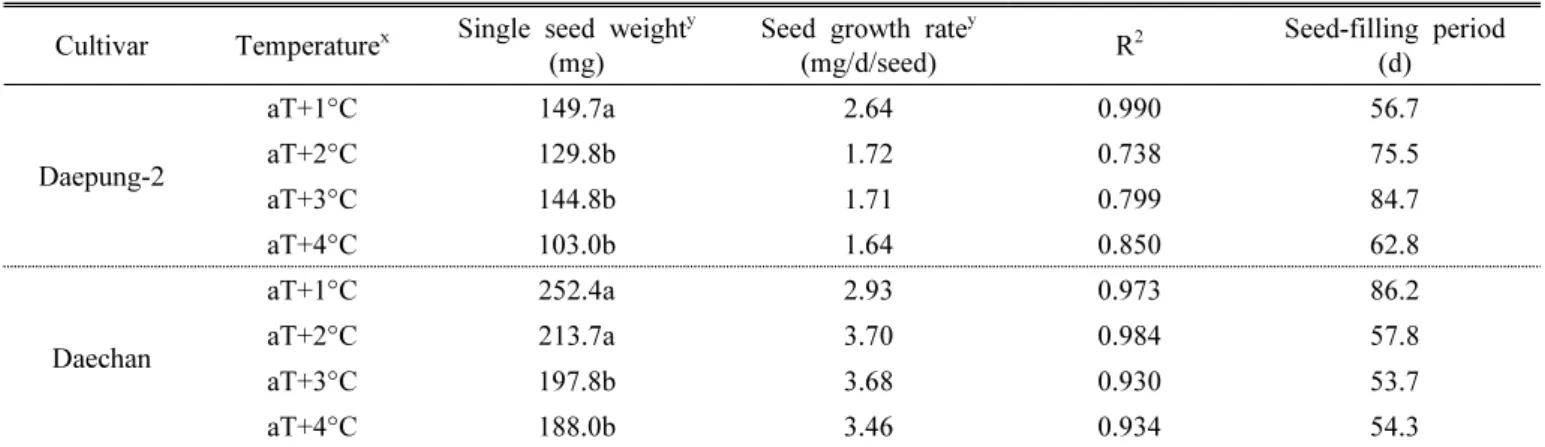
The effect of elevated temperature on seed growth rate showed different responses depending on the cultivar (Table 2). In
Fig. 1. Daily changes in the mean air temperature in a tem- perature-gradient chamber according to measuring points.
aT+1°C: ambient temperature+1°C, aT+2°C: ambient
temperature+2°C, aT+3°C: ambient temperature+3°C,
aT+4°C: ambient temperature+4°C.
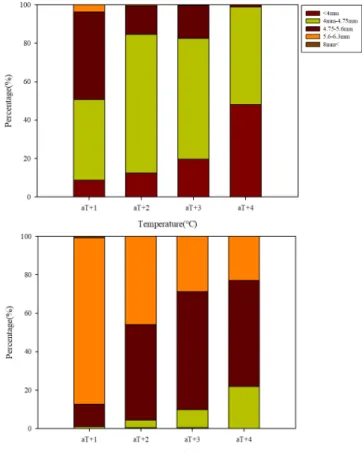
large-seed cultivar such as Daechan, seed growth rate increased in aT+4°C condition, resulting in a decrease in the number of days for the full maturity. While Daepung-2, which is medium- seed cultivar, tended to have a decrease in the seed growth rate, increasing the seed-filling period. Also, single seed weight decreased in both cultivars. These results might be associated with the seed quality. In other words, Daechan seemed to be affected by high temperature in the seed quality, given that the seed weight decreased despite the increase in seed growth rate.
Thomas et al. (2010) reported that the higher the temperature, the lower the seed growth rate and seed size. Especially, cultivar with larger seed size was more sensitive to high temperature than small seed cultivar (Puteh et al., 2013). Our results also suggest
that large-seed cultivar such as Daechan seem to be vulnerable to high temperature stress, given the seed quality. However, further study is required to analyze the response of seed quality to high temperature according to seed size.
Seed Yield and Yield Components
Table 3 show the results of the correlation analysis between the yield and yield components. Seed yield is determined by the value multiplied by seed number and seed weight. Seed yield showed a higher correlation with seed weight (r=0.713
***) than seed number (r=0.346
***), and a lower correlation with pod number (r=0.11). The seed number per plant showed a very high correlation (r=0.86***) with the pod number. Gibson and Mullen Table 1. Mean temperature between phenophases according to cultivar and temperature.
Cultivar Temperature
xMean temperature (°C)
VE-R1
yR1-R5
yR5-R8
yVE-R8
yDaepung-2
aT+1°C 25.9 29.4 21.0 24.0
aT+2°C 26.0 29.9 22.8 25.4
aT+3°C 27.0 31.1 24.0 26.5
aT+4°C 28.0 32.0 25.1 27.6
Daechan
aT+1°C 26.7 28.320.4 23 .8
aT+2°C 27.6 28.9 21.0 24.5
aT+3°C 28.5 30.6 23.3 26.6
aT+4°C 29.7 31.0 24.5 27.6
x
aT+1°C: ambient temperature+1°C, aT+2°C: ambient temperature+2°C, aT+3°C: ambient temperature+3°C, aT+4°C: ambient temperature+4°C.
y
VE: Emergence, R1: Beginning of blooming, R5: Beginning of seed filling, R8: Full maturity.
Table 2. Seed growth attributes of two soybean cultivars grown under elevated temperature.
Cultivar Temperature
xSingle seed weight
y(mg) Seed growth rate
y(mg/d/seed) R
2Seed-filling period
(d) Daepung-2
aT+1°C 149.7a 2.64 0.990 56.7
aT+2°C 129.8b 1.72 0.738 75.5
aT+3°C 144.8b 1.71 0.799 84.7
aT+4°C 103.0b 1.64 0.850 62.8
Daechan
aT+1°C 252.4a 2.93 0.973 86.2
aT+2°C 213.7a 3.70 0.984 57.8
aT+3°C 197.8b 3.68 0.930 53.7
aT+4°C 188.0b 3.46 0.934 54.3
x
aT+1°C: ambient temperature+1°C, aT+2°C: ambient temperature+2°C, aT+3°C: ambient temperature+3°C, aT+4°C: ambient temperature+4°C.
y
based on the dry matter of seed.
(1996) revealed that the largest yield reduction occurred when high temperature (35°C) occurred from flowering to maturity.
According to the results of the correlation analysis in this experiment, seed weight showed a higher correlation with seed yield. In other words, it is important to ensure proper seed weight through stable growth during maturity period under high temperature conditions.
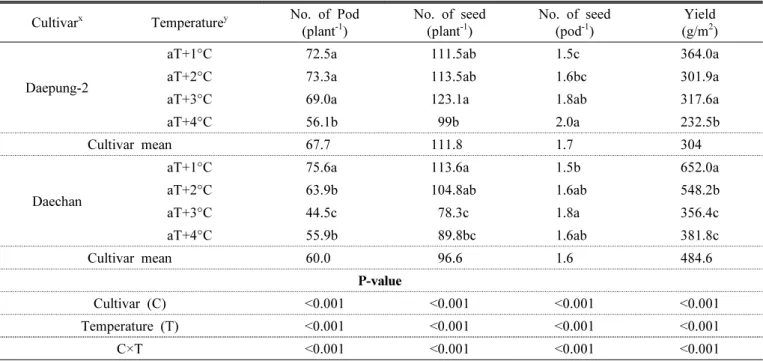
Also, Table 4 shows the seed yield and yield components of two soybean cultivars under elevated temperature. Pod number per plant, seed number per plant, seed number per pod and single seed weight showed a significant difference between cultivar and temperature and the interaction effect between cultivar and temperature treatment was also recognized. Daepung-2 and
Daechan did not show statistically significant difference up to aT+3°C and aT+2°C in the number of seeds, respectively, but showed a sharp decrease under aT+4°C condition. Pod number and seed number per plant showed high positive correlation (r=0.862***) (Table 3), and thus showed similar decreasing tendency with temperature rise. The pod number and seed number were the lowest in the condition of aT+4°C in Daepung-2, while Daechan was the lowest in the condition of aT+3°C. Meanwhile, seed number per pod and seed weight showed similar response for each cultivar. The number of seeds per pod increased with temperature rise, reducing single seed weight in both cultivars.
Daepung-2 had the lowest seed yield at aT+4°C due to a decrease in the single seed weight. Also, Daechan had the lowest
Table 3. Correlation coefficient between seed yield and yield components of two soybean cultivars grown under conditions of elevated temperature.
Correlation coefficient Pod number
(plant
-1) Seed number
(plant
-1) Single seed weight
(mg) Seed yield
(g/m
2)
Pod number (plant
-1) 1.000 0.862*** -0.389*** 0.110ns
Seed number (plant
-1) 1.000 -0.251*** 0.346***
Single seed weight (mg) 1.000 0.713***
Seed yield (g/m
2) 1.000
*** and ‘ns’ denote significance at p<0.001 and not significant (p>0.05), respectively.
Table 4. Seed yield and yield components of two soybean cultivars grown under elevated temperature.
Cultivar
xTemperature
yNo. of Pod
(plant
-1) No. of seed
(plant
-1) No. of seed
(pod
-1) Yield
(g/m
2) Daepung-2
aT+1°C 72.5a 111.5ab 1.5c 364.0a
aT+2°C 73.3a 113.5ab 1.6bc 301.9a
aT+3°C 69.0a 123.1a 1.8ab 317.6a
aT+4°C 56.1b 99b 2.0a 232.5b
Cultivar mean 67.7 111.8 1.7 304
Daechan
aT+1°C 75.6a 113.6a 1.5b 652.0a
aT+2°C 63.9b 104.8ab 1.6ab 548.2b
aT+3°C 44.5c 78.3c 1.8a 356.4c
aT+4°C 55.9b 89.8bc 1.6ab 381.8c
Cultivar mean 60.0 96.6 1.6 484.6
P-value
Cultivar (C) <0.001 <0.001 <0.001 <0.001
Temperature (T) <0.001 <0.001 <0.001 <0.001
C×T <0.001 <0.001 <0.001 <0.001
x
![The Effects of Increased Temperature on Soybean[Glycine max(L.) Merrill] Yield and Seed Quality in Temperature Gradient Chamber](data:image/gif;base64,R0lGODlhAQABAIAAAP///wAAACH5BAEAAAAALAAAAAABAAEAAAICRAEAOw==)