온도구배챔버에서 온도 상승에 따른 콩의 생육과 수량 반응에 미치는 영향
이윤호⋅조현숙⋅김준환⋅상완규⋅신평⋅백재경⋅서명철*1) 농촌진흥청 국립식량과학원 작물재배생리과
(2018년 3월 30일 접수; 2018년 6월 18일 수정; 2018년 6월 20일 수락)
The Effects of Increased Temperature on Soybean [Glycine max (L.) Merrill] Growth and Seed Yield
Responses in Temperature Gradient Chamber
Yun-Ho Lee, Hyeoun-Suk Cho, Jun-Hwan Kim, Wan-Gyu Sang, Pyong Shin, Jae-Kyeong Baek and Myung-Chul Seo
*Crop Physiology and Production, National Institute of Crop Science, Rural Development Administration, 181, Hyeoksin-ro, Iseo-myeon, Wanju-gun, Jeollabuk-do 55365, Republic of Korea
(Received March 30, 2018; Revised June 18, 2018; Accepted June 20, 2018)
ABSTRACT
The seed yield of summer plants is affected by climate change due to high temperature.
High temperature during the reproductive growth period decrease pod, seed weight in soybean. This study was conducted at National Institute of Crop Science (NICS) during the growing season. The objective of this study was to determine the effect of high temperature on growth and seed yield responses of soybean varieties using a temperature gradient chamber (TGC). In 2017, the Daewonkong (DWK), Pungsannamulkong (PSNK), and Deapungkong (DPK) were grown in three TGCs. Four temperature treatments, Ta (near ambient temperature), Ta+1 (ambient temperature+1℃), Ta+2℃ (ambient temperature+2℃), Ta+3℃ (ambient temperature+3℃), Ta+4℃ (ambient temperature+4℃), were established by dividing the rows along which the temperature gradient was created. In all three cultivars, beginning bloom (R1) delayed at elevated temperature in Ta+4℃. In addition, the days to beginning of seed fill and maturity were longer under higher temperature. The numbers of pod, 100 seed weight, and seed yield increased at elevated temperature in DWK. In contrast, seed yield components of PSNK and DPK were reduced in Ta+4℃. The results suggest that 100 seed weight and seed size of soybean was low by increased temperature in Ta+4℃ of PSNK and DPK.
Key words: Climate change, Temperature gradient chamber, Soybean, Phenology, High temperature
* Corresponding Author : Myung-Chul Seo ([email protected])
DOI: 10.5532/KJAFM.2018.20.2.159
ⓒ Author(s) 2018. CC Attribution 3.0 License.
Korean Journal of Agricultural and Forest Meteorology, Vol. 20, No. 2 160
Ⅰ
. 서 언2017년 전 지구의 평균기온은 20세기 평균 기온 (14.0℃)보다 0.84℃ 높아 1880년 관측 이래 세 번째로 높았다(CIP, 2017). 이러하듯 최근 지구온난화가 지속 됨에 따라 홍수, 가뭄, 이상고온 등과 같은 비생물적 스트레스가 빈번하게 발생하고 있으며, 이로 인해 농 업 생산성에 부정적인 영향을 주고 있다. 우리나라의 주요 작물들 중 벼, 옥수수, 콩과 같은 여름을 중심으 로 생육하는 1년생 작물들은 고온피해에 쉽게 노출되 어있으며, 그 중 콩의 경우 생식생장기간에 고온 피해 를 받기가 쉽다.
콩은 C3 작물로 일장과 온도변화에 매우 민감하게 반응을 하는데 37℃를 벗어나게 되면 출아율이 감소 하고 40℃에서는 출아가 정지되는 현상이 나타난다 (Wallace and Yan, 1998). 또한 40℃ 이상 단기간 노출 시 종실 수량이 급격하게 감소를 한다(Kitano
et al., 2006). 일반적으로 C3 작물들은 35℃까지는
광합성률이 증가하지만 40℃에서는 광합성률이 불충 분하게 이루어지고 호흡만 증가하여 종실 크기와 수 량을 감소 시킨다(Yamori et al., 2005; Kumar et al., 2016).생식생장기인 개화기부터 종실비대기사이에 고온 현상과 낮은 토양 수분 함량이 발생하게 되면 높은 불임률로 착협수가 감소되어 립 당 종실무게와 종실 크기 감소를 하게 되는 원인이 되며(Konno et al., 1964; Saitoh et al., 1999; Thoms et al., 2010), 이 기간 동안 야간 온도가 20∼25℃이상 지속하게 되면 종실 크기와 수량 감소로 이어지게 된다(Sato and Ikeada 1979; Zheng et al., 2002). 일반적으로 생식생 장기 동안의 온도 범위는 18∼26℃(Sionit et al.,1987;
Boote et al., 1998)인데, 이 상 한치 이상을 벗어나게 되면 착협과 결실률이 불량하게 되고 종실의 1립 무게 에도 영향을 주게 되어 수량을 감소 시킨다(Ferris et
al., 1999; Mochizuk et al., 2005: Oh-e et al., 2007;
Park et al., 2010).
지난 몇 년간 온도구배하우스에서 온도 상승에 따 른 종실 1립중의 무게가 감소한 것으로 알려져 있다 (Mochizuki et al., 2005; Oh-e et al., 2007; Tacaridua
et al., 2012; Tacaridua et al., 2013). 따라서 생식생장
기간 평균 기온이 27.5℃ 이상 고온을 유지하게 되면 종실 수량 감소로 이어지게 된다(Heinemann et al., 2006; Rainey and Griffiths, 2005).콩은 개화기부터 수량구성 요소를 결정하는데, 특 히 착협기(R3)에서 종실비대기(R5)까지 환경에 지배 적인 영향을 받는다(Kantolic et al., 2013). 따라서 본 연구는 지구온난화가 가속화되고 있는 가운데 온도구 배챔버(Temperature Gradient Chamber: TGC)(Horie
et al., 1995)에서 자연상태와 유사한 군락 환경을 유지
하면서 상승된 온도구간에 따라 콩의 생육 특성과 수 량 반응을 구명함으로써 향후 기후변화 대응 자료로 활용하고자 수행하였다.Ⅱ
. 재료 및 방법본 연구는 2017년 국립식량과학원 포장에 설치된 가로 2 m × 세로 30 m의 온도구배챔버에서 수행하였 으며, 온도구배는 각 구간 마다 온도계를 설치하여 Ta+1, Ta+2, Ta+3, Ta+4℃로 온실 입구 쪽부터 외부 온도보다 1℃ 높아지면서 안쪽으로 갈수록 외부 온도 보다 4℃가 높게 설정되었다. 시험에 사용된 품종은 대원콩, 대풍콩 그리고 풍산나물콩으로 재식거리는 50 cm × 15 cm로 6월 20일에 파종을 하였고, 시비량은 N-P2O5-K2O를 10a당 3-3-3.4kg을하였다. 관수는 파 종 후부터 개화시까지 주 2∼3회 하였고, 개화기부터 성숙기까지 주 1회 공급하였다. 개화기(R1)부터 성숙 기까지(R7)의 조사 방법은 Fehr and Caviness(1977) 을 근거로 주 3회 육안 검사를 통해 이루어졌다. 수량 구성요를 위해 각 온도구간 당 20∼23개체씩 수확하 여 착협수, 100립중을 조사 하였다.
연구 결과의 통계분석은 SAS 9.1(SAS Institute Inc., Cary, NC, USA) 통계패키지를 이용하여 수행하 였으며, ANOVA(P<0.05)로 유의성 분석을 하였다.
Ⅲ
. 결과 및 고찰3.1 생육기간 온도변화와 생물계절
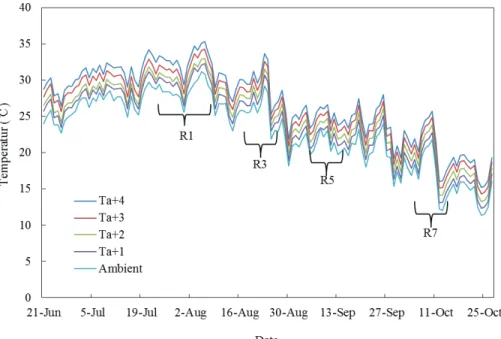
재배기간 동안의 온도변화는 Fig. 1과 같다. 대원콩 과 풍산나물콩 그리고 대풍콩의 개화시(R1)는 7월 26 일부터 8월 16일이었고, 종화기는 8월 22일∼9월 2일 이었다. 착협기(R3)는 8월 13일에서 8월 26일 사이였 으며, 종실비대기(R5)는 8월 26일부터 9월 4일이었다.
성숙기(R7)는 10월 7일부터 10월 16일로 온도 상승에 따라 온도구배와 품종간에 차이를 보였다. 특히 고온 인 구간이 개화기가 지연되었다.
Ta+1 : ambient temperature+1℃, Ta+2℃ : ambient temperature+2℃, Ta+3℃ : ambient temperature+3℃, Ta+4℃ : ambient temperature+4℃.
R1 : Beginning bloom, R3 : Beginning pod, R5: Beginning seed, R7 : Beginning maturity
Fig. 1. Daily changes in mean air temperature at different temperature in a temperature-gradient chamber in 2017.
Culti varsz
Treat menty
VE-R1x R1-R5 R5-R7 VE-R7
Duration (days)
Temperature (℃)
Duration (days)
Temperature (℃)
Duration (days)
Temperature (℃)
Duration (days)
Temperature (℃)
DWK
Ta 27.1 27.3 20.5 24.6
Ta+1 32 28.0 31 28.2 43 21.4 106 25.5
Ta+2 31 28.7 32 29.2 42 22.7 105 26.5
Ta+3 31 29.8 33 30.0 42 23.4 106 27.4
Ta+4 32 31.0 35 30.6 44 23.8 111 28.1
PSNK
Ta 27.1 26.2 20.3 24.4
Ta+1 38 28.0 31 27.1 39 21.2 108 25.3
Ta+2 37 28.3 32 27.7 39 21.8 108 25.9
Ta+3 37 29.8 34 28.7 37 23.1 108 27.3
Ta+4 38 31.0 34 29.6 40 23.3 112 27.9
DPK
Ta 27.8 23.9 19.9 24.1
Ta+1 43 28.8 19 24.9 41 20.9 103 25.1
Ta+2 43 29.6 19 25.8 41 21.8 103 26.0
Ta+3 43 30.6 22 26.9 40 22.8 105 27.0
Ta+4 43 31.7 22 28.0 41 23.4 106 27.8
zDWK : Daewonkong, PSNK : Pungsannamulkong, DPK : Deapungkong.
yTa : near ambient temperature, Ta+1 : ambient temperature+1℃, Ta+2℃ : ambient temperature+2℃, Ta+3℃ : ambient temperature+3℃, Ta+4℃ : ambient temperature+4℃.
xVE : Vegetative stage emergence, R1 : Beginning bloom, R5 : Beginning seed, R7 : Beginning maturity.
Table 1. Duration and average temperature of VE-R1, R1-R5, R5-R7, and VE-R7 periods of three soybean
cultivars grown to increased temperatureKorean Journal of Agricultural and Forest Meteorology, Vol. 20, No. 2 162
재배기간 동안 생육 시기별 일수와 평균 온도에 대 한 결과는 Table 1과 같다. 출현기에서 개화기까지의 평균 소요일수는 대원콩이 32일, 풍산나물콩이 38일 그리고 대풍콩이 42일로 품종 간 최대 차이는 일주일 정도를 보였다. 온도 변화는 외기 온도가 27.1℃이었 으며, 같은 기간 동안 Ta+4℃가 30℃ 이상으로 가장 높았다. 개화기에서 종실비대까지의 평균 소요일수는 대원콩이 33일, 풍산나물콩이 33일 그리고 대풍콩이 21일이었으며, 이 기간 외기의 온도가 8월 중순과 하 순에 찬 공기와 강수로 인해 무더위가 누구려 지면서 온도 차이가 나타나 온도구배간에 있어서 약 2∼4일 차이를 보였다. 그러나 종실비대기에서 성숙기까지 소 요일수는 대원콩이 43일, 풍산나물콩이 39일, 그리고 대풍콩이 40일로 품종 간 차이를 보이지 않은 이유는 같은 기간 동안 평균 온도가 20.9∼23.8℃ 사이로 온 도가 급속하게 내려가면서 모든 온도구간에서 생육 적 정 온도 범위에 속한 것으로 판단된다. 총 생육기간 일수는 103일에서 112일로 3개 품종 중 Ta+4℃구간 이 다른 온도구간보다 약 3∼4일 길었다. 같은 기간 동안 온도구배의 평균 온도는 25.1∼28.1℃ 사이로 재 배기간 동안 Ta+4℃가 가장 높게 유지 하였다.
본 연구에서 주목 할 것은 개화기부터 종실비대기 까지 Ta+1, Ta+2, Ta+3℃까지는 소요 일수는 비슷하 였으나, Ta+4℃에 약 4일 정도 지연된 것을 알 수 있었 다. 이러한 원인은 Ta+4℃ 구간에서 개화기에서 종화 기사이에 35℃ 이상 넘어가는 일수가 2일간 지속되어 개화기간이 지연된 것으로 판단된다. 일반적으로 개화 기에 35℃ 이상의 고온이 지속되면 꽃눈 형성이나 개 화기간이 지연되고 꽃이나 어린 꼬투리가 감소하는 비 율이 증가한다고 보고하였다(Mochizuki et al., 2005;
Kumari et al., 2016).
3.2 상승된 온도와 종실 수량 구성과의 관계 콩 종실의 수량 반응은 온도에 따라 민감하게 변화 를 보이는데, 특히 생식생장기에 취약하다(Puteh et
al., 2013). Table 2는 온도 상승에 따른 수량구성요소
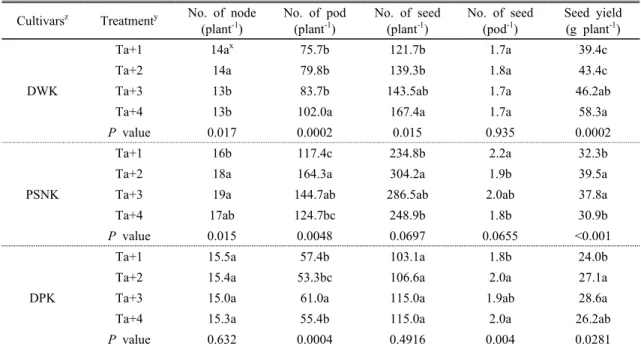
와 종실의 수량 결과이다. 콩의 수량은 개화기, 착협기 그리고 종실비대기에 결정되는데(Jiang and Egli, 1995), 이 기간 동안 온도가 상승하게 되면 수량 구성 요소 중 착협과 결실이 불량해지고 종실의 1립중이 작아지는 경향을 보인다고 보고하였다(Mochizuki etal., 2005). 본 연구에서는 개체당 협수는 온도가 상승
Cultivarsz Treatmenty No. of node (plant-1)
No. of pod (plant-1)
No. of seed (plant-1)
No. of seed (pod-1)
Seed yield (g plant-1)
DWK
Ta+1 14ax 75.7b 121.7b 1.7a 39.4c
Ta+2 14a 79.8b 139.3b 1.8a 43.4c
Ta+3 13b 83.7b 143.5ab 1.7a 46.2ab
Ta+4 13b 102.0a 167.4a 1.7a 58.3a
P value
0.017 0.0002 0.015 0.935 0.0002PSNK
Ta+1 16b 117.4c 234.8b 2.2a 32.3b
Ta+2 18a 164.3a 304.2a 1.9b 39.5a
Ta+3 19a 144.7ab 286.5ab 2.0ab 37.8a
Ta+4 17ab 124.7bc 248.9b 1.8b 30.9b
P value
0.015 0.0048 0.0697 0.0655 <0.001DPK
Ta+1 15.5a 57.4b 103.1a 1.8b 24.0b
Ta+2 15.4a 53.3bc 106.6a 2.0a 27.1a
Ta+3 15.0a 61.0a 115.0a 1.9ab 28.6a
Ta+4 15.3a 55.4b 115.0a 2.0a 26.2ab
P value
0.632 0.0004 0.4916 0.004 0.0281zDWK : Daewonkong, PSNK : Pungsannamulkong, DPK : Deapungkong
yTa+1 : ambient temperature+1℃, Ta+2℃ : ambient temperature+2℃, Ta+3℃ : ambient temperature+3℃, Ta+4℃ : ambient temperature+4℃.
xMeans separation within columns by Duncan’s multiple ranges at 5% level of significance.
Table 2. Yield components and seed yield of three soybean cultivars grown to temperature
될 수록 대원콩은 증가하였으나, 풍산나물콩은 온도에 민감하게 반응하여 Ta+3℃와 Ta+4℃에서 감소를 하 였고, 대풍콩은 Ta+4℃에서 급속히 감소를 하였다. 이 러한 결과는 감수분열기인 화분 성숙기에 30℃이상의 고온의 피해를 받으면 수정 할 수 있는 능력이 저해되 어 착협수가 감소한다고 보고 하였으며(Kaushak et
al., 2016), 고온에 의한 피해는 화분세포보다 배낭세
포가 민감하게 반응을 한다고 보고하였다(Sage et al., 2015). 개체당 종실 수는 온도가 상승 할 수록 대원콩 은 증가하였고, 풍산나물콩은 Ta+3℃와 Ta+4℃에서 는 감소하는 경향을 보였다. 반면 대풍콩은 온도 상승 에 따라 유의한 차이가 나타나지 않았다. 협 당 종실 수는 대원콩과 풍산나물콩은 유의한 차이가 없었으나, 대풍콩은 Ta+1℃에서만 낮을 뿐 다른 온도구배간에 서는 차이를 보이지 않았다. 종실 수량을 보면 대원콩 은 온도 상승과 함께 수량이 증가 하고 있는 반면 풍산 나물콩과 대풍콩은 Ta+4℃에서 감소하였다. 이는 대 원콩은 고온에 대한 내성이 높은 반면 풍산나물콩과 대풍콩은 온도에 민감하게 반응을 보인 것으로 판단된 다. 따라서 등숙기 동안 온도 변화는 종실 수량에 매우 중요한 요인 중의 하나로 판단된다.3.3 상승된 온도와 종실 크기 분포
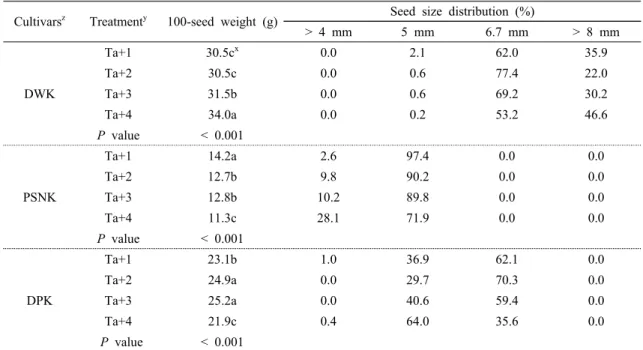
Table 3은 상승된 온도에 따른 100립중과 종실 크기 분포를 보면 대립종인 대원콩은 온도가 상승 될수록 100립중이 증가되는 현상을 보였고 특히 Ta+4℃에서 가장 높았다. 그러나 소립중인 풍산나물콩과 중립중인 대풍콩은 Ta+4℃에서 감소를 보였다. 개화기에서 성 숙기의 평균 온도와 백립중은 부의 관계를 보였으며 (Matsuda et al., 2011), 같은 기간에 평균 온도가 25℃
까지는 종실 수량과 1립중이 증가 하지만 이 온도를 벗어나면 감소하는 경향을 보였다고 하였다(Uchikawa
et al., 2003). 최근 고온 저항성 유전자형과 고온 감수
성 유전자형을 연구한 결과 36/24℃(주/야간)에서 고온 저항성은 고온 감수성에 비해 100립중이 낮았으나 42/26℃(주/야간)에서는 모두 감소하였다고 보고 된바 있다(Chebrolu et al., 2016). 따라서, 생식생장기에 극 한의 고온 현상을 받게 되면 종실 무게와 크기는 급격 하게 감소한다고 보고된바 있다(Kumari et al., 2017).상승된 온도에 따라 종실 크기 분포를 비교해보면 대원콩은 50 % 이상이 6.7 mm에 분포하고 있으며 8 mm 이상에서는 Ta+4℃가 다른 온도구간에 비하여 높 았다. 풍산나물콩은 5 mm에서 가장 많은 분포를 보였
Cultivarsz Treatmenty 100-seed weight (g) Seed size distribution (%)
> 4 mm 5 mm 6.7 mm > 8 mm
DWK
Ta+1 30.5cx 0.0 2.1 62.0 35.9
Ta+2 30.5c 0.0 0.6 77.4 22.0
Ta+3 31.5b 0.0 0.6 69.2 30.2
Ta+4 34.0a 0.0 0.2 53.2 46.6
P value
< 0.001PSNK
Ta+1 14.2a 2.6 97.4 0.0 0.0
Ta+2 12.7b 9.8 90.2 0.0 0.0
Ta+3 12.8b 10.2 89.8 0.0 0.0
Ta+4 11.3c 28.1 71.9 0.0 0.0
P value
< 0.001DPK
Ta+1 23.1b 1.0 36.9 62.1 0.0
Ta+2 24.9a 0.0 29.7 70.3 0.0
Ta+3 25.2a 0.0 40.6 59.4 0.0
Ta+4 21.9c 0.4 64.0 35.6 0.0
P value < 0.001
zDWK : Daewonkong, PSNK : Pungsannamulkong, DPK : Deapungkong
yTa+1 : ambient temperature+1℃, Ta+2℃ : ambient temperature+2℃, Ta+3℃ : ambient temperature+3℃, Ta+4℃ : ambient temperature+4℃.
xMeans separation within columns by Duncan’s multiple ranges at 5% level of significance.
Table 3. 100-seed weight and seed size distribution of three soybean cultivars grown to increased temperature
Korean Journal of Agricultural and Forest Meteorology, Vol. 20, No. 2 164
으나 Ta+4℃에서 가장 낮았다. 대풍콩은 6.7 mm가 50
%이상을 차지하였으나 Ta+4℃가 다른 온도구간에 비 해 낮았다. 이와 같이 온도 상승에 따라 대립인 대원콩 의 종실 무게는 증가 하였으나, 소립과 중립인 풍산나물 콩과 대풍콩은 일정 온도를 벗어나면 종실 무게가 감소 하여 종실 수량이 낮아진 것으로 판단된다. Egli and Wardlaw(1980)의 보고에 따르면 33/28℃(주/야간)가 24/19℃(주/야간)에 비해 종실 크기가 약 22%가 감소하 였다. 생식생기간 동안 시기별로 30∼35℃로 고온 처리 를 하였을 때 개화기∼종실비대시(14일)가 개화기∼개 화성(5일)에 비하여 종실의 크기와 무게가 작아 졌다고 보고 하였다(Puteh et al., 2013). 또한 온도구배하우스 에서 수행된 결과를 보면 온도 상승에 따른 콩 종실의 1립중이 감소하는 경향을 보였고, 특히 Ta+3℃까지는 종실 수량이 증가 하였으나 Ta+4℃에서 감소한다고 보 고하였으며, 등숙기간 평균온도와 100립중은 부의 상관 관계가 있다고 하였다(Oh-e et al., 2007).
적 요
본 연구는 급격하게 진행되고 있는 기후변화에 따 른 콩의 생육과 종실 수량 반응을 온도구배챔버에서 수행하였다. 생식상 장기간의 고온 발생은 농업 생산 성을 저해시키며, 인류의 식품안정성에도 영향을 줄 수 있다. 모든 품종이 Ta+4℃에서 개화기간이 지연되 는 현상을 보여 영양생장기보다 생식생장기의 고온에 대해 민감하게 반응을 하였다. 온도 변화에 대한 종실 수량 구성 반응을 보면 대원콩은 온도가 상승 할수록 협수, 종실 무게가 높아져 수량이 증가하였다. 반면 풍산나물콩과 대풍콩은 각각 Ta+3℃와 Ta+4℃사이 에서 각각 일정 온도를 벗어나게 되면 온도에 민감하 게 반응하여 착협수와 100립중이 감소를 하여 수량 감소로 이어졌다. 종자 크기로 보았을 때 대립 품종인 대원콩은 일정 온도 범위까지는 수량이 증가 할 것으 로 판단된다. 반면 중립과 소립품종인 대풍콩과 풍산 나물콩은 일정 온도를 벗어나게 되면 수량이 감소 할 것으로 판단된다.
감사의 글
본 논문은 농촌진흥청 국립식량과학원 농업과학기 술 연구개발사업 (과제번호: PJ011952)의 지원에 의해 이루어진 것임.
REFERENCES
Chebrolu, K. K., F. B. Fritschi, S. Ye, H. B. Krishnan, J. R. Smith, and J. D. Gillman, 2016: Impact of stress during seed development on soybean seed metabolome. Metabolomics 12(2), 128.
Egli, D., and I. Wardlaw, 1980: Temperature response of seed growth characteristics of soybean.
Agronomy Journal 72, 560-564.
Ergo, V. V., R. Lascano, C. R. C. Vega, R. Parola, and C. S. Carrera, 2018: Heat and water stressed field-grown soybean: A multivariate study on the relationship between physiological-biochemical traits and yield. Environmental and Experimental
Botany 148, 1-11.
Fehr, W. R., and C. E. Caviness, 1977: Stages of soybean development. Iowa State University of Science and Technology Special Report 80.
Ferris, R., T. R. Wheeler, R. H. Eillis, and P.
Hadley, 1999: Seed yield after environmental stress in soybean grown under elevated CO2. Crop
Science 39, 710-718.
Gibdon, L. R., and R. E. Mullen, 1996: Influence of day and night temperature on soybean seed yield.
Crop Science 36, 98-104.
Heinemann, A. B., A. H. N. Maia, D. Dourado-neto, K. T. Ingram, and G. Hoogenboom, 2006:
Soybean [Glycine max(L.) Merrill] growth and development response to CO2 enrichment under different temperature regimes. European Journal of
Agronomy 24, 52-61.
Horie, T., H. Nakagawa, J. Nakano, K. Hamotanl, and H. Y. Kim, 1995: Temperature gradient chambers for research on global environment change Ⅲ A system designed for rice in Kyoto, Japan. Plant Cell Environment 18, 1064-1069.
Jiang, H., and D. B. Egli, 1995: Soybean seed number and crop growth rate during flowering.
Agronomy Journal 87, 264-267.
Kantoli, A. G., G. E. Peralta, and G. A. Slafer, 2013: Seed number responses to extended photoperiod and shading during reproductive stage in indeterminate soybean. European Journal of
Agronomy 51, 91-100.
Kitano, M., K. Saitoh, and T. Kuroda, 2006: Effects of high temperature on flowering and pod set in soybean. Scientific Reports of the Faculty of Agriculture Okayama University 95, 49-55.
Konno, S., J. Fukui, and M. Ojima, 1964: Influence of soil moisture condition on chemical composition
and seed formation of soybean plant. Bullet
National Institute of Agricultural Science 11,
111-149.Kumar, J., R. Kant, S. Kumar, P. S. Basu, A.
Sarker, and N. P. Sibgh, 2016: Heat tolerance in lentil under field conditions. Legume Genomics
Genet 7, 1-11.
Kumari, S., A. Sehgal, H. HanumanthaRao, R. M.
Nair, P. V. V. Prasad, S. Kumar, P. M. Gaur, M.
Farooq, K. H. M. Siddique, R. K. Varshney, and H. Nayyar, 2017: Food legumes and rising temperatures: Effects, adaptive functional mechanisms specific to reproductive growth stage and strategies to improve heat tolerance. Frontiers in Plant Science 8, 1658. doi: https://doi.org/10.3389/fpls.
2017.01658
Matsuda, H., Y. Shibata, S. Mori, and H. Fujii, 2011: Effect of temperature during the ripening period on the 100-grain weight of soybean in Shonai district of Yamagata prefecture. Japan
Journal of Crop Science 80, 43-48.
Mochizuki, A., T. Shiraiwa, H. Nakagawa, and T.
Horie, 2005: The effect of temperature during the reproductive period on development of reproductive organs the occurrence of delayed stem senescence in soybean. Japan Journal of Crop Science 74, 339-343.
OH-e, I., R. Uwagoh, S. Jyo, T. Kurahashi, K.
Saitoh, and T. Kuroda, 2007: Effect of rising temperature on flowering, pod set, dry-matter production and yield in soybean. Japan Journal of
Crop Science 76, 433-444.
Park, K. W., T. H. Ahn, and J. W. Cho, 2010: Effect high temperature during reproductive growth period on soybean growth, nitrogen and cation content.
Korean Journal of Crop Science 55, 14-18.
Puteh, A. B., M. ThuZar, M. M. A. Mondal, N.
APB. Abdullah, and M. R. A. Halim, 2013:
Soybean [Glycine max (L.) Merrill] seed yield response to high temperature stress during reproductive growth stages. Australian Journal of
Crop Science 10, 1472-1479.
Rainey, K. M., and P. D. Griffiths, 2005:
Differential response of common bean genotypes to high temperature. Journal for the American
Society for Horticultural Science 130, 8-23.
Saitoh, K., N. Wakui, T. Mahmood, and T. Kuuroda, 1999: Differentiation and development type of soybean. Plant Production Science 2, 47-50.
Sato, K., and T. Ikeda, 1979: The growth responses
of soybean plant to photoperiod and temperature.
5. The effect of temperature during the ripening period on the yield and characters of seeds. Japan
Journal of Crop Science 48, 283-290.
Sage, T. L., S. Agha, V. Lundsgaard-Nielson, H. A.
Branch, S. Sultmanis, and R. F. Sage, 2015: The effect of high temperature stress on male and female reproduction in plants. Field Crops
Research 182, 30-42.
Tacrindua, C. R. P., T. Shirawa, K. Homma, E.
Kumagai, and R. Sameshima, 2012: The response of soybean seed growth characteristics to increase temperature under near-field conditions in temperature gradient chamber. Field Crops Research
131, 26-31.
Tacrindua, C. R. P., T. Shirawa, K. Homma, E.
Kumagai, and R. Sameshima, 2013: The effects of increased temperature on crop growth and yield of soybean grown in a temperature gradient chamber.
Field Crops Research 154, 74-81.
Thomas, J. M. G., K. J. Boote, D. PAN, and L. H.
Allen, 2010: Elevated temperature delays onset of reproductive growth and reduces seed growth rate of soybean. Journal of Agro Crop Sciences 1, 19-32.
Thuzar, M., A. B. Puteh, N. A. P. Abdullah, MB.
M. Lassim, and K. Jusoff, 2010: The effects of temperature stress on the quality and yield soybean [Glycine max (L.) Merrill]. Journal of
Agricultural Science 2, 172-179.
Uchikawa, O., Y. Fukushima, and Y. Matusue, 2003:
Statistical analysis of soybean yield and meteorological condition in Northern Kyushu.
Japan Journal of Crop Science 72, 203-209.
Wallace, D. H., and W. Yan, 1998: Plant breeding
and whole crop systems, improving adaption, maturity, and yield. CAB International, Wallingford,
UK.Yamori, W., K. Noguchi, and I. Terashimal, 2005:
Temperature acclimation of photosynthesis in spinach leaves: analyses of photosynthetic components and temperature dependence of photosynthetic partial reactions. Plant Cell &
Environment 28, 536-547.
Zheng, S. H., H. Nakamoto, K. Yoshikawa, T.
Furuya, and M. Fukuyama, 2002: Influences of high night temperature on flowering and pod setting in soybean. Plant Production Science 5, 215-218.