경락경혈학회지 Vol.28, No.4, pp.59 66, 2011∼ Korean Journal of Acupuncture
Seung-Wook Lee , Jung-Yoon Kim , Na-Ra Lee , Young-Ho Kim , Yong-Heum Lee
Dept. of Biomedical Engineering, College of Health Science, Oriental medical Engineering Lab, Yon-Sei University Dept. of Biomedical Engineering, Institute of Medical Engineering, Yon-Sei University
Abstract
Objectives : This study is aimed to evaluate and objectify the therapeutic effect of moxibustion on muscle fatigue recovery.
Methods : To evaluate the therapeutic effect on the muscle fatigue recovery, we compared the fatigue recovery of two groups (non-stimulation group and moxibustion group) by analyzing the EMG and peak torque after strenuous knee exercise of isokinetic contraction.
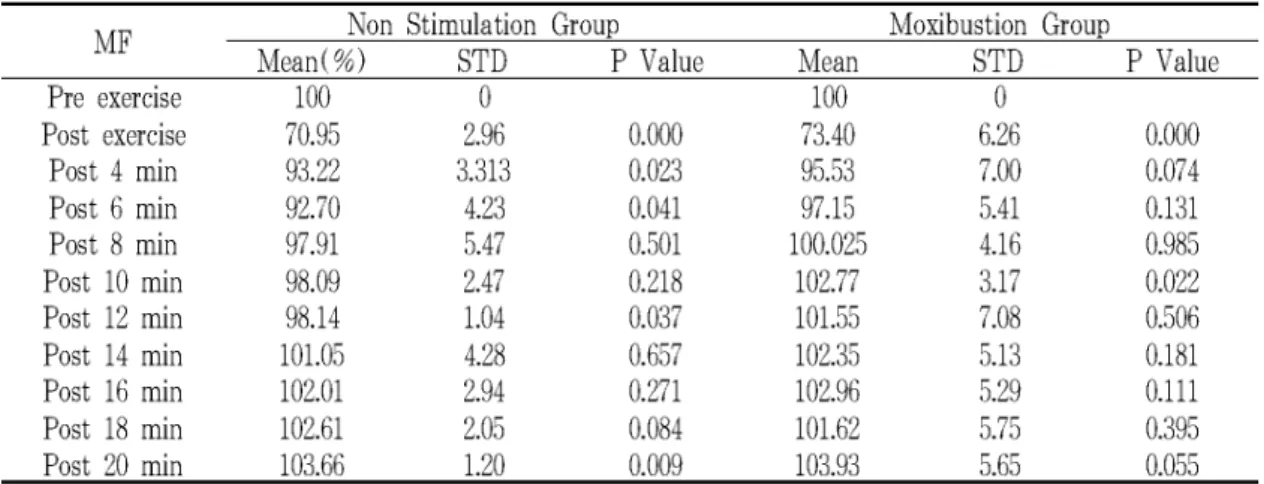
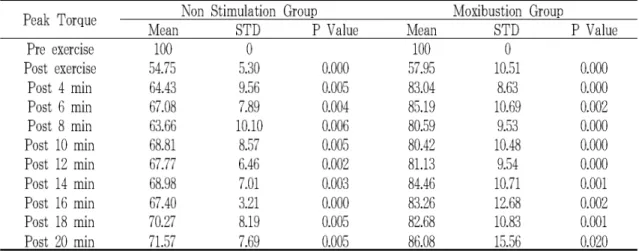
Results : The median frequency (MF) of the moxibustion group was recovered faster than that of the non-stimulation group. However, the peak torques of both groups were not restored until after 20 minutes. Nevertheless, the moxibustion group's peak torque was regained higher than that of the non-stimulation group.
Conclusions : We confirmed the therapeutic effect of moxibustion and found that the moxibustion can used as prevention method for musculoskeletal disease.
Key words : moxibustion, muscle fatigue, acupoint, rectus femoris, median frequency, peak torque
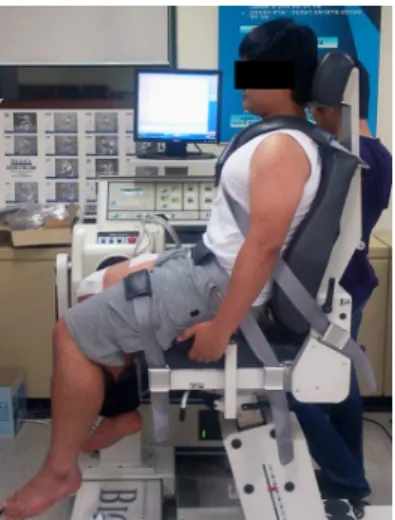
Fig. 1. Experiment Set-up by using Biodex system 3.
Table 1. The mean and STD of time and sets for all subjects until 55 percent of peak torque by isokinetic contraction
Fig. 3. The mean and standard error of the MF for Non Stimulation Group and Moxibustion Group as time passed.
Table 2. The analysis of the MF in the Non Stimulation Group and Moxibustion Group as Time passed
Table 3. The analysis of the Peak Torque in the Non Stimulation Group and Moxibustion Group as Time passed