• 검색 결과가 없습니다.

Preliminary Investigation of Association between Methylphenidate and Serum Growth Markers in Children with Attention-Deficit/Hyperactivity Disorder: A Cross-Sectional Case-Control Study

N/A
N/A
Protected

Academic year: 2021

Share "Preliminary Investigation of Association between Methylphenidate and Serum Growth Markers in Children with Attention-Deficit/Hyperactivity Disorder: A Cross-Sectional Case-Control Study"

Copied!
7
0
0

로드 중.... (전체 텍스트 보기)

전체 글

(1)

INTRODUCTION

Methylphenidate (MPH), which inhibits dopamine reup- take in the central nervous system, is the most commonly pre- scribed medication for the treatment of attention-deficit/hy- peractivity disorder (ADHD) [1]. It remains unclear whether MPH affects growth in children as a side effect. Previous stud- ies have suggested that MPH may suppress growth in chil- dren with ADHD [2,3]. Other studies, on the contrary, have demonstrated that MPH treatment may not affect growth in

children with ADHD [4,5]. It has also been suggested that the pathophysiology of ADHD itself could suppress growth [6]. Thus, so far, the findings on whether MPH is associated with growth suppression in children with ADHD have been inconclusive. In addition to anthropometric indices such as height and weight, serum biochemical markers of growth could be considered when measuring the growth status of children. Growth hormones and thyroid hormones are di- rectly involved in growth, affecting the synthesis and release of growth factors. Adequate bone mineralization and forma- tion, which are related to the metabolism of calcium, phos- phorus, and vitamin D, are essential to growth [7]. Serum bio- chemical markers representing nutritional status, such as

This is an Open Access article distributed under the terms of the Creative Commons Attribution Non-Commercial License (https://creativecommons.org/licenses/by-nc/4.0) which permits unrestricted non-commercial use, distribution, and reproduction in any medium, provided the original work is properly cited.

Preliminary Investigation of Association between

Methylphenidate and Serum Growth Markers in Children with Attention-Deficit/Hyperactivity Disorder:

A Cross-Sectional Case-Control Study

Woo Jin Kim

1

, Young Rong Bang

2

, Je-Wook Kang

3

, Jae Ho Yoo

4

, Seong Hwan Kim

2

, and Jae Hong Park

2

1

Department of Psychiatry, Dong-A University Graduate School of Medicine, Busan, Korea

2

Department of Psychiatry, Dong-A University Hospital, Busan, Korea

3

Department of Psychiatry, Inje University Busan Paik Hospital, Busan, Korea

4

Department of Pediatrics, Dong-A University Hospital, Busan, Korea

Objectives: It remains unclear whether methylphenidate (MPH) has yadverse effects on growth in children. This study aimed to investigate the association of MPH with serum biological markers of growth in children with attention-deficit/hyperactivity disorder (ADHD).

Methods: The present study included 103 children with ADHD (64 drug-naive children, 39 MPH-treated children) and 112 control subjects. Children with ADHD were diagnosed on the basis of a semi-structured interview. Levels of biochemical markers of growth, including insulin-like growth factor-I, thyroid stimulating hormone (TSH), free T

4

, calcium, phosphorus, alkaline phosphatase, vitamin D, hemoglobin, total protein, albumin, total cholesterol, and hematocrit were measured in these individuals.

Results: Except in case of TSH, no intergroup differences were found in the levels of the growth markers. The levels of TSH were found to be lower in the MPH-treated boys with ADHD than in the drug-naive and control groups (p<0.05), although the levels of TSH in all the groups were within normal limits.

Conclusion: In this cross-sectional study, no significant association was found between MPH and growth markers. This calls for the need to carry out prospective longitudinal research studies in the future that investigate the effect of MPH on the growth trajectory in children.

Key Words: ADHD; Methylphenidate; Side effect; Growth; Case-control study.

Received: March 19, 2020 / Revision: June 9, 2020 / Accepted: June 15, 2020

Address for correspondence: Jae Hong Park, Department of Psychiatry, Dong-A University Hospital, 26 Daesingongwon-ro, Seo-gu, Busan 49201, Korea

Tel: +82-51-240-5467, Fax: +82-51-253-3542, E-mail: [email protected]

(2)

hemoglobin (Hb), hematocrit (Hct), total protein, albumin, and total cholesterol, play an important role in growth [8].

Therefore, the analysis of biochemical growth markers is rel- evant in studies investigating factors that influence the growth of children. Although most studies have focused only on an- thropometric indices, few studies have compared the growth of children with ADHD on the basis of particular biochem- ical markers.

This study aims to investigate differences in the serum bio- chemical markers of growth among MPH-treated children with ADHD, drug-naive children with ADHD, and healthy control subjects.

METHODS

Participants

A cross-sectional case-control study was conducted as part of a broader investigation by the Korea Food and Drug Ad- ministration; this study aimed to examine the association between adverse environmental exposure and neurodevel- opmental disorders [9]. The participants included 215 chil- dren aged 6 to 12 years (64 drug-naive children with ADHD, 39 MPH-treated children with ADHD, and 112 healthy con- trol subjects), who were enrolled at two university hospitals (Dong-A Univerisity Hospital, Inje University Busan Paik Hospital) in Busan, Korea. The ADHD and control subjects were recruited via advertisements at the two university hos- pitals and in the local communities. The study protocol was approved by the Institutional Review Board of the National Cancer Center (NCCNCS13712).

Participants were classified into case and control groups after physical and psychiatric evaluation by pediatricians and child psychiatrists. The inclusion criteria for ADHD cases were as follows: 1) children between the ages of 6 and 12 years, 2) diagnosis of ADHD based on the Diagnostic and Statisti- cal Manual of Mental Disorders, 4th edition (DSM-IV) [10], and 3) provision of written informed consent by the parents and assent from the child. The exclusion criteria were as fol- lows: 1) neurological disorders, such as epilepsy, cerebral pal- sy, mental retardation, or pervasive developmental disorders;

2) congenital malformation, hematological disorders, or chronic physical diseases; 3) acute diseases (including upper respiratory infection, enteritis) at the time of enrolment; and 4) previous history of head injury. Children with ADHD were divided into an MPH-treated ADHD group and a drug-naive group. The control group included healthy subjects who met all the above criteria, except ADHD diagnosis and treatment.

ADHD diagnosis

The screening section and ADHD supplement section of

the Korean version of the Kiddie-Schedule for Affective Dis- orders and Schizophrenia-Present and Lifetime Version (K- SADS-PL-K) [11] were used to diagnose ADHD. The K-SADS- PL-K is a semi-structured interview tool based on DSM-IV.

Anthropometric indices

Height and weight were measured for each child. The body mass index (BMI) was calculated in units of kg/m

2

. Then we transformed height, weight, and BMI to age- and sex-correct- ed standard scores (z-score) using norms from the 2017 Ko- rean National Growth Charts for children and adolescents [12].

Biochemical markers of growth

Blood sampling was carried out at the two university hos- pitals. The blood samples were transferred to the Dong-A University Hospital for hematological analysis of biochemi- cal markers.

Measurement of insulin-like growth factor-I levels Although the levels of most growth hormones have diur- nal variations, the levels of insulin-like growth factor-I (IGF-I) are maintained at a constant range. Thus, the serum concen- trations of IGF-I were used as biochemical markers of growth hormone secretion [13]. A one-step sandwich chemilumi- nescence immunoassay was carried out to measure the IGF-I concentrations using the Liaison autoanalyzer (DiaSorin, Saluggia, Italy).

Measurement of thyroid hormone levels

The direct effects of thyroid hormones on growth include stimulation of endochondral ossification, maturation of epiph- yseal plates in bones, linear bone growth, and increase in the maturation and activity of chondrocytes in the growth plate cartilage [14,15]. In the present study, the serum concentra- tions of thyroid stimulating hormone (TSH) and thyroxine (free T

4

) were measured using a chemiluminescent micropar- ticle immunoassay (Architect TSH Reagent Kit, Architect Free T

4

Reagent Kit; Abbott Ireland Diagnostics Division, Longford, Ireland).

Measurement of calcium, phosphorus, alkaline phosphatase, and vitamin D levels

The bone begins to mineralize about two weeks after the formation of the bone matrix in children [16]. Approximate- ly 50–70% of the bone is composed of minerals [17]; calcium and phosphorus are the chief minerals found in the bone.

Bone mineralization is the process of deposition of minerals

on the bone matrix. In the present study, the bone mineral

density was not evaluated; instead, the serum levels of calci-

(3)

um, phosphorus, alkaline phosphatase (ALP), and vitamin D, which serve as indicators of bone mineralization, were mea- sured to indirectly evaluate bone mineralization.

Serum calcium, phosphorus, and ALP levels were mea- sured using an automatic multi-purpose analyzer (TBA200 FR, Toshiba Medical Products, Tokyo, Japan). An enzyme- linked fluorescence assay was carried out to measure the vi- tamin D levels using a Vidas PC autoanalyzer (Biomerieux SA, Lyon France).

Measurement of hemoglobin, hematocrit, total protein, albumin, and total cholesterol levels

To identify anemia and the nutritional status, we measured the levels of Hb, total protein, albumin, total cholesterol, and Hct. Hb and Hct levels were measured using a hematology

analyzer (Sysmex XE-2100, TOA Medical Electronics, Kobe, Japan). The serum levels of total protein, albumin, and total cholesterol were measured using an automatic multi-purpose analyzer (TBA200 FR).

Statistical analysis

To account for sex-based differences in the normal growth curve and reference values of laboratory tests, we analyzed data from boys and girls separately. Because our data did not show a normal distribution, the data were analyzed using the Kruskal-Wallis test to compare the drug-naive ADHD, MPH- treated ADHD, and control groups. Post-hoc tests were used for comparison among the three groups. All the collected data were analyzed using the SPSS statistics software (ver- sion 22.0, for Windows; IBM Corp., Armonk, NY, USA). The

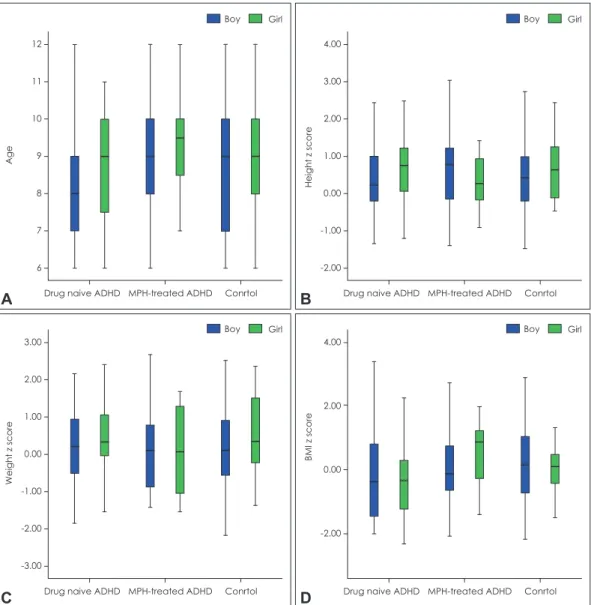
Fig. 1. Distribution (box plot) of (A) age, (B) height, (C) weight, and (D) BMI in study participants. Data expressed as minimum, 1st quar- tile, median, 3rd quartile, and maximum. Age was presented as years and height, weight, and BMI was presented as z-score. ADHD:

attention-deficit/hyperactivity disorder, BMI: body mass index, MPH: methylphenidate.

12 11 10 9 8 7 6

Age

MPH-treated ADHD Conrtol Drug naive ADHD

Boy Girl

A

3.00 2.00 1.00 0.00 -1.00 -2.00 -3.00

Weight z score

MPH-treated ADHD Conrtol Drug naive ADHD

Boy Girl

C

4.00 3.00 2.00 1.00 0.00 -1.00 -2.00

Height z score

MPH-treated ADHD Conrtol Drug naive ADHD

Boy Girl

B

4.00

2.00

0.00

-2.00

BMI z score

MPH-treated ADHD Conrtol Drug naive ADHD

Boy Girl
D

(4)

significance threshold was set at p<0.05.

RESULTS

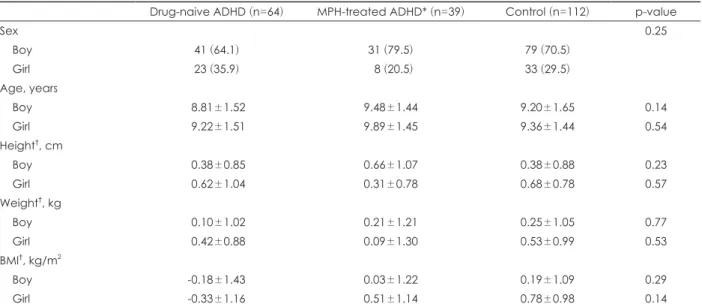
Demographic and anthropometric characteristics There was no significant difference in sex distribution and age of the study subjects among the different groups. The mean duration of drug treatment and mean dose of MPH in the MPH-treated ADHD group were 1.79±1.11 years and 1.02±0.39 mg/kg, respectively. Distributions of age and an- thropometric indices of the participants have been represent- ed in a box plot graph (Fig. 1). The z-scores of height, weight, and BMI of the boys and girls were not significantly different among the three groups (Table 1).

Biochemical markers of growth

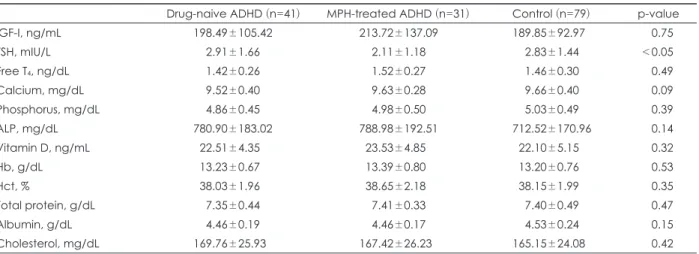
There were no significant differences in the mean IGF-I concentrations among the drug-naive ADHD, MPH-treated ADHD, and control groups for both boys and girls. The boys in the MPH-treated ADHD group had significantly lower (p<0.05) mean TSH concentrations, as compared to those in the drug-naive ADHD and control groups. No significant differences were found in the mean concentrations of free T

4

among the groups. The calcium, phosphorus, ALP, and vi- tamin D levels did not differ significantly among the drug- naive ADHD, MPH-treated ADHD, and control groups. There were no differences in the Hb, Hct, total protein, albumin, and total cholesterol levels among the drug-naive ADHD, MPH-treated ADHD, and control groups (Tables 2 and 3).

DISCUSSION

The present study investigated the association of MPH with the levels of serum biochemical markers of growth in children. The serum concentrations of IGF-I, free T

4

, calci- um, phosphorus, ALP, and vitamin D were not significantly different among the three groups and all the measurements were within the normal limits of laboratory values in the pres- ent study.

Few other studies have investigated the IGF levels in chil- dren with ADHD. Results of the present study correspond with an earlier study that reported no differences in the se- rum concentrations of IGF-I between MPH-treated children with ADHD and either drug-naive children with ADHD or healthy children [18]. In a longitudinal study in Turkey that monitored MPH-treated children with ADHD for 16 months, despite the drop in the serum concentrations of IGF-I at 4 months, the levels were found to be within normal limits at all times; the serum concentrations of IGF-I were found to recover later [19].

In contrast to the results of our study, a previous study found that children with ADHD had lower levels of vitamin D than the healthy control group [20]. Serum vitamin D sta- tus is affected by various conditions; lifestyle factors, such as outdoor activities are essential determinants of photosynthe- sis of vitamin D [21]. Also, a study that investigated vitamin D levels in Korean children revealed that serum vitamin D lev- els are associated with body weight and undergo seasonal variations [22]. Thus, various confounders may affect the se- rum levels of vitamin D. A limitation of our study is that we

Table 1. Demographic and anthropometric characteristics

Drug-naive ADHD (n=64) MPH-treated ADHD* (n=39) Control (n=112) p-value

Sex 0.25

Boy 41 (64.1) 31 (79.5) 79 (70.5)

Girl 23 (35.9) 8 (20.5) 33 (29.5)

Age, years

Boy 8.81±1.52 9.48±1.44 9.20±1.65 0.14

Girl 9.22±1.51 9.89±1.45 9.36±1.44 0.54

Height

, cm

Boy 0.38±0.85 0.66±1.07 0.38±0.88 0.23

Girl 0.62±1.04 0.31±0.78 0.68±0.78 0.57

Weight

, kg

Boy 0.10±1.02 0.21±1.21 0.25±1.05 0.77

Girl 0.42±0.88 0.09±1.30 0.53±0.99 0.53

BMI

, kg/m

2

Boy -0.18±1.43 0.03±1.22 0.19±1.09 0.29

Girl -0.33±1.16 0.51±1.14 0.78±0.98 0.14

Variables are presented as n (%) or mean±standard deviation. *mean duration of treatment: 1.79 (±1.11) years; mean MPH dose:

1.02 (±0.39) mg/kg,

age- and sex-corrected standard scores (z-scores). ADHD: attention-deficit/hyperactivity disorder, BMI: body

mass index, MPH: methylphenidate

(5)

did not account for these variables. Further studies need to be carried out to explore the association between vitamin D sta- tus and ADHD while accounting for potential confounders.

In the present study, the levels of TSH in MPH-treated boys were found to be lower than those in the other two groups.

However, the levels of TSH in the MPH-treated boys were within the normal range; thus, no clinical significance was presumed. No differences were notes in the levels of free T

4

between the three groups. A previous study has also report- ed no differences in the levels of thyroid hormones between MPH-treated children with ADHD and drug-naive children with ADHD or control subjects [19]. In case of boys, the in- tergroup differences in TSH levels can be interpreted in two ways. First, dopamine agonist is a physiological regulator of TSH. Activation of dopamine D2 receptor exerts its effect on the hypothalamic-pituitary-thyroid axis and suppresses se- rum TSH [23]. However, it has been reported that the serum concentrations of TSH remain within the normal range and

thus, the association of MPH with TSH is of limited clinical significance [19]. Second, depressed TSH status (e.g., hyper- thyroidism) could be associated with ADHD regardless of MPH treatment. A recent study reports an estimated preva- lence ratio of 1.7 for ADHD in those with and without hyper- thyroidism (2.4 in males and 1.9 in females) [24]. Given that there are a few common symptoms between hyperthyroid- ism and ADHD, such as hyperactivity or short attention span, there is a chance of misclassifying children with hyperthy- roidism as ADHD cases. Although children with acute and chronic physical conditions were excluded from our study, it is still possible that subjects with subclinical hyperthyroid- ism were included in our ADHD cases. In case of girls, no in- tergroup differences were observed in the TSH levels. Gen- erally, girls are more vulnerable to thyroid dysfunction than boys. It is possible that the small sample size of our study (es- pecially in case of MPH-treated ADHD girls, n=8) limited the power to detect group differences.

Table 2. Biochemical markers of growth of boys in the drug-naive ADHD, MPH-treated ADHD, and control groups

Drug-naive ADHD (n=41) MPH-treated ADHD (n=31) Control (n=79) p-value

IGF-I, ng/mL 198.49±105.42 213.72±137.09 189.85±92.97 0.75

TSH, mIU/L 2.91±1.66 2.11±1.18 2.83±1.44 <0.05

Free T

4

, ng/dL 1.42±0.26 1.52±0.27 1.46±0.30 0.49

Calcium, mg/dL 9.52±0.40 9.63±0.28 9.66±0.40 0.09

Phosphorus, mg/dL 4.86±0.45 4.98±0.50 5.03±0.49 0.39

ALP, mg/dL 780.90±183.02 788.98±192.51 712.52±170.96 0.14

Vitamin D, ng/mL 22.51±4.35 23.53±4.85 22.10±5.15 0.32

Hb, g/dL 13.23±0.67 13.39±0.80 13.20±0.76 0.53

Hct, % 38.03±1.96 38.65±2.18 38.15±1.99 0.35

Total protein, g/dL 7.35±0.44 7.41±0.33 7.40±0.49 0.47

Albumin, g/dL 4.46±0.19 4.46±0.17 4.53±0.24 0.15

Cholesterol, mg/dL 169.76±25.93 167.42±26.23 165.15±24.08 0.42

Variables are presented as mean±standard deviation. ADHD: attention-deficit/hyperactivity disorder, MPH: methylphenidate, IGF-I:

insulin-like growth factor I, TSH: thyroid stimulating hormone, ALP: alkaline phosphatase, Hb: hemoglobin, Hct: hematocrit Table 3. Biochemical markers of growth of girls in the drug-naive ADHD, MPH-treated ADHD, and control groups

Drug-naive ADHD (n=23) MPH-treated ADHD (n=8) Control (n=33) p-value

IGF-I, ng/mL 316.25±169.19 289.56±174.99 257.22±131.28 0.45

TSH, mIU/L 2.63±1.17 2.55±1.68 3.35±1.78 0.25

Free T

4

, ng/dL 1.36±0.23 1.49±0.17 1.39±0.22 0.21

Calcium, mg/dL 9.67±0.25 9.63±0.28 9.66±0.40 0.91

Phosphorus, mg/dL 5.11±0.56 4.83±0.63 5.02±0.39 0.55

ALP, mg/dL 869.04±123.69 733.38±143.04 884.09±197.79 0.09

Vitamin D, ng/mL 21.23±5.16 20.40±5.71 19.67±4.86 0.66

Hb, g/dL 12.83±0.83 13.13±0.83 13.09±0.98 0.72

Hct, % 38.09±2.11 37.75±2.38 38.27±2.76 0.80

Total protein, g/dL 7.42±0.34 7.28±0.32 7.35±0.37 0.33

Albumin, g/dL 4.47±0.16 4.40±0.21 4.49±0.19 0.35

Cholesterol, mg/dL 166.00±21.96 162.75±17.02 174.82±26.40 0.36

Variables are presented as mean±standard deviation. ADHD: attention-deficit/hyperactivity disorder, MPH: methylphenidate,

IGF-I: insulin-like growth factor I, TSH: thyroid stimulating hormone, ALP: alkaline phosphatase, Hb: hemoglobin, Hct: hematocrit

(6)

This study has the following limitations. First, the study had a cross-sectional design; a chronological relationship be- tween MPH treatment and growth of children with ADHD was not analyzed in this study. This did not allow us to eval- uate growth suppression or catch-up growth. It is well estab- lished that growth velocity and the levels of serum growth markers differ depending on age. Although we recruited study subjects aged between 6 and 12 years, we could not stratify the population further into different age groups because of the small sample size. Second, pubertal age, which could in- fluence anthropometric indices and serum growth factors (especially IGF-I), was not investigated in this study [25]. Fu- ture studies could include Tanner staging or bone age mea- surements, which are more accurate evaluations of physical development in children. Third, other major factors that in- fluence anthropometric indices and serum growth markers, such as individual nutritional status and physical activity could also be considered in the future studies. In our study, children with chronic physical conditions were excluded; however, we did not exclude psychiatric comorbidities such as depression, which could also suppress growth in children. Fourth, MPH dosage, serum concentrations, and compliance were not con- sidered, which did not allow for the identification of a dose- response in our study. In addition, the influence of other drugs used in conjunction with MPH was not considered. Fifth, a selection bias might exist in this study since the study partic- ipants were recruited from hospitals. These limitations make it difficult to confirm our results and to interpret their clini- cal significance.

CONCLUSION

To our knowledge, this is the first study that investigates the association of MPH with biochemical growth parame- ters in Korean children. The present study found lack of any association between MPH treatment and the levels of serum growth markers. The cross-sectional design of our study lim- its the generalization of our results. Several factors, such as individual growth velocity, pubertal stage, nutritional status, comorbidity, and long-term treatment with MPH, could af- fect the final growth of children; these factors were not in- vestigated in our study. Thus, our results cannot be applied in the clinical setting. Future prospective longitudinal stud- ies will be required to investigate the effects of MPH on bio- chemical markers of growth in children with ADHD.

Acknowledgments

This research was funded and supported by the Korea Food and Drug Administration (Grant No. 13162MFDS892).

Conflicts of Interest

The authors have no potential conflicts of interest to disclose.

Author Contributions

Conceptualization: Woo Jin Kim, Jae Ho Yoo, Jae Hong Park. Formal analysis: Young Rong Bang, Jae Hong Park. Investigation: Woo Jin Kim, Young Rong Bang, Je-Wook Kang, Jae Ho Yoo. Writing—original draft:

Woo Jin Kim. Writing—review & editing: Je-Wook Kang, Seong Hwan Kim.

ORCID iDs

Woo Jin Kim https://orcid.org/0000-0002-0920-2771 Young Rong Bang https://orcid.org/0000-0002-2803-6916 Je-Wook Kang https://orcid.org/0000-0003-4306-2503 Jae Ho Yoo https://orcid.org/0000-0003-3065-944X Seong Hwan Kim https://orcid.org/0000-0001-5707-5917 Jae Hong Park https://orcid.org/0000-0001-9710-4735

REFERENCES

1) Greenhill LL, Pliszka S, Dulcan MK, Bernet W, Arnold V, Beitch- man J, et al. Practice parameter for the use of stimulant medica- tions in the treatment of children, adolescents, and adults. J Am Acad Child Adolesc Psychiatry 2002;41(2 Suppl):26S-49S.

2) Lisska MC, Rivkees SA. Daily methylphenidate use slows the growth of children: a community based study. J Pediatr Endocrinol Metab 2003;16:711-718.

3) Swanson J, Greenhill L, Wigal T, Kollins S, Stehli A, Davies M, et al. Stimulant-related reductions of growth rates in the PATS. J Am Acad Child Adolesc Psychiatry 2006;45:1304-1313.

4) Kang KD, Yun SW, Chung U, Kim TH, Park JH, Park IH, et al. Ef- fects of methylphenidate on body index and physical fitness in Ko- rean children with attention deficit hyperactivity disorder. Hum Psy- chopharmacol 2016;31:76-82.

5) Spencer TJ, Faraone SV, Biederman J, Lerner M, Cooper KM, Zim- merman B; CONCERTA STUDY GROUP. Does prolonged thera- py with a long-acting stimulant suppress growth in children with ADHD? J Am Acad Child Adolesc Psychiatry 2006;45:527-537.

6) Ptacek R, Kuzelova H, Stefano GB, Raboch J, Kream RM, Goetz M.

ADHD and growth: questions still unanswered. Neuro Endocrinol Lett 2014;35:1-6.

7) Misra M, Pacaud D, Petryk A, Collett-Solberg PF, Kappy M; Drug and Therapeutics Committee of the Lawson Wilkins Pediatric En- docrine Society. Vitamin D deficiency in children and its manage- ment: review of current knowledge and recommendations. Pediat- rics 2008;122:398-417.

8) Allen LH. Nutritional influences on linear growth: a general review.

Eur J Clin Nutr 1994;48 Suppl 1:S75-S89.

9) Park JH, Seo JH, Hong YS, Kim YM, Kang JW, Yoo JH, et al. Blood lead concentrations and attention deficit hyperactivity disorder in Korean children: a hospital-based case control study. BMC Pediatr 2016;16:156.

10) American Psychiatric Association. Diagnostic and statistical manu- al of mental disorders. 4th ed. text revision (DSM-IV-TR). Wash- ington, DC: American Psychiatric Press;2000.

11) Kim YS, Cheon KA, Kim BN, Chang SA, Yoo HJ, Kim JW, et al.

The reliability and validity of Kiddie-Schedule for Affective Dis- orders and Schizophrenia-Present and Lifetime Version- Korean version (K-SADS-PL-K). Yonsei Med J 2004;45:81-89.

12) Kim JH, Yun S, Hwang SS, Shim JO, Chae HW, Lee YJ, et al. The 2017 Korean National Growth Charts for children and adolescents:

development, improvement, and prospects. Korean J Pediatr 2018;61:

135-149.

13) Growth Hormone Research Society. Consensus guidelines for the

(7)

diagnosis and treatment of growth hormone (GH) deficiency in childhood and adolescence: summary statement of the GH Re- search Society. J Clin Endocrinol Metab 2000;85:3990-3993.

14) Harvey CB, O’Shea PJ, Scott AJ, Robson H, Siebler T, Shalet SM, et al. Molecular mechanisms of thyroid hormone effects on bone growth and function. Mol Genet Metab 2002;75:17-30.

15) Shao YY, Wang L, Ballock RT. Thyroid hormone and the growth plate. Rev Endocr Metab Disord 2006;7:265-271.

16) Glorieux FH, Travers R, Taylor A, Bowen JR, Rauch F, Norman M, et al. Normative data for iliac bone histomorphometry in growing children. Bone 2000;26:103-109.

17) Clarke B. Normal bone anatomy and physiology. Clin J Am Soc Nephrol 2008;3 Suppl 3:S131-S139.

18) Toren P, Silbergeld A, Eldar S, Laor N, Wolmer L, Koren S, et al.

Lack of effect of methylphenidate on serum growth hormone (GH), GH-binding protein, and insulin-like growth factor I. Clin Neuro- pharmacol 1997;20:264-269.

19) Bereket A, Turan S, Karaman MG, Haklar G, Ozbay F, Yazgan MY.

Height, weight, IGF-I, IGFBP-3 and thyroid functions in prepuber-

tal children with attention deficit hyperactivity disorder: effect of methylphenidate treatment. Horm Res 2005;63:159-164.

20) Goksugur SB, Tufan AE, Semiz M, Gunes C, Bekdas M, Tosun M, et al. Vitamin D status in children with attention-deficit-hyperactiv- ity disorder. Pediatr Int 2014;56:515-519.

21) Holick MF, Chen TC, Lu Z, Sauter E. Vitamin D and skin physiol- ogy: a D-lightful story. J Bone Miner Res 2007;22 Suppl 2:V28- V33.

22) Chung IH, Kim HJ, Chung S, Yoo EG. Vitamin D deficiency in Ko- rean children: prevalence, risk factors, and the relationship with para- thyroid hormone levels. Ann Pediatr Endocrinol Metab 2014;19:86- 23) Haugen BR. Drugs that suppress TSH or cause central hypothy- 90.

roidism. Best Pract Res Clin Endocrinol Metab 2009;23:793-800.

24) Zader SJ, Williams E, Buryk MA. Mental health conditions and hy- perthyroidism. Pediatrics 2019;144:e20182874.

25) Soliman A, De Sanctis V, Elalaily R, Bedair S. Advances in pubertal growth and factors influencing it: can we increase pubertal growth?

Indian J Endocrinol Metab 2014;18(Suppl 1):S53-S62.

수치

Fig. 1. Distribution (box plot) of (A) age, (B) height, (C) weight, and (D) BMI in study participants
Table 1. Demographic and anthropometric characteristics
Table 2. Biochemical markers of growth of boys in the drug-naive ADHD, MPH-treated ADHD, and control groups

참조

관련 문서