Journal of the Korean Chemical Society 2011, Vol. 55, No. 5
Printed in the Republic of Korea
http://dx.doi.org/10.5012/jkcs.2011.55.5.896
-896-
단신
(Notes)
Effect of Modification of Granular Activated Carbon on Pb(II) Adsorption
Dae Ho Kim, Bo-Hye Kim†,*, Kap Seung Yang†,‡,*, Kwang Cheol Kang§, Yong-Kyun Lim§, and Wonng Eui Lee#
Department of Advanced Chemical Engineering, Chonnam National University, Gwangju 500-757, Korea.
*E-mail: [email protected], [email protected]
†Alan G. MacDiarmid Energy Institute, Chonnam National University, Gwangju 500-757, Korea
‡Department of Polymer & Fiber System Engineering, Chonnam National University, Gwangju 500-757, Korea
§Microfilter Co., Ltd, 162-1, Sansu, Deoksan, Jinchun, Chung-Buk 365-842, Korea
#Department of Phamacology& Cosmetology, Kwangju Women’s University, 506-713, Korea (Received September 2, 2011; Accepted September 7, 2011)
Key words: Granular activated carbon, Modification, Pb(II), Functional group
In these days, lead (Pb) contamination in water and wastewater, which discharged from many industries such as metal plating, mining and tanneries, is a serious prob- lem due to the poisoning on humans. Specially, the heavy metals of lead and mercury are considered to be most harmful to the environment.1 Their high toxicity and the more severe regulations of new environmental legislation have demanded the advanced technologies to treat water bodies or industrial effluents contaminated with the heavy metals.2,3 A number of techniques have been developed for removing lead pollutant from aqueous effluents to minimize its impact. Activated carbons (ACs) have been proven to be effective adsorbents for the removal of a wide variety of organic and inorganic pollutants. ACs are widely used to treat waters contaminated with heavy met- als because of their well developed porous structures, large surface area and a wide spectrum of surface func- tional. This capacity is mainly derived from (i) their porous texture, which gives them a large surface area, and (ii) their chemical nature, which can be appropriately modified by physical or chemical treatments to increase their adsorption capacity. The surface chemistry of ACs has a major influence on their capacity to adsorb inor- ganic compounds, especially metallic cations.4,5 The objective of the present work is to enhance the adsorption capacity of Pb ion from solution with NaOH-modified granular activated carbons (GACs). The changes of phys- icochemical properties of NaOH-modified GACs are investigated in terms of the change of surface and pore properties of ACs during modification.
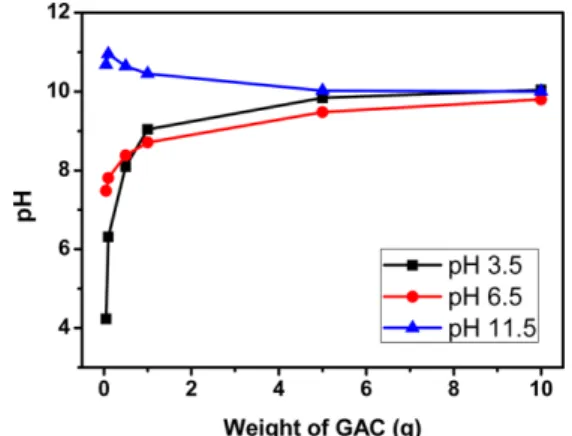
The mass titration result for GACs are shown in Fig. 1.
These graphs plot pH values as a function of the mass fraction of GACs in the solution. They also demonstrate that a plateau is found in the plot of pH versus mass frac- tion. It is noted that there are some deviations in the asymptotic values of the curves for different initial pH conditions. By measuring the mass titration, the chemical nature of the used GACs surface are basicity because the pH of point of zero charge (PZC) were around 10. There- fore the GACs will be modified by NaOH, which will enhance the adsorption process because of the greater attractive electrostatic interactions between the surface of the modified GACs and the Pb(II) species present at the pH of the experiments. It is clear that the nature of surface chemical functionalities is significantly altered by the NaOH treatment.
Fig. 2 shows the SEM micrographs of the pristine and NaOH-modified GACs. There are small cavities, cracks
Fig. 1. Variation of pH as a function of the weight of GACs.
2011, Vol. 55, No. 5
Effect of Modification of Granular Activated Carbon on Pb(II) Adsorption 897
and attached fine particles over the activated carbon sur- face, forming a system of complicated pore networks.
After modification, relatively regular pore structures, which are mesoporous and/or microporous, are found in Fig. 2(b-c).
The nitrogen adsorption-desoprtion isotherms of unmod- ified and modified GACs are shown in Fig. 3, and the porous structure of the GACs is summarized in Table 1.
According to BDDT (Brunauer-Deming-Deming-Teller) classification,6 the isotherms are of Type I, indicating that GACs are microporous materials. It is evident that most of the pore volumes of samples are filled below P/P0≈0.1, indicating that these samples are highly microporous.
However, the specific surface areas of GACs are decreased by the chemical modification. In this work, the isotherms and porosities of modified GACs assure that some of the pores were blocked by oxide functional groups intro- duced by the chemical treatment.7 The decrease of sur- face area was mainly ascribed to the decrease of the micropore volume.
Quantitative peak analyses were also carried out to determine the concentrations of the surface elements by XPS, which are showed in Fig. 4(a). It was found that the chemical composition of C and O of modified GACs increased with an increase concentration of NaOH. As a result, the NaOH treatment led to an increase of oxygen- containing polar functional groups and total acidity as Fig. 2. SEM images of as received (a) GAC; modified (b)
NaGAC1 (c) NaGAC2 (d) NaGAC3.
Fig. 3. Nitrogen adsorption-desorption isotherms of (a) GAC;
modified (b) NaGAC1 (c) NaGAC2 (d) NaGAC3.
Table 1. Pore characteristics of the used A-GACs SBETa
(m2/g)
Vtb
(cm3/g)
Vmc
(cm3/g) APDd GAC
NaGAC2 NaGAC3
1360.0 1327.4 1216.5
0.58 0.56 0.52
0.55 0.54 0.50
1.72 1.71 1.70
aSBET=BET surface area; bVt= Total pore volume, cVm= micropore volume by the t-method, dAverage pore diameter (nm)
Fig. 4. (a) Chemical compositions of unmodified and base-modified GACs and (b) Deconvolution of O1s of NaGAC3, measured from XPS analysis.
898 Dae Ho Kim, Bo-Hye Kim, Kap Seung Yang, Kwang Cheol Kang, Yong-Kyun Lim, and Wonng Eui Lee
Journal of the Korean Chemical Society
well. The deconvolution of the O1s XPS spectrum (Fig.
4b) revealed three Gaussian curves centered at 531.0, 532.0 and 533.1 eV, which can be assigned to COO-/O=C- O and C-OH/O=C and O=C-OH/R-O-R, respectively.8
Fig. 5 shows the effect of contact time on Pb(II) adsorp- tion onto GACs. Pb ion removal efficiency of GACs was almost completed within 2 min. the Pb(II) adsorption of modified GACs is superior to that of untreated GACs, due to the increased oxygen-containing functional groups, more adsorption sites are available, causing higher removal of Pb(II). This result is interesting because time to equi- librium is one of the parameters for economical waste- water treatment plant applications.
Meanwhile, the specific surface areas or micropore vol- umes were slightly decreased after the chemical treatment due to the micropore filling or blocking. Nevertheless, the total Pb(II) adsorption of modified GACs was increased with increasing of the NaOH concentration, attributed to the good interaction between Pb(II) ions and polar func- tional groups on the GACs. This indicates that the func- tional groups introduced by NaOH treatment improve the ion-exchange capabilities of the GACs and thus make Pd(II) adsorption capacities increase correspondingly (Fig. 6).
In conclusion, GACs are sensitive toward NaOH mod-
ification, which results in a decrease of pore volume/sur- face area and increase of functional groups. The decrease of surface area is mainly due to decreased micropore vol- ume resulting from pore blocking by surface oxide groups existing in some of the micropores. However, this treat- ment gives rise to a large increase in the amount of total acidity rise to a large increase in the amount of total acidity.
The total Pb(II) ions adsorption of GACs was increased with increasing of NaOH concentration for modification of GACs, attributed to the good interaction between Pb(II) ions and polar functional groups on the GACs.
EXPERIMENTAL
Materials and characterizations
The base adsorbent used in the study was commercially available GAC made from coconut shell (A-GAC), whose mesh size ranges 12*30. The surface morphology of the GAC were analyzed by Scanning electron micrograph (SEM) using the S-4700 (Hitachi, Tokyo, Japan) and sur- face area and pore size distributions for the sample were measured by the Brunauer-Emmett-Teller (BET) method using Micrometrics (ASPS2020, USA). The surface func- tional groups of the samples were characterized by a mono-chromatized Al Kα X-ray from X-ray photoelec- tron spectroscopy (XPS) (VG Scientific ESCALAB 250 Spectrometer). Inductively coupled plasma-atomic emis- sion spectroscopy (ICP) was used to analyze heavy metal absorption using OPTIMA 4300 DV (perkin elmer, USA).
Point of zero charge (PZC)9
To measure the PZC of the A-GAC sample, three dif- ferent initial pH solutions were prepared using 0.1 M HNO and 0.1 M NaOH; for example, pH=3.5, 6.5, and 11.5.
NaNO, was used as the background electrolyte. For each initial pH, six containers were filled with 100 ml of the solution, and different amounts of carbon sample were added (0.05%, 0.1%, 0.5%, l%, 5%, and 10% by weight).
The equilibrium pH was measured after 24 h.
Modification of GAC
The GACs were deposited in a three-necked flask, equipped with stirrer, condenser, dropping funnel and heating man- tle. The GACs (5 g) in 20 ml distilled water were treated with 1, 2, 3 N NaOH (5 g), respectively at 80oC for 1 h to increase the formation of functional groups and porosity.
The modified GACs were washed with deionized water and dried overnight at 80oC in vacuum oven to produce modified ACs such as NaGAC1, NaGAC2, and NaGAC3.
Fig. 5. Adsorption percentage of Pb(II) ions with respect to con- tact time.
Fig. 6. Possible mechanism of ion exchange between Pb(II) ion and carboxyl group on GACs.
2011, Vol. 55, No. 5
Effect of Modification of Granular Activated Carbon on Pb(II) Adsorption 899
Adsorption measurements
Adsorption isotherms of the Pb ion were carried out in batches as follow. Salts used were Pb(NO3)2 for Pb(II) with a high degree of purity. Experiments were carried out using 250 mL of Pb ion aqueous solution containing 10 mgl-1 concentration and a constant modified GACs, in 300 mL Teflon bath at 20±1.5oC. At a given intervals, sam- ples were filtered using 0.45µm cellulose acetate filters and the content of remaining Pb ion was analyzed every 2 min by using ICP.
Acknowledgements. This work supported by the Com- ponents and Materials Technology Development Pro- gram of Ministry of Knowledge Economy (MKE).
REFERENCES
1. International Program on Chemical Safety. Environmen-
tal Health Criteria; World Health Organization: Geneva, 1988.
2. Ramahlo, R. S. Tratamiento de Aguas Residuales; Edi- torial Reverte, S.A.: Barcelona, 1991.
3. M. Saanchez-Poloand, J. Ruvera-Utrilla, Environ. Sci.
Technol. 2002, 36, 3850.
4. Radovic, L. R.; Moreno Castilla, C.; Rivera Utrilla, J. Chem- istry and Physics of Carbon, Vol. 27; Marcel Dekker: New York, 2001; p 227.
5. Xiaolan Song, Hongyan Liu, Lei Cheng, Yixin Qu, Desalination 2010, 255, 78.
6. Brunauer, B.; Deming, L. S.; Deming, W. E.; Teller, E. J.
Am. Chem. Soc. 1940, 62, 1723.
7. Kutics, K.; Suzuki, M. Adsorption of organics on surface modified activated carbon fibers. 2nd Korea-Japan Sym- posium on Sep. Tech.; Seoul, South Korea, 1990; p. 395.
8. Shimoda, K.; Park, J.-S.; Hinoki, T.; Kohyama, A. Appl.
Surf. Sci. 2007, 253, 9450.
9. Noh, J. S., S. Carbon 1990, 28, 675.