Introduction
Bentonite is a material with high adsorption capacity of metals and low permeability (hydraulic conductivity).
The low permeability of the bentonite impedes or reduces the passage of liquid effluents through soil and its high capacity of adsorption immobilizes the metals contained in leachate (Tavani and Volzone, 1999).
Landfill liners installed beneath landfills generally are to prevent the uncontrolled release of leachate into the environment, but bentonite, commonly used for liner constructions, possesses many limitations (Gleason et al., 1997). Municipal landfill leachate contains high levels of metal species, including Cu, Zn, Cd and Pb generating competitive interactions between these metal species and the clay liner materials (Clement et al., 1997). However, leaching of heavy metal still occurs towards the groundwater at the existing municipal landfill disposal
practices, whether the liners are built of synthetic materials or of sand and bentonite mixtures (Lee, 2002;
Reinhart and McCreanor, 1999). Therefore, the requirements of the clay liner material are reduction of contaminant migration by convection and/or diffusion, high adsorption capacity, retardation of pollutants, resistance to chemicals and erosion, self-healing ability, flexibility, and proper swelling and shrinkage characteristics (Brandl, 1992).
Natural bentonite as used commercially falls into two main categories: One is called the swelling type or sodium bentonite (Na-bentonite, Na-B), which has single water layer particles containing Na
+as the exchangeable ion. The other has double water layer particles with Ca
++as the exchangeable ion. It is called calcareous (calcium) bentonite (Ca-bentonite, Ca-B)or non-swelling type. Na
+or Ca
2+can be exchanged by Mg
2+or Fe2
2+. Also the swelling mechanism of bentonite results from the unique microstructure and its net negative charge (Low 1987).
The sheet faces of montmorillonite species that acquire an overall negative charge through isomorphous substitution
Received : 22 January 2007 Accepted : 15 February 2007*Corresponding author: Phone : 82428216739, E-mail : [email protected]
Swelling Indexes and Relevant Removal of Cd and Pb of the Na-bentonite activated with Na
2CO
3and NaHCO
3Doug-Young Chung
1,
*Jae E. Yang
2, Taek-G. Oh
1, and Kyo-S. Lee
11
Department of Bioenvironmental Chemistry, College of Agricultural and Life Science, Chungnam National University, Daejeon 305-764, Korea
2
Division of Biological Environment, Kangwon National University, Chuncheon 200-701, Korea
In this experiment we transformed the Ca-bentonite into Na-bentonite with two inorganic Na-chemicals under different temperatures. These two Na-chemicals were selected among five different Na-chemicals which carries Na as cation. The swelling capacity of the Na chemical-treated bentonite was increased with increasing Na concentration, while the maximum concentration of Na solution decreased with increasing temperature.
Na
2CO
3was most effective in exchanging Ca ions and resulting in the highest swelling index among the Na- chemicals. The swelling index was significantly increased with increasing temperature to 100℃ ℃. But the equilibration time reversely affected the swelling index due to a rapid increase in evaporation of water.
Within same amount of Na treatment SI slightly decreased not only with increasing contacting time but also with increasing temperature. The adsorption for the transformed Na-bentonite was increased with increasing equilibrium concentrations of Pb and Cd ions for all the activated Na-B and indigenous Ca-B and Na-B while the adsorbability of Pb
2+onto each Na-B sample is more than that of Cd
2+. And the maximum adsorption capacity sequence of Na-B samples for Pb and Cd has been found to be 5 % Na
2CO
3.
¯ 5 % NaHCO
3> 3 % NaHCO
3> 3 % Na
2CO
3> 1 % NaHCO
3> 1 % Na
2CO
3> indigenous Na-B >
indigenous Ca-B, showing that there are contradictory results about the relationship of cation adsorption to CEC.
Key words : Swelling Indexes, Removal, Heavy metals, Na-bentonite, Activation
heavy metals. The ability of a sorption chemical barrier to adsorb heavy metals, as a means of improving landfill liner effectiveness for bentonite, is an important property with respect to the increasing contamination of aquatic environments and soils by toxic wastes (Hwang, 1980).
Compared to the Na-bentonite that is used as a landfill liner or other construction uses, Ca-bentonite most common in Korea is generally very poor in the montmorillonite mineral and carries a very low swelling capacity and relatively high permeability.
Due to ion exchange, the Ca-B is converted to an activated Na-B by addition of Na
2CO
3, and the Na-B is also converted to Ca-B by treatment with CaCl
2. It is possible to replace Ca ion at the interlayer with sodium ion by means of alkaline activation, converting Ca-B to Na-B; the latter has greater expansion properties and is better suited to various applications. Fahn (1973) found that different chemical analyses, X-ray diffraction patterns and surface properties were observed depending on the Na
2CO
3and CaCl
2treatments. In this experiment we observed the Removal with Ca-B and several Na-B activated by various concentration of Na-chemicals in order to investigate how types and its concentration of Na-chemicals influence the chemical properties of Ca-B to be used as a liner material.
Materials and Methods
In this experiment to investigate effective activation method for adsorption of heavy metals, one commercial Ca-B, produced at Kyoungjoo area in Korea and containing approximately 27 % of the montmorillonite mineral was used. This Ca-B was sieved through a 80 mesh sieve and dried at 105 ℃ for 48 hr before examination. A chemical analysis of the Ca-B is given in Table 1.
To observe swelling index for Na-activation by different rates of Na-chemicals under different curing temperature and time, Ca-B was throughly mixed with 1.
3. and 5 wt % of Na
2CO
3and NaHCO
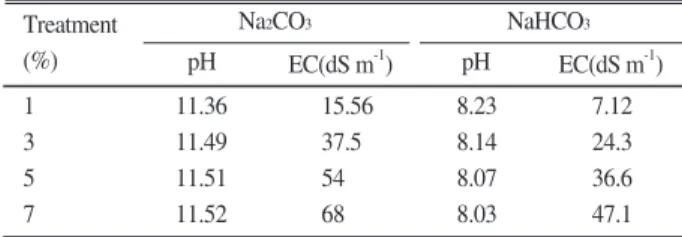
3using a Jar Tester (Vision 200, Korea) equipped with temperature adjustable hot plate for 15, 30, and 60 min under four temperature levels of 25, 50 75, and 100 ℃. pH and EC of the solution were measured (Table 1). The mixing rate of soil to solution for all treatments was 71g and 300g as of mass basis. Then the activated Na-B was dried and ground to pass a 80 mesh sieve for measurement of
index for all Na-Bs were analyzed (Table 2). To measure the swelling index (hereafter SI), 2.00 grams of each sample were slowly added to 100 mls of distilled water in a graduate cylinder and left it over 36hr. There was a 4-7 min interval between addition of the sample (Volzone et al., 2000). After 36hrs, we measured the size of the swelling of the sample of each graduated cylinder by taking a measure of the height. If the sample around the cylinder show several areas, the results were averaged.
In the adsorption experiment one Ca-B and three Na-Bs were examined. To do this, one gram in weight were weighed accurately and put into 50 ml conical tubes. 100 mL of salt solutions of nine levels ranging from 0 to 2.5 mmol L
-1were added to each of the samples. The clay- solution systems were throughly mixed with a spatula and then equilibrated in a reciprocal shaker for 48 hours by occasionally shaking at room temperature The suspensions were centrifuged, the supernatant liquid was separated, and heavy metals were determined using Atomic adosption spectrophotometer (Shimatsu 5600, Japan). The amounts of metal ions retained by the adsorbents were calculated by the difference between the initial and final (equilibrium) concentrations of ions in each solution.
Results and Discussion
Na-activation and swelling index The swelling indexes of Na-B converted from Ca-B treated with
Treatment (%) 1 3 5 7
11.36 11.49 11.51 11.52
8.23 8.14 8.07 8.03
7.12 24.3 36.6 47.1 15.56
37.5 54 68
EC(dS m-1) EC(dS m-1) pH
pH
Na2CO3 NaHCO3
Table 1. pH and EC of the solution dissolved with different amount of Na2CO3and NaHCO3.
Ca-bentonite Na-bentonite
pH (1:5) EC (dS m-1) CEC (cmol kg-1)
Swelling index (SI, mL 10g-1)
10.59 18.77 70.52 110.97
9.83 3.69 64.97 55.97 Table 2. Basic chemical properties of indigenous Na-bentonite and Ca-bentonite.
different rates of Na
2CO
3and NaHCO
3under the conditions of different curing time and temperature is illustrated in Table 3 and 4, respectively. Compared to typical chemical properties between indigenous and Na- activated bentonite, CEC of the activated Na-B is lower than those indigenous Na-B and Ca-B while both pH and EC of the activated Na-B are higher by than those of ones investigated in this study. And EC of the activated Na-B is much higher than sum of indigenous Ca-B (3.69 dS m
-1) and solution of Na
2CO
3(15.56 - 68 dS m
-1). But CEC of the activated Na-B is slightly lower than those of indigenous Ca-B and Na-B. Therefore, we assume that the slightly lower CEC of the activated Na-B than those of indigenous ones is influenced by high electrolytic concentration of the activated Na-B although pH is slightly higher. And pH and EC of the activated Na-B is decreased after swelling, showing addition of water dilutes the electrolytes in solution phase.
As shown in Table 2, the indigenous SIs for Na-B and Ca-B are 110 and 55, respectively. Activation of Ca-B by Na
2CO
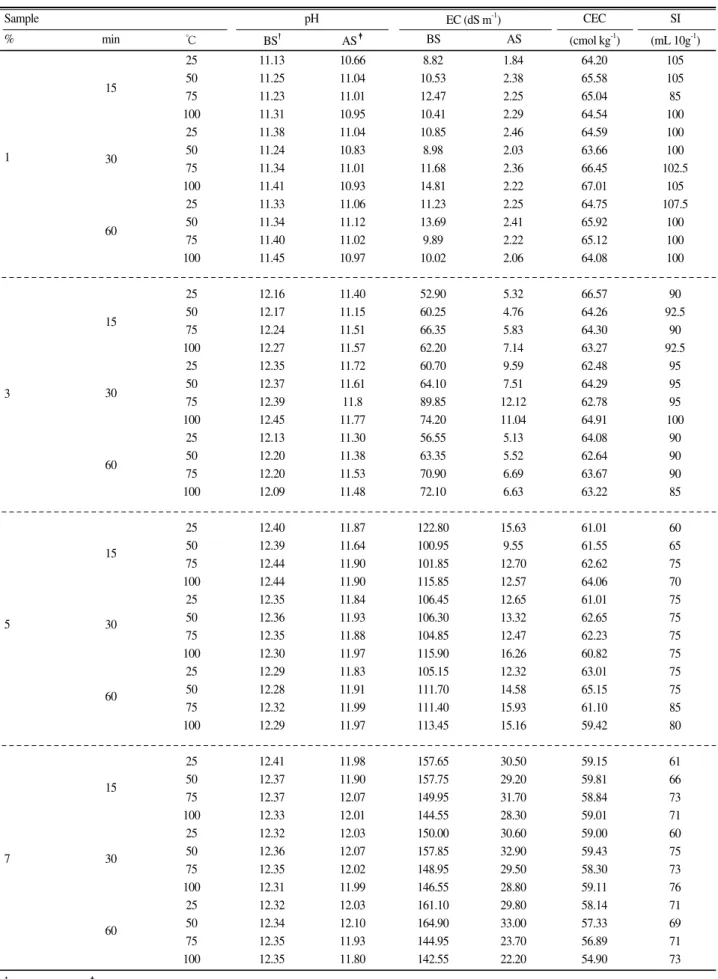
3treatment significantly increases SI of Ca-B. The SI ranges from 70 to 122.5 for 30 min mixing-75 ℃ in 7
% Na
2CO
3and 15 min. mixing-50 ℃ in 1 % Na
2CO
3, respectively, showing that increasing amount of Na
2CO
3reversely influences SI of Na-B converted from Ca-B.
Within the same amount of Na
2CO
3treatment SI slightly decreased not only with increasing contacting time but also with increasing temperature.
According to Norrish (1954), the swelling effect of montmorillonite results from additional embedding of water molecules into the thin layers. With the increase of the water content, the thickness of the water film increases. If the water is not pure, the presence of ions results in a decrease of the film thickness, which may be described by the electric double layer theory (Quirk, 1997). Therefore, we assumed that SI was significantly influenced by amount of Na which can be ionized in solution.
Similar results are obtained from NaHCO
3activation for Ca-B (Table 4). pH and EC of all NaHCO
3solutions are lower than those of Na
2CO
3.
SIs of the activated Na-B by NaHCO
3ranges from 60 to 107.5 for 30 min mixing-25℃ in 7 % Na
2CO
3and 60 min. mixing-25℃ in 1 % NaHCO
3respectively, showing that increasing amount of Na
2CO
3reversely influences swelling of Na-B converted from Ca-B as shown in Na
2CO
3. Compared to the SI of the activated Na-B by Na
2CO
3, all the SIs are slightly lower, as well as CEC.
Therefore, we can assume that the adsorption affinity of the activated Na-B by NaHCO
3can be changed.
We investigated removal of Cd and Pb by two types of activated Na-B treated with Na
2CO
3and NaHCO
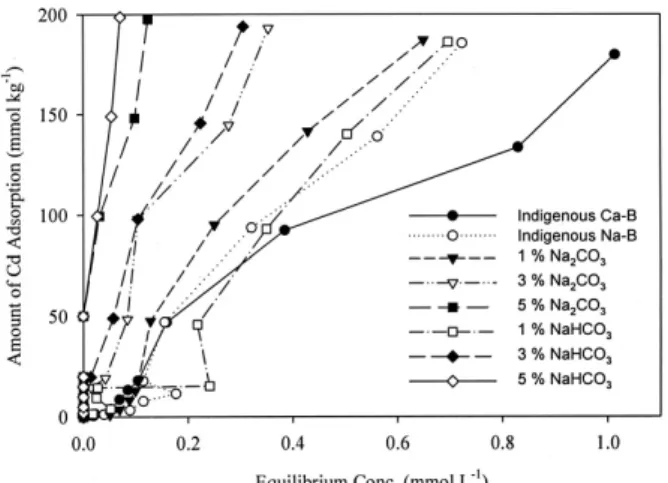
3. To do this, we selected the activated Na-B which has the highest CEC among the treatments. The adsorption was increased with increasing equilibrium concentrations of Pb and Cd for all the activated Na-B and indigenous Ca- B and Na-B while the adsorbability of Pb
2+onto each Na- B samples are more than that of Cd
2+. And the maximum adsorption capacity sequence of Na-B samples for Pb and Cd has been found to be 5 % Na
2CO
3. ≈ 5 % NaHCO
3>
3 % NaHCO
3> 3 % Na
2CO
3> 1 % NaHCO
3> 1 % Na
2CO
3> indigenous Na-B > indigenous Ca-B. The retention capacity of heavy metals by clay has been known to be positively correlated to the CEC. There are contradictory results about the adsorption of heavy metals to CEC in the experiment. Inel (1998) also found an inverse relation between CEC and cu and Pb fixation. In the sorption of Cu
2+ions by Ca-bentonite the majority of the adsorption sites are considered to be lattice OH groups located at crystal defects and edges (Puls and Bohn, 1988). However, the adsorption of heavy metals on montmorillonite cannot be explained in terms of simple ion exchange mechanism and CEC cannot be considered to be the sole predicting parameter. When considering the sorption of heavy metals on clay minerals, solution pH must be taken into account because precipitation may also occur, especially in the high pH range (Inel, 1998).
Conclusion
From this study, the following conclusions can be made: Swelling capacity for the activated Na-B is influenced by concentration and treatment methods such as mixing time and temperature. Removal of Pb and Cd ions were followed other cationic Removal. Cd
2+and Pb
2+retention capacities of the modified Na-B are inversely related to the CEC and surface area values of the clays. These data suggest that the adsorption of heavy metals on bentonitic clays cannot be explained in terms of simple ion-exchange mechanism, and surface area cannot be considered to be a parameter.
Acknowledge
This Study was supported by Technology Development
% (mL 10g-1) SI EC (dS m-1) CEC
pH Treatment
"
Before saturatio, ‡After saturation
(cmol kg-1) AS
AS‡ BS BS"
℃ 25 50 75 100
25 50 75 100
25 50 75 100
25 50 75 100
25 50 75 100
25 50 75 100
25 50 75 100
25 50 75 100
25 50 75 100
25 50 75 100
25 50 75 100
25 50 75 100
11.54 11.78 11.62 11.59 11.77 11.81 11.66 11.60 11.74 11.86 11.57 11.55
12.59 12.47 12.43 12.65 12.02 12.03 12.05 12.58 12.27 12.15 12.49 12.70
12.03 12.05 12.14 12.21 12.52 12.55 12.56 12.63 12.61 12.58 12.66 12.66
12.47 12.49 12.37 12.55 12.50 12.52 12.66 12.62 12.67 12.67 12.66 12.62
11.09 11.22 11.20 11.20 11.24 11.09 11.08 10.78 10.81 11.00 11.06 10.91
11.88 11.80 11.93 11.98 11.66 11.65 11.71 11.99 11.58 11.62 11.66 11.84
11.60 11.56 11.81 11.66 11.75 11.97 11.95 11.99 11.96 11.85 12.01 11.89
11.91 12.07 11.72 12.04 11.96 12.00 11.96 12.08 12.15 12.19 12.13 12.21
23.60 24.25 29.80 21.15 24.25 27.05 24.10 20.80 23.60 28.00 24.10 21.65
91.45 99.05 96.10 100.25 78.65 84.60 94.20 104.40 90.80 87.00 98.60 98.20
114.95 118.45 141.00 146.80 128.80 136.50 134.25 136.30 134.65 131.40 137.55 140.95
144.25 156.60 141.20 159.45 158.00 151.75 171.50 157.30 189.75 187.00 186.73 214.00
4.35 4.71 5.08 3.50 4.40 1.68 4.03 3.84 4.14 4.98 4.69 3.99
16.52 18.31 16.91 20.70 15.76 18.66 18.63 20.50 16.60 14.77 14.64 22.60
22.30 22.40 29.00 33.60 24.90 27.00 29.00 31.90 30.50 28.10 29.50 32.00
32.70 31.90 27.40 37.80 32.30 28.70 34.00 32.20 41.50 43.00 39.40 56.40
65.89 65.89 62.97 64.86 64.40 65.47 64.13 68.17 64.38 65.80 66.15 65.46
67.19 63.00 65.22 65.25 60.72 59.93 61.58 65.66 64.29 61.41 62.29 66.80
61.62 58.39 67.91 58.94 56.72 57.88 60.37 62.01 62.82 60.75 62.75 62.10
57.38 61.87 59.41 58.33 57.29 58.23 59.62 60.47 59.48 55.07 56.70 55.41
115 122.5
115 115 116 117.5
110 110 115 120 110 100
100 100 95 105
88 77.5 86.5 91 95 80 87.5 100
85 80 80 80 90 90 90 90 90 85 80 90
80 85 80 80 86 84.5
70 74 95 94.5
85 88 min
15
1
3
5
7
30
60
15
30
60
15
30
60
15
30
60 to 100℃℃.
% (mL 10g-1) SI EC (dS m-1) CEC
pH Sample
"
Before saturatio, ‡After saturation
(cmol kg-1) AS
AS‡ BS BS"
℃ 25 50 75 100
25 50 75 100
25 50 75 100
25 50 75 100
25 50 75 100
25 50 75 100
25 50 75 100
25 50 75 100
25 50 75 100
25 50 75 100
25 50 75 100
25 50 75 100
11.13 11.25 11.23 11.31 11.38 11.24 11.34 11.41 11.33 11.34 11.40 11.45
12.16 12.17 12.24 12.27 12.35 12.37 12.39 12.45 12.13 12.20 12.20 12.09
12.40 12.39 12.44 12.44 12.35 12.36 12.35 12.30 12.29 12.28 12.32 12.29
12.41 12.37 12.37 12.33 12.32 12.36 12.35 12.31 12.32 12.34 12.35 12.35
10.66 11.04 11.01 10.95 11.04 10.83 11.01 10.93 11.06 11.12 11.02 10.97
11.40 11.15 11.51 11.57 11.72 11.61 11.8 11.77 11.30 11.38 11.53 11.48
11.87 11.64 11.90 11.90 11.84 11.93 11.88 11.97 11.83 11.91 11.99 11.97
11.98 11.90 12.07 12.01 12.03 12.07 12.02 11.99 12.03 12.10 11.93 11.80
8.82 10.53 12.47 10.41 10.85 8.98 11.68 14.81 11.23 13.69 9.89 10.02
52.90 60.25 66.35 62.20 60.70 64.10 89.85 74.20 56.55 63.35 70.90 72.10
122.80 100.95 101.85 115.85 106.45 106.30 104.85 115.90 105.15 111.70 111.40 113.45
157.65 157.75 149.95 144.55 150.00 157.85 148.95 146.55 161.10 164.90 144.95 142.55
1.84 2.38 2.25 2.29 2.46 2.03 2.36 2.22 2.25 2.41 2.22 2.06
5.32 4.76 5.83 7.14 9.59 7.51 12.12 11.04 5.13 5.52 6.69 6.63
15.63 9.55 12.70 12.57 12.65 13.32 12.47 16.26 12.32 14.58 15.93 15.16
30.50 29.20 31.70 28.30 30.60 32.90 29.50 28.80 29.80 33.00 23.70 22.20
64.20 65.58 65.04 64.54 64.59 63.66 66.45 67.01 64.75 65.92 65.12 64.08
66.57 64.26 64.30 63.27 62.48 64.29 62.78 64.91 64.08 62.64 63.67 63.22
61.01 61.55 62.62 64.06 61.01 62.65 62.23 60.82 63.01 65.15 61.10 59.42
59.15 59.81 58.84 59.01 59.00 59.43 58.30 59.11 58.14 57.33 56.89 54.90
105 105 85 100 100 100 102.5
105 107.5
100 100 100
90 92.5
90 92.5
95 95 95 100
90 90 90 85
60 65 75 70 75 75 75 75 75 75 85 80
61 66 73 71 60 75 73 76 71 69 71 73 min
15
1
3
5
7
30
60
15
30
60
15
30
60
15
30
60
Table 4. pH, EC, and swelling index of Na-B with different amount of NaHCO3under various mixing time and temperatures from 25 to 100℃℃.
Program (2004155-3) for Agriculture and Forestry, Ministry of Agriculture and Forestry, Republic of Korea
References
Clement, B., Janssen, C.R., Le Du-Delepierre, A. 1997. Estimation of the Hazard of Landfills Through Toxicity Testing of Leachates:
2. Comparison of Physio-Chemical Characteristics of Landfill Leachates with their Toxicity Determined with a Battery of Tests.
Chemosphere 35: 2783-2796.
Brandl, H, 1992, "Mineral Liners for Hazardous Waste Containment," Geotechnique, Vol. 42, pp. 57-65.
Fahn, R. 1973. Fette Seifen Anstsrichm., 75:77-82.
Gleason, M. N, Daneel, DE, and Eykholt, GR, 1997, "Calcium and Sodium Bentonite for Hydraulic Containment Application,"
ASCE. Journal of Geotechnical and Geoenvironmental Engineering, Vol. 123, pp. 438-445.
Huang, P.M. 1980. The Handbook of Env. Chem. Vol. 2. Academic
Press.
Tavani, E. L., and C. Volzone. 1999. Adsorption of sulphuric acid on smectite from acidic aqueous solutions. Cerâmica vol.45 n.295 Lee, G.F. 2002. Solid waste management: USA lined landfill
reliability. Natural Resources Forum, 25(4).
Low, P.F. 1987. Structural component of the swelling pressure of clays. Langmuir, 3: pp.18-25.
Quirk, J.P. 1997. Application of double-layer theories to the extensive crystalline swelling of Limontmorillonite. Langmuir, 13:pp.6241-6248.
Reinhart, D., and McCreanor, P. 1999. Implications of time/space variable leachate head on liner leakage . College of Engineering, University of Central Florida, Orlando, Fla.
Volzone, C., J.O. Rinaldi, and J. Ortiga. 2000. Swelling of tetramethylammonium-and hexade cylpyridinium- Montmorillonites in Water and Toluene Media: Influence of the Type Montmorillonites. Materials Research, Vol. 3(4). 115-118.
Fig. 1. Removal of Cd ion on the activated Na-B with various amount of Na2CO3and NaHCO3and indigenous Ca-B and Na-B.
Fig. 2. Removal of Pb ion on the activated Na-B with various amount of Na2CO3 and NaHCO3and indigenous Ca-B and Na-B.
본 실험은 서로 다른 온도조건하에서 두 가지 Na 화합물을 이용하여 Ca-벤토나이트를 Na-벤토나이트 전환하 였다. 두 가지 Na 화합물은 양이온 원으로 Na를 가지고 있는 5가지 화합물 중에서 선택하였다. 전환된 Na-벤 토나이트의 팽창능은 Na의 농도가 높아질수록 증가하였으며 반면 온도가 증가할수록 최대 Na 농도는 감소하 는 경향을 보였다. Na2CO3 은 조사된 Na-화합물 중에서 최대 팽창능을 보여주었으며 팽창지수는 처리온도가 최대 100 에 도달할 때까지 최고로 증가하였다. 동일 Na 처리농도에서는 팽창지수는 체류시간이 증가하거나 온도가 높아질 때 다소 감소하였다. 전환된 Na-벤토나이트의 흡착은 조사된 Pb나 Cd의 평형농도가 증가함에 따라 증가하는 경향을 보였으며 Pb의 흡착량이 Cd보다 다소 높은 것으로 조사되었다. 그리고 전환된 Na-벤토 나이트에 Pb와 Cd의 흡착은 5 % Na2CO3. 5 % NaHCO3 > 3 % NaHCO3 > 3 % Na2CO3 > 1 % NaHCO3 >
1 % Na2CO3 > 원형 Na-B > 원형 Ca-B. 그러나 이러한 결과는 CEC에 따른 흡착의 결과와는 다소 상반되는 결과를 보여주고 있다.
Na
2CO
3와 NaHCO
3로 활성화한 Na-벤토나이트의 팽창특성과 Cd와 Pb의 상대적 등온흡착곡선
정덕영1,*·양재의2·오택근1·이교석1
1충남대학교 생물환경화학, 2강원대학교 자원생물환경학과