Vol. 17, No. 11 pp. 701-707, 2016
해양생태독성평가를 위한 열대 요각류 Nitocra sp.의 이용 가능성
이균우*, 최영웅
한국해양과학기술원
The availability of tropical copepod Nitocra sp. for marine ecotoxicological evaluation
Kyun-Woo Lee
*, Young-Ung Choi
Marine Life & Ecosystem Division, Korea Institute of Ocean Science & Technology
요 약 열대지역과 같은 특정지역에서 오염물질의 독성평가 시, 그 지역의 생태환경에 적합한 위해성평가를 위해서는 그 지방 고유의 생물에 대한 독성실험이 요구된다. 따라서 본 연구는 열대에서 분리한 열대 요각류 Nitocra sp.를 독성실험생물 로 사용하기 위해 이들을 안정적으로 배양/유지하기 위한 최적배양환경조건과 해양생태독성평가 가능성을 조사하였다. 최적 배양환경요인으로 수온, 염분 및 먹이에 대해 조사하였으며 생태독성평가는 급성독성과 만성독성 실험으로 나누어 실시하였 다. 최적배양조건 실험데이터의 통계분석을 위해 One-way ANOVA test를 실시하였다. 최적배양환경조건을 조사한 결과, Nitocra sp.는 수온 29℃, 염분 24∼34‰에서 먹이로 Tetraselmis suecica를 공급하였을 때, 비교적 빠른 발달기간과 높은 생존 율을 보였다. 최적배양조건을 바탕으로 구리와 비소에 대한 독성평가를 실시한 결과, 구리와 비소의 각 노출농도에 따라 민감 하게 잘 반응해서 반수치사농도 즉 LC50값과 영향을 미치지 않는 농도인 NOEC값을 얻을 수 있었다. 만성독성시험 결과, 구리와 비소노출 모두, 성비와 생산력은 유의적인 차이가 없었던 반면, 발달기간과 생존율은 농도에 따라 반응을 보였기 때문 에 종말점으로 사용이 가능한 것으로 나타났다. 본 연구를 종합해 보았을 때, 열대 요각류인 Nitocra sp.는 열대 해양독성물질 평가를 위한 생태독성실험생물로 사용이 가능할 것으로 판단되며 차후 다양한 독성물질의 평가에 활용이 기대된다.
Abstract Indigenous species are needed for more accurate toxicity assessments in tropical regions. Thus, we determined not only the optimum culture conditions for stable maintenance of Nitocra sp. isolated from tropical regions but also the availability of copepods for marine ecotoxicological evaluation. Experiments on temperature, salinity, and diet as factors for optimum culture conditions as well as acute and chronic toxicity tests for ecotoxicological assessment were carried out. Data on optimum culture conditions were analyzed for statistically significant observations using one-way analysis of variance (ANOVA). Optimum temperature and salinity for Nitocra sp. were 29℃ and 24∼39‰, and Nitocra sp. fed Tetraselmis suecica had relatively faster development and higher survival than other microalga. Under optimum culture conditions, toxicity tests were carried out. The LC50 level and NOEC (no observed effect concentration) levels of copper and arsenic were calculated in the acute toxicity test. In the chronic test of Cu and As, developmental time and survival traits were usable endpoints for toxicity assessments.
As a result, tropical copepod Nitocra sp. seems to be a potential candidate organism for marine ecotoxicological evaluation.
Keywords : Tropical, Copepod, Nitocra sp., Ecotoxicological evaluation, Endpoint
본 논문은 한국해양과학기술원 연구과제(PE99243, PO01285)로 수행되었음.
*Corresponding Author : Kyun-Woo Lee(Korea Institute of Ocean Science & Technology) Tel: +82-31-400-7827 email: [email protected]
Received October 4, 2016 Accepted November 10, 2016
Revised October 31, 2016 Published November 30, 2016
1. 서론
과학과 산업의 발달에 따라 해양오염은 전 세계에서 광범위하게 발생하고 있으며 극지나 열대해역과 같은 청 정해역도 인간의 활동 증가로 인한 오염정도가 증가하여 세계적 걱정거리가 되고 있다. 특히, 열대 산호초 지역은 전 해양에서 가장 높은 생물 다양성과 생산성을 가지며 일부 선진국에서는 열대해역의 중요성을 인식하고 해양 생물과 기후변동 연구를 진행 중에 있다[1-2]. 생활폐수, 플라스틱, 농약, 중금속, 기름 또는 화학물질 누출사고 및 대기를 통해 이동하는 잔류유기오염물질 (POPs) 등 은 열대 해양오염의 원인이 되며 이들은 열대 해양생물 에 직/간접적으로 악영향을 미친다. 특히, 대부분의 열대 해양은 빈영양 환경에 의한 제한적인 분해 미생물군의 서식으로 다른 해역보다 오염에 더 민감한 것으로 알려 져 있다[1]. 따라서 열대 해양생태계는 전 지구적으로 보 호되어야할 필요성이 있으며 열대 해양오염에 대한 지속 적인 모니터링과 생물영향평가는 반드시 필요하다.
해양에는 다양한 요각류가 서식하며 이들은 대부분 1 차 소비자로서 생산자와 소비자사이의 에너지흐름을 연 결해 주는 핵심적인 역할을 수행한다. 또한 이들은 짧은 생활사를 가지고 취급이 쉽기 때문에 지속적이고 일정한 배양/유지를 통해 필요시에 즉시 안정적으로 사용할 수 있을 뿐 아니라 작은 크기는 오염물질의 독성평가시 사 용되는 독성물질의 양을 최소화할 수 있는 장점이 있어 다양한 기관에서 독성실험생물로 개발하기 위한 계속적 인 노력이 진행되고 있다 [4-7]. 특정지역에서 오염물질 의 독성평가 시, 그 지역의 생태환경에 적합한 위해성평 가를 위해서는 그 지방 고유의 생물에 대한 독성실험이 요구된다. 예를 들어, 같은 종일지라도 온대지역과 열대 지역에 서식하는 생물의 특정 독성에 대한 민감성은 확 연히 다르게 나타난다[2, 8-12]. 이러한 차이에도 불구하 고 현재까지 열대역 생태독성실험을 위해 개발된 시험생 물은 온대생물에 비해 매우 한정적이며[8], 국내에서는 아직까지 열대시험생물에 대한 연구가 시도된 바 없다.
현재 우리나라의 한국해양과학기술원은 극지와 열대국 가에 연구기지를 운영하고 있고 이는 국가경제영토의 확 대와 생물자원부국실현이라는 측면에서 그 가치가 계속 적으로 증가되고 있어 열대시험생물개발에 대한 당위성 을 부여할 수 있다. 따라서 본 연구는 열대해양생태독성 평가를 위한 독성실험생물의 개발을 위해, 열대역에서
요각류인 Nitocra sp.를 분리한 다음 최적배양환경을 조 사하였으며, 표준독성물질인 구리와 비소에 노출하여 독 성평가가능성을 조사하였다.
2. 재료 및 방법
2.1 요각류의 채집 및 동정
열대 요각류 Nitocra sp.는 마이크로네시아 Chuuk주 Weno섬 인근 rock pool (7°24'40.3"N; 151°52'27.1"E) 에서 채집하였다. 채집지역의 염분, 수온, pH 및 DO는 각각 37‰, 36.6℃, 8.43 및 12.05 mg/L였다. 채집된 요 각류는 해부현미경하에서 isolation되었고 수온 29±1℃, 염분 33 ‰에서 먹이로 식물플랑크톤인 Tetraselmis suecica와 Isochrysis galbana를 공급하면서 2014년 4월 부터 현재까지 한국해양과학기술원에서 배양/유지되고 있다. 식물플랑크톤은 Lee and Choi[13-15]의 방법에 따 라 배양되었다. 요각류의 DNA동정을 위해 18s rDNA 유전자를 사용하였으며 밝혀진 염기서열은 GenBank Database (http://www.ncbi. nlm.nih.gov/BLAST/)를 통 하여 동정하였다.
2.2 Nitocra sp.의 최적 배양환경조건규명 Nitocra sp.의 안정적인 배양을 위해 이들의 최적배양 조건을 조사하였다. 염분(24, 29, 34, 39 및 44‰), 수온 (25, 29, 33, 37 및 41℃) 및 먹이(Tetraselmis suecica, Isochrysis galbana, Nannochloropsis sp., Rhodomonas sp. 및 Chaetoceros simplex)에 따른 Nitocra sp.의 발달 기간 및 생존률을 조사하였다. 12 well culture plate (배 양수 2 mL)에 갓 부화한 nauplius를 접종하여 1일 간격 으로 발달단계를 관찰하였다. 수온별 실험을 위해 설정 온도가 일정하게 유지되는 multi-thermo 배양기 (비젼과 학, VS-1203P9)를 사용하였으며, 염분별 실험은 증류수 및 증발법을 사용하여 각각의 설정염분으로 조정한 후 29℃로 유지되는 배양기(대한과학, SIR-250) 내에서 실 시하였다. 모든 실험에서 먹이는 각 well 당 약 4 μg (건 중량) 되도록 유지하였으며, 실험기간 동안 환수는 실시 하지 않았다.
2.3 생태독성평가를 위한 endpoint 조사 및 생태독성평가 적용
2.3.1 급성독성시험
Nitocra sp.를 이용한 급성독성시험을 위한 표준독성 물질로 구리 (CuSO4 5H2O, Sigma, USA, > 99% pure) 와 비소 (sodium m-arsenite (NaAsO2, Sigma, USA, 94% pure)를 사용하였다. 실험 요각류로 24 h이 지나지 않은 성체 암컷을 사용하였고 12 well culture plate (Nunc, Inc., USA; working volume, 4mL)에 각 hole당 10 마리를 수용하여 34‰, 29℃에서 48 h 동안 폐사율을 조사하였다. 각 중금속의 처리농도는 Cu는 0, 0.032, 0.063, 0.13, 0.25, 0.5, 1 mg/L, As는 0, 0.32, 0.63, 1.25, 2.5, 5.0 mg/L으로 설정하였다. Nitocra sp.의 폐사 율은 입체현미경 하에서 1분 이상 움직임이 없는 개체를 계수하여 계산하였다. 모든 실험은 3반복 실시하였다.
실험결과는 probit 분석법에 의해 LC10 및 LC50값을 얻 었고 Dunnett's test에 의해 NOEC (no oberved effect concentration)를 계산하였다.
2.3.2 만성독성시험
Nitocra sp.의 개체발생기간과 성체까지의 생존율, 성 비 및 생산력 조사를 위한 실험으로 Lee et al. (2008)의 방법[16]에 근거하여, 부화 후 24시간이 지나지 않은 Nitocra sp.의 nauplius (N1∼N2기)를 일정농도의 각 배 양수 4 mL가 담겨있는 12 wells tissue culture plate에 각각 10 마리를 넣고 20℃, 32 psu에서 광주기 12L:12D 하에서 먹이로 Tetraselmis suecica (10,000 cells/mL)를 1일 1회 공급하여 배양하였다. 배양수는 1일 1회 환수하 였으며 nauplius기는 ∼50%, copepodite 변태이후는 ∼ 100% 환수를 실시하였다. Nauplius기부터 copepodite기 와 성체 (암컷의 포란시기)까지의 개체발생기간 (N-C 및 N-A) 과 성숙 후 이들의 생존율 및 성비를 스테레오현 미경하에서 관찰 후 기록하였다. 다시 포란한 암컷개체 를 1 마리씩 분리하여 12 wells tissue culture plate에 넣 고 위와 같은 환경조건에서 성체암컷의 첫 번째 nauplius 생산수 (fecundity)를 조사하였다. Fecundity는 부화한 nauplius를 성체암컷과 분리한 다음 현미경하에 서 계수하는 방법으로 측정하였다. 모든 실험은 3반복 실시하였다.
Isolation of Nitocrasp.
Investigation of endpoint for toxicity tests (Cu and As)
Investigation of optimum culture conditions for the copepod
Temperature Salinity Diet
chronic toxicity test Acute
toxicity test
Availability of Nitocrasp.
for ecotoxicological evaluation Fig. 1. Schematic diagram of this study
2.4 데이터 분석
최적배양조건 실험에서 염분, 수온 및 먹이에 따른 Nitocra sp.의 발달기간과 생존결과의 통계분석을 위해 One-way ANOVA test를 실시하였으며, 처리평균간의 유의성(P<0.05)은 Duncan의 다중검정법(Duncan's multiple range test)으로 분석하였다. 모든 통계 분석은 SPSS Version 17.0(SPSS Inc, Chicago, IL, USA)을 사 용하여 실시하였다.
3. 실험결과
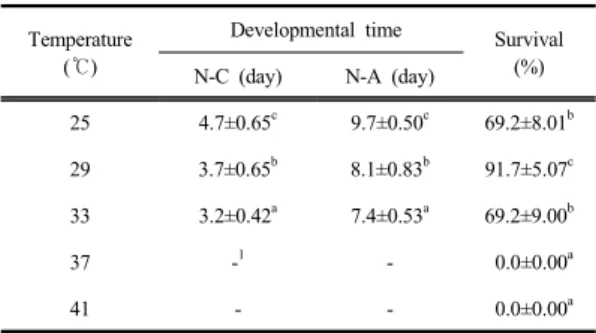
3.1 Nitocra sp.의 최적 배양환경조건규명 Nitocra sp.의 배양을 위한 최적수온 조사 결과, 수온 이 높을수록 빠른 발달기간을 보였으나 37℃ 이상에서 는 생존하지 못하고 폐사하였다. 생존율은 29℃ 실험구 에서 91.7%로 가장 높게 나타났으며(P<0.05), 25℃와 33℃는 유의적인 차이를 보이지 않았다(P>0.05; Table 1).
염분실험결과, nauplius에서 copopodite까지의 발달 기간(N-C)은 29‰에서 가장 빠른 발달을 보였고 가장 느린 발달을 보인 44‰ 실험구와 통계적인 차이를 보였 다. nauplius에서 성체까지 발달기간(N-A)도 N-C와 비 슷한 경향을 보였으나 모든 실험구간에서 유의적인 차이 는 나타나지 않았다(P>0.05). 생존율은 44‰에서 30.8%
로 다른 실험구에 비해 가장 낮았고(P<0.05), 다른 실험 구는 모두 유의적인 차이를 보이지 않았다(P>0.05;
Table 2).
Table 1. The developmental phase and survival of Nitocra sp. cultured with Tetraselmis suecica at the different temperatures*
Temperature (℃)
Developmental time Survival N-C (day) N-A (day) (%)
25 4.7±0.65c 9.7±0.50c 69.2±8.01b
29 3.7±0.65b 8.1±0.83b 91.7±5.07c
33 3.2±0.42a 7.4±0.53a 69.2±9.00b
37 -1 - 0.0±0.00a
41 - - 0.0±0.00a
1not available
N, nauplius; C, copepodite; A, adult.
*Values (mean±S.D) in the same column not sharing a common superscript are significantly different (P<0.05).
Table 2. The developmental phase and survival of Nitocra sp. cultured with Tetraselmis suecica at the different salinities*
Salinity (‰)
Developmental time
Survival (%) N-C (day) N-A (day)
24 3.9±1.06ab 7.6±1.19a 53.3±4.51b 29 3.4±0.79a 7.4±0.52a 66.7±5.25b 34 3.5±1.13ab 7.9±1.45a 69.2±7.60b 39 4.0±1.54ab 8.0±1.22a 69.2±15.28b 44 4.5±1.27b 8.5±1.29a 30.8±10.10a
N, nauplius; C, copepodite; A, adult.
*Values (mean±S.D) in the same column not sharing a common superscript are significantly different (P<0.05).
Table 3. The developmental phase and survival of Nitocra sp. cultured with different alga at 2 9℃, 34‰ salinity.
Alga Developmental time
Survival (%) N-C (day) N-A (day)
Tetraselmis suecica 4.2±0.10a 8.7±0.21a 80.0±10.00d Isochrysis galbana 5.1±0.20b 9.1±0.36b 53.3±11.55bc
Nannochloropsis sp. - - 0.0±0.00a
Rhodomonas sp. 4.9±0.35b 9.6±0.15c 43.3±11.54b Chaetoceros simplex 4.8±0.20b 9.5±0.06bc 63.3±5.77c
1not available
N, nauplius; C, copepodite; A, adult.
*Values (mean±S.D) in the same column not sharing a common superscript are significantly different (P<0.05).
Nitocra sp.의 배양을 위한 최적먹이조사결과, nauplius에서 copopodite까지의 발달기간은 T. suecica 를 공급한 실험구가 다른 실험구에 비해 가장 빠른 것으 로 나타났으며(P<0.05), Nannochloropsis sp.를 제외한 다른 실험구는 통계적 차이를 보이지 않았다(P>0.05).
성체까지 발달기간은 T. suecica를 공급한 실험구가 8.7 일로 가장 빨랐으며 Rhodomonas sp. 공급구는 9.6일로 다른 실험구에 비해 유의적으로 느린 것으로 나타났다 (P<0.05). Nannochloropsis sp.를 공급한 실험구는 copepodite기까지 발달하지 못하고 폐사하였다(Table 3).
3.2 Nitocra sp.를 이용한 독성시험
표준독성물질로 구리와 비소를 사용하여, 성체암컷과 갓 부화한 유생을 대상으로 급성독성평가를 실시한 결 과, 무영향관찰농도(NOEC)는 구리에 대해 0.13-0.32 mg/L, 비소에 대해 1.25-2.5 mg/L으로 나타났으며, nauplius와 성체암컷 모두, 구리에 노출시, 반수치사농도 (LC50)가 각각 0.46 mg/L와 0.96 mg/L로 비소노출시 (nauplius: 4.58 mg/L, 성체 : 6.43 mg/L)보다 낮게 나타 나 구리의 급성독성이 강한 것으로 나타났다. 또한 전체 적으로 nauplius가 성체암컷보다 약 2배정도 민감한 것 으로 나타났다(Table 4).
만성독성실험 결과, 구리노출 시, 0.13 mg/L에 노출 된 실험구의 Nitocra sp.의 성숙기간(N-A)은 대조구에 비해 유의적으로 빠르게 나타났으며(P<0.01), 최고 노출 농도인 0.25 mg/L의 농도에서는 nauplius 기간 (N-C)과 N-A 모두 대조구에 비해 유의적으로 길게 나타났다 (P<0.001). 생존율은 0.25 mg/L 실험구가 50%로 가장 낮게 나타났으며(P<0.01) 0.25 mg/L보다 낮은 농도에서 는 대조구와 유의한 차이를 보이지 않았다(P>0.05; Fig.
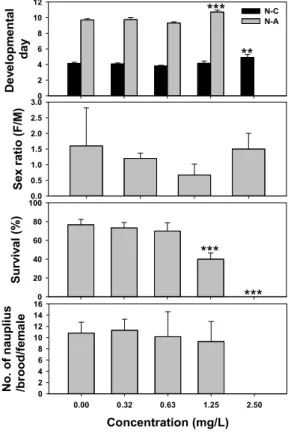
2). 비소노출 시, 1.25 mg/L 농도 실험구의 N-A와 2.5 mg/L 실험구의 N-C는 대조구에 비해 유의적으로 길게 나타났으며(P<0.01) 2.5 mg/L 농도에서는 copepodite기 까지 발달하였으나 성체까지는 발달하지 못하였다. 1.25 mg/L의 농도에서 생존율은 40%로 대조구에 비해 낮게 나타났으며 2.5 mg/L에서는 변태이후 전량 폐사하였다 (P<0.001; Fig. 3).
Table 4. EC10, EC50, 95% confidence intervals (CI) and no observed effect concentration (NOEC) for Nitocra sp. nauplius (N1-2) and adult female exposed to copper and arsenic for 48 hours.
Heavy metals
NOEC* (mg/L)
LC10
(95% CI; mg/L)
LC50
(95% CI; mg/L)
Nauplius
Cu 0.13 0.26
(0.19-0.31)
0.46 (0.39-0.53)
As 1.25 2.49
(1.82-3.03)
4.58 (3.90-5.38)
Adult
Cu 0.32 0.50
(0.33-0.64)
0.96 (0.80-1.14)
As 2.5 3.34
(2.43-4.09)
6.43 (5.45-7.59)
*NOEC was calculated by Dunnett's test.
Developmental day
0 2 4 6 8 10 12 14
N-C N-A
Sex ratio (F/M)
0.0 0.5 1.0 1.5 2.0 2.5 3.0 3.5
Survival (%)
0 20 40 60 80 100
Concentration (mg/L)
0.00 0.03 0.06 0.13 0.25
No. of nauplius /brood/female
0 2 4 6 8 10 12 14 16 18
***
***
**
**
Fig. 2. Developmental time (N–C, nauplius to copepodid and N–A, nauplius to adult), sex ratio, survival and fecundity of Nitocra sp.
exposed to different concentrations of copper.
Developmental day
0 2 4 6 8 10 12
N-C N-A
Sex ratio (F/M)
0.0 0.5 1.0 1.5 2.0 2.5 3.0
Survival (%)
0 20 40 60 80 100
Concentration (mg/L)
0.00 0.32 0.63 1.25 2.50
No. of nauplius /brood/female
0 2 4 6 8 10 12 14 16
***
**
***
***
Fig. 3. Developmental time (N–C, nauplius to copepodid and N–A, nauplius to adult), sex ratio, survival and fecundity of Nitocra sp.
exposed to different concentrations of arsenic.
4. 고찰
4.1 Nitocra sp.의 최적 배양환경조건규명 본 연구에서, Nitocra sp.의 배양을 위한 최적 수온은 29℃인 것으로 나타났다. Nitocra sp.는 수온이 높을수록 빠른 발달을 보였지만 33℃에서는 생존율이 69%로 오 히려 낮아져 안정적인 배양을 위해서는 33℃이하가 적 합할 것으로 판단된다. 열대 요각류인 N. affinis도 본 연 구와 비슷한 경향을 보여 35℃에서 발달이 다소 지연되 거나 유의적 차이를 보이지 않는 것(P>0.05)으로 나타났 다[17].
염분별 실험에서 발달기간은 염분에 따라 큰 차이를 보이지 않는 것으로 나타났다. 본 실험에 사용된 Nitocra sp.는 염분변화가 심한 조수웅덩이에서 분리되었으며 보 통 이러한 환경에 서식하는 저서성 요각류는 대부분 광 염종으로 극심한 염분 변화에도 잘 적응하는 것으로 알
려져 있다[18-19]. 다만, 44‰에서는 성체까지 생존율이 다른 실험구에 비해 낮게 나타나 최적배양을 위해서는 이보다 낮은 염분에서 배양되어야 할 것으로 판단된다.
먹이별 실험에서, Nitocra sp.의 빠른 발달과 높은 생 존율을 보인 먹이로 T. suecica가 가장 효율적이었으며 다음으로 C. simplex였다. Matias-Peralta et al.[17]의 연 구에서도 N. affinis의 배양을 위해 C. calcitrans, T.
tetrathele를 혼합·공급하여 본 연구와 유사한 결과를 얻 었지만 본 연구에서는 성장하지 못하고 폐사원인이 되었 던 Nannochloropsis oculata도 추가적으로 사용하여 본 연구와 상반된 결과를 보였다.
4.2 Nitocra sp.를 이용한 독성시험
일반적으로 수서생물의 급성독성시험에 사용되는 종 말점(endpoint)은 폐사(mortality)나 운동능력저해 (immobilization)과 같은 비교적 판단하기 쉬운 명확한 반응이다. 본 연구에서, Nitocra sp.의 운동능력저해의 정도는 명확한 구분이 어려웠으므로 가장 명확한 반응인 폐사를 선택하였다. 표준독성물질로 구리와 비소를 사용 하여 급성독성평가를 실시한 결과, 각 독성물질의 노출 농도에 따라 Nitocra sp.가 민감하게 잘 반응하여 반수치 사농도 즉 LC50값과 독성을 미치지 않는 농도인 NOEC 값을 어렵지 않게 얻을 수 있었다. 따라서 Nitocra sp.를 이용한 특정 독성물질의 급성독성시험시 종말점 (endpoint)으로 폐사(mortality)의 활용이 가능할 것으로 판단된다.
만성독성실험 결과, 구리와 비소노출 모두, 성비와 nauplius 생산력은 유의적인 차이가 없었던 반면, 발달 기간과 생존율은 농도에 따라 명확한 반응을 보였기 때 문에 만성독성시험에서 종말점으로 사용이 가능할 것으 로 판단된다. 조간대 서식 요각류인 Tigriopus japonicus 도 구리와 비소의 노출에 있어서 성비와 nauplius 생산 력이 대조구와 통계적인 차이를 보이지 않아서 본 연구 와 비슷한 경향을 보였다[16].
구리 노출실험에서, 0.13 mg/L 농도에서 오히려 대조 구에 비해 발달기간이 짧게 나타났다. 이것은 호르메시 스 효과(hormesis effect)로 간단히 설명될 수 있지만 또 다른 이유로, 절지동물의 발달과 탈피에 중요한 역할을 하는 ecdysteroid 조절에 관여하는 cytochrome P450 효 소가 구리에 의해 발현되어 Nitocra sp. 의 탈피주기를 가속화시켰기 때문일 수 있다[20-23].
5. 결론
본 실험을 종합해 보았을 때, Nitocra sp.의 안정적인 최적배양조건은 빠른 발달과 높은 생존율 측면에서, 수 온 29℃, 염분 24-39‰에서 먹이로 Tetraselmis suecica 를 공급하는 것으로 나타났다. 위 배양조건을 적용하여 구리와 비소의 급성독성과 만성독성을 시험한 결과, Nitocra sp.의 폐사, 발달기간 및 생존율과 같은 명확한 종말점을 얻을 수 있었다. 따라서 열대 요각류인 Nitocra sp.를 열대해양독성물질평가를 위한 생태독성실험생물 로 사용이 가능할 것으로 판단되며 차후 다양한 독성물 질의 평가에 활용이 기대된다.
References
[1] L. Hansen, “Increasing the resistance and resilience of tropical marine ecosystems to climate change”, in Buying time: a user’s manual, edited by L.J. Hansen, J.L. Biringerm, and J.R. Hoffman, pp. 157-176. 2003.
[2] P. L. Howe, A. J. Reichelt-Brushett, and M. W. Clark,
“Aiptasia pulchella : a tropical cnidarian representative for laboratory ecotoxicological research”, Environl.
Toxicol. Chem. 31, pp. 2653-2662. 2012.
DOI: http://dx.doi.org/10.1002/etc.1993
[3] K. W. Lee, S. Raisuddin, D. S. Hwang, H. G. Park, and J. S. Lee, “Acute toxicities of trace metals and common xenobiotics to the marine copepod Tigriopus japonicus:
Evaluation of its use as a benchmark species for routine ecotoxicity tests in Western Pacific coastal regions”, Environ. Toxicol. 22, pp. 532-538. 2007.
DOI: http://dx.doi.org/10.1002/tox.20289
[4] OECD, “OECD validation report of the full life-cycle test with the harpacticoid copepods Nitocra spinipes and Amphiascus tenuiremis and the clanoid copepod Acartia tonsa—Phase 1. Organization for economic cooperation and development”, Brussels Belgium. (79.
ENV/JM/MONO). 2007.
[5] USEPA, “Short term methods for measuring the chronic toxicity of effluents and receiving waters to marine and estuarine organisms”, third ed United States Environmental Protection Agency, Office of Water, Washington, DC. (EPA-821-R-02-014). 2002.
[6] ISO, “Water quality—determination of acute lethal toxicity to marine copepods (copepoda, crustacea)”, Draft International Standard ISO/DIS 14669. International Organization for Standardization, Geneve, Switzerland.
1999.
[7] ASTM, “Standard guide for conducting renewal microplate-based life-cycle toxicity tests with a marine meiobenthic copepod. E2317-04”, American Society for Testing Materials International, West Conshohocken, PA, USA. 2004.
[8] R. van Dam, A. Harford, M. Houston, A. Hogan, and A.
Negri, “Tropical marine toxicity testing in Australia: a review and recommendations”, Australasian J. Ecotox.
14, pp. 55-88. 2008.
[9] F. Gissi, M. T. Binet, and M. S. Adams, “Acute toxicity testing with the tropical marine copepod Acartia sinjiensis: Optimization and application”, Ecotoxicol.
Environ. Saf. 97, pp. 86-93. 2013.
DOI: http://dx.doi.org/10.1016/j.ecoenv.2013.07.008 [10] A. Rose, A.-M. Carruthers, J. Stauber, R. Lim, and S.
Blockwell, “Development of an acute toxicity test with the marine copepod Acartia sinjiensis”, Australasian J.
Ecotox. 12, pp. 73-81. 2006.
[11] K. Kwok, K. Leung, G. Lui, S. Chu, P. Lam, D. Morritt, L. Maltby, T. Brock, P. Van den Brink, M. Warne, and M. Crane, “Comparison of tropical and temperate freshwater animal species' acute sensitivities to chemicals:
implications for deriving safe extrapolation factors”, Integr. Environ. Assess. Manag. 3, pp. 49-67. 2007.
DOI: http://dx.doi.org/10.1002/ieam.5630030105 [12] M. Ismail, S. M. Phang, S. L. Tong, and M. T. Brown,
“A modified toxicity testing method using tropical marine microalgae”, Environ. Monit. Assess. 75, pp.
145-154. 2002.
DOI: http://dx.doi.org/10.1023/A:1014483713719 [13] K. W. Lee, and Y. W. Choi, “Mass culture of the
brackish water cyclopoid copepod Paracyclopina nana Smirnov”, J. Korea Acad. Industr. Coop. Soc. 17, pp.
262-266. 2016.
DOI: http://dx.doi.org/10.5762/KAIS.2016.17.8.262 [14] K. W. Lee and Y. U. Choi, “Population growth of a
tropical tintinnid, Metacylis tropica on different temperature, salinity and diet”, J. Korea Acad. Industr.
Coop. Soc. 17, 322-328. 2016.
DOI: http://dx.doi.org/10.5762/KAIS.2016.17.9.322 [15] K. W. Lee, J. H. Kang, and H. G. Park, “Effect of food
concentration on grazing, growth and fecundity of cyclopoid copepod Paracyclopina nana”, J. Korea Acad.
Industr. Coop. Soc. 13, 5206-5210. 2012.
DOI: http://dx.doi.org/10.5762/KAIS.2012.13.11.5206 [16] K. W. Lee, S. Raisuddin, D. S. Hwang, H. G. Park, H.
U. Dahms, I. Y. Ahn, and J. S. Lee, “Two-generation toxicity study on the copepod model species Tigriopus japonicus”, Chemosphere 72, pp. 1359-1365. 2008.
DOI: http://dx.doi.org/10.1016/j.chemosphere.2008.04.023 [17] H. Matias-Peralta, F. M. Yusoff, M. Shariff, and A.
Arshad, “Effects of some environmental parameters on the reproduction and development of a tropical marine harpacticoid copepod Nitocra affinis f. californica Lang”, Mar. Pollut. Bull. 51, pp. 722-728. 2005.
DOI: http://dx.doi.org/10.1016/j.marpolbul.2005.02.047 [18] R. McAllen and E. Brennan, “The effect of
environmental variation on the reproductive development time and output of the high-shore rockpool copepod Tigriopus brevicornis”, J. Exp. Mar. Biol. Ecol. 368, pp.
75-80. 2009.
DOI: http://dx.doi.org/10.1016/j.jembe.2008.10.013 [19] R. McAllen and A. Taylor, “The effect of salinity change
on the oxygen consumption and swimming activity of the high-shore rockpool copepod Tigriopus brevicornis”, J. Exp. Mar. Biol. Ecol. 263, pp. 227-240. 2001.
DOI: http://dx.doi.org/10.1016/S0022-0981(01)00308-2
[20] A. C. Bejarano, G. T. Chandler, L. J. He, and B. C.
Coull, “Individual to population level effects of South Louisiana crude oil water accommodated hydrocarbon fraction (WAF) on a marine meiobenthic copepod”, J.
Exp. Mar. Biol. Ecol. 332, pp. 49-59. 2006.
DOI: http://dx.doi.org/10.1016/j.jembe.2005.11.006 [21] B. H. Hansen, D. Altin, K. M. Hessen, U. Dahl, M.
Breitholtz, T. Nordtug, and A. J. Olsen, “Expression of ecdysteroids and cytochrome P450 enzymes during lipid turnover and reproduction in Calanus finmarchicus (Crustacea : Copepoda)”, Gen. Comp. Endocrinol. 158, pp. 115-121. 2008.
DOI: http://dx.doi.org/10.1016/j.ygcen.2008.05.013 [22] A. Tan and S. R. Palli, “Edysone receptor isoforms play
distinct roles in controlling molting and metamorphosis in the red flour beetle, Tribolium castaneum”, Mol. Cell.
Endocrinol. 291, pp. 42-49. 2008.
DOI: http://dx.doi.org/10.1016/j.mce.2008.05.006 [23] K. W. Lee, W. J. Shim, U. H. Yim, and J. H. Kang,
“Acute and chronic toxicity study of the water accommodated fraction (WAF), chemically enhanced WAF (CEWAF) of crude oil and dispersant in the rock pool copepod Tigriopus japonicus”, Chemosphere 92, pp. 1161-1168. 2013.
DOI: http://dx.doi.org/10.1016/j.chemosphere.2013.01.080
이 균 우(Kyun-Woo Lee) [정회원]
•2001년 2월 : 강릉원주대학교 해양 생명공학과 (이학석사)
•2004년 2월 : 강릉원주대학교 해양 생명공학과 (이학박사)
•2013년 8월 ~ 현재 : 한국해양과 학기술원 선임연구원
<관심분야>
해양생물학, 해양환경독성학
최 영 웅(Young-Ung Choi) [정회원]
•2002년 2월 : 제주대학교 수산생물 학과 (이학석사)
•2006년 8월 : 제주대학교 수산생물 학과 (이학박사)
•2012년 7월 ~ 현재 : 한국해양과 학기술원 책임연구원
<관심분야>
해양생물학, 번식생리학