http://e-jbm.org/
51
Copyright © 2016 The Korean Society for Bone and Mineral Research
This is an Open Access article distributed under the terms of the Creative Commons Attribution Non-Commercial Li- cense (http://creativecommons.org/licenses/by-nc/3.0/) which permits unrestricted non-commercial use, distribu- tion, and reproduction in any medium, provided the original work is properly cited.
J Bone Metab 2016;23:51-54
http://dx.doi.org/10.11005/jbm.2016.23.2.51 pISSN 2287-6375 eISSN 2287-7029
Can Alarming Improve Compliance with Weekly Bisphosphonate in Patients with Osteoporosis?
Jae-Hwi Nho1, Young-Kyun Lee2, Yong-Chan Ha3, Chung-Hyun Kim1, You-Sung Suh1, Kyung-Hoi Koo2
1Department of Orthopaedic Surgery, Soonchunhyang University Hospital Seoul, Seoul;
2Department of Orthopaedic Surgery, Seoul National University Bundang Hospital, Seoul National University College of Medicine, Seongnam;
3Department of Orthopaedic Surgery, Chung-Ang University College of Medicine, Seoul, Korea
Background: Although bisphosphonate is effective for the prevention and treatment of osteoporosis, poor medication compliance is a key-limiting factor. We determined whe- ther alarm clock could improve compliance with weekly bisphosphonate in patients with osteoporosis, by comparing with age- and gender-matched control group. Meth- ods: Fifty patients with osteoporosis were recruited and participated in alarm clock group.
Patients were asked to take orally weekly risedronate for 1 year, and received alarm clock to inform the time of taking oral bisphosphonate weekly. Using the propensity score matching with age and gender, 50 patients were identified from patients with osteopo- rosis medication. We compared the compliance with bisphosphonate using medication possession ratio (MPR) between two groups. Results: Although there was no significant difference of baseline characteristics between both groups, the mean MPR (0.80±0.33) of alarm clock group was higher than that (0.56±0.34) of control group (P<0.001). Con- clusions: Alarming could improve the compliance with weekly oral bisphosphonate in patients with osteoporosis.
Key Words: Bisphosphonate osteoporosis, Patient compliance
INTRODUCTION
Osteoporosis is a systemic skeletal disease characterized by low bone mass and micro-architectural deterioration of bone tissue, with a consequent increase in bone fragility and susceptibility to fracture.[1-4]
Bisphosphonate is the most widely used drugs to prevent and treat osteoporo- sis.[5-9] Although bisphosphonate is effective for the treatment of osteoporosis and prevention of osteoporotic fractures, poor medication compliance is a key- limiting factor in terms of the prevention and treatment of osteoporosis.[5-7,10,11]
Bisphosphonate-related factors including gastroesophaseal irritation and com- plex method of ingestion have been well-known risk factors for low compliance with bisphosphonate.[12-14] To overcome poor compliance, new type of bisphos- phonate with various dose intervals have introduced. Bisphosphonates with lon- ger interval have shown better compliance.[15-17]
However, there have been few intervention studies on improving compliance with bisphosphonate. Our purpose was to determine whe ther alarm clock could Corresponding author
Young-Kyun Lee
Department of Orthopaedic Surgery, Seoul National University Bundang Hospital, 82 Gumi-ro 173beon-gil, Bundang-gu, Seongnam 13620, Korea
Tel: +82-31-787-7204 Fax: +82-31-787-4056 E-mail: [email protected] Received: February 13, 2016 Revised: April 8, 2016 Accepted: April 14, 2016
No potential conflict of interest relevant to this article was reported.
We appreciated Sanofi Aventis providing alarm clocks.
Original Article
Jae-Hwi Nho, et al.
52
http://e-jbm.org/ http://dx.doi.org/10.11005/jbm.2016.23.2.51improve compliance with weekly bisphosphonate in pa- tients with osteoporosis, by comparing with age- and gen- der-matched control group without alarm clock.
METHODS
This is a case-control study conducted with prospective- ly complied data.
From May 2012 to May 2013, 50 patients with osteopo- rosis were recruited and participated in alarm clock group.
The inclusion criteria were (1) 65 years of age and over, (2) diagnosis of osteoporosis (T-score below -2.5 standard de- viation) based on the most recent bone mineral density (BMD) measurements (hip or spine, dual energy X-ray ab- sorptiometry [DXA]), (3) without contraindications to oral bisphosphonate, (4) no cognitive impairment, and (4) abil- ity of interview independently. All eligibility patients were asked to take orally weekly risedronate for 1 year, and re- ceived alarm clock to inform the time of taking oral bispho- sphonate weekly (Fig. 1). Clocks were provided by Sanofi Aventis. In order to avoid selection bias, written informed consent was not required.
To obtain control group, the propensity score matching with age and gender was used. As control group, 50 pa- tients, who had taken weekly oral risedronate for treatment of osteoporosis and were followed up for 12 months or more, were identified from patients with osteoporosis med- ication between 2005 and 2010. The medical records whom they had not received alarm clock in were reviewed to eval- uate compliance with bisphosphonate.
To compare the compliance between two groups, we
analyzed compliance with bisphosphonates during 12 mon- ths after first prescription. Compliance with bisphospho- nates was measured a period of 1 year of treatment after first prescription by using medication possession ratio (MPR) as the parameter.[9,18] MPR was defined as the sum of days of supply of osteoporosis medications divided by the length of follow-up, i.e., 365 days. Compliance was catego- rized with MPR<80% and MPR≥80%.[18,19]
The study protocol was reviewed and approved by the Institutional Review Boards and Ethics Committee.
1. Statistical analysis
For statistical analysis, student’s t-test was used for con- tinuous data and Pearson’s chi-squared test for categorical data. All continuous data are expressed as means and stan- dard deviations (SD). P-values<0.05 were considered sig- nificant.
RESULTS
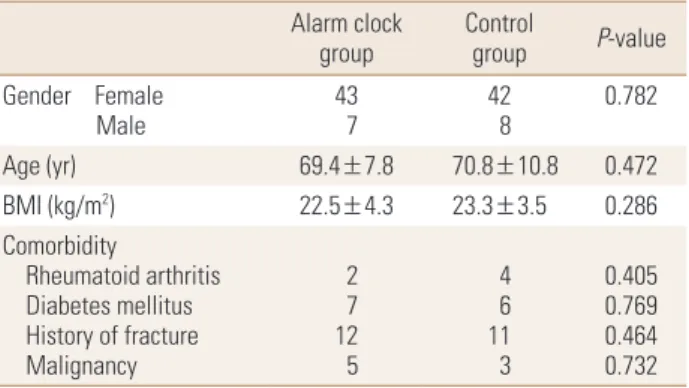
There was no significant difference of baseline charac- teristics including age and gender between both groups (Table 1).
The mean MPR (0.80±0.33) of alarm clock group was higher than that (0.56±0.34) of control group (P<0.001).
DISCUSSION
To our knowledge, this is the first study that evaluates compliance with weekly oral bisphosphonate in patients alarmed with clock. This study presented that alarming could improve the compliance with weekly bisphospho- nate in patients with osteoporosis.
Table 1. Baseline characteristics of both groups Alarm clock
group Control
group P-value Gender Female
Male 43
7 42
8 0.782
Age (yr) 69.4±7.8 70.8±10.8 0.472
BMI (kg/m2) 22.5±4.3 23.3±3.5 0.286
Comorbidity
Rheumatoid arthritis Diabetes mellitus History of fracture Malignancy
2 7 12 5
4 6 11 3
0.405 0.769 0.464 0.732 BMI, body mass index.
Fig. 1. Alarm clock will ring, when it reaches target day.
Alarming for Compliance with Weekly Bisphosphonate
http://dx.doi.org/10.11005/jbm.2016.23.2.51 http://e-jbm.org/
53
Poor compliance is a major challenge in contemporary therapeutics, because osteoporosis has asymptomatic fea- ture itself like other silent chronic diseases. Higher ages, low socioeconomic status, low awareness on osteoporosis, various interval of administration, and adverse effect of bisphosphonate have been presented to be risk factors for low compliance with bisphosphonate.[12-14] Identifying patients with high risk of low compliance and efforts to in- crease compliance are very important in treatment of os- teoporosis.
Complex dosing schedules related to other chronic dis- eases, such as hypertension, hyperlipidemia, and diabetes mellitus could lead to lack of compliance for osteoporosis medication. Simply forgetting to take the medication may also result in non-persistence or non-compliance in old ages.[20,21] In a previous study, 24% of the patients an- swered that they occasionally forgot to refill a prescription, as the reason why they did not fill prescriptions with drug regimens.[21] Therefore, it is important to alarm patients taking the medication, not to forget.
In this study, the MPR (0.56) of oral bisphosphonate with- out alarm clock is similar with that of another study.[22,23]
However, weekly bisphosphonate with alarm clock could improve MPR (0.80) obviously in this study.
In this study, we used clock with alarming function. Cur- rently, this intervention using alarming can be conducted with smartphone or message service using IT technology.
There are some limitations. First, we did not perform ran- domized study, but used historical control group. But, not to intervene control group will be ethical problem. Second, we included only patients with weekly oral bisphospho- nate. Third, we did not evaluate the change of BMD and compare the incidence of osteoporotic fracture. Fourth, we did not calculate a sample size prior to study. But, power of this study was 94.5% with type 1 error of 5%.
This study, which is the first study to intervene for com- pliance with bisphosphonate, presented that alarming could improve the compliance with weekly bisphosphonate in patients with osteoporosis.
REFERENCES
1. Park C, Ha YC, Jang S, et al. The incidence and residual life- time risk of osteoporosis-related fractures in Korea. J Bone Miner Metab 2011;29:744-51.
2. Salaffi F, Cimmino MA, Malavolta N, et al. The burden of prevalent fractures on health-related quality of life in post- menopausal women with osteoporosis: the IMOF study. J Rheumatol 2007;34:1551-60.
3. Yoon HK, Park C, Jang S, et al. Incidence and mortality fol- lowing hip fracture in Korea. J Korean Med Sci 2011;26:
1087-92.
4. Haentjens P, Autier P, Collins J, et al. Colles fracture, spine fracture, and subsequent risk of hip fracture in men and women. A meta-analysis. J Bone Joint Surg Am 2003;85- a:1936-43.
5. Siris ES, Selby PL, Saag KG, et al. Impact of osteoporosis treatment adherence on fracture rates in North America and Europe. Am J Med 2009;122:S3-13.
6. Hadji P, Claus V, Ziller V, et al. GRAND: the German retro- spective cohort analysis on compliance and persistence and the associated risk of fractures in osteoporotic wom- en treated with oral bisphosphonates. Osteoporos Int 2012;
23:223-31.
7. Landfeldt E, Ström O, Robbins S, et al. Adherence to treat- ment of primary osteoporosis and its association to frac- tures--the Swedish Adherence Register Analysis (SARA).
Osteoporos Int 2012;23:433-43.
8. Ha YC, Lee YK, Lim YT, et al. Physicians' attitudes to con- temporary issues on osteoporosis management in Korea.
J Bone Metab 2014;21:143-9.
9. Soong YK, Tsai KS, Huang HY, et al. Risk of refracture asso- ciated with compliance and persistence with bisphospho- nate therapy in Taiwan. Osteoporos Int 2013;24:511-21.
10. Russell RG, Watts NB, Ebetino FH, et al. Mechanisms of ac- tion of bisphosphonates: similarities and differences and their potential influence on clinical efficacy. Osteoporos Int 2008;19:733-59.
11. Bilezikian JP. Efficacy of bisphosphonates in reducing frac- ture risk in postmenopausal osteoporosis. Am J Med 2009;
122:S14-21.
12. Kamatari M, Koto S, Ozawa N, et al. Factors affecting long- term compliance of osteoporotic patients with bisphos- phonate treatment and QOL assessment in actual practice:
alendronate and risedronate. J Bone Miner Metab 2007;
25:302-9.
13. Kertes J, Dushenat M, Vesterman JL, et al. Factors contrib- uting to compliance with osteoporosis medication. Isr Med Assoc J 2008;10:207-13.
14. Weycker D, Macarios D, Edelsberg J, et al. Compliance with
Jae-Hwi Nho, et al.
54
http://e-jbm.org/ http://dx.doi.org/10.11005/jbm.2016.23.2.51osteoporosis drug therapy and risk of fracture. Osteopo- ros Int 2007;18:271-7.
15. Cramer JA, Amonkar MM, Hebborn A, et al. Compliance and persistence with bisphosphonate dosing regimens among women with postmenopausal osteoporosis. Curr Med Res Opin 2005;21:1453-60.
16. Lee YK, Nho JH, Ha YC, et al. Persistence with intravenous zoledronate in elderly patients with osteoporosis. Osteo- poros Int 2012;23:2329-33.
17. Cramer JA, Gold DT, Silverman SL, et al. A systematic re- view of persistence and compliance with bisphosphonates for osteoporosis. Osteoporos Int 2007;18:1023-31.
18. Gold DT, Martin BC, Frytak JR, et al. A claims database anal- ysis of persistence with alendronate therapy and fracture risk in post-menopausal women with osteoporosis. Curr Med Res Opin 2007;23:585-94.
19. Siris ES, Harris ST, Rosen CJ, et al. Adherence to bisphos- phonate therapy and fracture rates in osteoporotic wom-
en: relationship to vertebral and nonvertebral fractures from 2 US claims databases. Mayo Clin Proc 2006;81:1013- 22.
20. Silverman SL, Gold DT. Compliance and persistence with osteoporosis therapies. Curr Rheumatol Rep 2008;10:118- 22.
21. Silverman SL, Schousboe JT, Gold DT. Oral bisphospho- nate compliance and persistence: a matter of choice? Os- teoporos Int 2011;22:21-6.
22. Ziller V, Kostev K, Kyvernitakis I, et al. Persistence and com- pliance of medications used in the treatment of osteopo- rosis--analysis using a large scale, representative, longitu- dinal German database. Int J Clin Pharmacol Ther 2012;50:
315-22.
23. Ziller V, Wetzel K, Kyvernitakis I, et al. Adherence and per- sistence in patients with postmenopausal osteoporosis treated with raloxifene. Climacteric 2011;14:228-35.