• 검색 결과가 없습니다.

Successful Repair of Critical Tricuspid Regurgitation Secondary to a Ruptured Papillary Muscle in a Neonate

N/A
N/A
Protected

Academic year: 2021

Share "Successful Repair of Critical Tricuspid Regurgitation Secondary to a Ruptured Papillary Muscle in a Neonate"

Copied!
4
0
0

로드 중.... (전체 텍스트 보기)

전체 글

(1)

Korean J Thorac Cardiovasc Surg 2014;47:398-401 □ Case Report □ http://dx.doi.org/10.5090/kjtcs.2014.47.4.398 ISSN: 2233-601X (Print) ISSN: 2093-6516 (Online)

− 398 −

Department of Thoracic and Cardiovascular Surgery, Seoul National University Hospital, Seoul National University College of Medicine

†Presented at the 263th monthly conference at Seoul and Gyeonggii province of the Korean Society for Thoracic and Cardiovascular Surgery.

Received: November 11, 2013, Revised: November 22, 2013, Accepted: November 24, 2013, Published online: August 5, 2014

Corresponding author: Woong-Han Kim, Department of Thoracic and Cardiovascular Surgery, Seoul National University Children’s Hospital, Seoul National University College of Medicine, 101 Daehak-ro, Jongno-gu, Seoul 110-744, Korea

(Tel) 82-2-2072-3637 (Fax) 82-2-3672-3637 (E-mail) [email protected]

C

The Korean Society for Thoracic and Cardiovascular Surgery. 2014. All right reserved.

CC
This is an open access article distributed under the terms of the Creative Commons Attribution Non-Commercial License (http://creative- commons.org/licenses/by-nc/3.0) which permits unrestricted non-commercial use, distribution, and reproduction in any medium, provided the original work is properly cited.

Successful Repair of Critical Tricuspid Regurgitation Secondary to a Ruptured Papillary Muscle in a Neonate

Jooncheol Min, M.D., Eung Re Kim, M.D., Chan Kyu Yang, M.D., Woong-Han Kim, M.D., Ph.D., Woo Sung Jang, M.D., Sungkyu Cho, M.D.

Severe tricuspid regurgitation resulting from a flail leaflet is a rare cause of neonatal cyanosis. We report a neo- nate with profound cyanosis and severe tricuspid regurgitation caused by a rupture of the papillary muscle support- ing the anterior leaflet, without other structural heart defects. Ductal patency could not be established. The repair of the tricuspid valve was performed after initial stabilization by using extracorporeal membrane oxygenation.

Key words: 1. Neonate

2. Tricuspid valve insufficiency 3. Tricuspid valve surgery 4. Papillary muscles

5. Extracorporeal membrane oxygenation

CASE REPORT

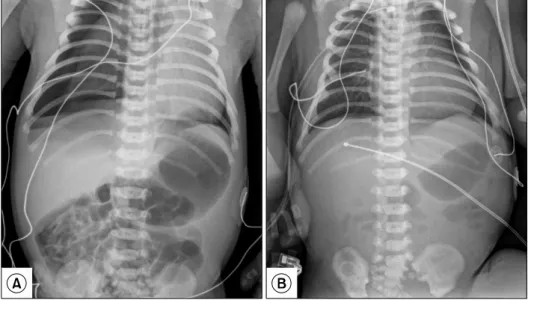
A 3,240-g male neonate born at the 39th week of gestation was transferred to Seoul National University Hospital due to severe cyanosis and cardiac arrest. Pregnancy and delivery had been uneventful, and the prenatal ultrasound had been normal. There was no history of perinatal distress. Soon after birth, the baby developed severe cyanosis. Although ventilator support was provided, he remained profoundly hypoxemic, and cardiac arrest occurred. After restoration of spontaneous circulation with cardiopulmonary resuscitation (CPR), he was transferred to Seoul National University Hospital 3 hours af- ter birth. An infantogram taken immediately after admission revealed a pneumothorax on the right side (Fig. 1A); thus, we performed a closed thoracostomy. Although the lung was

fully expanded after the closed thoracostomy (Fig. 1B), the observed oxygen saturation level did not improve.

Transthoracic echocardiogram (TTE) showed severe tricuspid regurgitation (TR), with a flail anterior leaflet having a thick- ened, echogenic tip (Fig. 2A). The pulmonary valve had a normal appearance, but the antegrade pulmonary flow was nearly absent, consistent with functional pulmonary atresia. A right-to-left shunt was detected through the patent foramen ovale, and patent ductus arteriosus was not present. The right atrium and ventricle were not markedly dilated, favoring the acute occurrence of secondary TR due to a papillary muscle rupture.

Despite maximum conventional ventilator support, the neo-

nate continued to be severely hypoxemic, with an oxygen sat-

uration of less than 60%. Continuous inhalation of nitric ox-

(2)

Papillary Muscle Rupture of Tricuspid Valve in Neonate

− 399 −

Fig. 1. (A) Initial infantogram show- ing a right pneumothorax. (B) Infan- togram after closed thoracostomy.

Fig. 2. (A) Preoperative transthoracic echocardiogram showing a flail anterior leaflet of the tricuspid valve with a thickened echogenic tip prolapsing into the right atrium (arrow). (B) Postoperative transthoracic echocardiogram showing the artificial cord supporting the leaflet and the restoration of adequate coaptation. RA, right atrium; RV, right ventricle; LV, left ventricle.

ide, aimed at lowering the pulmonary vascular resistance was attempted, but this produced a minimal increase in oxyge- nation. Other adjunctive measures, including infusion of so- dium bicarbonate, inotropic agents, and prostaglandin E5, all failed to improve either oxygenation or the state of low car- diac output. The heart failure became progressive, and cardiac arrest occurred repeatedly, necessitating CPR. The patient was placed on venoarterial extracorporeal membrane oxygenation (ECMO) at 36 hours of life, and tricuspid repair was

undertaken.

Ascending aortic and bicaval cannulation was implanted,

and mild hypothermic cardiopulmonary bypass was main-

tained. The papillary muscle of the anterior tricuspid valve

(TV) leaflet was ruptured, showing organized and ischemic

change (Fig. 3A). We reimplanted the ruptured papillary mus-

cle head into the healthy endocardium (7-0 polytetrafluoro-

ethylene [PTFE] pledget-supported suture) and created artifi-

cial chordae from 7/0 PTFE in the case of papillary muscle

(3)

Jooncheol Min, et al

− 400 −

Fig. 3. (A) Intraoperative finding of a ruptured papillary muscle of the anterior leaflet of the tricuspid valve (arrow). (B) Schematic representation of the papillary muscle reimplantation and the creation of the artificial chordae (a, native chordae; b, pledg- et-supported polytetrafluoroethylene su- ture at the ruptured papillary muscle;

c, artificial chordae).

re-rupture (Fig. 3B). The ligamentum arteriosum was divided, and the patent foramen ovale was preserved. The patient was weaned easily from bypass on low-dose inotropics.

Ventilation with nitric oxide was necessary for the next few days, which was followed by extubation on the 11th post- operative day. TTE on the 17th postoperative day showed negligible TR and good systolic function of both ventricles (Fig. 2B). The patient was discharged on the 20th post- operative day. After 6 months of postoperative follow-up, the patient remained very well and his TTE showed normal car- diac function with trivial TR.

DISCUSSION

Papillary muscle rupture in a neonate is a rare event that leads to severe mitral or tricuspid insufficiency and is asso- ciated with high perinatal mortality. There are few reports in the English literature regarding cases of newborns with crit- ical atrioventricular valve insufficiency secondary to ruptured papillary muscle or chordae tendinae [1]. Further, in the Korean literature, one case was reported in 1997 [2].

Hypoxia in the newborn is a possible cause of papillary muscle dysfunction, pulmonary hypertension, and tricuspid insufficiency. Myocardial ischemia, which can result from an- tepartum or peripartum asphyxia, congenital heart disease, vi- ral infections, Rhesus isoimmunization, thromboembolism, or other more obscure causes, can induce a papillary muscle rupture [1]. Furthermore, permanent antenatal ductal closure is an interesting cause of the papillary muscle rupture of the tricuspid valve. If ductal closure occurs suddenly, a tremen- dous increase in the right ventricular afterload would result during severe fetal stress, and the combined hemodynamic

and metabolic insult might provoke an ischemic rupture of the tricuspid papillary muscle [3].

Gerry et al. [4] reported two cases of a ruptured papillary muscle of the TV as a complication of CPR. However, tri- cuspid insufficiency is thought to be a rare complication of blunt, non-penetrating chest trauma. Parmley et al. [5] found 24 cases of papillary muscle ruptures in an autopsy study of 546 cases of trauma, but there was only one instance of an isolated rupture of the tricuspid papillary muscle. Almost all of these cases had coexisting myocardial lesions such as my- ocardial ruptures.

In our case, the etiology of the papillary muscle rupture is unclear because TR was not diagnosed before CPR. However, soon after birth and prior to CPR, the patient had already de- veloped severe cyanosis, which might have been related to severe TR with functional pulmonary atresia. This supports the echocardiographic and intraoperative findings that suggest that the rupture of the papillary muscle was induced by my- ocardial ischemia.

TR secondary to a papillary muscle rupture may be suffi-

ciently severe to preclude an antegrade pulmonary flow, with

a resultant massive right-to-left atrial shunt. Medical treat-

ment, which is aimed at reducing the high pulmonary vas-

cular resistance, allows for an increase in the antegrade flow

from the right ventricle and may also improve the systemic

perfusion. However, the inability to open the ductus limits

the therapeutic options, with the exception of ECMO [6]. In

our case, severe TR without ductal patency did not provide

appropriate vital signs; thus, the repair of TV was performed

after initial stabilization by using ECMO. A number of sim-

ilar cases have been reported for the use of ECMO as a

bridge to TV repair [7].

(4)

Papillary Muscle Rupture of Tricuspid Valve in Neonate

− 401 − Long-term follow-up studies on PTFE artificial chordae in TV repair in children are lacking. However, promising results have been achieved with the use of the artificial chordae of the mitral valve. Freedom from reoperation with chordal placement in the mitral valve position was 94.7% at 5 years and 89.5% at 8 years [8]. Considering that PTFE sutures lack the possibility of growth, further studies on the TV position in neonates is warranted.

CONFLICT OF INTEREST

No potential conflict of interest relevant to this article was reported.

REFERENCES

1. Anagnostopoulos PV, Alphonso N, Nolke L, et al. Neonatal mitral and tricuspid valve repair for in utero papillary mus- cle rupture. Ann Thorac Surg 2007;83:1458-62.

2. Kim TY, Lee JH, Jung TE, et al. Tricuspid regurgitation

due to rupture of a chordae in newborn: a report of one cases. Korean J Thorac Cardiovasc Surg 1997;30:927-31.

3. Setzer E, Ermocilla R, Tonkin I, John E, Sansa M, Cassady G. Papillary muscle necrosis in a neonatal autopsy pop- ulation: incidence and associated clinical manifestations. J Pediatr 1980;96:289-94.

4. Gerry JL Jr, Bulkley BH, Hutchins GM. Rupture of the pap- illary muscle of the tricuspid valve: a complication of car- diopulmonary resuscitation and a rare cause of tricuspid insufficiency. Am J Cardiol 1977;40:825-8.

5. Parmley LF, Manion WC, Mattingly TW. Nonpenetrating traumatic injury of the heart. Circulation 1958;18:371-96.

6. Misu Y, Hiraishi S, Oguchi K, Amano K. Successful man- agement of severe tricuspid regurgitation associated with hy- drops fetalis in a case of dysplastic tricuspid valve. Pediatr Cardiol 1999;20:435-7.

7. Sachdeva R, Fiser RT, Morrow WR, Cava JR, Ghanayem NS, Jaquiss RD. Ruptured tricuspid valve papillary muscle:

a treatable cause of neonatal cyanosis. Ann Thorac Surg 2007;83:680-2.

8. Minami K, Kado H, Sai S, et al. Midterm results of mitral

valve repair with artificial chordae in children. J Thorac

Cardiovasc Surg 2005;129:336-42.

수치

Fig. 1. (A) Initial infantogram show- show-ing a right pneumothorax. (B)  Infan-togram after closed thoracostomy.
Fig. 3. (A) Intraoperative finding of  a ruptured papillary muscle of the  anterior leaflet of the tricuspid valve  (arrow)

참조

관련 문서