ISSN 2234-3806 • eISSN 2234-3814
https://doi.org/10.3343/alm.2020.40.2.169
Diagnostic Performance of the GENEDIA MTB/NTM Detection Kit for Detecting Mycobacterium
tuberculosis and Nontuberculous Mycobacteria With Sputum Specimens
Sunghwan Shin , M.D.1,*, In Young Yoo , M.D., Ph.D.1,*, Hyang Jin Shim , M.T.2, On Kyun Kang , M.T.1, Byung Woo Jhun , M.D., Ph.D.3, Won-Jung Koh , M.D., Ph.D.3, Hee Jae Huh , M.D., Ph.D.1,
and Nam Yong Lee , M.D., Ph.D.1
1Department of Laboratory Medicine and Genetics, 2Samsung Biomedical Research Institute, and 3Division of Pulmonary and Critical Care Medicine, Department of Medicine, Samsung Medical Center, Sungkyunkwan University School of Medicine, Seoul, Korea
The GENEDIA MTB/NTM Detection Kit (GENEDIA MTB/NTM; Green Cross Medical Sci- ence Corp., Chungbuk, Korea) is a multiplex real-time PCR assay used for differential iden- tification of Mycobacterium tuberculosis complex (MTBC) and nontuberculous mycobac- teria (NTM). While the importance of differential identification of MTB/NTM is recognized, there is limited data on the performance of GENEDIA MTB/NTM assay to date. A total of 687 consecutive sputum specimens were cultured and analyzed with the GENEDIA MTB/
NTM and GENEDIA MTB assays. Nineteen specimens (2.8%) were MTBC-positive, and 69 (10.0%) were NTM-positive based on mycobacterial culture. All specimens showed concordant results for MTBC using both assays, with a kappa value of 1.00, overall sensi- tivity of 63.2% (12/19), and specificity of 100% (668/668). The overall NTM sensitivity and specificity were 23.2% (16/69) and 99.7% (616/618) for GENEDIA MTB/NTM. The association between NTM-positivity using GENEDIA MTB/NTM and the diagnosis of NTM pulmonary disease was not statistically significant. In conclusion, the two real-time PCR assays showed similar diagnostic performance for MTBC detection. However, the sensitiv- ity for NTM detection was lower than that for MTBC detection.
Key Words: Mycobacterium tuberculosis complex, Nontuberculous mycobacteria, Perfor- mance, Detection, Real-time PCR, Mycobacterial culture
Received: June 4, 2019 Revision received: July 29, 2019 Accepted: September 25, 2019 Corresponding author:
Hee Jae Huh, M.D., Ph.D.
Department of Laboratory Medicine and Genetics, Samsung Medical Center, Sungkyunkwan University School of Medicine, 81 Irwon-ro, Gangnam-gu, Seoul 06351, Korea
Tel: +82-2-3410-1836 Fax: +82-2-3410-2719 E-mail: [email protected] Co-corresponding author:
Nam Yong Lee, M.D., Ph.D.
Department of Laboratory Medicine and Genetics, Samsung Medical Center, Sungkyunkwan University School of Medicine, 81 Irwon-ro, Gangnam-gu, Seoul 06351, Korea
Tel: +82-2-3410-2706 Fax: +82-2-3410-2719 E-mail: [email protected]
* These authors equally contributed to this study.
© Korean Society for Laboratory Medicine This is an Open Access article distributed under the terms of the Creative Commons Attribution Non-Commercial License (http://creativecom- mons.org/licenses/by-nc/4.0) which permits unrestricted non-commercial use, distribution, and reproduction in any medium, provided the original work is properly cited.
2017-03-16 https://crossmark-cdn.crossref.org/widget/v2.0/logos/CROSSMARK_Color_square.svg
Tuberculosis (TB), caused by members of the Mycobacterium tuberculosis complex (MTBC), mainly M. tuberculosis (MTB), is one of the top 10 causes of death worldwide [1]. While MTB is an obligate human pathogen without an environmental reser- voir, nontuberculous mycobacteria (NTM), which include myco- bacteria other than MTBC and Mycobacterium leprae, are ubiq- uitous organisms frequently isolated from soil and water [2, 3].
A recent epidemiological study of the incidence and prevalence of NTM infection identified rapid growth in the number of pa- tients with NTM pulmonary disease (NTM-PD) in Korea, consis- tent with the global trend of increasing NTM infections [4]. Ow- ing to the increasing incidence and prevalence of both MTBC and NTM in Korea, rapid and accurate differentiation between MTBC and NTM infections is crucial for appropriate treatment and infection control [5].
Detection of acid-fast bacilli (AFB) by microscopic examina- tion is a rapid and inexpensive method for TB diagnosis; how- ever, this approach does not differentiate between MTBC and NTM, which requires an additional phenotypic identification step using biochemical assays that are time-consuming and la- bor intensive [6, 7]. To overcome these disadvantages, various molecular diagnostic assays for differential identification of MTBC and NTM have been developed and evaluated [8-12].
The GENEDIA MTB/NTM Detection Kit (GENEDIA MTB/NTM;
Green Cross Medical Science Corp., Chungbuk, Korea) is a mul- tiplex real-time PCR assay used for differential identification of MTBC and NTM. This assay targets the IS6110 region of MTB, the internal transcribed spacer region, and the rpoB gene of NTM. Previously, we evaluated the performance of this assay using liquid media [8]. While the performance of GENEDIA MTB Detection Kit (GENEDIA MTB; Green Cross Medical Science Corp.) has been studied using respiratory specimens [13], the performance of GENEDIA MTB/NTM with direct respiratory spec- imens has not been studied to date. We evaluated and com- pared the performance of GENEDIA MTB/NTM and the GENE- DIA MTB assays using sputum specimens.
We used a total of 687 non-selective, consecutive sputum specimens submitted for AFB smear and mycobacterial culture between January and March 2018. This prospective study was approved by the Institutional Review Board of Samsung Medical Center, Seoul, Korea (approval number 2018-04-015). All sub- mitted clinical specimens were decontaminated with the same volume of 2% N-acetyl-l-cysteine-sodium hydroxide and then centrifuged at 3,000 ×g for 20 minutes. The AFB smear was initially performed with an auramine-rhodamine fluorescent stain, which was confirmed by Ziehl-Neelsen staining. Smear results
were graded based on the American Thoracic Society (ATS)/
Centers for Disease Control and Prevention guidelines [14, 15].
Smear-positive is defined as a grade higher than 1+. Mycobac- terial culture was performed by inoculating 500 μL and 100 μL aliquots of decontaminated specimens into a mycobacterial growth indicator tube (MGIT 960 system; Becton Dickinson, Sparks, MD, USA) and onto 3% Ogawa agar (Shinyang, Seoul, Korea) as a reference method. The inoculated media were incubated at 36°C for six weeks. For culture-positive specimens, we rou- tinely performed GENEDIA MTB/NTM assay for MTBC and NTM differentiation.
To extract DNA, 100 μL of decontaminated sputum specimens were suspended in 100 μL of DNA extraction buffer, and the mixtures were boiled for 10 minutes. After centrifugation, the supernatants were used for both GENEDIA MTB/NTM and GENEDIA MTB assays, which were conducted in parallel, ac- cording to the manufacturer’s instructions. For the two GENE- DIA assays, positive and negative controls were included in each run, and an internal control was used throughout the as- say to detect PCR inhibitors. PCR amplification was conducted with a 7500 real-time PCR system (Applied Biosystems, Foster City, CA, USA). Positive MTBC and NTM results of GENEDIA MTB/NTM were determined when the cycle threshold (Ct) value was less than 40 and 35, respectively. The same Ct value of 40 was used for the MTBC detection using GENEDIA MTB.
The detection limit of the GENEDIA MTB/NTM was measured using serial dilutions of DNA extracted from the reference strains (MTB, Mycobacterium avium, and Mycobacterium abscessus).
The lower detection limit was defined as the lowest concentra- tion detected by the assay in a series of three replicates.
Patient information was reviewed in NTM-positive patients to determine the association between the NTM PCR results and NTM-PD. The ATS/Infectious Diseases Society of America diag- nostic criteria for NTM disease were applied to patients from whom NTM species were isolated [16].
The sensitivity, specificity, positive predictive value (PPV), and negative predictive value (NPV) with 95% confidence intervals (CIs) of each assay stratified by AFB smear status was calculated based on the results of the reference methods. Kappa value was calculated to compare the agreement between GENEDIA MTB/NTM and GENEDIA MTB for the detection of MTBC. A Chi-square test was used to determine the association between the NTM PCR results and NTM-PD. Statistical analyses were performed using MedCalc Statistical Software version 19.0.5 (MedCalc Software, Ostend, Belgium) and the VassarStats web- site (http://vassarstats.net/). P <0.05 was considered statistically
significant.
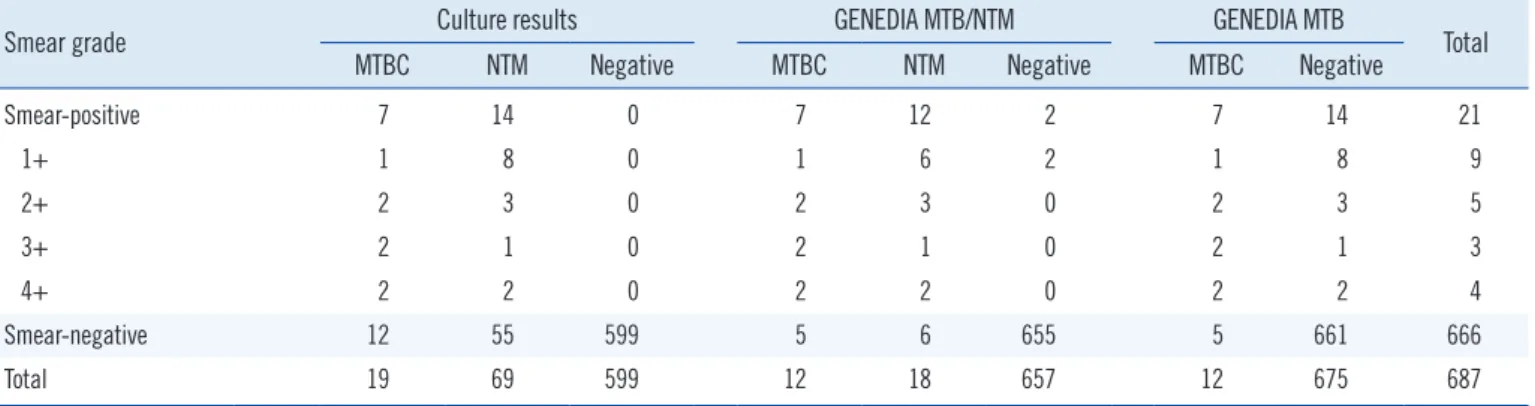
Of the 687 specimens, 12 were positive for MTBC using both the GENEDIA MTB/NTM and GENEDIA MTB assays, with a kappa value of 1.00. Nineteen (2.8%) and 69 (10.0%) speci- mens were positive for MTBC and NTM by mycobacterial cul- ture, respectively (Table 1). Seven of the 19 MTBC culture-posi- tive specimens (36.8%) were smear-positive, while the remain- ing 12 (63.2%) were smear-negative. For the 69 NTM culture- positive specimens, 14 (20.3%) were smear-positive and 55 (79.7%) were smear-negative. Of these culture-positive speci- mens, 16 were NTM-positive based on the GENEDIA MTB/NTM, while of the 618 NTM culture-negative specimens, two were NTM-positive.
The sensitivities and specificities of the GENEDIA MTB/NTM and GENEDIA MTB assays based on the concurrent culture re- sults with smear status are shown in Table 2. GENEDIA MTB/
NTM and GENEDIA MTB exhibited the same overall performance for MTBC detection from direct sputum specimens. For NTM detection using GENEDIA MTB/NTM, the sensitivity was 85.7%
for smear-positive specimens and 7.3% for smear-negative speci- mens. The PPVs and NPVs for detecting MTBC and NTM are further described in Table 2, since the population in this study reflects the true disease prevalence in our hospital. Of the 69 NTM culture-positive specimens, 16 were NTM-positive by GEN- EDIA MTB/NTM, and 62.5% (10/16) were specimens obtained from patients with NTM-PD. The remaining 53 specimens were NTM-negative by GENEDIA MTB/NTM, and 49.1% (26/53) spec- imens were obtained from patients with NTM-PD. However, the association between NTM PCR-positive results and NTM-PD was not statistically significant (P =0.35).
The detection limit of GENEDIA MTB/NTM for MTB detection was 5.0×10⁻⁶ ng/µL (equal to 1 copy/µL). The measured limits for M. avium and M. abscessus were 5.0×10⁻³ ng/µL (equal to
953 copies/µL) and 1.5×10⁻⁴ ng/µL (27 copies/µL), respectively.
The overall MTBC sensitivity using GENEDIA MTB/NTM was identical to that of the GENEDIA MTB, and all the smear-positive MTBC were detected by both GENEDIA MTB/NTM and GENE- DIA MTB. However, smear-negative MTBC specimens showed lower sensitivities with both methods (41.7%), as reported pre- viously in various real-time PCR assays [13, 17]. While GENE- DIA MTB/NTM detected the vast majority of NTM in smear-pos- itive specimens, NTM sensitivity with smear-negative specimens
Table 1. GENEDIA MTB/NTM assay, MTB assay, and culture result comparisons stratified by AFB smear grade
Smear grade Culture results GENEDIA MTB/NTM GENEDIA MTB
Total
MTBC NTM Negative MTBC NTM Negative MTBC Negative
Smear-positive 7 14 0 7 12 2 7 14 21
1+ 1 8 0 1 6 2 1 8 9
2+ 2 3 0 2 3 0 2 3 5
3+ 2 1 0 2 1 0 2 1 3
4+ 2 2 0 2 2 0 2 2 4
Smear-negative 12 55 599 5 6 655 5 661 666
Total 19 69 599 12 18 657 12 675 687
Abbreviations: AFB, acid-fast bacilli; MTBC, Mycobacterium tuberculosis complex; NTM, nontuberculous mycobacteria.
Table 2. Diagnostic performance of the GENEDIA MTB/NTM De- tection Kit for detecting MTBC and NTM
Target Perfor-
mance N/total N
% (95% CI)
Smear result
Smear-positive Smear-negative MTBC* Sensitivity 12/19
63.2 (38.6–82.8) 7/7
100 (56.1–100) 5/12 41.7 (16.5–71.4) Specificity 668/668
100 (99.3–100)
14/14 100 (73.2–100)
654/654 100 (99.3–100)
PPV 12/12
100 (69.9–100) 7/7
100 (56.1–100) 5/5 100 (46.3–100)
NPV 668/675
99.0 (97.8–99.5)
14/14 100 (73.2–100)
654/661 98.9 (97.7–99.5) NTM Sensitivity 16/69
23.2 (14.2–35.2) 12/14
85.7 (56.2–97.5) 4/55 7.3 (2.4–18.4) Specificity 616/618
99.7 (98.7–99.9)
7/7 100 (56.1–100)
609/611 99.7 (98.7–99.9)
PPV 16/18
88.9 (63.9–98.1) 12/12
100 (69.9–100) 4/6 66.7 (24.1–94.0)
NPV 616/669
92.1 (89.7–94.0)
7/9 77.8 (40.2–96.1)
609/660 92.3 (89.9–94.1)
*The diagnostic performance of the GENEDIA MTB/NTM Detection Kit and GENEDIA MTB Detection Kit was identical.
Abbreviations: CI, confidence interval; MTBC, Mycobacterium tuberculosis complex; NTM, nontuberculous mycobacteria; NPV, negative predictive val- ue; PPV, positive predictive value.
was <10%. Because differentiation between MTB and NTM is important for smear-negative specimens when mycobacterial infection is suspected, insufficient detection of NTM is a limiting factor for clinical use.
The analytical sensitivity of M. avium and M. abscessus was 953 and 27 copies/µL, respectively, with GENEDIA MTB/NTM, suggesting that the clinical sensitivity of NTM could also depend on the species. Further investigation with more focus on the species-specific performance of NTM detection is therefore rec- ommended. In addition, we previously assessed the analytical specificity of GENEDIA MTB/NTM with 85 reference mycobac- terial and nonmycobacterial Corynebacterineae species strains, including one Corynebacterium sp., two Gordonia spp., two Rho- dococcus spp., three Nocardia spp., and one Tsukamurella sp.
[8]; the assay correctly identified all strains except Tsukamurella pulmonis.
Recently, Kim, et al. [18] suggested that an NTM directly iso- lated from respiratory specimens by real-time PCR assay is a causative organism of true NTM disease. In their study, the vast majority of PCR-positive NTM specimens were obtained from patients with NTM disease. However, our data revealed no sig- nificant difference in NTM-PD between the PCR-positive and PCR-negative groups. Further studies are required to confirm the validity of these findings.
This study had some limitations. First, few MTBC culture-pos- itive specimens were included owing to the relatively low num- ber of TB patients enrolled. Second, as only sputum specimens were evaluated, further studies with various types of specimens are required to more broadly evaluate the GENEDIA MTB/NTM assay for differentiation between MTBC and NTM.
In conclusion, our data indicate that the GENEDIA MTB/NTM and the GENEDIA MTB assays have similar clinical performance for detecting MTBC from direct sputum specimens. However, the GENEDIA MTB/NTM assay showed significantly lower sensi- tivity for NTM detection than for MTBC detection, especially for smear-negative specimens.
Author Contributions
Huh HJ and Lee NY initiated and designed the study and coor- dinated the drafting of the manuscript. Shim HJ and Kang OK participated in specimen collection and experiments. Shin S, Yoo IY, and Huh HJ carried out data analysis and wrote the man- uscript. Jhun BW and Koh WJ supervised the study design, re- viewed and commented on the manuscript. All authors read and approved the final manuscript.
Conflicts of Interest
None declared.
Research Funding
None declared.
ORCID
Sunghwan Shin https://orcid.org/0000-0003-1038-029X In Young Yoo https://orcid.org/0000-0003-1505-846X Hyang Jin Shim https://orcid.org/0000-0002-9387-4932 On Kyun Kang https://orcid.org/0000-0002-1031-1991 Byung Woo Jhun https://orcid.org/0000-0002-6348-8731 Won-Jung Koh https://orcid.org/0000-0002-4756-3527 Hee Jae Huh https://orcid.org/0000-0001-8999-7561 Nam Yong Lee https://orcid.org/0000-0003-3688-0145
REFERENCES
1. World Health Organization. Global tuberculosis report 2018. https://
www.who.int/tb/publications/global_report/en/ (Updated on March 2019).
2. Honda JR, Virdi R, Chan ED. Global environmental nontuberculous my- cobacteria and their contemporaneous man-made and natural niches.
Front Microbiol 2018;9:2029.
3. Jeon D. Infection source and epidemiology of nontuberculous myco- bacterial lung disease. Tuberc Respir Dis (Seoul) 2019;82:94-101.
4. Lee H, Myung W, Koh WJ, Moon SM, Jhun BW. Epidemiology of nontu- berculous mycobacterial infection, South Korea, 2007-2016. Emerg In- fect Dis 2019;25:569-72.
5. Ryu YJ, Koh WJ, Daley CL. Diagnosis and treatment of nontuberculous mycobacterial lung disease: clinicians’ perspectives. Tuberc Respir Dis (Seoul) 2016;79:74-84.
6. van Ingen J. Microbiological diagnosis of nontuberculous mycobacterial pulmonary disease. Clin Chest Med 2015;36:43-54.
7. Huh HJ, Kim SY, Jhun BW, Shin SJ, Koh WJ. Recent advances in mo- lecular diagnostics and understanding mechanisms of drug resistance in nontuberculous mycobacterial diseases. Infect Genet Evol 2019;72:
169-82.
8. Jung YJ, Kim JY, Song DJ, Koh WJ, Huh HJ, Ki CS, et al. Evaluation of three real-time PCR assays for differential identification of Mycobacteri- um tuberculosis complex and nontuberculous mycobacteria species in liquid culture media. Diagn Microbiol Infect Dis 2016;85:186-91.
9. Wang HY, Kim H, Kim S, Kim DK, Cho SN, Lee H. Performance of a re- al-time PCR assay for the rapid identification of Mycobacterium species.
J Microbiol 2015;53:38-46.
10. Sali M, De Maio F, Caccuri F, Campilongo F, Sanguinetti M, Fiorentini S, et al. Multicenter evaluation of Anyplex Plus MTB/NTM MDR-TB assay for rapid detection of Mycobacterium tuberculosis complex and multi- drug-resistant isolates in pulmonary and extrapulmonary specimens. J Clin Microbiol 2016;54:59-63.
11. Choe W, Kim E, Park SY, Chae JD. Performance evaluation of Anyplex plus MTB/NTM and AdvanSure TB/NTM for the detection of Mycobac-
terium tuberculosis and nontuberculous mycobacteria. Ann Clin Micro- biol 2015;18:44-51.
12. Perry MD, White PL, Ruddy M. Potential for use of the Seegene Anyplex MTB/NTM real-time detection assay in a regional reference laboratory.
J Clin Microbiol 2014;52:1708-10.
13. Huh HJ, Kwon HJ, Ki CS, Lee NY. Comparison of the Genedia MTB de- tection kit and the Cobas TaqMan MTB assay for detection of Mycobac- terium tuberculosis in respiratory specimens. J Clin Microbiol 2015;53:
1012-4.
14. CLSI. Laboratory detection and identification of mycobacteria; approved guideline. CLSI M48-A. Wayne, PA: Clinical and Laboratory Standards Institute. 2008.
15. Diagnostic standards and classification of tuberculosis in adults and children. This official statement of the American Thoracic Society and the Centers for Disease Control and Prevention was adopted by the ATS
Board of Directors, July 1999. This statement was endorsed by the Coun- cil of the Infectious Disease Society of America, September 1999. Am J Respir Crit Care Med 2000;161:1376-95.
16. Griffith DE, Aksamit T, Brown-Elliott BA, Catanzaro A, Daley C, Gordin F, et al. An official ATS/IDSA statement: diagnosis, treatment, and preven- tion of nontuberculous mycobacterial diseases. Am J Respir Crit Care Med 2007;175:367-416.
17. Horita N, Yamamoto M, Sato T, Tsukahara T, Nagakura H, Tashiro K, et al. Sensitivity and specificity of Cobas TaqMan MTB real-time polymerase chain reaction for culture-proven Mycobacterium tuberculosis: meta- analysis of 26999 specimens from 17 Studies. Sci Rep 2015;5:18113.
18. Kim JU, Ryu DS, Cha CH, Park SH. Paradigm for diagnosing mycobac- terial disease: direct detection and differentiation of Mycobacterium tu- berculosis complex and non-tuberculous mycobacteria in clinical speci- mens using multiplex real-time PCR. J Clin Pathol 2018;71:774-80.