Journal of the Korean Society of Marine Engineering
Numerical Study Of H 2 O-Cu Nanofluid Using Lattice-Boltzmann Method
M.A. Taher1⋅Kui-Ming Li2 ․Yeon-Won Lee†
(Received December 16, 2009; Revised January 11, 2010; Accepted January 23, 2010)
Abstract: In the present study, a laminar natural convection flow of H2O-Cu nanofluid in a two dimensional enclosure has been investigated using a thermal lattice Boltzmann approach with the Bhatnagar-Gross-Krook (BGK) model. The effect of suspended nanoparticles on the fluid flow and heat transfer process have been studied for different controlling parameters such as particle volume fraction (Ф), Rayleigh number (Ra). For this investigation the Rayleigh number changes from 104 to 106 and volume fraction varied from 0 to 10% with three different particle diameters (dp), say 10 nm, 20 nm and 40 nm. It is shown that increasing the Rayleigh number (Ra) and the volume fraction of nanofluid causes an increase of the effective heat transfer rate in terms of average Nusselt number (Nu) as well as the thermal conductivity of nanofluid. On the other hand, increasing the particle diameter causes the decrease of the heat transfer rate and thermal conductivity. The result of the analysis are compared with experimental and numerical data both for pure and nanofluids and it is seen a relatively good agreement.
Key words :Nanofluid, Lattice-Boltzmann Method, Rayleigh number, Volume fraction, Particle diameter.
†Corresponding Author(School of Mechanical Engineering, Pukyong National University, E-mail:[email protected], Tel: 051)629-6162)
1 Department of Mathematics Dhaka Univerity of Engg.& Technology, Bangladesh (former graduate student of Pukyong National University)
2 Graduate School of Mechanical Engineering, Pukyong National University
1. Introduction
In the recent years, the micro and nano systems have become of great interest due to their important and promising applications in various fields. Nanofluids are envisioned to describe a solid-liquid mixer which consists of nano-sized solid particles and a base liquid. It has potential applications in the micro electro mechanical systems (MEMS) and electronics cooling industries. The performance of heat transfer of nanofluid depends on more factors such as shape, dimension and the volume fractions of particle in the suspensions, and the thermal properties of
particle materials [1-2]. However, significant amounts of experimental and theoretical work have been performed on buoyancy induced flow in conventional fluid [3,4,5]. From the microscopic point of view, classical mechanics has no insight into the microstructure of the substance.
However, statistical mechanics can calculate the properties of state on the basis of molecular motions in a space, and on the basis of the intermolecular interactions.
The Lattice Boltzmann Method (LBM) is
one of the methods available to deal with
such problems. LBM has been developed
to simulate flows containing multiple
phases and components [8-9]. Using the two-component LBM, Shan [10] simulated the Rayleigh-Benard convection in two and three dimensions. However, Buick and Gretaed [11] introduced a body force into LBM by modifying the collision function. To overcome the limitations of multi-component flows in the existing traditional computational methods, many researchers interested to use multi- component LBM [12-13]. In the present work, multi-component thermal Lattice- Boltzmann method (TLBM) is used for simulating natural convection H
2O-Cu nanofluid with Boussinesq approximation in a square cavity. As far we know, there is no work on nanofluid heat transfer under natural convection using TLBM.
The results of the analysis are compared with experimental and numerical data both for pure and nanofluids, and shows a relatively good agreement.
2. Formulation of the problem
To ensure the model satisfies the N-S equations for a fluid under the influence of body force, multi-component Lattice- Boltzmann equation (LBE) can be written as [10]
∆ ∆
∙
(1)
Here, ω
σ =1/τ
σmis the relaxation parameter of =1, 2 components with lattice velocity vectors
,
is the adjustable coefficient, is the dimension and
is applied force. For two
dimensional D2Q9 (two dimensional lattice with nine velocities) model, the equilibrium distribution function,
, can be defined as
(2)
where
is the lattice weighting factors. Therefore the equilibrium velocity becomes
(3)
Simultaneously, the lattice Boltzmann energy equation without viscous dissipation for nanofluid defined as [12]
∆ ∆
(4)
The energy distribution function can be written as
(5)
is the internal energy variable. The mean velocity, temperature, viscosity and thermal diffusivity of the nanofluid can be written as
∆ and
∆Where
and
are the concentration of viscosity and diffusivity of each component respectively. Solving the equations (1) and (5) with other approximations, we get all information that we interested in our study.
3. Results and discussion
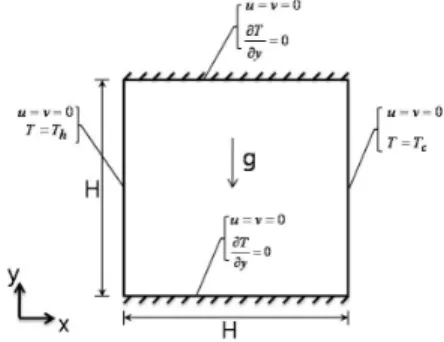
Consider a two dimensional square cavity as shown in Figure 1. The horizontal walls are assumed to be insulated whereas the left vertical walls is high temperature
(hot) and right vertical temperature is cold temperature
(cold). The non-dimensionalized velocity and temperature fields are defined as
∆
∆
The characteristic speed ∆ must be chosen carefully so that the low Mach number approximation holds in order to insure the problem is in the incompressible regime. For better approximation, the value ∆ should be less than about 0.1. Throughout the calculation, the lattice units are considered.
Figure 1: The schematic diagram of the computational configuration and coordinate system
For natural convection, the momentum and energy equations are coupled and the flow is driven by temperature or mass gradient, Under Boussinesq approximation, the force term per unit mass can be written as
(6)
The ratio of the buoyancy force to the product of viscous force and heat diffusion rates defined by the Rayleigh number,
Pr ×
∆
, where is the Grashof number, Pr is the Prandtl number. In order to assess the accuracy of this method, the result of LBM is verified with the conventional benchmark and with experimental results as shown in Figue 2 and 3
0 0.25 0.5 0.75 1
-0.4 -0.3 -0.2 -0.1 0 0.1 0.2 0.3 0.4
Present-LBM Krane & Jessee [4]-Exp Khanafer et al.[3]-Num
x/H
V- ve lo ci ty
0 0.25 0.5 0.75 1
0 0.2 0.4 0.6 0.8 1
Present-LBM Krane & Jessee [4]-Exp Khanafer et al.[3]-Num
x/H
T em per at ur e
Figure 2: Comparison of temperature and velocity
profiles for pure fluid (Pr=0.71,Ra=1.89×10
5).
0.2 0.4 0.6 0.8 1 -0.1
-0.05 0 0.05 0.1 0.15
Present-LBM Khanafer et al. [3]-Num
x/H
V -v el oc ity
0.2 0.4 0.6 0.8 1
0 0.2 0.4 0.6 0.8 1
Present-LBM Khanafer et al. [3]-Num
x/H
T em per at ur e
Figure 3: Comparison of temperature and velocity profiles for nanofluid (Pr=6.2, Gr=10
5,Φ=10%).
It can be seen from Figure 2 that our present numerical simulation has a good agreement with both numerical results of and experimental solutions of reference [4] for pure fluid (air, Pr=0.71). However, agreement is obtained between the present solution and bench mark solution of Khanafer [6] as illustrated in Figure 3 for H
2O-Cu nanofluids, the diameter of Cu nanoparticle is taken as 10 nm. This confirms that our method is correct both for pure and nanofluids.
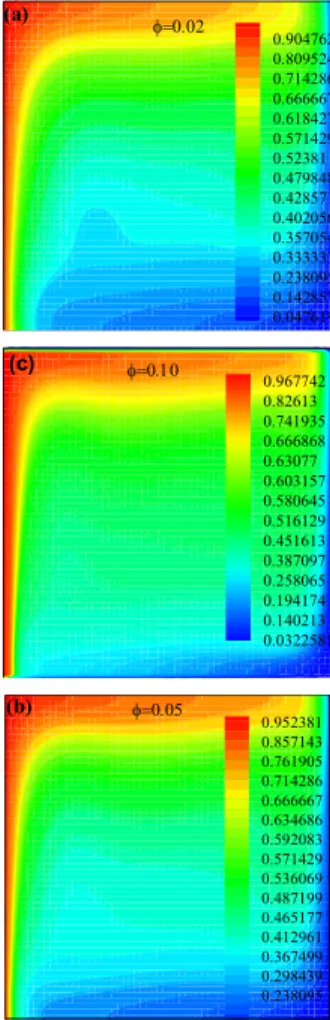
It is seen from Figure 4 and 5 that the non dimensional temperature of nanofluid increases remarkably in the core region with increasing the Rayleigh numbers and the particle volume fractions. The temperature drops very gradually from the value at the wall to the value at the center. For natural convection in a cavity, the rate of cooling is expected to be higher near the heated and unheated
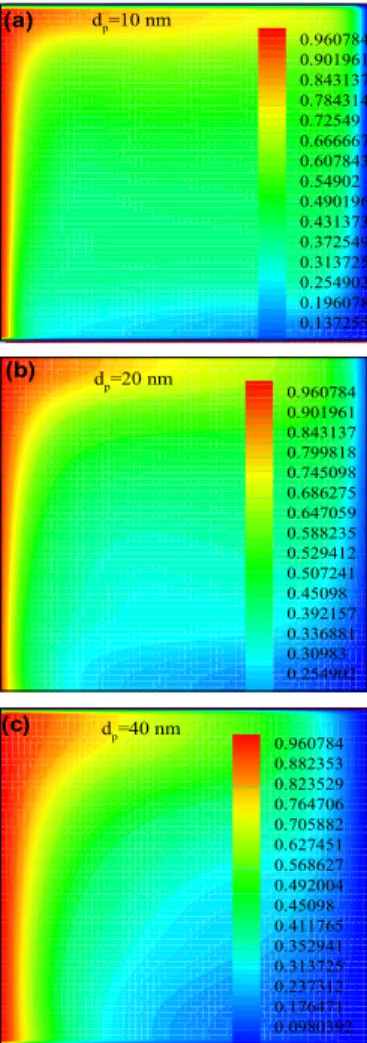
walls due to the fluid motion and hydrodynamics effects. This phenomenon is attributed to buoyancy-induced cellular flows in the boundary layer adjoining the heated and cold walls. On the other hand, Figure 6, it is observed that increasing the particle diameters causes the decreases of temperature distribution on the core regions. In addition, from the above figures, it is clear that the temperature profiles of nanofluid are similar to pure fluid. This suggested that nanofluid behave like the carrier fluid not as a solid fluid mixer.
0.904762 0.809524 0.714286 0.666667 0.618427 0.571429 0.52381 0.479848 0.428571 0.402056 0.357054 0.333333 0.238095 0.142857 0.047619 φ=0.02
(a)
0.967742 0.82613 0.741935 0.666868 0.63077 0.603157 0.580645 0.516129 0.451613 0.387097 0.258065 0.194174 0.140213 0.0322581
(c) φ=0.10
0.952381 0.857143 0.761905 0.714286 0.666667 0.634686 0.592083 0.571429 0.536069 0.487199 0.465177 0.412961 0.367499 0.298439 0.238095 φ=0.05
(b)
Figure 4: Temperature distribution with d=10nm and
Ra=105 for different particle volume fractions (Φ)
0.903226 0.806452 0.774194 0.709677 0.645161 0.580645 0.483871 0.419355 0.374976 0.345775 0.340388 0.334045 0.330491 0.322581 0.225806 Ra= 104
(a)
0.97561 0.90243 0.82926 0.75609 0.68292 0.60975 0.53658 0.46341 0.39024 0.31707 0.24390 0.17073 0.09756 0.02439 Ra= 105
(b)
0.97561 0.87804 0.78048 0.70653 0.60975 0.51219 0.41463 0.31707 0.24390 0.20028 0.14634 0.08792 0.02439 Ra= 106
(c)
Figure 5: Temperature contours for different Rayleigh numbers (Ra) with d=10nm and Φ=0.05
To investigate the heat transfer performance in terms of effective thermal conductivity of the nanofluid, the local Nusselt number
and the averaged Nusselt number are respectively defined in dimensionless form as follows:
and
where
and
are the thermal conductivity of the nanofluid and base fluid respectively.
0.960784 0.901961 0.843137 0.784314 0.72549 0.666667 0.607843 0.54902 0.490196 0.431373 0.372549 0.313725 0.254902 0.196078 0.137255 (a) dp=10 nm
0.960784 0.901961 0.843137 0.799818 0.745098 0.686275 0.647059 0.588235 0.529412 0.507241 0.45098 0.392157 0.336881 0.30983 0.254902
(b) d
p=20 nm
0.960784 0.882353 0.823529 0.764706 0.705882 0.627451 0.568627 0.492004 0.45098 0.411765 0.352941 0.313725 0.237312 0.176471 0.0980392 (c) dp=40 nm
Figuer 6: Temperature contours for different particle diameters (d) with Φ = 0.05 and Ra=10
5It is seen from Figure 7(a), the rate of heat transfer linearly increases with increasing the particle volume fractions.
As the volume fraction increases,
irregular and random movement of
nanoparticles increases energy exchange
rates in the fluid. However, it is not
observed for large particle diameter in
natural convection. It is noted that, the
surface area of nanoparticles enhances the
heat conduction of nanofluid, since heat
transfer takes place at the surface of
particles. Figure 7(b) has shown that, if
the Rayleigh number increased, the heat transfer rate also increased significantly due to higher convection heat transfer. It is obvious from above figures that nanofluids exhibit superior heat transfer characteristics to the convectional heat transfer fluids.
0 0.02 0.04 0.06 0.08 0.1 0.12 0
2 4 6
8 dp=10nm
dp=20nm dp=40nm
Particle volume fraction
N ussel tn um ber ,N u
(a)
0 0.02 0.04 0.06 0.08 0.1 0.12
2 4 6 8
Ra =104 Ra =105 Ra =106
Particle volume fraction
Nusseltnumber,Nu
Figure 7: Nusselt number (Nu) as a function of volume fraction for different (a) particle diameter, (b) Rayleigh number (Ra)
Figure 8: Comparisons of Cu-H
2O nanofluid with pure fluid (H
2O) for different Rayleigh numbers with dp=10nm and Φ=5%
Figure 8 represents the variation of the
average Nusselt number against Rayleigh number, product of Grashof number(Gr) and Prandtl number(Pr), for dp = 10nm with particle volume fraction Φ=0.05. For natural convection of base fluid, water, the numerical and experimental results are obtained by Leong et al.[14] and Wen and Ding [15] respectively. It is shown that the Nusselt number increases with Rayleigh number in the entire range of 10
4≤Ra≤10
6. Comparing with base fluid, it is observed that the enhancement of heat transfer in nanofluid significantly increases at low Rayleigh number. The enhancement rates of nanofluid heat transfer are 158% for Ra =10
4and 63%
for Ra=10
5respectively. However, for Ra=10
6, the enhancement rate is very small, approximately 3%, comparing with numerical works[14].
0 0.02 0.04 0.06 0.08 0.1 0.12
1 1.1 1.2 1.3
Ra=10
4Ra=10
5Ra=10
6Particle volume fraction k
nf/k
f(b)
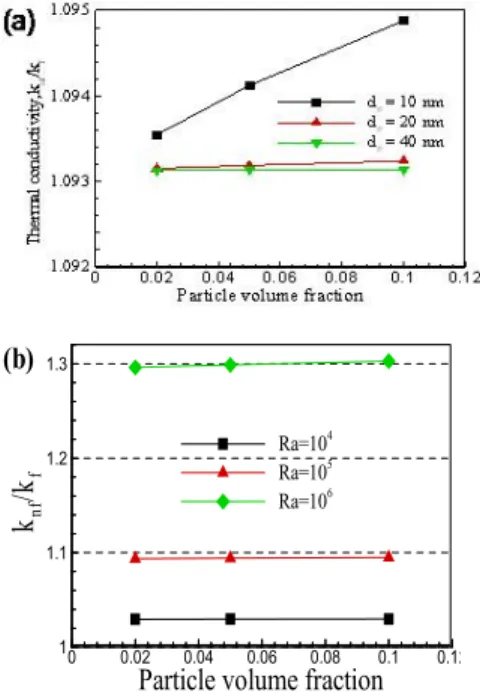
Figuer 9: Conductivity ratio versus volume fraction
for different (a) particle diameter, and (b) Rayleigh
number (Ra)
On the basis of the definition, the effective thermal conductivity for a two-component mixture (H
2O-Cu) is defined as
. Figure 9 shows the enhancement of thermal conductivity of nanofluid within the enclosure at different Rayleigh numbers, volume fractions as well as the particle diameters due to its practical applications.
It can be seen from Figure 9(a) that thermal conductivity is increased with increased of volume fraction. This increased is significantly changed for small particle diameter. The particle size is important factor in this case. Because, in natural convection flow, only buoyancy force is a dominant force, therefore particle movement is very important. The main problem for large size of particle is the rapid settling in the fluid. These problems are highly undesirable for many practical cooling industries. However, it is seen from Figure 9 (b) that the thermal conductivity of nanofluids can be enhanced with a factor 1.02, 1.09 and 1.29 for Ra=10
4,10
5,10
6respectively under the same particle volume fraction, Φ = 2%.
When the Rayleigh number (Ra) increases, two tends were observed for nanofluid: enhanced mixing of the hot and cold fluid, and increases the temperature gradient near the hot and cold walls. As a result the irregular and random movement of nanoparticles increases energy exchange rates in the fluid and consequently enhanced the thermal conductivity in the nanofluid.
4. Conclusions
In the present paper, the thermal
Lattice-Boltzmann Method (TLBM) is successfully applied to study buoyancy- driven heat transfer characteristics and flow performance of H
2O-Cu nanofluid in a square cavity. The suspended nanoparticles remarkably enhance heat transfer process and the nanofluid has larger heat transfer coefficient than that of the original base liquid under the same Raleigh number.
The present results indicate that the heat transfer rate of nanofluid increases with the increase of nanoparticles volume fraction as well as Rayleigh numbers.
However, it is significantly decreases, if the particle diameter increases. The enhancement rates of nanofluid heat transfer comparing with base fluid are 158% for Ra =10
4and 63% for Ra=10
5respectively. However, for Ra=10
6, the enhancement rate is very small, approximately 3%, comparing with numerical works. In addition, in the same range of buoyancy parameter, the thermal conductivity enhanced 26% with the same particle volume fraction. The results from our analysis shows that LBM can be a good tool to investigate nanofluids and heat trasfer enhancement plays a significant role in engineering applications such as in the electronic cooling industries or MEMS devices.
Acknowledgement
This research was supported by the Post BK21 project of Ministry of Education, Science & Technology.
Reference
[1] S. Lee, S. U. S. Choi, S. Li and J. A.
Eastman, “Measuring thermal conductivity
of fluids containing oxide nanoparticles”, Transactions of the ASME, vol. 121, pp. 280-289, 1999.
[2] Y. Xuan and Q. Li, “Heat transfer enhancement of nanofluids”, Int. J.
Heat and Fluid Flow, vol. 21, pp.
58-64, 2000.
[3] S. Saravanan, A. K. Abdul Hakeem, P. Kandaswamy and J. Lee,
“Buoyancy convection in a cavity with mutually orthogonal heated plates”, vol.55, pp. 2903-2912, 2008.
[4] R. J. Krane and J. Jessee, “Some detailed field measurement for a natural convection flow in a vertical square enclosure”, Proceedings of the first ASME-JSME thermal engineering joint conference, vol. 1, pp. 323-329, 1983.
[5] C. H. Cheng and C. L. Chen,
“Buoyancy-induced periodic flow and heat transfer in lid-driven cavities with different cross-sectional shapes”, vol. 32, pp.483-490, 2005.
[6] K. Khanafer, K. Vafai and M. Lightstone,
“Buoyancy-driven heat transfer enhancement in a two-dimensional enclosure utilizing nanofluids”, Int. J.
Heat and Mass transfer, vol. 46, pp.
3639-3653, 2003.
[7] S. K. Das, S. U .S. Choi, W. Yu and T. Pradeep, Nanofluids, Science and Technology, Wiley Interscience, 2007.
[8] X. Shan, and H. Chen, “Lattice Boltzmann model for simulating flows with multiple phases and components”, Physical Review E, vol. 47, no. 3, pp.
1815-1820, 1993.
[9] N. S. Martys and H. Chen, “Simulation of multicomponent fluids in complex
three-dimensional geometries by the lattice Boltzmann method”, Physical Review E, vol. 53, no. 1, pp. 743-750, 1996.
[10] X. Shan, “Simulation of Rayleigh - Bernard convection using Lattice Boltzmann method”, Physical Review E, vol. 55, no.3, pp. 2780-2788, 1997.
[11] J. M. Buick and C. A. Greated,
“Gravity in lattice Boltzmann model”, Physical Review E, vol. 61, No.5, pp.5307-5320, 2000.
[12] Y. Xuan and Z. Yao, “Lattice Boltzmann model for nanofluids”, Heat Mass Transfer, vol. 41, pp. 199-205, 2005.
[13] Y. Xuan, K. Yu and Q. Li,
“Investigations of flow and heat transfer of nanofluids by the thermal lattice-Boltzmann model”, Prog.
Computational fluid Dynamics, vol. 5, no. 1/2, pp. 13-19, 2005.
[14] W. H. Leong, K. G. T. Hollands and A. Brunger, “Experimental Nusselt numbers for a cubical-cavity benchmark problem in natural convection”, Int. J.
Heat Mass Transfer, vol. 42, pp.
1979-1989, 1998.
[15] D. Wen and Y. Ding, “Natural convective heat transfer of suspensions of titanium dioxide nanoparticles (nanofluids), IEEE Transactions on nanotechnology, vol. 5, no. 3, pp.
220-227, 2006
Author Profile
M.A.Taher
He graduated (B. Sc. 1997 and M. Sc.
1998) in Applied Mathematics from the University of Rajshahi, Bangladesh. He received Ph.D. Degree from Pukyong National University(2009) in Korea. He has been serving as a assistant professor of Mathematics Dept. in Dhaka University of Engineering & Technology(DUET) in Bangladesh since 2004.
Kui-Ming Li
He graduated (B. Sc.2003) in mechanical engineering from JiLin University, JiLin, China, At present, he has been studying as a M. Sc. student.
School of Mechanical Engineering (CFD
& Energy laboratory) in Pukyong National University, Busan, Korea.
Yeon-Won Lee
He graduated from Kyungpook National University (B.E. 1981, M.S. 1983)in Korea. He received his Ph.D degree from the University of Tokyo(Doctor of Engineering 1993) in Japan. He worked at POSCO E&C for 3 years as a team Leader of Division of Mechanical Design. He visited the Institute of Industrial Science of the University of Tokyo as a visiting professor in 1997. He has been serving as a professor of the School of Mechanical Engineering in Pukyong National University since 1993. His research interests are CFD including various energy problems and engineering education.