Acupuncture for Rehabilitation in Patients with Traffic Accident in South Korea: a Systematic Review
Kim Kun-hyung, Nam Dong-woo, Kang Jung-won, Lee Jae-dong and Choi Do-young
Department of Acupuncture and Moxibustion, College of Oriental Medicine, Kyung Hee University
Objectives : This study aims to evaluate current clinical evidence of acupuncture treatment for rehabilitation in patients with traffic accident in South Korea.
Methods : Seven Korean databases were searched for prospective clinical trials for acupuncture on rehabilitation in patients with traffic accident from their inception to June, 2009. Only studies conducted in Korean language were searched. Risk of bias in included randomized controlled trials were assessed by Cochrane Handbook procedure.
Results : Fifteen clinical trials were included among 31 studies searched. Eight were observational studies, five were non-randomizedcontrolled trials, and two were randomized controlled trials. In all of included studies, acupuncture were conducted with other concomitant treatment. Included studies dealt with such conditions as neck pain, low back pain tinnitus after traffic accident, post-traumatic stress, oculomotor nerve palsy, diplopia and insomnia. All of included studies reported favorable effects of acupuncture group compared to baseline or control group. All of included studies lacked the occurrence of adverse events. High risk of bias were observed in two randomized controlled trials.
Conclusions : There is no evidence that acupuncture is effective for rehabilitation of traffic accident.
All of included studies lacked appropriate methodological qualities and internal validity. Future well- designed clinical trials that evaluate the effects and safety of acupuncture treatment for rehabilitation in patients with traffic accident is needed.
Key words : Acupuncture, rehabilitation, traffic accident, car accident, whiplash injury
1)
국내 교통사고 후유증의 침치료에 대한 체계적 문헌고찰
김건형․남동우․강중원․이재동․최도영
경희대학교 한의과대학 침구학교실
․접수 : 2009. 11. 10. ․수정 : 2009. 12. 2. ․채택 : 2009. 12. 3.
․교신저자 : 최도영, 서울시 동대문구 회기동 1 경희의료원 한방병원 침구과 Tel. 02-958-9196 E-mail : [email protected]
원 저
Abstract
Ⅰ. 서 론
자동차가 현대사회의 주요한 교통수단이 된 이후, 교통사고 역시 꾸준히 증가하여 왔으며, 우리나라의 경우 1990년대 이후 매년 20만 건 이상 꾸준히 교통 사고 발생률이 증가하여 왔다
1). 현재 교통사고 급성 기의 발생 증상 및 손상의 진단과 치료는 양방의료기 관에서 일차적으로 담당하고 있다. 그러나 급성기 치 료 후 신체적⋅정신적 후유증의 관리 및 재활에는 다 양한 치료방법으로 구성된 최적화된 프로그램을 통하 여 환자의 효과적 증상관리 및 삶의 질 향상을 도모 하고, 사회적 손실을 최소화하는 것이 필요하다
2). 교 통사고로 인한 후유증의 경우 장기간 증상이 지속되 는 경우가 많은데, 한의학에서는 이러한 증상들에 대 하여 어혈의 범주로 관리하고, 통기활혈의 방법으로 치료해왔다
3). 현재 교통사고 치료에 대한 한방의료보 험이 일부 적용되고 있으며 향후 교통사고 후유증의 한의학적 치료는 더욱 증가할 전망이지만
4), 이에 대 한 체계적인 임상근거의 평가 및 바람직한 진료지침 의 제시는 아직 이루어지지 않은 상황이다.
우리나라에서 침치료는 한의학적 치료의 주요 부 분으로, 2008년 2,000명의 성인을 대상으로 한 전국적 온라인 설문조사에서 설문대상자의 총 60%가 최근 3 년간 한방치료를 받은 경험이 있으며, 그 중 82%가 침치료를 받아본 경험이 있다고 보고하였다
5). 또한 침치료는 만성통증 및 장기간 지속되는 후유증상의 관리에 다양하게 적용되고 있어, 교통사고 후유증의 한의학적 관리법에서 필수적인 치료방법이다. 따라서 최적의 교통사고 후유증 치료 프로그램 구성을 위해 서는, 침치료의 효과 정도 및 비중에 대한 임상적 근 거가 마련될 필요가 있으나, 현재까지 이루어지지 않 은 상황이다. 이에 본 논문에서는 교통사고 후유증에 대한 기존의 침치료 임상연구들에 대하여 체계적 고 찰을 수행함으로써 현재의 임상근거들을 평가하고, 향후 연구에서 유의할 점들에 대해 토론하고자 한다.
Ⅱ. 대상 및 방법
1. 검색방법
관련문헌의 검색은 각 데이터베이스의 자료제공일
및 저널 발행일로부터 2009년 6월까지 발간된 논문을 대상으로 시행하였다. 전자검색은 국내 의학논문의 원 문 및 서지사항을 제공하는 데이터베이스 7개(Korean Studies Information, DBPIA, Korea Institute of Sci- ence and Technology Information, KoreaMed, RISS4u, National Assembly Library, Oriental Medicine Ad- vanced Searching Integrated System)를 기반으로 시 행하였다. 검색어는 ‘침’ AND ‘교통사고’로 하였다. 또 한 검색된 원문의 참고문헌 및 관련된 원문 역시 필 요 시 추적하여 수기 검색하였다.
2. 원문 선정기준
국내에서 발간되었으며, 교통사고 후 발생한 모든 후유증상에 대한 무작위 대조군 연구, 비무작위 대조 군 연구, 사례군 연구, 증례보고 등 모든 형태의 전향 적 침치료 임상연구가 선정되었다. 침치료는 수기 침, 전기침, 약침 등 바늘 형태의 침을 사용하여 경혈을 관통한 모든 방법을 포함하였으며, 침치료 단독 혹은 한약 등 기타 한의학적 치료와 동반된 경우도 모두 포함하였다. 초록만 제공되는 경우라도, 본 분석에 필 요한 정보가 포함되어 있을 경우 선정하였다.
3. 자료추출 및 비뚤림 위험 평가
자료 추출은 2명의 저자(김 및 남)에 의해 수행되 었으며, 추출된 자료의 전문 및 전문이 불가능할 경우 초록을 읽고 분석하였다. 무작위 대조군 연구의 경우, Cochrane Handbook의 비뚤림 위험(risk of bias) 평가법 을 사용하였다
6). 비뚤림 위험은 선택비뚤림(selection bias), 실행비뚤림(performance bias), 탈락비뚤림(attrition bias), 결과확인비뚤림(detection bias), 및 보고비뚤림 (reporting bias) 등 총 5개의 영역에서 평가를 시행하 였다. 비뚤림 위험이 적은 경우 ‘Yes’, 비뚤림 위험이 큰 경우 ‘No’, 주어진 자료로는 판단이 불가능할 경우
‘Unclear’로서 각 문헌의 비뚤림 위험을 표기하였다.
Ⅲ. 결 과
1. 검색 및 분석결과
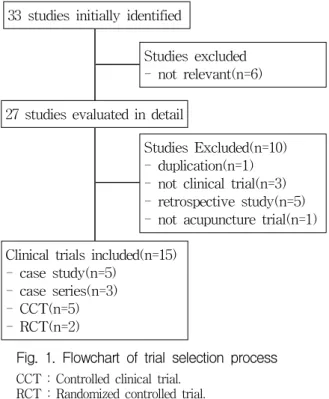
총 33건의 원문이 초기 검색되었다(Fig. 1). 이 중
총 15개의 임상연구가 최종 선정되었다. 연구 디자인
Studies excluded - not relevant(n=6)
Studies Excluded(n=10) - duplication(n=1) - not clinical trial(n=3) - retrospective study(n=5) - not acupuncture trial(n=1) 33 studies initially identified
27 studies evaluated in detail
Clinical trials included(n=15) - case study(n=5)
- case series(n=3) - CCT(n=5) - RCT(n=2)
Fig. 1. Flowchart of trial selection process
CCT : Controlled clinical trial.RCT : Randomized controlled trial.
상 증례연구(case study) 5건
7-11), 사례군 연구(case- series) 3건
12-14), 비무작위배정 대조군 연구(non ran- domized controlled trial ; non-RCT) 5건
15-19), 무작위 배정 대조군 연구(randomized controlled trial ; RCT)
2건
20,21)이 포함되었다. 포함된 임상연구는 2001년 1건,
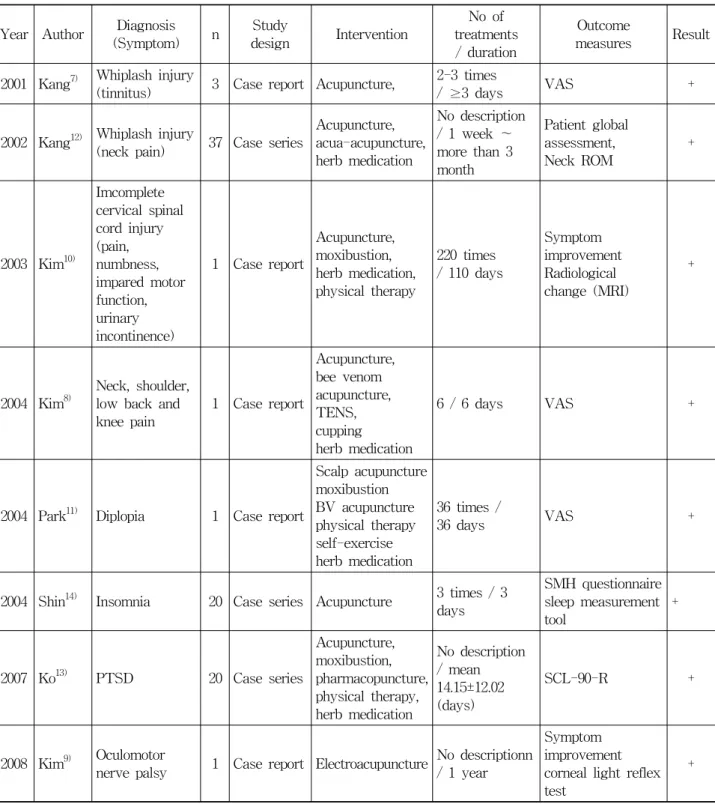
2002년 1건, 2003년 1건, 2004년 4건, 2005년 2건, 2007년 5건 및 2008년 1건 수행되었다. 각 임상연구에 대한 주요 분석내용은 Table 1, 2에 요약하여 제시하 였다.
2. 증례 연구 및 사례군 연구
총 8건의 연구가 분석되었으며 이는 Table 1에 표 시되어 있다.
1) 진단 및 증상
증례 연구 및 사례군 연구의 대상 진단명 및 증상 으로 경추부 척수손상(n=1), 경항통(n=2), 이명(n=1), 복시(n=1), 불면증(n=1), 마비성 사시(n=1), 교통사고 후 외상성 스트레스 장애(n=1) 등이 있었다.
2) 치료법
8건의 연구 중 7건의 연구에서 침 및 기타 한의학 적 치료법의 병행을 보고하였으며
7,8,10-13,14), 1건의 연
구에서 전침치료 단독시행이 보고되었다
9). 7건의 연 구에서 병행한 한의학적 치료법은 뜸, 부항, 물리치료, 운동요법, 봉독약침 및 기타 약침, 한약투여 등으로 다양하였다.
3) 치료 및 관찰기간
치료 및 관찰기간은 3일 이하에서 1년까지 다양하 였다.
4) 평가도구
8건의 연구 중 2건에서 타당도 검사가 된 체계화된 설문지를 사용하였다
13,14). 나머지 6건에서는 환자의 주관적 증상 호전을 비구조화된 임상경과보고 및 시 각상사척도 등을 통해 보고하였다. 2건의 연구에서는 환자의 임상경과에 MRI상 경추부 척수손상정도 및 안구운동검사의 변화 추이 등을 함께 제시하였다
9,10).
5) 치료 결과
8건의 관찰연구 모두 침치료 및 한의학적 치료 이 후 증상이 호전되었음을 보고하였다.
6) 이상반응 보고
8건의 관찰연구 모두에서 이상반응 발생 여부에 대한 보고는 이루어지지 않았다.
3. 대조군 연구
총 7건의 연구가 분석되었으며 이는 Table 2에 제 시되어 있다.
1) 진단 및 증상
대조군 연구의 진단명 및 증상으로, 편타성 손상 (Whiplash injuries)에 의한 경항통(n=4 for non-RCT, n=2 for RCT)
15-17,19-21)및 교통사고 후 요통(n=1 for non-RCT)
18)등이 있었다.
2) 치료법
7건의 모든 대조군 연구에서, 치료군의 치료법은
다양하게 병행되었으며, 한 연구 내에서 시행된 치료
내용은 2가지에서 5가지까지 다양하였다. 치료군에
제공된 치료법의 종류는 침, 전기침, 부항, 봉독약침,
기타약침, 한약투여, 물리치료 등이었다.
Year Author Diagnosis
(Symptom) n Study
design Intervention No of treatments / duration
Outcome
measures Result
2001 Kang
7)Whiplash injury
(tinnitus) 3 Case report Acupuncture, 2-3 times
/ ≥3 days VAS +
2002 Kang
12)Whiplash injury
(neck pain) 37 Case series Acupuncture, acua-acupuncture, herb medication
No description / 1 week ~ more than 3 month
Patient global assessment,
Neck ROM +
2003 Kim
10)Imcomplete cervical spinal cord injury (pain, numbness, impared motor function, urinary incontinence)
1 Case report
Acupuncture, moxibustion, herb medication, physical therapy
220 times / 110 days
Symptom improvement Radiological change (MRI)
+
2004 Kim
8)Neck, shoulder, low back and
knee pain 1 Case report
Acupuncture, bee venom acupuncture, TENS, cupping herb medication
6 / 6 days VAS +
2004 Park
11)Diplopia 1 Case report
Scalp acupuncture moxibustion BV acupuncture physical therapy self-exercise herb medication
36 times /
36 days VAS +
2004 Shin
14)Insomnia 20 Case series Acupuncture 3 times / 3 days
SMH questionnaire sleep measurement
tool +
2007 Ko
13)PTSD 20 Case series
Acupuncture, moxibustion, pharmacopuncture, physical therapy, herb medication
No description / mean 14.15±12.02 (days)
SCL-90-R +
2008 Kim
9)Oculomotor
nerve palsy 1 Case report Electroacupuncture No descriptionn / 1 year
Symptom improvement corneal light reflex test
+
VAS : visual analogue scale. PTSD : post-traumatic stress disorder. ROM : range of motion. SCL-90-R : symptom check list 90-Revision. TENS : transcutaneous electrical nerve stimulation. MRI : magnetic resonance imaging. SMH : Saint Mary Hospital.
+ : positive results.
Table 1. Summary of Uncontrolled Observational Studies of Acupuncture for Patients with Traffic Accident
3) 대조군 설정
대조군으로 무처치 대기군을 설정한 1건의 무작위 대조연구
20)외 6건의 연구에서 3~4가지의 다양한 치
료법이 병행되었다
15-19,21). 대조군 내 사용된 치료법은,
체침, 전기침, 한약투여, 부항, 물리치료, 생리식염수
주입, 추나치료 등이었다. 2건의 무작위대조연구에서
Year /
Author Diagnosis
(Symptom) Design Allocation
Method n Treatment
intervention Control intervention
No of treatments
/ duration Outcomes Results
2004 /
Lee
18)LBP CCT Not reported 60
Acupuncture (Eo-Hyeol Bang) Herb medication Cupping Physical therapy
Body- acupuncture Herb medication Cupping Physical therapy
Not reported / 10 days
VAS symptom improvement index
T>C, p=0.033
2005 / Park
15)Whiplash injury (neck pain)
CCT Not reported
33 (T : 18,
C : 15) BV
acupuncture Cupping Physical therapy
Acupuncture Cupping Physical therapy
T : 4~12 / 8~21 days C : 7~22 / 14~42 days
VAS symptom grade
T>C (in symptom grade) p (not reported)
2005 / Seol
16)Whiplash injury (neck pain)
CCT Not reported
60 (T : 24,
C : 36)
JSO herbal- acupuncture Acupuncture Cupping Herb medication Physical therapy
Acupuncture Cupping Herb medication Physical therapy
5 / 5 days VAS symptom grade
T>C, p=0.003
2007 / Song
17)Whiplash injury (neck pain)
CCT Not reported
60 (T : 30,
C : 30)
Acupuncture (Eo-Hyeol Bang) Herb medication Chuna Infrared
Body- acupuncture Herb medication Chuna Infrared
8 / 28 days VNRS NDI T=C, p>0.05
2007 / Chang
19)Whiplash injury (neck pain)
CCT Not reported
44 (T : 24,
C : 20)
Herbal- acupuncture Herb medication Electroacupu ncture Physical therapy
Manual- acupuncture Herb medication Electroacupu ncture Physical therapy
Not reported / T : mean 18.80±11.38 days, C : mean 20.41±9.49 days
VAS ROM
T>C, p<0.05 (in mean reduction of VAS)
2007 / Kim
20)Whiplash injury (neck pain)
RCT Not reported
35 (T : 23,
C : 8) BV
Acupuncture Waiting list 8 / 28 days VAS SF-36
T>C, p<0.05 (only in PF and RLP)
2007 / Song
21)Whiplash injury (neck pain)
RCT Not reported
25 (T : 15,
C : 10) SBV Acupuncture Herb medication Physical therapy
NS injection Acupuncture Herb medication Physical therapy
5 / not
reported VAS ROM
T>C, p=0.002 (in mean reduction of VAS)
CCT : controlled clinical trial. RCT : randomized controlled trial. T : treatment group. C : control group. JSO : jungsongouhyul.BV : bee venom acupuncture. SBV : sweet bee venom acupuncture. NS : normal saline. VAS : visual analogue scale. VNRS : verbal numerical rating scale. NDI : neck disability index. ROM : range of motion. RLP : role limitation physical.
Table 2. Summary of Controlled Clinical Trials of Acupuncture in Patients with Traffic Accidents
는 무처치 대조군 1건
20), 봉독약침에 대한 생리식염수 침 및 기타 병행치료 대조군 1건이 있었다
21).
4) 치료 및 관찰기간
치료 및 관찰기간은 5일에서 최장 42일까지 다양 하였다.
5) 평가도구
Visual analogue scale(VAS) 및 verbal numerical rating scale(VNRS)가 7건의 모든 연구에서 사용되었다.
경추가동범위(range of motion ; ROM)(n=2)
19,21), 증상호전 정도(n=3)
15,16,18), SF-36 삶의 질 설문지(n=1)
20), neck disability index(NDI)(n=1)
17)등이 병행 사용되었다.
6) 치료 결과
7건의 대조군 연구 중 6건에서 시험군이 대조군에 비해 통계적으로 유의한 호전반응이 있었음을 보고하
였다
15,16,18-21). 그러나 평가변수의 측정시점 및 전체 치
료횟수가 명확히 본문에 제시되지 않은 연구들이 있 었다(n=3)
18,19,21). 편타성 손상 환자의 치료에 대한 6건 의 논문에서, 봉독약침 및 약침치료는 침치료, 생리식 염수 주입, 무처치 대기군에 비해 통계적으로 유의한 호전반응이 있다고 보고되었다
15-17,19-21). 사암침법 어 혈방 치료는 일반 침치료에 비해 교통사고 후 요통치 료에서 유의한 호전반응을 보였으나
18), 편타성 손상에 대하여는 그렇지 않았다고 보고되었다
17).
7) 이상반응 보고
7건의 연구에서 단 1건만이 침치료 후 이상반응이
Kim
(2007)
20)Song (2007)
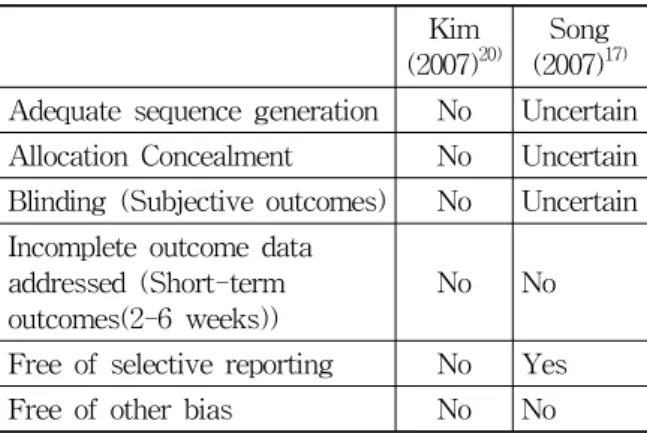
17)Adequate sequence generation No Uncertain Allocation Concealment No Uncertain Blinding (Subjective outcomes) No Uncertain Incomplete outcome data
addressed (Short-term
outcomes(2-6 weeks)) No No Free of selective reporting No Yes Free of other bias No No
Yes means low risk of bias. No means high risk of bias. Uncertain means uncertain risk of bias6).
Table 3. Summary of ‘Risk of Bias’ in Inculded RCTs
없었음을 보고하였다
16). 나머지 연구에서는 안전성 평 가가 이루어지지 않았다.
4. 무작위대조군연구의 연구방법론 및 보고의 질