Invader Detection System Using the Morphological Filtering and Difference Images Based on the Max-Valued Edge Detection Algorithm
Jae-Hyun Lee†․Sungshin Kim1․Jung-Min Kim2 (Received May 21, 2012; Revised June 25, 2012; Accepted July 19, 2012)
Abstract:
Recently, pirates are infesting on the sea and they have been hijacking the several vessels for example Samho Dream and Samho Jewelry of Korea. One of the items to reduce the risk is to adopt the invader detection system. If the pirates break in to the ship, the detection system can monitor the pirates and then call the security alarm. The crew can gain time to hide to the safe room and the report can be automatically sent to the control room to cope with the situation. For the invader detection, an unmanned observation system was proposed using the image detection algorithm that extracts the invader image from the recording image. To detect the motion area, the difference value was calculated between the current image and the prior image of the invader, and the ‘AND’ operator was used in calculated image and edge line. The image noise was reduced based on the morphology operation and then the image was transformed into morphological information. Finally, a neural network model was applied to recognize the invader. In the experimental results, it was confirmed that the proposed approach can improve the performance of the recognition in the invader monitoring system.Key w ords:
Image detection, Morphology, Invader detection and recognition†Corresponding Author (Korea Maritime University, E-mail: [email protected], Tel: 051-410-4254)
1 School of Electrical and Computer Engineering, Pusan National University, E-mail: [email protected], Tel:
051-510-2374
2 School of Electrical and Computer Engineering, Pusan National University, E-mail: [email protected], Tel:
051-510-2367
1. Introduction
Recently, the ships have been frequently hijacking by the pirates and this should be a serious nuisance to the governments. For example, Samho Dream and Samho Jewelry were hijacked by the Somalia pirate and some crews were injured and finally the mother company, Samho Shipping Company filed for receivership. Therefore, any solution is urgently needed to reduce the shipping risk occurring by the pirates. In this study, the invader detection system is proposed to solve the pirate problem.
High-performance intrusion detection systems are required to cope with intellectual crimes. And for the high-performance, expensive hardwares and
complicated softwares are necessary in the invader inspection system. Therefore, the kinds of the systems have been usually installed and operated in the financial companies [1]. However, recently, because importance of the security system is increasing, the surveillance systems are broadly applied.
To develop the surveillance system, several methods have been applied but the light effect is still problem. To reduce the light effect, the variable background image was used based on the light variation with the threshold value [2] and in the other study, the fuzzy binarization technique was applied to extract the light color from the target image [3]. In the case that it is difficult to
remove the background noise, ancillary instruments have been used. Sound source tracking sensor [4]
or motion sensor [5] was adjunctively employed to improve the performance. And aside from the above approaches, prediction of the long-term motion of the invader was utilized to track the geometric path of the invader [6].
The several studies related to the feature extraction for the surveillance system consist of two major approaches. In the first method, specific features are extracted from a moving object that is separated from an original image and then the system detects whether intrusion happens or not.
This method can be available when objects or people don’t hide. In the second method, time base features such as movement of the invader are applied for invader detection because the surface shape of the invader can be changed with respect to time varying. The above applications require a high computation work and a mathematical approach, that is, the simulation can be achieved by complicated procedures or algorithms based on non-real-time methods. In particular, image processing algorithms, post-image processing algorithms, and detection algorithms require at least over two DSP(Digital Signal Processor). In the image processing algorithm, whole image data containing color and brightness information are used and in the post-image processing algorithm, high computation procedures are applied such as labeling, clustering, and matching. And iterated computing is required for the detection algorithms such as Hidden Markov Model, Kalman Filter, and others. In the invader detection system, the algorithm has to be embedded in small and cheap hardware for real-time application. And the traditional image processing methods have some problems that show not good performance under varying object conditions such as noise change and human movement.
To solve the above problems in this study, a cheap PC-camera (camera for a personal computer) was used for invader detection and recognition. The proposed tracking algorithm consists of the three steps. In the first step, the proposed motion detection method is used to detect a moving object and in the second step, motion of the human or background is detected and feature information is extracted from the detected image. In the final step, the extracted information is used in neural network models to recognize the invader. The neural network models applied in this study are feedforward networks and a back-propagation algorithm is used for training. The final goal of the study is to construct the real-time invader detection and recognition system that can inform the invading situation to the ship crews promptly.
In this manuscript, Section 2 shows research trend and problems of the motion detection, Section 3 describes traditional motion detection methods for invader detection. Section 4 explains the invader monitoring application proposed in this study and Section 5 shows the experimental results of the proposed approach. The conclusions are summarized in Section 6.
2. Literature Survey
In this section, traditional researches and algorithms for detection and tracking of the motion objects, and extraction of the motion are introduced. In particular, classification approaches with respect to input images in motion extraction and tracking the motion will provided. Advantages and disadvantages of PC-camera used in this study for invader detection and research trend of the invader detection systems based on difference images are compared and represented in this section. Finally, major techniques of the motion detection using blocking are evaluated. From the comparison, the critical problem in the motion
detection methods will be defined [2].
2.1 Motion Detection Methods
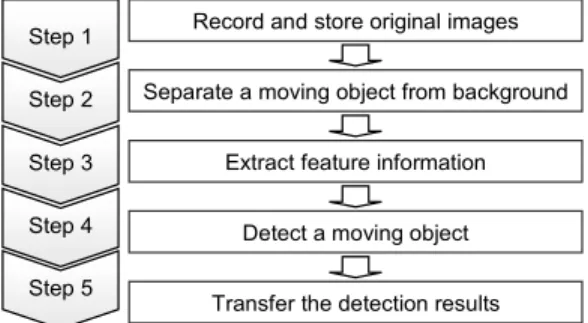
The traditional procedure for feature extraction and detection from the moving objects is shown in Figure 1. Feature extraction and detection from the moving object can be generally achieved by the five steps. First, images are acquired using a camera and in the second stage, a moving object is separated from a background using difference image between a current image and a prior image of the recording images. In the third stage, feature information is extracted from the separated area. In the fourth stage, the moving object is detected based on the extracted feature. And finally, the recognition result of the moving object from the fourth stage is informed to the user.
Record and store original images Separate a moving object from background
Extract feature information Detect a moving object Transfer the detection results Step 1
Step 2 Step 3 Step 4 Step 5
Figure 1: Detection and recognition algorithm
In this section, the research trend is introduced based on major factors of the extraction and detection system of the moving object [7]. The purpose of this section is to compare the several motion detection methods focusing on advantages and disadvantages of the methods.
2.1.1 Classification based on input image type In the extraction and detection researches of the moving object, different features can be extracted from initial images with respect to the image acquisition methods. In the research, the input
image is extracted by the three popular methods that use a gray scale image [8-12], a distance [13], and an infrared ray [14-15].
Input images used in this study are CCD types recorded by a PC-camera, and YUV (Ycbcr) color typed and 320 by 240 sized color images. As comparing to other types of the sensors, this algorithm requires cheaper equipment and provides high accuracy in detection performance because it gathers shape, brightness, and color information that is the same with human’s eye view. However, the problems of the computation load and treatment speed still exists. The proposed algorithm in this study will solve the processing load of the color images and improve reliability of the detection performance.
2.1.2 Classification using feature information Significant feature information is necessary to detect well the moving object for extraction and detection of the moving object from the acquisition image. Feature information includes the geometric feature of the moving object [8-11] and the motion feature during the fixed time interval [12-13]. The features can be used together because the combined algorithm provides high reliability for detection and tracking of the moving object.
In general studies, invader and background images can be classified by motion information, but it is difficult to detect object’s motion correctly owing to several unexpected motions such as non-targeted human beings and noise signals. To solve the problem, morphological feature information extracted from motion information was used for neural network inputs that can improve performance of detection and classification.
2.1.3 Classification using detection method Object detection methods are closely related to extracted feature information and extraction
methods. Therefore detection methods can be different corresponding to the feature type and extraction method. In special, special purpose systems can separate the moving object from the background and detect the moving object without the significant boundary in the separation and detection stage. Today, HMM(Hidden Markov Model), fuzzy logic, and neural networks are broadly studied [8, 10].
Non-linear classification methods are necessary to detect an invader whose shape is frequently changed based on a PC-Camera, but the traditional methods cannot guarantee good performance due to the variation of the invader motion. To solve the problem in this study, neural network models with a BP(Back-Propagation) learning rule were applied to detect and identify the several shapes of the invaders from the background noises.
2.2 Classification of Motion Detection Algorithms Using difference images between the current flame and the time past flame(prior image) is a major method of the motion detection that can detect moving objects from time-series images. The second method is to separate the current image and the background image(zero time images) and to detect the moving objects. Using blocks is also a method of the movement detection and several methods are used for motion detection under specific environment and purposes.
In this section, two methods using difference images and blocks are introduced that are most general methods in motion detection [16].
2.2.1 Motion Detection using difference image This method uses difference of the pixel value between a current frame and a prior frame of the image and then statistical feature of the difference image is used for motion detection [17-18]. A motion detection algorithm using a difference image
can obtain many information of the pixel because this directly uses the pixel values. But it requires a large memory size than a block algorithm and it is sensitive to the camera noise and environment change because this method stores all pixel value.
Therefore the appropriate algorithm and feature in motion detection are essentially applied that can adapt to the environment condition and target object.
Figure 2 shows a general motion detection method using difference images. The motion detection method using the difference image can obtain information of each pixel owing to using the pixel values between both images and can detect motion using many statistical features of the difference image. However, it requires huge memory sizes relatively than the block based algorithm because whole pixel values of the initial images are stored in the algorithm and can sensitively react to noises of the camera or environment changes because of pixel based computation. Therefore, suitable features and algorithms are essential for motion detection corresponding to the environment conditions and application purposes [16].
In the motion detection algorithms using difference images of the past researches, the three typical algorithms have been proposed that use time variation of the pixel value, histogram for features, and adaptive real-time operation(modify the first method). This study modifies the motion detection algorithms using difference images and improves the sensitivity and computation speed of the motion detection algorithm by only using the highest varied color in the RGB color model.
Image subtraction Previous frame (t-1)
New frame (t)
Feature 1>Threshold 1
Feature n>Threshold n
••• Motion
recognition
Figure 2: Motion detection using difference images.
2.2.2 Motion Detection using blocks
The frame memory is not necessary in the feature extraction method using the block and it is necessary that block features of the initial image are just stored. And this method has low effect to the noise and is not sensitive to camera shaking than the motion detection method using the difference image. But detection accuracy and performance can be changed with respect to the block size, so accuracy and correlation analysis corresponding to the change of the block size is required. This method has a speed problem for algorithm calculation in real-time application [17], [19].
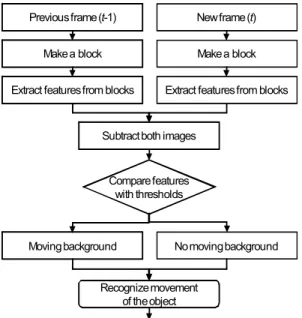
Figure 3 shows a general motion detection algorithm using the blocks. In block based feature extraction, block based features of the initial images and the current images are just compared, so frame memories are not necessary and block features of the initial images are just required to be stored.
And the feature average value of the block based features can reduce noise effects of the whole image than the feature average value of the pixel
Previous frame (t-1) New frame (t)
Make a block Make a block
Extract features from blocks Extract features from blocks
Compare features with thresholds
Moving background No moving background
Recognize movement of the object Subtract both images
Figure 3: Flow chart using movement detection.
based difference image. But in the block based motion detection algorithm, the block size can play an important role. If the size is too small, it is difficult to extract the statistical feature of the moving objects, on the contrary, it is too big, it is impossible to detect motion of the object that is moving for a long time in the block [19]. Finally, accuracy of motion detection is dependent on the block size, thus, analysis of the accuracy and correlation corresponding to variation of the block size is necessary and the problem of the computation speed exists in the disadvantage of the algorithm.
3. Conventional Approach for Invader Detection
3.1 Conventional Motion Detection Method
A PC-Camera is cheap equipment based on a digital processing type and strong to motion detection, but in the motion detection algorithm, complete detection of the motion area is dependent on how to separate the motion area from the initial image such as a background area. This phenomenon can be occurred by a whit noise that is generated by small numbers of the pixel variation of the background area caused by lighting variation.
To track the moving object, firstly, a moving object has to be detected and segmented with a background area in the image. Continuous images and derivative of the images for calculating variation of the pixel intensity are used to detect motion from the images recorded continuously using a camera [20]. In this section, the traditional algorithm and the proposed algorithm in this study will be compared and analyzed. The initial image used in this study is shown in Figure 4. The figure shows time-based images that are applied in the invader detection algorithm.
(a) Background image (b) Image at the past time
(c) Image at the current time
Figure 4: Initial CCD images for this experiment
3.1.1 Motion area detection using background image
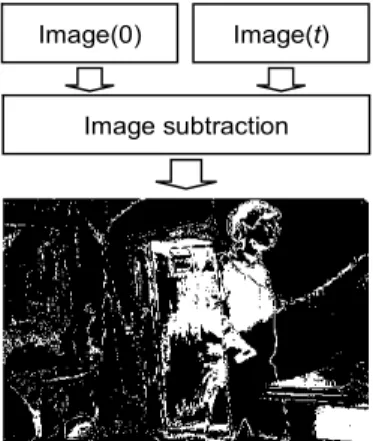
The most traditional detection algorithm of the motion area in image processing uses and processes the background frame(1st time image) that is not an extraction image and the current frame(time t image) when the object is moved. The result of the detection algorithm of the motion area using the background image is shown in Figure 5. This method can treat the fixed background noise effectively but a serious information loss can occur owing to the big noise such as curtains, shadow, and illuminators. This problem can cause ineffective detection of the motion area.
Image(0) Image(t) Image subtraction
Figure 5: Movement detection by image subtraction
3.1.2 Motion area detection using prior image The motion detection method using the prior image is one of the popular methods in motion area detection. This method uses the difference image between the current frame(time t image) and the prior frame(time t-1 image). The result of this method for motion detection is shown in Figure 6.
This algorithm is an effective method for motion area detection than the detection method using the background image but the nose effect is still big problem in area detection.
Image(t-1) Image(t)
Image subtraction
Figure 6: Movement detection by image subtraction
3.1.3 Extraction Method Using Boundary of Motion Area and Current Area
As mentioned above, it is difficult to extract the motion region using the motion detection algorithm with the background image or the prior image because the algorithm can be highly influenced by the noises. To solve the problem, the modified algorithm is developed that uses edges of the motion regions and the current regions. The edge is a gradient value in an image and exists in the highly varied points of the image brightness. That is, the edge is the area at the big gradient values of the image. To find the high varied points of the brightness, first order differential(gradient) and second order differential equations(Laplacian) are
used as following equations (1) and (2). Firstly, as shown in Eq. (1), a gradient vector is calculated and then as shown in Eq. (2), the magnitude of the gradient vector(Laplacian) is calculated for edge detection. However, the following equations are not suitable in programming applications, so the specific mask satisfying the mathematical conditions and providing similar efficiency is used.
x y
f
G x
F G f
y δ δ δ δ
∇ = =
(1)
12
2 2
( ) [
x y] F mag F G G
∇ = ∇ = +
(2)The typical types of the masks are shown in Figure 7. The Prewitt mask has rapid computation ability but edges are not shapely detected because it set the different weights to the boundary of brightness. The Robert mask uses small kernels, so it is very sensitive to noises and detects very clear edges. However, the Sobel mask is slow-calculated relatively but edges can be shapely extracted with considering noises as edges. Thus, the edges extracted by the Sobel mask can be used to detect edges of the motion areas and current areas.
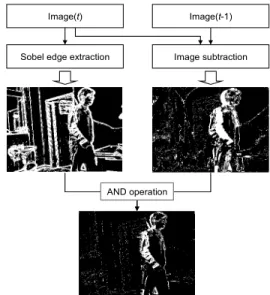
Figure 8. shows the result of the applied algorithm that uses the edges of the motion region and current region. In this algorithm, firstly, the Sobel edge detection mask is employed to the current frames(time t images) and secondly, the difference image is calculated between the current frames(time t images) and the prior frames(time t-1 images). After obtaining both images, AND operation is performed with the both images to detect the moving object in the current region effectively.
As comparing to the two traditional algorithms for detecting the moving object, the combined algorithm using the motion area and the current
area can effectively detect the moving objects but a noise problem still exists. To solve the problem, the typical de-noise algorithm for noise removing such as the morphological filtering and labeling method will be described in the next section.
1 0 -1
1 0 -1
1 1 -1
1 0 -1
1 0 -1
1 1 -1
-1 -1 -1
0 0 0
1 1 1
-1 -1 -1
0 0 0
1 1 1
(a) Prewitt mask
0 0 0
0 1 0
-1 0 0
0 0 0
0 1 0
-1 0 0
0 0 0
0 1 0
0 0 -1
0 0 0
0 1 0
0 0 -1
(b) Robert mask
1 0 -1
2 0 -2
1 1 -1
1 0 -1
2 0 -2
1 1 -1
-1 -2 -1
0 0 0
1 2 1
-1 -2 -1
0 0 0
1 2 1
(c) Sobel mask
Figure 7: Three typical masks for edge detection.
Image(t) Image(t-1)
Image subtraction Sobel edge extraction
AND operation
Figure 8: The object detection algorithm using movement and current areas (a typical method).
3.2 Noise Removing Algorithm
In this section, the morphological filtering and labeling method are described to minimize and to remove noise effects that exist in the difference images.
3.2.1 Morphological Filtering
Morphological filtering is basically used to reconstruct and emphasize the object shape in the image as well as is used in application of the number, symbol, and character [21-22].
Morphological filtering has many techniques such as dilation, erosion, and a combination method, namely, opening and closing operation.
In this study, erosion operation among the several filtering techniques was used to remove the noise rapidly. Erosion operation is to enlarge the background and to reduce the object size of the image. The mathematical equation of erosion operation is as follows:
⊆
(3) where, A is a target image fro the erosion operation and B shows the Sobel mask. The erosion of the target A image by the Sobel mask B is transported by x and B is a set x that includes all points of A.Equation (1) is not suitable for physical application that induces lowing of the process capacity in programming. Therefore, a mask was employed that has the same efficiency and satisfies the above equation. The general erosion operations use a three by three mask, but in this study, a two by two mask was applied to remove just small noises, that is, a three by three mask removes important information when an information size is a little big.
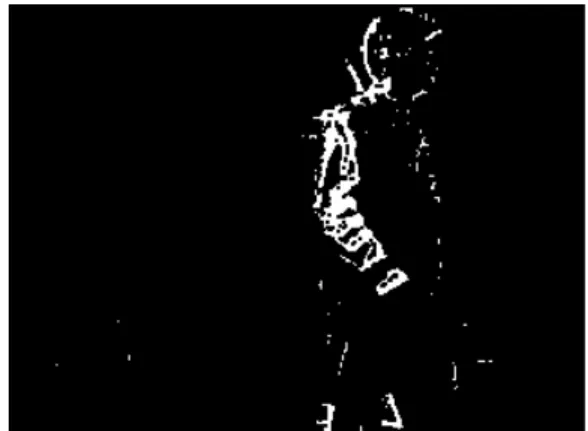
Figure 9 shows the result of the two by two erosion operation to the image pretreated by the motion area and current area algorithm. The
morphological filtering requires more computation times corresponding to noise amounts and as mentioned above, the operation can remove available information of the moving objects.
However, noises smaller than the mask size can be removed. That is, existing noises are removed by the erosion operation and the remnant areas of the de-noised image are reduced.
Figure 9: The result by the erosion operation.
3.2.2 Labeling Method
The labeling technique is a method to detect the object in the image using some feature such as shape, size, and others. Using the labeling process, each pixel indicating each object is grouped as a specific area and then the tied groups are examined and classified with respect to the area, center value, area length, circular ratio, and others. To inspect connection between pixels, a 4-neighbor or an 8-neighbor method is used to inspect pixel connectivity to the neighbor pixel. The pixels including in the examined group show a specific object such as symbols, figures, faces, and others.
The defined pixel group has a specific label to provide some information in image processing, that is, the labeling technique.
In this study, a 4-neighbor method among the labeling methods was employed [23]. A 4-neighbor boundary tracking algorithm direction is achieved
by a two by two mask as shown in Figure 10. The mask starts from a boundary between shades and counterclockwise scans the image from left to right and from top to down before meeting a boundary of the image. When meeting a boundary point, the boundary point is set as Xk and then the proceeding direction of the mask is determined with considering the pixels corresponding to A and B. In this case, the track passed by the Xk becomes the boundary of the image. If a pixel A and B are all background, the mask is rotated to the proceeding direction to Xk and if A is a boundary, Xk is moved to A and the mask is moved one pixel forward. And if B is a boundary, the mask traces clockwise to the Yk and the Xk is moved to the boundary B. If A and B are all boundary, the Xk is moved the closer A and Yk is moved to Xk avoiding B because B is a boundary for a moving target. Table 1 shows Xk+1 and Yk+1 that are proceeding directions of the Xk and Yk with respect to A and B values. A pixel A and B have 0 or 1 where 0 indicates the background pixel and 1 indicates the boundary pixel.
The labeling method has an advantage in the
Scanning direction
Tracking direction
A B
X
kY
kFigure 10: A 2 by 2 mask for edge tracking.
Table 1: Moving direction of a 2 by 2 mask with respect to A and B.
Direction A B Xk+1 Yk+1
Forward 1 0 A B
Right 0 1 B Yk
Right 1 1 A Xk
Left 0 0 Xk A
computation time as comparing to the morphological filtering method, but if there is no information of the target objects, noise problems can occur causing by incomplete treatment between noise areas and object areas.
3.3 Detection Region Segmentation
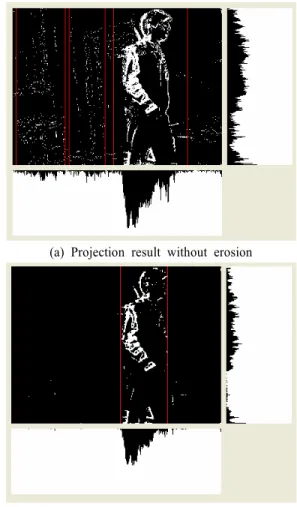
In the traditional region segmentations, labeling, and vertical and horizontal projection are generally used. Between both algorithms, the projection technique is a final process for motion detection to extract the moving object and track the motion position continuously. In this technique, a two
(a) Projection result without erosion
(b) Projection result with erosion
Figure 11: Projection histogram into horizontal and vertical axes using existing methods.
Image(t) Image(t-1)
Image subtraction based on Max-value Sobel edge
detection & extraction Image(t) Image(t-1)
0 k M-1
0 j L-1
0 i N-1
……
…… …………
………… …………
Th
Th
Xp0 Xpi XpN-1 Wji
Wkj θk
θj
0 k M-1
0 j L-1
0 i N-1
……
…… …………
………… …………
Th
Th
Xp0 Xpi XpN-1 Wji
Wkj θk
θj
Morphometric features (10 features):
area, around, ratio between around and square around, degree of circle shape, ratio between height and width, main direction, inner length of vertical direction, inner length of horizontal direction, area ratio of area between area and square area, log scale of height and width
1ststep: image recording
2ndstep: object detection
4thstep: object recognition
3rdstep: feature extraction
AND operation
Densitometric feature (6 features):
mean, standard deviation, and variance values of brightness, maximum, low, and high values of intensity
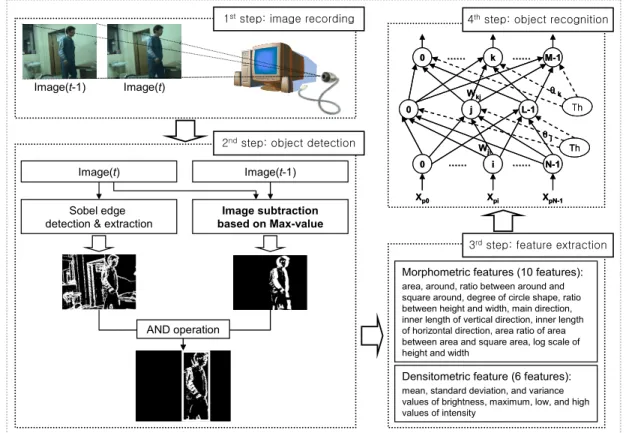
Figure 12: The system structure for invader detection and classification in this study.
dimensional image is projected to x- and y-axis, that is, horizontal and vertical projection. Through this process, the pixel values are converted to one-dimensional information and then the threshold value is applied to extract specific positions what the use wants to get. The extracted values provide important information to track the moving object.
The moving object is segmented by the projection results in this study as shown in Figure 11. Figure 11 (b) shows the result of the projection operation to the erosion image that is massaged by the pre-treatment algorithm using the boundary of the motion area and current area. As shown in Figure 11 (a), when the projection algorithm is employed to the untreated imaged with erosion, several areas are segmented as motion areas caused by the existing noises. And as shown in Figure
11(b), it is difficult to detect motion because information of the moving object disappears. In these cases, the moving object can be detected by complicated algorithms but the complex algorithms require the high computation load. The high computation algorithm is not suitable for real-time applications.
In the next section, the novel algorithm is proposed to solve both problems in motion detection. The proposed algorithm can detect the motion area completely without reducing the necessary information based on filtering.
4. The Invader Monitoring Application Proposed in This Study
In this section, the structure and operating principal of the proposed invader detection system
are introduced and the proposed method and the past studied method using the difference image are compared and analyzed for invader detection.
Algorithm Proposed in This Study
4.1 Structure of the Detection System
In this study, the proposed system consists of the three parts. First, a PC-camera records the initial image, secondly, motion is detected, and then the feature is extracted for recognition. Finally, the invader is recognized. The designed system block diagram is shown in Figure 12. As shown in the block diagram, a PC-Camera is installed and the moving object is recorded and detected. The object can be detected by difference images between the prior image and the current image. After object detection, morphometric features and densitometric features are extracted by a trial and error method.
Motion recognition is performed by a neural network model that is a general feedforward typed network.
4.2 Motion Area Detection Using Max- Valued Edge Detection
Because the above traditional methods using the background image or the prior image can be affected by the image noises, the moving object can not be exactly detected. But the traditional algorithm is simple and fast. The other algorithm using the motion area and the current area provides the good performance for motion detection, but this method is weak to the image noises. To improve the performance, the noise has to be removed. In this case, the computation time can be increased and important information can be reduced what we want to detect. For development of the invader detection system that has high reliability and practicality, the algorithm has to be simple, insensitive to the environment variation (noise
influence), and detect the exact motion area.
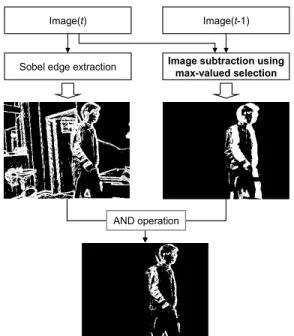
In this study, to solve the problems, the improved method is proposed as shown in Figure 13. The proposed algorithm uses the highest varied color among red (R), green (G), and blue (B) pixel colors of the current frame (time t image). With the same approach, the difference image is calculated between the maximum valued color of the previous frame (time t-1 image) pixel and the current frame (time t image). The Eq. (4) is proposed in this study to extract the edge of the image.
(4)
where Max and abs mean the maximum and the absolute value, respectively. MImgt[x][y] is the pixel value of the difference image between the t and t-1 frame. Imgt[x][y] is the pixel value of the t frame and Imgt-1[x][y] is the pixel value of the t-1 frame.
Gray, R, G, and B mean gray scale values, red values, green values, blue values, respectively.
The calculated difference image is treated by the Sobel algorithm and then the result image is operated by ‘AND’ operation with the extracted edge image of the current frame. Using this procedure, information of the moving object can be obtained.
Figure 14 shows the result image of the detection area separation using the proposed algorithm and the projection method. The proposed algorithm is stronger to the environment change (noise variation) than the traditional algorithm, therefore the noise removing algorithm is not necessary and the information loss is also no problem in the proposed algorithm. And the algorithm is simple, so the exact motion area can be detected in real-time system.
Image(t) Image(t-1)
Image subtraction using max-valued selection Sobel edge extraction
AND operation
Figure 13: The object detection using max-valued selection(the proposed method).
Figure 14: Projection histograms into horizontal and vertical axes using the proposed method.
4.3 Invader Recognition Using Neural Networks Feature information of the extracted images can show several aspects because of the various situations of the lighting conditions and background images. Therefore it is not easy to classified using any linear classification method. Because the linear method can not separate the expanded areas from
extracted information, in this study, neural network models are implemented.
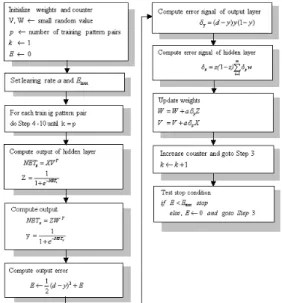
4.3.1 Structure of Back-propagation Algorithm The neural network model used in this study is a simple type that uses the back-propagation (BP) algorithm. The structure of the network is similar to the single layer network, but the BP can use a sigmoid function that is a differentiable function in hidden and output layers. Therefore, the network can be trained as a non-linear model and the algorithm can be used for training the feedforward multi-layer networks. Figure 15 shows the structure of the feedforward multi-layer network and Figure 16 shows the flow chart of the algorithm.
The BP algorithm uses error values of the output layers for training the hidden layers and then the error values are propagated backward to the input layers. The BP algorithm can solve the ambiguous problem in classification and system application is easy for physical applications. First of all, the neural network has adaptation to the variation of the data or system conditions that shows the insensitive performance to the noises. But there is a big problem for training the models. If there is no
0 k M-1
0 j L-1
0 i N-1
…… ……
…… ……
Threshold
Threshold
Xp0 Xpi XpN-1
Wji
Wkj θk
θj
Figure 15: A structure of forward propagation at multi layer neural networks.
Figure 16: Error back-propagation algorithm.
suitable determination of the layer or node numbers, the model can be over-fitted, and vice verse. Therefore, the users have to know the system characteristics and training mechanisms. In this study, three layers networks were designed and 32 nodes for the hidden layers were used. Nodes for the output layers are dependent on the result types.
In this study, the result has just two values that one is the motion area and the other is the background area.
4.3.2 Invader Identification Using Feature Information
The invader detection system based on real-time image processing has to detect the noisy area caused by the background variation that is generated by the non-fixed objects and recognize several types of the invaders. Therefore, it is difficult to detect the invader using feature information extracted from the fixed objects.
For the 4th step of Figure 12, the Figure 16 features were applied to input nodes of the neural network model to identify the object. That is, the ten morphometric features (such as area, around,
ratio between around and square around, degree of circle shape, ratio between height and width, main direction, inner length of vertical direction, inner length of horizontal direction, area ratio of area between area and square area, log scale of height and width) and the six densitometric features (such as mean, standard deviation and variance of brightness, and maximum, low, and high value of intensity) are applied to the invader recognition model. In the experimental results, feature information extracted in this study is powerful and useful to separate the object area with the noise area that can be ignored for motion detection. The goal of this study is to develop the invader detection and classification system that can be used generally and broadly, so feature information requiring complex computation is rejected.
5. Simulations and Results
In this section, it is described that the proposed algorithm can efficiently detect the invader under the physical environment. The tested images were recorded under the some specific conditions such as straight, left, right, and stop movement of the invader. The motion area of the tested images was detected without effects of the environment noise such as movement of a fan and a curtain. After detection of the motion area, neural network models were applied to classify invader motion using the specific patterns that are extracted from the detected area. The learning algorithm is back-propagation that is general and broad algorithm in the field applications.
5.1 Experiment Environments
WDM(Microsoft driver model) and Microsoft DirectShow 8.1 provided by Microsoft are applied to obtain from a PC-camera. The algorithm is programmed based on Visual C++ 6.0 on PC. A QuickCam PC-camera is installed to record the 24
frame per second of the 320 by 240 image size. To simulate motion area detection and invader detection, the experiment images are recorded five times with respect to the moving direction of the target object (such as forward, left, right, and stoop movement) and of the meaningless object (such as fan and curtain movement). The 50 frame images are obtained at one recording time; therefore total 250 images for each movement direction were used for motion area detection and invader detection.
There is limitation of the installation conditions and constraint of the using environments for the automatic invader detection system. The neural network model reduces the above drawbacks with adaptation function, but the long computation time is necessary for model training and the model cannot be trained with respect to the initial weight values and training conditions. To solve the problem in this study, the prior weights that are calculated under the trained case successfully are used for the next initial weights for model retraining. For example, if model retraining is unsuccessful using the stored weights, the weights of the invader are re-initialized for retraining. The training parameters of the classification model used in this study are as shown in Table 2. The ranges of the initial weights are randomly determined from -0.5 to 0.5.
Table 2: Parameters of back-propagation algorithms Input
patterns Target
value Error Learning rate
(0,1) 1 0.01 0.8
5.2 Experiment Results of Motion Area
The results of motion area detection are shown in Table 3. In these experiments, where it is correctly detected or not was determined by the empirical knowledge of the operator.
As shown in the results, the performance of the proposed algorithm for motion area detection can
be influenced by the similarity of the background, and existence and nonexistence of the shadow. In the forward movement case, the detection accuracy is 85.2%, and 70% and 72.4% in the left and the right movement case, respectively. In the stoop case, the accuracy is 59.6%, that is, over 59.6% of the motion area can be detected using 24 frame images per second. In this study, 24 frame images per second are used and at least over one frame of the 24 frame images can be correctly detected in motion detection. The detection ratio was calculated by the subjective decision of the operator.
Table 4 shows the noise detection results caused by the fan and the curtain image that is included in the motion detection simulation. As shown in the table, a considerable change of fan or curtain movement is frequently detected as irruption occurrence, because the image subtraction method is implemented for motion detection in this study.
This drawback decreases the detection accuracy and leads to provide inaccurate information to the users.
In the next stage for invader detection, this problem can be solved by features of the motion area that are inputs of the neural networks. The specific features extracted from the motion area give important information to classify the motion area to human movement and stuff movement. The proper features can increase the detection performance in the next invader detection stage.
Figure 17 shows the detection result using the movement images of the human who continuously moved in the room. The proposed algorithm could detect the edge of the human properly.
Table 3: Detection results of the motion area.
Direction
Items Forward Left Right Stoop No of input images 250 250 250 250 No of correct detection of
motion area 213 175 181 149
Accuracy 85.2% 70% 72.4% 59.6%
Table 4: Detection results of the noise objects.
Noise source
Evaluation items Electric fan Curtain No of input images 250 250 No of correct detection
of non invader area 77 124
Accuracy 30.8% 49.6%
⇒
⇒ ⇒
⇒ ⇒
⇒ ⇒
Figure 17: Detection results of the continuous movement.
5.3 Experiment Results for Invader Recognition
Among the 50 frame images, 15 frame images are used for training and 20 frame images are used for testing for each condition such as forward, left, right, stop, electric fan, and curtain moving. In this study, the 32 hidden nodes and the 2 output nodes are used that are determined by the trial and error method. The learning rate is 0.8.
The results of invader recognition are shown in Table 5. The performance of invader recognition is varied due to the change of lighting and the feature of the object behavior. Namely, the performance variation occurs when the staying time in the
inspection area is very slow and the moving direction is rapidly changed. Even though the situation exists, in the forward movement case, the accuracy is 85% and 60% and 55% in the left and the right movement case, respectively. In the stoop case, the accuracy is 40%. This accuracy was evaluated by 24 frames per second, so as considering per second, most of the invasion was recognized by the applied neural network model.
Table 6 shows the noise recognition. Curtain movement was perfectly recognized as a noise image but the three fan movement was not correctly recognized. The accuracy of fan and curtain movement was 85% and 100%, respectively.
The motion area detection process is affected by the system condition and the image noise such as fan or curtain movement but in this recognition process, it is possible that specific feature information describing the characteristics of the invasion reduces environment effects. The feature information was used in the neural network model and invasion situations were detected and recognized.
Table 5: Results of invasion recognition using neural networks.
Direction
Items Forward Left Right Stoop No of input images 20 20 20 20 No of correct
recognition of
invader 17 12 11 8
Accuracy 85% 60% 55% 40%
Table 6: Results of background recognition using neural networks.
Noise source Evaluation items
Electric
fan Curtain
No of input images 20 20
No of correct recognition
of non invader 17 20
Accuracy 85% 100%
6. Conclusions
In this study, the invader detection system is proposed that uses the difference image of the recording images using a PC-camera. For motion detection, the difference image is calculated between the current frame and the prior frame and then the edge image of the current frame is extracted by the Sobel algorithm. Next, ‘AND’
operation is implemented to the difference image and the edge image to detect moving object.
Feature information is extracted from the detected motion area and then the invader is detected by neural network models using the extracted features.
As analyzing the experiment results, the proposed system shows the improved performance of invader detection than the traditional approaches.
In the future works, we want to develop a mobile image transmission system embedding the proposed invader detection algorithm. Today, the industry of the mobile image transmission system is an early stage that the system just real-time inspects the invader without a warning function.
Therefore, the automatic detection and warning system can be attractive in the mobile image inspection service industry.
References
[1] S. U. Lee, Moving Object Segmentation and Classification Using Multi-Layer Neural Network on the Difference Image, M.S.
Thesis, Kyunghee University, 1997.
[2] J. S. Do, “A robust algorithm for moving object segmentation in illumination variation”, Journal of Korea Information Assurance Society, vol. 7, no. 1, pp. 1-10, 2007.
[3] J. H. Ryu, K. Y. Choi, J. H. Cho, D. H.
Song, and K. B. Kim, “A study on intruder surveillance system using fuzzy binarization”, Proceedings of the Korean Institute of Information and Commucation Sciences
Conference, vol. 14, no. 1, pp. 201-204, 2010.
[4] J. H. Park, H. G. Yeom, B. G. Jung, I. H.
Jang, and K. B. Sim, “Soundsource localization and tracking system of intruder for intelligent surveillance system”, Journal of Korean Institute of Intelligent Systems, vol.
17, no. 6, pp. 786-791, 2007.
[5] C. W. Kwon, “Development of a Monitoring System Based on the Cooperation of Image and Sensor Information”, Thesis of M. S.
Degree, Daegu University, 2010.
[6] J. Park, J. S. Choi, J. Kim, S. H. Ji and B. H.
Lee, “Long-term stealth navigation in a security zone where the movement of the invader is monitored”, International Journal of control Automation and Systems vol. 8, no. 3, pp. 604-614, 2010.
[7] A.T. Ali and E. L. Dagless, “Computer vision for security suveillance and movement control”, IEEE Colloquium on Electronic Image Processing in Security and Forensic Science, pp. 6/1-6/7, 1990.
[8] T. Takano and K. Ushita, “Intruder detection system by image processing”, Proceeding of the International Carnahan Conference on Security Technology. pp. 194-196, 1994.
[9] K. H. Stage and K. M. Wickhman,
“Estimating performance limits for an intelligent scene monitoring system (ISM) as a perimeter intrusion detection System (PIDS)”, Proceeding of the International Carnahan Conference on Security Technology. pp.
98-103, 1994.
[10] T. J. Ellis, P. L. Rosin, and P. Golton,
“Model-based vision for automatic alarm interpretation”, IEEE, International Carnahan Conference on Security Technology. pp. 62-67, 1990.
[11] Y. Kuno and T. Watanabe, “Automated detection of human for viual surveillance
System”, IEEE, Information Center for Physics Research. pp. 865-869, 1996.
[12] H. Murase, "Recognizing Individuals from the silhouettes of their walk", The Institute of Electronics, Information and Communication Engineers 6, pp.1096-1098, 1992.
[13] H. D. Arlowe and D. E. Coleman, “The mobile intrusion detection and assessment system(MIDAS)”, IEEE 1990 International Carnahan Conference on Security Technology, pp. 54-61, Oct. 10-12, 1990.
[14] D. A. Pritchard, “Status of the video imaging system for detection tracking and assessment (VISDTA) scanning sensor program”, IEEE, International Carnahan Conference on Security Technology. pp. 194-196, 1990.
[15] S. J. Yeom, Implementation of WebCam Image Surveillance System Using Motion Detection Algorithm, M.S. Thesis, Hannam University, 2001.
[16] W. C. Kim, A Study on a Moving Object and Edge Detection Algorithm Using CCD, M.S.
Thesis, Hongik University, 1997.
[17] Y. H. Kim, An Image Processing System for Unmanned Surveillance, Ph.D. Thesis, Yonsei University, 1996.
[18] Y. S. Yang, A Study on a Motion Detection Algorithm and Implementation for a Digital Surveillance System, M.S. Thesis, Hanyang University,1999.
[19] G. L. Foresti, Real-Time Detection of Multiple Moving Objects in Complex Image Sequences, John Wiley & Sons, Inc. 1999.
[20] D. Murray and A. Basu, "Motion tracking with an active camera", IEEE Transactions on Pattern Analysis and Machine Intelligence. vol.
16, no. 5, 1995.
[21] A. K. Jain, Fundamentals of Digital Image Processing, Prentice Hall, 1989.
[22] S. Y. Kim, T. K. Kweon, and M. H. Kim,
"Extraction of simplified boundaries using tracing", Proceedings of Korea Multimedia Society Spring Conference. vol. 2, no. 1, pp.
356-361, 1999.