http://dx.doi.org/10.5916/jkosme.2015.39.2.143 Original Paper
This is an Open Access article distributed under the terms of the Creative Commons Attribution Non-Commercial License (http://creativecommons.org/licenses/by-nc/3.0), which permits unrestricted non-commercial use, distribution, and reproduction in any medium, provided the original work is properly cited.
Copyright ⓒ The Korean Society of Marine Engineering
A Study on Power Performance of a 1kW Class Vane Tidal Turbine
Changjo Yang † ㆍ Manh Hung Nguyen 1 ㆍ Anh Dung Hoang 2
(Received November 17, 2014; Revised December 17, 2014; Accepted February 12, 2015)
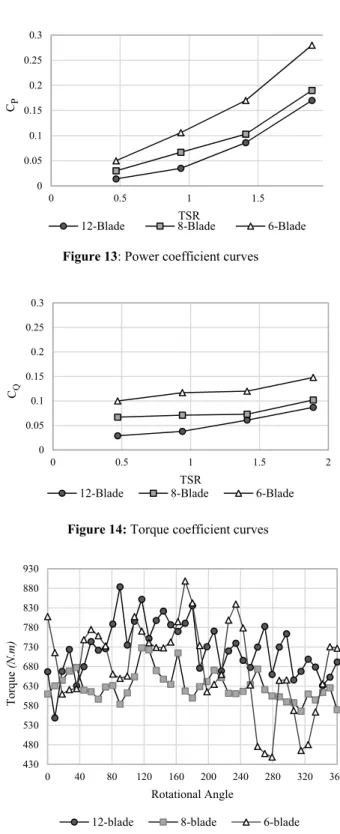
Abstract: Recently, tidal current energy conversion is a promising way to harness the power of tides in order to meet the growing demands of energy utilization. A new concept of tidal current energy conversion device, named Vane Tidal Turbine (VTT), is introduced in this study. VTT has several special features that are potentially more advantageous than the conventional tidal turbines, such as propeller type tidal turbines. The purpose of this study on VTT is to analyze the possibility of extracting the hydrokinetic energy of tidal current and converting it into electricity, and evaluate the performance of turbines for various numbers of blades (six, eight and twelve) using Computational Fluid Dynamics (CFD). At various tip-speed ratios (TSR), the six-bladed turbine obtains the highest power and torque coefficients, power efficiency is up to 28% at TSR = 1.89. Otherwise, the twelve blade design captures the smallest portion of available tidal current energy at all TSRs. However, by adding more blades, torque extracted from the rotor shaft of twelve-bladed turbine is more uniform due to the less interrupted generation of force for a period of time (one revolution).
Keywords: Vane tidal turbine, Computational fluid dynamics, Power coefficient, Tidal current energy, Torque coefficient.
1. Introduction
In order to meet the human's aspiration for energy security, reducing dependence on finite and polluting fossil fuels and to struggle against the climate change, the available natural and sustainable resources all over the world were exploited. The oceans, which cover more than two-thirds of our planet, offer an incredible store of energy. One of the forms of energy within the oceans is that resulting from the gravitational effects of the planetary motions of the Earth, the Moon and the Sun, which produce the tides that drive strong marine currents. Tides possess both potential and kinetic energy. Tidal energy can be utilized by capturing potential energy i.e., by means of tidal barrage and tidal fence, or by capturing kinetic energy i.e., by means of tidal current turbines. This study is focused on a vane type tidal current turbine that captures kinetic energy. The research on tidal energy is underway around the globe [1]-[3], and the technology has been tested in many countries [4]-[6]. At present, there are many kinds of tidal current energy conversion devices which have been powerfully developing by researchers from many countries all over the world, such as propeller type
turbines, Darrieus types turbines, and so on.
Recently, there is a study on water wheel turbines using computational fluid dynamics simulation [7], which was done for two kinds of blade design in shape (triangle and rectangle), the influence of number of blade (four and six) is also taken into account. This research on water wheel turbines indicated that the triangular blade design show weak performance compared to rectangular one (about 30% reduction in efficiency). Derived from the similar concept, we have been developing a new type of horizontal axis turbines that is optimized for tidal applications. This turbine is named Vane Tidal Turbine (VTT) and is planned to be installed in areas with high potential of tidal energy, such as banks, estuaries and so on.
Originally, VTT was designed with twelve blades and was carefully analyzed in previous studies [8][9]. It is found that generated power was unexpectedly low at 1m/s cut-in velocity of water flow and 10 rpm rotational speed of the rotor. Thus, in this study, the scope is broadened to discover VTT’s capability for different numbers of blades (six, eight and twelve). As a result, by analyzing the power coefficient and torque coefficient