특 집
Preparation of Polyolefin Based Segmented Copolymers Through Controlled Radical Polymerization Technique
Sung Chul Hong
†, Seong-hoon Lee*, and Hyun-chul Cho*
Department of Nano Science and Technology, Sejong University, 98 Gunja-dong, Gwanjin-gu, Seoul 143-747, South Korea
*Polymeric Materials Research Team, Hyundai Motor Company, 772-1 Jangduk-dong, Whasung-si, Gyunggi-do 445-706, South Korea
(Received August 19, 2009, Revised & Accepted August 28, 2009)
조절 라디칼 중합법에 의한
폴리올레핀 기반 분절 공중합체의 제조
홍 성 철†
․ 이 성 훈
*․ 조 현 철
*세종대학교 나노공학과,
*현대자동차 고분자재료연구팀 (2009년 8월 19일 접수, 2009년 8월 28일 수정 및 채택)
ABSTRACT:Polyolefins are important commodity polymers with the largest volume of business owing to their outstanding
combination of cost performance and excellent physical properties. However, the lack of functional groups often has limited their end uses, such as compatibilizer, modifier and adhesive, where the interaction with other materials is especially important.
The incorporation of functional groups as polymer segments to afford block or graft polyolefin copolymers has been extensively investigated in the context of the functional polyolefin hybrids. Living polymerization processes have been considered to be an efficient method to prepare the polyolefin hybrids with precisely controlled architecture and compositions. Among the living polymerization techniques, controlled/“living” radical polymerization (CRP) methods are very effective not only because of the controllability of polymerization but also because of the versatility of monomers and polymerization conditions.
In this review paper, progresses on the preparations of polyolefin graft or block copolymers through CRP techniques are summarized. The commodity polymers such as polyisobutylene, polyethylene and polypropylene are combined with polar segments such as polyacrylate, polymethacrylate, polystyrene to yield functionalized polyolefins.
요 약:폴리올레핀은 뛰어난 물성과 낮은 가격으로 인하여 가장 큰 시장을 가진 범용 고분자이다. 그러나, 폴리올레핀
은 대표적인 비극성 고분자로, 다른 물질과의 상호 작용이 중요한 상용화제, 개질제, 접착제 등의 용도로는 그 사용이 제한될 수 밖에 없다. 따라서, 보다 극성을 가진 고분자 사슬을 폴리올레핀에 블록 또는 그라프트 공중합체의 형태로 도입함으로써 기능성 폴리올레핀 하이브리드를 제조하려는 노력이 계속되어 왔다. 특히, 잘 제어된 구조와 조성을 가진 공중합체를 제조하기 위하여 리빙라디칼 중합법이 사용될 수 있으며, 그 중 조절라디칼 중합법은 중합을 잘 제어할 수 있다는 장점 이외에 다양한 단량체종과 중합 공정에 적용될 수 있다는 점에서 많은 주목을 받고 있다.
이에 따라, 본 리뷰 논문에서는 조절라디칼 중합법을 이용한 폴리올레핀 기반 블록 또는 그라프트 공중합체의 제조에 대하여 정리해 보았다. 폴리이소부틸렌, 폴리에틸렌, 폴리프로필렌 등의 비극성 범용고분자들과 폴리아크릴레이트, 폴리메타아크릴레이트, 폴리스티렌 등의 극성 고분자들과의 하이브리드를 통한 기능성 폴리올레핀의 제조에 대하여 정리하였다.
Keywords:polyolefin, polar segment, copolymers, controlled/"living" radical polymerization, block, graft
†
Corresponding Author. E-mail: [email protected]
Ⅰ . Introduction
Polyolefins are important commodity polymers with the largest volume of business owing to their outstanding combina-
tion of cost performance and excellent physical properties.
However, the lack of functional groups has limited many of
their end uses, such as compatibilizer, modifier and adhesive,
where the interaction with other materials is especially im-
portant.
1Therefore, the introduction of various functional
groups or segments into a polyolefin has been one of the most
important research fields for polymer chemists.
One of the approaches to solve this problem is the direct copolymerization of olefins with polar monomers.
2-4However, in coordination polymerization processes, this approach often suffered from a low tolerance of metal catalysts to polar vinyl monomers, which led to only limited success.
3,5-7Also for con- trolled/“living” free-radical polymerization (CRP) processes, examples on direct copolymerization of olefin and polar mono- mers are rare and often only restricted to a copolymerization with α-olefins.
8-16Different from a direct copolymerization, the incorporation of functional groups as polymer segments to afford block or graft polyolefin copolymers has been extensively investigated in the context of functional polyolefin hybrids.
17-20By this method, the loss of original properties of polyolefin can be minimized while the functional segments increase the inter- action with a broad range of polar materials.
1,21Generally, block copolymers can be prepared following a chain extension method, where a macroinitiator is employed for a successive polymerization reaction. For the preparation of graft copolymers, three main strategies can be used: i)
“grafting-from”, when initiating sites located on the main poly- mer chain initiate the polymerization of a second monomer, ii) “grafting-onto”, when a growing polymer or a pre-formed polymer with reactive end groups reacts with pendant func- tional sites located on another polymer backbone, iii) “graft- ing-through”, when a macromonomer is copolymerized as a monomer.
A grafting of polar monomers to polyolefin during a simple radical polymerization has been introduced in industry for pro- duction of polyolefin hybrids.
22-26However, well-defined poly- mer structures are difficult to be obtained, due to side reactions of radical species such as recombination, disproportionation, crosslinking, and chain scission.
Living polymerization processes have then been considered to be an efficient method to prepare polyolefin hybrids with precisely controlled architecture and compositions. Living pol- ymerization techniques including cationic,
27,28anionic,
29-32and radical
33-45polymerization have been employed for this pur- pose.
Among them, the concept of CRP has achieved a high level of industrial and academic interests due to the accurate control over macromolecules afforded from radically polymerizable functional monomers.
46Especially, the CRP technique has at- tracted much attentions from researchers due to its availability for the synthesis of well defined block and graft copoly- mers.
47,48CRP methods are also very effective tools for the preparation of polyolefin hybrids with well-defined structures not only because of the controllability of polymerization but also because of the versatility of monomers and polymerization conditions.
There are three main approaches to CRP. Two of them are based on the principle of a reversible activation/deactivation, either spontaneous (nitroxide mediated polymerization, NMP)
49-51or catalyzed (atom transfer radical polymerization, ATRP).
52-54An alternative approach utilizes a degenerative transfer mecha- nism using thio compounds (reversible addition fragmentation transfer, RAFT) as transfer agents.
55In this review paper, progresses on the preparations of poly- olefin graft or block copolymers through CRP techniques are summarized. The commodity polymers such as polyisobuty- lene (PIB), polyethylene (PE) and polypropylene (PP) are com- bined with polar segments such as polyacrylate, polymetha- crylate and polystyrene (PS) to yield functionalized polyolefins.
Ⅱ. Peroxyborane-mediated radical polymeriza- tion using borane-containing polyolefin
1. Polyolefin block copolymers from peroxyborane-medi- ated radical polymerization
Chung et al.
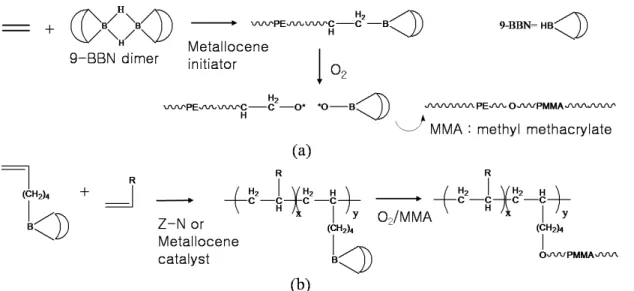
56-58developed a peroxyborane-mediated radical polymerization using borane-containing polyolefin to give a variety of copolymers. To prepare block copolymers, a borane (B-H) in situ chain transfer reaction in metallocene catalyzed olefin polymerization was performed. The chemistry provided a route to prepare borane-terminated polyolefins that were functionalized to perxoxide moiety to initiate successive radi- cal polymerization of polar monomers. The reaction process resembled a transformation reaction from metallocene coordi- nation polymerization to living free radical polymerization via a borane group at the polymer chain end (Figure 1a).
Borane-terminated polyolefins was used to initiate radical polymerization of methyl methacrylate (MMA) to prepare PP-block-PMMA diblock copolymer.
59The borane-terminated polyolefin approach also provided a route for the incorporation of the methyl acrylate (MA) units with controllable molecular structure.
60The resulting relatively well-defined PP-MA co- polymers were evaluated in the reactive blending of PP/poly- amide as a compatibilizer.
612. Polyolefin graft copolymers from peroxyborane-medi- ated radical polymerization
It was also demonstrated by Chung et al. that the intro-
duction of borane groups into polyolefins was possible through
a copolymerization of olefins with borane containing mono-
mers via Ziegler-Natta and metallocene copolymerization
reactions.
62,63Trialkyborane moieties, unlike other organic
functional groups, were stable to early transition metal com-
plexes and compatible with olefin monomers. The borane
group was transformed into a stable polymeric radical that then
Figure 1. Schematic representation for the preparation of polyolefin based block copolymers (a) and graft copolymers (b) through a peroxyborane-mediated radical polymerization technique.
56Figure 2. Synthetic procedure for the preparation of polyethylene-block-poly(methyl methacrylate) through ATPR by using terminally hydroxylated polyethylene.
64initiated a living free radical polymerization of the functional monomers to provide graft copolymers (Figure 1b).
58Ⅲ . Atom transfer radical polymerization (ATRP) technique
1. Polyolefin block copolymers from atom transfer radical polymerization
Matsugi et al. reported the synthesis polyolefin hybrids via ATRP technique with polyolefin macroinitiators derived from ethylene/allyl alcohol copolymer.
64Terminally hydroxylated PE, prepared by the ethylene/allyl alcohol copolymerization with a specific metallocene catalyst, was transformed into ter-
minally esterified PE containing initiating units. With the ter- minal as an initiator, MMA polymerization was subsequently performed through ATRP technique to afford block copolymer (Figure 2).
Terminally unsaturated polyolefin, which is prepared either
by thermal degradation of polyolefin or by chain transfer re-
action with β-hydride elimination during olefin polymer-
ization, has been well known as end-functionalized polyolefin
and used as a building block of polyolefin based block
copolymers.
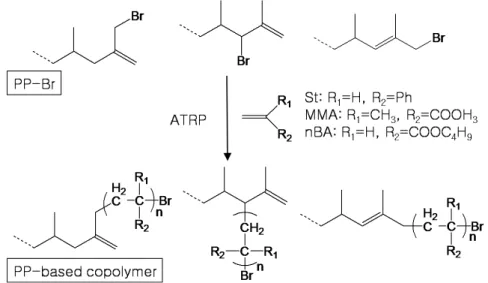
34,41,65Kaneko et al.
66reported bromination of ter-
minally unsaturated PP prepared by pyrolysis of commercial
PP. This method afforded PP based macroinitiator for the fol-
lowing CRP, which successfully afforded PP based block co-
polymers (Figure 3). It was confirmed that the chain extension
Figure 3. Schematic representation for the preparation of polypropylene (PP) based block copolymers by using PP-Br macroinitiator.
66Figure 4. Tandem strategy for synthesis of functionalized polyethylene block copolymers by combining Pd-diimine catalyzed ethylene polymerization and ATRP.
40polymerization was certainly initiated from allylic bromide moieties with high efficiency. However, although its pro- duction process was simple and low cost compared with those for olefin copolymerization with functional monomers, in- troduction of the initiation site into the unsaturated bond was generally not easy.
A combination of different polymerization mechanisms, e.g.
degenerative transfer (DT) ethylene polymerization and ATRP, afforded PE based block copolymers. DT coordination poly- merization was mediated by a bis(imino)pyridine iron/diethyl zinc binary catalyst system, resulting in PE with high Zn chain end functionality. The Zn-terminated PE was then oxidized using dry air, followed by hydrolysis to provide a mono- hydroxy-terminated PE (PE-OH). The PE-OH was again con- verted into a PE macroinitiator through an esterification re- action with 2-bromo-2-methylpropionyl bromide, and ATRP of polar monomers using the macroinitiator produced block copolymers.
36In a similar context, Ye et al. combined Pd-diimine catalyzed
ethylene polymerization with ATRP for the synthesis of PE diblock copolymers (Figure 4).
40A functionalized Pd-diimine catalyst containing 2-bromoisobutyryl group on its chelate structure was prepared for this purpose. Ethylene polymer- ization using the catalyst directly afforded PE chains bearing end-capped 2-bromoisobutyryl group that was active for suc- cessive ATRP. Because of the “living” polymerization nature of both polymerization procedures, the block copolymers pos- sessed well-defined structures with narrow molecular weight distributions and controllable lengths for both PE and func- tional monomer blocks.
To obviate tedious synthetic chemical procedures for the
preparation of end-functionalized polyolefins, commercially
available functional polyolefins has also been pursued. Com-
mercially available monohydroxyl terminated poly(ethyl-
ene-co-butylene) (Kraton L-1203, Shell Chemicals) prepared
through anionic mechanism can be transformed to an ATRP
macroinitiator by esterification with 2-bromopropionyl chlo-
ride. Subsequent ATRP process using the macroinitiator af-
Figure 5. Polyethylene macroinitiator for the preparation of polyethylene based graft copolymers.
35H
2C CH CH
3+ H
2C CH
CH CH
2H
2C H
C CH
3H
2C H
C
CH CH
3n m
H
2C H
C CH
3H
2C H
C
CH CH
2n m
Cl
H
2C H
C CH
3H
2C H
C
CH CH
3n m
H
2C C
CO
2CH
3Cl H
2C C
CO
2CH
3MgCl
2/DIBP/TiCl
4AlEt
3/DDS
HCl
ATRP H
2C C
CO
2CH
3CH
3CH
3CH
3x
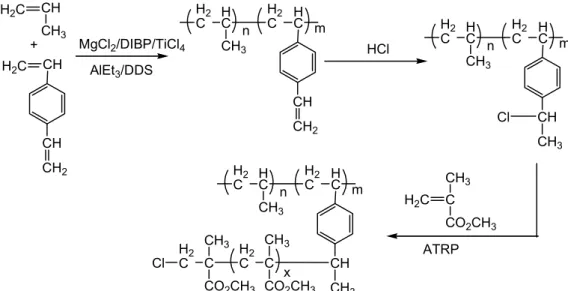
Figure 6. Schematic representation for the preparation of polypropylene macroinitiator by using pendant vinylbenzene groups and subsequent ATRP process to produce graft copolymers.
37forded block copolymers.
67,68A method for the transformation of carbocationic polymerization to CRP is also available. For example, α,ω-difunctional PIB end-capped with few units of styrene (Cl-Sty-PIB-Sty-Cl) was synthesized by “living”
carbocationic polymerization. The prepared Cl-Sty-PIB-Sty-Cl was used as an efficient difunctional macroinitiator for ATRP of polar monomers.
692. Polyolefin graft copolymers from atom transfer radical polymerization
PE based graft copolymers were prepared through the com- bination of metallocene-catalyzed ethylene/10-undecen-1-ol copolymerization and conversion of the copolymer into a mac- roinitiator for ATRP (Figure 5).
35Well-defined acrylate and methacrylate graft copolymers were successfully prepared un- der dilute ATRP conditions through “grafting-from” technique by using the macroinitiator. The key for success in the con- trolled ATRP from the PE macroinitiator was a combination of low monomer concentration and halogen exchange.
PP containing several pendant vinyl benzene groups was
prepared as a precursor for macroinitiator through the Ziegler- Natta copolymerization of propylene and 1,4-divinylbenzene.
The pendant vinyl benzene groups were then transformed into benzyl halides by hydrochlorination reaction. Under ATRP condition, “grafting-from” process using the macroinitiator af- forded PP-based graft copolymers (Figure 6).
37Ying and coworkers reported a bromination of ethylene- propylene-diene terpolymer (EPDM) and the synthesis of EPDM-graft-PMMA using the brominated EPDM as an initiator.
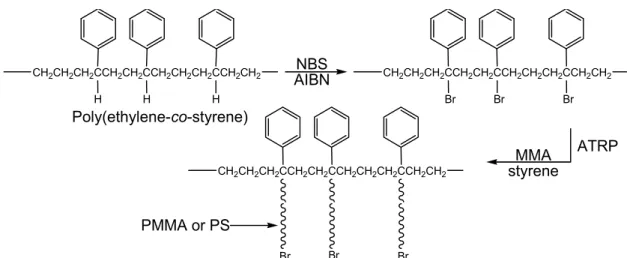
70Sen and coworkers synthesized the PE based graft copolymers from brominated ethylene/styrene copolymer (Figure 7)
71and Jiang and coworkers also synthesized the PE-based graft copolymers through the bromination of ethyl- ene/p-methylstyrene copolymer.
43Bae et al.
39synthesized hydroxy-functionalized poly(1-bu-
tene) through transition metal-catalyzed regioselective C-H
borylation reaction at the side chain of the commercially avail-
able poly(1-butene) and subsequent oxidation of the boronic
ester functionality. Esterification of the hydroxy group in the
polymer with 2-bromoisobutyl bromide generated a side
chain-functionalized polyolefin macroinitiator.
CH2CH2CH2CCH2CH2CCH2CH2CH2CCH2CH2
H H H
Poly(ethylene-co-styrene)
CH2CH2CH2CCH2CH2CCH2CH2CH2CCH2CH2
Br Br Br
CH2CH2CH2CCH2CH2CCH2CH2CH2CCH2CH2
Br Br Br
AIBN NBS
styrene MMA
ATRP
PMMA or PS
Figure 7. Schematic representation for the preparation of polyethylene based graft copolymers from brominated ethylene/styrene copolymer.
71O O
O O O O O N O O N O
OH OH
N O
O O N O
O O Br
O O Br Polypropylene-MAh
Polypropylene-OH
Polypropylene-Br H2N OH
Br O
Br
Et3N
Figure 8. Preparation of polypropylene based macroinitiator from maleic anhydride functionalized polypropylene for
“grafting-from” process of ATRP.
42OCH2CBr3 H2
C H2 C
O O
O O O O O O O O
OH OH OH OH
O23OCHCBr 23OCHCBr O O23OCHCBr O PE
BPO / MAh H2O, pyridine 2,2,2-tribromoethanol
H2 C H2
C
PE C
OH
C OH
C
OH C
OH UV irradiation
DCC
C O
Figure 9. Introduction of the graft initiation sites on polyethylene films for ATRP graft copolymerization.
72PP graft copolymers were also successfully synthesized by
a graft copolymerization from maleic anhydride-modified PP (PP-MAH). PP-MAH reacted with ethanolamine to produce a hydroxyl group functionalized PP (PP-OH), where the PP-OH was treated with 2-bromoisobutyryl bromide and con- verted to a 2-bromoisobutyryl group containing PP (PP-Br, Figure 8). ATRP of polar monomers using the PP-Br afforded the graft copolymers.
42Solid PE film was modified with 2,2,2-tribromoethanol and benzophenone by applying radical generating agent or UV pre-irradiation, which converted to the appropriate initiation
sites for ATRP process (Figure 9).
72An appropriate UV pre-ir- radiation time controlled the number of initiation sites in- troduced to the PE films. Peroxides on PE as initiating sites for ATRP can also be generated by γ-ray irradiation in air.
73Surface bromination of PP films was also accomplished by a photo-bromination process, followed by ATRP process to provide surface modified PP films.
74Although these approaches are excellent and useful, it seems
arduous to prepare the functionalized polyolefins and sub-
sequently convert them to the macroinitiators. Therefore, how
to prepare the precise-site-selective polyolefin macroinitiator
H2C C CH2 CH3
CH3
CH
CH2Br
CH2CH
CH3
x y z H2C C CH2
CH3
CH3
CH
CH2
CH2CH
CH3
x y z
CUCl/dNbpy R
R n
CuCl/dNbpy
Figure 10. Preparation of poly(isobutylene-graft-vinyl monomer) using polyisobutylene macroinitiator.
44Figure 11. Preparation of poly(ethylene-co-glycidyl methacrylate) based macroinitiators for the synthesis of polyethylene graft copolymers.
76Figure 12. Schematic diagram for chlorosulfonated polyethylene macroinitiator and the preparation of polyethylene graft copolymers.
78with another simple and facile way is an important factor. A one-pot procedure for the synthesis of hyperbranched PEs teth- ered with ATRP initiating sites was prepared by chain walking ethylene copolymerization by using Pd-diimine catalyst in the presence of an acrylate-type ATRP inimer, 2-(2-bromoisobu- tyryloxy) ethyl acrylate. The polymerization automatically generated polyfunctional macroinitiators for the ATRP to fur- ther synthesize core-shell structured functionalized copolymers with a hyperbranched PE core.
38Furthermore, there have been a few reports on the graft co- polymers synthesized by CRP using commercially available polymers with initiation sites, such as poly(isobutylene) co- polymers (Figure 10, EXXPRO3035 elastomer).
44,75By the
combination of this rubbery polymers with glassy side chains, it was possible to change the properties of the graft polymer from a toughened glassy polymer to an elastomer according to their compositions.
Poly(ethylene-co-glycidyl methacrylate) is also commer-
cially available and has been converted into ATRP macro-
initiators. The pendant-functionalized PE was used to initiate
the ATRP of styrene and MMA to give PE graft copolymers
(Figure 11).
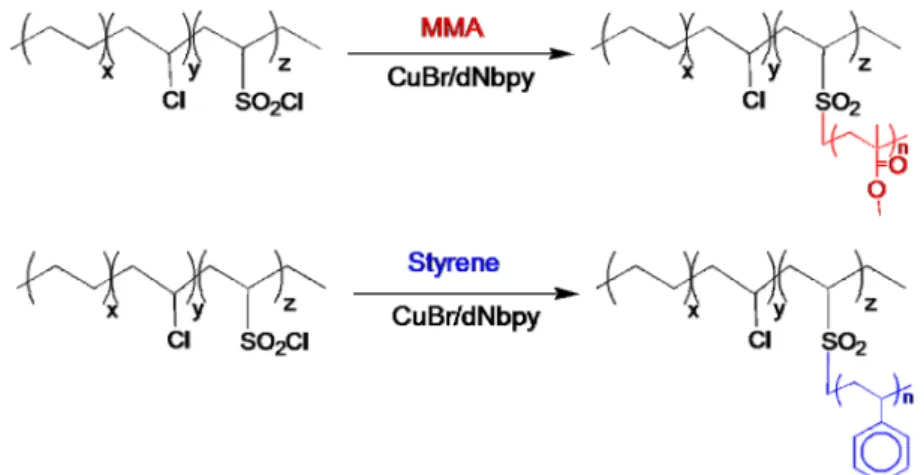
76Chlorosulfonated PE (CSPE) is a commercially
available elastomer that contains sulfonyl chloride groups ran-
domly distributed on a PE chain. Sulfonyl chloride groups are
known to be good initiators for ATRP.
77Therefore, CSPE was
used as macroinitiator in ATRP to produce graft copolymers
O
O O
O
CH
3ATRP
O
O
O
OO
O O
O
O
O O
O O
O O
O O
O
CH
3+
Polyethylene macromonomer
x
y
n
Poly(n-butyl acrylate)- graft-polyethylene n-Butyl acrylate
T = 100 oC Solvent = anisole Catalyst = CuBr/PMDETA Initiator = DMDBHD or
z x
y z
n
EBP
Figure 13. ATRP of n-butyl acrylate with polyethylene macromonomer for the preparation of poly(n-butyl acrylate)- graft-polyethylene.
45+
N O
Metallocene/MAO toluene
N O
n x
styrene 115
oC
n x
N m O
Polypropylene
Polystyrene
Figure 14. Schematic representation for the preparation of polyolefin based graft copolymers through a combination between metallocene catalyzed and nitroxide mediated polymerization technique.
21(Figure 12).
78Grafting-through method can also be applied to prepare PE graft copolymers. For example, ATR copolymerization of PE macromonomers with polar monomers was successfully con- ducted to prepare corresponding graft copolymers.
45A branched PE macromonomer with a methacrylate functional- ized end-group was prepared by Pd-mediated living olefin polymerization. The macromonomer was then copolymerized with n-butyl acrylate by ATRP (Figure 13).
Ⅳ . Nitroxide mediated polymerization (NMP) technique
1. Polyolefin block copolymers from nitroxide mediated polymerization
D’Agosto et al.
33,79exhibited pseudo-living ethylene polymer- ization along with chain transfer reaction between dia- lkylmagnesium derivatives and the lanthanidocene complex.
The resulting long-chain polyolefinic dialkylmagnesium com- pounds are then transformed to be end-functionalized with ni- troxide derivatives, affording a macroinitiator for NMP. The NMP of polar monomers in succession produced block
copolymers.
2. Polyolefin graft copolymers from nitroxide mediated pol- ymerization
Coordination copolymerization of olefins with alkoxyamine substituted alkenes is a viable process leading to polyolefin containing initiating groups for living free radical polymer- izations (Figure 14). The presence of alkoxyamine groups at the side ends of these graft copolymers was used to reinitiate polymerization leading to grafted block copolymer struc- tures.
21,80,81Shimada et al.
82,83succeeded in the grafting of styrene to irradiated PP powder by using NMP method. The PP peroxide was first prepared through irradiation, which was then trans- formed to a macroinitiator for “grafting-from” polymerization of styrene in the presence of nitroxide agent.
Polyolefin macroinitiators can also be prepared through a
treatment of polyolefin with radical generating agent such as
benzoyl peroxide in the presence of nitroxide agent. Polar seg-
ments were successfully grafted to polyolefin backbone chains
as a result of bulk polymerization of polar monomers with
the macroinitiators.
84Polyolefinic elastomers such as EPDM
Figure 15. Schematic representation for the preparation of elastomeric graft copolymers through a modification of polyolefinic backbone with nitroxide agent and successivie “grafting-from” polymerization reaction.
85,86OH
Me2Si ZrCl2
OH
Cl O O Cl Cl
O
S
S Mg Cl O
O
S S O
O
S S CH2
C CO2CH3
H3C
n
+
m
m
AIBN m MMA m
S S
CN
O OH
HO H C C
H2
CH2
H2C CH2
H2C CH2
CH3
n + m
S S
CN
O
O CH C H2
CH2
H2C CH2
H2C H2C
CH3
n m
(a)
(b)
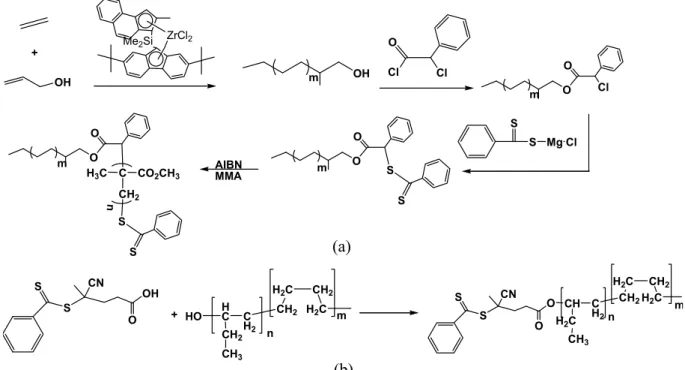
Figure 16. Synthetic route for polyolefin block copolymers via RAFT polymerization method: Kawahara’s work (a)
88and Monteiro’s work (b).
89and polybutadiene can also be modified following similar pro- cedures (Figure 15).
85-87V. Reversible addition and fragmentation transfer (RAFT) technique
1. Polyolefin block copolymers from reversible addition and fragmentation transfer technique
PE-block-PMMA was successfully synthesized via RAFT polymerization of MMA with PE macro chain transfer agent by Kawahara et al. (Figure 16a).
88In the first step, PE-OH, which possessed primary alcohol at its chain end, was success-
fully obtained through the copolymerization of ethylene with
aluminum protected allyl alcohol. In the second step, the termi-
nally hydroxyl group of PE was reacted with 2-chlor-
ophenylacetylchloride to produce PE-CPA, which was then re-
acted with dithiocarbonyl compound to produce macro chain
transfer reagent in RAFT polymerization with MMA.
88Monteiro et al.
89also prepared polyolefin based block co-
polymers with a macromolecular RAFT agent prepared from
a commercially available polyolefin (Kraton L-1203). The
macromolecular RAFT agent was synthesized from a reaction
between hydroxyl-terminated ethylene butylene copolymer
(Kraton L-1203) and an acid-functionalized dithioester com-
pound (Figure 16b), which were then applied in the chain ex-
tension polymerization with styrene or styrene/maleic anhy- dride.
89Similar to the strategy used in NMP processes, D’Agosto et al. reported di-polyethylenyl magnesium compounds, ob- tained by a transition metal catalyzed chain growth reaction on butyloctyl magnesium, which were then reacted with a range of disulfides of thiocarbonylated compounds to afford a PE based RAFT macroagent.
90The macro-RAFT agents served as building blocks for the synthesis of block copolymers based on polyolefins and polar segments.
2. Polyolefin graft copolymers from reversible addition and fragmentation transfer technique