This is an Open Access article distributed under the terms of the Creative Commons Attribution Non-Commercial License (http://creativecommons.org/licenses/by-nc/4.0/) which permits unrestricted non-commercial use, distribution, and reproduction in any medium, provided the original work is properly cited.
Copyright © 2017. Anatomy & Cell Biology
atrioventricular canal. Thus, an oblique passage called fora- men ovale connects the right and left atria till birth. At the time of birth, the septum primum and secundum fuse with each other and complete the formation of the interatrial sep- tum. The foramen ovale normally closes within three months following birth. In about 30% of individuals, the foramen ovale doesn’t close completely but remains as a small foramen called patent foramen ovale. If the patent foramen ovale is very small, it may go unnoticed for decades together with- out causing any complications. However if it is very large, it might show symptoms early during childhood. I report here, the persistence of a large ostium secundum for about five de- cades.
Case Report
During routine dissections for medical students, I found a large atrial septal defect (ASD) in the heart of a female cadav- er aged approximately 50 years. The body was donated to the Department of Anatomy for teaching and research purpose.
No documents were available about the cause of death and the past history about the lifestyle of woman and problems
Introduction
The interatrial septum is the partition between the right and left atria of the heart. It starts to develop in the fourth week of intrauterine life [1]. As the beginning of this event, first the septum primum grows down from the roof of the common atrium. The gap between it and the endocardial cushions in the atrioventricular canal is called ostium pri- mum. As the septum primum grows down and closes the os- tium primum, another opening called ostium secundum ap- pears in the upper part of the septum primum and is known as ostium secundum. Another sickle shaped septum called septum secundum develops on the right side of the septum primum but it fails to touch the endocardial cushions of the
Case Report
https://doi.org/10.5115/acb.2017.50.2.152 pISSN 2093-3665 eISSN 2093-3673
Corresponding author:
Satheesha B. Nayak
Department of Anatomy, Melaka Manipal Medical College (Manipal Campus), Manipal University, Madhav Nagar, Manipal, Udupi District, Karnataka State 576104, India
Tel: +91-844009059, Fax: +91-820-2571905, E-mail: nayaksathish@gmail.
com
Functional and clinical importance of a large sized ostium secundum defect in a middle aged female cadaver: a case report
Satheesha B. Nayak
Department of Anatomy, Melaka Manipal Medical College (Manipal Campus), Manipal University, Manipal, India
Abstract: Atrial septal defect (ASD) is one of the common congenital anomalies of the heart in humans. Its complications depend on the size of the defect and can manifest at any age. The common symptoms of ASD include dyspnea and fatigue.
Most of the ASDs are associated with morbidity and mortality, Earlier the treatment, it is better to the patient. I saw a large ostium secundum defect in the heart of an adult female cadaver during dissection classes for undergraduate medical students.
The interatrial septum had large defect at the region where fossa ovalis should have been located. It was about 1.25 inches in diameter and oval in shape. This type of large septal defect might result in cyanosis, stroke or death of the patient at any age.
Key words: Atrial septal defect, Ostium secundum, Interatrial septum Received March 3, 2017; Revised March 28, 2017; Accepted April 7, 2017
Ostium secundum defect
https://doi.org/10.5115/acb.2017.50.2.152
Anat Cell Biol 2017;50:152-154
153
www.acbjournal.org
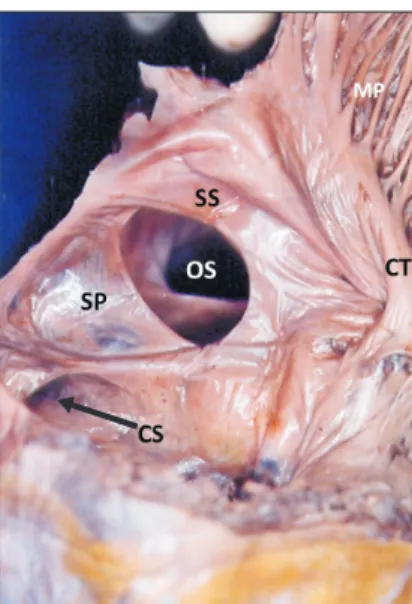
associated with this ASD. But, the cadaver had a moderate built and did not present any other obvious anomalies. While dissecting the right atrium, I observed the large oval foramen (Figs. 1, 2) which had a diameter of 1.25 inches. The partially grown septum secundum was seen separating the upper part of the atria incompletely. The septum primum was seen as a semilunar, membranous valve projecting up from the right side of the septum secundum (Figs. 1, 2). Neither the heart, nor the body of the cadaver had any other notable abnormali- ties.
Discussion
ASDs are the abnormal communications between the right and left atria allowing the mixing up of the blood of two com- partments. They are of three types; ostium secundum defect, ostium primum defect, and sinus venosus defect. The ostium secundum defect is the true defect that is seen in the region of fossa ovalis. Ostium primum defect is characterized by the presence of a common atrioventricular valve and the sinus ve- nosus defect is associated with anomalous pulmonary venous system. Down syndrome is associated with ASDs and the offspring of patients with ASDs are at a risk of heart disease [2, 3]. Many patients with ASDs may not present any symptoms early in life. The age at which symptoms appear is highly vari- able. Dyspnea and fatigue is the most common symptom in those having ASDs. Large ASDs are associated with increased
morbidity and mortality [4]. They can be surgically or medi- cally treated and the earlier the treatment, more benefit for the patient [5, 6].
Patent foramen ovale is a condition where the septum primum and septum secundum fail to fuse after birth. Under certain hemodynamic conditions, when there is a transient pressure gradient from the right to left atria, a patent foramen ovale can open and enable blood to pass from the venous to the arterial circulation. This shunting of the blood is the mechanism of paradoxical embolism [7-9]. Another condi- tion associated with the patent foramen ovale is the crypto- genic stroke which has been reported by several workers [10- 12].
Very large septal defect like the one being reported here would be life threatening at any age. The symptoms might appear even with a small amount of exercise and may lead to stroke or death. How the lady survived for about 50 years with such a large septal defect is a mystery. It is possible that she had symptoms like fatigue and dyspnea. She would have had a compromised life with a lazy lifestyle. She would have lead a less strenuous life to live for such a long period with such a big defect in her interatrial septum.
References
1. Sadler TW. Langman’s medical embryology. 11th ed. Philadel- phia, PA: Lippincott Williams and Wilkins; 2011. p.175.
Fig. 1. Interior of the right atrium showing the large ostium secundum defect. Crista terminalis (CT) and musculi pectinati (MP) can also be seen.
Fig. 2. Closer view of the interior of the right atrium. CS, opening of coronary sinus; CT, crista terminalis; MP, musculi pectinati; OS, ostium secundum; SP, septum primum; SS, septum secundum.
Anat Cell Biol 2017;50:152-154 Satheesha B. Nayak
154
www.acbjournal.org https://doi.org/10.5115/acb.2017.50.2.152
2. Burn J, Brennan P, Little J, Holloway S, Coffey R, Somerville J, Dennis NR, Allan L, Arnold R, Deanfield JE, Godman M, Houston A, Keeton B, Oakley C, Scott O, Silove E, Wilkinson J, Pembrey M, Hunter AS. Recurrence risks in offspring of adults with major heart defects: results from first cohort of British col- laborative study. Lancet 1998;351:311-6.
3. Uebing A, Steer PJ, Yentis SM, Gatzoulis MA. Pregnancy and congenital heart disease. BMJ 2006;332:401-6.
4. Campbell M. Natural history of atrial septal defect. Br Heart J 1970;32:820-6.
5. Konstantinides S, Geibel A, Olschewski M, Görnandt L, Ros- kamm H, Spillner G, Just H, Kasper W. A comparison of surgical and medical therapy for atrial septal defect in adults. N Engl J Med 1995;333:469-73.
6. Attie F, Rosas M, Granados N, Zabal C, Buendía A, Calderón J.
Surgical treatment for secundum atrial septal defects in patients
>40 years old. A randomized clinical trial. J Am Coll Cardiol 2001;38:2035-42.
7. Choong CK, Calvert PA, Falter F, Mathur R, Appleton D, Wells FC, Schofield PM, Crawford R. Life-threatening impending
paradoxical embolus caught "red-handed": successful manage- ment by multidisciplinary team approach. J Thorac Cardiovasc Surg 2008;136:527-8.
8. Kim RJ, Girardi LN. "Lots of clots": multiple thromboemboli including a huge paradoxical embolus in a 29-year old man. Int J Cardiol 2008;129:e50-2.
9. Ahmed S, Sadiq A, Siddiqui AK, Borgen E, Mattana J. Paradoxi- cal arterial emboli causing acute limb ischemia in a patient with essential thrombocytosis. Am J Med Sci 2003;326:156-8.
10. Cabanes L, Mas JL, Cohen A, Amarenco P, Cabanes PA, Oubary P, Chedru F, Guérin F, Bousser MG, de Recondo J. Atrial septal aneurysm and patent foramen ovale as risk factors for crypto- genic stroke in patients less than 55 years of age: a study using transesophageal echocardiography. Stroke 1993;24:1865-73.
11. Di Tullio M, Sacco RL, Gopal A, Mohr JP, Homma S. Patent foramen ovale as a risk factor for cryptogenic stroke. Ann Intern Med 1992;117:461-5.
12. Handke M, Harloff A, Olschewski M, Hetzel A, Geibel A. Patent foramen ovale and cryptogenic stroke in older patients. N Engl J Med 2007;357:2262-8.