ABSTRACT
Background: This study was conducted to evaluate the prognostic value of the frailty index based on routine laboratory data (FI-L) in elderly patients who underwent surgical aortic valve replacement (SAVR).
Methods: A total of 154 elderly patients (≥ 75 years) (78.7 ± 3.6 years; men:women = 78:76) who underwent aortic valve replacement with stented bioprosthesis between 2001 and 2018 were enrolled. The FI-L was calculated as the proportion of abnormal results out of 32 items based on laboratory tests, pulse rate and blood pressure. The primary outcome was all-cause mortality. Secondary outcomes included operative mortality and aortic valve-related events (AVREs) during follow-up. The predictive values of FI-L for the early and late outcomes were evaluated using logistic regression and Cox proportional hazards models, respectively. The median follow-up duration was 40 months (interquartile, 15–74).
Results: The operative mortality rate was 3.9% (n = 6). Late death occurred in 29 patients.
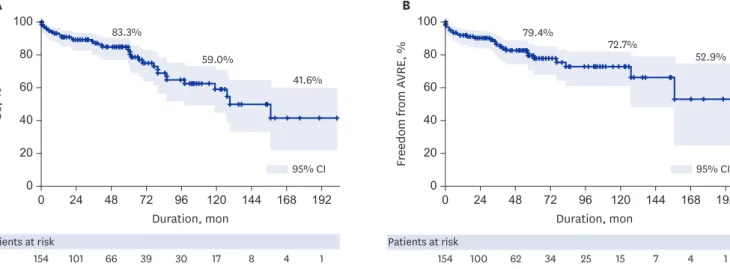
The overall survival (OS) rates at 5, 10, and 15 years were 83.3%, 59.0%, and 41.6%, respectively. The AVREs occurred in 28 patients and the freedom rates from AVREs at 5, 10, and 15 years were 79.4%, 72.7%, and 52.9%, respectively. Multivariable analyses demonstrated that FI-L was a significant factor for OS (hazard ratio, 1.075; 95% confidence interval, 1.040–1.111). A minimal P value approach showed that a FI-L of 25% was the best cutoff value to predict OS after SAVR.
Conclusion: The FI-L is significantly associated with early and long-term outcomes after SAVR in elderly patients. Frailty rather than a patient's age should be considered in the decision-making process for SAVR in elderly patients.
Keywords: Frailty; Elderly; Aortic Stenosis; Aortic Valve Replacement
INTRODUCTION
Aortic valve stenosis (AS) is the most common valvular heart disease in the elderly.1,2 Although surgical aortic valve replacement (SAVR) has been the treatment of choice to correct significant AS, the use of trans-catheter aortic valve implantation (TAVI) for the management of AS has been rapidly growing, and its indications have been widely expanded to intermediate and even low-risk patients for SAVR.3-7
Original Article
Received: Apr 29, 2019 Accepted: Jul 11, 2019 Address for Correspondence:
Ho Young Hwang, MD, PhD
Department of Thoracic and Cardiovascular Surgery, Seoul National University Hospital, 101 Daehak-ro, Jongno-gu, Seoul 03080, Korea.
E-mail: [email protected]
© 2019 The Korean Academy of Medical Sciences.
This is an Open Access article distributed under the terms of the Creative Commons Attribution Non-Commercial License (https://
creativecommons.org/licenses/by-nc/4.0/) which permits unrestricted non-commercial use, distribution, and reproduction in any medium, provided the original work is properly cited.
ORCID iDs Bongyeon Sohn
https://orcid.org/0000-0003-0613-8273 Jae Woong Choi
https://orcid.org/0000-0002-0921-756X Ho Young Hwang
https://orcid.org/0000-0002-8935-8118 Myoung-jin Jang
https://orcid.org/0000-0001-8123-5001 Kyung Hwan Kim
https://orcid.org/0000-0002-2718-8758 Ki-Bong Kim
https://orcid.org/0000-0002-4918-7262 Disclosure
The authors have no potential conflicts of interest to disclose
Bongyeon Sohn ,1 Jae Woong Choi ,1 Ho Young Hwang ,1 Myoung-jin Jang ,2 Kyung Hwan Kim ,1 and Ki-Bong Kim 1
1Department of Thoracic and Cardiovascular Surgery, Seoul National University Hospital, Seoul, Korea
2Department of Medical Research Collaborating Center, Seoul National University Hospital, Seoul, Korea
Frailty Index is Associated with
Adverse Outcomes after Aortic Valve Replacement in Elderly Patients
Medicine General & Policy
Author Contributions
Conceptualization: Hwang HY. Data curation:
Sohn B, Choi JW, Hwang HY. Formal analysis:
Sohn B, Hwang HY, Jang MJ. Investigation:
Sohn B, Choi JW, Hwang HY. Methodology:
Sohn B, Hwang HY, Kim KH, Kim KB.
Validation: Hwang HY. Writing - original draft:
Sohn B. Writing - review & editing: Hwang HY.
Current risk scores, such as the European System for Cardiac Operative Risk Evaluation (EuroSCORE) II and Society of Thoracic Surgery (STS) score, which were initially developed to predict early results after surgery, have been proven to be effective in predicting long-term outcomes after cardiac surgery8,9 and currently are used in the decision-making process between SAVR and TAVI.
In addition to these specialized risk score models for cardiac surgical patients, frailty has been suggested to be a major factor influencing patients' outcomes.10 Frailty is a state of increased vulnerability to poor resolution of homeostasis after a stressor event, which increases the risk of adverse outcomes.11 The frailty index (FI) was designed to quantify the variability in frailty status and various FI types have been introduced.12 Among the various scales, the FI based on routine laboratory data (FI-L), blood pressure and pulse rate was proven to be significantly associated with all-cause mortality during a 9-year follow-up and was as effective as the FI based on self-reported clinical features.13 The FI-L has advantages compared with other frailty measures; 1) it could be easily obtained from preoperative vital signs and blood sample tests without further examinations, 2) it is highly versatile and reproducible because it is determined by totally objective manner, and 3) it can reflect subclinical conditions which emerges only subtle changes in laboratory tests.
Because recent guidelines suggested age (≥ 75 years) as one of the significant factors to favor TAVI during the discussion in the heart team,6 this study hypothesized that frailty rather than the patient's age might be more important in the decision-making process for elderly patients. Therefore, the present study was conducted to evaluate the predictive value of FI-L on clinical outcomes after SAVR in elderly patients.
METHODS
Patient characteristics
From January 2001 to June 2018, 154 patients who were 75 years or older underwent primary SAVR at our institution and were enrolled in the present study. Patients who underwent concomitant valvular heart surgery and those with infective endocarditis were excluded.
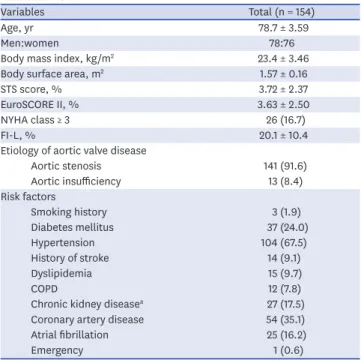
The etiologies of aortic valve disease were AS and aortic regurgitation in 141 and 13 patients, respectively. The mean age at the operation was 78.7 ± 3.6 years, and 78 patients (50.6%) were men. The mean EuroSCORE II and STS scores were 3.6 ± 2.5 and 3.7 ± 2.4, respectively.
Twenty-six patients (16.7%) were in New York Heart Association functional classification III–
IV. The baseline characteristics of the enrolled patients are summarized in Table 1.
Surgical procedures and operative data
All operations were performed through median sternotomy. Bovine pericardial and porcine valves were used in 126 and 28 patients, respectively, with sizes ranging from 18 to 27 mm.
Concomitant procedures included coronary artery bypass grafting (n = 28), ascending aorta replacement (n = 23) and arrhythmia surgery (n = 10). The mean cardiopulmonary bypass and aortic cross-clamp times were 183 ± 77 and 111 ± 38 minutes, respectively (Table 2).
FI-L calculation
The concept of FI-L was started with the view of seeing frailty as a state of impaired health arising from the accumulation of health deficits. The FI-L was calculated as a proportion of variables showing abnormal results out of 32 preoperative parameters based on blood and
urine tests and the blood pressure and pulse rate (Supplementary Fig. 1).13 Median 28 (range, 26–32) variables could be obtained from study patients. Normal reference ranges for each variable as demonstrated in the Supplementary Fig. 1 were used to code each deficit as binary fashion. Each patient's FI-L score was calculated as the number of deficits present divided by the total number of deficits measured. Therefore, the FI-L score shows a quantitative measure of health deficits. A higher score indicates greater frailty.
Evaluation of clinical outcomes
Operative mortality was defined as any death within 30 days after surgery or during the same hospitalization. Postoperative follow-up was performed regularly on an outpatient basis with 3- to 4-month intervals. Patients who did not visit the clinic at the scheduled time were contacted by telephone to confirm their condition. In addition, data for the vital status and death from cardiovascular diseases were obtained from death certificates available at Statistics Korea. Clinical follow-up was closed on June 30, 2018. The median follow-up duration was 40 months (interquartile range [IQR], 15–74 months). Aortic valve-related events (AVREs) were defined based on the guidelines as follows14: cardiac death, structural Table 1. Preoperative characteristics and risk factors
Variables Total (n = 154)
Age, yr 78.7 ± 3.59
Men:women 78:76
Body mass index, kg/m2 23.4 ± 3.46
Body surface area, m2 1.57 ± 0.16
STS score, % 3.72 ± 2.37
EuroSCORE II, % 3.63 ± 2.50
NYHA class ≥ 3 26 (16.7)
FI-L, % 20.1 ± 10.4
Etiology of aortic valve disease
Aortic stenosis 141 (91.6)
Aortic insufficiency 13 (8.4)
Risk factors
Smoking history 3 (1.9)
Diabetes mellitus 37 (24.0)
Hypertension 104 (67.5)
History of stroke 14 (9.1)
Dyslipidemia 15 (9.7)
COPD 12 (7.8)
Chronic kidney diseasea 27 (17.5)
Coronary artery disease 54 (35.1)
Atrial fibrillation 25 (16.2)
Emergency 1 (0.6)
Values are presented as mean ± standard deviation or number (%).
STS = The Society of Thoracic Surgeons, EuroSCORE = European System for Cardiac Operative Risk Evaluation, NYHA = New York Heart Association, FI-L = frailty index based on routine laboratory data, COPD = chronic obstructive pulmonary disease.
aA glomerular filtration rate < 60 mL/min/1.73 m2 for more than 3 months.
Table 2. Operative data
Variables Total (n = 154)
CPB time, min 183 ± 77
ACC time, min 111 ± 38
Concomitant procedures
Arrhythmia surgery 10 (6.5)
Aorta surgery 23 (14.9)
Coronary artery bypass grafting 28 (18.2) Values are mean ± standard deviation or number (%).
CPB = cardiopulmonary bypass, ACC = aortic cross-clamp.
valve deterioration, nonstructural valve dysfunction, valve thrombosis, embolism, bleeding event, and prosthetic valve endocarditis.
Statistical analysis
The statistical analyses were performed using the IBM SPSS statistical software version 23.0 (IBM Corp., Armonk, NY, USA), STATA version 12.0 (StataCorp, College Station, TX, USA) and SAS V.9.2 (SAS Institute, Cary, NC, USA). The data are expressed as the means ± standard deviations, medians with IQR or proportions. Comparisons of categorical and continuous variables were performed with the χ2 test or Fisher's exact test and Student's t-test or the Mann-Whitney U test, respectively. Time-related events were estimated using the Kaplan- Meier method and risk factors were analyzed using the Cox proportional hazards model. The proportional hazards assumption was checked by log-minus-log plots of survival functions for categorical variables or time-dependent covariates in the Cox model. Restricted cubic splines were used to check the assumption of linearity between continuous variable and its log hazard.
Variables with P < 0.050 in the univariate analyses were entered into the multivariable models, and multicollinearity was controlled using backward stepwise regression. Discrimination ability for death was evaluated with Harrell's C-statistics from the jackknife method in the somersd package of STATA (StataCorp) and concordance index (C-index) was presented.15 The minimal P value approach was used to estimate an optimal cutoff value of a continuous variable predicting a time-related event.16 A P < 0.050 was considered statistically significant.
Ethics statement
The study protocol was reviewed and approved by the Institutional Review Board at our institution (approval No. H-1806-086-951). Informed consent was waived because this study was a minimal risk retrospective study.
RESULTS
Early results
The mean patient FI-L was 20% ± 10.4%. The operative mortality rate was 3.9% (6 of 154 patients). The causes of death were low cardiac output syndrome (n = 2), sepsis (n = 3), and acute bowel ischemia (n = 1). Postoperative complications included new-onset atrial fibrillation (n = 45), respiratory complications (n = 15), and acute kidney injury (n = 13) (Table 3). One Table 3. Early clinical outcomes
Variables Total (n = 154)
Operative mortality 6 (3.9)
Postoperative complications
Atrial fibrillation (new onset) 45 (34.9)a
Acute kidney injuryb 13 (8.4)
LCOSc 10 (6.5)
Reoperation for bleeding 8 (5.2)
Respiratory complicationsd 15 (9.7)
Stroke 5 (3.2)
Permanent pacemaker implantation 1 (0.6)
Any paravalvular leak 6 (3.9)
Data are presented as number (%).
LCOS = low cardiac output syndrome.
aDrawn from 129 patients who had no atrial fibrillation preoperatively; bAn increase of > 50% in serum creatinine level from the preoperative value; cCardiac index < 2.0 L/min/m2 or a systolic arterial pressure < 90 mmHg requiring inotropic support (dopamine or dobutamine) of > 5 mcg/kg per minute; dPostoperative pneumonia or prolonged ventilator support over 48 hours.
patient required a second-run cardiopulmonary bypass to correct a significant paravalvular leak detected on intraoperative transesophageal echocardiography. A paravalvular leakage was detected by postoperative transthoracic echocardiography in 6 patients, but the grade was trivial in all cases. One patient needed permanent pacemaker implantation on the 16th postoperative day due to a complete atrioventricular block after surgery.
Long-term outcomes
During follow-up, late deaths occurred in 29 patients including 9 cardiac deaths. The overall survival (OS) rates at 5, 10, and 15 years were 83.3%, 59.0%, and 41.6%, respectively (Fig. 1A).
The AVREs occurred in 28 patients. The paravalvular leak disappeared in 5 out of 6 patients on follow-up echocardiography. In the other patient, it remained as less than moderate degree during the 1-year follow-up after surgery. Bleeding events and embolic stroke occurred in 6 and 4 patients, respectively. Aortic valve reoperation was required in only one patient due to prosthetic valve endocarditis 31 months after surgery. One additional patient was diagnosed with infective endocarditis, which was successfully managed with antibiotic therapy. The freedom rates from AVREs at 5, 10, and 15 years were 79.4%, 72.7%, and 52.9%, respectively (Fig. 1B).
Impact of the FI-L on early and late outcomes
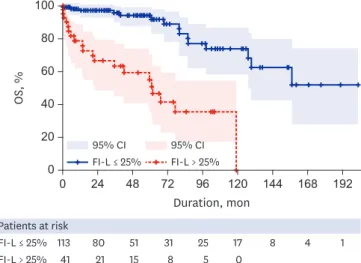
Univariate analyses demonstrated that chronic kidney disease (P = 0.009), diabetes mellitus (P = 0.030), EuroSCORE II (P = 0.009), STS score (P = 0.007), and FI-L (P = 0.002) were associated with early mortality. The Cox proportional hazards analysis showed that the FI-L was a significant factor associated with OS (Table 4). The C-index for OS was 0.767 for FI-L. Among 32 variables included in the FI-L, diastolic blood pressure (P = 0.034), serum bicarbonate (P = 0.002), calcium (P = 0.029), blood urea nitrogen (P = 0.009), albumin (P = 0.004), total bilirubin (P = 0.021), hemoglobin (P = 0.003), and glycohemoglobin (P = 0.014) levels were significant factors associated with OS. The C-index increased up to 0.825 when it was calculated from combined EuroSCORE II and FI-L. When the FI-L was combined with the STS score, the C-index increased up to 0.827 (Table 5). A minimal P value approach demonstrated that a FI-L of 25% was the best cutoff value to predict all-cause mortality after SAVR (Fig. 2). When the clinical outcomes were compared based on the FI-L, frail patients
A
80 100
20
00 24 48 72 96 120 144 168 192
60
OS, % 40
Duration, mon
154 101 66 39 30 17 8 4 1
Patients at risk
95% CI 83.3%
59.0%
41.6%
B
80 100
20
00 24 48 72 96 120 144 168 192
60 40
Freedom from AVRE, %
Duration, mon
154 100 62 34 25 15 7 4 1
Patients at risk
95% CI 79.4%
72.7%
52.9%
Fig. 1. Long-term outcomes (Kaplan-Meier curve). (A) OS and (B) freedom from AVRE.
OS = overall survival, CI = confidence interval, AVRE = aortic valve-related event.
(FI-L > 25%) had higher rates of operative mortality (12.2% vs. 0.9%, P = 0.005) and cardiac death (P < 0.001) and AVRE (P < 0.001) during the follow-up (Table 6 and Fig. 3).
DISCUSSION
The present study demonstrated two main findings. First, the early and long-term outcomes of SAVR in the elderly patients were favorable with early mortality and 10-year survival rates of 3.9% and 59%, respectively, and low incidences of paravalvular leak and permanent pacemaker implantation after surgery. Second, the FI-L was significantly associated with early and long-term mortality after SAVR in elderly patients.
Table 4. Risk factor analyses for overall survival
Variables Univariate analysis Multivariable analysis
P value Hazard ratio (95% CI) P value
Age, yr 0.293 - -
Chronic kidney disease 0.012 - 0.503
Diabetes mellitus 0.014 - 0.632
Atrial fibrillation 0.024 - 0.125
EuroSCORE II, % < 0.001 1.212 (1.101–1.335) < 0.001
STS score, % < 0.001 - 0.406
FI-L, % < 0.001 1.075 (1.040–1.111) < 0.001
CI = confidence interval, EuroSCORE = European System for Cardiac Operative Risk Evaluation, STS = The Society of Thoracic Surgeons, FI-L = frailty index based on routine laboratory data
Table 5. C-index for overall death
Variables C-index 95% CI
FI-L 0.767 0.681–0.852
EuroSCORE II 0.723 0.637–0.809
STS score 0.741 0.654–0.828
FI-L and EuroSCORE II 0.825 0.758–0.891
FI-L and STS score 0.827 0.764–0.890
C-index = concordance index, CI = confidence interval, FI-L = frailty index based on routine laboratory data, EuroSCORE = European System for Cardiac Operative Risk Evaluation, STS = the society of thoracic surgeons.
80 100
20
00 24 48 72 96 120 144 168 192
60
OS, % 40
Duration, mon Patients at risk
113 80 51 31 25 17 8 4 1
FI-L ≤ 25%
41 21 15 8 5 0
FI-L > 25%
95% CI FI-L ≤ 25%
95% CI FI-L > 25%
Fig. 2. Kaplan-Meier curves for OS according to the cutoff value of the frailty index (FI-L).
OS = overall survival, CI = confidence interval, FI-L = frailty index based on routine laboratory data.
Since the first report in 2002, the indications for TAVI have been expanded from high or prohibited surgical risk patients to intermediate and even low-risk patients for SAVR in current clinical practice.3,17 In addition, recent guidelines suggested age (≥ 75 years) as one of the significant factors to favor TAVI during the discussion in the heart team.6 However, previous studies demonstrated favorable early and long-term results after SAVR even in octogenarians,18-21 with early mortality rates from 5.5% to 9% and 5-year survival rates of approximately 70%. The early and long-term outcomes in the present study were in agreement with those of previous studies with operative mortality and 5-year survival rates of 3.9% and 83.3%, respectively.
In addition to age, the concept of frailty has emerged as one of the risk profiles especially in the elderly. Evidences has shown a significant association between the frailty and clinical outcomes in elderly cardiac surgical patients, which have also been growing very recently.22-24 However, current models such as the EuroSCORE II and STS, included age but not frailty as a major risk factor for mortality and major morbidity after cardiac surgery.
The Frailty in Aortic Valve Replacement study22 is the largest prospective study to date to investigate the impact of frailty scales on outcomes after surgery in elderly patients Table 6. Comparisons of early and long-term clinical outcomes according to the FI-L
Variables FI-L > 25% (n = 41) FI-L ≤ 25% (n = 113) P value
Operative mortality 5 (12.2) 1 (0.9) 0.005
Postoperative complications
Atrial fibrillation (new onset) 8 (26.7a) 37 (37.4a) 0.281
Acute kidney injury 6 (14.6) 7 (6.2) 0.109
LCOS 4 (9.8) 5 (4.4) 0.248
Reoperation for bleeding 1 (2.4) 7 (6.2) 0.682
Respiratory complications 6 (14.6) 9 (8.0) 0.229
Stroke 1 (2.4) 4 (3.5) 0.999
Data are presented as number (%).
FI-L = frailty index based on routine laboratory data, LCOS = low cardiac output syndrome.
aDrawn from 30 and 99 patients in the FI-L > 25% and FI-L ≤ 25% groups, respectively, who had no atrial fibrillation preoperatively.
Patients at risk 80 100
20
00 24 48 72 96 120 144 168 192
60 40
Freedom from AVRE, %
Duration, mon
113 76 48 27 21 13 6 3 0
FI-L ≤ 25%
41 21 15 7 4 0
FI-L > 25%
95% CI FI-L ≤ 25%
95% CI FI-L > 25%
80 100
20
00 24 48 72 96 120 144 168 192
60 40
Freedom from cardiac death, %
Duration, mon Patients at risk
113 80 51 31 25 17 8 4 1
FI-L ≤ 25%
41 21 15 8 5 0
FI-L > 25%
95% CI FI-L ≤ 25%
95% CI FI-L > 25%
A B
Fig. 3. Impact of the FI-L on clinical outcomes (Kaplan-Meier curve). (A) Freedom from cardiac death and (B) AVRE according to the cutoff value of the frailty index (FI-L).
CI = confidence interval, AVRE = aortic valve related event, FI-L = frailty index based on routine laboratory data.
undergoing SAVR or TAVI. The authors suggested that a brief 4-item scale outperformed other frailty scores and was recommended for use in this setting. However, the assessment of frailty should not rely on a subjective method. In the present study, the FI-L was selected from the various frailty scales for several reasons. It is an accumulation of different objective estimates as biomarkers of frailty. The validity of the FI-L in evaluating the frailty status has been proven in previous studies.13,25 The FI-L is convenient and feasible using only existing preoperative data. Finally, it could be adopted in any retrospective studies like the present study. Our study clearly showed that the FI-L was significantly associated with early and long- term outcomes after SAVR in elderly patients. The minimal P value approach showed that a FI-L of 25% was the best cutoff value for predicting poor outcomes after SAVR. The C-index for OS was better with FI-L (0.767) than current risk model (EuroSCORE II). The C-index was increased when converging FI-L and EuroSCORE II in both early and long-term predictions of survival. Therefore, in addition to the current risk scores and age itself, the FI-L should be considered in the decision-making process between the SAVR and TAVI for the elderly.
There are several limitations that must be recognized in the present study. First, this study was a retrospective observational study conducted at a single institution. Second, the number of patients enrolled was relatively small to draw definitive conclusions. Third, multivariable analysis for the early mortality was not presented because the number of events was too small to run adequate analysis for this outcome. Fourth, only SAVR patients were enrolled and the results were not compared with those of TAVI patients. Further study might be needed if the FI-L could be a useful tool in decision making process between SAVR and TAVR.
In conclusion, frailty score but not patients' age is significantly associated with early and long-term clinical outcomes after SAVR in the elderly patients equal or more than 75 years. Combining frailty score to current risk scores might be helpful to predict long-term outcomes after SAVR in elderly patients.
ACKNOWLEDGMENTS
The authors wish to thank the Medical Research Collaborating Center, Seoul National University Hospital for statistical consultation.
SUPPLEMENTARY MATERIAL
Supplementary Fig. 1
Laboratory frailty index (FI-L) items.
Click here to view
REFERENCES
1. Carabello BA, Paulus WJ. Aortic stenosis. Lancet 2009;373(9667):956-66.
PUBMED | CROSSREF
2. Iung B, Vahanian A. Epidemiology of valvular heart disease in the adult. Nat Rev Cardiol 2011;8(3):162-72.
PUBMED | CROSSREF
3. Nishimura RA, Otto CM, Bonow RO, Carabello BA, Erwin JP 3rd, Fleisher LA, et al. 2017 AHA/ACC focused update of the 2014 AHA/ACC guideline for the management of patients with valvular heart disease: a report of the American College of Cardiology/American Heart Association task force on clinical practice guidelines. Circulation 2017;135(25):e1159-95.
PUBMED | CROSSREF
4. Smith CR, Leon MB, Mack MJ, Miller DC, Moses JW, Svensson LG, et al. Transcatheter versus surgical aortic-valve replacement in high-risk patients. N Engl J Med 2011;364(23):2187-98.
PUBMED | CROSSREF
5. Nielsen HH, Klaaborg KE, Nissen H, Terp K, Mortensen PE, Kjeldsen BJ, et al. A prospective, randomised trial of transapical transcatheter aortic valve implantation vs. surgical aortic valve replacement in operable elderly patients with aortic stenosis: the STACCATO trial. EuroIntervention 2012;8(3):383-9.
PUBMED | CROSSREF
6. Baumgartner H, Falk V, Bax JJ, De Bonis M, Hamm C, Holm PJ, et al. 2017 ESC/EACTS guidelines for the management of valvular heart disease. Eur Heart J 2017;38(36):2739-91.
PUBMED | CROSSREF
7. Wyler von Ballmoos MC, Barker CM, Reul RM, Dadu R, Ramchandani M, Kleiman NS, et al. When to SAVR in the age of TAVR? A perspective on surgical aortic valve replacement in 2018. Cardiovasc Revasc Med 2018;19(2):139-41.
PUBMED | CROSSREF
8. Barili F, Pacini D, D'Ovidio M, Ventura M, Alamanni F, Di Bartolomeo R, et al. Reliability of modern scores to predict long-term mortality after isolated aortic valve operations. Ann Thorac Surg 2016;101(2):599-605.
PUBMED | CROSSREF
9. Holinski S, Jessen S, Neumann K, Konertz W. Predictive power and implication of EuroSCORE, EuroSCORE II and STS score for isolated repeated aortic valve replacement. Ann Thorac Cardiovasc Surg 2015;21(3):242-6.
PUBMED | CROSSREF
10. Sepehri A, Beggs T, Hassan A, Rigatto C, Shaw-Daigle C, Tangri N, et al. The impact of frailty on outcomes after cardiac surgery: a systematic review. J Thorac Cardiovasc Surg 2014;148(6):3110-7.
PUBMED | CROSSREF
11. Rockwood K, Mitnitski A. Frailty defined by deficit accumulation and geriatric medicine defined by frailty. Clin Geriatr Med 2011;27(1):17-26.
PUBMED | CROSSREF
12. Theou O, Brothers TD, Mitnitski A, Rockwood K. Operationalization of frailty using eight commonly used scales and comparison of their ability to predict all-cause mortality. J Am Geriatr Soc 2013;61(9):1537-51.
PUBMED | CROSSREF
13. Blodgett JM, Theou O, Howlett SE, Rockwood K. A frailty index from common clinical and laboratory tests predicts increased risk of death across the life course. Geroscience 2017;39(4):447-55.
PUBMED | CROSSREF
14. Akins CW, Miller DC, Turina MI, Kouchoukos NT, Blackstone EH, Grunkemeier GL, et al. Guidelines for reporting mortality and morbidity after cardiac valve interventions. Ann Thorac Surg 2008;85(4):1490-5.
PUBMED | CROSSREF
15. Harrell FE Jr, Lee KL, Mark DB. Multivariable prognostic models: issues in developing models, evaluating assumptions and adequacy, and measuring and reducing errors. Stat Med 1996;15(4):361-87.
PUBMED | CROSSREF
16. Altman DG, Lausen B, Sauerbrei W, Schumacher M. Dangers of using “optimal” cutpoints in the evaluation of prognostic factors. J Natl Cancer Inst 1994;86(11):829-35.
PUBMED | CROSSREF
17. Cribier A, Durand E, Eltchaninoff H. Patient selection for TAVI in 2014: is it justified to treat low- or intermediate-risk patients? The cardiologist's view. EuroIntervention 2014;10 Suppl U:U16-21.
PUBMED | CROSSREF
18. Asimakopoulos G, Edwards MB, Taylor KM. Aortic valve replacement in patients 80 years of age and older: survival and cause of death based on 1100 cases: collective results from the UK heart valve registry.
Circulation 1997;96(10):3403-8.
PUBMED | CROSSREF
19. Florath I, Albert A, Boening A, Ennker IC, Ennker J. Aortic valve replacement in octogenarians:
identification of high-risk patients. Eur J Cardiothorac Surg 2010;37(6):1304-10.
PUBMED | CROSSREF
20. Kolh P, Kerzmann A, Honore C, Comte L, Limet R. Aortic valve surgery in octogenarians: predictive factors for operative and long-term results. Eur J Cardiothorac Surg 2007;31(4):600-6.
PUBMED | CROSSREF
21. Langanay T, Flécher E, Fouquet O, Ruggieri VG, De La Tour B, Félix C, et al. Aortic valve replacement in the elderly: the real life. Ann Thorac Surg 2012;93(1):70-7.
PUBMED | CROSSREF
22. Afilalo J, Lauck S, Kim DH, Lefèvre T, Piazza N, Lachapelle K, et al. Frailty in older adults undergoing aortic valve replacement: the FRAILTY-AVR study. J Am Coll Cardiol 2017;70(6):689-700.
PUBMED | CROSSREF
23. Kim DH, Kim CA, Placide S, Lipsitz LA, Marcantonio ER. Preoperative frailty assessment and outcomes at 6 months or later in older adults undergoing cardiac surgical procedures: a systematic review. Ann Intern Med 2016;165(9):650-60.
PUBMED | CROSSREF
24. Conaway DG, House J, Bandt K, Hayden L, Borkon AM, Spertus JA. The elderly: health status benefits and recovery of function one year after coronary artery bypass surgery. J Am Coll Cardiol 2003;42(8):1421-6.
PUBMED | CROSSREF
25. Howlett SE, Rockwood MR, Mitnitski A, Rockwood K. Standard laboratory tests to identify older adults at increased risk of death. BMC Med 2014;12(1):171.
PUBMED | CROSSREF