https://doi.org/10.9713/kcer.2017.55.6.854 PISSN 0304-128X, EISSN 2233-9558
Polysulfone에 Di-(2-ethylhexyl)-phosphoric acid와 Carbon Nanotubes를 고정화한 PSf/D2EHPA/CNTs 비드의 제조와 Sr(II)의 제거 특성
이민규 · 윤종원* · 서정호**,†
부경대학교 화학공학과 48547 부산광역시 남구 신선로 365
*대구대학교 생명공학과
38453 경상북도 경산시 진량읍 대구대로 201
**울산과학대학교 환경화학공업과 44610 울산광역시 남구 대학로 57
(2017년 5월 29일 접수, 2017년 7월 27일 수정본 접수, 2017년 7월 28일 채택)
Preparation of PSf/D2EHPA/CNTs Beads Immobilized with Carbon Nanotubes and Di-(2-ethyl- hexyl)-phosphoric acid on Polysulfone and Removal Characteristics of Sr(II)
Min-Gyu Lee, Jong-Won Yun* and Jung-Ho Suh**,†
Department of Chemical Engineering, Pukyoung National University, 365, Sinseon-ro, Nam-gu, Busan, 48547, Korea
*Department of Biotechnology, Daegu University, 201, Daegu-daero, Jinryang-eup, Kyungsan, Gyeongbuk, 38453, Korea
**Department of Environmental & Chemical Industry, Ulsan College, 57, Daehak-ro, Nam-gu, Ulsan, 44610, Korea (Received 29 May 2017; Received in revised form 27 July 2017; accepted 28 July 2017)
요 약
본 연구에서는 di-(2-ethylhexyl)-phosphoric acid (D2EHPA)와 carbon nanotubes (CNTs)를 polysulfone (PSf)에 고정 화시켜 PSf/D2EHPA/CNTs 비드를 제조하였으며, 제조한 비드에 의한 Sr(II)의 제거특성을 살펴보았다. Scanning electron microscopy (SEM), Fourier transform infrared spectrometer (FTIR) 및 Thermo gravimetric analysis (TGA) 분석을 통 하여 PSf/D2EHPA/CNTs 비드의 형태적 특성들을 조사하였다. PSf/D2EHPA/CNTs 비드에 의한 Sr(II)의 제거는 운전 시간 60 min 정도에서 평형에 도달하였으며, 속도 실험결과는 유사 2차 속도식에 잘 부합하는 것으로 나타났다. 또한 PSf/D2EHPA/CNTs 비드에 의한 Sr(II)의 제거에서 Langmuir 식으로부터 구한 최대 제거량은 4.75 mg/g이었다. PSf/
D2EHPA/CNTs 비드에 의한 Sr(II)의 제거효율은 추출제 D2EHPA 만을 사용하는 경우보다 CNTs를 첨가함으로써 Sr(II) 의 제거량이 2.5배 정도 향상되는 결과를 보였다.
Abstract − PSf/D2EHPA/CNTs beads were prepared by immobilizing extractant di-(2-ethylhexyl)- phosphoric acid (D2EHPA) and adsorbent carbon nanotubes (CNTs) on polysulfone (PSf), and the adsorption characteristics of Sr(II) on the beads were studied. The morphological characteristics of the prepared PSf/D2EHPA/CNTs beads were observed by scanning electron microscopy (SEM), thermo gravimetric analysis (TGA), and Fourier transform infrared spectrometer (FTIR). The equilibrium time for the removal of Sr(II) by PSf/D2EHPA/CNTs beads was 60 min. The experimental kinetic data followed pseudo-second-order model more than pseudo-first-order kinetics model. The maximum removal capacity of Sr(II) obtained from Langmuir isotherm was 4.75 mg/g. The removal efficiencies of Sr (II) by PSf/D2EHPA/
CNTs beads were improved 2.5 times by adding the adsorbent CNTs more than by using only the extractant D2EHPA.
Key words: Carbon nanotubes, CNTs, Di-(2-ethylhexyl)-phosphoric acid, D2EHPA, Immobilization, Polysulfone, Sr(II) removal
†To whom correspondence should be addressed.
E-mail: [email protected]
‡
이 논문은 부경대학교 이제근 교수님의 정년을 기념하여 투고되었습니다.
This is an Open-Access article distributed under the terms of the Creative Com-
mons Attribution Non-Commercial License (http://creativecommons.org/licenses/by-
nc/3.0) which permits unrestricted non-commercial use, distribution, and reproduc-
tion in any medium, provided the original work is properly cited.
재하며, 이 두 이온의 농도는 수중에 존재하는 Ca와 Mg 이온에 영 향을 받는다고 보고하였다.
수중에 존재하는 중금속 이온을 제거하는 데는 흡착[4], 이온교환 [5], 액-액 추출[6] 등의 방법들이 주로 사용되고 있다. 이 중에서 추 출제를 이용하는 액-액 추출법은 금속이온에 대한 선택성이 높고 제 거능이 우수하여 일반적으로 산업에서 많이 사용되고 있으나, 액-액 추출법은 많은 양의 유기용매가 사용되며, 사용된 유기용매의 손실 로 인해 수중 생태계를 오염 시킬 수 있는 우려가 있다[7].
최근에는 비표면적이 넓고, 중금속 이온에 대해 높은 흡착능을 가 진 carbon nanotubes (CNTs)를 사용하여 수중의 중금속 이온을 제 거하는 연구가 주목받고 있다[8]. 탄소 물질중의 하나인 CNTs는 클 로로벤젠[9]이나 제초제[10]와 같은 유기물질뿐만 아니라 Pb[11], Ni[12], Cu[13] 및 Cd 이온[14]과 같은 중금속을 제거하는 데 있어서 잠재력을 가진 새로운 흡착제로 인식되고 있다. Vellaichamy와 Palanivelu[15]는 CNTs에 추출제인 di-(2-ethylhexyl)-phosphoric acid (D2EHPA)를 함침시킨 흡착제를 제조하여 Cr(III)의 제거특성을 고찰하였으며, CNTs를 사용한 경우에 Cr(III)의 제거량은 0.75 mg/g 이었으나, CNTs에 D2EHPA를 함침시킨 흡착제를 사용한 경우에 Cr(III)의 제거량은 0.96 mg/g으로 향상되었다고 하였다. 그러나 이와 같이 흡착제에 추출제를 함침시키는 경우에는 흡착제 외부로 추출 제가 유출될 수 있으며, 유출된 추출제는 수중 오염을 야기[16] 시킬 수 있다. 또한, CNTs는 미세 분말상으로 되어 있기 때문에 흡착 공 정 후 처리수에서 CNTs 분말을 제거 또는 회수하는 것이 용이하지 않 다. 여과에 의해 분리시 필터가 CNTs 분말에 의해 막히는 문제가 발 생하며 Tofighy와 Mohammadi[17]는 CNTs가 환경에 유출되면 건강 과 환경에 심각한 위험을 초래할 수 있기 때문에 CNTs가 누출되지 않는 처리방안이 필요하다고 하였다.
따라서 본 연구에서는 분리막의 재료로 널리 사용되고 있는 고분자 물질인 polysulfone (PSf) 고분자 매트릭스 내에 추출제인 D2EHPA와 흡착제인 CNTs를 고정화한 PSf/D2EHPA/CNTs 비드를 제조하고, SEM, FTIR 및 TGA를 사용하여 특성 분석을 하였다. 제조한 PSf/
D2EHPA/CNTs 비드에 의한 저농도 Sr(II)의 제거특성을 회분식 실 험을 통하여 살펴보고, 실험결과를 속도식 및 등온식에 적용하여 고 찰하였다.
2. 실 험 2-1. PSf/D2EHPA/CNTs 비드의 제조
본 연구에서 사용한 PSf/D2EHPA/CNTs 비드는 다음과 같이 제조 하였다. 100 mL 비커에 1-Methyl-2-pyrrolidone (NMP, Samchun, EP) 17 mL와 Polysulfone (PSf, Sigma-aldrich) 2.125 g을 넣고 용해시킨
석하였다. TGA 분석은 질소 분위기에서 온도를 50~800oC까지 10oC/min의 승온 속도로 증가시키면서 실시하였다.
2-2. Sr(II) 제거 실험
Sr(II) 용액은 Sr(NO3)2(EP, Shimakyu's Pure Chemicals)을 1 L 용 량플라스크에 넣고 증류수로 1,000 mg/L의 모액을 제조하여 사용 하였다. Sr(II)의 제거 실험은 회분식으로 수행하였으며, 250 mL 삼 각플라스크에 Sr(II) 용액 100 mL와 PSf/D2EHPA/CNTs 비드 5 g을 넣고 수평 진탕기(Johnsaem Co., Js-Fs-2500)를 사용하여 170 rpm 으로 교반하면서 일정 시간 간격으로 시료를 채취하였다. 채취한 시료 중의 Sr(II) 이온 농도는 원자흡광광도계(Shimadzu, AA-7000)를 사용하여 분석하였다. 용액의 pH는 0.1 M HCl과 0.1 M NaOH를 사용하여 조절하였으며, pH 미터(Istek, AJ-7,724)를 이용하여 측정 하였다.
3. 결과 및 고찰 3-1. PSf/D2EHPA/CNTs 비드의 특성분석
Fig. 1은 PSf/D2EHPA/CNTs 비드의 SEM 분석 결과를 나타낸 것 이다. Fig. 1(a)는 PSf/D2EHPA/CNTs 비드의 외형을 나타낸 것으로 비드는 직경이 3 mm인 구형이었다. 그리고 Fig. 1(b)와 Fig. 1(c)는 CNTs의 함량이 각각 0.3 g 및 0.6 g인 경우에 PSf/D2EHPA/CNTs 비드의 절단면을 촬영하여 나타낸 것으로 CNTs의 첨가량이 0.3 g에서 0.6 g으로 증가함에 따라 비드 내부에 채워진 CNTs의 함량이 더 많 아짐을 알 수 있었다. 그리고 제조한 PSf/D2EHPA/CNTs 비드의 내 부는 다공성 구조로 형성되었으며, 이러한 다공성 구조가 형성되는 것은 PSf/D2EHPA/CNTs 비드가 경화되는 과정 중에 PSf/D2EHPA/
CNTs 비드 내의 NMP가 혼합용액(증류수와 알코올)으로 빠르게 확 산됨에 따른 것으로 생각된다[18].
Fig. 2는 PSf/CNTs 비드와 D2EHPA 그리고 PS/D2EHPA/CNTs 비드의 FTIR 분석결과를 나타낸 것이다. Fig. 2(a)에서 보듯이 PSf/
CNTs 비드는 2,967 cm-1에서 C-H, 1,322 cm-1에서 O=S=O, 1,234 cm-1에서 C-O-C, 1,147 cm-1에서 O=S=O의 피크를 보였으며 이는 Ozcan 등[16]의 결과와 동일하였다. Fig. 2(b)의 D2EHPA 분석결과 에서 보면 1,223.5 cm-1에서 P=O 피크와 1,014.9 cm-1에서 P-O 피크 가 관찰되었으며, 이 결과는 Kebiche-Senhadji 등[19]과 Yadav 등 [20]의 관찰결과와 유사하였다. 그리고 Fig. 2(c)의 PSf/D2EHPA/
CNTs 비드의 경우에는 PSf/CNTs 비드에서 보이지 않는 D2EHPA의 P=O와 P-O 피크가 각각 1,223.5 cm-1및 1,014.9 cm-1에서 관찰되었 으며, 이러한 결과는 PSf/D2EHPA/CNTs 비드 내에 D2EHPA가 잘 고정화되어 있는 것을 확인해 주는 것으로 판단되었다.
Fig. 3은 PSf/CNTs 비드, D2EHPA, PSf/D2EHPA/CNTs 비드의 TGA 결과를 나타낸 것이다. Fig. 3(a)의 PSf/CNTs 비드의 경우에는 520oC에서 590oC 사이에서 PSf의 분해로 인해 49%의 질량감소를 보였으며[21], Fig. 3(b)에서 D2EHPA는 230oC에서 260 oC 사이에 서 결합이 붕괴되면서 75%의 질량감소가 나타났다[20]. Fig. 3(c)에 나타낸 PSf/D2EHPA/CNTs 비드의 경우에는 D2EHPA의 분해가 일 어나는 구간인 230oC에서 260 oC 사이에서 약 15%의 질량감소와 520oC에서 590oC 사이에서 PSf의 분해로 인해 약 40%의 질량감소가 관찰됨으로써 PSf/D2EHPA/CNTs 비드 내에 D2EHPA가 고정화되 어 있는 것을 확인할 수 있었다.
3-2. PSf 내 D2EHPA와 CNTs 함량 결정
Fig. 4는 PSf로 D2EHPA와 CNTs를 고정화하는 경우에 D2EHPA와 CNTs 양의 변화에 따른 Sr(II)의 제거효율을 나타낸 것이다. Fig. 4에 Fig. 2. FTIR spectra of (a) PS/CNTs beads, (b) D2EHPA, and (c)
PS/D2EHPA/CNTs beads.
Fig. 1. SEM images of (a) outer shape of PSf/D2EHPA/CNTs bead, (b) cross-sectional shape of PSf/D2EHPA/CNTs (0.3 g) bead, and (c) PSf/
D2EHPA/CNTs (0.6 g) bead.
Fig. 3. TGA analysis of (a) PSf/CNTs beads, (b) D2EHPA, and (c) PSf/
D2EHPA/CNTs beads.
Fig. 4. Effect of amounts of CNTs and D2EHPA on removal effi- ciency (initial concentration=20 mg/L, PSf/D2EHPA/CNTs beads=5.0 g/0.1 L, pH=5.2, temperature=20oC).
3-3. pH의 영향
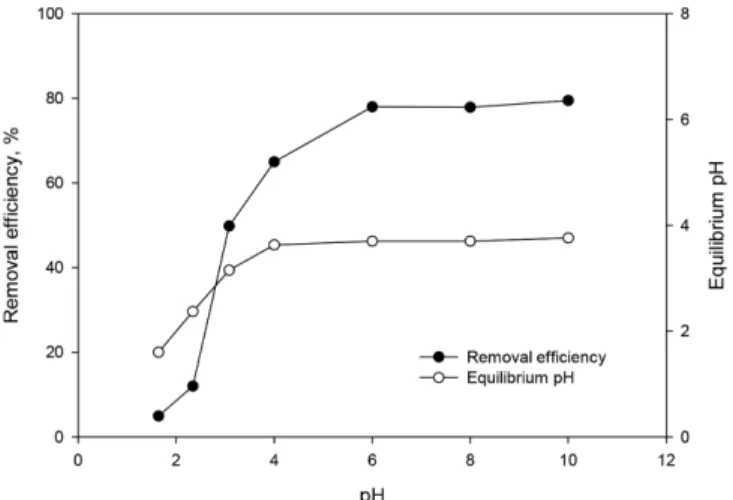
Fig. 5는 pH 변화가 Sr(II)의 제거효율에 미치는 영향을 알아보기 위하여 Sr(II)용액의 초기농도를 20 mg/L로 일정하게 하고서 pH를 2~10으로 조절하여 실험을 행한 결과를 나타낸 것이다. Fig. 5에서 보는 바와 같이, pH 6~10 사이의 범위에서는 Sr(II)의 제거효율이 높게 안정적으로 나타났으나, pH 4 이하에서는 제거효율이 크게 감 소하였다. 이는 낮은 pH에서는 수중에 존재하는 수소 이온과 Sr(II)의 경쟁으로 인해 제거효율이 낮아지는 것으로 생각되었다. 또한, Cheon 등[22]의 연구에 의하면, 수용액 상에서 pH 12이하에서는 Sr(II)가 이온 상태로만 존재하므로, 본 연구에서 수행한 pH 범위 내 에서는 Sr(II)이 모두 PSf/D2EHPA/CNTs 비드에 의해 제거된 것으로 판단되었다. 한편 초기 pH에 따른 Sr(II)의 제거 실험에서 평형 pH 변화를 살펴보면, 용액의 초기 pH가 4이하에서는 평형 pH가 초기 pH와 비슷하였으며, 초기 pH가 6이상에서는 평형 pH가 3.8까지 감 소하는 것으로 나타났다. 이는 산성 추출제인 D2EHPA에 의한 Sr(II) 제거가 D2EHPA의 H+와 Sr(II) 사이에 이온교환이 일어나며 [23], 이로 인해 수중에 H+의 농도가 증가하기 때문에 용액의 평형 pH가 감소하는 것으로 사료되었다. Rahman 등[24]이 제시한 zeolite 상의 Sr(II)의 흡착결과에서, pH가 2~6으로 증가함에 따라 Sr(II)의 분배계수(kd)가 증가한 후, pH 6이상에서 kd가 증가하지 않고 일정해 진다고 보고하였다. Fujikawa와 Fukui [25]는 Sr(II)의 kd가 pH 4.5~6에서 0.003~0.251로 증가한다고 보고하였다. Fig. 5에서 Sr(II) 제거율이 pH 2~6에서 거의 선형적으로 증가한 후 pH 6에서는 거의 일정해지는 경향을 보이는 것은 pH에 따른 kd값의 변화로 PSf/
D2EHPA/CNTs 비드상에서 Sr(II)의 이온교환이 활발해져 Sr(II)의 제거율이 높아진 것으로 판단된다.
3-4. 시간에 따른 농도 변화
Fig. 6은 PSf/D2EHPA/CNTs 비드에 의한 Sr(II)의 제거 실험에서 초기 농도를 10~150 mg/L로 달리한 경우에 시간에 따른 제거량의 변화를 나타낸 것이다. PSf/D2EHPA/CNTs 비드에 의한 Sr(II)의 제 거는 30 min 까지 농도가 급격하게 감소하였으며, 그 이후에는 서서 히 감소하다가 60 min 이후에 평형에 도달하였다. 이러한 결과는 Li 등[26]이 CNTs를 이용하여 Pb2+, Cu2+및 Cd2+ 흡착 시에 초기 30 min 까지 흡착이 빠르게 진행되다가 60 min 이후에 평형에 도달하였다는 결과와 Vellaichamy와 Palanivelu[15]가 CNTs에 추출제인 di-(2- ethylhexyl)-phosphoric acid (D2EHPA)를 함침시킨 흡착제를 사용 하여 Cr(III)을 제거 시에 초기 45 min까지는 흡착이 빠르게 진행되 다가 90 min 내에 평형에 도달하였다는 결과와 유사하였다. 초기 단 계에서 제거가 빠르게 진행되는 것은 초기단계에서는 D2EHPA와 CNTs의 활성점이 비어 있어 쉽게 Sr(II)의 제거가 일어나지만, 시간 이 경과함에 따라 활성점이 줄어들게 되므로 물질전달 구동력이 감 소하기 때문으로 생각된다[27].
3-5. 속도식
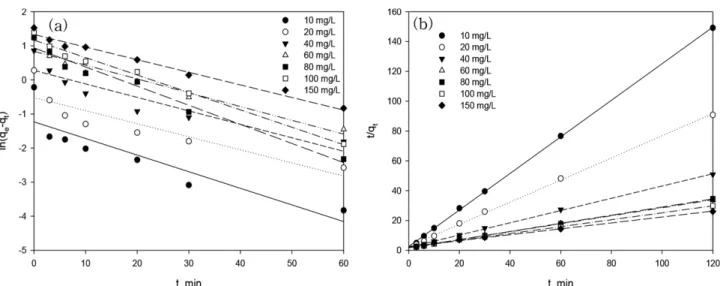
PSf/D2EHPA/CNTs 비드에 의한 Sr(II)의 제거 속도를 검토하기 위하여 유사 1차 속도식과 유사 2차 속도식을 사용하였다.
유사 1차 속도식은 다음과 같이 정의된다[28].
(1) 유사 2차 속도식은 다음과 같이 정의된다[29].
(2) 회분식 실험으로부터 얻은 자료를 식 (1)과 식 (2)에 적용한 결과를 각각 Fig. 7에 나타내었으며, 이로부터 구한 파라미터 값들을 Table 1 에 정리하였다. Table 1에서 보면 유사 1차 속도식의 경우에 결정계
qe–qt
( )
ln =lnqe–k1t
t qt ---- 1
k2qe2 --- 1
qe ----t +
=
Fig. 5. Effect of pH on removal efficiency (initial concentration=20 mg/L, PSf/D2EHPA/CNTs beads=5.0 g/0.1 L, temperature
=20oC).
Fig. 6. Effect of contact time on Sr(II) adsorption (PSf/D2EHPA/
CNTs beads=10.0 g/0.2 L, pH=5.2, temperature=20oC).
수(r2)는 0.796~0.986이고, 유사 2차 속도식에 적용한 경우에 r2는 0.995~0.999인 결과를 보여 PSf/D2EHPA/CNTs 비드에 의한 Sr(II)의 제거는 유사 2차 속도식에 잘 부합하였다. 이러한 결과는 Li 등[11]이 CNTs에 의한 Pb2+이온의 흡착시 유사 2차 속도식에 잘 부합하였다는 결과와, 본 연구자들이 추출제 D2EHPA를 PSf에 고정화한 PSf/
D2EHPA 비드를 사용하여 Cu(II)와 Pb(II)의 제거 시 유사 2차 속도 식에 잘 부합하였다는 결과[30]와 유사하였다.
3-6. 등온식
PSf/D2EHPA/CNTs 비드에 의한 Sr(II)의 평형실험 결과를 Langmuir 등온식과 Freundlich 등온식에 적용하여 검토하였다.
Langmuir 등온식은 다음과 같이 표현된다[31].
(3)
Freundlich 등온식은 다음과 같이 표현된다[32].
(4) Table 2에 실험으로부터 얻은 흡착 평형 실험 자료와 식 (3)과 식
(4)에 적용하여 구한 파라미터 값들을 나타내었으며, Fig. 8에 실험 결과와 식 (3) 및 식 (4)에 의해 계산한 결과를 비교하여 나타내었다.
qe kLqmCe 1 k+ LCe ---
=
qe kLCe
1n ---
=
Fig. 7. Plots of (a) pseudo-first-order and (b) pseudo-second-order kinetic for Sr(II) adsorption.
Table 1. Kinetic parameters for Sr(II) adsorption
C0, mg/L Pseudo-first-order Pseudo-second-order
k1, l/min qe, mg/g r2 k2, g/mg·min qe, mg/g r2
10 0.049 0.29 0.805 0.604 0.82 0.999
20 0.038 0.60 0.796 0.219 1.35 0.999
40 0.039 1.32 0.852 0.085 2.43 0.999
60 0.040 2.31 0.935 0.043 3.73 0.999
80 0.056 2.55 0.972 0.044 3.66 0.999
100 0.051 3.21 0.986 0.029 4.29 0.998
150 0.037 3.78 0.982 0.016 5.05 0.995
Table 2. Isotherm parameters for Sr(II) adsorption
Langmuir Freundlich
kL, L/mg qm, mg/g r2 kF (mg/g)(L/mg)1/n n r2
0.129 4.75 0.987 1.03 2.93 0.983
Fig. 8. Adsorption isotherms of Sr(II) adsorption (PSf/D2EHPA/
CNTs beads=5.0 g/0.1 L, pH=5.2, temperature=20oC).
4. 결 론
본 연구에서는 PSf로 D2EHPA와 CNTs를 고정화한 PSf/D2EHPA/
CNTs 비드를 제조하였으며, 제조한 비드에 의한 Sr(II)의 제거특성을 살펴보았다. SEM, FTIR 및 TGA 분석 결과로부터 PSf/D2EHPA/
CNTs 비드 내에 CNTs와 D2EHPA가 잘 고정화되어 있는 것을 확인 할 수 있었다. PSf/D2EHPA/CNTs 비드에 의한 Sr(II)의 제거는 운전 시간 60 min 정도에서 평형에 도달하였으며, 제거 실험결과는 유사 2차 속도식에 잘 부합하는 것으로 나타났다. 또한 PSf/D2EHPA/
CNTs 비드에 의한 Sr(II)의 제거에서 Langmuir 식으로부터 구한 최 대 제거량은 4.75 mg/g이었으며, 추출제 D2EHPA 만을 사용하는 경 우보다 CNTs를 첨가함으로써 Sr(II)의 제거량이 약 2.5배 정도 향상 되는 결과를 나타내었다.
Nomenclature Ce : equilibrium concentration [mg/L]
Co : initial concentration [mg/L]
k1 : pseudo-first-order rate constant [1/min]
k2 : pseudo-second-order rate constant [g/mg·h]
kF : Freundlich isotherm constant [(mg/g)(L/mg)1/n] kL : Langmuir isotherm constant [L/mg]
n : Freundlich isotherm constant related to adsorption intensity qe : equilibrium adsorption capacity [mg/g]
qm : maximum adsorption capacity [mg/g]
qt : adsorption capacity at time t [mg/g]
r2 : decision coefficient t : time [min]
References
1. Ochiai, S., Nagao, S., Yamamoto, M., Itono, T., Kashiwaya, K., Fukui, K. and Iida, H., “Deposition Records in Lake Sediments in Western Japan of Radioactive Cs from the Fukushima Dai- ichi Nuclear Power Plant Accident,” Appl. Radiat. Isot., 81, 366- 370(2013).
2. Ahmadpour, A., Zabihi, M., Tahmasbi, M. and Bastami, T. R.,
“Effect of Adsorbents and Chemical Treatments on the Removal of Strontium from Aqueous Solutions,” J. Hazard. Mater., 182(1- 3), 552-556(2010).
3. Hilton, J., NoLan, L. and Jarvis, K. E., “Concentrations of Stable Isotopes of Cesium and Strontium in Freshwaters in Northern England
taining Di-(2-ethylhexyl)phosphoric acid(DEHPA) as Carrier Agent,” J. Hazard. Mater., 165(1-3), 729-735(2009).
7. Ochoa, N. A., Illanes, C., Marchese, J., Basualto, C. and Valenzuela, F., “Preparation and Characterization of Polymeric Microspheres for Cr(VI) Extraction,” Sep. Purif. Technol., 52(1), 39-45(2006).
8. Sitko, R., Zawisza, B. and Malicka, E., “Modification of Carbon Nanotubes for Preconcentration, Separation and Determination of Trace-metal Ions,” Trends in Analytical Chemistry, 37, 22-31 (2012).
9. Peng, X., Li, Y., Luan, Z., Di, Z., Wang, H., Tian, B. and Jia, Z.,
“Adsorption of 1,2-Dichlorobenzeze from Water to Carbon Nano- tubes,” Chem. Phys. Lett., 376(1-2), 154-158(2003).
10. Biesaga, M. and Pyrzynska, K., “The Evaluation of Carbon Nanotubes as a Sorbent for Dicamba Herbicide,” J. Sep. Sci., 29, 2241-2244(2006).
11. Li, Y. H., Di, Z., Ding, J., Wu, D., Luan, Z. and Zhu, Y., “Adsorp- tion Thermodynamic, Kinetic and Desorption Studies of Pb2+ on Carbon Nanotubes,” Water Res., 39, 605-609(2005).
12. Chen, C. and Wang, W., “Adsorption of Ni(II) from Aqueous Solu- tion using Oxidized Multiwall Carbon Nanotubes,” Ind. Eng.
Chem. Res., 45(26), 9144-9149(2006).
13. Wu, C. H., “Studies of the Equilibrium and Thermodynamics of the Adsorption of Cu2+ onto As-produced and Modified Carbon Nanotubes,” J. Colloid Interface Sci., 311(2), 338-346(2007).
14. Li, Y. H., Wang, S., Luan, Z., Ding, J., Xu, C. and Wu, D., “Adsorp- tion of Cadmium (II) from Aqueous Solution by Surface Oxidized Carbon Nanotubes,” Carbon, 41(5), 1057-1062(2003).
15. Vellaichamy, S. and Palanivelu, K., “Speciation of Chromium in Aqueous Samples by Solid Phase Extraction using Multiwall Car- bon Nanotubes Impregnated with D2EHPA,” Indian J. Chem., 49(7), 882-890(2010).
16. Ozcan, S., Tor, A. and Aydin, M. E., “Removal of Cr(VI) from Aqueous Solution by Polysulfone Microcapsules Containing Cya- nex 923 as Extraction Rreagent,” Desalination, 259(1-3), 179-186 (2010).
17. Tofighy, M. A. and Mohammadi, T., “Salty Water Desalination using Carbon Nanotube Sheets,” Desalination, 258(1-3), 182-186 (2010).
18. Tae, G., Kornfield, J. A. and Hubbell, J. A., “Sustained Release of Human Growth Hormone from In Situ Forming Hydrogels using Self-assembly of Fluoroalkyl-ended Poly(ethylene glycol),” Bio- materials, 26(25), 5259-5266(2005).
19. Kebiche-Senhadji, O., Mansouri, L., Tingry, S., Seta, P. and Ben- amor, M., “Facilitated Cd(II) Transport Across CTA Polymer Inclu- sion Membrane using Anion (Aliquat 336) and Cation (D2EHPA) Metal Carriers,” J. Membrane Sci., 310(1-2), 438-445(2008).
20. Yadav, K. K., Singh, D. K., Anitha, M., Varshney, L. and Singh, H., “Studies on Separation of Rare Earths from Aqueous Media by Polyethersulfone Beads Containing D2EHPA as Extractant,”
Sep. Purif. Technol., 118, 350-358(2013).
21. Ma, Y. X., Li, Y. F., Yang, L. Q. and Zhao, G. H., “Preparation and Characterization of Polysulfone/Graphite Nanosheets Com- posites Capsules for the Adsorption of Phenol in Aqueous Solu- tion,” Polym. Composite., 34(2), 204-213(2013).
22. Cheon, K. H., Choi, J. H., Shin, W. S. and Choi, S. J., “Adsorption Characteristics of Cobalt, Strontium, and Cesium on Natural Soil and Kaolin,” J. Environ. Sci. Int., 23(9), 1609-618(2014).
23. Belkhouche, N. E., Didi, M. A. and Vellemin, D., “Separation of Nickel and Copper by Solvent Extraction using Di-2-ethylhex- ylphosphoric Acid-based Synergistic Mixture,” Solvent Extr. Ion Exc., 23(5), 677-693(2005).
24. Rahman, R. O. A., Ibrahim, H. A., Hanafy, M. and Monem, N.
M. A., “Assessment of Synthetic Zeolite Na A-X as Sorbing Bar- rier for Strontium in a Radioactive Disposal Facility,” Chem. Eng.
J., 157(1), 100-112(2010).
25. Fujikawa, V. and Fukui, M., "Radionuclide Sorption to Rocks and Mineral: Effect of pH and Inorganic Anions. Part 1. Sorption of Cesium, Cobalt, Strontium and Manganese,” Radiochimica Acta, 76, 153-162(1997).
26. Li, Y. H., Di, Z. C., Luan Z. K., Ding, J., Zuo, H., Wu, X. Q.,
Xu, C. L. and Wu, D. H., “Removal of Heavy Metals from Aqueous Solution by Carbon Nanotubes: Adsorption Equlibrium and Kinetics,” J Environ. Sci., 16(2), 208-211(2004).
27. Lee, M. G., Kam, S. K. and Suh, K. H., “Adsorption of Non- degradable Eosin Y by Activated Carbon,” J. Environ. Sci. Int., 21(5), 623-631(2012).
28. Lagergren, S., “About the Theory of so-called Adsorption of Soluble Substances,” Kunglia Svenska Vetenskapsa-kademiens Handlingar, 24(4), 1-39(1898).
29. Ho, Y. S. and McKay, G., “The Kinetics of Sorption of Basic Dyes from Aqueous Solution by Sphagnum Moss Peat,” Can. J. Chem.
Eng., 76(4), 822-827(1998).
30. Vipin, A. K., Ling, S. and Fugetsu, B., “Sodium Cobalt Hexacy- anoferrate Encapsulated in Alginate Vesicle with CNT for Both Cesium and Strontium Removal,” Carbo. Polym., 111(13), 477- 484(2014).
31. Langmuir, I., “The Adsorption of Gases on Plane Surface of Glass, Mica and Platinum,” J. Am. Chem. Soc., 40(9), 1361-1403(1918).
32. Freundlich, H. M. F., “Over the Adsorption in Solution,” J. Phys.
Chem., 57, 385-470(1906).
33. Lee, C. H., Kam, S. K., Suh, J. H. and Lee, M. G., “Removal of Strontium Ion from Aqueous Solution by PS-D2EHPA Beads Prepared by Immobilizing Di-2-ethylhexyl Phosphoric Acid onto Polysulfone,” IEEC 2017, Submitted(2017).
![Fig. 3 은 PSf/CNTs 비드, D2EHPA, PSf/D2EHPA/CNTs 비드의 TGA 결과를 나타낸 것이다. Fig. 3(a)의 PSf/CNTs 비드의 경우에는 520 o C 에서 590 o C 사이에서 PSf의 분해로 인해 49%의 질량감소를 보였으며[21], Fig](https://thumb-ap.123doks.com/thumbv2/123dokinfo/5405044.218883/3.892.73.821.130.343/비드의-결과를-나타낸-것이다-경우에는-사이에서-질량감소를-보였으며.webp)