Original Article: Food Science/Microbiology
Extraction of β-glucosidase from Bagasse Fermented by Mixed Culture under Solid State Fermentation
Hoda Mohamed Abdel Halim Shata* · Mohamed Abdel Fattah Farid
Received: 27 September 2013 / Accepted: 27 December 2013 / Published Online: 30 September 2014
© The Korean Society for Applied Biological Chemistry 2014
Abstract Various parameters such as solvent selection, concentration, solid/liquid ratio, soaking time, temperature, stationary, shaking conditions, and repeated extractions were investigated in order to determine the optimum extraction conditions of β-glucosidase from bagasse fermented by mixed culture of Aspergillus niger NRC 7A and Aspergillus oryzae NRRL 447. Among various solvents tested, non ionic detergents gave the best results than the inorganic or organic salt solutions and distilled water. The optimum conditions for extraction of β-glucosidase were 30 min soaking time at 40oC under shaking condition at 150 rpm, with solid/liquid ratio 1:15 (w/v), which yielded 2882.74±95.52 U/g fermented culture (g fc) of enzyme activity. With repeated washes under the above optimum conditions, the results showed that enzyme extracted in the 1st and 2nd washes represents about 90% of the total activity.
Keywords Aspergillus niger · Aspergillus oryzae · β-glucosidase · extraction optimization · mixed culture · solid-state fermentation
Introduction
β-Glucosidases (β-D-glucoside glucohydrolase, 3.2.1.21) are a group of enzymes mainly involved in the hydrolysis of β- glycosidic bonds connecting carbohydrate residues in different classes of β-D-glycosides such as aryl, alkyl and amino-β-D-
glycosides, short oligosaccharide chains and disaccharides (Job et al., 2010). They have been regarded as a component of cellulase system. Even though they are not directly acting on cellulose, they convert cellobiose and cellooligosaccharides produced by the endo and exoglucanases to glucose (Cai et al., 1999). Since cellobiose and cellooligosaccharides are inhibitors of the cellulose degrading enzymes their removal is crucial and essential for the effective and continuous degradation of cellulose by the above-mentioned enzymes (Hong et al., 2009). This enzyme is of a considerable industrial interest due to its extensive applications in the cosmetic, textile, detergents, grain wet milling, animal feed, tobacco, food industries, cassava detoxification, natural polymer modifications, organic chemical synthesis, diagnostics fields, and deinking of printing ink from waste paper (Dhake and Patil, 2005).
Solid state fermentation (SSF) processes present a series of advantages over submerged fermentations. The culture conditions are more similar to the natural habitat of filamentous fungi, so that these are able to grow and excrete large quantities of enzymes.
Product concentrations after extraction are usually larger than those of products obtained by submerged fermentation and the quantity of liquid waste generated is lower. However, one of the important aspects of SSF is the adequate recovery of enzymes from the fermented solids (Castilho et al., 1999). According to Ikasari and Mitchell (1996), extraction efficiency is a critical factor determining the economic feasibility of SSF for enzyme production. In order to make SSF applicable for the production of high-purity enzymes, some studies are found about extraction of enzymes in SSF. However, there have been few studies concerning the optimum conditions for cellulases extraction from SSF cultivations. Heck et al. (2005), Pal and Khanum (2010) and Rezaei et al. (2011) studied several extraction parameters, aiming at an improvement of the extraction of xylanases and cellulases produced in solid-state cultivations. Chandra et al. (2008; 2010) investigated the extraction of Filter paperase (Fpase) and β- endoglucanase produced under SSF.
To the best of our knowledge, no reports on β-glucosidase recovery from the fermented sugar cane bagasse in SSF have been published yet. In the present study, the optimization of the various H. M. A. H. Shata
Microbial Chemistry Department, National Research Center, Dokki, Cairo, Egypt
M. A. F. Farid
Natural and Microbial Products Department, National Research Center, Dokki, Cairo, Egypt
*Corresponding author (H. M. A. H. Shata: [email protected]) This is an Open Access article distributed under the terms of the Creative Commons Attribution Non-Commercial License (http://creativecommons.
org/licenses/by-nc/3.0/) which permits unrestricted non-commercial use, distribution, and reproduction in any medium, provided the original work is properly cited.
factors affecting the extraction of β-glucosidase from fermented sugar cane bagasse by the co-culture of A. niger and A. oryzae under SSF was reported.
Materials and Methods
Microorganisms and culture maintenance. A. niger NRC 7A was obtained from the stock culture of Natural and Microbial Products Department, National Research Center, Egypt and A.
oryzae NRRL 447 was kindly obtained from Northern Regional Research Laboratory, USA. Cultures were maintained on potato- dextrose-agar (PDA) slants and stored at 4oC in a cold cabinet and transplanted into fresh slants every two weeks.
Inoculum preparation. The spores from a fully sporulated fungal strain slant grown on PDA agar slants at 28oC for 7 days were dispersed in three milliliters of sterile distilled water, by dislodging them with a sterile loop under aseptic conditions. The spore suspension was used as inoculum for each 250 mL Erlenmeyer flask containing the solid medium. Each flask containing 5 gram dry substrate was inoculated with 1.5 mL spore suspension (106– 107 spores/mL) of each A. niger NRC 7A and A. oryzae NRRL 447 simultaneously. Spore count was measured by the dilution plate count method (Parkinson et al., 1971).
β-Glucosidases production under SSF. Solid-state fermentation was carried out in 250 mL Erlenmeyer flasks, each having 5 g of dry sugar cane bagasse (1–5 mm) moistened with 15 mL mineral salt solution (g/L: (NH4)2SO4, 0.2; KH2PO4, 0.5; CoCl2, 0.001;
CaCl2, 0.01; MgSO4, 0.001; lactose, 0.02 and pH 5.5) to attain the final substrate-to-moisture ratio of 1:3 (w/v). The flasks were sterilized by autoclaving at 120oC (15 psi), and thereafter cooled to room temperature and inoculated with desired volume of inoculums. Unless otherwise stated, the moisture content of the substrates after pretreatment, addition of nutrients and inoculum was 90% (w/w) in SSF. Sterilized water was added if required, to obtain the desired moisture content of the substrate in the fermentation medium. The contents of the flasks were mixed well under aseptic conditions with sterilized glass rod to distribute the inoculum throughout the substrate and incubated at 28–30oC (Noor El-Deen et al., 2013).
Assay of β-glucosidase. β-glucosidase analysis was performed using p-nitrophenyl-β-D-glucopyranoside (pNPG) as substrate according to De Vries et al. (2004) with some modifications. One unit of β-glucosidase is defined as “the amount of enzyme that catalyzes the hydrolysis of pNPG to liberate 1.0µM of p- nitrophenol in one min under standard assay conditions. It is expressed as U/g fermented culture (fc) (where, g fc = gram of the culture growth).
Enzyme extraction. After the incubation period, 15 mL/g fc of each solvent was added to the fermented substrate in each flask.
Unless otherwise stated, the flasks were rotated on a rotary shaker at 150 rpm for 30 min at room temperature. The fermented broth extract was centrifuged at 6,000 rpm for 10 min, to get a clear supernatant which was analyzed for β-glucosidase.
Solvent selection.Various solvents such as water, 0.05 M citrate- phosphate buffer (pH 6.0), 0.05 M succinate buffer (pH 6.0) and 0.125% (v/v) of each of the following non ionic surfactants; Triton X100, Tween 20, Tween 40, Tween 60, and Tween 80 were used in order to determined their efficiency on recovery of β-glucosidase from fermented culture during the extraction process. Different concentrations of the most suitable solvent were tested for the extraction efficiency.
Optimization of soaking time and temperature. Two different states viz. stationary and shaking were employed during extraction from fermented sugar cane. Stationary conditions were achieved by adding the fermented sugar cane bagasse culture and the solvent in the flasks and placing them at 25oC for different times (10 –120 min). To assess the optimum soaking time and extraction temperature, fermented biomass was also incubated for different times ranging from 10 to 120 min at different temperatures (25, 30,40, and 50oC) and the process were carried out at 150 rpm while keeping all other parameters at their optimum levels. The fermented broth extract of each treatment was centrifuged at 6,000 rpm for 10 min, to get a clear supernatant which was analyzed for β-glucosidase.
Solid/liquid ratio. In the SSF system free flowing solvent is very limited. Thus, adequate amount of solvent is required to leach out the enzyme present. Different volumes of the selected solvent varied from 5 to 20 mL/g fc were tested to determine the optimum solid/liquid ratio for β-glucosidase extraction. The enzyme activity per mL of each extract was extrapolated to obtain the activity per gram of fermented culture.
Repeated extractions.To study the efficiency of the extracting method, four consecutive extractions were carried out with the selected solvent at its optimum conditions. Fresh solvent was added in each extraction step to the same fermented culture and the extraction process was carried out at the optimal condition as described before. Hundred per cent (100%) of β-glucosidase activity was defined as the sum the activities measured for each extract.
Data analysis.Treatment effects were analyzed and the mean comparison was performed by one-way analysis of variance (ANOVA) using computer software Minitab 16 and the average values were reported. Significant differences among the replicates have been presented at the 95% confidence level (p≤0.05).
Results and Discussion
Solvent selection. Recovery of enzyme from the solid medium was one important aspect of SSF. An ideal solvent would extract the enzyme selectively and completely at room temperature with minimal contact time and, preferably, at the pH of the cultivated substrate (Singh et al., 1999). Different solvents were selected in this study included distilled water, 0.05 M (pH 6.0) citrate- phosphate buffer, 0.05 M (pH 6.0) succinate buffer, 0.125% (v/v) of each of the following non ionic detergents: Triton X100, Tween 20, Tween 40, Tween 60, and Tween 80 in order to determined
their effect on recovery of β-glucosidase during the extraction process. Results in Fig. 1 show that organic solvents (Tween 20, Tween 40, Tween 60, Tween 80, and Triton X100) gave the best results which indicate that organic solvents are more effective as soaking solvents than the inorganic ones (0.05 M (pH 6.0) citrate- phosphate buffer, 0.05 M (pH 6.0) succinate buffer and distilled water. Maximum β-glucosidase activity (1386.62±53.47 U/g fc) was obtained with 0.125% (v/v) Tween 60 solution, which is supported by prior evidence suggesting organic solvents as being the most suitable for enzyme extraction (Castilho et al., 1999;
2000).These results are in accordance with that reported by other researchers for extraction of some enzymes (Ikasari and Mitchell, 1996; Tunga et al., 1999; Palit and Panerjee, 2001). The reason can be explained by Debye-Hickel theory (Maron and Prutton, 1965) as follows:
F = 1/D/(Q1 Q2)/r2
where F = force of attraction or repulsion, D = dielectric constant, Q1, Q2 = charges of the attracting molecules, r = distance of two attracting molecules. All solvents have its own dielectric constant, organic solvents generally posses lower dielectric constant than inorganic solvents, so water possesses higher dielectric constant than organic solvents. Therefore, from the above theory it can be concluded that force of interaction between β-glucosidase and solvent may have increased due to lowered dielectric constant of the extracting solvent. On the other hand, non-ionic detergents such as Tween 20, Tween 40, Tween 60, and Tween 80 act on both cell wall and cytoplasmic membrane making the cell permeable to certain protein materials. These are useful for the extraction of membrane-bound enzymes in addition to extracellular enzymes
(Lonsane and Krishnaiah, 1992). It was also reported that organic solvents easily form a hydrogen bond with the protein molecule, granting a good stability of enzyme molecules during enzyme extraction process (Stryer, 1975). In contrast, Soares et al. (2003) demonstrated that water was the best solvent for transglutaminase extraction on solid-state cultivation. In many works on solid-state production of xylanases, the solvent used has been either acetate buffer, pH around 5.0 (Silva et al., 1999; Souza et al., 1999) or water (Heck et al., 2005). The best solvent to obtain polygalacturonase (PG) of the white rot fungus Fomes sclerodermeus in SSF (Salariato et al., 2010) was 0.1 M Na2SO4 followed by 0.1 M NaCl. The authors also mentioned that the use of Tween 80 or glycerol produced similar values to those of distilled water. The maximum amount of proteins was obtained with Na2SO4 and glycerol. However, glycerol was effective to extract other proteins but not PG. Similarly, Singh et al. (1999) obtained the highest activities with Na2SO4 0.1 M and mentioned that the action of this salt could help break the bonds between carbohydrates and proteins. Of all solvents tested for Fpase extraction, distilled water served as the best leachate in extracting Fpase from the fermented bran (Chandra et al., 2008). The use of citrate-phosphate buffer (pH 4.0) to leach other enzymes such as α-galactosidase from the fermented mass has been reported by Annunziato et al. (1986).
Distilled or tap water alone or with glycerin or sodium chloride gave the highest yield in the amyloglucosidase extraction from fermented biomass (Ramakrishna et al., 1982). In other studies of endoglucanase production employing SSF, the solvent used has been either water (Gao et al., 2008) or a buffer solution (Jatinder et al., 2006; Camassola and Dillon, 2007). Nevertheless, Pirota et al. (2013) mentioned that the use of a buffer solution as solvent is preferable, since it can improve enzyme stability.
Tween 60 concentration. Among using different concentrations of Tween 60 (0.125 to 2 % v/v), Fig. 2 shows that 0.125% (v/v) Tween 60 was the concentration which provided maximum (1380±16.8 U/g fc) β-glucosidase extraction, whereas Tween 60 at high concentration (2% v/v) gave minimum (917.35±47.36 U/g fc) yield in the enzyme extraction from the fermented biomass. The results presented show that for all four surfactant concentrations (0.125, 0.25, 0.5, and 1% v/v) no significant difference between them could be detected. Enzyme inactivation or activation in the presence of aqueous solutions of nonionic surfactants are interpreted in terms of hydrophobic interactions between enzyme and surfactants which may induce the denaturation in some enzymes, or little activation in the others (Savelli et al., 2000). The increase of the enzyme activity in the presence of surfactants can also occur as a result of surfactant product or surfactant-substrate interactions (Savelli et al., 2000).
Therefore, subsequent optimization experiments were carried out only with 0.125% (v/v) Tween 60. ANOVA was employed for the determination of significant parameters and to estimate β-glucosidase extraction as a function of Tween 60 concentration.
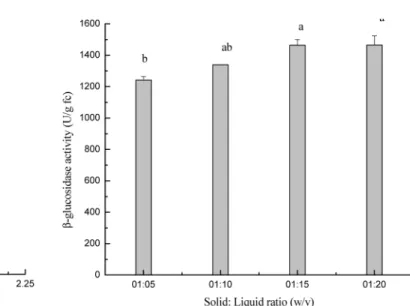
Solid/liquid ratio.The ratio of solid -to- solvent plays an important role in the extraction of enzymes from the fermented biomass. Information on the extraction of cellulolytic enzymes Fig. 1 Effect of different solvents on extraction of β-glucosidase from
fermented bagasse by mixed culture of A. niger NRC 7A and A. oryzae NRRL 447. Y-error bars indicate the standard deviation (±SD) among the replicates. Means that do not share a letter are significantly different at p≤0.05.
from the fermented bran is still need more studies (Chandra et al., 2008). In this experiment the ratio of solid to Tween 60 (0.125%
(v/v)) was varied from 1:5 to 1:20 (w/v) and the extraction process were done on a rotary shaker (150 rpm) at room temperature (28±2oC) for 60 min. It was found that solid/ liquid ratio of 1:15 (g/mL) was optimum for extraction of β-glucosidase (1463±35.89 U/g fc) Fig. 3. The total activity decreased when lower volume of the solvent was used for extraction. Recovery of the low yield of enzyme from the fermented mass with lower volume of solvent might be due to the insufficient solvent volume to penetrate the solid fermented mass (Chandra et al., 2008). However, higher solvent to solid ratios also causes the solute to be more dilute in the final extract. The increase of enzyme recovery can be attributed to the mass transfer process, which is driven by the concentration gradient between the solid (substrate) and liquid (solvent) phases (Pirota et al., 2013). A higher concentration gradient between the two phases facilitates transfer of the solutes to the liquid medium, which favors extraction of the enzyme. An increase in the solid to- solvent-ratio from 1:2 to 1:9 (w/v) improved the efficiency of the leaching of α-amylase from 41 to 100% (Ramesh and Lonsane, 1988). The ratios used by other workers in leaching of the enzymes were in the range of 1:1 to 1:10 (w/v) (Lonsane and Krishnaiah, 1992; Palit and Banerjee, 2001; Chandra et al., 2008; 2010). The increase in leaching efficiency gained at higher ratios must, therefore, be balanced against the extra effort for concentration of the dilute extract. However, Lonsane and Krishnaiah (1992) mentioned that in many cases, it may not be possible to achieve an economic balance.
Extraction time and temperature.Two different extraction conditions, stationary condition and agitation at 150 rpm, were employed at 25oC for β-glucosidase from fermented mass. The
results in Figs. 4 A and B show that agitation was more effective for β-glucosidase extraction than stationary condition at 25oC. The agitation at 150 rpm for different times (10–120 min) at 25oC gave 17–54 % more β-glucosidase yield compared to static condition.
Provision of shaking conditions during extraction, improved recovery of β-endoglucanase by 70% over stationary conditions (Chandra et al., 2010). Similarly, Palit and Banerjee (2001) studied three different leaching conditions viz. stationary, agitation and recirculation. They reported beneficial nature of both agitation and recirculation conditions on extraction of amylase from the fermented bran than stationary condition. Beneficial nature of shaking conditions might be attributed to uniform distribution of fermented bran in the continuous phase of solvent, reducing concentration polarization (Tunga et al., 1999). During recirculation an additional drag force was added by the peristaltic pump, which facilitated the extraction process, by isolating maximum amount of amylolytic enzyme (Palit and Banerjee, 2001).
The influence of contact time (10–120 min) and temperature (30–50oC) on β-glucosidase extraction was shown in Figs. 4C, D, and E. The recovered activity of β-glucosidase ranged from 368–
2882 U/g fc using 0.125% (v/v) Tween 60. A soaking period beyond 60 min generally had no significant impact on β-glucosidase extraction (Fig. 4), while 40oC was the most suitable temperature for maximum enzyme recovery (Fig. 4D). Maximum β-glucosidase activity (2882.74±95.52 U/g fc) was recorded at 40oC after 30 min. At higher temperature (50oC) the enzyme may has been denatured, causing reduction in the enzyme activity (Lonsane and Krishnaiah, 1992). Pirota et al. (2013) reported that for all solvents tested (distilled water, 0.2 mol/L acetate buffer at pH 4.8, 0.05 mol/L citrate buffer at pH 4.8, 0.1% Tween 80 solution) the highest endoglucanase recoveries were achieved for an extraction Fig. 3 Effect of different solid: liquid ratio on extraction of β-glucosidase from fermented bagasse by mixed culture of A. niger NRC 7A and A.
oryzae NRRL 447. Y-error bars indicate the standard deviation (±SD) among the replicates. Means that do not share a letter are significantly different at p≤0.05.
Fig. 2 Effect of different concentrations of Tween 60 on extraction of β- glucosidase from fermented bagasse by mixed culture of A. niger NRC 7A and A. oryzae NRRL 447. Y-error bars indicate the standard deviation (±SD) among the replicates. Means that do not share a letter are significantly different at p≤0.05.
time of 10 min, with no further increases in endoglucanase recovery using longer extraction times. In another study, 90 min contact time between the solvent and the solid fermented bran achieved maximum recovery of the Fpase (EC 3.2.1.91), one of the components of the cellulase complex, (Chandra et al., 2008).
Soaking of the mouldy substrate in water at room temperature (25 to 28oC) for 60 min was used for the recovery of cellulases and β- glucosidase (Singh and Garg, 1995). Other enzymes levansucrase needed 90 min contact time for extraction in SSF (Ahmed, 2008).
Contact time within a range of 60–180 min with occasional Fig. 4 Effect of extraction time and temperature on β-glucosidase extraction from fermented bagasseby mixed culture of A. niger NRC 7A and A. oryzae NRRL 447. A: 25oC static, B: 25oC shaking at 150 rpm, C:
30oC shaking at 150 rpm, D: 40oC shaking at 150rpm, E: 50oC shaking at 150rpm.Y-error bars indicate the standard deviation (±SD) among the replicates. Means that do not share a letter are significantly different at p ≤0.05.
agitation was employed for leaching of enzymes (Chandra et al., 2010).
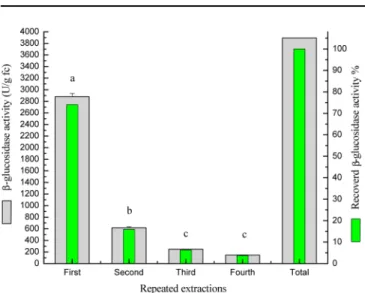
Number of wash. In earlier experiments, extraction of enzyme from the fermented bran was carried out with a single washing of the solvent. In order to check whether a single wash could completely recover enzyme, fermented bagasse collected from the previous extraction was re-extracted again with the fresh lots of solvent in repeated manner for enzyme recovery. Yields of enzyme in repeated washings are presented in Fig. 5. It was observed that out of four washes the first two were sufficient for leaching most of the enzyme. As expected, the first wash was more effective (2882.62±53.47 U/g fc). In the present study, the first and second wash recovered about 74 and 15.9% of the β- glucosidase from fermented bagasse on the basis of total yields by four washes together. The first two washes together could account for about 90% of total recovery. Similar observation was recorded by Palit and Banerjee (2001) on extraction of α-amylase in the solid state fermentation of wheat bran by Bacillus circulans GRS313.
Acknowledgment This work was supported by Microbial Chemistry Department and Natural and Microbial Products Department, National Research Center, Dokki, Cairo, Egypt. The authors express their sincere gratitude and gratefully acknowledge the National Research Center Authority, Dokki, Cairo, Egypt.
References
Ahmed A (2008) Optimization of production and extraction parameters of Bacillus megaterium levansucrase using solid state fermentation. J Appl Sci Res 4(10), 1199–204.
Annunziato ME, Mahoney RR, and Mudgett RE (1986) Production of α- galactosidase from Aspergillus oryzae grown in solid state culture. J Food Sci 51, 1370.
Cai YJ, Chapman SJ, Buswell JA, and Chang S (1999) Production and distribution of endo-β-glucanase, cellobiohydrolase and β-glucosidase components of the cellulolytic system of Volvariella volvacea, the edible straw mushroom. Appl Environ Microbiol 65(2), 553–9.
Camassola M and Dillon AJP (2007) Production of cellulases and hemicellulases by Penicillium echinulatum grown on pretreated sugar cane bagasse and wheat bran in solid-state fermentation. J Appl Microbiol 103, 2196–204.
Castilho LR, Alves LM, and Medronho RA (1999) Recovery of pectolytic enzymes produced by solid state culture of Aspergillus niger. Process Biochem 34, 181–6.
Castilho LR, Medronho RA, and Alves LM (2000) Production and extraction of pectinases obtained by solid state fermentation of agro-industrial residues with Aspergillus niger. Bioresour Technol 71, 45–50.
Chandra MS, Reddy RB, and Choi YL (2008) Optimization of extraction of Filter paperase from the fermented bran of Aspergillus niger in solid state fermentation. J Appl Biol Chem 51(4), 155–9.
Chandra MS, Viswanath B, and Reddy RB (2010) Optimization of extraction of β-endoglucanase from the fermented bran of Aspergillus niger. Indian J Microbiol 50, 122–6.
De Vries RP, Burgers K, van de Vondervoort PJI, Frisvad JC, Samson RA, and Visser J (2004) A new black Aspergillus species, A. vadensis, is a promising host for homologous and heterologous protein production.
Appl Environ Microbiol 70, 3954–9.
Dhake AB and Patil MB (2005) Production of β-glucosidase by Penicillum purpurogenum. Braz J Microbiol 36, 170–6.
Gao J, Weng H, Zhu D, Yuan M, Guan F, and Xi Y (2008) Production and characterization of cellulolytic enzymes from the thermoacidophilic fungal Aspergillus terreus M11 under solid-state cultivation of corn stover. Bioresour Technol 99, 7623–9.
Heck JX, Hertz PF, and Ayub MA (2005) Extraction optimization of xylanases obtained by solid-state cultivation of Bacillus circulans BL53.
Process Biochem 40, 2891–5.
Hong M, Kim Y, Park C, Lee J, Kim Y, and Oh D (2009) Characterization of a recombinant β-glucosidase from the thermophilic bacterium Caldicellulosiruptor saccharolyticus. J Biosci Bioeng 108, 36–40.
Ikasari L and Mitchell DA (1996) Leaching and characterization of Rhizopus oligosporus acid protease form solid-state fermentation. Enzyme Microbial Technol 19, 171–5.
Jatinder K, Chadra BS, and Saini HS (2006) Optimization of medium components for production of cellulases by Melanocarpus sp MTCC 3922 under solid-state fermentation. World J Microbiol Biotechnol 22, 15–22.
Job J, Sukumaran RK, and Jayachandran K (2010) Production of a highly glucose tolerant β-glucosidase by Paecilomyces variotii MG3: Optimization of fermentation conditions using Plackett-Burman and Box Behnken experimental designs. World J Microbiol Biotechnol 26, 1385–91.
Lonsane BK and Krishnaiah MM (1992) Leaching of product and further downstream processing. In Solid substrate cultivation, Doelle HW, Mitchell DA, and Rolz CE (eds.), pp. 141−71. Elsevier, UK.
Maron SH and Prutton CF (1965) In Principles of physical chemistry, (4th ed.), Oxford and IBH Publishing Co. Pvt Ltd, India.
Noor El-Deen AM, Shata HMA, and Farid MA (2013) Improvement of β- glucosidase production by co-culture of Aspergillus niger and Aspergillus oryzae under solid state fermentation through feeding process. Ann Microbiol, in press.
Pal A and Khanum F (2010) Production and extraction optimization of xylanase from Aspergillus niger DFR-5 through solid-state-fermentation.
Bioresour Technol 101, 7563–9.
Palit S and Banerjee R (2001) Optimization of extraction parameters for recovery of α-amylase from the fermented bran of Bacillus circulans GRS313. Braz Arch Biology Technol 44 (1), 107–11.
Parkinson D, Gray TRG, and Williams ST (1971) Methods for studying the ecology of soil microorganisms. In International Biological Programme Handbook, (19th ed.), p. 116, Blackwell Scientific Publications, UK.
Pirota RDPB, Miotto LS, Delabona PS, and Farinas CS (2013) Improving the extraction conditions of endoglucanase produced by Aspergillus niger under solid-state fermentation. Braz J Chem Eng 30, 117–23.
Fig. 5 Effect of number of washes on β-glucosidase extraction from fermented bagasse by mixed culture of A.niger NRC 7A and A.oryzae NRRL 447.Y-error bars indicate the standard deviation (±SD) among the replicates. Means, in each bar, followed by the same letter are not significantlydifferent (p≤0.05).
Ramakrishna SV, Suseela T, Ghidyal NP, Jaleel SA, Perma P, Lonsane BK et al. (1982) Recovery of amyloglucosidase from moldy bran. Ind J Technol 20, 476–80.
Ramesh MV and Lonsane BK (1988) Factors effecting recovery of thermostable α-amylase from bacterial bran produced under SSF. Chem Mikrobiol Technol Lebensm 11, 155–9.
Rezaei F, Joh LD, Kashima H, Reddy AP, and Vander Gheynst JS (2011) Selection of conditions for cellulase and xylanase extraction from switch grass colonized by Acidothermus cellulolyticus. Appl Biochem Biotechnol 164, 793–803.
Salariato D, Diorio LA, Mouso N, and Forchiassin F (2010) Extraction and characterization of polygalacturonase of Fomes sclerodermeus produced by solid-state fermentation. Rev Argentina Microbiol 42, 57–62.
Savelli G, Spreti N, and Di Profio P (2000) Enzyme activity and stability control by amphiphilic self-or-ganizing systems in aqueous solutions.
Curr Opin Colloid Interface Sci 5, 111–7.
Silva CHC, Puls J, Souza MV, and Ferreira-Filho EX (1999) Purification and characterization of a low molecular weight xylanase from solid-state cultures of Aspergillus fumigatus fresenius. Rev Microbiol 30:114–9.
Singh J and Garg AP (1995) Production of cellulases by Gliocladium virens on Eichhornia under solid-state fermentation conditions. J Ind Botanic Soci 74, 305–9.
Singh SA, Ramakrishna M, and Rao AGA (1999) Optimization of downstream processing parameters for the recovery of pectinase from the fermented bran of Aspergillus carbonarius. Process Biochem 35, 411–7.
Soares LHB, Assmann F, and Ayub MAZ (2003) Production of tranglutaminase from Bacillus circulans on solid-state and submerged cultivations. Biotechnol Letters 25, 2029–33.
Souza MCO, Roberto IC, and Milagres AMF (1999) Solid-state fermentation for xylanase production by Thermoascus auranticus using response surface methodology. Appl Microbiol Biotechnol 52,768–72.
Stryer L (1975) In Biochemistry, (2nd ed.), WH Freeman and Company Publishers, USA.
Tunga R, Banerjee R, and Bhattacharya BC (1999) Some studies on optimization of extraction processes for protease for production in SSF.
Bioprocess Eng 20, 485–9.