J Korean Soc Parenter Enter Nutr Vol. 5, No. 3, 2013
90
Received September 26, 2013 Revised October 28, 2013 Accepted November 4, 2013
Correspondence to Jae Gil Lee
Department of Surgery, Yonsei University College of Medicine, 50, Yonsei-ro, Seodaemun-gu, Seoul 120-752, Korea
Tel: +82-2-2228-2127, Fax: +82-2-313-8289, E-mail: [email protected] Copyright ⓒ 2013. The Korean Society for Parenteral and Enteral Nutrition. All Rights Reserved.
This is an Open Access article distributed under the terms of the Creative Commons Attribution Non-Commercial License (http://creativecommons.org/licenses/ by-nc/3.0) which permits unrestricted non-commercial use, distribution, and reproduction in any medium, provided the original work is properly cited.
외상 환자에서 영양지원
연세대학교 의과대학 외과학교실 이승환ㆍ장지영ㆍ이재길
Nutrition Support in Trauma Patients
Seung Hwan Lee, Ji Young Jang, Jae Gil Lee
Department of Surgery, Yonsei University College of Medicine, Seoul, KoreaMetabolic and gastrointestinal alterations associated with trauma can rapidly lead to malnutrition and its accom- panying complications. Malnutrition is harmful to the pa- tient because it is associated with impaired wound heal- ing, muscle weakness, immune dysfunction, and infec- tious complication, and is an independent risk factor for morbidity and mortality. Thus, adequate nutrition support is essential in management of trauma patients. The pur- pose of this paper is to expound on the metabolic alter- ations and to provide a rationale for nutrition support in trauma patients. (J Korean Soc Parenter Enter Nutr 2013;5(3):90-95)
Key Words: Nutrition support, Trauma, Intensive care units
중심 단어: 영양지원, 외상, 중환자실
서 론
다발성 외상 환자는 외과계 중환자의 많은 부분을 차지 하고 있다. 대부분의 외상 환자는 정상적인 영양상태로 입 원하지만, 외상과 관련되어 일어나는 신경-호르몬의 변화 와 시토카인(cytokine)의 분비에 의한 병태 생리적인 변화때
문에 영양불량의 위험성이 높아지게 된다.
1,2따라서 외상 환자에 대한 적절한 영양지원을 하기 위해서는, 외상 후 체 내 대사 반응의 변화 양상에 대한 이해가 선행되어야 한다.
외상이 발생하면 스트레스에 반응하여 대사가 항진되며, 이러한 상태가 교정되지 않고 지속될 경우 영양불량 및 그 와 관련된 감염성 합병증의 위험성이 높아질 수 있다. 영양 지원은 이러한 과대사(hyper-metabolism) 및 그로 인한 영양 불량을 차단하며, 면역 기능을 유지하고, 제지방량(lean body mass)의 감소를 최소화하며, 활성산소 등에 의한 세포 손상을 감소시킨다. 특히, 조기 경장영양을 시행할 경우 장 점막의 방어기능과 면역체계를 유지하여 감염성 합병증을 줄이는 것으로 알려져 있다. 따라서 외상과 관련한 대사적 변화를 잘 이해하고, 적절한 시기에 영양지원을 한다면 외 상 환자의 회복에 도움을 줄 것이다.
본 론
1. 외상 환자의 대사 변화
외상 후 체내에서는 단백질이 급격하게 소모되는 과이화 작용(hypercatabolism)이 나타나고, 부산물인 아미노산은 상 처의 회복과 급성기 반응 단백질(acute phase reactant pro- tein)의 합성, 당신생(gluconeogenesis) 등에 사용되면서 대사 과다증(hypermetabolism)이 동시에 나타난다.
1또한 단백질 이 손실되어 제지방량이 감소하고, 요소의 합성과 소변으 로 질소의 손실이 증가하게 된다.
3게다가, 체내 지방의 이 동과 중성지방의 제거율이 감소되며, 인슐린에 대한 저항 성이 증가하여 고지혈증 및 고혈당이 유발된다.
4,5외상이 발생하면 쇼크가 흔하게 동반되는데, 장 점막의
관류가 저하되면 흡수능이 감소하고, 장의 투과성이 증가
하여 장내 세균전위 및 그에 따른 패혈증의 위험성이 높아
질 수 있다.
6,7또한 억제 신경내분비 반사(inhibitory neuro-
endocrine reflex)에 의한 장 마비(ileus)가 흔하게 발생하여
영양소의 장관 내 통과 및 흡수가 감소하고, 폐쇄에 의한
역류의 가능성이 높아져서 흡인성 폐렴의 위험성이 증가할
수 있다.
8외상에 의한 대사 및 위장관의 병태 생리적인 변화는 결 국 영양불량을 초래하게 된다. 영양지원이 적절하게 이루 어지지 않거나 지연되는 경우, 영양불량은 더욱 악화될 수 있다. 이는 근육을 위축시켜 근력을 약화시키며, 특히 호흡 근을 약화시켜 인공호흡기간이 연장될 수 있다. 또한 면역 력을 저하시켜 감염의 위험성이 증가되고, 상처의 회복 또 한 지연될 수 있다.
2. 영양지원의 목적
외상 환자에서 영양지원은 대사 변화에 의한 영양불량과 감염에 대한 위험성을 최소화하기 위해 시행한다.
1) 급성 단백질 영양불량의 예방 및 최소화
외상 환자에서 급성기의 전신염증반응과 과이화작용에 의한 단백질 영양불량이 나타날 수 있으며, 이에 의한 면역 체계의 이상이 발생할 수 있다.
1따라서 적절한 단백질을 공급해 주어야 단백질 영양불량을 최소화할 수 있으며, 이 에 따른 감염성 합병증 및 장기부전증을 예방할 수 있다.
2) 제지방량의 감소 최소화
외상 후 과이화작용에 의해 단백질 소모가 증가하여 제 지방량의 감소가 발생하게 된다. 초기에는 급성 단백질 영 양불량과 관련된 심장, 폐, 간, 위장관, 면역 기능 장애를 일 으키고, 후기에는 감염성 합병증과 관련하여 과대사 혹은 과이화작용이 지속되어, 결국 다장기 부전이 발생할 수 있 다. 따라서 적절한 시기의 영양지원은 제지방량의 감소를 최소화하며, 궁극적으로 환자의 예후에 긍정적인 영향을 줄 것이다.
3) 면역 기능 유지
외상에 의한 시토카인과 전염증(pro-inflammatory) 물질에 의해서 전신염증반응이 나타나지만, 이와 더불어 보상성 항염증 반응(compensatory anti-inflammatory response syn- drome, CARS)도 나타나게 된다. 이때 면역 억제 반응이 나 타나고, 이는 감염 및 패혈증, 장기부전증을 유발할 수 있 다.
9그러므로 적절한 영양지원을 통해 면역 기능을 유지하 는 것이 필요하다.
4) 위장관 기능의 유지 및 장관 면역의 유지
외상 환자에서는 쇼크에 의한 위장관 혈류의 감소, 개복 술에 의한 위장관 마비, 중환자실에서 사용하는 약제에 의 한 위장관 기능의 저하 등이 나타날 수 있다. 이에 따라 장 점막이 위축되고, 장 벽의 투과도가 증가되어 장내 세균전 위가 일어날 수 있으며, 결국 패혈증으로 진행할 수 있다.
따라서 적절한 영양지원을 통해 장점막의 기능을 유지시켜 야 한다.
6,75) 조직의 재생과 상처의 회복 촉진
영양은 상처 치유 과정에 중요한 요소이다. 즉, 단백질, 비타민(A, B, D), 그리고 미량원소(셀레니움, 아연, 구리, 마 그네슘)는 상처 치유를 위해 필요한 영양소이다. 외상 후에 는 영양불량이 초래되며, 이로 인해서 상처 치유가 지연될 수 있다. 그러므로 외상 후 적절한 영양지원은 상처 치유 및 조직의 재생을 촉진하여 환자의 회복에 도움을 줄 수 있다.
3. 영양 공급량의 결정
외상 환자에서 에너지 공급량은 간접열량계(indirect calo- rimetry)를 이용하는 것이 가장 정확한 것으로 알려져 있다.
그러나 많은 기관에서 간접열량계를 보유하고 있지 않고, 사용한다 해도 제한 사항이 있어 일반적으로 활용되고 있 지는 않다. 영양 공급량은 Harris-Benedict 공식(HBE)을 사용 하거나 중환자에 대한 영양지원 가이드라인에 따라 25∼30 kcal/kg/day로 계산하여 결정하게 된다.
10-12HBE로 계산할 때는 기초대사량(basal energy expenditure)에 환자의 활동계 수와 스트레스 계수(외상 환자 1.2∼1.4)를 사용하여 영양 공급량을 결정할 수 있다.
12영양 공급량을 결정할 때 가장 중요한 것은 과다공급(overfeeding)을 피하는 것이다. HBE 를 이용하여 영양 공급량을 결정하는 경우 활동 계수와 스 트레스 계수를 동시에 이용하게 되면, 에너지 요구량이 실 제 필요량보다 높게 산정되어 에너지의 과다공급이 발생할 수 있다.
12따라서 기초대사량에 스트레스 계수만을 고려하 여 열량 요구량을 산정하는 것이 바람직할 것으로 생각된다.
단백질은 보통 1.25∼1.5 g/kg/day로 공급하며, 환자의 상 태 및 질소평형을 계산하여 공급한다.
12,13그러나 외상 환자 에서는 많은 양의 단백질이 소모되므로, 2 g/kg/day 이상 공 급이 필요한 경우도 있다.
당질은 최대 5 mg/kg/min을 넘지 않게 공급한다.
12다량의 당질은 인슐린 저항성을 증가시키고, 고혈당을 유발할 수 있으므로, 영양 공급 초기에는 공급 목표량의 1/2 정도로 시작하여 2∼3일에 걸쳐 목표량까지 증량한다.
또한 조기부터 과도한 영양 공급을 시행하는 경우에는 고혈당뿐만 아니라 저인산혈증 및 저칼륨혈증 등을 동반한 재급식증후군(refeeding syndrome)을 유발할 수 있으므로, 영양지원 시 주의 깊게 관찰하여야 한다.
4. 영양지원의 시기
외상 환자에서 영양지원은 조기 경장영양(입원 후 24∼
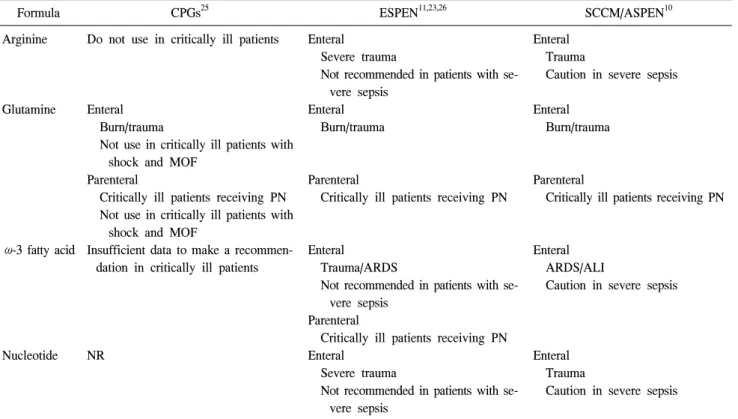
Table 1. Comparison of current guidelines for use of immune-modulating formula in critically injured patients
Formula CPGs25 ESPEN11,23,26 SCCM/ASPEN10
Arginine
Glutamine
ω-3 fatty acid
Nucleotide
Do not use in critically ill patients
Enteral Burn/trauma
Not use in critically ill patients with shock and MOF
Parenteral
Critically ill patients receiving PN Not use in critically ill patients with
shock and MOF
Insufficient data to make a recommen- dation in critically ill patients
NR
Enteral Severe trauma
Not recommended in patients with se- vere sepsis
Enteral Burn/trauma
Parenteral
Critically ill patients receiving PN
Enteral Trauma/ARDS
Not recommended in patients with se- vere sepsis
Parenteral
Critically ill patients receiving PN Enteral
Severe trauma
Not recommended in patients with se- vere sepsis
Enteral Trauma
Caution in severe sepsis
Enteral Burn/trauma
Parenteral
Critically ill patients receiving PN
Enteral ARDS/ALI
Caution in severe sepsis
Enteral Trauma
Caution in severe sepsis
CPGs = Canadian Clinical Practice Guidelines 2013; ESPEN = European Society of Parenteral and Enteral Nutrition; SCCM = Society of Critical Care Medicine; ASPEN = American Society for Parenteral and Enteral Nutrition; MOF = multiple organ failure, ARDS = acute respiratory distress syndrome; ALI = acute lung injury, PN = parenteral nutrition; NR= not reported.
48시간 내)을 권고하고 있다.
11,14,15조기 경장영양은 환자의 감염성 합병증과 패혈증의 발생을 감소시키며, 사망률을 감소시키는 것으로 알려져 있다.
15-17경장영양의 대상이 되 지 않는 환자에서는 정맥영양을 시행할 수 있으나, 조기에 정맥영양을 적용하는 환자에서 감염의 발생률이 높고, 임 상경과가 나쁘다는 연구결과도 있다.
18,195. 영양지원 방법-경장영양 vs. 정맥영양
경장영양은 정맥영양에 비해 많은 장점을 가지고 있다.
특히 장 점막세포의 재생을 촉진하고, 장 점막 방어 기능과 장벽의 면역체계를 유지시켜, 감염성 합병증의 발생을 줄 일 수 있다.
6,7,17,20그러므로 가능하다면 외상 환자는 먼저 경장영양을 시도한다.
11,16,20,21그러나 장간막의 저관류가 동 반된 환자나 혈역학적으로 불안정한 환자에서는 경장영양 시 장허혈 및 괴사와 같은 심각한 합병증이 발생할 수 있으 므로 경장영양을 시작할 때는 혈역학적인 안정이 선행되어 야 한다.
경장영양은 환자의 적응도에 따라 필요한 에너지를 공급 하는 데 오랜 시간이 소요되며, 흡수 장애나 설사와 같은 합병증이 발생할 수 있다.
22따라서 장기간(7일 이상) 경장
영양을 시작하지 못하거나, 경장영양으로 필요한 에너지를 공급할 수 없는 경우에는 정맥영양을 고려할 수 있다.
10,12,23정맥영양을 조기에 시행하는 경우에는 감염의 발생률이 높다고 알려져 있어,
18,19환자에 대한 적절한 평가가 이루어 진 후에 정맥영양의 적용 여부를 판단해야 할 것으로 생각 된다.
6. 면역영양
면역력을 조절할 수 있는 영양소들에 대한 연구가 활발 히 이루어지고 있으며, 영양지원 지침에서 일부 영양소들 은 환자에게 사용되도록 권고하고 있다(Table 1).
10,11,23-26글루타민은 필수영양소는 아니지만 외상 등의 스트레스
상황에서 요구량이 증가되는 아미노산으로, 외상 및 중환
자에서는 조건부 필수 아미노산으로 생각되고 있다.
11글루
타민은 장 점막세포, 림프구, 대식세포, 그리고 심근세포의
주된 에너지원으로 사용된다.
27-29또한 체내의 강력한 항산
화제인 글루타치온의 전구체로 작용하여, 체내 항산화 과
정에 기여하는 것으로 알려져 있다.
30,31따라서 글루타민의
투여는 장 점막세포의 위축을 방지하여 장 점막의 방어기
능을 유지시키며,
32활성산소의 발생을 감소시켜 전신염증
반응을 줄일 수 있는 것으로 알려져 있다.
33이와 더불어 감 염성 합병증과 인슐린 저항성을 낮추고, 질소평형을 유지 하는 데 도움을 주어 중환자실 입원기간이나 사망률을 감 소시키는 등 비교적 긍정적인 효과를 보이는 것으로 알려 져 있다.
34-37그러나 최근 대규모 임상 연구에서 글루타민에 대해 기존의 연구 결과와 상이한 보고를 하였는데, 다장기 부전 등이 있는 중환자를 대상으로 글루타민을 조기에 공 급하였을 때 임상 결과에 이득이 없고, 오히려 사망률이 증 가한 것으로 나타났다.
38그렇지만 현재까지 보고된 영양 지 원 지침들에 따르면 외상 환자에서 글루타민의 사용을 고 려하도록 하고 있으며, 정맥영양을 시행하는 중환자에서는 정맥투여를, 경장영양을 시행하는 환자에서는 경장투여를 권고하고 있다.
10,11,39아르기닌 역시 필수영양소는 아니지만, T 림프구의 기능, 콜라겐 합성, 성장호르몬을 포함한 여러 호르몬의 합성에 중요한 아미노산이다.
40아르기닌은 inducible nitric oxide synthase (iNOS)에 의해 산화질소로 활성화되어 전신염증반 응과 심기능을 악화시키고,
41혈관확장을 유발하여 패혈증 환자에서는 사망률을 높이는 것으로 알려져 있어 사용을 제한하고 있다.
8,42그러나 외상 환자에서는 iNOS의 농도가 높지 않아 아르기닌을 보충해 주어도 문제가 되지 않는 것 으로 알려져 있어, 경장영양을 시행하는 환자에서는 아르 기닌의 사용을 권고하고 있다.
43그러나 쇼크와 장간막 저관 류가 동반된 외상환자에서 아르기닌의 투여는 장손상과 염 증 반응을 증가시킬 수 있는 것으로 알려져 있어 사용 시 주의하여야 한다.
44지방산은 세포막의 중요한 구성 성분으로, 세포막에 포 함된 고도불포화 지방산(n-6 polyunsaturated fatty acids, PUFAs)인 아라키돈산은 cyclooxygenase (COX)와 lipoxygenase (LOX)의 효소 작용에 의해 아이코사노이드로 전환된다. 이 아이코사노이드에는 프로스타글란딘(prostaglandin, PG)과 류코트리엔(leukotriene, LT), 트롬복산 (thromboxane, TX) 등 이 포함되며, 이들은 체내 염증반응을 매개하는데, 주로 염 증반응의 기간이나 강도를 조절하는 것으로 알려져 있으
며,
45,46염증성 시토카인의 분비를 촉진하여 장기의 손상을
유발할 수 있다.
47그러나 ω-3 지방산(n-3 PUFAs)인 docosahexaenoic acid (DHA)와 eicosapentaenoic acid (EPA)는 염증반응을 덜 일으 키거나 항염증 작용을 가진 PG, LT와 TX를 만들어 내어, 체내 면역반응을 조절하는 역할을 한다.
12,46,48ω-3 지방산 은 중성지방의 농도를 조절하고, 심근을 안정시켜 부정맥 을 줄이고, 감염성 합병증과 재원 기간을 감소시키며, 급성 폐부전 환자에서는 사망률을 낮출 수 있는 것으로 보고되 고 있다.
49-52뉴클레오티드(nucleotide)는 deoxyribonucleic acid (DNA) 와 ribonucleic acid (RNA)의 합성과 세포 내 adenosine tri- phosphate (ATP) 대사에 중요한 역할을 하는 것으로 알려져 있다. 뉴클레오티드는 대부분의 세포에서 합성되지만 상피 세포나 T 림프구와 같이 빠르게 분열하는 세포에서는 합성 이 되지 않는 것으로 알려져 있다.
3,53외상과 같은 스트레스 상황에서 장 세포나 림프구 등의 빠른 세포 증식과 반응은 뉴클레오티드의 상대적 결핍을 일으킬 수 있다. 이러한 경 우 외부로부터 뉴클레오티드의 공급이 필요할 수 있는데, 섭취된 뉴클레오티드는 림프구, 장 세포, 그리고 자연살해 세포(natural killer cell)의 증식, 활성을 강화하여 감염에 대 한 저항성을 증가시킨다는 보고가 있다.
54-56결 론
외상 환자에서 영양지원은 환자의 회복을 돕고, 합병증 을 최소화하며, 재원기간을 감소시키는 등 많은 긍정적인 효과가 있어 반드시 시행되어야 하지만, 영양지원에 따른 부작용도 발생할 수 있음을 염두에 두어야 한다. 따라서 환 자의 상태를 적절히 파악하여 가능한 조기에 경장영양을 시행해야 하며, 경장영양을 시행할 수 없거나 지연될 것으 로 예상되는 환자에서는 정맥영양을 고려할 수 있다. 또한 영양지원을 시행할 때는 적절한 영양계획과 실행, 영양지 원에 따른 합병증의 발생 여부에 대한 모니터링이 필요하다.
REFERENCES
1. Ingenbleek Y, Bernstein L. The stressful condition as a nutri- tionally dependent adaptive dichotomy. Nutrition 1999;15(4):
305-20.
2. Dabrowski GP, Rombeau JL. Practical nutritional management in the trauma intensive care unit. Surg Clin North Am 2000;
80(3):921-32.
3. Latifi R. Nutritional therapy in critically ill and injured patients. Surg Clin North Am 2011;91(3):579-93.
4. McCowen KC, Malhotra A, Bistrian BR. Stress-induced hy- perglycemia. Crit Care Clin 2001;17(1):107-24.
5. Laird AM, Miller PR, Kilgo PD, Meredith JW, Chang MC.
Relationship of early hyperglycemia to mortality in trauma patients. J Trauma 2004;56(5):1058-62.
6. Kudsk KA. Current aspects of mucosal immunology and its influence by nutrition. Am J Surg 2002;183(4):390-8.
7. Jabbar A, Chang WK, Dryden GW, McClave SA. Gut im- munology and the differential response to feeding and starva- tion. Nutr Clin Pract 2003;18(6):461-82.
8. Todd SR, Kozar RA, Moore FA. Nutrition support in adult trauma patients. Nutr Clin Pract 2006;21(5):421-9.
9. Moore FA, Sauaia A, Moore EE, Haenel JB, Burch JM,
Lezotte DC. Postinjury multiple organ failure: a bimodal phenomenon. J Trauma 1996;40(4):501-10; discussion 510-2.
10. McClave SA, Martindale RG, Vanek VW, McCarthy M, Roberts P, Taylor B, et al; A.S.P.E.N. Board of Directors;
American College of Critical Care Medicine; Society of Critical Care Medicine. Guidelines for the provision and as- sessment of nutrition support therapy in the adult critically Ill patient: Society of Critical Care Medicine (SCCM) and American Society for Parenteral and Enteral Nutrition (A.S.P.E.N.). JPEN J Parenter Enteral Nutr 2009;33(3):277- 316.
11. Kreymann KG, Berger MM, Deutz NE, Hiesmayr M, Jolliet P, Kazandjiev G, et al. ESPEN guidelines on enteral nutrition:
intensive care. Clin Nutr 2006;25(2):210-23.
12. Jacobs DG, Jacobs DO, Kudsk KA, Moore FA, Oswanski MF, Poole GV, et al; EAST Practice Management Guidelines Work Group. Practice management guidelines for nutritional support of the trauma patient. J Trauma 2004;57:660-78; dis- cussion 79.
13. Frankenfield D. Energy expenditure and protein requirements after traumatic injury. Nutr Clin Pract 2006;21:430-7.
14. Heyland DK, Dhaliwal R, Drover JW, Gramlich L, Dodek P.
Canadian critical care clinical practice guidelines committee.
canadian clinical practice guidelines for nutrition support in mechanically ventilated, critically ill adult patients. JPEN J Parenter Enteral Nutr 2003;27:355-73.
15. Marik PE, Zaloga GP. Early enteral nutrition in acutely ill pa- tients: a systematic review. Crit Care Med 2001;29(12):2264- 70.
16. Moore EE, Jones TN. Benefits of immediate jejunostomy feeding after major abdominal trauma--a prospective, random- ized study. J Trauma 1986;26:874-81.
17. Doig GS, Heighes PT, Simpson F, Sweetman EA. Early enter- al nutrition reduces mortality in trauma patients requiring in- tensive care: a meta-analysis of randomised controlled trials.
Injury 2011;42:50-6.
18. Sena MJ, Utter GH, Cuschieri J, Maier RV, Tompkins RG, Harbrecht BG, et al. Early supplemental parenteral nutrition is associated with increased infectious complications in crit- ically ill trauma patients. J Am Coll Surg 2008;207(4):459-67.
19. Casaer MP, Mesotten D, Hermans G, Wouters PJ, Schetz M, Meyfroidt G, et al. Early versus late parenteral nutrition in critically ill adults. N Engl J Med 2011;365(6):506-17.
20. Kudsk KA, Croce MA, Fabian TC, Minard G, Tolley EA, Poret HA, et al. Enteral versus parenteral feeding. Effects on septic morbidity after blunt and penetrating abdominal trauma.
Ann Surg 1992;215(5):503-11; discussion 11-3.
21. Moore FA, Moore EE, Jones TN, McCroskey BL, Peterson VM. TEN versus TPN following major abdominal trauma--re- duced septic morbidity. J Trauma 1989;29:916-22; discussion 22-3.
22. Montejo JC. Enteral nutrition-related gastrointestinal compli- cations in critically ill patients: a multicenter study. The Nutritional and Metabolic Working Group of the Spanish
Society of Intensive Care Medicine and Coronary Units. Crit Care Med 1999;27(8):1447-53.
23. Singer P, Berger MM, Van den Berghe G, Biolo G, Calder P, Forbes A, et al. ESPEN guidelines on parenteral nutrition:
intensive care. Clin Nutr 2009;28:387-400.
24. Consensus recommendations from the US summitt on im- mune-enhancing enteral therapy. JPEN J Parenter Enteral Nutr 2001;25(2 Suppl):S61-3.
25. Critical Care Nutrition. Canadian Clinical Practice Guidelines 2013. Ontario:Clinical Evaluation Research Unit;2013 [updated 2013 Apr 9]. Available from: http://criticalcarenutrition.com/
index. php?option=com_content&view=category&layout=blog&
id=21&Itemid=10.
26. Weimann A, Braga M, Harsanyi L, Laviano A, Ljungqvist O, Soeters P, et al. ESPEN Guidelines on Enteral Nutrition:
Surgery including organ transplantation. Clin Nutr 2006;25(2):
224-44.
27. Groening P, Huang Z, La Gamma EF, Levy RJ. Glutamine restores myocardial cytochrome C oxidase activity and im- proves cardiac function during experimental sepsis. JPEN J Parenter Enteral Nutr 2011;35(2):249-54.
28. Ardawi MS. Glutamine and glucose metabolism in human pe- ripheral lymphocytes. Metabolism 1988;37(1):99-103.
29. Souba WW, Smith RJ, Wilmore DW. Glutamine metabolism by the intestinal tract. JPEN J Parenter Enteral Nutr 1985;9(5):
608-17.
30. Amores-Sánchez MI, Medina MA. Glutamine, as a precursor of glutathione, and oxidative stress. Mol Genet Metab 1999;
67(2):100-5.
31. Musch MW, Hayden D, Sugi K, Straus D, Chang EB. Cell- specific induction of hsp72-mediated protection by glutamine against oxidant injury in IEC18 cells. Proc Assoc Am Physi- cians 1998;110(2):136-9.
32. van der Hulst RR, van Kreel BK, von Meyenfeldt MF, Brummer RJ, Arends JW, Deutz NE, et al. Glutamine and the preservation of gut integrity. Lancet 1993;341(8857):1363-5.
33. Wilmore DW, Shabert JK. Role of glutamine in immunologic responses. Nutrition 1998;14(7-8):618-26.
34. Houdijk AP, Rijnsburger ER, Jansen J, Wesdorp RI, Weiss JK, McCamish MA, et al. Randomised trial of gluta- mine-enriched enteral nutrition on infectious morbidity in pa- tients with multiple trauma. Lancet 1998;352(9130):772-6.
35. Novak F, Heyland DK, Avenell A, Drover JW, Su X.
Glutamine supplementation in serious illness: a systematic re- view of the evidence. Crit Care Med 2002;30(9):2022-9.
36. Hammarqvist F, Wernerman J, Ali R, von der Decken A, Vinnars E. Addition of glutamine to total parenteral nutrition after elective abdominal surgery spares free glutamine in mus- cle, counteracts the fall in muscle protein synthesis, and im- proves nitrogen balance. Ann Surg 1989;209(4):455-61.
37. Bakalar B, Duska F, Pachl J, Fric M, Otahal M, Pazout J, et al. Parenterally administered dipeptide alanyl-glutamine pre- vents worsening of insulin sensitivity in multiple-trauma patients. Crit Care Med 2006;34(2):381-6.
38. Heyland D, Muscedere J, Wischmeyer PE, Cook D, Jones G, Albert M, et al; Canadian Critical Care Trials Group. A randomized trial of glutamine and antioxidants in critically ill patients. N Engl J Med 2013;368(16):1489-97.
39. Jones NE, Heyland DK. Pharmaconutrition: a new emerging paradigm. Curr Opin Gastroenterol 2008;24(2):215-22.
40. Barbul A, Lazarou SA, Efron DT, Wasserkrug HL, Efron G.
Arginine enhances wound healing and lymphocyte immune re- sponses in humans. Surgery 1990108(2):331-6; discussion 6-7.
41. Lowenstein CJ, Dinerman JL, Snyder SH. Nitric oxide: a physiologic messenger. Ann Intern Med 1994;120(3):227-37.
42. Lorente JA, Landín L, Renes E, De Pablo R, Jorge P, Ródena E, et al. Role of nitric oxide in the hemodynamic changes of sepsis. Crit Care Med 1993;21(5):759-67.
43. Jacob TD, Ochoa JB, Udekwu AO, Wilkinson J, Murray T, Billiar TR, et al. Nitric oxide production is inhibited in trauma patients. J Trauma 1993;35(4):590-6; discussion 6-7.
44. Sato N, Moore FA, Kone BC, Zou L, Smith MA, Childs MA, et al. Differential induction of PPAR-gamma by luminal gluta- mine and iNOS by luminal arginine in the rodent postischemic small bowel. Am J Physiol Gastrointest Liver Physiol 2006;
290(4):G616-23.
45. Lewis RA, Austen KF, Soberman RJ. Leukotrienes and other products of the 5-lipoxygenase pathway. Biochemistry and re- lation to pathobiology in human diseases. N Engl J Med 1990;323(10):645-55.
46. Calder PC. n-3 polyunsaturated fatty acids, inflammation, and inflammatory diseases. Am J Clin Nutr 2006;83(6 Suppl):
1505S-1519S.
47. Calder PC, Grimble RF. Polyunsaturated fatty acids, in- flammation and immunity. Eur J Clin Nutr 2002;56(Suppl 3):S14-9.
48. Singer P, Shapiro H, Theilla M, Anbar R, Singer J, Cohen J. Anti-inflammatory properties of omega-3 fatty acids in crit- ical illness: novel mechanisms and an integrative perspective.
Intensive Care Med 2008;34:1580-92.
49. Gadek JE, DeMichele SJ, Karlstad MD, Pacht ER, Donahoe M, Albertson TE, et al. Effect of enteral feeding with eicosa- pentaenoic acid, gamma-linolenic acid, and antioxidants in pa- tients with acute respiratory distress syndrome. Enteral Nutrition in ARDS Study Group. Crit Care Med 1999;27(8):
1409-20.
50. Heller AR, Rössler S, Litz RJ, Stehr SN, Heller SC, Koch R, et al. Omega-3 fatty acids improve the diagnosis-related clinical outcome. Crit Care Med 2006;34(4):972-9.
51. Singer P, Theilla M, Fisher H, Gibstein L, Grozovski E, Cohen J. Benefit of an enteral diet enriched with eicosapentae- noic acid and gamma-linolenic acid in ventilated patients with acute lung injury. Crit Care Med 2006;34(4):1033-8.
52. Calò L, Bianconi L, Colivicchi F, Lamberti F, Loricchio ML, de Ruvo E, et al. N-3 Fatty acids for the prevention of atrial fibrillation after coronary artery bypass surgery: a randomized, controlled trial. J Am Coll Cardiol 2005;45(10):1723-8.
53. Kulkarni AD, Rudolph FB, Van Buren CT. The role of dietary sources of nucleotides in immune function: a review. J Nutr 1994;124(8 Suppl):1442S-6S.
54. Gil A. Modulation of the immune response mediated by diet- ary nucleotides. Eur J Clin Nutr 2002;56(Suppl 3):S1-4.
55. Todd SR, Gonzalez EA, Turner K, Kozar RA. Update on post- injury nutrition. Curr Opin Crit Care 2008;14(6):690-5.
56. Van Buren CT, Kulkarni AD, Fanslow WC, Rudolph FB.
Dietary nucleotides, a requirement for helper/inducer T lym- phocytes. Transplantation 1985;40(6):694-7.