• 검색 결과가 없습니다.

Quantification of the Bioactive Components of the Rhizomes of Curcuma wenyujin and Assessment of Its Anti-inflammatory Effect in Benign Prostatic Hyperplasia-1 Cells

N/A
N/A
Protected

Academic year: 2022

Share "Quantification of the Bioactive Components of the Rhizomes of Curcuma wenyujin and Assessment of Its Anti-inflammatory Effect in Benign Prostatic Hyperplasia-1 Cells"

Copied!
6
0
0

로드 중.... (전체 텍스트 보기)

전체 글

(1)

238

Hyperplasia-1 Cells

Chang-Seob Seo, Eunsook Park, Mee-Young Lee, and Hyeun-Kyoo Shin*

Herbal Medicine Research Division, Korea Institute of Oriental Medicine, Daejeon 34054, Korea

Abstract – In this study, the marker compounds of Curcumae Rhizoma (CR) were simultaneously quantified by high-performance liquid chromatography equipped with a photodiode array detector and the anti-inflammatory effects of CR extract and marker compounds in human benign prostatic hyperplasia epithelial-1 (BPH-1) cell lines were investigated. The marker components (4S,5S)-(+)-germacrone-4,5-epoxide, furanodienone, and germacrone, were separated on Gemini C

18

columns (250 mm × 4.6 mm, 5 µm) at 40

o

C by using a gradient of two mobile phases eluting at 1.0 mL/min. Prostaglandin E

2

(PGE

2

) levels in Human BPH-1 cells were determined with an ELISA kit. The coefficients of determination in a calibration curve of each analyte were all 0.9997. The limits of detection and quantification of the three compounds were 0.10 – 0.32 µg/mL and 0.30 – 0.98 µg/mL, respectively. The content of three compounds, (4S,5S)-(+)-germacrone-4,5-epoxide, furanodienone, and germacrone, in the CR sample were found to be 5.79 – 5.92 mg/g, 4.72 – 4.86 mg/g, and 1.06 – 1.09 mg/g, respectively. Regarding pharmacological activity against benign prostatic hyperplasia, CR and its components significantly suppressed PGE

2

levels of BPH-1 cells. The established analysis method will help to improve quality assessment of CR samples and related products. In addition, CR and its components exhibit anti- inflammatory activity in BPH-1 cells, suggesting the inhibitory efficacy of these compounds against the pathogenesis of BPH.

Keywords – Curcuma wenyujin, Anti-inflammatory effect, BPH-1 cell, HPLC–PDA

Introduction

Traditional herbal medicines, which are generally com- posed of many constituents, have long been used to treat and prevent a range of diseases. Curcumae Rhizoma (CR) is one of these herbs and it has been used for the treat- ment of jaundice, chest pain, abdominal pain, articular neuralgia, hematuria, dysmenorrhea, epilepsy and psychataxia for centuries.

1

CR is the rhizome of Curcuma wenyujin Y.

H. Chen et C. Ling (Fam. Zingiberaceae), which is a perennial plant that is cultivated mainly in China.

2

In the Korean Pharmarcopoeia, Curcuma genus includes Curcuma phaeocaulis Val., Curcuma kwangsiensis S. G. Lee et C.

F. Liang, and Curcuma wenyujin Y. H. Chen et C. Ling.

3

Among the various phytochemical constituents, terpenoids, especially sesquiterpenoids, such as curcujinone A and B, amoxanthin A, curcumenol, germacrone, and curdione

have been reported in CR.

4-6

These components have been demonstrated to have various biological effects including anti-influenza viral,

1

anti-inflammatory,

5,7,8

and anticancer activities.

6-9

However, studies have not yet been reported on the anti-inflammatory effect of CR on human benign prostatic hyperplasia epithelial-1 (BPH-1) cell lines. Therefore, in the present study, the anti-inflam- matory effect of CR in BPH-1 cells was investigated and a quantification of the bioactive compounds was perfor- med using a high-performance liquid chromatography–

photodiode array (HPLC–PDA) detection system to assess the quality of CR.

Experimental

Plant materials – CR was purchased from Kwang- myungdang Medicinal Herbs (Ulsan, Korea) in June 2016 and taxonomically identified by Dr. Goya Choi at the Korea Institute of Oriental Medicine (KIOM, Daejeon, Korea). A voucher specimen (KIOM2016GO33-1) has been deposited at KIOM.

*Author for correspondence

Dr. Hyeun-Kyoo Shin, Herbal Medicine Research Division, Korea Institute of Oriental Medicine, 1672 Yuseong-daero, Yuseong-gu, Daejeon 34054, Korea.

Tel: +82-42-868-9464; E-mail: [email protected]

(2)

Chemicals and reagents – Three reference standards, (4S,5S)-(+)-germacrone-4,5-epoxide (PubChem CID:

13922653, purity 98.1%), furanodienone (PubChem CID:

6442374, purity 99.0%), and germacrone (PubChem CID:

6436348, purity 99.4%) were purchased from ChemNorm Biotech (Wuhan, China), ChemFaces Biochemical (Wuhan, China), and Shanghai Sunny Biotech (Shanghai, China), respectively. The chemical structures of these reference sesquiterpenoid compounds are shown in Fig. 1. HPLC- grade solvents, methanol, acetonitrile, and water, were purchased from J.T. Baker (Phillipsburg, NJ, USA) and ACS reagent grade formic acid ( ≥98.0%) was purchased from Merck (Darmstadt, Germany).

Preparation of 70% ethanol extract of CR – Dried CR (20 kg) was extracted with 70% ethanol (200 L) at 80

o

C for 3 h using an electric extractor (Cosmos-660;

Kyungseo E&P Co., Incheon, Korea). The extracted 70%

ethanol solution was filtered using a standard sieve (No.

270, 53 μm; Chung Gye Sang Gong Sa, Seoul, Korea), evaporated at 60

o

C with a Ev-1020 rotary evaporator (DAIHAN Science, Incheon, Korea) to remove the organic solvent, and then the water suspension was freeze-dried with a PVT100 freeze dryer (IlShinBioBase, Yangju, Korea) to give a powder. The amount of lyophilized 70% ethanol extract produced was 498.1 g (yield: 2.49%).

Preparations of standard and sample solutions – The three sesquiterpenoids, (4S,5S)-(+)-germacrone-4,5- epoxide, furanodienone, and germacrone, were accurately weighed and dissolved in methanol at a concentration of 1.0 mg/mL and stored at 4

o

C as standard solutions. For the quantitative analysis, 200 mg of ground CR was dissolved in 20 mL of distilled water for 60 min at room temperature using a Branson 8510E-DTH ultrasonicator (Danbury, CT, USA). The extracted solution was filtered through a 0.2 μm membrane (Pall Life Sciences, Ann Arbor, MI, USA) before injection into the HPLC system.

Apparatus and conditions – Quantitative analysis of the three sesquiterpenoids, (4S,5S)-(+)-germacrone-4,5- epoxide, furanodienone, and germacrone, in CR was carried out with a Prominence LC-20A series system

(Shimadzu, Kyoto, Japan) equipped with a solvent delivery unit, online degasser, column oven, auto sample injector, and a PDA detector. All chromatographic data were measured and processed using Lab Solution software (version 5.53, SP3, Kyoto, Japan). The three sesquiterpenoid compounds were separated with a Phenomenex Gemini C

18

(250 mm × 4.6 mm; particle size 5 μm, Torrance, CA, USA) at a column temperature of 40

o

C. The mobile phases were 0.1% (v/v) formic acid in distilled water (A) and acetonitrile (B) with gradient elution. The gradient of the two mobile phases was as follows: 30 – 100% B for 0 – 30 min, 100% B for 30 – 40 min, and 100 – 30% B for 40 – 45 min. The analysis was conducted at a flow rate of 1.0 mL/min and injection volume of 10 μL.

Method validation – Calibration curves of (4S,5S)-(+)- germacrone-4,5-epoxide, furanodienone, and germacrone were obtained by plotting peak areas versus the con- centration of each standard solution. The linear ranges were 3.13 – 200.00 μg/mL for (4S,5S)-(+)-germacrone- 4,5-epoxide, 1.56 – 100.00 μg/mL for furanodienone, and 0.78 – 50.00 μg/mL for germacrone. The limits of detection (LOD) and limits of quantification (LOQ) values were calculated as 3.3 × σ/S and 10 × σ/S, respectively (where σ is the standard deviation of the intercept from the regression equation and S is the slope of the calibration curve). Intra- and interday precisions were assessed by using the standard addition method and established by the relative standard deviation (RSD). The repeatability of the established HPLC method was evaluated by RSD values of peak areas and retention times of each compound after measuring six replicates of the mixed standard solutions.

Recovery experiments were carried out by adding three different concentrations (low, medium, and high) of three standard compounds to 200 mg of CR sample.

Cell culture – Human BPH-1 cell line was purchased from Creative Bioarray (Shirley, NY, USA) and mai- ntained in RPMI 1640 medium (Gibco, Grand Island, NY, USA) supplemented with 20% fetal bovine serum (FBS;

Invitrogen, Carlsbad, CA, USA) at 37

o

C under 5% CO

2

atmosphere.

10

Fig. 1. Chemical structures of the three bioactive components of CR.

(3)

macrone-4,5-epoxide, furanodienone or germacrone was charged in each well and incubated for 24 h. Cell supernatants were harvested and used to measure PGE

2

levels using a monoclonal PGE

2

EIA kit (Cayman Chemical, Ann Arbor, MI, USA), according to the manufacturer’s instructions.

Statistical analysis – Data are presented as the mean

± standard error of the mean (SEM). Statistical analysis was performed by a one-way analysis of variance (ANOVA) with Bonferroni post hoc test. P < 0.05 was considered statistically significant.

Results and Discussion

In this study, various HPLC conditions, column type (Gemini C

18

, SunFire C

18

, and OptimaPak C

18

), column temperatures (30, 35, and 40

o

C), and mobile phases (acids such as acetic acid, formic acid, and trifluoroacetic acid, and an organic solvent with methanol and acetonitrile) were tested for efficient simultaneous analysis of major components such as (4S,5S)-(+)-germacrone-4,5-epoxide, curcumenone, aerugidiol, bisdemethoxycurcumin, curcumin, curdione, furanodienone, demethoxycurcumin, dihydro- curcumin, and neocurdion in CR. As a result, only the three components, (4S,5S)-(+)-germacrone-4,5-epoxide, furanodienone, and germacrone were detected in this

(4S,5S)-(+)-germacrone-4,5-epoxide, furanodienone, and germacrone were separated within 30 min (18.24, 22.40, and 25.45 min) with a resolution ≥6.88 (Table 1). Repre- sentative HPLC chromatograms of standard compounds and the CR sample are shown in Fig. 2.

In the calibration curve, the coefficient of determination (r

2

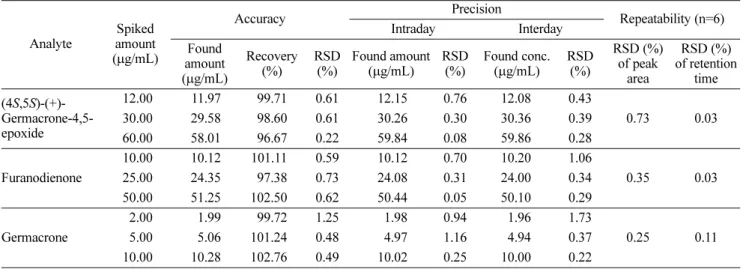
) of the three bioactive compounds, (4S,5S)-(+)-ger- macrone-4,5-epoxide, furanodienone, and germacrone, was all 0.9997 and showed good linearity. The LOD and LOQ values of these analytes were 0.01 – 1.61 and 0.03 – 5.36 μg/mL within the tested ranges. These results are summarized in Table 2. The recovery of the three ses- quiterpenoids was 96.67 – 102.76% with a RSD of 0.23 – 1.25%. A repeatability test was evaluated based on RSD values of peak areas and retention times of each com- ponent, all of which showed good repeatability, with less than 0.80% variation. In addition, the RSD values of the intra- and interday precisions of the three sesquiter- penoids, (4S,5S)-(+)-germacrone-4,5-epoxide, furanodienone, and germacrone, in the CR sample were 0.05 – 1.16% and 0.22 – 1.73%, respectively. The results are summarized in Table 3 and show that the established HPLC–PDA analytical method is suitable for simultaneous analysis of CR samples.

Recently, studies on the quantitative analysis of volatile and sesquiterpenoids components of steamed and non-

Table 1. System suitability for the three bioactive marker components

Compounds Capacity factor Selectivity Number of theoretical plates Resolution Tailing factor (4 S,5S)-(+)-Germacrone-

4,5-epoxide 5.65 1.27 12556.39 7.57 1.00

Furanodienone 7.16 1.15 39996.43 6.88 1.04

Germacrone 8.27 1.15 54232.50 6.88 1.05

Table 2. Linear range, regression equation, coefficient of determination, LOD, and LOQ for the three bioactive compounds (n = 3) Compound Linear range

( μg/mL) Regression equation Correlation

coefficient ( r

2

)

LOD

( μg/mL) LOQ

( μg/mL) (4 S,5S)-(+)-

Germacrone- 4,5-epoxide

3.13 – 200.00 y = 15669.46x – 5419.30 0.9997 0.32 0.98

Furanodienone 1.56 – 100.00 y = 13116.07x – 1737.27 0.9997 0.16 0.48

Germacrone 0.78 – 50.00 y = 6680.46x – 1197.83 0.9997 0.10 0.30

y: peak area (mAU) of compounds; x: concentration (μg/mL) of compounds; LOD: 3.3 × σ/S; LOQ: 10 × σ/S. (s is the standard deviation

of the intercept from the regression equation and S is the slope of the calibration curve)

(4)

Fig. 2. HPLC chromatograms of standard mixtures (A) and CR sample (B) at UV wavelength 246 nm (I) and 260 nm (II). (4S,5S)- Germacrone-4,5-epoxide (1), furanodienone (2), and germacrone (3).

Table 3. Recovery, precision, and repeatability of the three investigated compounds in CR

Analyte

Spiked amount (μg/mL)

Accuracy Precision

Repeatability (n=6)

Intraday Interday

Found amount (μg/mL)

Recovery (%)

RSD (%)

Found amount ( μg/mL) RSD

(%)

Found conc.

( μg/mL) RSD (%)

RSD (%) of peak

area

RSD (%) of retention

time (4 S,5S)-(+)-

Germacrone-4,5- epoxide

12.00 11.97 99.71 0.61 12.15 0.76 12.08 0.43

0.73 0.03

30.00 29.58 98.60 0.61 30.26 0.30 30.36 0.39

60.00 58.01 96.67 0.22 59.84 0.08 59.86 0.28

Furanodienone

10.00 10.12 101.11 0.59 10.12 0.70 10.20 1.06

0.35 0.03

25.00 24.35 97.38 0.73 24.08 0.31 24.00 0.34

50.00 51.25 102.50 0.62 50.44 0.05 50.10 0.29

Germacrone

2.00 1.99 99.72 1.25 1.98 0.94 1.96 1.73

0.25 0.11

5.00 5.06 101.24 0.48 4.97 1.16 4.94 0.37

10.00 10.28 102.76 0.49 10.02 0.25 10.00 0.22

Recovery (%) = Found amount / Spiked amount × 100.

(5)

steamed CR using gas chromatography–mass spectrometry (GC–MS) and HPLC have been reported.

2

Curzerene, germacrone, and curdione were detected as major com- ponents of volatile components by GC–MS and (4S,5S)- (+)-germacrone-4,5-epoxide, curcumenone, furanodiene, and germacrone were detected as main components in sesquiterpenoids by HPLC. Wang et al.

11

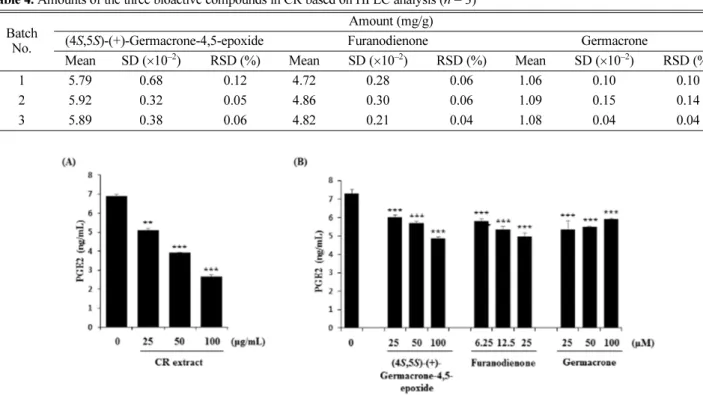
also reported the optimum extraction conditions of curdione, furanodienone, curcumol, and germacrone, which are the major com- ponents of CR, using the response surface methodology coupled with a desirability function. Among these four components, curdione and furanodienone were the most abundant. In this study, simultaneous determination of the three sesquiterpenoid constituents in CR was performed using a PDA detector with detection at 260 nm for (4S,5S)-(+)-germacrone-4,5-epoxide and at 246 nm for furanodienone and germacrone. Based on the established HPLC–PDA analytical methods, the amount of the three bioactive components was 1.06 – 5.92 mg/g (Table 4).

Among these three components, (4S,5S)-(+)-germacrone- 4,5-epoxide and furanodienone were detected as major components of CR.

CR has pharmaceutically anti-inflammatory activity.

12,13

In addition to inflammatory diseases such as infection and allergy, inflammation is implicated in pathologies including

carcinogenesis and hyperplasia through cellular turnover to proliferation.

14,15

Recently, it has been reported that BPH, which is characterized by the overproliferation of prostatic cells, is associated with inflammation. Inflamma- tory infiltrates and the increased production of proinflam- matory cytokines were observed in BPH specimens.

16,17

To investigate whether CR affects inflammation of BPH, we assessed the synthesis of PGE

2

, a major mediator of inflammation, in BPH-1 cells. CR treatment from 25 μg/

mL to 100 μg/mL, non-toxic concentrations, significantly inhibited PGE

2

levels in a concentration-dependent manner (Fig. 3A). Moreover, among three tested components of CR, (4S,5S)-(+)-germacrone-4,5-epoxide and furanodienone significantly suppressed PGE

2

levels of BPH-1 cells in a concentration dependent manner (Fig. 3B). Germacrone exhibited inhibitory activity on PGE

2

levels but its action was independent of concentration and was less effective than either (4S,5S)-(+)-germacrone-4,5-epoxide or furano- dienone. The inhibitory activity of the three components of CR against PGE

2

synthesis was insufficient compared with that of CR. In this regard, the efficacy of CR in the inhibition of PGE

2

synthesis seems to result from the combined effects of CR components, including others as well as the three components tested in this study. PGE

2

synthesis is involved in the pathogenesis of BPH as well

3 5.89 0.38 0.06 4.82 0.21 0.04 1.08 0.04 0.04

Fig. 3. The effect of the 70% ethanol extract of CR and its three marker components on PGE

2

levels of BPH-1 cells. BPH-1 cells were

treated with CR extract (A) or its three compounds (B) and incubated for 24 h. PGE

2

levels in culture supernatants from cells were

measured using an EIA kit. Value are presented as the mean ± SEM. **, P < 0.01; ***, P < 0.001 compared with vehicle (0 μg/mL).

(6)

as inflammation. The secretion of PGE

2

in BPH-1 cells is higher than in other prostatic cancer cells.

18

An increase of urinary PGE

2

concentration was observed in patients with BPH.

19

In conclusion, a convenient and simple HPLC–PDA method was established and validated. The method allowed the simultaneous analysis of three sesquiterpenoids, (4S,5S)-(+)-germacrone-4,5-epoxide, furanodienone, and germacrone, for quality assessment in CR. In addition, we showed the inhibitory effects of CR and its three marker components against PGE

2

synthesis in BPH-1 cells, suggesting that CR and its components may exhibit inhibitory efficacy against the pathogenesis of BPH.

Acknowledgement

This research was supported by a grant from the Korea Health Technology R&D Project through the Korea Health Industry Development Institute (KHIDI), funded by the Ministry of Health & Welfare (Grant no. H116C 0078, D18011) and by a grant from Korea Institute of Oriental Medicine (Grant no. K18241).

References

(1) Dong, J. Y.; Ma, X. Y.; Cai, X. Q.; Yan, P. C.; Yue, L.; Lin, C.; Shao, W. W. Phytochemistry 2013, 85, 122-128.

(2) An, Y. W.; Hu, G.; Yin, G. P.; Zhu, J. J.; Zhang, Q. W.; Wang, Z. M.;

Peng, J.; Fan, B. J. Chromatogr. Sci. 2014, 52, 961-970.

(3) Korean Pharmacopoeia Committee. The Korean Pharmacopoeia, 11th eds; Shinilbooks, 2014, Seoul, p 1836.

(4) Yan, J.; Chen, G.; Tong, S.; Feng, Y.; Sheng, L.; Lou, J. J.

Chromatogr. A. 2005, 1070, 207-210.

(5) Qiu, G.; Yan, P.; Shao, W.; Zhou, J.; Lin, W.; Fang, L.; Zhao, X.;

Dong, J. Chem. Pharm. Bull. 2013, 61, 983-986.

(6) Zhou, C. X.; Zhang, L. S.; Chen, F. F.; Wu, H. S.; Mo, J. X.; Gan, L.

S. Fitoterapia 2017, 121, 141-145.

(7) Lou, Y.; Zhao, F.; He, H.; Peng, K. F.; Chen, L. X.; Qiu, F. Chem.

Biodivers. 2010, 7, 1245-1253.

(8) Dong, J.; Shao, W.; Yan, P.; Cai, X.; Fang, L.; Zhao, X.; Lin, W.;

Cai, Y. Bioorg. Med. Chem. Lett. 2015, 25, 198-202.

(9) Ma, Z. J.; Meng, Z. K.; Zhang, P. Fitoterapia 2009, 80, 374-376.

(10) Park, E.; Lee, M. Y.; Seo, C. S.; Jeon, W. Y.; Shin, H. K. J.

Ethnopharmacol. 2017, 209, 230-235.

(11) Wang, X.; Jiang, Y.; Hu, D. Chem. Cent. J. 2016, 10, 32.

(12) Tohda, C.; Nakayama, N.; Hatanaka, F.; Komatsu, K. Evid. Based Complement. Alternat. Med. 2006, 3, 255-260.

(13) Hou, Y.; Lu, C. L.; Zeng, Q. H.; Jiang, J. G. EXCLI J. 2015, 14, 706-713.

(14) Shacter, E.; Weitzman, S. A. Oncology (Williston Park) 2002, 16, 217-226.

(15) Gual-Vaqués, P.; Jané-Salas, E.; Egido-Moreno, S.; Ayuso- Montero, R.; Marí-Roig, A.; López-López, J. Med. Oral Patol. Oral Cir.

Bucal. 2017, 22, e36-e42.

(16) Robert, G.; Descazeaud, A.; Nicolaiew, N.; Terry, S.; Sirab, N.;

Vacherot, F.; Maillé, P.; Allory, Y.; de la Taille, A. Prostate 2009, 69, 1774-1780.

(17) Handisurya, A.; Steiner, G. E.; Stix, U.; Ecker, R. C.; Pfaffeneder- Mantai, S.; Langer, D.; Kramer, G.; Memaran-Dadgar, N.; Marberger, M.

Prostate 2001, 49, 251-262.

(18) Wu, Q.; Zhou, Y.; Chen, L.; Shi, J.; Wang, C. Y.; Miao, L.;

Klocker, H.; Park, I.; Lee, C.; Zhang, J. J. Endocrinol. 2007, 195, 89-94.

(19) Zhang, Y. J.; Bai, Q. Natl. J. Androl. 2014, 20, 244-248.

Received May 19, 2019

Revised May 21, 2019

Accepted May 31, 2019

수치

Table 2. Linear range, regression equation, coefficient of determination, LOD, and LOQ for the three bioactive compounds (n = 3) Compound Linear range
Table 3. Recovery, precision, and repeatability of the three investigated compounds in CR
Fig. 3. The effect of the 70% ethanol extract of CR and its three marker components on PGE 2  levels of BPH-1 cells

참조

관련 문서

MP Yousef Al-Fadalah, Supervisor of Parliament Business Environment Committee declared that the Public Institution for Housing Care intends to dedicate nearly 150

Second, as a direct impact, the abolishing of licensing gives both incumbent and entrants higher option value directly because the new facility based

The main objective of the Bi Regional Center for SMES Development is oriented towards generating the conditions of cooperation among the countries which

Current Tokyo is rich in green compared to other metro cities. In some parts, the greenery has been contributed by the many inherited gardens from the Edo era to today which

In a statement to Kuwait News Agency (KUNA) on the sidelines of a meeting of the Arab Parliament's Foreign Affairs Political and National Security

The meeting was attended by Assistant Foreign Minister for GCC Affairs, Ambassador, Nasser Al-Muzayyen, and Deputy Assistant Foreign Minister for the Office of the

“ Sheikh Nasser has a written message from HH the Amir, Sheikh Sabah Al-Ahmad Al-Jaber Al-Sabah to the Chinese President, Chi Gen Beng related to enhancing mutual

On his part, CEO of Express Roads Authority, Saud Al-Naqqi said that the heavy rains of the previous day led to clogging parts of the express