Veterinary Science
http://dx.doi.org/10.4142/jvs.2013.14.4.457
Received: 30 Oct. 2012, Revised: 21 Dec. 2012, Accepted: 16 Feb. 2013
Original Article
*Corresponding author: Tel: +82-31-400-5513; Fax: +82-31-406-6316; E-mail: [email protected]
†The first two authors contributed equally to this work.
ⓒ 2013 The Korean Society of Veterinary Science.
This is an Open Access article distributed under the terms of the Creative Commons Attribution Non-Commercial License (http://creativecommons.org/licenses/by-nc/3.0) which permits unrestricted non-commercial use, distribution, and reproduction in any medium, provided the original work is properly cited.
Genetic diversity of Korean Bacillus anthracis isolates from soil evaluated with a single nucleotide repeat analysis
Sang Hoon Kim
1,†, Kyoung Hwa Jung
1,†, Se Kye Kim
1, Seong-Joo Kim
1, Ji-Cheon Kim
1, Soo Young Cho
1, Jin Choul Chai
1, Young Seek Lee
1, Yun Ki Kim
2, Hyun Chul Hwang
2, Sam Gon Ryu
3, Young Gyu Chai
1,*
1
Division of Molecular and Life Sciences, Hanyang University, Ansan 426-791, Korea
2
Samyang Chemical Co., Ltd., Anyang 430-852, Korea
3
Agency of Defense Development, Daejeon 305-152, Korea
Bacillus (B.) anthracis, the etiological agent of anthrax, is one
of the most genetically monomorphic bacteria species in the world. Due to the very limited genetic diversity of this species, classification of isolates of this bacterium requires methods with high discriminatory power. Single nucleotide repeat (SNR) analysis is a type of variable-number tandem repeat assay that evaluates regions with very high mutation rates. To subtype a collection of 21 isolates that were obtained during a
B. anthracis outbreak in Korea, we analyzed four SNR markerloci using nucleotide sequencing analysis. These isolates were obtained from soil samples and the Korean Center for Disease Control and Prevention. The SNR analysis was able to detect 13 subgenotypes, which allowed a detailed evaluation of the Korean isolates. Our study demonstrated that the SNR analysis was able to discriminate between strains with the same multiple-locus variable-number tandem repeat analysis genotypes. In summary, we obtained SNR results for four SNR marker loci of newly acquired strains from Korea. Our findings will be helpful for creating marker systems and help identify markers that could be used for future forensic studies.
Keywords: Bacillus anthracis, molecular diversity, single nucleotide repeats, subgenotyping
Introduction
Anthrax is a zoonotic and infectious disease that occurs around the world and affects a wide range of species including humans and herbivorous mammals [1,21].
Bacillus (B.) anthracis, a Gram-positive and spore-forming bacterium, is the etiological agent of anthrax [16]. Virulent
strains of B. anthracis contain two virulence plasmids:
pXO1 and pXO2. These plasmids contain genes that enable toxin production and capsule synthesis in the bacterium, and are thus vital factors that influence the full virulence of B. anthracis [7,17,21].
B. anthracis cells that encounter an inhospitable environment form spores that can survive in the environment for an extended period of time and resist a wide variety of severe stresses. B. anthracis has an almost worldwide geographic distribution (World Health Organization, 2003) and causes sporadic outbreaks of anthrax in diverse locations [12]. In Korea, the first case of anthrax was recorded in 1905, and additional cases have occasionally occurred between 1905 and 2008 [6]. The most recent Korean anthrax outbreaks [6] include two cases that were reported in 1995 (one in Kyungju and another in Hongseong), one case in 1995 (in Hongseong), two other cases in 2000 (in Changnyung), and one case in 2008 (in Yeongcheon).
Depending on the route of infection, anthrax can be
transmitted to humans as inhalational, gastrointestinal, or
cutaneous forms of the disease. B. anthracis infectiousness
and survivability has led to the use of this bacterium for
bioterrorism. Because of both natural anthrax outbreaks
and potential bioterrorism use, many studies have focused
on the identification, detection, and molecular subtyping
of B. anthracis [23]. B. anthracis strains are genetically
monomorphic microbes with low levels of sequence
diversity, and this bacterium is considered to be
evolutionarily “young” [19,23]. Characterization of
closely related B. anthracis strains is necessary for
epidemiological studies, examination of biological
contamination through environmental isolation, and forensic investigation of bioterrorism events [3]. A variety of discriminatory approaches have been examined for their potential use in identifying and subdividing microbial pathogen groups. In particular, a high-resolution genotyping system introduced by Keim et al. [11] is suitable for the detailed analysis of closely related isolates.
This system involves the examination of single nucleotide polymorphisms (SNPs), the performance of multiple-locus variable-number tandem repeat analysis (MLVA), and the assessment of single nucleotide repeats (SNRs). These three genotyping methods have been used to identify effective genetic markers and understand broader genetic relationships among B. anthracis strains.
SNPs are rare in B. anthracis, but they have been identified and used as genetic markers for multiple whole-genome sequencing [23]. The mutation rates of SNPs are very stable (10
-10changes per nucleotide per generation), and a set of canonical SNPs from eight different strains can be used to discriminate among major clusters of B. anthracis [11,25,26]. MLVA has been performed to examine several loci (MLVA-8, MLVA-15, and MLVA-25) that have higher mutation rates than SNPs.
The combination of MLVA and SNP analysis can therefore be used to evaluate B. anthracis genotypes [23]. SNRs that display very high mutation rates (as high as 6.0 × 10
-4mutations per generation) are a type of variable-number tandem repeat (VNTR) [10]. Repeated stretches of a single type of nucleotide are more likely to occur in SNRs than in other types of simple sequence repeats (SSRs). DNA containing VNTRs can undergo strand separation and base pair slippage, thereby increasing the chances of slipped-strand mispairing that produces mutations at the SNR locus [15,23]. Due to the high mutation rate, SNR analysis can provide additional powerful genetic resolution when examining B. anthracis strains with the same MLVA genotype. Typical methods for this type of analysis have been described by Kenefic et al. [13] and Stratilo et al. [23]. Several strains of B. anthracis have already been studied using the aforementioned methods.
For example, investigations have performed in the United States (47 isolates), Italy (53 isolates), and Canada (19 isolates), and established genotype reference markers [3,13,23]. Subsequently, genotyping was recently performed to assess and identify several candidate strains in Namibia and Bangladesh [1,2].
Several B. anthracis isolates from Korea have also been analyzed with various molecular typing techniques such as amplified fragment length polymorphism (AFLP), SNP analysis, and MLVA [20]. In a study by Ryu et al. [20], eight MLVA markers were assessed to elucidate the evolutionary pattern of nucleotide differences among B.
anthracis isolates from 12 different regions in Korea, and nine MLVA types were identified. Among these nine
MLVA types, three (M1 to M3) were classified as pathogenic B. anthracis isolates and assigned to new genotypes belonging to the A4 and B3 clusters. In a study by Jung et al. [6], B. anthracis isolates were arranged into A3a, A3b, and B1 clusters using MLVA and subdivided into four canSNP subgroups (B.Br.001/002, A.Br.005/006, A.Br.001/002, and A.Br.Ames). In the present study, we isolated new Korean strains of B.
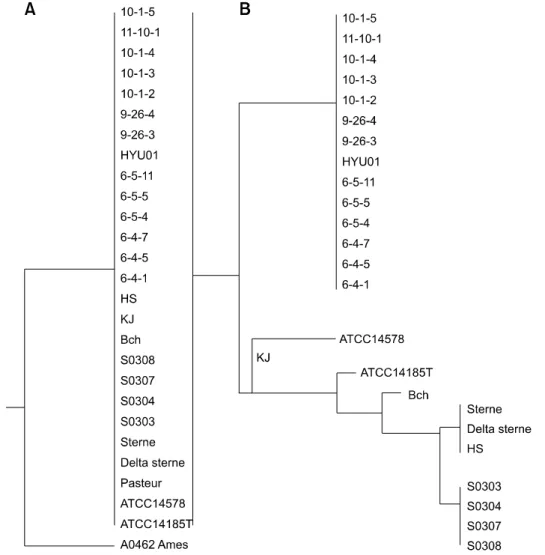
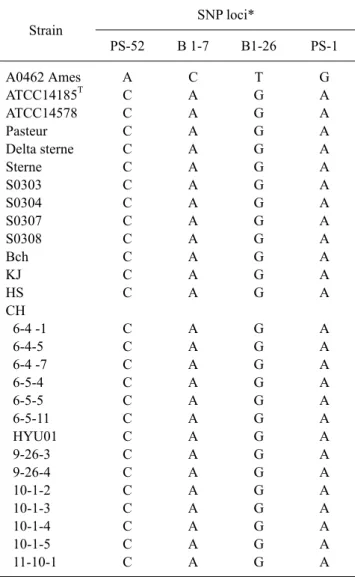
anthracis from the soil and measured the genetic diversity between strains that were obtained from different areas of the Korean peninsula. Furthermore, we typed these strains using SNR analysis and compared our findings with previously published MLVA and canonical SNP (canSNP) results.
Materials and Methods Bacterial strains
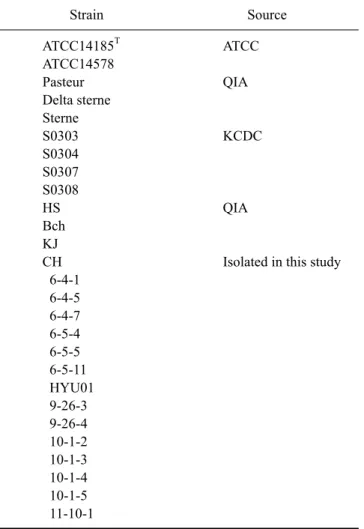
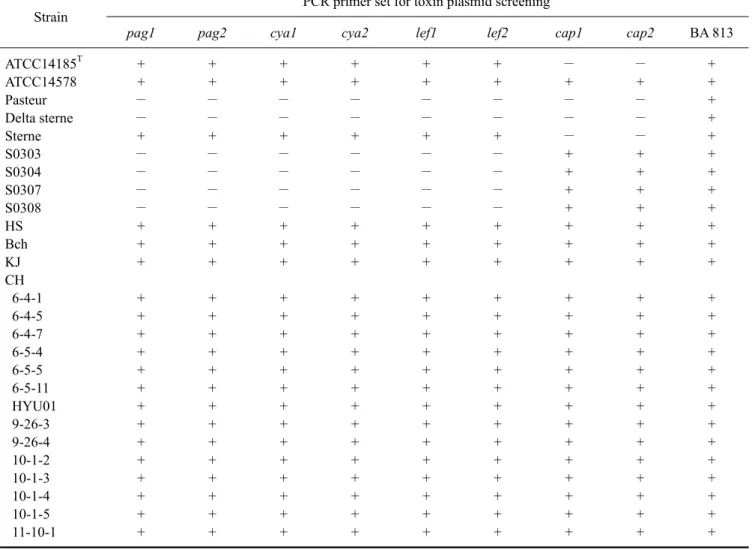
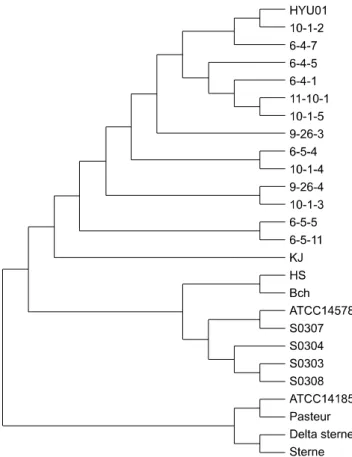
B. anthracis strains that were used in this study are listed in Table 1. Five strains were from different regions of the world (ATCC14185, ATCC14578, Pasteur, delta Sterne, and Sterne). ATCC14185 and ATCC14578 stains obtained from American type culture collection (ATCC, USA), and Pasteur, delta Sterne, and Sterne strain obtained from Animal and Plant Quarantine Agency (QIA, Korea). Four strains isolated in Korea were obtained from the Korean Center for Disease Control and Prevention (KCDC, Korea). Three were new isolates from different regions of Korea (HS, Bch, and KJ) and 14 other new isolates were acquired from one region in Korea (CH). The seventeen new isolates from Korea were collected from the soil and characterized with Gram staining, motility testing, and catalase analysis.
Extraction of B. anthracis DNA
All B. anthracis strains were cultured in brain heart infusion broth (BHI; Difco; Becton, Dickson and Company, USA) and grown for 8 h at 37
oC with shaking.
Total genomic DNA was extracted using a modified variant of Hunter’s method [4]. To isolate the DNA, cells were harvested by centrifugation at 20,215 g for 10 min at 4
oC, and then resuspended in 1 mL Tris-ethylenediamine tetraacetic acid (TE) containing lysozyme (0.1 mg/mL), 2% sodium dodecyl sulfate (SDS), and 10 μg/mL proteinase K at 55
oC for 3 h. After this incubation, DNA was extracted three times with 500 µL phenol-chloroform, precipitated with 1 mL isopropanol, and dissolved in 100 µL TE buffer with RNase (20 µg/mL).
B. anthracis screening by PCR
BA-813 and BA Kim were used as specific primers to
amplify a portion of B. anthracis chromosomal DNA for
identification [14,18]; the primer sequences are listed in
Table 2. Template DNA (10 ng) and 0.5 pmol of each
Table 2. The primer sequences used to screen for B. anthracis
Primer Sequence
BA-813 Forward Reverse BA Kim Forward Reverse
5´-TTAATTCACTTGCAACTGATGGG-3´
5´-AACGATAGCTCCTACATTTGGAG-3´
5´-TACTCACTCTCAAAAAGA-3´
5´-AGAAGGTCAATAGATGTAGG-3´
Table 1. Bacillus (B.) anthracis strains that were used for the current study
Strain Source
ATCC14185
TATCC14578 Pasteur Delta sterne Sterne S0303 S0304 S0307 S0308 HS Bch KJ CH 6-4-1 6-4-5 6-4-7 6-5-4 6-5-5 6-5-11 HYU01 9-26-3 9-26-4 10-1-2 10-1-3 10-1-4 10-1-5 11-10-1
ATCC QIA
KCDC
QIA
Isolated in this study
The strain type is indicated by a superscript T. ATCC: American Type Culture Collection (USA), QIA: Animal and Plant Quarantine Agency (Korea), KCDC: Korea Centers for Disease Control and Prevention (Korea).