
Veterinary Science
*Corresponding author
Tel: +82-2-880-1255; Fax: +82-2-885-0263 E-mail: [email protected]
Seroprevalence of low pathogenic avian influenza (H9N2) and
associated risk factors in the Gyeonggi-do of Korea during 2005-2006
Jong-Tae Woo
1, Bong Kyun Park
2,*
1
Gyeonggi-do Veterinary Service, Suwon 441-460, Korea
2
College of Veterinary Medicine and BK21 Program for Veterinary Science, Seoul National University, Seoul 151-742, Korea
Between November 2005 and March 2006, a total of 253 poultry flocks in the Gyeonggi-do of Korea were examined for seroprevalence against avian influenza (AI) using a hemagglutination inhibition (HI) test and an agar gel precipitation test. No low pathogenic avian influenza (LPAI) virus was isolated from 47 seropositive flocks that lacked clinical signs during sampling. The unadjusted percentage of seroprevalence rates of layer and broiler flocks were not significantly different, i.e., 26% (25/96) and 23% (22/97), respectively. The HI titer of the layers (mean = 89) was higher than the broilers (mean = 36; p < 0.001). A cross-sectional study was conducted for the seroprevalence of LPAI in the layers. Of 7 risk factors, farms employing one or more workers had a higher seropositive prevalence as compared to farms without hired employees (adjusted prevalence OR = 11.5, p = 0.031).
Layer flocks older than 400 d had higher seropositivity than flocks younger than 300 d (OR = 4.9, p = 0.017). The farmers recognized at least one of the clinical signs in seropositive flocks, such as decreased egg production, respiratory syndromes, and increased mortality (OR = 2.3,
p = 0.082). In a matched case-control study, 20 pairs ofcase and control flocks matched for type of flock, hired employees, age, and flock size were compared. Frequent cleansing with disinfectants was associated with a decreased risk of seropositivity (OR = 0.2, p = 0.022).
Although there was a low statistical association, using a foot disinfectant when entering the building led to a decreased rate of seropositivity (OR = 0.3, p = 0.105).
Keywords: avian influenza, HPAI virus, LPAI virus, risk factors, seroprevalence
Introduction
Avian influenza (AI) is one of the most contagious poultry diseases known and is caused by type A influenza virus, a member of the family Orthomyxoviridae [7]. Type A influenza viruses are further divided into subtypes based on H and N antigens. At present, 16 H subtypes (H1-H16) and 9 N subtypes (N1-N9) have been recognized [16], but only the H5 and H7 virus subtypes are highly virulent in poultry [1].
After the initial identification in Korea in December 2003, 19 highly pathogenic avian influenza (HPAI) virus isolates were found in various species of poultry, such as ducks, broiler breeders, and layers, between December 2003 and March 2004. All isolates were shown to be the H5N1 virus subtype [8]. In 1996, the first low pathogenic avian influenza (LPAI) virus was confirmed in the Gyeonggi-do of Korea (GPK), and the H9N2 virus subtype was isolated from several broiler breeder flocks (all were LPAI viruses). A total of 97,963 broiler breeders were depopulated to eliminate the AI virus (AIV) at that time [11]. However, LPAI has occurred sporadically since 1997.
For example, 24 cases of LPAI were reported in the GPK from 1 January 2000 to 1 April 2006 [13].
Unlike HPAI, in which the case mortality may be as high as 100% [17], LPAI is associated with mild clinical signs, such as a low fatality rate, primary respiratory symptoms, depression, and decreased egg production [5]. Therefore, most poultry producers do not consider LPAI as an important disease and often do not even realize that their flocks have the disease. The poultry producers may not report an outbreak of LPAI in their flocks for these reasons, even though LPAI is a reportable disease in Korea. HPAI is a first level reportable disease and LPAI is a second level reportable disease.
Thus, this study was conducted to address 3 questions: 1)
How many undetected or undiagnosed LPAI cases are
present in layer, broiler, domestic duck, and broiler breeder
flocks in the GPK? 2) What is the greatest risk factor for
introducing and maintaining LPAI in seropositive flocks?
and 3) What are the current monitoring and surveillance systems for LPAI in Korea?
Materials and Methods
Selection of poultry farms and determination of sample size
Two hundred fifty-three flocks were randomly selected from 1,654 farms in the GPK; 96 farms were selected from 582 layer farms, 97 farms were selected from 880 broiler farms, and 30 farms were selected from 81 breeder farms.
In addition, 30 flocks were selected from 111 domestic duck farms. The flock samples were selected using a computer program (Research Randomizer, USA).
The minimal sample size of birds in each flock to achieve 95% confidence for random sampling was determined to be 15, which was calculated using the Cannon and Roe formula [3].
Collection of samples
Between November 2005 and March 2006, the samples were collected as follows: 1) layer, broiler breeder, and domestic duck flocks: the samples of each flock were collected by staff from the Livestock Health Control Association and/or the Veterinary Service Center in Gyeonggi-do (VSCG); 2) broiler flocks: the samples were collected at the slaughter houses (62 flocks) or farms (35 flocks) by the VSCG staff. If there were no chickens in the farms selected by the computer program, alternative samples were collected from the closest flocks to the initially selected flocks.
Serological test
The hemagglutination inhibition (HI) test was used for detecting antibody from sera of layers, broilers, and broiler breeders, while the agar gel precipitation (AGP) test was used for detecting antibody from sera of domestic ducks.
Both immunologic tests were carried out according to the recommendations in the WHO manual [19]. The reagents for the HI and the AGP tests were obtained from the National Veterinary Research and Quarantine Service (Korea) and Animal Genetics (Korea), respectively.
According to the OIE manual [15], four hemagglutination units were used for the HI test. A tested flock with 15 blood samples was classified as a positive control if there was at least one inhibition at a serum dilution of 1/16 among the 15 blood samples.
Inoculation of embryonated chicken eggs for virus isolation
For detecting AI viruses and/or official reporting of AI to the Regional Veterinary Laboratory of Korea, initial serological tests and isolation of viruses from seropositive
birds are generally performed if there are no typical signs.
Therefore, this study was conducted followed that protocol and only the swab samples of seropositive birds were inoculated into embryonated SPF chickens eggs. The WHO manual was used as a guide [19].
Study design and collection of questionnaires The first part of the study was cross-sectional involving 96 layer flocks. Twenty-five seropositive flocks were compared with 71 seronegative samples. Based on the cross-sectional study, having employee(s) was shown to be a major risk factor for seropositivity; however, the specific employee risk factors were not determined. Therefore, a matched case-control study was conducted. For the purpose of this study, seropositive flocks with employee(s) were identified as cases and seronegative flocks with employee(s) were designated as controls.
Cross-sectional study
The questionnaire was designed to determine the possible risk characteristics for the seropositive flocks compared with the seronegative flocks and to evaluate if the poultry producers with seropositive layers recognized the clinical signs of AI when the disease was present. The question- naire covered 4 categories: (1) basic information; (2) management; (3) poultry house; and (4) retrospective data to evaluate if poultry producers had experience with clinical signs, such as decreased egg production. The questionnaires for layers, broiler breeders, and domestic duck flocks were filled out by the staff at the VSCG during the interview when they visited the farms for sampling.
Information regarding broiler flocks was collected from telephone interviews with 62 farmers and from farm visits to 35 farmers. The collected information was rechecked to verify the collected data by calling the poultry producers, if necessary.
Case-control study
Of the 25 seropositive layer flocks, 20 flocks were selected as cases; 5 farms were excluded from analysis for the following reasons: no employees, relocation, and empty chicken houses. To reduce the effects of confounding variables, cases (n = 20) and controls (n = 20) were matched based on hired employees, flock age, and flock size. The inquiry included 4 categories: 1) basic information regarding the owner; 2) habitation of the employees; 3) sanitary concept of the farm workers; and 4) activity of the employees. Data were collected by staff at the VSCG via interviews.
Analysis of data Cross-sectional study
In the cross-sectional study, all analyses was performed
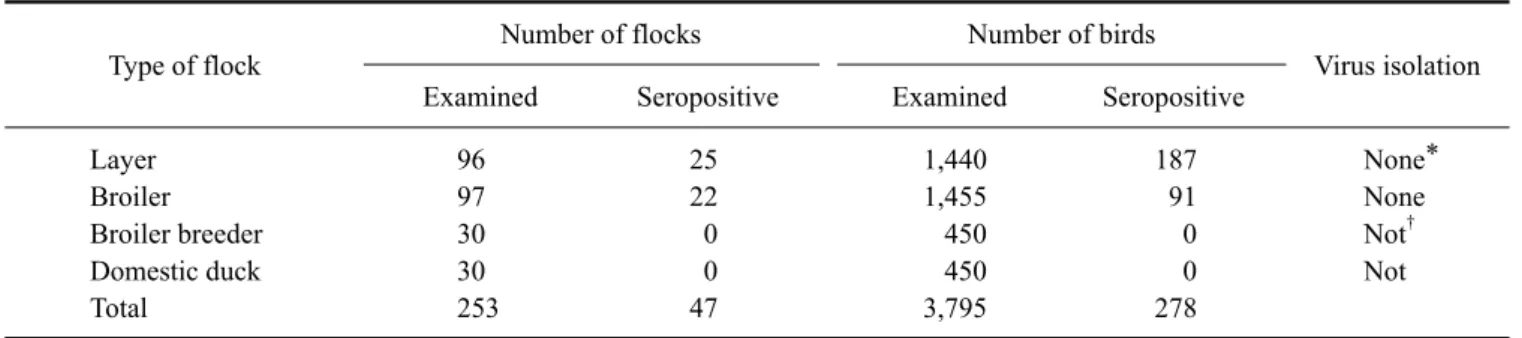
Table 1. Summary of the results for the detection of antibody and AIV isolation for AI from seropositive flocks
Type of flock Number of flocks Number of birds
Virus isolation
Examined Seropositive Examined Seropositive
Layer Broiler Broiler breeder Domestic duck Total
96 97 30 30 253
25 22 0 0 47
1,440 1,455 450 450 3,795
187 91 0 0 278
None*
None Not
†Not
*No AIV isolation (This study tried to detect AIV only from seropositive flocks). †Not done.
using Microsoft Excel 2000 and SPSS, version 12.0. For identifying possible risk factors, seven suspected factors were included as variables. The prevalence odds ratio (OR) of each variable with a 95% confidence interval and two-sided p-values were calculated using binary logistic regression. A p < 0.05 was considered significant. To compare the HI titers between layers and broilers, the geometric mean of the titer of each group was calculated with the raw titer (not log-transformed). A t-test was performed to ensure the significance of differences between the groups with log-transformed data. To analyze the relationship between an increase in age and seropositivity in the layer flocks, raw data pertaining to seropositivity and age were divided into 3 categories: 1) <300 d old, 2) 300-400 d old, and 3) >400 d old. The odds ratio of each category was calculated using multinomial logistic regression analysis.
In this study, the odds ratio of the <300 d old category was regarded as the baseline variable, and two categories were calculated according to the baseline odds ratio. To evaluate the difference in recognition of clinical signs between farmers with seropositive flocks and farmers with seronegative flocks, the relationship between retrospective data and seropositivity was statistically analyzed using a Chi-square test.
Case-control study
The results were analyzed using SPSS, version 12. Each OR and probability (p-value) was subjected to univariate analysis. The categorical variables were compared by Fisher’s exact test, and all tests of significance were two-tailed; a p < 0.05 was considered significant.
Results
Seroprevalence and virus isolation
In serology, the unadjusted percentage of seroprevalence rates of layers and broilers was not significantly different (26% [25/96] and 23% [22/97], respectively). The seropre- valence rate of individual birds, however, was twice as high in the layers (13% [187/1440]) as in the broilers (6%
[91/1455]). The AIV was not isolated from the seropositive flocks that showed no clinical signs when sampling. Some hemagglutinating agents were detected in the allantoic fluid inoculated with specimens of seropositive layers, but were not verified as an AIV with a test kit (Anigen, Korea).
Thus, further testing for identification of the AIV was not performed (Table 1).
Distribution of HI titers
Table 2 presents the distribution of HI antibody titers against AIV among the flocks. Titers obtained from the layers ranged between 16 and 512 (mean = 89), and were higher than the broilers (mean = 27; p < 0.001). Of 181 seropositive layers, the number of birds with a HI titer of 64 (45 birds) was most frequent, followed by titers of 32 (43 birds), and 16 (40 birds).
Analysis of cross-sectional study
A multivariate analysis using the logistic regression model is shown in Table 3. Of the seven risk factors, only farms that hired one or more workers were found to have a significant association with the risk of being seropositive (POR = 11.5, p = 0.031); other characteristics were not significantly associated with seropositive layers.
Table 4 shows the seroprevalence of layers by age in the GPK. There was a significant pattern, i.e., the older layers had a higher seroprevalence. The seroprevalence (40%) of the groups older than 400 d old was greater than twice that of the layer flocks younger than 300 d old. This demon- strated that the OR increased while the layers in the GPK were aging, with an adjusted OR of 4.9 (p = 0.017) for layers over 400 d old.
Analysis of retrospective data (Table 5) indicated that
there was little significant difference (OR = 2.3, p = 0.082)
in poultry producers with experience regarding clinical
signs of AI between seropositive layers and seronegative
layers. Having experience indicated that the poultry
producers recognized at least one clinical sign, such as
decreased egg production, respiratory syndromes, and
increased mortality. Of 25 seropositive flock growers, 13
Table 3. Odds ratio and p-value for significant and possible risk factors related to the seropositive layers
Variables Factors* Seropositive Seronegative Adjusted odds ratio
†(95% CI) Adjusted p-value Farm worker
‡Neighboring Farm
§Career
∥Wildbirds
¶All in and All out**
Housing type
††Disinfection
‡‡≥ 1 employee No employee
≤ 500 m
> 500 m
≥ 10 yr
< 10 yr Observing No Yes No Ground Cage Once a day Not a day
24 1 14 11 22 3 21 4 3 22 16 9 21 4
46 25 28 43 48 23 52 19 21 50 35 36 56 15
11.5 (1.2-106.1)
1.5 (0.5-4.7)
2.9 (0.6-14.6)
1.7 (0.4-6.9)
0.3 (0.1-2.0)
0.4 (0.1-2.3)
0.4 (0.1-1.4)
0.031 0.477 0.203 0.465 0.220 0.282 0.147
*All variables were analyzed with two factors. †Adjusted with age of flock and farm size. ‡Farm worker factors (more than one employee or not). §Neighboring farm factors (neighboring farm within 500 m or not). ∥Career factors (operating facility more than 10 years or not).
¶Wildbird factors (experience of observing wild birds or not). **All in and all out factors (yes or no). ††Housing type factors (ground- or cage- type). ‡‡Disinfection factors (performing disinfection once a day or performing less frequently).
Table 4. Seroprevalence by age of seropositive layers Age (days-old) Seroprevalence
(%)
Odds ratio
(95% CI)
p-valueAdjusted
†odds ratio (95% CI)
Adjusted
p-value< 300*
300-400
> 400
7/44 (15.9) 10/32 (31.3)
8/20 (40)
1 2.4 (0.8-7.2) 3.5 (1.1-11.8)
0.119 0.041
1 3.4 (1.0-10.9) 4.9 (1.3-18.0)
0.042 0.017
*Baseline variable. †Adjusted for hiring more than one person.
Table 2. Distribution of HI antibody titers against AIV in seropositive layers and broilers
Type of flock HI antibody titers*
Mean titer
‡Total 2 4 8 16 32 64 128 256 512
Layer Broiler
238
†318
5 50
14 112
32 65
40 46
43 31
45 8
38 4
15 2
6 0
56 27
*Reciprocal expression (16 = 24). †Number of chickens. ‡Geometric mean of positive titers. The dark portion represents a positive titer, i.e.,
>
16 is positive.growers (52%) recognized at least one clinical sign, but 32% of the growers with seronegative layers recognized one clinical sign as well.
Analysis of the case-control study
There were 20 pairs of case and control flocks that were
matched for type of flock, hired employees, flock age, and
flock size. All cases and controls were layer flocks. Of 20
case-control pairs, 20 (100%) were successfully matched
Table 5. Difference in farmer's recognition of clinical signs between seropositive and seronegative flocks Characteristics
No. (%) Odds ratio
(95%C.I)
p-value†Seropositive (n = 25) Seronegative (n = 71)
Realization of clinical signs* 13 (52) 23 (32) 2.3 (0.9-5.7) 0.082
*Realized at least one clinical sign (decreased egg production, respiratory syndromes, and increased mortality). †Pearson's chi square test was used.
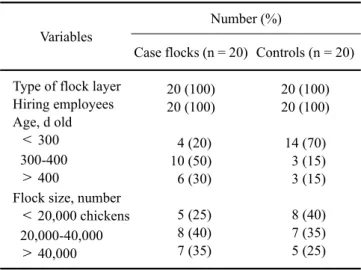
Table 6. The results of matching for the case-control study Variables
Number (%)
Case flocks (n = 20) Controls (n = 20) Type of flock layer
Hiring employees Age, d old
< 300 300-400
> 400
Flock size, number
< 20,000 chickens 20,000-40,000
> 40,000
20 (100) 20 (100) 4 (20) 10 (50) 6 (30) 5 (25) 8 (40) 7 (35)
20 (100) 20 (100) 14 (70) 3 (15) 3 (15) 8 (40) 7 (35) 5 (25)
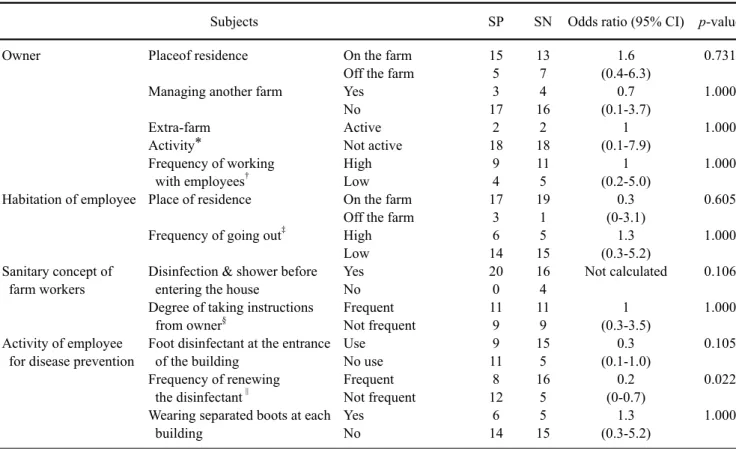
for hired employees. Case farms had a large number of flocks in comparison with control farms and were more likely to have older chickens than control farms. The details of the results of matching are shown in Table 6. As shown in Table 7, frequent cleansing with disinfectants resulted in a decreased risk of seropositivity (OR = 0.2, p = 0.022). Seropositivity had no association with the place of residence for the employees, frequency of going out, disinfection, and taking a shower when coming back to the farms after going out. Although there was little statistical association, usage of a foot disinfectant at the entrance of the building carried a decreased risk of seropositivity (OR
= 0.3, p = 0.105).
Discussion
For determination of the minimal sample size per flocks, it was calculated that the minimum prevalence was 20%
when the LPAI (H9N2) viruses were introduced into a flock. It was difficult to determine the precise seroprevalence of LPAI because of the sampling anomalies. However, a 20% attack rate was determined based on several studies [11,12,14]. In Pakistan, the seroprevalence of AI against subtype H9N2 was at least 54% (30/55 birds) [12]. In Iran, mortality in affected flocks with H9N2 was between 20
and 65% [14]. In addition, when the first outbreak of LPAI (H9N2) occurred in Korea, a 20-40% mortality rate was reported [11].
In this study, there was no virus isolation from seropositive flocks without clinical signs of infection. It could be inferred that for successful AIV isolation, specimens should be taken early after the onset of clinical symptoms, as described in other reports [4,6,12,14,20]. AIV can be isolated within 7-10 days infection [4,18], but antibodies are detected 7-10 days after infection; thus, it may be difficult to identify AIV from the birds that are sero- positive. For instance, the AIV was not isolated from any samples for a long time after diagnosis with the disease, although many layers in a complex continued to be seropositive [22].
Thus, attempts for successful viral isolation must be performed within a few days of onset, but not after detecting antibodies. The WHO also recommends that specimens for AIV isolation should generally be taken during the first 3 days after the onset of clinical signs [19].
In a cross-sectional study, broiler chickens were not analyzed because of maternal antibody persisting for up to 4 weeks [15]. When the antibodies were detected from broilers, it was not easy to differentiate between maternal antibody and antibody arising due to infection. Thus, only the data of 96 layer flocks was analyzed.
In this case, farms with employees were a significant factor for seropositivity in layers in the GPK. The presence of farm workers means that a poultry farm owner hired one or more people who participated in the farm work. This may be related to an increased chance of introducing AIV into the flocks by increased personnel movement, as most studies concluded that the secondary spread of the AIV was principally by the movement of personnel and equipment between farms [1].
In addition, the present study is supported by other studies
reporting that HPAI spread more rapidly on farms with
employees [9,21]. Other characteristics, such as frequency
of disinfection, were not significantly associated with
seropositive layers. These results are similar to other
reports. For example, a study [9] also suggested that various
routine biosecurity and presence of wild birds on the
premises were not significantly associated with infection
Table 7. The results of the case-control study
Subjects SP SN Odds ratio (95% CI) p-value
Owner
Habitation of employee
Sanitary concept of farm workers
Activity of employee for disease prevention
Placeof residence Managing another farm Extra-farm
Activity*
Frequency of working with employees
†Place of residence Frequency of going out
‡Disinfection & shower before entering the house
Degree of taking instructions from owner
§Foot disinfectant at the entrance of the building
Frequency of renewing the disinfectant
∥Wearing separated boots at each building
On the farm Off the farm Yes No Active Not active High Low On the farm Off the farm High Low Yes No Frequent Not frequent Use No use Frequent Not frequent Yes
No
15 5 3 17
2 18
9 4 17
3 6 14 20 0 11
9 9 11
8 12
6 14
13 7 4 16
2 18 11 5 19
1 5 15 16 4 11
9 15
5 16
5 5 15
1.6 (0.4-6.3)
0.7 (0.1-3.7)
1 (0.1-7.9)
1 (0.2-5.0)
0.3 (0-3.1)
1.3 (0.3-5.2) Not calculated
1 (0.3-3.5)
0.3 (0.1-1.0)
0.2 (0-0.7)
1.3 (0.3-5.2)
0.731 1.000 1.000 1.000 0.605 1.000 0.106 1.000 0.105 0.022 1.000
SP: Seropositive flocks (Cases), SN: Seronegative flocks (Controls). *Active meant that an owner had one social activity less than 3 d. Social activity means that an owner participated in a meeting or meets farmers for the poultry society, †High degree meant that an owner usually works together with employees every day, Low was defined when an owner almost did no work with employees, ‡If employees go out several times a day or once less than 2 d, it was described as frequent, §Frequent meant that employees take some instructions,like sanitary education or ex- planation from owner, at least once per 2 d, ∥If employee changed or refreshed disinfectants in front of the chicken house or entrance to the farm at least once per 3-4 d, it was designated as frequent.

![외국인 PCR검사 가능 기관 [Referral Laboratories : 11sites]](data:image/gif;base64,R0lGODlhAQABAIAAAP///wAAACH5BAEAAAAALAAAAAABAAEAAAICRAEAOw==)