WWW.KJOG.ORG 332
SUCCESSFUL TERM PREGNANCY AFTER
TRANSABDOMINAL CERCLAGE WITH PREVIOUS SECOND TRIMESTER LOSS FOLLOWING VAGINAL RADICAL TRACHELECTOMY
Ji-Eun Song, MD, Keun-Young Lee, MD, Su-Ran Choi, MD
Division of Maternal‐Fetal Medicine, Department of Obstetrics and Gynecology, Hallym University College of Medicine, Seoul, Korea
The ultimate goal of radical trachelectomy is to have a viable pregnancy. However, extremely short cervix following radical trachelectomy could result in cervical incompetence and nonviable preterm delivery. Although prophylactic cerclage is placed at the time of radical trachelectomy, it might not be suffi cient to prolong pregnancy until term. We report a successful term pregnancy after transabdominal cerclage with previous second trimester loss following vaginal radical trachelectomy.
Keywords:
Transabdominal cerclage; Vaginal radical trachelectomy; Cervical incompetence; Pregnancy outcome
Received: 2011.6.30. Revised: 2012.3.23. Accepted: 2012.4.1.
Corresponding author: Keun-Young Lee, MD, PhD
Division of Maternal-Fetal Medicine, Department of Obstetrics and Gynecology, Hallym University College of Medicine, 1 Singil-ro, Yeongdeungpo-gu, Seoul 150-950, Korea Tel: +82-2-829-5357 Fax: +82-2-833-5323
E-mail: [email protected]
Th is is an Open Access article distributed under the terms of the Creative Commons Attribution Non-Commercial License (http://creativecommons.org/licenses/
by-nc/3.0/) which permits unrestricted non-commercial use, distribution, and reproduction in any medium, provided the original work is properly cited.
Copyright © 2012. Korean Society of Obstetrics and Gynecology
Radical trachelectomy was proposed to preserve fertility in women with early stage cervical cancer [1,2]. However, it is clear that cer- vical incompetence (CI), which leads to very early preterm birth, is common in pregnancy following radical trachelectomy [3,4]. We report a successful term pregnancy after transabdominal cerclage (TAC) with previous second trimester loss following vaginal radical trachelectomy (VRT).
Case Report
A 29-year-old nulliparous woman presented to our institution for evaluation of a high-grade squamous intraepithelial lesion identi- fi ed on her Pap smear. A cervical punch biopsy showed a cervical intraepithelial neoplasia (CIN) III, and the patient underwent con- ization. The histology showed invasive squamous cell carcinoma with more than 4 mm in depth. She was assessed by clinical evaluation and was staged International Federation of Obstetrics and Gynecology (FIGO) stage IB1.
As she strongly desired to preserve her fertility, she underwent VRT with laparoscopic bilateral lymphadenectomy. She was informed of the possibility of preterm birth after VRT. A concurrent prophylactic cerclage using monofi lament nonabsorbable polyprophylene (1-0
Prolene, Ethicon, Somerville, NJ, USA) was performed. The histol- ogy demonstrated invasive squamous cell carcinoma with 5 mm in depth and no involvement of resection margins. No lymphatic or vascular invasion was observed on pathology.
A year later, she conceived spontaneously. However, she lost the fetus at 20 weeks of gestation resulting from CI. Next year, she presented to our institution for her second spontaneous preg- nancy. She was in good health and her repeat Pap smear showed negative intraepithelial lesion.
Transvaginal ultrasonography revealed short cervical length of
CASE REPORT
Korean J Obstet Gynecol 2012;55(5):332-334 http://dx.doi.org/10.5468/KJOG.2012.55.5.332 pISSN 2233-5188 · eISSN 2233-5196
WWW.KJOG.ORG 333
Ji-Eun Song, et al. Term pregnancy after TAC following VRT
“neo-cervix” (17.4 mm) with no funneling (Fig. 1). An additional cerclage was essential for preventing CI in her second pregnancy.
As no residual cervical tissue was remained suitable for additional vaginal cerclage, TAC using Mersilene tape was performed at 13 2/7 weeks of gestation. There was no intraabdominal adhesion
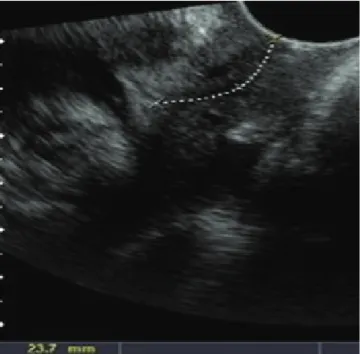
at the time of TAC. Postoperatively, transvaginal ultrasonography (TVU) revealed a cervical length of 23.7 mm with no funneling (Fig.
2). She was discharged home without any postoperative complica- tion, and was not restricted with movement. Her cervical length remained 20 mm at 35 weeks of gestation (Fig. 3). She showed no symptom or sign of preterm labor or preterm premature rup- ture of membrane (PPROM) or chorioamnionitis throughout the pregnancy.
At 39 6/7 weeks of gestation, she delivered healthy living female weighing 2,940 g via elective Cesarean section. We untied TAC knot because she did not desire to conceive anymore. Both mother and neonate were discharged well. Her postpartal Pap smear dem- onstrated negative lesion. She still thrives without any evidence of recurrence of cervical cancer.
Discussion
The optimal goal of pregnancy following radical trachelectomy is to deliver a viable infant. The lack of mechanical support and mu- cus of normal cervix could lead to CI and ascending infection [3,5].
The risk of second-trimester loss (9%
–10%) is much higher than general population (approximately 3%) in radical trachelectomy group [1]. Cerclage placement is the only option to preclude CI.
However, it is diffi cult to place vaginal cerclage in the “neo-cervix”
Fig. 1. Transvaginal sonogram revealing a precerclage short cervical length (17.4 mm).
Fig. 2. Transvaginal sonogram of the cervix after abdominal cerclage (23.7 mm) at 13 5/7 weeks of gestation.
Fig. 3. Transvaginal sonogram of the cervical length at 35 weeks of ges- tation (20 mm).
WWW.KJOG.ORG 334
KJOG Vol. 55, No. 5, 2012
following radical trachelectomy. Although permanent prophylactic cerclage was performed at the time of VRT, our patient lost her fi rst baby resulting from CI. Therefore, we elected transabdominal approach to place additional protective cerclage. The prolongation after TAC was 186 days. She did not demonstrate any symptoms or signs of preterm labor or PPROM, which is common in preg- nancy following radical trachelectomy. Finally she succeeded in her second pregnancy without complication.
A woman undergoing VRT does not have enough cervical tissue for supplementary vaginal cerclage, because cervix is amputated below cervical isthmus at the time of VRT. As TAC knot is placed higher than transvagincal cerclage, a slippage of the knot and an ascending infection may be decreased [6,7]. We suppose TAC could prevent CI and ascending infection following radical trach- electomy. Although we performed TAC following VRT, we presume that preconceptional TAC at the time of radical trachelectomy might improve pregnancy outcome. TVU follow-up is prudent after TAC for the evaluation of cervical competence. Excessive pressure by the TVU examiner should be avoided as the cervix has markedly modifi ed anatomy after VRT. We conclude that TAC is an accept- able option to preclude CI in pregnant women following radical trachelectomy and the combination of postoperative TVU and other adjunctive strategies could reduce the rate of preterm birth
after radical trachelectomy.
References
1. Farthing A. Future fertility after conservation surgery for cervi- cal cancer. Br J Hosp Med (Lond) 2006;67:250-2.
2. Rob L, Skapa P, Robova H. Fertility-sparing surgery in patients with cervical cancer. Lancet Oncol 2011;12:192-200.
3. Ramirez PT, Schmeler KM, Soliman PT, Frumovitz M. Fertil- ity preservation in patients with early cervical cancer: radical trachelectomy. Gynecol Oncol 2008;110:S25-8.
4. Plante M. Vaginal radical trachelectomy: an update. Gynecol Oncol 2008;111:S105-10.
5. Boss EA, van Golde RJ, Beerendonk CC, Massuger LF. Preg- nancy after radical trachelectomy: a real option? Gynecol On- col 2005;99:S152-6.
6. Lotgering FK, Gaugler-Senden IP, Lotgering SF, Wallenburg HC.
Outcome after transabdominal cervicoisthmic cerclage. Obstet Gynecol 2006;107:779-84.
7. Lee KY, Jun HA, Roh JW, Song JE. Successful twin pregnancy after vaginal radical trachelectomy using transabdominal cer- vicoisthmic cerclage. Am J Obstet Gynecol 2007;197:e5‐6.
근치적 자궁경부절제술 후 자궁경부무력증으로 임신 2분기 분만 후 시행한 복식 자궁경부원형결찰술로 만삭 출산한 1예
한림대학교 의과대학 산부인과학교실 송지은, 이근영, 최수란
초기 자궁경부암 환자에서 근치적 자궁경부절제술을 시행하는 이유는 자궁을 보존하여 임신 및 출산할 수 있도록 하기 위한 것이다. 하지 만, 근치적 자궁경부절제술 후에는 자궁경부 길이가 매우 짧아져 자궁경부무력증의 위험성이 매우 높다. 근치적 자궁경부절제술을 시행하 면서 예방적 자궁경부원형결찰술을 시행하지만, 이는 만삭까지 임신을 유지하기에는 불충분할 수 있다. 저자들은 질식 근치적 자궁경부절 제술 후 임신하였으나, 자궁경부무력증으로 임신 2분기에 태아 소실 후, 다음 임신에서 복식 자궁경부원형결찰술을 시행하여 만삭에 출산 한 1예를 보고하고자 한다.
중심단어: 복식 자궁경부원형결찰술, 자궁경부무력증, 질식 근치적 자궁경부절제술, 임신 예후