Erratum
Obstet Gynecol Sci 2016;59(5):426 http://dx.doi.org/10.5468/ogs.2016.59.5.426 pISSN 2287-8572 · eISSN 2287-8580
www.ogscience.org 426
Figure Correction
In the published article by Lee JH et al. entitled “Concomitant ultrasound-guided intra-gestational sac methotrexate-potassium chloride and systemic methotrexate injection in the recurrent cesarean scar pregnancy”
(Obstet Gynecol Sci 2016;59(3):245-248. doi: http://dx.doi.org/10.5468/ogs.2016.59.3.245), the Figure 2 is given incorrectly. The Editorial Office would like to correct the Figure 2 and apologizes for any inconvenience that it may have caused.
www.ogscience.org 247
Ju Hak Lee, et al. Concomitant intra-GS MTX-KCL and systemic MTX injection in recurrent CSP
But Hasegawa et al. [4] suggested that surgical management might be a preferable option for patients with first CSP, if the patients wish to become pregnant in the future. There are sev- eral case reports on surgical treatment at the first CSP, how- ever, not recurrent CSP. For example, in 2004, Maymon et al.
[7] reported emergency laparotomy and excision of the preg- nancy site in the cesarean scar. In 2006, Lee et al. [8] reported the excision of CSP with laparoscopic surgery. In addition, Park et al. [9] reported the treatment of CSP by transvaginal hyster- otomy in 2008.
In 2006, Ben Nagi et al. [5] reported the third case of recur- rent CSP. Interestingly, 3 consecutive CSPs were diagnosed in their case. The first treatment was laparoscopy and suction evacuation at 12 weeks of gestational age and, 10 months later, the second treatment was suction and curettage at 7 weeks of gestational age without complication. Six months later, the final treatment was surgical removal at 4 weeks of gestational age without complications; and 3 months later, a laparotomy was performed to repair the uterine-scar defect.
After the operation, the patient had 2 normal intrauterine pregnancies. However, both pregnancies aborted spontane- ously at 7 weeks and 8 weeks of gestational age, respectively.
Ben Nagi et al. [5] indicated that laparotomy for uterine repair
may be useful in recurrent cases of CSP for the subsequent normal intrauterine pregnancy. We agree with their sugges- tion that a laparotomy in the first event of CSP could result in post-operative abdominal adhesion that can cause subfertility.
A separate treatment of intra-GS MTX or systemic MTX might fail because of the poor vascularity and surrounding fibrosis in the recurrent case [5]. In agreement, the intra-GS MTX injection did not work at the first CSP in our case; there- fore, we chose the concomitant intra-GS and systemic MTX treatment at the recurrent CSP that was effective. McKenna et al. [10] previously reported a case that was successfully treated with simultaneous intra-GS MTX without KCL and systemic MTX at the first CSP, although not recurrent CSP.
Based on our case, concomitant treatment of intra-GS MTX- KCL and systemic MTX would be a minimally invasive option with efficacy and safety. However, it had limitations such as long term follow-up period of 70 days at the first CSP and 108 days at the recurrent CSP in our case, respectively.
Future pregnancy and prevention of recurrence are the first priority to consider in the management of recurrent CSP. Fur- thermore, patient’s pain and cosmesis must also be considered currently. In a 2002 review, Fylstra [11] suggested that upon diagnosis of CSP, laparotomy should be considered as the first
0 10,000 20,000 30,000 40,000 50,000 60,000 70,000
Day 0 Day 3 Day 6 Day 13 Day 27 Day 48 Day 77 Day 108
(b) Systemic MTX injection
(a) Intra-gestational sac MTX-KCL injection with systemic MTX (mlU/mL)
0 5,000 10,000 15,000 20,000 25,000 30,000
Day 0 Day 5 Day 7 Day 8 Day 10 Day 12 Day 14 Day 16 Day 18 Day 19 Day 22 Day 26 Day 29 Day 36 Day 43 Day 70 (mlU/mL)
(a) Intra-gestational sac KCL injection
(b) Systemic MTX injection
(c) Intra-gestational sac MTX injection
(d) Systemic MTX injection
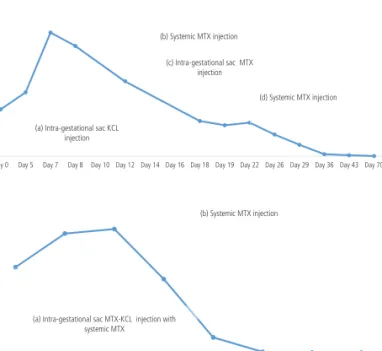
Fig. 2. Changes in serum β-human cho- rionic gonadotropin concentrations. (A) Changes in serum β-human chorionic go- nadotropin concentrations during follow- up at the first cesarean scar pregnancy. (a) Intra-gestational sac potassium chloride (KCL) injection, (b) systemic methotrex- ate (MTX) injection, (c) intra-gestational sac MTX injection, and (d) systemic MTX injection. (B) Changes in serum β-human chorionic gonadotropin concentrations during follow-up of a recurrent cesarean scar pregnancy. (a) Intra-gestational sac MTX-KCL injection with systemic MTX and (b) systemic MTX injection.
A
B
www.ogscience.org 247
Ju Hak Lee, et al. Concomitant intra-GS MTX-KCL and systemic MTX injection in recurrent CSP
But Hasegawa et al. [4] suggested that surgical management might be a preferable option for patients with first CSP, if the patients wish to become pregnant in the future. There are sev- eral case reports on surgical treatment at the first CSP, how- ever, not recurrent CSP. For example, in 2004, Maymon et al.
[7] reported emergency laparotomy and excision of the preg- nancy site in the cesarean scar. In 2006, Lee et al. [8] reported the excision of CSP with laparoscopic surgery. In addition, Park et al. [9] reported the treatment of CSP by transvaginal hyster- otomy in 2008.
In 2006, Ben Nagi et al. [5] reported the third case of recur- rent CSP. Interestingly, 3 consecutive CSPs were diagnosed in their case. The first treatment was laparoscopy and suction evacuation at 12 weeks of gestational age and, 10 months later, the second treatment was suction and curettage at 7 weeks of gestational age without complication. Six months later, the final treatment was surgical removal at 4 weeks of gestational age without complications; and 3 months later, a laparotomy was performed to repair the uterine-scar defect.
After the operation, the patient had 2 normal intrauterine pregnancies. However, both pregnancies aborted spontane- ously at 7 weeks and 8 weeks of gestational age, respectively.
Ben Nagi et al. [5] indicated that laparotomy for uterine repair
may be useful in recurrent cases of CSP for the subsequent normal intrauterine pregnancy. We agree with their sugges- tion that a laparotomy in the first event of CSP could result in post-operative abdominal adhesion that can cause subfertility.
A separate treatment of intra-GS MTX or systemic MTX might fail because of the poor vascularity and surrounding fibrosis in the recurrent case [5]. In agreement, the intra-GS MTX injection did not work at the first CSP in our case; there- fore, we chose the concomitant intra-GS and systemic MTX treatment at the recurrent CSP that was effective. McKenna et al. [10] previously reported a case that was successfully treated with simultaneous intra-GS MTX without KCL and systemic MTX at the first CSP, although not recurrent CSP.
Based on our case, concomitant treatment of intra-GS MTX- KCL and systemic MTX would be a minimally invasive option with efficacy and safety. However, it had limitations such as long term follow-up period of 70 days at the first CSP and 108 days at the recurrent CSP in our case, respectively.
Future pregnancy and prevention of recurrence are the first priority to consider in the management of recurrent CSP. Fur- thermore, patient’s pain and cosmesis must also be considered currently. In a 2002 review, Fylstra [11] suggested that upon diagnosis of CSP, laparotomy should be considered as the first
0 10,000 20,000 30,000 40,000 50,000 60,000 70,000
Day 0 Day 3 Day 6 Day 13 Day 27 Day 48 Day 77 Day 108
(b) Systemic MTX injection
(a) Intra-gestational sac MTX-KCL injection with systemic MTX (mlU/mL)
0 5,000 10,000 15,000 20,000 25,000 30,000
Day 0 Day 5 Day 7 Day 8 Day 10 Day 12 Day 14 Day 16 Day 18 Day 19 Day 22 Day 26 Day 29 Day 36 Day 43 Day 70 (mlU/mL)
(a) Intra-gestational sac KCL injection
(c) Intra-gestational sac MTX injection
(d) Systemic MTX injection (b) Systemic MTX injection
Fig. 2. Changes in serum β-human cho- rionic gonadotropin concentrations. (A) Changes in serum β-human chorionic go- nadotropin concentrations during follow- up at the first cesarean scar pregnancy. (a) Intra-gestational sac potassium chloride (KCL) injection, (b) systemic methotrex- ate (MTX) injection, (c) intra-gestational sac MTX injection, and (d) systemic MTX injection. (B) Changes in serum β-human chorionic gonadotropin concentrations during follow-up of a recurrent cesarean scar pregnancy. (a) Intra-gestational sac MTX-KCL injection with systemic MTX and (b) systemic MTX injection.
A
B