J Vet Sci 2018, 19(1), 51-57ㆍhttps://doi.org/10.4142/jvs.2018.19.1.51
JVS
Received 9 Jan. 2017, Revised 17 Mar. 2017, Accepted 5 May 2017
*Corresponding author: Tel: +82-55-772-2359; Fax: +82-55-772-2349; E-mail: [email protected]
Journal of Veterinary Scienceㆍⓒ 2018 The Korean Society of Veterinary Science. All Rights Reserved.
This is an Open Access article distributed under the terms of the Creative Commons Attribution Non-Commercial License (http://creativecommons.org/licenses/
pISSN 1229-845X
eISSN 1976-555X
Tannic acid-mediated immune activation attenuates Brucella abortus infection in mice
Alisha W. B. Reyes
1,2, Huynh T. Hop
1, Lauren T. Arayan
1, Tran X. N. Huy
1, Wongi Min
1, Hu Jang Lee
1, Hong Hee Chang
3, Suk Kim
1,3,*
1
Institute of Animal Medicine, College of Veterinary Medicine, and
3Institute of Agriculture and Life Science, Gyeongsang National University, Jinju 52828, Korea
2
Department of Veterinary Paraclinical Sciences, College of Veterinary Medicine, University of the Philippines Los Baños, Laguna 4031, Philippines
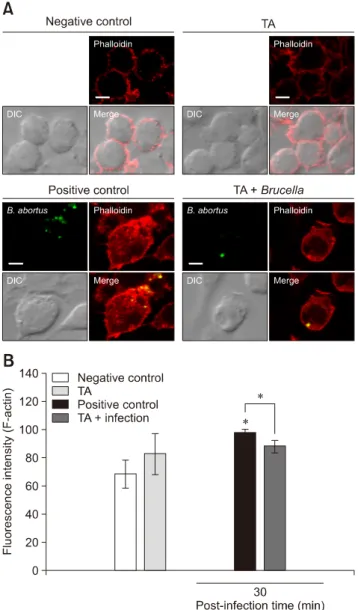
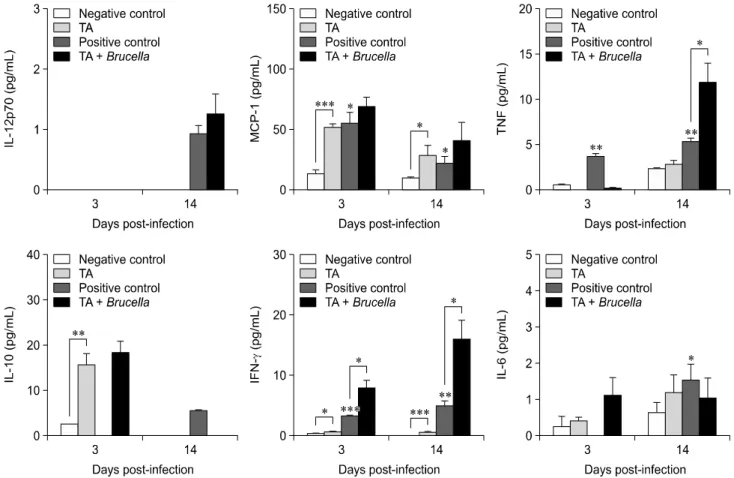
Brucellosis is an emerging infectious disease affecting humans and animals. In this study, we investigated the in vitro and in vivo effects of tannic acid (TA) against Brucella abortus infection. After infection, F-actin polymerization and mitogen-activated protein kinases (MAPKs) (ERK 1/2 and p38α) phosphorylation were reduced in TA-treated cells compared with that in control cells. The mice were infected via an intraperitoneal route and were orally given TA or phosphate-buffered saline for 14 days. Spleen weights of the TA-treated and control mice were not different; however, splenic proliferation of B. abortus was significantly reduced in the TA-treated group. Immune response analysis showed that, compared with the control group, non-infected TA-treated mice displayed increased levels of interferon-γ (IFN-γ), monocyte chemoattractant protein-1 (MCP-1), and interleukin-10 at 3 days post-infection and a further increase in IFN-γ and MCP-1 at 14 days post-infection. In contrast, compared with the control group, infected TA-treated mice displayed elevated levels of IFN-γ at 3 days post-infection, which continued to increase at 14 days post-infection, as was also observed for tumor necrosis factor. Taken together, the results showing TA activation of cytokine production and inhibition of bacterial proliferation in the host highlight a potential use of TA treatment in the control of Brucella infection.
Keywords: Brucella abortus, actins, cytokines, mitogen-activated protein kinase, tannins
Introduction
Brucellosis is a contagious disease affecting humans and domestic animals [22]. Due to its significant socioeconomic impact in terms of decreased animal productivity, including decreased milk production, abortion, and infertility, brucellosis is considered an important disease [17,26]. Brucella, the causative agent, binds to distinct phagocytic receptors resulting in zipper-like phagocytosis or phagocytosis through lipid raft microdomains. It is exposed to a harsh environment once inside a host cell but develops multiple strategies to evade the host’s immune response mechanisms, resulting in successful persistent infection and replication [1,20]. The mitogen-activated protein kinase (MAPK) cascade is important in the phagocytosis of bacteria via professional phagocytes and remodeling of the actin cytoskeleton [12].
Control programs for animal brucellosis are generally based on vaccination with live attenuated Brucella abortus S19 in
cattle and Brucella melitensis in sheep and goats; however, these vaccines may cause abortion, premature birth, and decreased milk yield, hence their use has been eliminated for use in cattle in Korea [7,26]. The use of antibiotics does not seem to have a significant role in brucellosis control programs, particularly in productive animals, due to economic, epidemiological, and public health factors [16]. Furthermore, treatment for brucellosis is complicated due to emerging treatment resistance that leads to high treatment failure or relapse rates [17]. Therefore, it is necessary to find alternative control options that are safe and effective in the treatment of brucellosis.
Tannins are natural products commonly found in almost
every plant part and are known for their antimicrobial properties
[24]. A specific type of tannin, namely tannic acid (TA), has
been reported to inhibit the growth of Aeromonas hydrophila,
Aeromonas sobria, Escherichia coli, Klebsiella pneumonia,
Listeria monocytogenes, Staphylococcus aureus, Salmonella