요 약
H.264/AVC는 화면 내, 화면 간 예측을 포함한 다양한 부호화 기술을 이용, 높은 부호화 성능을 보여준다. 그러 나 화면 내 예측은 화면 간 예측에 비해 여전히 많은 부호화 데이터를 포함하고 있다. 본 논문에서는 적응적 모드 선택 기술을 포함한 새로운 화면 내 부호화 기술을 제안한다. 인접 모드의 결합을 통한 새로운 부호화 모드와 단 순화된 gradient 모드가 추가되면서 세밀한 방향의 특징 및 gradation 영역을 효과적으로 부호화한다. 또한 주변블 록을 통해서 적절한 모드를 선택적으로 제공하면서 상대적으로 적은 복잡도와 높은 부호화 성능을 보여준다. 제안 한 방법은 1.72배의 복잡도 증가수준에서 1.96%의 비트율 절감 및 0.25 dB의 PSNR 향상을 보여주고 있다.
Key Words : adaptive mode selection, combined intra modes, simplified gradient modes, H.264/AVC, intra prediction
ABSTRACT
H.264/AVC has shown high coding efficiency by using various coding tools, including intra and inter prediction. However, there are still many more redundancy components in intra prediction than in inter prediction.
In this paper, a novel intra prediction method is proposed with adaptive mode selection. The combined intra prediction modes and simplified gradient modes are added in order to refine the directional feature and gradation region. Suitable modes are selected according to the neighboring blocks that provide a high compression rate and lower computational complexity. The improvement of the proposed method is 1.96% in terms of the bitrate, 0.25 dB in PSNR, and 1.72 times in terms of the computational complexity.
※ This research was supported by the MKE(The Ministry of Knowledge Economy), Korea, under the “ITRC(Information Technology Research Center)” support program (NIPA-2013-H0301-13-1008) supervised by the NIPA(National IT Industry Promotion Agency).
Also, it was supported by the National Research Foundation of Korea(NRF) grant funded by the Korea government(MEST)(No.
2011-0016302).
주저자:연세대학교 전기전자공학과 영상 및 비디오 패턴 인식 연구실, [email protected], 학생회원
° 교신저자:연세대학교 전기전자공학과 영상 및 비디오 패턴 인식 연구실, [email protected], 종신회원
* 연세대학교 전기전자공학과 영상 및 비디오 패턴 인식 연구실, [email protected], [email protected], [email protected] 논문번호:KICS2013-04-159, 접수일자:2013년 4월 2일, 최종논문접수일자:2013년 6월 3일
Ⅰ. Introduction
H.264/AVC is the latest video standard that has been developed by ITU-T and ISO/IEC[1]. It has shown greater coding efficiency than the existing video coding standards because it uses various coding tools including multiple reference frames,
variable block sizes, rate-distortion optimization (RDO), and so on[2,3]. There are two types of prediction, intra and inter prediction, which reduce the spatial and temporal redundancy, respectively[4]. Inter prediction uses multiple frames to de-correlate redundant components by using a motion compensation technique. Intra prediction reduces the
spatial redundancy by using the pixels from the already coded neighboring blocks[5]. Although intra prediction in H.264/AVC shows high coding efficiency, the compression ratio of intra prediction is lower than that of inter prediction[6].
Many studies have been done to improve the coding efficiency of intra prediction[6-13]. Tsukuba et al[7] selected one of five predictor sets consisting of nine prediction modes on each macroblock (MB).
Each prediction set is designed to do a better job of predicting local specific edges. Shiodera et al.[8]
suggested a change of the sub-block coding order in the MB and Bi-directional Intra Prediction (BIP), which is generated using a weighted combination of the prediction from the upper/left pixels and the prediction from the bottom/right pixels. Ye et al[9]
proposed enhanced intra prediction methods using nine BIP modes that are frequently used, directional transforms, and improved residual coefficient coding in CAVLC. Intra prediction with a spatial gradient and multiple reference lines is proposed[6]. Tian et al[10] used temporal-spatial prediction for intra coding. To perform the spatial prediction, it selects a block from the previous frame to obtain the reference data. Thiow Keng Tan et al[11] proposed a template matching method as a sample predictor using a region of reconstructed pixels. A recursive prediction and an enhanced block-matching algorithm are proposed[12]. Kwang Su Jung et al[13]
proposed a new 4x4 intra coding method by unidirectional prediction for improvement.
Although the previous studies have been dedicated to the improvement of intra coding efficiency, they cause very high computational complexity because of the exhaustive search range or because of the many intra mode decisions. In this paper, a novel intra prediction method is proposed which improves the coding efficiency with only a small increase in the computational complexity. The proposed algorithm provides prediction modes that are suitable for refining the direction or the region of gradation.
Moreover, the highly probable modes are decided according to the prediction modes of neighboring blocks using the adaptive mode selection method.
This paper is organized as follows. In Section Ⅱ,
the proposed method is described in detail. The simulation results are shown in Section Ⅲ. Finally, Section Ⅳ concludes this paper.
Ⅱ. Proposed Algorithm
2.1. Overall Algorithm
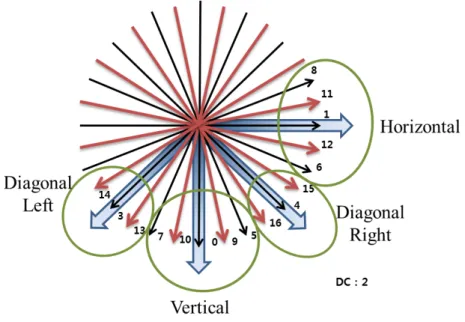
The coding loss in gradation or refine region is mainly from the lack of intra prediction modes which is only 8 directional modes and DC mode in H.264/AVC. In this paper, various intra prediction modes which are suitable for gradation or refine region are proposed and adaptively selected according to neighboring blocks. Fig. 1 represents the flowchart of the encoding of one macroblock based on the proposed algorithm. The eight combined modes and the sixteen simplified gradient modes which will be described in Section Ⅱ-2 are added to the 9 conventional prediction modes in Intra4x4 and Intra8x8 as shown in Fig. 2. The best modes of the neighboring blocks are classified according to 5 directional groups which will be described in Section Ⅱ-3. According to each group, the 17 candidate modes are adaptively selected. All of the candidate modes are tested to find the best intra mode using the Rate Distortion optimization process. To make bitstream decodable, the encoding method of the intra mode also changed. It will be described in Section Ⅱ-4.
2.2. Additional Intra Prediction Modes
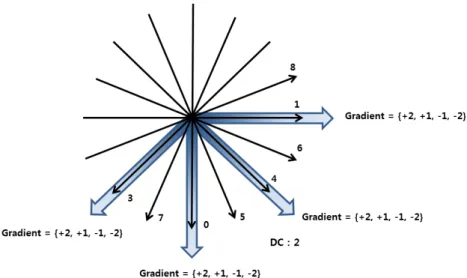
In intra prediction, Intra4x4 and Intra8x8 provide 8 directional modes and one DC mode as shown in Fig. 3. In addition to the conventional intra modes, additional prediction modes that are well-suited for the refined direction and the part of the gradation region are proposed. First, the combined modes are proposed in order to consider a more detailed directional feature between two adjacent modes. As shown in Fig. 4, eight modes are introduced using the following equation:
≫ (1)
where represents the predicted
Fig. 1. Overall encoding procedure of the proposed algorithm.
pixel values of the combined mode, and
and are the predicted pixel values of the two adjacent directional modes in H.264/AVC. The variables and range from 0 to 3 in Intra4x4, and from 0 to 7 in Intra8x8. The eight modes described following represent the combined modes according to each of the two adjacent modes.
Mode 9: vertical (0) + vertical right (5) Mode 10: vertical (0) + vertical left (7) Mode 11: horizontal (1) + horizontal up (8) Mode 12: horizontal (1) + horizontal down (6) Mode 13: diagonal down left (3) + vertical left (7) Mode 14: diagonal down left (3) + horizontal up (8) Mode 15: diagonal down right (4) + horizontal
Fig. 2. The proposed intra prediction modes.
Fig. 4. The directions of the combined modes.
Fig. 3. The directions of intra prediction modes.
down (6)
Mode 16: diagonal down right (4) + vertical right (5)
Second, the gradient modes are added for the gradation region. In general, the gradient mode has increasing or decreasing prediction values according to the distance from the reference pixel[6]. In the proposed scheme, the simplified gradient modes are introduced, which use only sixteen gradient modes.
Two increasing and decreasing gradient predictions are provided according to each direction of the
horizontal, vertical, diagonal down right, and diagonal down left modes. The simplified gradient mode prevents high encoding complexity and reduces the number of overhead bits for intra mode coding. Fig. 5 shows the sixteen gradient modes with conventional H.264/AVC intra modes.
The gradient modes can be obtained as follows:
× (2)
where is the gradient coefficient that can be selected from {+2, +1, -1, -2}, is the distance of the predicted pixel from the reference pixel, and represents the reference pixel values. Each of the gradient modes is defined as follows.
Mode 17: +1 gradient to vertical (0)
Fig. 5. The simplified gradient modes.
Fig. 6. The flowchart of Adaptive Mode Selection Mode 18: -1 gradient to vertical (0)
Mode 19: +1 gradient to horizontal (1) Mode 20: -1 gradient to horizontal (1)
Mode 21: +1 gradient to diagonal down left (3) Mode 22: -1 gradient to diagonal down left (3) Mode 23: +1 gradient to diagonal down right (4) Mode 24: -1 gradient to diagonal down right (4) Mode 25: +2 gradient to vertical (0)
Mode 26: -2 gradient to vertical (0) Mode 27: +2 gradient to horizontal (1) Mode 28: -2 gradient to horizontal (1)
Mode 29: +2 gradient to diagonal down left (3) Mode 30: -2 gradient to diagonal down left (3) Mode 31: +2 gradient to diagonal down right (4)
Mode 32: -2 gradient to diagonal down right (4) From the above additional prediction methods, a total of 24 additional modes are added to the 9 conventional prediction modes. This is applied to both Intra4x4 and Intra8x8 prediction.
2.3. Adaptive Mode Selection of Prediction Modes
Intra prediction uses the spatial correlation of neighboring blocks because it is highly correlated to the best mode of the current block. For example, the MPM (Most Probable Mode), which is frequently selected as the best mode, is decided from the neighboring blocks. The reference pixels that are
Fig. 7. The four groups of prediction modes according to the main direction.
Fig. 8. The current block with neighboring blocks.
used for the intra mode prediction are provided by the reconstructed neighboring blocks. Moreover, the best mode of the current block can be estimated according to the best mode of the neighboring blocks when a certain object with a directional feature or a region of edges is placed around some blocks, including the current block. To address this advantage, adaptive selection of the searching modes using the best mode of the neighboring blocks is proposed. The flowchart of adaptive mode selection algorithm is shown in Fig. 6.
As shown in Fig. 7, 32 directional modes are divided into 4 sets according to the main direction.
Each of the four groups is described as follows:
Horizontal group
= {modes 8, 11, 1, 12, 6, 19, 20, 27, and 28}
Diagonal Right group
= {modes 15, 4, 16, 23, 24, 31, and 32}
Vertical group
= {modes 5, 9, 0, 10, 7, 17, 18, 25, and 26}
Diagonal Left group
= {modes 13, 3, 14 21, 22, 29, and 30}
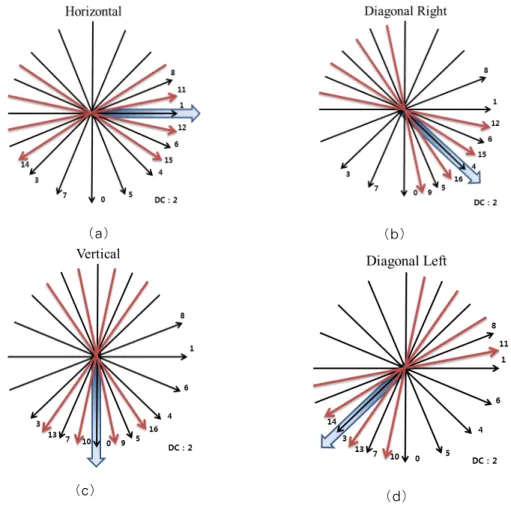
The candidate intra prediction modes are selected according to the best modes of blocks A and B shown in Fig. 8. If blocks A and B are encoded with the prediction modes of the same group, such as the Horizontal group, the candidate modes of the current block are selected as the 9 conventional
prediction modes and additional modes with corresponding directions, such as the horizontal direction in this case.
Fig. 9(a) shows the candidate modes when both blocks A and B are encoded with the mode of the Horizontal group. In this manner, if both blocks A and B are predicted to be the same group such as Diagonal Right, Vertical, or Diagonal Left, the current block uses 17 prediction modes with the proper additional modes of the corresponding directions as shown in Fig. 9. On the other hand, if blocks A and B are encoded with the modes of different groups, the candidate modes are decided as depicted in Fig. 4. By using the adaptive mode selection method, the number of candidate modes is always decided to be 17 modes. The candidate mode list (CML) is obtained as follows:
∈ ∈
∈∈
∈∈
∈ ∈
≠
(b)
(c) (d) (a)
(3)
(3) where is the conventional 9 intra prediction modes, , and are combined modes, gradient modes and group of corresponding direction, respectively. and are intra prediction modes of neighboring block.
As the equation (3), the candidate mode sets according to each cases are listed as follows:
Case I. Both blocks A and B are encoded with modes in the Horizontal group.
= {14, 3, 7, 0, 5, 4, 15, 6, 12, 20, 28, 1, 19, 27, 11, 8, 2}
Case II. Both blocks A and B are encoded with modes in the Diagonal Right group.
= {3, 7, 0, 9, 5, 16, 24, 32, 4, 23, 31, 15, 6, 12, 1, 8, 2}
Case III. Both blocks A and B are encoded with modes in the Vertical group.= {3, 13, 7, 10, 18, 26, 0, 17, 25, 9, 5, 16, 4, 6, 1, 8, 2}
Case IV. Both blocks A and B are encoded with modes in the Diagonal Left group.
= {14, 22, 30, 3, 21, 29, 13, 7, 10, 0, 5, 4, 6, 1, 11, 8, 2}
Case V. Blocks A and B are encoded with modes in different groups.
Fig. 9. The candidate prediction modes when neighboring blocks are coded with modes in (a) Horizontal group, (b) Diagonal Right group, (c) Vertical group, and (d) Diagonal Left group.
Parameters Conditions Profile
Entropy coding QPs RD optimization
Sequence Type Total Frames
High Profile CABAC 7, 12, 17, 22 High Complexity Mode
I I I…
100 Table 1. Simulation conditions
= {14, 3, 13, 7, 10, 0, 9, 5, 16, 4, 15, 6, 12, 1, 11, 8, 2}
In terms of intra mode coding, either one or four bits are used in H.264/AVC depending on whether or not the predicted mode is MPM. When the best mode that is determined from the rate distortion process is MPM, one bit is signaled. If it is not MPM, one bit is non-signaled, and the additional 3 bits are used to indicate one of the 8 remaining modes. Therefore, it uses a maximum of 4 bits in conventional mode coding. In the proposed algorithm, it needs some changes because of the 17 extended candidate modes. To make the bit stream decodable, it changes one bit for MPM or five bits for non-MPM in order to distinguish the intra prediction modes in the decoder.
2.4. The decision of MPM
In H.264/AVC, the MPM is set to be the minimum mode of blocks A and B. In the proposed scheme, the same MPM decision method as in H.264/AVC cannot guarantee a decodable bit stream, because each of the blocks uses different candidate modes according to the neighboring blocks. Therefore, the MPM for which the number is bigger than that of mode 16 is set into the corresponding main directional mode. The proposed decision method of MPM is described as follows:
Case I. min(A, B) <= 16
Set MPM = min(A, B).
Case II. min(A, B) = {22, 30, 21, 29}
Set MPM as mode 3.
Case III, min(A, B) = {18, 26, 17, 25}
Set MPM as mode 0.
Case IV, min(A, B) = {24, 32, 23, 31}
Set MPM as mode 4.
Case V, min(A, B) = {20, 28, 19, 27}
Set MPM as mode 1.
Ⅲ. Experimental Results
The simulation is performed using JM11.0 reference software. The various resolutions of video sequences such as the QCIF, CIF, and HEVC test sequences, which are Class A (4K), Class B
(1080p), Class C (WVGA), Class D (WQVGA), and Class E (720p), are used. CABAC is used for entropy coding, and four different QPs are tested.
The detailed simulation conditions are described in Table 1. A 3.20GHz processor with 6GB RAM is used for the simulation.
The results are presented according to the Bjontegaard Delta Bit Rate (BDBR) and Bjontegaard Delta PSNR (BDPSNR)[14]. The (+) sign in BDPSNR indicates the gain, and the (-) sign in BDBR indicates the bitrate reduction. The computational complexity, which is defined as
∆, can be represented by:
∆
. (4)
Table 2 shows the simulation results of the proposed algorithm and the proposed algorithm without adaptive mode selection. The proposed algorithm without adaptive mode selection shows 0.29 dB gain in BDPSNR and 2.28% reduction in BDBR while the encoding complexity is increased about 2.56 times on average. The proposed algorithm shows 0.25 dB in BDPSNR and 1.96%
BDBR reduction. It is especially noteworthy that approximately 0.35 dB gain and -2.59 % bitrate are achieved for the tempete sequence. But the average encoding time is 1.72 times which is faster than the proposed algorithm without adaptive mode selection.
It is because the number of searching mode in intra prediction is different. The proposed algorithm always provides 17 modes while the proposed algorithm without adaptive mode selection provides 33 modes. Table 3 presents the average simulation results of the proposed algorithm as compared with
CIF paris 0.24 -1.81 1.72 0.29 -2.14 2.31
tempete 0.35 -2.59 1.72 0.41 -3.05 2.26
Class A (4K)
Traffic 0.22 -2.30 1.73 0.26 -2.60 2.53
PeopleOnStreet 0.27 -2.56 1.73 0.31 -2.92 2.56
NebutaFestival 0.52 -0.58 1.68 0.56 -0.51 2.96
StreamLocomotiveTrain 0.45 -0.82 1.68 0.47 -0.83 2.96
Class B (1080p)
Kimono 0.19 -2.87 1.74 0.25 -3.69 1.93
ParkScene 0.21 -1.94 1.73 0.24 -2.19 2.33
Cactus 0.22 -1.91 1.73 0.24 -2.09 2.02
BasketballDrive 0.12 -1.32 1.70 0.15 -1.59 2.46
BQTerrace 0.16 -1.39 1.60 0.20 -1.73 2.81
Class C (WVGA)
BasketballDrill 0.23 -2.02 1.72 0.26 -2.26 3.19
BQMall 0.23 -2.04 1.72 0.25 -2.27 3.26
PartyScene 0.26 -1.59 1.72 0.32 -1.89 3.22
RaceHorsesC 0.26 -2.27 1.72 0.31 -2.76 3.19
Class D (WQVGA)
BasketballPass 0.21 -1.99 1.72 0.24 -2.21 2.98
BQSquare 0.19 -1.34 1.73 0.21 -1.47 3.06
BlowingBubbles 0.30 -2.25 1.71 0.35 -2.74 3.01
RaceHorses 0.28 -2.28 1.71 0.37 -2.97 3.02
Class E (720p)
Vidyo1 0.19 -2.69 1.81 0.21 -2.92 1.89
Vidyo3 0.15 -2.09 1.74 0.16 -2.06 2.02
Vidyo4 0.18 -2.37 1.73 0.20 -2.57 2.11
Average 0.25 -1.96 1.72 0.29 -2.28 2.56
[6] and [7] using the QCIF and CIF sequences. The proposed algorithm without adaptive mode selection shows higher coding gain than Ref. [7]. Compared with Ref. [6], it shows 0.1% more BDBR reduction with 2.16 times in encoding complexity. In the proposed algorithm, it results in 0.08 dB more gain in terms of BDPSNR compared with [7]. In terms of the encoding complexity, the proposed algorithm shows 1.72 times, while the corresponding complexity of [7] is 5.0 times. In [6], the average gains are 0.35 dB in BDPSNR and a 2.40% BDBR reduction, respectively. However, [6] requires a lot
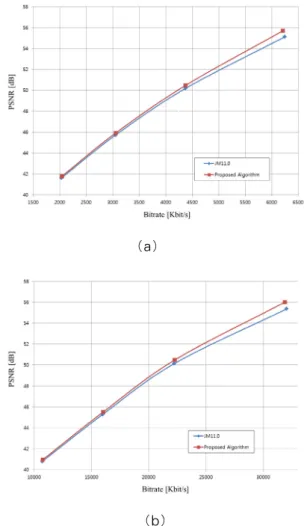
of encoding complexity of about 36.56 times because of its exhaustive mode searching. It is because the proposed algorithm always provides 17 intra prediction modes using adaptive mode selection which efficiently control the complexity of encoding. The rate distortion curves for the two sequences are shown in Fig. 10. The rate distortion curves show that the proposed method outperforms H.264/AVC.
(a)
(b)
Fig. 10. The RD curves comparing JM11.0 with proposed algorithm (a) foreman (QCIF) and (b) BlowingBubbles (WQVGA).
BDPSNR [dB]
BDBR [%]
△Time [times]
Proposed
Algorithm 0.28 -2.05 1.72
Proposed Algorithm without
Adaptive Mode Selection
0.34 -2.50 2.16
Ref. [7] 0.20 -2.35 5.00
Ref. [6]
MRL with gradient (delta=3)
0.35 -2.40 36.56
Table 3 The Average Performances and Computational Complexity compared with [7] and [6] in QCIF/CIF
Ⅳ. Conclusion
In this paper, a novel intra prediction with adaptive mode selection method is proposed in order to improve the coding efficiency. To consider the refined directional feature and gradation region, combined prediction modes and simplified gradient modes are introduced. Moreover, it efficiently prevents high computational complexity by using an adaptive mode selection method. The simulation results demonstrate that the proposed method improves the coding gain in terms of both the BDBR and BDPSNR with about 1.72 times computational complexity compared to H.264/AVC.
In addition, the proposed method has high compatibility with the existing prediction algorithm.
It can be adaptively extended to other intra prediction schemes. In future research, it will be applied to the intra prediction of High Efficiency Video Coding (HEVC). As HEVC standards have developed for high video quality and a data compression ratio compared to H.264/AVC, it is expected that this research can provide further coding performance improvements.
References
[1] ISO/IEC 14496-10. Information technology coding of audio-visual objects-Part 10:
advanced video coding. Dec. 2003.
[2] T. Wiegand, G. J. Sullivan, G. Bjonte, and A.
Luthra, “Overview of the H.264/AVC video coding standard,” IEEE Trans. Circuits Syst.
Video Technol., vol. 13, no. 7, pp. 560–576, July 2003.
[3] Parlak, M., Adibelli, Y., Hamzaoglu, I., “A novel computational complexity and power reduction technique for H.264 intra prediction,” Consumer Electronics, IEEE Transactions on, vol. 54, no. 4, pp.
2006-2014, Nov. 2008.
[4] Saha, A., Kallol Mallick, Mukherjee, J., Shamik Sural, “SKIP prediction for fast rate
[6] Matsuo, S., Takamura, S., Yashima, Y., “Intra prediction with spatial gradients and multiple reference lines,” in Proc. Picture Coding Symp. 2009, pp. 1-4, Chicago, U.S.A., May 2009.
[7] T. Takeshi, T. Yamamoto, Y. Tokumo, and T.
Aono, “Adaptive multidirectional intra prediction,” ITU-T SG16/Q.6 VCEG, VCEG-AG05, Shenzhen, China, Oct. 2007.
[8] T. Shiodera, A. Tanizawa, and T. Chujoh,
“Block based extra/inter-polating prediction for intra coding,” in Proc. IEEE Int. Conf.
Image Process. (ICIP) 2007, vol. 6, pp.
VI-445-VI-448, Sep. 2007.
[9] Y. Ye and M. Karczewicz, “Improved h.264 intra coding based on bi-directional intra prediction, directional transform, and adaptive coefficient scanning,” in Proc. IEEE Int. Conf.
Image Process. (ICIP) 2008, pp. 2116-2119, San Diego, U.S.A., Oct. 2008.
[10] T. Song, T. Shimamoto, T. Bando, and W.
Zhao, “Novel intra modes with temporal-spatial prediction for H.264/AVC,”
in Proc. IEEE Int. Conf. Consumer Electronics-Berlin (ICCE-Berlin) 2011, pp.
62-65, Berlin, Germany, Sep. 2011.
[11] T. K. Tan, C. S. Boon, and Y. Suzuki, “Intra prediction by template matching,” in Proc.
IEEE Int. Conf. Image Process. (ICIP) 2006, pp. 1693-1696, Atlanta, U.S.A., Oct. 2006.
[12] L. Song, Y. Xu, C. Xiong, and L. Traversoni,
“Improved intra-coding methods for H.264/AVC,” EURASIP J. Adv. Signal Process., vol. 2009, no. 328958, pp. 1-9, Feb.
2009.
[13] K. S. Jung, S. N. Park, D. G. Sim, Y. J. Lee,
임 경 민 (Kyungmin Lim)
2004년 3월 연세대학교 전기 전자공학과 학사
2008년 3월~현재 연세대학교 전자공학과 통합과정
<관심분야> Image Processing, H.264/AVC, HEVC
이 재 호 (Jaeho Lee)
2003년 3월 연세대학교 전기 전자공학과 학사
2007년 9월~현재 연세대학교 전자공학과 통합과정
<관심분야> H.264/AVC, HEVC, Pattern Recognition
김 성 완 (Seongwan Kim)
2003년 3월 연세대학교 전기전 자공학과 학사
2007년 3월~현재 연세대학교 전자공학과 통합과정
<관심분야> Video Coding, Image Enhancement, Face Detection
박 대 현 (Daehyun Pak)
2005년 3월 연세대학교 전기 전자공학과 학사
2009년 3월~현재 연세대학교 전자공학과 통합과정
<관심분야> H.264/AVC, HEVC, Mobile IPTV system
이 상 윤 (Sangyoun Lee)
1987년 2월 연세대학교 전자 공학과 학사
1989년 2월 연세대학교 전자 공학과 석사
1999년 2월 Georgia Tech. 전 기 및 컴퓨터공학과 박사 1989년~2004년 KT선임연구원 2004년~현재 연세대학교 전기전자공학부 부교수
<관심분야> 생체인식, 컴퓨터비전, 영상부호화