한국컴퓨터정보학회 하계학술대회 논문집 제20권 제2호 (2012. 7)
87
인트라 예측의 Semi-Diagonal을 EHD 에지 정보로 맵핑하는 방법
권용광○
○산안산대학교 컴퓨터정보과
e-mail:[email protected]○
A Method for Mapping Semi-Diagonal of Intra Prediction to Edge Information of MPEG-7 EHD
Yong-Kwang Kwon○
○Dept. of Computer Information, SinAnsan University
● Abstract ●
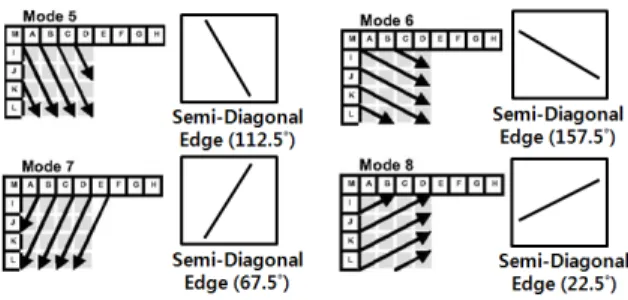
Because intra prediction modes in H.264 are determined by the brightness continuity between neighboring blocks, they can be used as a method for extracting edge information in the compression domain. However, if we just consider 9 intra prediction modes in H.264 as 9 different edge directions, we have the following two problems. First, intra prediction modes tend to yield too many edge blocks, generating unnecessary edge information. Second, we may not need all 9 directional edges (including the DC type) in H.264 intra prediction modes. For example, the EHD (edge histogram descriptor) in MPEG-7 defines only 4 directional edge types, namely horizontal, vertical, diagonal (HVD) edges with 0˚, 90˚, 45˚, and 135˚. Here, semi-diagonal (SD) edge types with 112.5˚, 157.5˚, 22.5˚, and 67.5˚ in the intra prediction modes in H.264 are not used. In this paper. we prepose a method that removes unnecessary edges from the intra prediction modes by utilizing the total average coefficient of 4x4 blocks in each slice and assign SD edges to HVD (horizontal, vertical, diagonal, 0˚, 90˚, 45˚, 135˚) edges by the contextual information of the neighboring blocks.
Experimental results show that the edges determined by the proposed method in the compression domain are comparable to those of the previous edge detection methods in the spatial domain.
Keywords: H.264, EHD
I. Introduction
Edges are considered as important features for image analysis and retrieval[2]. It is necessary to extract edge features from the image and video to form the EHD of MPEG-7. In the EHD, the non-normative edge extraction was done in the spatial domain. Thus, we need to devise an algorithm to extract edge information in the compressed bit-stream with minimal partial decoding. In an image encoded by previous MPEG-1/2 method, DCT coefficients were sufficient to extract the edge type from the compressed bit stream[2][3]. But the same technique can not be applied in H.264 bit stream. because H.264 adopt new techniques such as 4x4 block DCT after intra prediction[1]. Thus, further studies on extracting the characteristic from the compressed domain of H.264 are needed.
II. Previous Work
EHD determine the edge type in image blocks by an 2-D filter. Figure 1(b) shows EHD edges extracted by the filter in the saptial domain.
In the compression domain of MPEG-1/2, an edge can be converted into DCT domain in block unit according to the pixel value in spatial domain. The algorithm in compressed domain, which will be compared with intra prediction mode, is the method to extract edge by using DCT coefficient in MEPG(Figure 1(c).
(a) Original (b) EHD (c) DCT Fig. 1. Previous Algorithm
한국컴퓨터정보학회 하계학술대회 논문집 제20권 제2호 (2012. 7)
88
Figure 2 shows the directions in block matching to intra mode we concerned. 9 directional modes of H.264 intra prediction are tested for the best matching and the one with the smallest mode is chosen for the prediction mode.
FIg. 2. matching of edge direction by 4x4 intra prediction mode
III. Proposed Method
In this paper, among 9 edges extracted by intra prediction mode, SD (Semi-Diagonal, 112.5˚, 157.5˚, 67.5˚, 22.5˚) edges are classified to one of HVD (Horizontal, Vertical, Diagonal) edges, yielding total of 5 edges. Here, we make use of the contextual information of the neighboring block to assign SD to one of HVD. Now, the final 5 edges correspond to those of the EHD in MPEG-7 visual descriptor. Specifically, as shown in Figure 3(a), each of the SD edge have 4 neighboring reference blocks. That is, depending on the edge direction of the SD of the current block, we seek a possible edge continuity by considering edge types of the 4 neighboring blocks. Each one of the 4 neighboring blocks are tested whether its edge type matches one of two possible edge continuities.
Figure 3(b) shows edge comparisons using proposed method. Subjective evaluation should be followed about the proper elimination of block though the ratio of edge block was reduced by threshold.
(a) mapping method (b) result Fig. 3. SD edge mapping reference block and Result
IV. Conclusion
In this paper, SD edge was mapped to HVD edge by using the contextual information of the surrounding edges and this shows 80% of accuracy matching. When edge by intra prediction mode was expressed in a drawing, it showed low quality due to excessive edge preventing from recognizing original image. But with the proposed algorithm the distinction to the original image was possible and also showed similar performance comparing with EHD or DCT based edge.
Reference
[1] ISO/IEC 14496-10 / ITU-T Recom. H.264 AVC for Generic audio-vidual service. Mar. 2005
[2] M. Lee, “Role of Edge Detection in Video Semantics,”
ACM cinf. Proc., vol 161, pp 59-68, 2003
[3] H. Li, G. Liu, “An effective approach to edge classification from DCT domain,” IEEE ICIP, vol 1, pp940-943, 2002