• 검색 결과가 없습니다.

Development of Inverted Organic Photovoltaics with Anion doped ZnO as an Electron Transporting Layer

N/A
N/A
Protected

Academic year: 2021

Share "Development of Inverted Organic Photovoltaics with Anion doped ZnO as an Electron Transporting Layer"

Copied!
8
0
0

로드 중.... (전체 텍스트 보기)

전체 글

(1)

한국표면공학회지 J. Korean Inst. Surf. Eng.

Vol. 49, No. 6, 2016.

https://doi.org/10.5695/JKISE.2016.49.6.490

<연구논문>

ISSN 1225-8024(Print) ISSN 2288-8403(Online)

Development of Inverted Organic Photovoltaics with Anion doped ZnO as an Electron Transporting Layer

Jae Hoon Jeong

a,b

, Kihyon Hong

a

, Se-Hun Kwon

b,*

, Dong Chan Lim

a,*

a

Electrochemical Department, Surface Technology Division, Korea Institute of Materials Science (KIMS), Changwon Changwondaero 797, 51508, Korea

b

School of Materials Science and Engineering, Pusan National University, Busan 46241, Korea

(Received November 10, 2016 ; revised November 24, 2016 ; accepted November 25, 2016)

Abstract

In this study, 3-dimensional ripple structured anion (chlorine) doped ZnO thin film are developed, and used as electron transporting layer (ETL) in inverted organic photovoltaics (I-OPVs). Optical and electrical characteristics of ZnO:Cl ETL are investigated depending on the chlorine doping ratio and optimized for high efficient I-OPV. It is found that optimized chlorine doping on ZnO ETL enhances the ability of charge transport by modifying the band edge position and carrier mobility without decreasing the optical transmittance in the visible region, results in improvement of power conversion efficiency of I-OPV. The highest performance of 8.79 % is achieved for I-OPV with ZnO:Cl-x (x=0.5wt%), enhanced ~10% compared to that of ZnO:Cl- x (x=0wt%).

Keywords : Chlorine, ZnO ripple, Organic photovoltaics, Electron transporting layer, Doping, Sol-gel

1. Introduction

Using of solar light as unlimited energy resource has been attracted increasing interest, especially, solar cells that convert solar energy into electrical energy [1]. The inverted organic photovoltaics (I-OPVs) are using organic polymer materials as photoactive layer, which are cost-effective, portable, and applicable to the flexible substrates [2-8]. Generally, in I-OPVs, n- type materials such as zinc oxide (ZnO) [9,30,31], titanium dioxide (TiO

2

) [10,30], and cesium carbonate (Cs

2

CO

3

) [11,12] have been widely used as hole blocking layer (HBL) [1,13] and electron transpor- ting layer (ETL) [4,9-14]. Among them, ZnO is an

intrinsic n-type semiconductor, which has high optical transparency, wide band gap energy (3.2 eV), large exciton binding energy (60 meV), high electron mobility, and conductivity. And it has been widely used as optoelectronic device, chemical sensor, and photovoltaic application. For improving the conductivity and mobility of ZnO thin film, n-type doping process with group III metallic cation elements such as Al [15,17,20,24], Ga [16,20], and In [17,20] is widely used and that substitute the zinc atoms in ZnO lattice [20,24]. Furthermore, it is also well known that group VII non-metallic anion elements doping such as F [18,29], Cl [19-29], Br [29], and I [29] can also improve the conductivity and mobility. These anion elements can substitute the oxygen atoms in ZnO lattice [20,24,28]. Generally, the oxygen atoms as vacancies can act as an electron-hole recombination sites in I-OPVs [10,30,31], and results in decrease the performance of I-OPV. Among the various methods to reducing the recombination sites of ZnO ETL, anion doping can be one of the ideal concepts, because the atonic radius of group VII anion is almost similar to the oxygen atom as well as their

* Corresponding Author : Se-Hun Kwon

School of Materials Science and Engineering, Pusan National University

Tel : +82-51-510-3775 ; Fax: +82-51-510-3360 E-mail : [email protected]

**Corresponding Author : Dong Chan Lim

Electrochemical Department, Surface Technology Division, Korea Institute of Materials Science (KIMS)

Tel : +82-55-280-3511 ; Fax: +82-55-280-3570

E-mail : [email protected]

(2)

excess electrons can help to achieving the high mobility [23,26] and conductivity [21,24,26] while maintaining high optical transparency [20,21,23,27], compared to group III cation metallic elements.

Above all, anion element doping into ZnO ETL has been conducted by various deposition techniques such as electrochemical deposition [19,21,22,24,25], atomic layer deposition [26], radio frequency- magnetron sputtering [29], metalorganic chemical vapor deposition (MOCVD) [20,28], and pulsed laser deposition [23,27]. However, these previously used deposition techniques need complicated fabrication process, vacuum system, high price, and difficult to install. Compared to, the fabrication of ZnO thin film using sol-gel method has several advantages. It is cost-effective non-vacuum process, and stable in room temperature. Moreover, it is more easy to control the doping concentration, and solution volume. In this work, chlorine doped ZnO ETL are fabricated using sol-gel method with various chlorine doping ratio. Especially, chlorine-doped ZnO ETL thin film has 3-dimensional ripple structure and firstly applied in inverted organic photovoltaics as an ETL. The ripple structured chlorine-doped ZnO ETL has several advantages: high optical transparency in visible region without affecting the change of nano- morphology of active layer, high electrical conductivity as well as these properties can be adjusted by changing the chlorine doping ratio. We systematically demonstrate the role of chlorine-doped ZnO ETL on the performance of I-OPVs depending on the chlorine doping ratio.

2. Experimental

2.1 Fabrication for Chlorine-doped zinc sol-gel Zinc sol-gel solution of 0.5 M was prepared using zinc acetate dihydrate (1.09 g, JUNSEI), 2- methoxyethanol (10 ml, Sigma Aldrich), and ethanolamine (500 μl, Sigma Aldrich) as stabilizer.

Zinc acetate was dissolved in 2-methoxyethanol solvent containing ethanolamine. It was stirred at 60

o

C for 2 hours on hot plate. And, ammonium chloride (SAMCHUN) was dissolved in 0.5 M zinc solution and stirred at 60

o

C for 1 hour. Finally, chlorine-doped zinc sol-gel solution was filtered using 0.20 μm PTFE filter.

2.2 OPV device fabrication

Patterned indium tin oxide (ITO) glasses (AMG tech, 4.5 Ω/sq, and 25 mm × 25 mm) were cleaned

by using isopropyl alcohol and acetone for 20 minutes each steps. And the substrates were dried in oven (100

o

C) for 30 minutes. 0.5 M zinc sol-gel solution (pristine, chlorine-doped zinc sol-gel (0.25 wt%, 0.5 wt%, 1.0 wt%, and 2.0 wt%)) was spin-coated on ITO-coated substrates that had been pre-treated with UV-Ozone clean for 60 minutes. After coating, the substrates were dried in room-temperature to 180

o

C on a hot plate. The prepared doped ZnO electron transporting layer (ETL) in this work are denoted as ZnO:Cl-x (x = 0.25, 0.5, 1.0, 2.0) depending on the doping concentration.

To prepare the active layer, PTB7 and PC

70

BM used as donor and acceptor were mixed with a weight ratio of 1 : 1.5 in chlorobenzene/1,8-diiodooctane (CB/

DIO; 970 μl : 30 μl, Sigma Aldrich). This solution was stirred at 60

o

C for 24 hours. Continually, the active layer was coated on ZnO ETL by spin-coating method at 1000 rpm for 40 seconds in Argon atmosphere glove box. After drying for 30 minutes in glove box, PEDOT:PSS (Clevios PVP AI4083, Heraeus) as hole transporting layer was diluted in isopropyl alcohol (1 : 10 v/v ratio). Diluted PEDOT : PSS was spin-coated onto the active layer at 5000 rpm for 40 seconds and dried in glove box for 30 minutes. Finally, the Ag electrode (100 nm) was thermally evaporated on the top of the device under 3 × 10

-6

Torr. The active area of the device with the shadow metal mask was 0.38 cm

2

. The device architecture of inverted organic photovoltaic (I-OPV) was illustrated in Fig. 1(d).

2.3 Device characterization

The current density-voltage (J-V) curves were measured using a Keithley source and solar simulator (MODUSYS, PS-KS2C). The inverted organic photo- voltaics (I-OPVs) were measured under AM 1.5G condition simulated with 100 mW/cm

2

intensity. The photoluminescence (PL) spectra were obtained using a Raman/PL spectrometer (LabRam-HR, Horiba Jobin Yvon SAS) excited by 325 nm He-Cd laser for PL.

The optical transmittance spectra were obtained with an

ultraviolet-visible (UV) spectrometer (Varian Australia

Pty., LTD, Cary 5000). The hall mobility of ZnO ETL

and chlorine doped ZnO ETL was obtained from Hall

Effect measure system (MODUSYS). The work

function of ZnO ETL and chlorine-doped ZnO ETL

were obtained from using ultraviolet photo-

electron spectroscopy (Thermo Scientific, Multilab-

2000) with monochromatic He I (hυ = 21.22 eV) for

UPS.

(3)

3. Results and Discussion

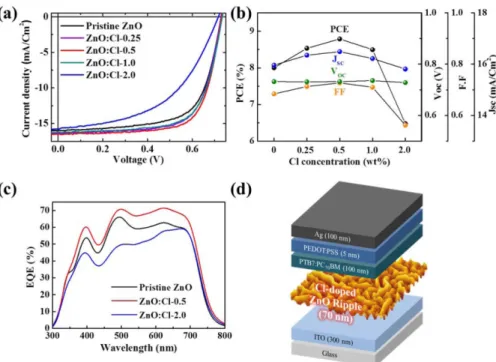
The J-V characteristics of the inverted organic photovoltaics (I-OPVs) including pristine and anion (chlorine) doped ZnO electron transporting layer (ETL) are shown in Fig. 1(a) depending on the doping concentration of chlorine. Device descriptions for all configurations are summarized in Table 1.

OPV with pristine ZnO ETL shows the power conversion efficiency (PCE) of 8.002% based on fill factor (FF) of 0.684, an open circuit voltage (V

oc

) of 0.732 V and a short circuit current density (J

sc

) of 15.960 mA/cm

2

. The power conversion efficiencies of I-OPVs with ZnO : Cl-x (x = 0.25, and 0.5) are improved more than ~5% and ~10%, respectively, with respect to the pure ZnO ETL. The improvements are originated from the increasing FF and Jsc values (Fig. 1(b)). Regarding the FF and Jsc, I-OPVs with ZnO:Cl-1.0 ETL resulted in a slightly decrease values of about ~0.5% with respect to the ZnO:Cl-

0.5 ETL which shows the highest device performance.

However, as shown in Fig. 1 and Table 1, with increasing the chlorine doping concentration to 2.0 wt%, the device performance, PCE, FF, and Jsc dramatically decrease up to 14%, 13%, and 10%, respectively. It is worth mentioning that the Voc is almost identical for all devices which means the prepared bulk hetero-junction photoactive layer are very stable and the used ZnO ETL in this work do not affect the field effect of the device. The variation of device performance depending on the doping concentration can be expected due to the change of morphology, transmittance and electrical property of ZnO ETL. However, geometrical effect of ZnO ETL for the deviation of solar cell performance can be excluded. The prepared pristine- and doped- ZnO ETL in Fig. 2(b) show 3-dimensional structure of around 70 nm in thickness, and furthermore peak to peak height and density do not be changed by anion doping. Figure 1(c) shows the external quantum Fig. 1. (a) J-V curves, (b) characteristics, and (c) external quantum efficiencies of I-OPVs with ZnO and ZnO:Cl ETLs.

(d) Schematic of an inverted organic photovoltaic structure.

Table 1. The device characteristics of chlorine doped ZnO ETL based IOPVs with different concentrations.

Concentration PCE (%) FF V

oc

(V) J

sc

(mA/Cm

2

)

Pristine ZnO 8.002 0.684 0.732 15.960

ZnO:Cl-0.25 8.534 0.713 0.731 16.350

ZnO:Cl-0.5 8.789 0.727 0.732 16.490

ZnO:Cl-1.0 8.497 0.710 0.736 16.220

ZnO:Cl-2.0 6.477 0.562 0.728 15.810

(4)

efficiency (EQE) spectra for the I-OPVs with ZnO:Cl-x (x = 0, 0.5, 2.0) ETL. The EQE spectra of I-OPVs with ZnO : Cl-0.5 ETL was drastically higher than that of pristine ZnO. However, when the highly doped ZnO ETL, ZnO : Cl-2.0, the value of EQE spectra decreased at 350 nm ~ 700 nm. The value of Jsc difference between the devices with ZnO:Cl-x ETL is consistent with the value originated from the EQE spectra.

In order to figure out the optical influence on performance of I-OPV, optical transmittance spectra of ZnO ETLs with various doping ratio was obtained in Fig. 2(a), which was deposited on pure soda-lime glass. As before mentioned the ripple structured ZnO ETLs have similar thickness regardless of doping ratio. In the region of below 380 nm, the ZnO : Cl- x ETL with more high doping ratio show increased transmittance. However, in the visible region between 380 nm ~ 800 nm, it shows almost similar transmittance of ~90%. It can be described that the incident light is injected from the side of glass, thus same amount of photo-energy is absorbed in the photoactive layers in this work. Based on the result, one can argue that optical transmittance of ZnO ETLs does not influence on the variation of characteristics of I-OPVs.

Another optical characteristic like photoluminescence (PL) spectroscopy has been widely used to determine the optical band structure, and also PL spectra in the high wavelength represents the status of the surface structure kinds of surface defects of ZnO thin film [22,25,26,30,31]. In conventional PL spectra of ZnO thin film, one can detect two major peaks, one is strong emission peaks in the UV region of 380 nm

~ 400 nm which is related to the property of optical band gap. For the pristine ZnO showed a strong emission peak at 386 nm, at 382 nm for the ZnO:Cl- 0.5, and at 392 nm for the ZnO:Cl-2.0, respectively.

It is well known that PL peak shift is related to the

change of optical band gap energy. Main peak shift to red, and blue can be understood the optical band edge is changed depending on the variation of doping concentration [32], and these results are well agreed with the results of transmittance in Fig. 2 and UPS in figure 4.

Another peak in PL spectra shown in the region between 450 nm and 700 nm is giving information about surface defect such as oxygen vacancy and/or point defects of ZnO thin film [22,25,26,30,31]. It is already well known that surface oxygen vacancy of metal oxide film is quite important for the high electrical conductivity of the film. However, these vacancies can be also reacted as an electron-hole recombination centers in OPV when metal oxide film is used as an interfacial layer between photoactive layer and electrode. In order to reduce these recombination sites and enhance the performance of OPV, generally, another ultra-thin metal oxide film or tiny nanoparticle such fullerene deliberates are coated on the metal oxide interfacial layer [35]. In this work, it is found that optimal anion doping in the ZnO ETL also reduce the surface defect. In Fig. 3, photoluminescence of doped ZnO ETLs are shown.

PL peak intensity of ZnO:Cl-0.5 film decrease compared to that of pristine ZnO, which means surface defect are reduced by the chlorine doping.

But, for the highly doped ZnO ETL, ZnO : Cl-2.0, the intensity dramatically increase again. Conven- tionally, the group III cation metallic elements (such as Al, Ga, and In) substitute the zinc atoms. On the other hands, group VII anion non-metallic element chlorine can substitute the oxygen atoms in ZnO lattice. The dopant, chlorine atom, can be located on the oxygen vacancy and/or replace the oxygen atoms in the ZnO lattice in this work. As a result, green emission peak of ZnO:Cl-0.5 decrease and the surface defects are cured by chlorine doping process.

However, the excessive chlorine doping cause the

Fig. 2. (a) UV-Vis transmittance spectra, and (b) AFM images of ripple structured ZnO:Cl-x (x = 0, 0.5, 2.0 ) ETLs.

(5)

distortion of ZnO lattice, i.e., the excessive chlorines are acted as the interstitial atoms, not substitution.

This trend is in line with the results of Hall effects and the variation of power conversion efficiency of I- OPV in Fig. 6 and 1, respectively.

In order to clarify the effect of chlorine doped ZnO ETL on the performance of I-OPV, energy band

diagram based on the band edge position obtained using ultraviolet photoelectron spectroscopy (UPS) are displayed in Fig. 4 and Table 2. The work functions (WFs) were calculated from the cut-off energy which are WF = hv – E

cut-off

; 21.22 eV – 16.45 eV = 4.77 eV (pristine ZnO), 21.22 eV – 16.44 eV = 4.78 eV (ZnO:Cl-0.5) and 21.22 eV – 16.50 eV = 4.72 eV (ZnO:Cl-2.0) [33]. At the low binding energy region of the UPS spectra, we could calculate the valence band maximums (VBMs). In addition, we could calculate the conduction band minimums (CBMs) by using VBMs and optical band gap energy (E

g

) measured by photoluminescence (PL) spectroscopy. The conventional work function (WF) of ITO glass is determined to be about 4.8~5.0 eV, and upon the surface modification like UV-ozone treatment in this work, the WF of ITO glass decreased to ~ 4.3 eV. For more efficient electron extraction from photoactive layer to ITO glass, energy level of highest occupied molecular orbital (HOMO) should be located between about 4.3 eV and 3.8 ~ 4.3 eV, work function of ITO and HOMO level of PC

70

BM, respectively. The detailed values extracted from UPS spectra of ZnO : Cl-x ETL Fig. 3. The normalized photoluminescence (PL) spectra

of ZnO ETLs with pristine, ZnO : Cl-0.5 and ZnO : Cl- 2.0 chlorine doping at room temperature.

Fig. 4. The ultraviolet photoelectron spectroscopy (UPS) spectra of ZnO ETLs with pristine, ZnO:Cl-0.5 and ZnO:Cl- 2.0 chlorine doping at room temperature.

Fig. 5. The energy band diagram of I-OPVs with ZnO:Cl-x (x = 0, 0.5, 2.0 ) ETLs.

(6)

depending on the doping concentration are 4.07 eV and 4.44 eV for the x = 0, and 0.5 wt%, respectively.

Obviously, this cathode modification, chlorine doping in ZnO ETL, reduces the energy barrier between ITO and PC

70

BM, resulting in facilitating electron transport from photoactive layer to ITO electrode.

Thus I-OPVs with ZnO : Cl-0.5 is showing the highest PCE. However, HOMO level of the ZnO:Cl- 2.0 is shifted into more lower energy level, 3.67 eV, which increase the electron injection barrier. The reduced electron transportation from PC

70

BM to ITO causes the reduced PCE of I-OPV.

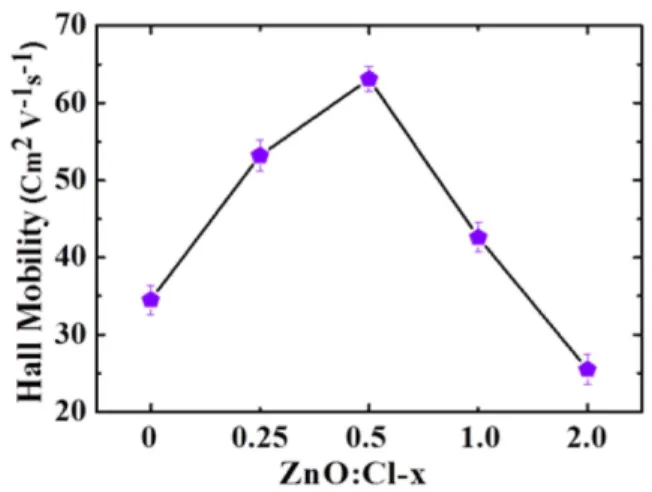
Beside the band edge position of ZnO ETL, electrical property of barrier layer such as carrier mobility is one of the important properties for efficient charge separation and transport from photoactive layer to electrode. Generally, the ZnO thin film with the high optical transparency has been widely used as transparent conductive oxide (TCO), and their mobility and conductivity can be improved through cationic doping of group III metallic elements such as Al, Ga, and In. In addition, group VII anion non-metallic elements (F, Cl, Br, and I) can be also used for modifying the electrical property of ZnO thin film. Figure 6 shows the electrical characteristic of ripple structured ZnO ETL depending on the doping ratio, which was obtained by using the Hall Effect measurement. The mobility

of pristine ZnO is about 35 Cm

2

V

-1

S

-1

. The samples of ZnO:Cl-0.25 and ZnO:Cl-0.5 is showing high Hall mobility of 54 Cm

2

V

-1

S

-1

and 63 Cm

2

V

-1

S

-1

, respectively.

On the other hand, the Hall mobility is dramatically decreased for the sample with over than 0.5wt%

doping concentration. Highly doped chlorine causes the lattice distortion of ZnO and results in the interruption of carrier mobility [34]. The trend of Hall mobility of doped ZnO ETL is similar to the change of PCE, Jsc, and FF of I-OPV cells. That means electrical characteristic, especially mobility in this work, of ZnO ETL is strong influencing on the performance of I-OPVs.

4. Conclusions

In summary, group VII non-metallic element, chlorine (Cl), is easily doped into ripple structured ZnO thin film using simple sol-gel method and which are applied as an electron transporting layer (ETL) in inverted organic photovoltaics. The highest performance of I-OPV is achieved with ZnO:Cl-0.5 ETL of 8.79%, enhanced ~10% compared with that of pristine ZnO. Optical property of ZnO:Cl-x ETL are influenced by the chlorine doping ratio that change the band edge position. Furthermore, chlorine doping can heal the surface defect of ZnO ETL, results in more enhancing electrical conductivity.

Acknowledgment

This research was supported by a grant from KIMS.

References

[1] D. C. Lim, W. H. Shim, K. –D. Kim, H. O. Seo, J. –H. Lim, Y. S. Jeong, Y. D. Kim, and K. H.

Lee, Spontaneous formation of nanoripples on the surface of ZnO thin films as hole-blocking layer of inverted organic solar cells, Sol. Energ. Mat.

Sol. Cells, 95 (2011) 3036-3040.

[2] S. –W. Cho, Y. T. Kim, W. H. Shim, S. –Y. Park, K. –D. Kim, H. O. Seo, Nilay Kumar Dey, J. – H. Lim, Y. S. Jeong, K. H. Lee, Y. D. Kim, and

Table. 2. Energy levels of (a) pristine ZnO, (b) ZnO : Cl-0.5, and (c) ZnO : Cl-2.0.

Conduction Band Energy (eV) Valence Band Energy (eV) Band Gap Energy (eV)

(a) Pristine ZnO 4.07 eV 7.27 eV 3.20 eV

(b) ZnO:Cl-0.5 4.44 eV 7.68 eV 3.24 eV

(c) ZnO:Cl-2.0 3.67 eV 6.82 eV 3.15 eV

Fig. 6. Hall effects of ZnO:Cl ETLs depending on the

chlorine doping ratio (The error bars: 5 measurements

standard deviation).

(7)

D. C. Lim, Influence of surface roughness of aluminium-doped zinc oxide buffer layers on the performance of inverted organic solar cells, Appl.

Phys. Lett. 98 (2011) 023102.

[3] Z. Yin, S. Sun, T. Salim, S. Wu, X. Huang, Q.

He, Y. M. Lam, and H. Zhang, Organic photovoltaic devices using highly flexible reduced graphene oxide films as transparent electrodes, ACS Nano.

4 (2010) 5263-5268.

[4] D. C. Lim, K. –D. Kim, S. –Y. Park, E. M.

Hong, H. O. Seo, J. –H. Lim, K. H. Lee, Y. S.

Jeong, C. S. Song, E. J. Lee, Y. D. Kim, and S.

U. Cho, Toward fabrication of high-performing organic photovoltaics: new donor-polymer, atomic layer deposited thin buffer layer and plasmonic effects, Energy Environ. Sci. 8 (2012) 9803-9807.

[5] S. K. Hau, H. L. Yip, H. Ma, and A. K. –Y.

Jen, High performance ambient processed inverted polymer solar cells through interfacial modification with a fullerene self-assembled monolayer, Appl.

Phys. Lett. 233304 (2013) 1-4.

[6] F. C. Krebs, S. A. Gevorgyan, and J. Alstrup, A roll-to-roll process to flexible polymer solar cells:

model studies, manufacture and operational stability studies, J. Mater. Chem. 19 (2009) 5442.

[7] J. Wang, W. Weng, M. Tsai, M. Lee, S. Horng, T. Perng, C. Kei, C. Yu, and H. Meng, Highly efficient flexible inverted organic solar cells using atomic layer deposited ZnO as electron selective layer, J. Mater. Chem. 20 (2010) 862.

[8] B. Zimmermann, H. Schleiermacher, M. Niggemann, and U. Würfel, ITO-free flexible inverted organic solar cell modules with high fill factor prepared by slot die coating, Sol. Energy. Mater. Sol. Cells.

95 (2011) 1587-1589.

[9] Z. Liang, Q. Zhang, L. Jiang, and G. Cao, ZnO cathode buffer layers for inverted polymer solar cells, Energy Environ. Sci. 8 (2015) 3442-3476.

[10] H. O. Seo, S. –Y. Park, W. H. Shim, K. –D.

Kim, K. H. Lee, M. Y. Jo, J. H. Kim, E. S. Lee, D. –W. Kim, Y. D. Kim, and D. C. Lim, Ultrathin TiO

2

Films on ZnO Electron-collecting Layers of Inverted Organic Solar cell, J. Phys. Chem. C.

115 (2011) 21517-21520.

[11] S. H. Nho, G. L. Baek, S. J. Park, B. R. Lee, M. J. Cha, D. C. Lim, J. H. Seo, S. –H. Oh, M.

H. Song, and S. U. Cho, Highly efficient inverted bulk-heterojunction solar cells with a gradiently doped ZnO layer, Energy Environ. Sci. 9 (2015) 240-246.

[12] H. P. Kim, A. Yusoff, H. J. Lee, S. J. Lee, H.

M. Kim, G. J. Seo, J. H. Youn, and J. Jang, Effect of ZnO:Cs

2

CO

3

on the performance of

organic photovoltaics, Nanoscale Res. Lett. 9 (2014) 323.

[13] S. H. Kim, J. H. Koh, X. Yang, W. S. Chi, C.

H. Park, J. W. Leem, B. G. Kim, S. J. Seo, Y.

N. Kim, J. S. Yu, J. H. Kim, and E. K. Kim, Enhanced Device Efficiency of Bilayered Inverted Organic Solar Cells Based on Photocurable P3HTs with a Light-Harvesting ZnO Nanorod Array, Adv.

Energy Mater. 4 (2014) 1301338.

[14] W. Wei, C. Zhang, D. Chen, Z. Wang, C. Zhu, J. Zhang, X. Lu, and Y. Hao, Efficient “Light- soaking”-free Inverted Organic Solar Cells with Aqueous Solution Processed Low-Temperature ZnO Electron Extraction Layers, ACS Appl. Mater.

Interfaces. 5 (2013) 13318-13324.

[15] B. –Y. Oh, M. –C. Jeong, D. –S. Kim, W. lee, and J. –M. Myoung, Post-Annealing of Al-Doped ZnO Films in Hydrogen Atmosphere, J. Cryst.

Growth. 281 (2005) 475-480.

[16] H. Wang, S. H. Baek, J. J. Song, J. H. Lee, and S. W. Lim, Microstructural and optical characteristics of solution-grown Ga-doped ZnO nanorod arrays, Nanotechnology. 19 (2008) 075607.

[17] F. Paraguay D. J. Morales, W. Estrada L, E.

Andrade, M. Miki-Yoshida, Influence of Al, In, Cu, Fe and Sn dopants in the microstructure of zinc oxide thin films obtained by spray pyrolysis, Thin Solid Films. 366 (2000) 16-27.

[18] J. Hu, and R. G. Gordon, Textured fluorine-doped ZnO films by atmospheric pressure chemical vapor deposition and their use in amorphous silicon solar cells, Solar Cells. 30 (1991) 437-450.

[19] F. Wang, J. –H. Seo, Z. Li, A. V. Kvit, Z. Ma, and X. Wang, Cl-doped ZnO Nanowires with Metallic Conductivity and Their Application for High-Performance Photoelectrochemical Electrodes, ACS Appl. Mater. Interfaces. 6 (2014) 1288-1293.

[20] E. Chikoidze, M. Nolan, M. Modreanu, V. Sallet, and P. Galtier, Effect of chlorine doping on electrical and optical properties of ZnO thin films, Thin Solid Films. 516 (2008) 8146-8149.

[21] P. Cembrero-coca, M. Mollar, K. C. Singh, and B. Mari, Effective Electrochemical n-Type Doping of ZnO Thin films for Optoelectronic Window Applications, ECS J. Solid State Sci. 2 (2013) 108-112.

[22] J. Fan, F. Güell, C. Fábrega, A. Shavel, A. Carrete, T. Andreu, J. R. Morante, and A. Cabot, Enhancement of the photoelectrochemical properties of Cl-doped ZnO nanowires by tuning their coaxial doping profile, Appl. Phys. Lett. 99 (2011) 262102.

[23] J. –C. Lee, N. G. Subramaniam, J. –W. Lee, J. –C.

Lee, and T. –W. Kang, Evaluation of optimal

(8)

chlorine doping concentration in zinc oxide on glass for application as new transparent conductive oxide, Phys. Status. Solidi. 210 (2013) 2638-2643.

[24] J. Rousset, E. Saucedo, and D. Lincot, Extrinsic Doping of Electrodeposited Zinc Oxide Films by Chlorine for Transparent Conductive Oxide Application, Chem. Mater. 21 (2009) 534-540.

[25] J. B. Cui, Y. C. Soo, and T. P. Chen, Low- Temperature Growth and Characterization of Cl- Doped ZnO Nanowires Array, J. Phys. Chem. C.

112 (2008) 4475-4479.

[26] Y. –J. Choi, K. –M. Kang, H. –S. Lee, and H. –H.

Park, Non-laminated growth of chlorine-doped zinc oxide films by atomic layer deposition at low temperatures, J. Mater. Chem. C. 3 (2015) 8336- 8343.

[27] J. C. Lee, E. J. Park, N. G. Subramaniam, J. E.

Lee, J. W. Lee, J. C. Lee, and T. W. Kang, Non- metallic element (chlorine) doped Zinc oxide grown by pulsed laser deposition for application in transparent electrode, Curr. Appl. Phys. 12 (2012) S80-S84.

[28] T. Tchelidze, E. Chikoidze, O. Gorochov, and P.

Galtier, Perspectives of chlorine doping of ZnO, Thin Solid Films. 515 (2007) 8744-8747.

[29] Y. Zhang, C. Liu, J. Liu, J. Xiong, J. Liu, K.

Zhang, Y. Liu, M. Peng, A. Yu, A. Zhang, Y.

Zhang, Z. Wang, J. Zhai, and Z. L. Wang, Lattice Strain Induced Remarkable Enhancement in Piezoelectric Performance of ZnO-Based Flexible Nanogenerators, ACS Appl. Mater. Interfaces. 8 (2016) 1381-1387.

[30] K. –D. Kim, D. C. Lim, H. O. Seo, J. Y. Lee, B. Y. Seo, D. J. Lee, Y. S. Song, S. U. Cho, J.

–H. Lim, and Y. D. Kim, Enhanced performance

of organic photovoltaics by TiO

2

-interlayer with precisely controlled thickness between ZnO electron collecting and active layers, Appl. Surf.

Sci. 279 (2013) 380-383.

[31] K. –D Kim, D. C. Lim, J. H. Hu, J. –D. Kwon, M. –G. Jeong, H. O. Seo, J. Y. Lee, K. –Y. Jang, J. –H. Lim, K. H. Lee, Y. S. Jeong, Y. D. Kim, and S. U. Cho, Surface Modification of a ZnO Electron-Collecting Layer Using Atomic Layer Deposition to Fabricate High-Performing Inverted Organic Photovoltaics, ACS Appl. Mater.

Interfaces. 5 (2013) 8718-8723.

[32] K. D. Girase, N. D. Girase, D. K. Sawant, H. M.

Patil, D. S. Bhavsar, Influence of Zn(II) Doping on the Structural and Optical Properties of Gel Grown Lead Iodate Crystals, Adv. Appl. Sci. Res.

2 (2011) 233-239.

[33] K. –C. Choi, E. –J. Lee, Y. –K. Baek, D. C. Lim, Y. –C. Kang, Y. –D. Kim, K. H. Kim, J. P. Kim, and Y. –K. Kim, Morphologically controlled ZnO nanostructures as electron transport materials in polymer-based organic solar cells, Electrochim.

Acta. 180 (2015) 435-441.

[34] J. –C. Lee, N. G. Subramaniam, J. –W. Lee, J. – C. Lee, and T. –W. Kang, Evaluation of optimal chlorine doping concentration in zinc oxide on glass for application as new transparent conductive oxide, Phys. Status. Solidi A 210, No.12 (2013) 2638-2643.

[35] S. U. Cho, K. –D. Kim, J. H. Heo, J. Y. Lee, G.

H. Cha, B. Y. Seo, Y. D. Kim, Y. S. Kim, S. –

Y. Choi, and D. C. Lim, Role of additional PCBM

layer between ZnO and photoactive layers in

inverted bulk-heterojunction solar cells, Scientific

reports, 4 (2014)

수치

Table 1. The device characteristics of chlorine doped ZnO ETL based IOPVs with different concentrations.
Fig. 5. The energy band diagram of I-OPVs with ZnO:Cl-x (x = 0, 0.5, 2.0 ) ETLs.
Fig. 6.   Hall effects of ZnO:Cl ETLs depending on the chlorine doping ratio (The error bars: 5 measurements standard deviation).

참조

관련 문서

This is a clear indication that o-carborane functions as an electron acceptor and end-on BODIPY conformational flexibility governs the overall energy

à Element nodes have child nodes, which can be attributes or subelements à Text in an element is modeled as a text node child of the element. à Children of a node

Improvement of the Performance and Stability of Oxide Semiconductor Thin-Film Transistors Using Double-Stacked Active Layers.. Metal oxide semiconductor

The laser-induced doping of Al into CdTe thin films is very simple and effective to dope a multilayered thin film solar cell with a relatively short

We report the fabrication of nano-porous ZnO nanowires (NWs) using a process combining laser-induced hydrothermal growth followed by a post annealing process.. Initially,

Although most often this energy is released in the form of an emitted photon, the energy can also be transferred to another electron, which is ejected from the atom;

In addition, the speckle correlative method for the non-destructive inspection is being developed into ESPI and Shearography and it is applied in the

An RNN model is neural network architecture using a single layer or multiple layers, consisting of circulation connections, commonly applied for learning the