ISSN 1225-1534 (Print) http://dx.doi.org/10.5303/PKAS.2012.27.4.271 Publications of the Korean Astronomical Society
27: 271 ∼ 274, 2012 September
° 2012. The Korean Astronomical Society. All Rights Reserved.c
AKARI IRC INFRARED 2.5–5 µm SPECTROSCOPY OF NEARBY LUMINOUS INFRARED GALAXIES
Masatoshi Imanishi1, Takao Nakagawa2, Mai Shirahata2, Yoichi Ohyama3 and Takashi Onaka4
1Subaru Telescope, 650 North A’ohoku Place, Hilo, Hawaii 96720, USA
1Department of Astronomy, School of Science, Graduate University for Advanced Studies (SOKENDAI), Mitaka, Tokyo 181-8588, Japan
2Institute of Space and Astronautical Science, Japan Aerospace Exploration Agency, 3-1-1 Yoshinodai, Sagamihara, Kanagawa 252-5210, Japan
3Institute of Astronomy and Astrophysics Academia Sinica, P.O. Box 23-141, Taipei 10617, Taiwan, R.O.C.
4Department of Astronomy, Graduate School of Science, University of Tokyo, Bunkyo-ku, Tokyo 113-0033, Japan E-mail: [email protected]
(Received March 01, 2012; Accepted August 02, 2012)
ABSTRACT
We present the result of systematic AKARI IRC infrared 2.5–5 µm spectroscopy of >100 nearby luminous infrared galaxies, to investigate the energetic roles of starbursts and optically-elusive buried AGNs. Based on (1) the equivalent widths of the 3.3 µm PAH emission features, (2) the optical depths of absorption features, and (3) continuum slopes, we can disentangle emission from starbursts and AGNs. We find that the energetic importance of buried AGNs increases with increasing galaxy infrared luminosities, suggesting that the AGN-starburst connections (and thereby possible AGN feedback to host galaxies) are luminosity dependent.
Key words: galaxies: formation; galaxies: active; galaxies: ISM; galaxies: nuclei; galaxies: seyfert;
galaxies: starburst; infrared: galaxies
1. INTRODUCTION
Luminous infrared galaxies (LIRGs) radiate the bulk of their large luminosities as infrared dust emission (LIR > 1011 L¯; Sanders & Mirabel, 1996). Galaxies with LIR > 1012 L¯ are called ultraluminous infrared galaxies (ULIRGs). The large infrared luminosities of (U)LIRGs mean that (1) (U)LIRGs possess very lumi- nous energy sources with L > 1011 L¯, (2) the energy sources are hidden by dust, which absorbs most of the primary energetic radiation, and (3) the heated dust radiates this energy as infrared dust thermal emission.
The dust-obscured hidden energy sources of (U)LIRGs can be nuclear fusion inside rapidly formed stars (i.e., starburst activity) and/or active mass accretion onto a central supermassive black hole (SMBH) with a mass
>106 M¯ (i.e., AGN activity). Since (U)LIRGs be- come an important population with increasing redshift,
in terms of the cosmic infrared radiation density (Ca- puti et al., 2008), understanding the physical nature of (U)LIRGs is closely related to clarify the AGN- starburst connections in the dust-obscured galaxy pop- ulation in the early universe.
Unlike AGNs surrounded by torus-shaped dusty medium, which show well-developed narrow line re- gions and so are classified optically as Seyferts, puta- tive AGNs in the majority of (U)LIRGs are likely to be obscured by dust along virtually all sightlines, and so become very difficult to identify through optical obser- vations. It is fundamental to understand the energetic role of such optically-elusive buried AGNs in (U)LIRG’s nuclei.
Infrared 2.5–5 µm low-resolution (R ∼ 100) spec- troscopy is an effective tool to scrutinize such optically- elusive buried AGNs in dusty (U)LIRG’s nuclei, be-
http://pkas.kas.org 271
272 IMANISHI ET AL.
(a)
AGN
(b)
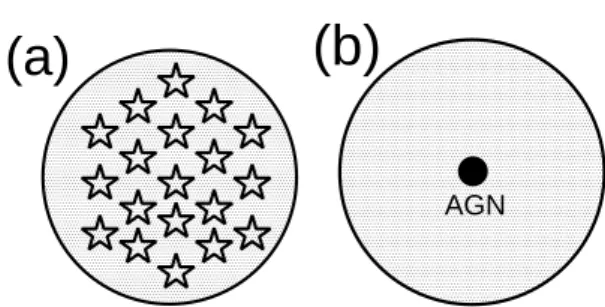
Fig. 1. Geometry of energy sources and dust. (Left):
Normal starburst. Stellar energy sources (open stars) and dust are spatially well mixed. The so-called mixed dust model is applied for dust extinction. (Right): Buried AGN.
The energy source (= a compact mass accreting supermas- sive black hole; filled circle) is more centrally concentrated than the surrounding dust, and so the so-called foreground screen dust model is applicable for dust extinction.
cause dust extinction is small (<0.06 AV). More impor- tantly, normal starburst and AGN emission are clearly distinguishable using infrared 2.5–5 µm spectra. First, in a normal starburst galaxy, large equivalent width polycyclic aromatic hydrocarbon (PAH) emission fea- tures should always be observed, regardless of dust ex- tinction of the starburst (Imanishi & Dudley, 2000;
Imanishi et al., 2006). On the other hand, in the close vicinity of an AGN, PAHs are destroyed by strong X- ray radiation from the AGN, and so a pure AGN emits a PAH-free continuum from larger-sized heated dust grains (Imanishi & Dudley, 2000). Next, in a normal starburst, where the stellar energy sources and dust are spatially well mixed (Figure 1, left), the observed optical depths of dust absorption features in infrared spectra cannot be so large, while the optical depths can be arbitrarily large in a buried AGN, because the energy source is more centrally concentrated than the surrounding dust (Figure 1, right) (Imanishi & Mal- oney, 2003; Imanishi et al., 2006).
In this manuscript, we present the result of our sys- tematic infrared 2.5–5 µm low-resolution spectroscopy of nearby (U)LIRGs classified optically as non-Seyferts (i.e., LINERs, HII-regions, and unclassified), using AKARI IRC (Onaka et al., 2007).
2. RESULTS AND DISCUSSION
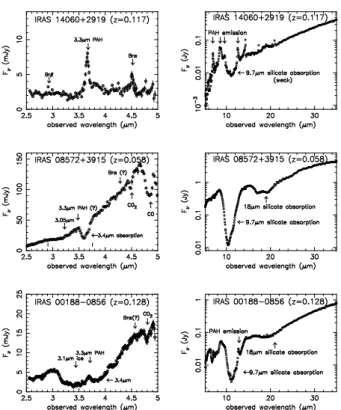
Figure 2 presents AKARI IRC infrared 2.5–5 µm spectra of selected nearby (U)LIRGs (Imanishi et al., 2008, 2010b). The observed sources are classified
into starburst-dominated, buried-AGN-dominated, and buried-AGN and starburst composite types, based on infrared spectral shapes. Although infrared 2.8–4.2 µm (L-band) spectroscopy is possible from the ground, AKARI IRC space-based spectroscopy has the follow- ing important advantages. First, ground-based L-band spectroscopic energy diagnostic is limited to (U)LIRGs at z < 0.15, due to Earth’s atmospheric window, whereas we can apply the energy diagnostic to galaxies at z > 0.15 using AKARI IRC. Second, unlike ULIRGs whose emission is usually dominated by compact nu- clear emission (Soifer et al., 2000; Imanishi et al., 2011), LIRGs with LIR< 1012L¯often show spatially- extended structures (Soifer et al., 2001). AKARI IRC slitless spectroscopic capability is best suited to study such spatially-extended LIRGs, by probing all galaxy emission components. Third, AKARI IRC spectra pro- vide much higher sensitivity and much broader wave- length coverage than ground-based L-band spectra ob- tained with 8–10 m large telescopes (Imanishi et al., 2006). Even for sources at z < 0.15, more useful infor- mation is obtainable from much higher quality AKARI spectra.
For many (U)LIRGs observed with AKARI IRC, we have also obtained Spitzer IRS infrared 5–35 µm spec- tra (Imanishi et al., 2007, 2010a; Imanishi, 2009). Fig- ure 3 shows some examples. The AKARI IRC 2.5–5 µm and Spitzer IRS 5–35 µm spectroscopic energy di- agnostic results are generally consistent for observed (U)LIRGs.
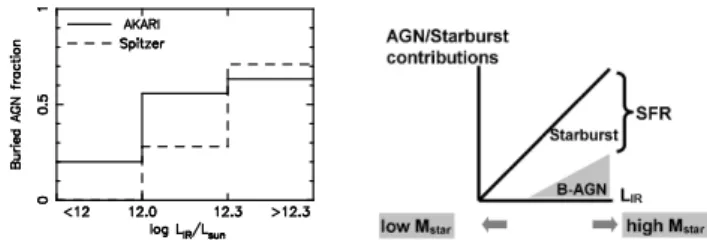
We then investigate buried AGNs as a function of galaxy infrared luminosity, and find a clear trend that the detectable buried AGN fraction increases with increasing galaxy infrared luminosity from LIRGs to ULIRGs (Figure 4), suggesting that the buried AGN- starburst connections are luminosity dependent.
For buried-AGN-classified ULIRGs with low PAH equivalent widths, the observed infrared 2.5–35 µm emission should be dominated by PAH-free hot dust emission heated by AGNs. Dust extinction toward the AGN-heated hot dust emitting regions is derived from the observed optical depths of absorption features in infrared spectra. By combining observed flux and dust extinction, we can quantitatively estimate the intrin- sic, dust-extinction-corrected buried AGN luminosities, which are found to account for a significant (10–50% in most cases) fraction of the observed large infrared lu- minosities of ULIRGs (Imanishi et al., 2008, 2010a, b;
NEARBY LUMINOUS IR GALAXIES 273
Fig. 2. Examples of AKARI IRC 2.5–5 µm low-resolution (R ∼ 100) spectra of optically non-Seyferts (U)LIRGs (Imanishi et al., 2008, 2010b). Top: Starburst-dominated (U)LIRGs. Large equivalent width PAH emission at rest- frame 3.3 µm and weak dust absorption features are seen.
Middle: ULIRGs dominated by buried AGNs, with no de- tectable starbursts. No 3.3 µm PAH emission and strong absorption features are detected. Bottom: ULIRGs with both detectable starburst and buried AGN activity. PAH emission is seen, but its equivalent width is low. H2O ice (rest-frame 3.1 µm), carbonaceous dust (3.4 µm), and CO2
(4.26 µm) absorption features are indicated, together with 3.3 µm PAH, Brβ (2.63 µm), Brα (4.05 µm), and Pfβ (4.65 µm) emission lines.
Imanishi, 2009). The remaining large absolute infrared luminosities due to star-formation in ULIRGs also in- dicate high current star formation rates and so many stars will be formed in the future.
Summarizing, buried AGNs are relatively more im- portant energetically in currently more infrared lumi- nous galaxies, the progenitors of more massive galax- ies with larger stellar masses (Figure 4). Since buried AGNs are surrounded by a large amount of gas and dust, it is buried AGNs, rather than optically- identifiable Seyfert AGNs with small gas/dust covering,
Fig. 3. Comparison of AKARI IRC 2.5–5 µm and Spitzer IRS 5–25 µm spectra of selected ULIRGs (Imanishi et al., 2007, 2008, 2010b). Top : Starburst-dominated ULIRG (IRAS 14060+2919). Both AKARI IRC and Spitzer IRS spectra display large equivalent width PAH emission and weak dust absorption features. Middle : ULIRG dom- inated by a buried AGN, with no detectable starbursts (IRAS 08572+3915). No PAH emission and strong ab- sorption features are detected in both spectra. Bottom : ULIRG with starburst and buried AGN activity (IRAS 00188−0856). PAH emission is seen, but its equivalent width is low in both data.
that can have strong feedback to the host galaxies. Our results might be related to the AGN feedback scenario as the possible origin of the galaxy downsizing phe- nomenon (Cowie et al., 1996), where massive galaxies are generally red in color and have finished their major star-formation in an earlier cosmic age, due to stronger AGN feedback in the past (Granato et al., 2004; Hop- kins et al., 2006).
ACKNOWLEDGEMENTS
M. I. has been supported by a Grant-in-Aid for Sci- entific Research (19740109, 22012006, 23540273).
274 IMANISHI ET AL.
Fig. 4. Left : Fraction of sources with clearly detectable buried AGN signatures as a function of galaxy infrared lu- minosity (Imanishi et al., 2010a, b). Both AKARI and Spitzer results are shown. The apparent difference of the fraction between AKARI and Spitzer comes predominantly from the fact that significantly different individual ULIRGs are observed between AKARI and Spitzer, rather than in- consistent energy diagnostic results for the same sources.
Right : Schematic diagram of the energetic importance of buried AGNs (B-AGN) and starbursts as a function of galaxy infrared luminosity. SFR means a star formation rate. In galaxies with currently higher infrared luminosi- ties, the energetic importance of buried AGNs is relatively higher, and higher SFRs suggest that these galaxies will evolve into more massive galaxies with larger stellar masses than currently less infrared luminous galaxies.
REFERENCES
Caputi, K. I., et al., 2007, The Infrared Luminosity Function of Galaxies at Redshifts z = 1 and z ∼ 2 in the GOODS Fields, ApJ, 660, 97
Cowie, L. L., Songaila, A., Hu, E. M., & Cohen, J.
D., 1996, New Insight on Galaxy Formation and Evolution from Keck Spectroscopy of the Hawaii Deep Fields, AJ, 112, 839
Granato, G. L., Zotti, G. D., Silva, L., Bressan. A.,
& Danese, L., 2004, A Physical Model for the Coevolution of QSOs and Their Spheroidal Hosts, ApJ, 600, 580
Hopkins, P. F., Hernquist, L., Cox, T. J., Di Mat- teo, T., Robertson, B., & Springel, V., 2006, A Unified, Merger-driven Model of the Origin of Starbursts, Quasars, the Cosmic X-Ray Back- ground, Supermassive Black Holes, and Galaxy Spheroids, ApJS, 163, 1
Imanishi, M., 2009, Luminous Buried Active Galactic Nuclei as a Function of Galaxy Infrared Lumi- nosity Revealed through Spitzer Low-resolution Infrared Spectroscopy, ApJ, 694, 751
Imanishi, M. & Dudley, C. C., 2000, Energy Diagnoses of Nine Infrared Luminous Galaxies Based on 3-4 Micron Spectra, ApJ, 545, 701
Imanishi, M., Dudley, C. C., & Maloney, P. R., 2006, Infrared 3-4 µm Spectroscopic Investigations of a Large Sample of Nearby Ultraluminous Infrared Galaxies, ApJ, 637, 114
Imanishi, M., Dudley, C. C., Maiolino, R., Maloney, P. R., Nakagawa, T., & Risaliti, G., 2007, A Spitzer IRS Low-Resolution Spectroscopic Search for Buried AGNs in Nearby Ultraluminous In- frared Galaxies: A Constraint on Geometry be- tween Energy Sources and Dust, ApJS, 171, 72 Imanishi, M., Imase, K., Oi, N., & Ichikawa, K., 2011,
Subaru and Gemini High Spatial Resolution In- frared 18 µm Imaging Observations of Nearby Lu- minous Infrared Galaxies, AJ, 141, 156
Imanishi, M. & Maloney, P. R., 2003, 3.1 Micron H2O Ice Absorption in LINER-Type Ultralumi- nous Infrared Galaxies with Cool Far-Infrared Colors: The Centrally Concentrated Nature of Their Deeply Buried Energy Sources, ApJ, 588, 165
Imanishi, M., Maiolino, R., & Nakagawa, T., 2010a, Spitzer Infrared Low-Resolution Spectroscopic Study of Buried Active Galactic Nuclei in a Com- plete Sample of Nearby Ultraluminous Infrared Galaxies, ApJ, 709, 801
Imanishi, M., Nakagawa, T., Ohyama, Y., Shirahata, M., Wada, T., & Onaka, T., 2008, Systematic Infrared 2.5-5 µm Spectroscopy of Nearby Ultra- luminous Infrared Galaxies with AKARI, PASJ, 60, S489
Imanishi, M., Nakagawa, T., Ohyama, Y., Shirahata, M., & Onaka, T., 2010b, AKARI IRC Infrared 2.5-5 µm Spectroscopy of a Large Sample of Lu- minous Infrared Galaxies, ApJ, 721, 1233 Onaka, T., et al., 2007, The Infrared Camera (IRC)
for AKARI – Design and Imaging Performance, PASJ, 59, 401
Sanders, D. B. & Mirabel, I. F., 1996, Luminous In- frared Galaxies, ARA&A, 34, 749
Soifer, B. T., et al., 2000, High Resolution Mid- Infrared Imaging of Ultraluminous Infrared Galaxies, AJ, 119, 509
Soifer, B. T., et al., 2001, High-Resolution Mid- Infrared Imaging of Infrared-Luminous Starburst Galaxies, AJ, 122, 1213