• 검색 결과가 없습니다.

STUDY OF CO<sub>2</sub>/H<sub>2</sub>O ICE ABUNDANCE RATIOS IN NEARBY GALAXIES WITH THE AKARI NEAR-INFRARED SPECTROSCOPY

N/A
N/A
Protected

Academic year: 2021

Share "STUDY OF CO<sub>2</sub>/H<sub>2</sub>O ICE ABUNDANCE RATIOS IN NEARBY GALAXIES WITH THE AKARI NEAR-INFRARED SPECTROSCOPY"

Copied!
5
0
0

로드 중.... (전체 텍스트 보기)

전체 글

(1)

⃝2017. The Korean Astronomical Society. All rights reserved. c https://doi.org/10.5303/PKAS.2017.32.1.141

STUDY OF CO

2

/H

2

O ICE ABUNDANCE RATIOS IN NEARBY GALAXIES WITH THE AKARI NEAR-INFRARED SPECTROSCOPY

Mitsuyoshi Yamagishi

1

, Hidehiro Kaneda

1

, Shinki Oyabu

1

, Daisuke Ishihara

1

, Takashi Onaka

2

, Takashi Shimonishi

3

, and Toyoaki Suzuki

4

1

Graduate School of Science, Nagoya University, Furo-cho, Chikusa-ku, 464-8602 Nagoya, Japan

2

Graduate School of Science, The University of Tokyo, 7-3-1 Hongo, Bunkyo-ku, 113-0033 Tokyo, Japan

3

Graduate School of Science, Kobe University, 1-1 Rokkodai, Nada-ku, Kobe 657-8501, Japan

4

SRON Netherlands Institute for Space Research, Sorbonnelaan 2, 3584 CA Utrecht, The Netherlands E-mail: [email protected]

(Received September 14, 2016; Revised Novemer 15, 2016; Accepted Novemer 15, 2016)

ABSTRACT

We study CO

2

/H

2

O ice abundance ratios in nearby galaxies using AKARI near-infrared slit spec- troscopy. Past studies of the ices intensively examined CO

2

/H

2

O ratios mainly in our Galaxy, and found that there were considerable variations in the CO

2

/H

2

O ratios from object to object. The cause of the variations is, however, still under debate. As a result of the analysis of our sample that includes 1031 regions in 158 galaxies, the CO

2

/H

2

O ratios are in a range of 0.05–0.30. In the dataset, we find that the CO

2

/H

2

O ratios positively correlate with the Brα/PAH 3.3 µm ratios which reflect the massive star formation activity. Furthermore, we find that the CO

2

/H

2

O ratios positively correlate with the specific star formation rates of the galaxies where the ices are detected, that reflect the evolutionary stage of a galaxy. These results suggest that the CO

2

/H

2

O ratios are enhanced in active star-forming regions and young galaxies.

Key words: infrared - galaxies: ISM - molecules

1. INTRODUCTION

In the universe, interstellar ices are formed on the sur- face of dust grains in dense (n

H

∼ 10

4

cm

−3

) and low- temperature (T ∼ 10 K) molecular clouds. Observa- tionally, absorption features due to ices are seen in near- and mid-infrared spectra. It is widely known that abun- dances of ices are sensitive to the interstellar environ- ment such as radiation field, temperature, and chem- istry. In this study, we focus on H

2

O and CO

2

ices, which are the most abundant ones among various ice species and show the absorption features at 3.05 µm and 4.27 µm, respectively. Several formation processes have been proposed for H

2

O and CO

2

ices. For example, H

2

O ice is thought to be formed through the following reactions (Cuppen & Herbst, 2007; Oba et al., 2012;

http://pkas.kas.org

Miyauchi et al., 2008);

H + OH → H

2

O, (1)

OH + H

2

→ H

2

O + H, (2)

O

2

+ H → HO

2

, (3)

HO

2

+ H → H

2

O

2

, (4)

H

2

O

2

+ H → H

2

O + OH. (5) It was confirmed by the laboratory experiments that these processes progress with no energy input at tem- perature of ∼10 K. By contrast, CO

2

ice is thought to be efficiently formed through the following reaction (Watanabe & Kouchi, 2002);

H

2

O + CO + hν → CO

2

+ 2H. (6)

In this process, UV irradiation to H

2

O and CO ices is

essential. Focusing on these formation processes, it is

141

(2)

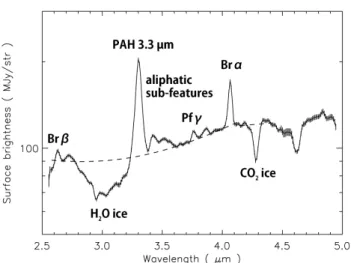
Figure 1. An example of the AKARI near-infrared spectra for NGC 253. The dashed curve represents the best-fit con- tinuum.

possible that UV radiation field changes CO

2

/H

2

O ice abundance ratios.

The ices in our Galaxy have been studied intensively (e.g., Gibb et al., 2004; Pontoppidan et al., 2008; Aikawa et al., 2012). As a result, it was found that there were considerable variations in the CO

2

/H

2

O ratios from ob- ject to object, but the cause of the variation is still un- clear. In the observations of Galactic regions, the variety of the interstellar environment is rather limited. In or- der to examine CO

2

/H

2

O ratios in detail, it is crucial to observe a wide range of the interstellar environment.

In this paper, based on systematic study of the ices in nearby galaxies with AKARI, we examine variations in the CO

2

/H

2

O ratios utilizing the characteristics of the ice formation processes.

2. OBSERVATION AND DATA ANALYSIS

We used near-infrared slit spectroscopic data obtained using the AKARI/IRC in a wavelength range of 2.5–5.0 µm. We analyzed all the observed data of 158 galaxies located at z < 0.03. All the data were taken from the AKARI archives

1

. We determined the number of the spectra to be extracted from a slit aperture on the basis of the intensity of a target. As a result, we extracted 4–10 spectra from a slit and obtained 1031 spectra in total. Figure 1 shows an example of the observed spec- tra, which shows several prominent features; absorption features due to H

2

O ice at 3.05 µm and CO

2

ice at 4.27 µm, emission features due to polycyclic aromatic hydro- carbons (PAHs), and hydrogen recombination lines.

We performed spectral fitting calculations for all the

1

http://darts.jaxa.jp/astro/akari/

H

2

O ice

Wavelength 2.5–4.1 µm

Absorption pure H

2

O ice at 10 K

a

Continuum multi-temp. blackbody

(200, 400, 800, 1600, 3200 K) Emission PAH 3.3 µm, aliphatic sub-features,

Brα, Brβ, Pfγ CO

2

ice

Wavelength 4.1–4.4 µm

Absorption H

2

O:CH

3

OH:CO

2

=9:1:2 at 10 K

a

Continuum linear function

Emission None

a

Profile taken from Ehrenfreund et al., (1996).

spectra, and evaluated the column densities of H

2

O and CO

2

ices one by one. The wavelength ranges and spec- tral components used in the fitting model are summa- rized in Table 1. By using the components, we fitted the absorption, continuum, and emission components simultaneously. The following function was used for the fitting:

I

obs

=

( ∑

i

a

i

I

icont

)

× exp(−τI

abs

) + ∑

j

b

j

I

jem

, (7)

where a

i

, τ , and b

i

are free parameters, and I

icont

, I

abs

, and I

jem

are continuum, absorption, and emission com- ponents listed in Table 1, respectively. We derive the column density, N , from the equation

N =

τ dν/A, (8)

where A, τ , and ν are the band strength of each ice feature measured in a laboratory, an optical depth, and a wavenumber, respectively. We applied the band strengths of 2.0 × 10

−16

cm molecule

−1

for H

2

O ice and 7.6 × 10

−17

cm molecule

−1

for CO

2

ice (Gerakines et al., 1995). For example, the column densities of H

2

O and CO

2

ices for the spectrum in Fig. 1 are 5.3 × 10

17

cm

−2

and 7.7 × 10

16

cm

−2

, respectively.

3. RESULTS

We detect H

2

O ice from 125 regions in 30 galaxies and

CO

2

ice from 54 regions in 12 galaxies. Figure 2 shows

the resultant CO

2

ice column densities plotted against

H

2

O ice column densities for all the regions where the

ices are detected. Overall, there is a positive correla-

tion in the figure, and the averaged CO

2

/H

2

O ratio

(3)

Figure 2. Column densities of CO

2

ice plotted against those of H

2

O ice for all the regions where the ices are detected.

The dashed lines indicate the CO

2

/H

2

O ratios of 0.30, 0.14, and 0.05 from top to bottom.

is 0.14 ±0.01. There are, however, large variations in the ratios between 0.05 and 0.3 as expected from the past studies, suggesting that there are also large varia- tions in the interstellar environment for ice-formation.

What is the parameter that causes such variations in the CO

2

/H

2

O ratios?

4. Discussion

4.1. Variations in CO

2

/H

2

O Ratios in M82

In order to examine the variations in detail, first, we check the CO

2

/H

2

O ratios in the particular galaxy, M82. M82 is a nearby galaxy, which shows intense star- burst activities in the galactic center. The dashed boxes in Fig. 3(a) represent the observed slit positions with AKARI. Figure 3(b) shows examples of the spectra ex- tracted from the galactic center of M82, which reveal variations of the spectra in the direction from the galac- tic center to the southeast. Here it is notable that H

2

O ice is widely distributed in M82, while CO

2

ice is de- tected only near the galactic center. This is the first result which shows clear variations in the CO

2

/H

2

O ra- tios on a galactic scale. Figure 3(b) indicates that the ice-forming interstellar environment is not uniform even within a galaxy.

Figure 4 shows the CO

2

/H

2

O ratios plotted against the Brα/PAH 3.3 µm ratios for the regions in M82.

In the figure, there is a tight positive correlation. In general, Brα and PAH emissions are emitted from H II regions and photo-dissociation regions (PDRs), respectively. Therefore, Fig. 4 suggests that H II- dominated regions show high CO

2

/H

2

O ratios, while

Figure 3. (a) Slit positions observed with AKARI in M82 overlaid on the contours which represent the PAH emission (Kaneda et al., 2010). (b) Examples of the near-infrared spectra extracted from the center of the galaxy (top) to the southeast direction (bottom) along the slit aperture.

PDR-dominated regions show low ratios. Since the Brα/PAH 3.3 µm ratio represents the hardness of the UV radiation field that depends on the massive star formation activity, the positive correlation implies that massive stars play an important role in increasing the CO

2

/H

2

O ratios. It is likely that the intense star- burst activities in M82 contribute to the increase in the CO

2

/H

2

O ratios.

Our result favors the CO

2

ice formation process using

UV photons (Watanabe & Kouchi, 2002). However, it is

notable that interstellar UV photons emitted from mas-

sive stars do not contribute to the CO

2

ice formation

process in dense molecular clouds due to the interstel-

(4)

Figure 4. CO

2

/H

2

O ratios plotted against the Brα/PAH 3.3 µm ratios. The dashed line represents the best-fit relation for M82 data.

lar extinction. In such a situation, a possible origin of the UV photons is interactions between cosmic-rays and hydrogen molecules (Prasad & Tarafdar, 1983), which produces UV photons even in dense molecular clouds.

It is possible that the intense massive star-forming ac- tivities make many supernova remnants that are likely accelerators of cosmic-rays, and contribute to the CO

2

ice formation via cosmic-ray induced UV photons in a cloud associated with the massive star-forming region.

4.2. Variations in CO

2

/H

2

O Ratios in all the Sample Galax- ies

The relation between CO

2

/H

2

O ratios and Brα/PAH 3.3 µm ratios obtained from M82 is applied to the other galaxies where the ices are detected. Figure 4 also shows the relation for the other galaxies, where the data points for NGC 253 are consistent with the best-fit relation for M82 data. As a whole, however, there is no clear cor- relation and a systematic difference along the vertical direction from galaxy to galaxy. This result suggests that a CO

2

/H

2

O ratio in a galaxy is determined by an- other parameter as well as the Brα/PAH 3.3 µm ratio.

We focus on the properties of the galaxies. For ex- ample, NGC 3256, which is a more active star-forming galaxy than M82, shows systematically high CO

2

/H

2

O ratios relative to M82. By contrast, Centaurs A, which is classified by an elliptical galaxy, shows systematically low ratios. Hence, a possible parameter causing the dif- ference along the vertical axis is evolutionary stage of a galaxy.

In order to examine the evolutionary stage of the galaxies, we introduce the specific star formation rate (SSFR), which is the ratio of the star-formation rate

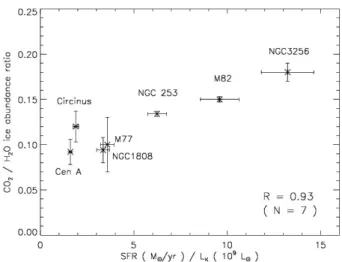
Figure 5. CO

2

/H

2

O ratios plotted against the SSFRs of the galaxies. The correlation coefficient and the number of sam- ples are shown at the bottom right.

(SFR) to the stellar mass (M

); a young star-forming galaxy shows a large SSFR. We evaluated SSFRs of the galaxies using far-infrared and K

s

-band luminosi- ties (L

K

) based on the AKARI far-infrared all sky sur- vey maps ver.1 (Doi et al., 2012) and 2MASS archive data, respectively. The relation in Kennicutt, (1998) is used in the conversion from a far-infrared luminosity to a star formation rate. Since the flux in the K

s

band mainly represents photospheric emission from low-mass stars, we use L

K

instead of M

and interpret SFR/L

K

as SSFR. Figure 5 shows the CO

2

/H

2

O ratios plotted against the SSFRs of the galaxies. In the figure, there is a remarkable positive correlation, suggesting that the CO

2

/H

2

O ratio decreases with the evolution of star for- mation. Hence, our results suggest that the CO

2

/H

2

O ratio depends on not only the massive star-formation activity but also the evolutionary stage of a galaxy.

5. SUMMARY

We have examined variations in CO

2

/H

2

O ratios in nearby galaxies with the AKARI NIR slit spectroscopy.

Our sample galaxies show the CO

2

/H

2

O ratios in a

range of 0.05–0.3. In the dataset, we find that the

CO

2

/H

2

O ratios positively correlate with the Brα/PAH

3.3 µm ratios, suggesting that massive stars are impor-

tant to enhance the CO

2

/H

2

O ratios. It is possible

that the intense starburst activities make many super-

nova remnants that are possible accelerators of cosmic-

rays, and contribute to CO

2

ice formation in a cloud

via cosmic-ray induced UV photons. Additionally, we

find that the CO

2

/H

2

O ratios positively correlate with

the SSFRs of the galaxies where the ices are detected,

(5)

suggesting that the CO

2

/H

2

O ratio decreases with the evolution of star formation. Hence our results suggest that the CO

2

/H

2

O ratios are enhanced in active star- forming regions and young galaxies.

ACKNOWLEDGMENTS

This work is based on observations with AKARI, a JAXA project with the participation of ESA. We also express many thanks to the anonymous referee for the useful comments.

REFERENCES

Aikawa, Y., Kamuro, D., Sakon, I., et al., 2012, AKARI ob- servations of ice absorption bands towards edge-on young stellar objects, A&A, 538, A57

Cuppen, H. M. & Herbst, E., 2007, Simulation of the Forma- tion and Morphology of Ice Mantles on Interstellar Grains, ApJ, 668, 294

Doi, Y., Komugi, S., Kawada, M., et al., 2012, AKARI Far- Infrared All-Sky Survey Maps, Publication of Korean As- tronomical Society, 27, 111

Ehrenfreund, P., Boogert, A. C. A., Gerakines, P. A., et al., 1996, A laboratory database of solid CO and CO

2

for ISO, A&A, 315, L341

Gerakines, P. A., Schutte, W. A., Greenberg, J. M., & van Dishoeck, E. F., 1995, The infrared band strengths of H

2

O, CO and CO

2

in laboratory simulations of astrophysical ice mixtures, A&A, 296, 810

Gibb, E. L., Whittet, D. C. B., Boogert, A. C. A., & Tielens, A. G. G. M., 2004, Interstellar Ice: The Infrared Space Observatory Legacy, ApJS, 151, 35

Kaneda, H., Ishihara, D., Suzuki, T., et al., 2010, Large-scale distributions of mid- and far-infrared emission from the center to the halo of M82 revealed with AKARI, A&A, 514, A14

Kennicutt, R. C., Jr., 1998, Star Formation in Galaxies Along the Hubble Sequence, Annual Review of Astron- omy and Astrophysics, 36, 189

Miyauchi, N., Hidaka, H., Chigai, T., et al., 2008, Forma- tion of hydrogen peroxide and water from the reaction of cold hydrogen atoms with solid oxygen at 10 K, Chemical Physics Letters, 456, 27

Oba, Y., Watanabe, N., Hama, T., et al. 2012, Water For- mation through a Quantum Tunneling Surface Reaction, OH + H

2

, at 10 K, ApJ, 749, 67

Pontoppidan, K. M., Boogert, A. C. A., Fraser, H. J., et al., 2008, The c2d Spitzer Spectroscopic Survey of Ices around Low-Mass Young Stellar Objects. II. CO

2

, ApJ, 678, 1005 Prasad, S. S. & Tarafdar, S. P., 1983, UV radiation field

inside dense clouds - Its possible existence and chemical implications, ApJ, 267, 603

Watanabe, N. & Kouchi, A., 2002, Measurements of Conver-

sion Rates of CO to CO

2

in Ultraviolet-induced Reaction

of D

2

O(H

2

O)/CO Amorphous Ice, ApJ, 567, 651

수치

Figure 1. An example of the AKARI near-infrared spectra for NGC 253. The dashed curve represents the best-fit  con-tinuum.
Figure 4 shows the CO 2 /H 2 O ratios plotted against the Brα/PAH 3.3 µm ratios for the regions in M82.
Figure 4. CO 2 /H 2 O ratios plotted against the Brα/PAH 3.3 µm ratios. The dashed line represents the best-fit relation for M82 data.

참조

관련 문서