Jung, Sang Hee(SAP Korea)1) Chung, Byoung Gyu(Sungkyul University/)2)
Influence of Digital Experience Factors on Purchase
- Focusing on Moderating Effects of Digital Experience Frequency -
Abstract
The 4th Industrial Revolution and Covid 19 are moving the fashion industry from offline to online.
Fashion shows that took place offline are being replaced by online. Online is greatly increasing consumers' digital customer experience based on digital technologies. In this study, we studied the effect of digital experience factors on digital customer satisfaction based on the Schmitt(1999)’s experience marketing. The effect of digital customer satisfaction on purchase, continuous use intention, and recommendation intention were also studied. In addition, the moderating effect of experience frequency was studied. We randomly sampled 180 individuals among fashion mall users.. SPSS 24, AMOS 23 and Process Macro 3.5 were used for statistical analysis. In the study in which digital experience factors influence digital customer satisfaction, all except the digital act showed positive influence. The impact of influence was digital sense (β = .366) > digital think (β = .225)> digital feel (β = .191) > digital relate(β = .163). Digital customer satisfaction have been positive impact on purchasing, continuance use and recommendation intention. In the moderating effect of digital experience frequency, between digital feel, digital act and digital customer experience showed a statistically effective relationship. Based on the this study, We suggested theoretical and practical implications.
■ Keywords: Fourth Industrial Revolution, Online Fashion Shopping, Digital Customer Experience, Digital Customer Satisfaction, Experience Frequency, Moderating Effect
Ⅰ. Research purpose
With the advent of the 4th industry and the aftermath of the Covid 19, the customer purchase journey in the fashion industry is rapidly moving from offline to online. The important
1)First Author, Partner/Managing Director of SAP Korea, Ph. D. [email protected]
2)Corresponding Author, Assistant Professor of Business Administration, Ph.D, Sungkyul University, [email protected]
· 투고일: 2020-7-10 · 수정일: 2020-8-21 · 게재확정일: 2020-10-8
communication channel with consumers in the fashion industry is called fashion shows. The four major fashion weeks in the world (London, Paris, New York, and Milan) are called Fashion Week when designers present their works and intensive fashion shows are held. During Fashion Week, events including fashion shows by various designers are held, and it is an important event for customers to purchase. However, even in the fashion industry, fashion shows and offline purchases, which are physical events, are being brought online with CPS (Cyber, Physical System, the fusion of digital and physical worlds) of the 4th industrial revolution. In particular, new digital technologies represented by AI (artificial intelligence), IoT (Internet of Things), AR (augmented reality) are playing an important role in the fashion industry. They are contributing a lot to making the traditional communication network of fashion companies not in offline fashion shows but in virtual digital spaces such as Facebook, YouTube, and Instagram. Digitally-friendly consumers and hyper-personalized digital customer experiences based on digital technologies are fueling this phenomenon.
Recently in Korea, due to social distancing, offline Seoul Fashion Week was canceled, and new products for the coming autumn and winter season could not be introduced. So, it can be said that a fashion show is being conducted online such as YouTube and Instagram. In addition, Burberry, Tommy Hifiger, and Tom Ford have enabled consumers to instantly purchase products at online shopping malls using digital devices on offline fashion runways. What customers experience through the customer journey is called customer experience. The digital customer journey following digitalization takes a completely different form from the consumer decision-making process in a physical environment(Chung and Jung, 2018). This means that the purchase decision-making process in a physical environment mainly considers cognitive drivers, while the digital customer journey also considers cognitive, emotional, and behavioral factors..
Offline stores conduct guided selling by receiving product information, price information, and sales promotion information through the clerk. On the other hand, online shopping is a non-face-to-face contact, requiring consumers to complete the purchase from start to finish.
Therefore, digital experience provision and digital customer satisfaction from various digital touch points are important attributes.
In this way, it is difficult to find research on digital customer experience in online fashion shopping malls even though a large part of the fashion industry moves from offline to online.
Looking at the research so far, First, most of the research on purchasing experience is focused on offline. Second, it consists of research focusing on single devices such as mobile and kiosks.
It is difficult to find digital customer experience research through various channels. In this study, it was achieved from various viewpoints free from these limitations, and the purpose is as follows.
First, analyze the effect of digital customer experience on digital customer satisfaction, purchase, and intention to use and recommend. Second, we analyze the moderating role of experiences frequency in the relationship with them. Based on the this study, We intend to derive theoretical and practical implications.
Ⅱ. Literature Review
2.1 Experience marketing
Experience marketing is a marketing method that focuses on consumer experience. It covers all the experience of purchasing a product, experience of using a product, and experience after use.
Today, the age of experiential marketing is coming out of the traditional marketing era. These experiences are usually not induced automatically. For example, when we consider the case of purchasing goods, experience is a response to stimuli provided before and after purchasing by corporate marketing efforts(Schmitt, 1999)
The research flow of experiential marketing can be summarized in three ways. First, Schmidt's total experience theory(Schmitt, 1999) distinguishes five types of experience : sense, feel, think, act and relate. Total experience theory was defined customer experience as the sum of SFTAR(Sense, Feel, Think, Act, Relate) experienced by customers from various delivery agents encountered in the purchase decision process. This theory is being used to achieve the purpose of experiential marketing to sell products and enhance brand value. He argued that these five types of experiences should be provided to achieve marketing objectives such as selling products and building brand equity. Second, Pine and Gilmor describe experience as an experience economy in terms of economic value(Pine and Gilmore, 1998). Third, Hoffman and Novak describe the online experience as a psychological process involving leading variables and outcome variables in terms of flow(Hoffman and Novak, 2009). In this study, we adopt five factors of Schmitt.
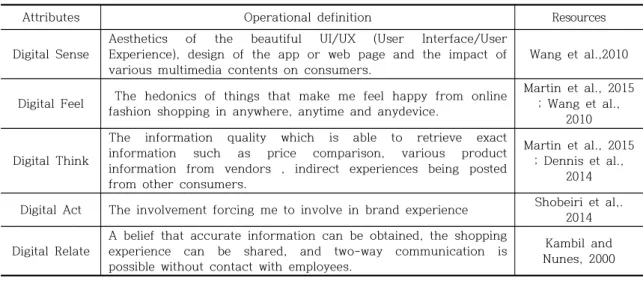
Schmitt(1999) divides the types of experiences into the following five types. Sense marketing appeals to human senses for the purpose of experiencing sensory experiences by stimulating human senses such as taste, smell, touch, sight, and hearing. In an online fashion shopping mall, it can be defined as aesthetics of the beautiful UI/UX (User Interface/User Experience) design of the app or web page and the impact of various multimedia contents on consumers. Feel marketing is the use of emotional stimuli as part of an emotional strategy during consumption or communication so as to have a positive impact on people's mood and emotions. In an online fashion shopping mall, it can be defined as hedonics of things that make me feel happy from online fashion shopping in anywhere, anytime and anydevice. The think marketing may change the major paradigm of society when people change existing expectations. The key logic to provide the right motivation for cognition is to combine sensation, interest, and surprise. In an online fashion shopping mall, it can be defined as information quality which is able to retrieve exact information such as price comparison, various product information from vendors, indirect experiences being posted from other consumers(Dennis et al., 2014). Act marketing is creating a customer experience that is related to physical, long-term behavior patterns, and lifestyle as well as experiences that result from interacting with others. In an online fashion shopping mall, it can be defined as involvement forcing me to involve in brand experience(Shobeiri et al., 2014). Relate marketing can connect consumers with a broader society or reflect a brand from a cultural point of view, resulting in a social identity to consumers. In an online fashion shopping mall, it can be defined as a belief that accurate information can be obtained, and the shopping experience can be
Table 1. Attributes and operational definition of Digital Experiences
Attributes Operational definition Resources
Digital Sense
Aesthetics of the beautiful UI/UX (User Interface/User Experience), design of the app or web page and the impact of various multimedia contents on consumers.
Wang et al.,2010
Digital Feel The hedonics of things that make me feel happy from online fashion shopping in anywhere, anytime and anydevice.
Martin et al., 2015
; Wang et al., 2010
Digital Think
The information quality which is able to retrieve exact information such as price comparison, various product information from vendors , indirect experiences being posted from other consumers.
Martin et al., 2015
; Dennis et al., 2014 Digital Act The involvement forcing me to involve in brand experience Shobeiri et al,.
2014 Digital Relate
A belief that accurate information can be obtained, the shopping experience can be shared, and two-way communication is possible without contact with employees.
Kambil and Nunes, 2000
shared, and two-way communication and conversation is possible without contact with employees(Kambil and Nunes, 2000 ; Rousey and Morganosky, 1996).
2.2 Digital Customer Experience
Digital customer experience means customer's emotions, reactions and behaviors that occur in the process of online communication (eg, search, question, review, evaluation, change of personal information) or trading (eg, purchase and payment, return, charge and gift, open a bank account, transfer, etc.) with companies using digital devices (eg, smartphones, tablets, PCs, etc.) that customers have. In other words, digital customer experience is a collective term for customer's emotions, reactions, and behaviors in the process of communication and trading using smart devices(SAP, 2017). Research on customer experience has been the mainstream in evaluating service quality and analyzing the impact of this quality on customer behavior. The representative model is the SERVQUAL model(Zeithaml et al., 1990, 1996).
However, Verhoef et al. (2009) argue that it is important to focus on brands because they can have a competitive advantage through customer experience, and customer experience should be more than assessing service quality. In other words, the biggest difference between customer experience and service quality is that customer experience includes customer emotion. On the contrary, the service quality has been focused on the customer's cognitive evaluation, so that the customer's emotional role has been neglected. In the study of digital customer experience, Hoffman and Novak (2009) viewed the digital customer experience from a cognitive perspective that interacts digitally. However, Rose et al. (2012) emphasized the importance of customer emotions in digital experience. Understanding the customer's behavior in the digital environment is still a stepping stone(Trevinal and Stenger, 2014). Chung and Jung (2018) derived 12 attribute items based on previous research on these digital experience attributes and applied them to 4 product groups. As a result, 12 attributes can be grouped into personalization service factor, quality factor, and functional factor. Attributes and operational definition of digital experiences are shown in Table 1.
Fig.1. Service Profit Chain(SPC) Model
2.3 Service Profit Chain Model
The purpose of this study is to analyze the impact of digital customer experience on the process from digital customer experience to brand loyalty and purchasing. Therefore, we first examine the service profit chain model which has already theorized this series of processes.
Heskett et al. (1994) established the relationship between service quality, customer satisfaction, customer loyalty, and profitability of the firm as a Service Profit Chain (SPC) model in the Harvard Business Review (Heskett et al., 1994).
As shown in Fig. 1, the Service Profit Chain (SPC) model implies that higher service quality increases customer satisfaction, customer satisfaction increases customer loyalty, and ultimately loyalty raises corporate profits. In addition, many scholars have been studying the relationship between the factors and testing their relationship(Chuah et al., 2017 ; Kasiria, et al., 2017).
2.4 Experience Frequency
Investigating purchase intention as a key outcome variable is common with the widespread adoption of fashion by recognizing that past behavior often leads to ongoing behavior. However, it can be argued that this behaviour may increase or decrease depending on the context and the frequency of experience. Both Rose et al. (2012) and Trevinal and Stenger(2014) identified a generalised frequency in their sample characteristics, but treated all participants equally. Klaus (2013) suggests that online shoppers weight the different conditions of digital customer experience depending on the stage of their buying process. However, Rose et al. (2012) are asking for additional research on understanding how digital customer experience relationships may differ across frequency and it argues that some prior and consequential factors provide insight into whether it is more important to frequent or infrequent customers. Customer groups can be examined based on their frequency of digital experience( Min et al., 2012). In a broad managerial sense, it is important to understand market segments in this way because frequent shoppers contribute a far higher volume of sales than infrequent shoppers(Chiou and Pan, 2009).
Additionally, heavy digital customer experiencer not only contribute to higher sales, but also experience higher satisfaction and greater loyalty towards an brand(Chiou and Pan,2009). Further, marketers often suggest targeting towards heavy and frequent shoppers rather than light and infrequent shoppers (Anschuetz, 1997). Additionally, research in online contexts, including the grocery industry, highlights behavioural variances between frequent and infrequent experiencer(Overby and Lee, 2006). This suggests that meaningful insights may be gained from testing digital experience in the context of frequency. The positive effect of AES(affective
Fig.2 Research Model
experience state) on shopping satisfaction was greater for frequent shoppers and the positive effect of shopping satisfaction on repurchase intentions will be greater for the frequent shoppers than for infrequent shoppers.
The positive effect of CES(cognitive experience state) on shopping satisfaction was greater for infrequent shoppers(Martin et al., 2015).
Ⅲ. Research model and hypothesis
3.1 Research model
This study focuses on identifying which customer experience attributes have a significant effect on customer satisfaction among customer experience attributes, customer satisfaction, loyalty, and purchasing process in digital customer experience. Especially, we tried to clarify the moderating role of the frequency of experience in this process. The customer experience attributes adopted modifying the five elements of experiential marketing (sense, feel, think, act, relate) proposed by Schmitt (1999). For a series of processes leading to customer satisfaction, loyalty, and purchasing, we used the Service Profit Chain model proposed by Heskett et al. (1994).
The experience frequency was used as a moderating variable. The research model of this study is shown in Fig.2.
3.2 Hypothesis setting
Based on previous studies, the hypothesis of this study is set as follows. If customers have a positive digital customer experience, the satisfaction, purchasing intention, willingness to repurchase, and recommendation intention are increased (Verhoef et al., 2009). Brodie et al. (2011) reported that digital customer experience affects customer satisfaction and ongoing intention to use. As a result, the following hypotheses were established in relation to digital customer experience attributes and customer satisfaction
H1-1. The sense factor among digital customer experience attributes will have a positive(+) effect on customer satisfaction.
H1-2. Digital feel factor will have a positive(+) effect on customer satisfaction.
H1-3. The think factor among digital customer experience attributes will have a positive(+) effect on customer satisfaction.
H1-4. The act factor in digital customer experience attributes will have a positive(+) effect on customer satisfaction.
H1-5. The relate factor in digital customer experience attributes will have a positive(+) effect on customer satisfaction.
On the other hand, Luo et al. (2011) suggested that digital customer experience improves recommendation intentions in online games through empirical analysis. Digital customer experience is an opportunity for companies to increase their brand involvement and is the key to long-term customer relationship development(Wirtz et al. 2013). According to Liang et al. (2018) who studied the relationship between airbnb's customer satisfaction and purchasing, their relationship was positive. In this study, the following hypotheses were set.
H2. Digital customer satisfaction will have a positive (+) impact on continuance use.
H3. Digital customer satisfaction will have a positive (+) impact on purchasing.
H4. Digital customer satisfaction will have a positive(+) effect on recommendation intentions.
H5. Purchasing will have a positive (+) impact on continuance use
H6. Purchase will have a positive (+) impact on recommendation intentions.
On the other hand, Martin et al. (2015) and Min et al. (2012) have reported on the moderating role of experience frequency. In other words, according to these studies, customer satisfaction and customer loyalty differ according to the experience frequency. In this study, the following hypotheses were set.
H7-1. Experience frequency will play a moderating role between digital sense and digital customer satisfaction.
H7-2. Experience frequency will play a a moderating role between digital feel and digital customer satisfaction.
H7-3. Experience frequency will play a moderating role between digital think and digital customer satisfaction.
H7-4. Experience frequency will play a a moderating role between digital act and digital customer satisfaction.
H7-5. Experience frequency will play a moderating role between digital relate and digital customer satisfaction.
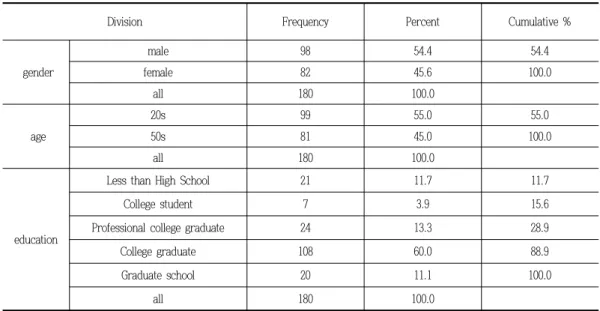
Table 2. Demographic Characteristics of the Sample
Division Frequency Percent Cumulative %
gender
male 98 54.4 54.4
female 82 45.6 100.0
all 180 100.0
age
20s 99 55.0 55.0
50s 81 45.0 100.0
all 180 100.0
education
Less than High School 21 11.7 11.7
College student 7 3.9 15.6
Professional college graduate 24 13.3 28.9
College graduate 108 60.0 88.9
Graduate school 20 11.1 100.0
all 180 100.0
Ⅳ. Results
4.1 Research design
In this study, we selected the fashion industry with a strong consumer nature in order to analyze the experience frequency, satisfaction, loyalty and purchasing influence in digital customer experience. We randomly sampled 180 individuals.. SPSS 24, AMOS 23 and Process Macro 3.5(Hayes, 2013) were used for statistical analysis.
4.2 Characteristics of research group
The characteristics of the sample are as follows. The male sex is 54.4% and women account for 45.6%. The age was 55.0% in their 20s and 45.0% in the 50s. 60% of university graduates were educated.
4.3 Confirmatory factor analysis
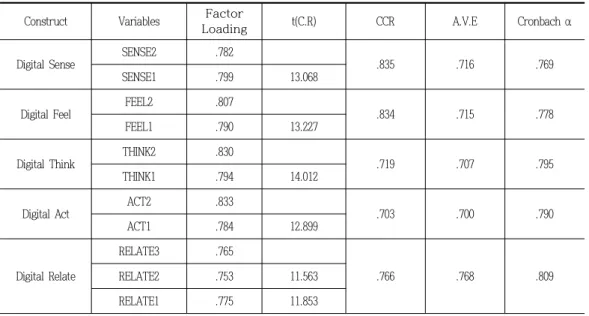
In the present study, exploratory factor analysis was omitted because the digital experience attributes were based on Schmitt's previous research. In order to test the convergent validity of the items, confirmatory factor analysis was conducted. confirmatory factor analysis results are shown in Table 3.
By judging from the structural equation model, the model with value of χ²/df = 2.730, RMR = .023, RMSEA = .040, GFI = .970, AGFI = .943, NFI = .974, CFI = .983 have been derived. The validity of this research model satisfies the acceptance criteria because it meets the absolute fitness index and incremental fitness index criteria.. The criteria for the convergent validity are the standardized regression factor of .7 or more, the value of t(C.R) in the significance is 1.965 or
Table 4. Correlation Analysis
Digital SENSE Digital FEEL Digital ACT Digital THINK Digital RELATE
Digital SENSE .846
Digital FEEL 0.696** .845
Digital ACT 0.560** 0.606** .836
Digital THINK 0.668** 0.651** 0.660** .840
Digital RELATE 0.566** 0.519** 0.578** 0.577** .876
** : P < .01, shadow : square root of AVE
Table 3. Confirmatory Factor Analysis and Reliability Analysis
Construct Variables Factor
Loading t(C.R) CCR A.V.E Cronbach α
Digital Sense SENSE2 .782
.835 .716 .769
SENSE1 .799 13.068
Digital Feel
FEEL2 .807
.834 .715 .778
FEEL1 .790 13.227
Digital Think
THINK2 .830
.719 .707 .795
THINK1 .794 14.012
Digital Act ACT2 .833
.703 .700 .790
ACT1 .784 12.899
Digital Relate
RELATE3 .765
.766 .768 .809
RELATE2 .753 11.563
RELATE1 .775 11.853
χ²/df = 2.730, RMR = .023, RMSEA = .040, GFI = .970, AGFI = .943, NFI = .974, CFI = .983
more, the reliability of the composite construct(CCR) is .7 or more, and AVE (average variance extracted) is more than .5 (Cho, 2017 ; Woo, 2017). On the basis of these standards, it is largely consistent with model acceptance criteria.
4.4 Correlation analysis
Table 4 shows the results of the correlation analysis to test the discriminant validity of the factors that were confirmed through the factor analysis.
The correlation coefficient between each factor was lower than the square root of AVE and the discriminant validity was satisfied.
4.5 Hypothesis test result
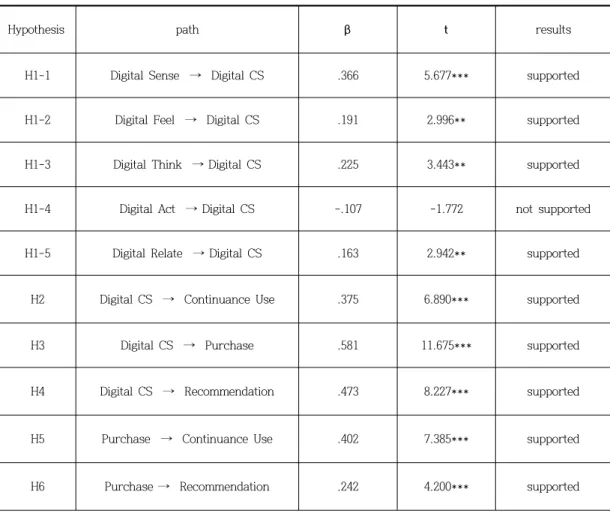
Table 5. Results of Hypothesis Test
Hypothesis path β t results
H1-1 Digital Sense → Digital CS .366 5.677*** supported
H1-2 Digital Feel → Digital CS .191 2.996** supported
H1-3 Digital Think → Digital CS .225 3.443** supported
H1-4 Digital Act → Digital CS -.107 -1.772 not supported
H1-5 Digital Relate → Digital CS .163 2.942** supported
H2 Digital CS → Continuance Use .375 6.890*** supported
H3 Digital CS → Purchase .581 11.675*** supported
H4 Digital CS → Recommendation .473 8.227*** supported
H5 Purchase → Continuance Use .402 7.385*** supported
H6 Purchase → Recommendation .242 4.200*** supported
χ²/df = 2.721, RMR = .047, RMSEA = .059, GFI = .923, AGFI = .875, NFI = .929, CFI = .942
Table 6. Results of moderating effects test
4.5.1 Results of Hypothesis Test
Judging from the structural equation model, χ²/df = 2.721, RMR = .047, RMSEA = .059, GFI = .923, AGFI = .875, NFI = .929, CFI = .942 is judged to be a comparable model. As a result of the hypothesis test, only the act factor among the experiential factors showed no significant effect on the customer satisfaction, and all the others showed a positive (+) influence. So hypothesis of H1-1, H1-2, H1-3, H1-5, H2, H3, H4, H5, H6 have been supported, however H1-4 has not supported.
4.5.2 Results of Results of moderating effects test
In the case of the fashion industry, the experience frequency plays a moderating role between feel factor and customer satisfaction, act factor and customer satisfaction. So hypothesis of H7-2 and H7-4 have been supported, but hypothesis of H7-1, H7-3 and H7-5 have not been supported.
path coeff t LLCL ULCL statisti
cs results
Digital Sense → Digital CS
const 3.649 101.478 3.578 3.719
△R²=.
004 F=
2.157 P=.143
Not suppor
ted Digital Sense .701 13.908 .602 .800
Experience
Frequency -.113 -3.046 -.187 -.040
Interaction -.073 -1.469 -.172 .025
Digital Feel → Digital CS
const 3.653 94.442 3.559 3.711
△R²=.0 19 F=
8.572 P=.004
suppor ted Digital Feel .583 11.255 .481 .685
Experience
Frequency -.129 -3.287 -.207 -.052
Interaction -.164 -2.928 -.275 -.054
Digital Think → Digital CS
const 3.646 92.504 3.568 3.724
△R²=.0 04 1.775 F=
P=.184 Not suppor
ted Digital Think .571 11.010 .469 .674
Experience
Frequency -.106 -2.607 -.185 -.026
Interaction -.069 -1.332 -.172 .033
Digital Act → Digital CS
const 3.641 83.767 3.555 3.726
△R²=.0 12 F=
4.216 P=.041
suppor ted Digital Act .371 7.014 .267 .475
Experience
Frequency -.149 -3.320 -.237 -.061
Interaction -.109 -2.053 -.214 -.004
Digital Relate → Digital CS
const 3.659 88.543 3.577 3.740
△R²=.0 00 F=.005 P=.944
Not suppor
ted Digital Relate .525 9.701 .419 .632
Experience
Frequencyt -.150 -3.495 -.234 -.065
Interaction -.004 -.071 -.107 .099
Ⅴ. Conclusions
5.1 Summary of research
In this study, we studied the effect of digital experience factors on digital customer satisfaction based on the Shimtt(1999)’s experience marketing. The effect of digital customer satisfaction on purchase, continuous use intention, and recommendation intention were also studied. In addition, the moderating effect of experience frequency was studied. In the study in which digital experience factors influence digital customer satisfaction, all except the digital act showed positive influence. The impact of influence was digital sense (β = .366) > digital think (β = .225)> digital feel (β = .191) > digital relate(β = .163). Digital customer satisfaction have been positive impact on purchasing, continuance use and recommendation intention. In the moderating effect of digital experience frequency, between digital feel, digital act and digital customer experience showed a
statistically effective relationship.
5.2 Discussion and Implications
The academic and practical implications of this study are as follows. On an academic level, First, satisfaction of digital experience has a significant effect on between digital customer satisfaction, purchasing, continuance use and recommendation intention. It also supported previous study of Hyoung(2019) that customers' positive digital experiences affect brand affect, purchase intention, purchase and recommendation. It also supported the previous study of Brodie et al.(2013) that digital customer expe- rience affects ongoing intent to use. In the analysis of the size of the influence, it came out as digital sense (β = .366) > digital think (β = .225)> digital feel (β = .191) > digital relate(β = .163). Digital technologies such as web/app pages and multimedia with beautiful characteristics of online fashion shopping malls have formed a high impact relationship on digital customer satisfaction.
Second, in the study of the moderating effects of experience frequency, it also supported the previous study of Chiou and Pan(2009) that heavy digital customer experiencers not only contribute to higher sales, but also experience higher satisfaction and greater loyalty towards an brand. It also supported the previous study of Martin et al. (2015) that the positive effect of AES(affective experience state) on shopping satisfaction will be greater for frequent shoppers and the positive effect of shopping sat- isfaction on repurchase intentions will be greater for the frequent shoppers than for infrequent shoppers. The positive effect of CES(cognitive experience state) on shopping satisfaction was greater for infrequent shoppers..
Third, when comparing behavioral loyalty and attitude loyalty after purchase, a higher influence relationship was constructed on behavioral loyalty of continuance use by repurchase than attitudinal loyalty of recommendation intention.
Practical implications are as follows. First, for customer satisfaction and success in online fashion shopping malls, it is necessary to actively utilize the advantages of digital technologies such as artificial intelligence (AI), Internet of Things (IoT), augmented reality (AR), virtual reality (VR) etc. In particular, the visual and auditory experience of digital content and the tactile digital sense experience such as digital signage play the most important role in increasing the satisfaction of online fashion. In addition, it was investigated that the digital relate of online use experience and community formation, which are important characteristics of online, have an important influence.
However, before the rich experience frequency, the digital act did not form a statistically significant relationship to digital customer satisfaction.
Second, before the experience frequency, the splendor of the Web/App page, the initial stimulus of the video, and the auditory work such as audio are stimulated. On the other hand, after the experience frequency, digital feel and digital act activities are stimulated to increase digital customer satisfaction.
Finally, a differentiated digital strategy is needed for consumers with high experience frequency and those who do not. Customers with high experience frequency should appeal to the digital act, which enhances brand and activities through active participation. At the same time, fashion industry companies should appeal to consumers by focusing on the digital feel that gives emotional pleasure to shopping. On the other hand, for consumers with low experience frequency, it is necessary to
appeal to digital sense, which emphasizes the sensational part through multimedia and the beauty of online fashion shopping mall pages. In addition, it provides a lot of various information, so it needs a lot of appeal from digital think.
5.3 Limitations and Future Research
In this study, we have analyzed online fashion shopping industry and found out the same result re- gardless of the brand and product group. First, this results can be suggested to be somewhat general- izable to fashion consumer products. However, for more generalization, it is necessary to expand re- search into other industry. Second, the experience frequency or purchase used as a dependent variable was not based on real measurement data but dependent on the self-entry method from survey.
Consequently it would be the bias of the data that could come from the self-entry way.
REFERENCE
Anschuetz, N.(1997), “Profiting from the “80–20 rule of thumb,” Journal of Advertising Research, 37(6), 51–56.
Brodie, R. J., L. D. Hollebeek, B. Juric, and A. Ilic(2011), “Customer engagement : Conceptual domain, fundamental propositions, and implications for research,” Journal of Service Research, 14(3), 252–271.
Chiou, J.-S. and L-Y. Pan(2009), “Antecedents of internet retailing loyalty : Differences between heavy versus light shoppers,” Journal of Business Psychology, 24(3), 327–339.
Cho, C. H.(2017), SPSS / AMOS Utilization Structural Equation Model Analysis, Bulletin of Book Publishing, Seoul.
Chung, B. G. and S. H. Jung(2018), "The effects of digital customer experience on brand loyalty and purchasing : Focusing on 4 product groups," Journal of Marketing, 21(6), 109-118.
Chuah, S. H., P. A. Rauschnabel, M., Marimuthu, R. Thurasamy, and B. Nguyen(2017), “Why do satisfied customers defect? A closer look at the simultaneous effects of switching barriers and inducements on customer loyalty,” Journal of Service Theory and Practice, 27(3), 616-641.
Dennis, C., J. J. Brakus, S. Gupta and E. Alamanos(2014), “The effect of digital signage on shoppers’
behavior : The role of the evoked experience,” Journal of Business Research, 67(11), 2250-2257.
Hayes, A. H.(2013), Introduction to Mediation, Moderation and Conditional Process Analysis : A Regression-Based Approach, The Guilford Press.
Heskett, J. L., T. O. Jones, G. W. Loveman, W. E. Sasser Jr., and L. A. Schlesinger(1994)., “Putting the service–profit chain to work,” Harvard Business Review, 72(2), 164–174.
Hoffman, D. L., and T. P. Novak(2009), “Flow online : Lessons learned and future prospects,” Journal of Interactive Marketing, 23(1), 23-34.
Hyoung, W. J. (2019), The Effects of Omni-Personalization Attributes of Digital Experience on Brand Affect and Brand Performance, Doctoral Dissertation, Yonsei University.
Kambil, A. and P. Nunes (2000), “Internet marketing : Lessons from the field, research note”, Accenture Institute for Strategic Change. [Online] Available: http://www.accenture.com/xd/xd.asp?it=enweb&xd=_isc/iscre- searchnote_12.xml (Retrieved from July 14 2000).
Kasiria, L. A., K. T. G. Cheng, M. Sambasivan, and S. Sidind(2017), “Integration of standardization and
customization : Impact on service quality, customer satisfaction, and loyalty,” Journal of Retailing and Consumer Services, 35, 91-97.
Klaus, P.(2013), “The case of amazon.com : Towards a conceptual framework of online shoppers service experience (OCSE) using the emerging consensus technique (ECT),” Journal of Service Marketing, 27(6), 443–457.
Liang, L. J., H. C. Chpi, and M. Joppe(2018), “Exploring the relationship between satisfaction, trust and switching intention, repurchase intention in the context of airbnb,” International Journal of Hospitality Management, 69, 41-48.
Luo, M. M., J. S. Chen, R. K. ,Ching, and C. C. Liu,C.C.(2011), “An examination of the effects of virtual experiential marketing on online customer intentions and loyalty,” The Service Industries Journal, 31(13), 2163-2191.
Martin, J., G. Mortimer, and L. Andrews(2015), “Re-examining online customer experience to include purchase frequency and perceived risk,” Journal of Retailing and Consumer Services, 25, 81-95.
Min, S., J. W. Overby, and K. S. Im(2012), “ Relationships between desired attributes, consequences and purchase frequency,” Journal of Consumer Marketing, 29(6), 423–435.
Overby, J .W. and E. J. Lee(,2006), “The effects of utilitarian and hedonic online shopping value on consumer preference and intentions,” Journal of Business Research, .59(10/11), 1160–1166.
Pine, B. J., and J. H. Gilmore(1998), “Welcome to the experience economy,” Harvard Business Review, 76(4), 97–105.
Rousey, S. P. and M. A. Morganosky(1996), “Retail format change in US markets”, International Journal of Retail & Distribution Management, 24(3), 8-16.
Rose, S., N. Hair, and M. Clark(2012), “Online customer experience : A review of the business -to-consumer online purchase context,” International Journal of Management Reviews, 13(1), 24-39.
SAP(2017), South Korea Digital Experience Report, SAP Korea,
Schmitt, B.(1999), “Experiential marketing,” Journal of Marketing Management, 15( 1-3), 53-67.
Shobeiri, S., E. Mazaheri and M. Laroche(2014), “Improving customer website involvement through ex- periential marketing,” The Service Industries Journal, 34(11), 885-900.
Trevinal, A. M., and T. Stenger(2014), “Toward a conceptualization of the online shopping experience,”
Journal of Retailing and Consumer Services, .21, 314-326.
Verhoef, P.C., K. N. Lemon, A. Parasuraman, A., Roggeveen, M., Tsiros, and L.A. Schlesinger(2009),
“Customer experience creation : Determinants, dynamics and management sStrategies,” Journal of Retailing, 85(1), 31-41.
Wang, Y. J., M. D. Hernandez and M. S. Minor (2010), “Web aesthetics effects on perceived online service quality and satisfaction in an e-tail environment : The moderating role of purchase task,” Journal of Business Research, 63(9), 935-942.
Wirtz, J., A. den Ambtman, J. Bloemer, C. Horváth, R. Ramaseshan, J. van de Klundert, and J.
Kandampully(2013), “Managing brands and customer engagement in online brand communities,”
Journal of Service Management, 24(3), 223-244.
Woo, J. P.(2017), Concept and Understanding of Structural Equation Model, Hannarae, Seoul.
Zeithaml, V.A., L. L. Berry, and A. Parasuraman(1996), “The behavioral consequences of service quality,” Journal of Marketing, 60, 31-46.
Zeithaml, V.A., A. Parasuraman, and L. L.Berry(1990), Delivering Service Quality, Free Press.
정상희(SAP Korea 상무)1) 정병규(성결대학교 경영학과 조교수)2)
디지털 경험 요소가 구매에 미치는 영향 -경험빈도의 조절효과를 중심으로-
국 문 요 약
4차산업혁명과 코로나 19의 진전으로 인하여 패션 산업은 급속이 오프라인에서 온라인으로 이동하고 있다. 전통적 인 패션쇼 조차도 온라인이 오프라인을 대체하고 있는 실정이다. 온라인 서비스로 인하여 디지털 기술에 기반을 둔 고객의 디지털 경험이 급속히 증가하고 있다. 본 연구에서는 이러한 배경하에 다음과 같은 목적을 가지고 이루어졌다.
첫째, 디지털 경험이 고객만족에 영향을 미치는지를 알아보기 위해 Schmitt의 경험 마케팅의 요소를 기반으로 연구 변수를 도출하였다. 둘째, 서비스-이익 모델에 의해 품질, 고객만족, 충성도, 이익으로 이어지는 일련의 과정을 디지털 경험을 출발점으로 하여 검증하였다. 셋째, 디지털 경험 회수가 독립변수와 고객만족 간 조절 역할을 하는지에 대해서 도 규명을 하였다. 이를 위해 패션 쇼핑몰 이용자 180명에게 설문을 받았다. 설문 분석은 SPSS 24, AMOS 23와 Process Macro 3.5를 활용하였다. 연구 결과 디지털 경험 요소로 도출된 디지털 sense, feel, think, act, relate 5가 지 요소중 act만 제외하고 모두 고객만족에 정(+)의 영향을 미치는 것을 나타났다. 이들의 영향력 크기는 digital sense (β = .366) > digital think (β = .225)> digital feel (β = .191) > digital relate(β = .163)순으로 나타났다. 디지털 고객 만족은 구매, 지속적 구매, 추천 의향에 정(+)의 영향을 미치는 것으로 나타났다. 한편, 디지털 경험 빈도의 조절효 과 분석 결과 디지털 경험 빈도는 digital feel 및 digital act와 고객만족 간 조절 역할을 하는 것으로 나타났다. 이러한 연구 결과를 바탕으로 학술적 및 실무적 시사점을 제시하였다.
■ 중심어: 4차산업혁명, 온라인 패션 쇼핑몰, 디지털 고객 경험, 디지털 고객 만족, 경험회수, 조절 효과
1)주저자: 경영학박사, SAP상무, [email protected]
2)교신저자: 경영학박사, 성결대학교 경영학과 조교수, [email protected]
저 자 소 개
▪정 상 희(Jung, Sang-hee)
▪SAP상무/파트너, 정보경영학 박사, SAP Customer Experience 어드바이저, 경영지도사 <관심분야> : 고객 경험, digital experience, 4차산업 플랫폼 비즈니스
교 신 저 자 소 개
▪정 병 규(Chung, Byoung-gyu)
▪성결대학교 경영학과 조교수, 정보경영학 박사, 경영지도사, 창업보육전문매니저
▪NIPA, IITP, KISA 등 4차산업관련 평가위원
<관심분야> : ICT전략 및 마케팅, AR/VR 및 3D 프린팅 비즈니스, 고객여정, 4차산업기술수용, 6차산업체험