1. INTRODUCTION
Bioethanol can be produced from renewable resources other than starches or sugars such as lignocellulosic biomass. Lignocellulosic biomass continues to be investigated as a source of fermentable sugars for bioethanol production because of their high availability. The efficient conversion of lignocellulosic biomass to fer- mentable sugars is essential for the realization of economic bioethanol (Sheehan and Himmel, 1999). The utilization of lignocellulosic residues
in a bioconversion process involving enzymatic hydrolysis requires a pretreatment of raw material.
Steam explosion is one of the most intensive investigated pretreatment technology of ligno- cellulosic material for both ethanol and biogas production (Cara et al., 2006). The steam ex- plosion treatment is applied for a few minutes and then the pressure is abruptly reduced, which make the material suffer an explosive decompression. This produces the hydrolysis of the hemicellulose into water-soluble oligomers
Original Article
Enhancing Enzymatic Digestibility of Miscanthus sinensis using Steam Explosion Coupled with Chemicals 1
Ji Young Jung
2⋅Jae-Kyung Yang
2,†ABSTRACT
The effect of steam explosion coupled with alkali (1% sodium hydroxide, 1% potassium hydroxide and 15%
sodium carbonate) or organosolv solvent (85% methanol, 70% ethanol and dioxane) on the production of sugar, changes in the chemical composition of M. sinensis were evaluated. The steam explosion coupled with 1%
potassium hydroxide and dioxane were better as compared with other treatments based on the removals of acid insoluble lignin, and about 89.0% and 85.4%. Enzymatic hydrolysis of steam explosion with 1% potassium hydroxide and dioxane treated M. sinensis, gave a 98.0% and 96.5% of glucose conversion, respectively.
These results suggested that pretreatment of M. sinensis with either potassium hydroxide or dioxane could be a promising pretreatment method for glucose production.
Keywords : Miscanthus sinensis, steam explosion, pretreatment, enzymatic hydrolysis, potassium hydroxide, dioxane
1
Date Received October 14, 2015, Date Accepted December 25, 2015
2
Division of Environmental Forest Science and Institute of Agriculture & Life Science, Gyeongsang National University, Jinju, 52828, Republic of Korea
†
Corresponding author: Jae-Kyung Yang (e-mail: [email protected])
or to individual sugars, and also generates a good substrate for enzymatic hydrolysis by cellulases (Fernández-Bolaños et al., 2001).
Recently, a small number of studies have been published on the steam explosion pretreat- ment coupled with chemicals and enzymatic hydrolysis. The chemicals applied include so- dium hydroxide (Sun et al., 2015; Huang et al., 2015; Sun et al., 2014; Montané et al., 1998), hydrogen peroxide/sodium hydroxide (Yang et al., 2002), sodium chlorite (Fernández-Bolaños et al., 2001; Ballesteros et al., 2006), sulfuric acid (Martín et al., 2002), ethanol (Hongzhang and Liying, 2007) and methanol (Sasaki et al., 2014). Alkali cleaves lignocellulosic biomass structure, such as significantly alters and sol- ubilizes lignin to enhance the fermentable sugar. Mild alkali pretreatment have also rec- ommended mild alkali pretreatment as an effective option for the pretreatment of ligno- cellulosic biomass. In previous studies, it was reported that the different components are dis- solved in accordance with the alkali reagent type (Sun and Hughes, 1998). Organic solvent has some advantages as follows: (1) Organic solvents are always easy to recover by dis- tillation and recycled for treatment; (2) the chemical recovery in organosolv treatment can isolate lignin as a solid material and car- bohydrates as syrup, both of which show promise as chemical (Zhao et al., 2009).
Organosolv treatment is an effective method in the biorefinery concept.
M. sinensis has attracted considerable at- tention as a possible dedicated energy crop. M.
sinensis is a perennial grass that requires little nitrogen or herbicide, it can grow over 3 m tall per year to produce from 20 to 25 tons of dry matter per hectare, and it is noninvasive.
Moreover, it is a rhizomatous C4 grass species that has a high carbon dioxide fixation rate (Sørensen et al., 2008).
In this study, the M. sinensis was pretreated with steam explosion followed by various chemicals (1% sodium hydroxide, 1% potas- sium hydroxide and 15% sodium carbonate, 85% methanol, 70% ethanol and dioxane : wa- ter (9 : 1)), and the sequential biomass enzy- matic saccharification was conducted. In addi- tion, the glucose conversion after various pre- treatments was also evaluated in order to find out an optimal biomass conversion process for M. sinensis.
2. MATERIALS and METHODS 2.1. Materials
The Miscanthus sinensis used in this study was obtained from the SK Energy Institute of Technology. The M. sinensis, cut to an average size 2 - 3 cm for steam explosion pretreatment.
The M. sinensis and steam exploded M. si-
nensis was milled into 1 - 2 mm and then
sieved through a -20 mesh/ +80 mesh screen
and collected for chemical composition analysis
as described below.
2.2. Steam explosion pretreatment coupled with chemicals
2.2.1. Steam explosion condition
The “severity factor : log ( Ro)” is used to map the destruction, desegregation, and depo- lymerization of soybean hull Ro is calculated using the following relation, Eq. (1) (Fernández-Bolaños et al., 2001):
Ro = {t × exp[(T-100)/14.75]} ··· Eq. (1)
where T is the temperature (℃) and t the time (min). A steam temperature of 225 - 250 ℃ and pretreatment time of 5 - 10 min were ap- plied to realize a log ( Ro) = 4.38, 4.68, 5.12, 5.41 and 5.59. The exploded M. sinensis was recovered in a cyclone and after cooling to about 40 ℃ filtered for liquid and solid fraction.
2.2.2. Steam explosion pretreatment coupled with chemical extraction
In the alkali extraction, the M. sinensis was soaked in alkali solutions at 30 ℃, 100 rpm for 3 h. The solid fraction (cellulignin) from steam explosion pretreatment was extracted using the alkali solution (Fig. 1). The ratio of the liquid and solid was maintained was 25 : 1. The chemicals used were 1% (w/v) sodium hydrox- ide, 1% (w/v) potassium hydroxide and 15%
(w/v) sodium carbonate. The extracted M. si- nensis was extensively washed with distilled water to remove impurities. It was then neutral- ized with 1 N HCl, washed with distilled water
and dried at 60 ℃ for 24 h.
In the organosolv extraction, the M. sinensis was soxhlet extracted in organic solvent at 80 ℃ for 3 h. The solid fraction (cellulignin) from steam explosion pretreatment was extracted using the organic solvent. The ratio of the liquid and solid was maintained was 25 : 1. The organic solvent used were 85% (w/v) methanol, 70% (w/v) ethanol and dioxane : water (9 : 1 (v/v)). The extracted M. sinensis was ex- tensively washed with distilled water and dried at 60 ℃ for 24 h.
2.3. Enzymatic hydrolysis
Enzymatic hydrolysis was carried out with commercial enzyme complexes, Celluclast 1.5 ℓ (15 FPU/g biomass; cellulase) and Viscozyme ℓ (24 CBU/g biomass; β-glucosidase) in 50 mM citrate buffer (pH 4.8) with 5% (w/v) of un- treated M. sinensis and treated M. sinensis.
The reaction was then incubated at 50 ℃, 150
rpm for 96 h. Samples were withdrawn after
0, 24, 48, 72 and 96 h to monitor the progress
of hydrolysis. Each sample taken from the hy-
drolysis solution was heated to 100 ℃ immedi-
ately for 10 min to denature the enzymes,
cooled to room temperature, and then centri-
fuged for 15 min at 3,000 rpm (Hanilmicro-12
from Hanil Science Industrial Co., Korea). The
supernatant was used for sugar analysis. The
percent glucan conversion was calculated as
follows (Eq. (2)):
Glucose conversion (%) = GH (%)
× 100 ··· Eq. (2) GP (%)
where GH is the dry-weight percentage of glucose in enzyme hydrolysis supernatant (g glucose/g solids hydrolyzed %), GP is the dry-weight percentage glucose in pretreated solids (g glucose/g solids pretreated %).
2.4. Analytical methods
The chemical composition of untreated M. si-
nensis and treated M. sinensis were determined
by the National Renewable Energy Laboratory
(NREL) using Standard Biomass Analytical
Procedures (Sluiter et al., 2005). The ash con-
tent was determined after combustion of the
samples at 525 ℃ for 4 h. Extractives content
was determined as the solubilized material after
Fig. 1. Flowsheet of procedures for the production of glucose of M. sinensis.
a soxhlet extraction with ethanol for at boiling point for 24 h. Acid insoluble lignin content was assessed gravimetrically as Klason lignin.
Acid soluble lignin content was measured spectrophotometrically by reading the UV ab- sorbance at 205 nm in the filtrate. Total lignin content in the sample was the sum of the Klason lignin and the acid soluble lignin.
Cellulose and hemicellulose content was de- termined based on monomer content measured after a two-step acid hydrolysis procedure to fractionate the fiber. A first step with 72%
H
2SO
4at 30 ℃ for 60 min was used. In a second step, the reaction mixture was diluted to 4% H
2SO
4and autoclaved at 121 ℃ for 1 h.
This hydrolysis liquid was then analyzed for sugar content by high performance liquid chromatography (HPLC) in a Waters 2695 liquid chromatography with refractive index detector. An Aminex HPX-87P carbohydrate analysis column (Bio-Rad, Hercules, CA) operating at 85 ℃ with deionized water as mobile-phase (0.6 m ℓ/min) was used. Prior to HPLC injection, all samples were neutralized with calcium carbonate, and filtered through 0.2 µm syringe filters. The cellulose and hemicellulose contents were calculated using Eq. (3) and (4), where 0.90 and 0.88 is the correction coefficient for hydration:
Cellulose (%) =
glucose released (g) × 0.90
× 100 ··· Eq. (3) sample dry weight (g)
Hemicellulose (%) =
(xylose + arabinose (g) × 0.88) + (mannose + galactose
released (g) × 0.90)
× 100 ·· Eq. (4) sample dry weight (g)
All analytical determinations were performed in duplicate and average results are shown.
3. RESULTS and DISCUSSION 3.1. Raw material composition
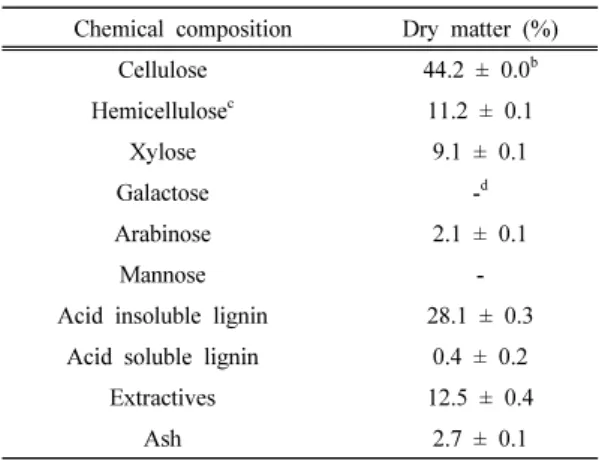
The chemical composition of the untreated M.
sinensis can be seen in Table 1. The carbohy- drate content was the most abundant fraction (cellulose and hemicellulose) followed by lignin (acid insoluble lignin and acid soluble lignin) content and extractive. Glucose (44.2%) rep- resented the largest fraction of carbohydrate, followed by xylose (9.1%). Arabinose repre- sented only a small portion (2.1%) of the M.
sinensis. However, galactose and mannose were not detected. Classification of hemicelluloses is generally done according to the main sugar residue in the backbone. Because of the large fraction of the pentose xylose, the hemicellulose of M. sinensis is of xylan type (Vanderghem et al., 2012). The lignin content of the M. sinensis was 28.5% (w/w) of which acid insoluble being 28.1% (w/w) and soluble lignin being 0.4%
(w/w). The results found for untreated M. si-
nensis are similar to those found in the liter-
ature (de Vrije et al., 2002; Sørensen et al.,
2008). The sum of cellulose and hemicellulosic
sugar gave a carbohydrate content of 55.4%.
This result is comparable to that of other sources of lignocellulosic biomass, such as switchgrass (64.5%) (Li et al., 2010a), corn stover (64.1%) (Li et al., 2010b), poplar (58.6%) (Kumar et al., 2009), rice straw (53.4%) (Chen et al., 2011), sweet sorghum bagasse (41.8%) (Li et al., 2010c), wheat straw (48.9%) (Ballesteros et al., 2006).
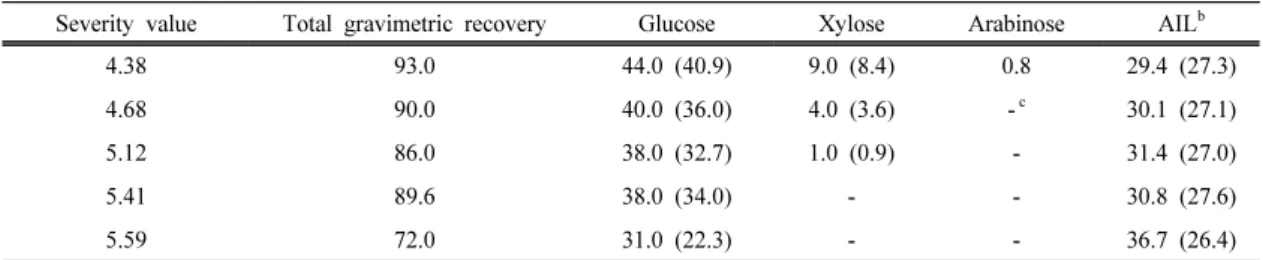
3.2. Steam explosion pretreatment The chemical composition change of M. si- nensis was important indices for the effective- ness of its pretreatment. The compositions of the steam exploded M. sinensis (solid fraction) and liquid fraction (Fig. 1) with different steam explosion conditions are listed in Table 2 and Table 3. The total gravimetric recovery of steam exploded M. sinensis and their composi- tions were obviously different depending on
steam explosion conditions. The total gravi- metric recovery ranged between 72.0 and 93.0%. A decrease of total gravimetric recovery was detected as the severity factor increased.
The glucose decreased from 44.0 to 31.0% and xylose from 9.0 to 1.0%, respectively, with se- verity factor increased from log ( Ro) 4.38 to log ( Ro) 5.59. The arabinose was removed at log ( Ro) 4.68. The largest decrease is for xy- lose, which decreases by 97% during steam ex- plosion at log ( Ro) 5.12. These results are in good agreement with Liu and Wyman, who re- ported that xylan removal increases with both temperature and residence time, and confirms that xylan is mostly solubilized as oligomers (Liu and Wyman, 2003). Removal of hemi- celluloses from the microfibrils is believed to expose the cellulose surface and increase en- zyme accessibility to the cellulose microfibrils (Kabel et al., 2007).
The acid insoluble lignin contents of the steam exploded M. sinensis, referred to raw material, showed a slight decreased at log ( Ro) 5.59. The acid insoluble lignin contents after pretreatment is affected by several parameters, such as degradation and solubilization of sugars (and also mineral, protein and wax content) leading to a concentration of lignin in the fiber fraction. However, some of the lignin is also degraded and dissolved in the liquid fraction during pretreatment e.g. as free phenols (Petersen et al., 2009).
The composition of liquid fraction after steam explosion pretreatment is shown in Table 3.
The glucose ranged between 0.7 and 1.9
Chemical composition Dry matter (%)
Cellulose 44.2 ± 0.0
bHemicellulose
c11.2 ± 0.1
Xylose 9.1 ± 0.1
Galactose -
dArabinose 2.1 ± 0.1
Mannose -
Acid insoluble lignin 28.1 ± 0.3 Acid soluble lignin 0.4 ± 0.2
Extractives 12.5 ± 0.4
Ash 2.7 ± 0.1
a
Data in the table are based on oven dry samples.
b
Mean values of duplicate samples with standard deviations.
c
Hemicellulose: xylose + galactose + arabinose + mannose
d
Not detected.
Table 1. Chemical composition of M. sinensis
ag/100 g raw material, the xylose g/100 g raw material ranged 0.8 and 2.3, respectively. The arabinose was only detected at log ( Ro) 4.38 (0.3 g/100 g raw material). Sugars were recov- ered mainly in glucose and xylose in the liquid fraction. Considerable amounts of sugar as a result of steam pretreatment have also been reported by other authors (Shevchenko et al., 2000). The pH values of liquid fraction, ranging from log ( Ro) 4.01 to log (Ro) 4.48, are also shown on Table 3. At higher steam explosion severity factor lower final pH values were obtained. Steam explosion pretreatment often result in the generation of by-products such as acetic, levulinic acids, 5-hydroxymethyl
furfural (HMF), furfural and phenolic com- pounds (Kim et al., 2011). The reduction of pH is mainly attributed to the amount of by-products.
3.3. Steam explosion pretreatment coupled with chemicals
The main component (cellulose and acid in soluble lignin) of untreated M. sinensis, steam exploded M. sinensis (log (Ro) 4.38 and log ( Ro) 4.68), and steam exploded - chemical treated M. sinensis are presented in Table 4.
Lignin is removed only to a limited extent dur- ing the steam explosion but is redistributed on
Severity value Total gravimetric recovery Glucose Xylose Arabinose AIL
b4.38 93.0 44.0 (40.9) 9.0 (8.4) 0.8 29.4 (27.3)
4.68 90.0 40.0 (36.0) 4.0 (3.6) -
c30.1 (27.1)
5.12 86.0 38.0 (32.7) 1.0 (0.9) - 31.4 (27.0)
5.41 89.6 38.0 (34.0) - - 30.8 (27.6)
5.59 72.0 31.0 (22.3) - - 36.7 (26.4)
a
Data are expressed in parentheses as a percentage based on dry weight of raw material.
b
Acid insoluble lignin
c
Not detected.
Table 2. Total gravimetric recovery rate (%) and composition (%) of solid fraction from different steam explosion conditions in M. sinensis
aSeverity value Glucose Xylose Arabinose pH
4.38 1.0 0.9 0.3 4.48
4.68 1.9 2.0 -
b4.31
5.12 1.1 2.3 - 4.18
5.41 0.9 1.8 - 4.09
5.59 0.7 0.8 - 4.01
a
Data in the table are based on oven dry samples.
b
Not detected.
Table 3. Sugar weight (g/100 g raw material) of the liquid fraction from different steam explosion conditions
in M. sinensis
athe fiber surfaces as a result of melting and depolymerization / repolymerization reactions (Kabel et al., 2007).
Overall, alkali and organic solvents changed the main components in the M. sinensis. The lowest lignin content indicated the steam ex- ploded (log ( Ro) 4.68) - 1% potassium hydrox- ide treated M. sinensis. Also, the highest cellu- lose content indicated that steam exploded (log ( Ro) 4.38) - 85 % methanol treated M. sinensis.
Generally, the steam exploded - alkali treatment results showed a low lignin contents, steam ex- ploded - organic solvent treatment has the high cellulose content.
Alkali solvent can mostly cause the dis- sociation of entire wall polymers (Li et al., 2007). Therefore, alkali gives damage to the cellulose. Sodium hydroxide solvent has been extensively studied to investigate its effect to improve glucose conversion (Chandra et al., 2012). High loading of sodium hydroxide may cause serious environmental problems due to the difficulty of recycling. While potassium hy-
droxide is also a strong base and may be recov- ered from the black liquor and used as fertilizer (Pang et al., 2008).
The steam exploded - dioxane : water (9 : 1) treated M. sinensis contained higher amount of cellulose content and lower amounts of lignin compared to chemical treated M. sinensis. In a previous study, considering the yield, separation process, and chemical activity, dioxane ex- traction was considered to be the most favor- able method to isolate lignin from bio-ethanol production residue (Guo et al., 2013).
3.4. Enzymatic hydrolysis
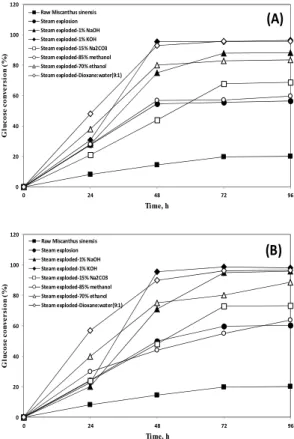
The cellulosic fiber obtained after steam exploded - chemical extraction was hydro- lyzed enzymatically to assess the effects of pretreatment. The glucose conversion during enzymatic hydrolysis is presented in Fig. 2.
The result indicated that pretreatment of substrate enhanced the glucose conversion of M. sinensis.
Sample Severity log ( Ro) 4.38 Severity log ( Ro) 4.68
Cellulose, g Lignin, g Cellulose, g Lignin, g
Steam exploded 40.9 27.3 36.0 27.1
Steam exploded - 1% sodium hydroxide 28.0 4.2 27.4 4.5
Steam exploded - 1% potassium hydroxide 28.2 4.2 27.7 3.1
Steam exploded - 15% sodium carbonate 31.9 18.1 30.7 19.0
85% methanol 36.0 13.6 32.8 10.2
70% ethanol 32.3 10.1 30.8 7.2
Dioxane : water (9 : 1) 32.9 6.9 31.3 4.1
a
Data in the table are based on oven dry samples.
Table 4. Cellulose content and lignin content (g/100 g raw material) of resulting from different chemical treatment
in steam exploded M. sinensis
aThe glucose conversion of steam exploded (log ( Ro) 4.38) - 1% sodium hydroxide, steam exploded (log ( Ro) 4.38) - 1% potassium hy- droxide, steam exploded (log ( Ro) 4.38) - 15%
sodium carbonate, steam exploded (log ( Ro) 4.38) - 85% methanol, steam exploded (log ( Ro) 4.38) - 70% ethanol and steam exploded (log ( Ro) 4.38) - dioxane : water (9 : 1) were founds to be 88.3%, 96.5%, 68.8%, 59.8%, 83.5% and 95.9%, respectively. Also, the glucose conversion of steam exploded Ro 4.68 - 1% sodium hydroxide, steam exploded (log ( Ro) 4.38) - 1% potassium hydroxide, steam exploded (log ( Ro) 4.38) - 15% sodium car- bonate, steam exploded (log ( Ro) 4.38) - 85%
methanol, steam exploded (log ( Ro) 4.38) - 70% ethanol and steam exploded (log ( Ro) 4.38) - dioxane : water (9 : 1) were founds to be 95.7%, 98.0%, 73.1%, 63.9%, 88.5% and 96.5%, respectively. Results show that when compared with the untreated M. sinensis (20.1%) and steam exploded M. sinensis (56.6% and 60.3%), both alkali and organosolv extraction increase glucose conversion. The highest conversion of cellulose into glucose is found when M. sinensis is pretreated at steam exploded (log ( Ro) 4.38) - 1% potassium hy- droxide (98.0%).
The increase in the extent of glucose con- version was proportional to the delignification (Table 3), which occurred when the delignifica- tion was increased. In previous papers (Timilsena et al., 2013), it appears that enzy- matic hydrolysis of untreatd M. sinensis, autohydrolysed M. sinensis and organosolv
M. sinensis showed low cellulose-to-glucose conversions (11%, 8% and 7% respectively).
By using the combinative pretreatment, the cellulose was made more amenable to enzyme, yielding 48% cellulose-to-glucose conversion.
A mass balance of steam exploded (log ( Ro) 4.38) - 1% potassium hydroxide and steam exploded - dioxane : water (9 : 1) treated M.
sinensis is shown in Fig. 3. This pretreatment resulted in steam exploded (log ( Ro) 4.38) - 1%
0 20 40 60 80 100 120
0 24 48 72 96
Glucose conversion (%)
Time, h Raw Miscanthus sinensis
Steam explosion Steam exploded-1% NaOH Steam exploded-1% KOH Steam exploded-15% Na2CO3 Steam exploded-85% methanol Steam exploded-70% ethanol Steam exploded-Dioxane:water(9:1)
(A)
0 20 40 60 80 100 120
0 24 48 72 96
Glucose conversion (%)
Time, h Raw Miscanthus sinensis
Steam explosion Steam exploded-1% NaOH Steam exploded-1% KOH Steam exploded-15% Na2CO3 Steam exploded-85% methanol Steam exploded-70% ethanol Steam exploded-Dioxane:water(9:1)