INTRODUCTION
In general, phytoplankton growth is limited by water velocity and light availability in streams (Wetzel, 1983; Harris, 1986; Lambert and Som- mer, 1997). But as the order of streams increase, the reduction of water velocity and the increase of nutrients enhance the growth and the primary production of phytoplankton (Wetzel, 1983;
Harris, 1986; Lambert and Sommer, 1997). Im- poundments and channelization further provide favorable condition for excessive algal growth.
Recently, many lotic ecosystems have been transformed into lentic ecosystem by the cons- truction of dams to exploit freshwater resources in Korea. The Han River system is the most re-
gulated river with a number of dams constructed in the upstream area, by which the ecosystem of the Han River was changed from lotic to a series of lentic habitats. The downstream reach of the Han River adjoining Seoul was the upper boun- dary of an estuary where tidal effect on the flow rate could be exerted. However, according to the comprehensive river regulation project, the river was deepened and impounded by two overflow dikes in order to keep stable water level facilita- ting water intake and sightseeing cruise, which provided favorable condition for algal growth in this sewage-polluted eutrophic reach.
Dynamics of the phytoplankton community and primary productivity in rivers have been in- vestigated by many researchers and the general patterns could be deduced (Wetzel, 1983; Harris,
* Corresponding Author: Tel: 033) 250-8572, Fax: 033) 251-3991, E-mail: [email protected]
─
─ 267 ──
Primary Productivity of Phytoplankton at the Eutrophic down Reach of a Regulated River (the Han River, Korea)
Namkung, Hyun, Gilson Hwang1, Bomchul Kim* and Kapsoo Kim2
(Department of Environmental Science, Kangwon National University, Chunchon, 200-701 Korea,
1 Korea Agricultural & Rural Infrastructure Corporation, Rural Research Institute,
2 Seoul Development Institute)
The downstream reach of the Han River adjoining Seoul in Korea was the upper boundary of an estuary where tidal effect on the flow rate could be exerted.
According to the comprehensive river regulation project, the river was channelized and impounded by two overflow dams, which provided favorable condition for algal growth in this sewage polluted eutrophic reach. In this study primary productivity of phytoplankton was measured in the down reach and the autochthonous and allochthonous organic carbon loadings were estimated. Primary production of phytoplankton measured by C--14 uptake and P--I model method ranged from 140 to 4,890 mgC m--2 d--1 (median value 1,865 mgC m--2 d--1) showing the level of eutrophic lakes. Phytoplankton density that varied according to water f low rate was highest in spring. Allochthonous organic carbon loading was dominated by sewage input through tributaries in most of days except flood flow period. The average proportion of autochthonous carbon generation by phytoplankton was 40.9%, which is very high proportion for a lotic habitat.
Key words : Primary production, Phytoplankton, Autochthonous organic carbon, Eutrophic river, Han River
1999) and the Nakdong River (Ha et al., 1998;
Kim and Joo, 2000), though primary productivity has been less examined. It is a general rule that the energy source in river ecosystems is terres- trial input. However, phytoplankton f lourishes in eutrophic down reach of the Han River. Hence we examined primary production of phytoplank- ton as a possible major source of organic energy in the Han River, Korea.
MATERIALS AND METHODS
Study sites and period
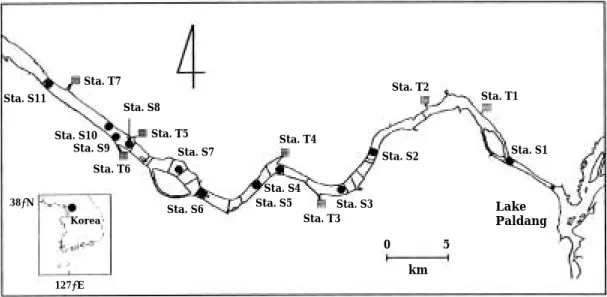
The study area was the lower reach of the Han River from Paldang Dam to Haengju Bridge (Sta.
S11) with length of 47.9 km and water surface area of 36.9 km2(Fig. 1). In this area two over- flow water dikes were constructed near the Jam- sil Bridge (Sta. S3) and near the Haengju Bridge (Sta. S11). Water quality and primary producti- vity of phytoplankton were measured at eleven stations (Sta. S1-Sta. S11 at Fig. 1). Allochthon- ous organic carbon loading from the watershed was surveyed at one mainstream site (Sta. S1) and seven tributary sites. Eight surveys were conducted from June 1993 to May 1994 to cover all seasons.
intensity was determined using a submersible photometer (Li-Cor Li-188B). The vertical light attenuation coefficient was determined from the logarithmic plot of light intensity. Water samples for nutrients analysis were preserved by the addition of sulfuric acid to pH 2. Total phospho- rus was determined by ascorbic acid method after decomposing sample by persulfate digestion method (APHA, 1992). Total nitrogen was deter- mined by autoanalyzer (SKALAR 5100) employ- ing cadmium reduction column after decompos- ing sample by persulfate digestion method (APHA, 1992). Adequate aliquots of sample were filtered through Whatman GF/C filters and the filter papers were kept frozen for chlorophyll analysis.
Filters for chlorophyll a analysis were ground in a tissue homogenizer with 6 mL of 90% acetone and centrifuged to remove turbidity. Concentra- tions of chlorophyll a were determined by spec- trophotometric method (Lorenzen, 1967).
Photosynthesis--irradiance parameters The photosynthesis-irradiance (P-I) relation- ship has been used to understand the physiologi- cal and ecological characteristics of phytoplank- ton in lakes. The parameters of initial slope (α), photoinhibition coefficient (β) and assimilation
Fig. 1. Map showing sampling sites in the Han River, Korea.
Sta. T7
Sta. T6 Sta. S8
Sta. S7
Sta. S3
Sta. S2 Sta. S1
Korea 38��N
127��E
Lake Paldang
0 5
km Sta. S6
Sta. S4 Sta. S5 Sta. S11
Sta. S10 Sta. S9
Sta. T5
Sta. T3 Sta. T4
Sta. T2
Sta. T1
number (AN) were calculated according to P-I curve model by Platt et al. (1980):
P = Ps∙(1-e-αI/Ps)∙e-βI/Ps
where P (mgC m-3 hr-1) is photosynthetic rate, Ps (mgC m-3 hr-1) is maximum potential photosyn- thetic rate, if there were no photoinhibition, α (gC m2 gChl-1 E-1) is initial slope, β(gC m2 gChl-1 E-1) is photoinhibition coefficient, and I (µE m-2 sec-1) is light intensity.
Primary productivity and autochthonous organic carbon
Primary productivity of phytoplankton was cal- culated from the measurement of P-I curves and simulation of underwater light environment (Platt et al., 1980; Kim and Kim, 1989). Photo- synthetic rates were measured by C-14 method.
Incubation of samples of Sta. S3 and Sta. S7 was performed at eight light gradients, including a dark condition, to obtain the P-I parameters.
Samples of the other sites were incubated at three light intensities around optimum light intensity of 300µE m-2 s-1 to measure the maximum pho- tosynthetic rate. Primary productivity at the sites where P-I curves were not measured was calcu- lated by using the P-I parameters of Sta. S3 or Sta. S7. Sodium bicarbonate solution of 1.25 mi- crocurie C-14 was added to each 50 mL incuba- tion bottle f illed with sample water. At the end of incubation, bottles were transferred to a dark box and filtered immediately. Filters were acid- fumed for an hour to remove remaining inorga- nic carbonates, and immersed in 10 mL of scintil- lation cocktail. Activities of fixed C-14 were measured by Packard Scintillation Counter. To- tal CO2 concentration was calculated from the alkalinity measured by Gran titration method (Gran, 1952) and dissociation factors that depend on water temperature and pH (Wetzel and Likens, 1991). Average autochthonous carbon loading of a season was obtained from the season average primary productivity (mgC m-2 day-1) at each segment multiplied by the surface area of each segment.
Allochthonous organic carbon
Inflow rate of the mainstream were obtained from the monthly average of discharge from Lake Paldang. Inflow rate and chemical oxygen de- mand (COD) of major tributaries referred to the
data of the report, ‘A study on the Han River’
(Seoul City, 1994). COD in oxygen unit (mgO2L-1) was converted into carbon unit (mgC L-1). COD concentrations were divided by the decomposi- tion efficiency of organic matter in COD analysis, 0.9 (Shin and Kim, 1986), and multiplied by molecular weight ratio of C/O2(12/32). Alloch- thonous carbon loading was calculated from the inflow rates multiplied by the concentrations of organic carbon.
RESULTS AND DISCUSSION
Physical parameters
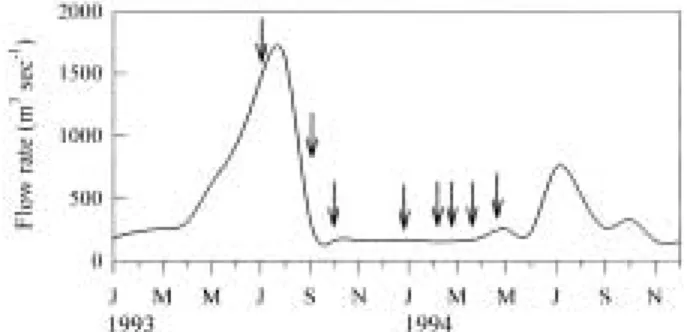
The sum of inf low rate of seven tributary streams varied from 28 to 80 m3 sec-1. The discharge from Lake Paldang ranged from 100 to 200 m3 sec-1 during dry season, while it was elevated to 1,622 m3 sec-1 during rainy season (Fig. 2). The ratio of inflow rate from tributary streams to mainstream showed to be 1 : 3 during dry season, but the ratio greatly increased to 1 : 25 in rainy season. Annual discharge from Lake Paldang contributed 89% of total water f low in this study period.
Water temperature at the downstream samp- ling sites was higher than the upstream samp- ling stations, but the difference between the sta- tions was usually less than 0.6�C (Table 1). Light extinction coeff icient was higher in summer (1.8 m-1) than other seasons (1.4 or 1.5 m-1) because of larger amount of turbid matter discharge in rainy season.
Nutrients and chlorophyll a
Total phosphorus (TP) concentrations varied
Fig. 2. Variation of inf low rate from Lake Paldang in the Han River, Korea. The arrows indicate sampling dates.
greatly seasonally (Table 1). The mean concen- tration was high in spring (735.0 mg m-3), while it was low in winter (14.5 mg m-3). Sta. S1 showed the lowest TP concentration among the stations, and TP increased at Sta. S4 and Sta. S5. TP at the downstream site S6 was near 60 mg m-3with less variation. This indicates that water quality of tributary streams (Sta. T3-Sta. T7) caused large increase of TP at the stations below Sta. S4.
Total nitrogen (TN) concentrations were near 3.5 mg L-1 with less seasonal variation than TP (Table 1). As river flow from Sta. S1 toward Sta.
S11, TN became higher. TP and TN showed lower concentration in summer when the flow rate is high. Generally, in Korea the concentra- tions of river phosphorus in upstream area are higher in summer because of storm runoff from non-point sources laden with high phosphorus (Heo et al., 1992; Lee et al., 1993; Heo et al., 1998). However, in highly populated downstream area nutrients concentration is lower in rainy season due to the dilution of sewage by storm runoff, as is the case of the Han River in this study.
Chlorophyll a concentrations varied between 2.6 and 50.2µg L-1 with higher concentration in winter and lower in summer (Table 1). Reducing of chlorophyll a concentrations was consistent with higher flow rate and higher elevated light extinction coefficient (Table 1). Lower phyto- plankton density can be expected in summer due to higher flow rate in Korean streams. However, in the Nakdong River, algal blooms occur in some dry summer (Kim et al., 1996). In 1994 we had drought in summer, and the chlorophyll a concentration at the downstream of the Nakdong River increased from 7.0~27.6µg L-1 in May to 33.0~223.0µg L-1 in August, when cyanobac- terial blooms were stimulated by warmer and stagnant water.
Chlorophyll a concentration in this study was greatly dependent on the water flow rate that
varied between 150 m3 sec-1 and 1,622 m3 sec-1 (Fig. 3). Chlorophyll a decreased down to ⁄10 µg L-1at high water flow. Spearman Rank Correla- tion showed negative correlation between chlo- rophyll a and flow rate (n = 82, r2=-0.78, P⁄
0.0001). Therefore it can be concluded that dis- charge of Lake Paldang was an important con- trolling factor determining chlorophyll a in rainy season. Similar relationship with flow rate had been reported in Kainji Lake of Nigeria where during the flood, light transparency was low and phytoplankton production was low correspon- dingly (Karlman, 1982). Smith and Demaster (1996) reported that phytoplankton photosyn- thesis influenced by river flow appeared to be limited by low levels of available irradiance in Amazon River. High oscillation of discharge may bring also variations of phytoplankton structure.
Also it had been reported that the biomass and community composition of phytoplankton were controlled by river discharge in the estuary of San Francisco Bay (Cloern et al., 1983) and in the Aliakmon River of Greece (Montesanto and Tryfon, 1999). During this study periods, cyano- bacterial blooms were not observed, although
Light (m-1) 1.8±0.2 1.5±0.3 1.5±0.1 1.4±0.2
Chl.a (µg L-1) 3.5±0.8 9.1±6.7 36.4±5.2 17.3±5.7
TP (mg m-3) 75.7±56.9 70.3±36.9 14.5±10.9 735.0±302.0
TN (mg L-1) 3.3±0.7 3.1±1.0 3.9±1.7 3.5±1.4
Fig. 3. Average chlorophyll a concentration of the Han River, Korea, as a function of discharge (n = 82).
phytoplankton standing crop was high. Six phy- toplankton groups -Bacillariophyceae, Chloro- phyceae, Cyanobacteria, Dinophyceae, Crypto- phyceae and Euglenophyceae- were represented (Seoul city, 1994). Aulacoseira granulata was do- minant in summer (49.9% of the total cell den- sity). In autumn, Aulacoseira granulata and Cryptomonas ovata co-occurred (35.0 and 41.6%, respectively). Stephanodiscus hantzschii and Cyclotella sp. dominated during winter (95.1%) and spring (69.1%), respectively.
Parameters of P--I curve model
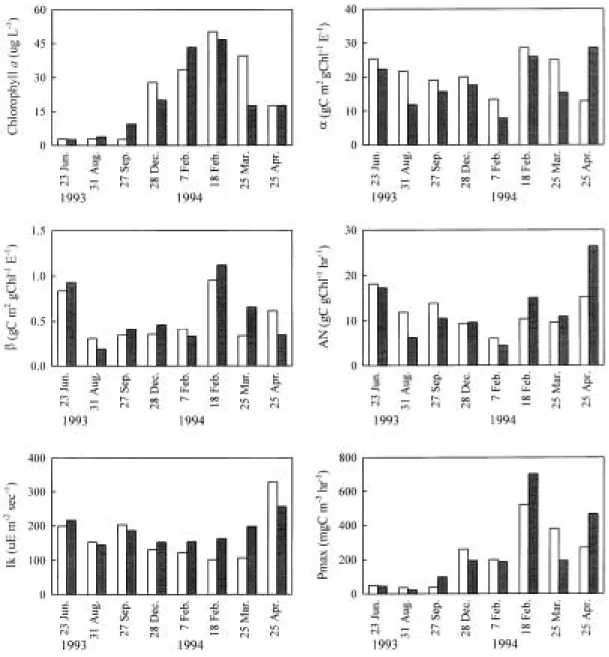
Table 2 shows means and standard deviations of the P-I parameters at Sta. S3 and S7. Maxi- mum photosynthetic rate (Pmax) was highest in winter and spring and was lowest in summer (Fig. 4). Pmax had its maximum in the end of Fe- bruary (521 and 703 mgC m-3hr-1at Sta. S3 and Sta. S7, respectively). Correlations between chlorophyll a and Pmax were highly positive (n = 71, r2= 0.65, P⁄0.001), implying productivity is primarily determined by biomass as reported in Lake Soyang (Hwang, 1996).
Initial slope (α) of P-I curves at Sta. S3 and Sta. S7 showed similar range (Fig. 4). Initial slope was much higher than other reports from lakes, which implies phytoplankton in the Han River is suffering limitation of light because the variation of initial slope is thought to be the result of adaptation of algae to light availability.
Harrison et al. (1985) reported initial slopes ranging 0.039 to 0.056 gC m2 gChl-1 hr-1 w-1 in two arctic and one temperate marine surveys, corresponding to 2.4 and 3.4 gC m2 gChl-1 E-1. The variation of α in this study did not show sig- nificant seasonal variation pattern that was ob- served in a temperate lake (Kim and Kim, 1989).
Photoinhibition coefficient (β) ranged 0.340~
0.571 gC m2 gChl-1 E-1 and 0.411~0.634 gC m2 gChl-1 E-1 at Sta. S3 and Sta. S7, respectively
(Fig. 4). β can vary with species composition of phytoplankton and underwater light availability associated with light penetration and surface mixing depth. In this study β showed the sea- sonal trend that it was higher in winter than in autumn (P⁄0.05). Hwang (1996) reported in Lake Soyang that β was measured 0.001~0.10 gC m2 gChl-1 E-1 from April to September, then was elevated 0.05~2.0 gC m2 gChl-1 E-1 from October to March, coinciding with the increase of mixing depth. In Lake Paldang, β had been re- ported to show a maximum of 0.69 gC m2 gChl-1 E-1in August and minimum of 0.08 in May (Han et al., 1999). Transparency of 1.0 m in August and 1.5 m in May was attributed to the seasonal difference of β. Kim and Kim (1989) reported that β was much higher in autumn, which is thought to be caused by the adaptation of phytoplankton to low light intensity due to high turbidity.
Assimilation number (AN) is the photosynthe- tic rate per unit amount of chlorophyll a at the optimum light intensity that reflects overall effi- ciency of photosynthesis determined by tempera- ture and nutrients concentration. In this study it varied between 8.6 and 15.0 gC gChl-1hr-1 at Sta. S3, and between 9.7 and 18.7 gC gChl-1 hr-1 at Sta. S7 (Fig. 4). But AN did not show signifi- cant seasonal pattern. Hwang (1996) reported in Lake Soyang that AN was high in summer and low in cold seasons, which coincided with varia- tions of temperature and phosphorus concentra- tions in lake water. In Lake Paldang, AN rea- ched a maximum of 20.5 gC gChl-1 hr-1 in Au- gust, then decreased to 11.3 gC gChl-1hr-1 in October (Han et al., 1999).
Ik, the light intensity at the intersection of an extension from the initial slope of P-I curves and Pmax, is often cited as a measure of light-adap- tation. Ik showed significant variation between seasons, which was the highest in spring and the lowest in winter (P⁄0.05). Hwang (1996) reported in Lake Soyang that Ikvaried from 79 to 128µE
Table 2. Initial slope (α), photoinhibition coefficient (β), assimilation number (AN) and light saturation value (Ik) of P-I curves at Sta. S3 and Sta. S7 (mean±SD) from 1993 to 1994 in the Han River, Korea.
α(gC m2 gChl-1 E-1) β(gC m2 gChl-1 E-1) AN (gC gChl-1 hr-1) Ik(µE m-2 sec-1) Sta. S3 Sta. S7 Sta. S3 Sta. S7 Sta. S3 Sta. S7 Sta. S3 Sta. S7 Summer (n = 2) 23.5±1.8 17.1±5.3 0.569±0.268 0.558±0.372 15.0±3.1 11.7±5.6 176±24 180±36
Autumn (n = 1) 19.0 15.7 0.340 0.411 13.9 10.5 203 186
Winter (n = 3) 20.7±6.2 17.1±7.4 0.571±0.271 0.634±0.348 8.6±1.9 9.7±4.4 118±13 156±4 Spring (n = 2) 19.0±6.1 22.0±6.7 0.474±0.143 0.499±0.159 12.5±2.9 18.7±7.8 218±112 227±29
m-2 sec-1, and it was higher in summer than in winter. Wolfstein et al. (2000) reported in the bay of Meldorf of the German Wadden Sea that Ik
was low in spring (40µE m-2 sec-1) and increased towards summer (140µE m-2 sec-1).
Primary production of phytoplankton
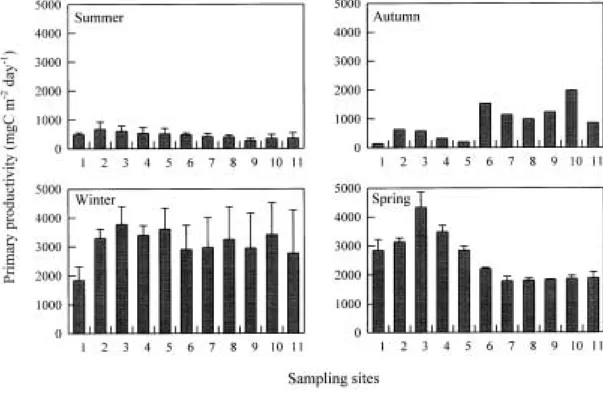
Primary productivity of phytoplankton varied between 140 and 4,890 mgC m-2 day-1(Fig. 5).
Productivity was maximum at Sta. S3 and Sta.
S4 with mean of 3,366 and 3,079 mgC m-2 day-1,
respectively, and it was lower at Sta. S1 and Sta.
S11. The seasonal variations of productivity were very high. While productivity was low consisten- tly, about 500 mgC m-2 day-1 in summer, it was elevated up to 1,000 mgC m-2 day-1in autumn at the downstream sites of Sta. S6. In winter, pro- ductivity increased substantially to about 3,000 mgC m-2 day-1at all sites except for Sta. S1. And productivity was maintained high up to 2,000 mgC m-2 day-1at the upstream sites of Sta. S6 in spring.
Primary productivity of phytoplankton gene-
Fig. 4. Chlorophyll a concentraions, maximum phytosynthetic rate and P-I parameters (α, β, AN and Ik) at Sta. S3 (open bars) and Sta. S7 (shaded bars) in the Han River, Korea.
rally increases with eutrophication (Likens, 1975;
Wetzel, 1983). Typical productivity in oligotro- phic, mesotrophic and eutrophic lakes range between 50~300, 250~1,000 and more than 600 mgC m-2 day-1, respectively (Likens, 1975). In the Han River, high productivity in the seasons except for summer is typical of eutrophy to accor- ding to the classification scheme of Likens (1975).
This indicates that high nutrients concentrations and low water velocity lead to eutrophication in the Han River (Table 1; Fig. 3; Fig. 5). Similar results have been recorded in the lower part of the Nakdong River. Estuarine dam was cons- tructed at the Nakdong River mouth resulting in the increase of nutrients concentrations and sta- gnation of water body, and then it caused cyano- bacterial blooms in a source of drinking water (Kwon, 1991; Ha et al., 1998). High primary productivity of 1,000 mgC m-2 day-1was reported in estuarine reservoir of the Youngsan River and the Kum River, too (Kim et al., 1997b).
Even though the Han River is a lotic habitat, trophic state was similar to that of domestic large reservoirs, such as Lake Daechung, Lake Okjong and Lake Hapchon, from the point of high productivity all the year round (Hwang et
al., 1994; Kim et al., 1997a; Kim et al., 1998).
Primary productivity was reported in the reser- voirs located on the Han River as follows. In Lake Soyang, it was 141~1,156 mgC m-2 day-1 in 1995~1997 (Kim et al., 2000b) and 255~828 mgC m-2 day-1in 1998~1999 (Kim et al., 2000a).
In Lake Euiam, it was 1,293 mgC m-2 day-1 in 1993~1994 (Kim et al., 1997b). In Lake Paldang, it was measured 1,000~2,000 mgC m-2 day-1 in 1993~1994 (Kim et al., 1995) and 8,195~9,341 mgC m-2 day-1in August 1992 (Han et al., 1999).
As rivers flow toward the lower part of the river from reservoirs located in upstream, productivity increased gradually. Growth of phytoplankton was likely to controlled by wash out and light transparency during stormy season in the Han River (Fig. 3).
Contribution of phytoplankton to organic carbon loading
Organic carbon loading by phytoplankton was from 18 to 112 tC day-1(Table 3). It was higher in winter and spring when phytoplankton standing crop was higher (Fig. 5). Carbon loading from main stream varied from 15 to 195 tC day-1, while organic matter discharge from tributaries show-
Fig. 5. Primary productivity of phytoplankton (mean±SD) in the Han River.
ed less variation ranging from 49 to 88 tC day-1. Phytoplankton production contributed average 32.4% of total carbon loading (Table 3). Contribu- tion of allochthonous loading to total carbon loading was 67.6% with the contribution of main streams and tributaries of 29.6% and 38.0%, res- pectively. Kim et al. (1996) reported that contri- bution of primary production to total carbon loading was 49% in the Nakdong River that is high level, considering it was a lotic ecosystem.
Discharge during f lood period must be exclude in the calculation of relative organic carbon contri- bution because hydraulic residence time is very short during f lash f lood period and discharged material is just washed away to the sea without affecting ecosystem of the river itself. Even in large reservoirs such as Lake Soyang storm runoff laden with high concentrations of organic carbon and phosphorus just pass through the intermediate layer of stratified ecosystem (Kim et al. 2000b). If f lood f low period is exclude from the loading calculation in the Han River, contri- bution of phytoplankton to total carbon loading become higher to 40.9%, while contribution of allochthonous loading become lower to 59.1%
(main stream and major tributaries were 14.7%
and 44.4%, respectively).
In conclusion, it can be concluded that primary productivity of phytoplankton in the downstream reach of the Han River is as high as eutrophic lentic habitats. Average 40.9% of organic carbon loading was contributed by phytoplankton pro- duction, which implies the necessity of additional processes for algal control in order to reduce organic matter pollution in the Han River. In addition to organic carbon removal from sewage
REFERENCES
American Public Health Association. 1992. Standard Methods for the Examination of Water and Was- tewater, 18th ed. APHA, Washington D.C.
Cloern, J.E., A.E. Alpine, B.E. Cole, R.L.J. Wong and J.F. Arthur. 1983. River discharge controls phyto- plankton dynamics in the northern San Francisco Bay estuary. Estuarine, Coastal and Shelf Science 16: 415-429.
Descy, J.P. 1993. Ecology of the phytoplankton of the River Moselle: effects of disturbances on commu- nity structure and diversity. Hydrobiologia 249:
111-116.
Gran, G. 1952. Determination of the equivalence point in potentiometric titrations. Part II. Analyst 77:
661-671.
Ha, K., H.W. Kim and G.J. Joo. 1998. The phytopl- ankton succession in the lower part of hypertro- phic Nakdong River (Mulgum), South Korea.
Hydrobiologia 369/370: 217-227.
Han, M.-S., D.-S. Yi, J.-K. Ryu, Y. Park and K.-I.
Yoo. 1999. Ecological studies on Pal’tang river- reservoir system in Korea. 3. Photosynthetic para- meters and primary productivity of phytoplank- ton. Kor. J. Limnol. 32: 8-15 (in Korean).
Harris, G.P. 1986. Phytoplankton Ecology. Chapman and Hall, New York.
Harrison, W.G., T. Platt and M.R. Lewis. 1985. The utility of light-saturated models for estimating maring primary productivity in the field; A com- parison with conventional “simulated” in situ methods. Can. J. Fish. Aquat. Sci. 42: 864-872.
Heo, W.M., B. Kim, T.S. Ahn and K.J. Lee. 1992.
Phosphorus loading from watershed and f ish- farms into Lake Soyang and the phosphorus budget. Kor. J. Limnol. 25: 207-214 (in Korean).
Heo, W.M., B. Kim, Y. Kim and K.S. Choi. 1998. Storm runoff of phosphorus from nonpoint sources into Lake Soyang and transportation of turbid water- mass within the lake. Kor. J. Limnol. 31: 1-8 (in Korean).
Hwang, G. 1996. A study of the primary productivity and eutrophication in Lake Soyang. Ph.D. Thesis.
Kangwon National University (in Korean).
Hwang, G., D.S. Kim, W.M. Heo and B. Kim. 1994.
The primary productivity and the organic carbon loading from the watershed and fishfarming in Lake Daechung. Kor. J. Limnol. 27: 299-306 (in Korean).
Karlman, S.G. 1982. The annual flood regime as a regulatory mechanism for phytoplankton produc- Phytoplankton Mainstream Tributary loading
tC day-1 tC day-1 tC day-1 tC day-1
(%) (%) (%)
Summer 18 ( 6.9) 195 (74.4) 49 (18.7) 26 Autumn 29 (22.0) 15 (11.3) 88 (66.7) 132 Winter 112 (56.6) 20 (10.1) 66 (33.3) 198 Spring 101 (44.1) 52 (22.7) 76 (33.2) 229
Mean (32.4) (29.6) (38.0)
(40.9)* (14.7)* (44.4)*
*indicates calculation excluding data of summer season.
tion in Kainji Lake, Nigeria. Hydrobiologia 86:
93-97.
Kim, B. and D.S. Kim. 1989. Primary productivity measurement by Photosynthesis-Irradiance model method in Lake Soyang and the behavior of model parameters. Kor. J. Limnol. 22: 167-177.
Kim, B., D.S. Kim, G. Hwang, K. Choi, W.M. Heo and W.K. Park. 1996. Contribution of primary produc- tion of phytoplankton to organic pollution in a eutrophic river, the Naktong River. Algae 11: 231 -237 (in Korean).
Kim, B., H. Namkung, D.S. Kim, G. Hwang, K. Choi and C. Kim. 2000a. The contribution of primary productivity of phytoplankton to organic carbon loading in a deep reservoir, Lake Soyang, Korea.
The 65th Annual Meeting of Japanese Limnologi- cal Society, Fukuoka, Japan.
Kim, B., J.H. Park, B.J. Lim, W.M. Heo, G. Hwang, K. Choi and K.S. Chae. 1997a. The limnological survey of major reservoirs in Korea (1): Lake Okjong. Kor. J. Limnol. 30: 431-453 (in Korean).
Kim, B., J.H. Park, B.J. Lim, W.M. Heo, G. Hwang, K. Choi and K.S. Chae. 1998. The limnological survey of major reservoirs in Korea (2): Lake Hap- chon. Kor. J. Limnol. 31: 312-327 (in Korean).
Kim, B., J.H. Park, G. Hwang and K. Choi. 1997b.
Eutrophication of large freshwater ecosystems in Korea. Kor. J. Limnol. 30: 512-517.
Kim, B., K. Choi, C. Kim, U.H. Lee and Y.H. Kim.
2000b. Effects of the summer monsoon on the dis- tribution and loading of organic carbon in a deep reservoir, Lake Soyang, Korea. Wat. Res. 34:
3495-3504.
Kim, D.S., B. Kim, G. Hwang and J.H. Park. 1995.
Trend of Eutrophication in Lake Paldang. J. Kor.
Soc. Wat. Pol. Res. Con. 11: 295-302 (in Korean).
Kim, H.W. and G.J. Joo. 2000. The longitudinal distribution and community dynamics of zoopl- ankton in a regulated large river: a case study of the Nakdong River (Korea). Hydrobiologia 438:
171-184.
Kim, S.H. and J.H. Lee. 1999. Environmental studies of the lower part of Han River IV. Zooplankton dynamics. Kor. J. Limnol. 32: 16-23 (in Korean).
Kwon, O.S. 1991. Effect of River Barrage on the Changes of Environmental Factors in Naktong Estuary. Kor. J. Limnol. 24: 231-238 (in Korean).
Lambert, W. and U. Sommer. 1997. Limnoecology:
the ecology of lakes and streams. Oxford Univer- sity Press, Inc.
Lee, K.J., W.M. Heo and B. Kim. 1993. Phosphorus loading from watershed and fishfarms into Lake Daechung and the phosphorus budget. J. Kor. S.
Wat. Pollut. Res. Cont. 9: 139-144 (in Korean).
Likens, G.E. 1975. Primary production of inland aquatic ecosystem, In: Primary productivity of the biosphere (H. Lieth and R.H. Whittaker eds.).
Springer Verlag, New York.
Lorenzen, C.J. 1967. Determination of chlorophyll and pheo-pigments: spectrophotometric equation.
Limnol. Oceanogr. 12: 343-346.
Montesanto, B. and E. Tryfon. 1999. Phytoplankton community structure in the drainage network of a mediterranean river system (Aliakmon, Greece).
Int. Rev. Hydrobiol. 84: 451-468.
Platt, T., C.L. Gallegos and W.B. Harrison. 1980. Pho- toinhibition of photosynthesis in natural assem- blages of marine phytoplankton. J. Mar. Res. 38:
687-701.
Seoul City. 1994. A study on the Han River. Seoul Development Institute (in Korean).
Shin, J.R. and Y.H. Kim. 1986. Analysis of Oxygen Consumption, “Part 2 of Water quality; DO, BOD, OC Analysis”. Nokwon Press, Seoul (in Korean).
Smith, W.O. and D.J. Demaster. 1996. Phytoplank- ton biomass and productivity in the Amazon River plume: Correlation with seasonal river discharge.
Cont. Shelf Res. 16: 291-319.
Sorokin, Y.I. and P.Y. Sorokin. 1996. Plankton and primary production in the Lena River Estuary and in the south-eastern Laptev Sea. Estuarine, Coa- stal and Shelf Science 43: 399-418.
Wetzel, R.G. 1983. Limnology. Saunders College Publishing, Orlando.
Wetzel, R.G. and G.E. Likens. 1991. Limnological analyses. 2nd ed. Springer Verlag, New York.
Wolfstein, K.F. Colijn and R. Doerffer. 2000. Seaso- nal dynamics of microphytobenthos biomass and photosynthetic characteristics in the northern German Wadden Sea, obtained by the photosyn- thetic light dispensation system. Estuarine, Coastal and Shelf Science 51: 651-662.
(Received 1 Nov. 2001, Manuscript accepted 5 Dec. 2001)
부영양한 한강하류수역에서 식물플랑크톤의 1차생산
남궁현∙황길순1∙김범철*∙김갑수2
(강원대학교 환경과학과, 1농업기반공사 농어촌연구원, 2서울시정개발연구원)
수도권의 중심부를 가로지르는 한강의 하류수역은 조수의 영향을 받을 수 있는 하구의 상단부에 위치해 있다. 한강 하류수역은 한강종합개발사업의 일환으로 이루어진 준설과 수중보 건설에 의해 서 강물이 정체되었으며, 또한 지천으로부터 유입되는 많은 오염물질에 의해서 식물플랑크톤의 대 량 발생을 촉진할 수 있는 환경으로 변화되었다. 본 연구에서는 부영양한 한강 하류수역에서 식물 플랑크톤의 1차생산을 측정하였으며, 더불어 내부생성유기물과 외부기원유기물을 산정하였다. 1차 생산력은C-14 uptake법과 P-I 모델법으로 측정하였다. 1차생산력의 범위는 140~4,890 mgC m-2 day-1(중앙값1,865 mgC m-2 day-1)이었으며, 국내의 부영양한 호수와 유사한 수준이었다. 식물플랑 크톤의 생물량 변동은 봄철에 최대치를 보였으며, 유량의 변화와 관련이 있는 것으로 나타났다. 외 부기원유기물은 여름철 홍수기를 제외한 연중 내내 지천을 통하여 유입되는 오염물질에 의해서 좌 우되었다. 총 유기물 부하량에 대하여 식물플랑크톤의 1차생산이 차지하는 기여도는 40.9%로서, 유수 생태계로서는 높은 수준이었다.