─ 71 ─ ISSN: 2288-1115 (Print), 2288-1123 (Online)
ⓒ The Korean Society of Limnology. All rights reserved.
This is an open-access article distributed under the terms of the Creative Commons Attribution Non-Commercial License (http://creativecommons.org/licenses/by-nc/3.0/), which permits unrestricted non-commercial use, distribution, and reproduction in any medium, provide the original work is properly cited.
한반도 담수어류의 분포와 다양성
윤주덕·김정희
1
·박상현1
·장민호2,
*국립생태원 환경영향평가팀,
1
에코리서치,2
공주대학교 생물교육과The Distribution and Diversity of Freshwater Fishes in Korean Peninsula. Yoon, Ju-Duk (0000-0003-1667- 327X), Jeong-Hui Kim
1(0000-0003-2331-4232), Sang-Hyeon Park
1(0000-0003-4014-3375) and Min-Ho Jang
2,* (0000-0001-6108-3186) (Environmental Impact Assessment Team, National Institute of Ecology, Seocheon 33657, Republic of Korea;
1EcoResearch, Gongju 32588, Republic of Korea;
2Department of Biology Education, Kongju National University, Gongju 32588, Republic of Korea)
Abstract A recent topic of interest within ecology is ecosystem services that are importantly connected with
biodiversity. Biodiversity is a fundamental component of ecological studies and has been the subject of many studies worldwide. However, studies on the diversity and distribution of freshwater fish were not undertaken in earnest until 2000, and the number of internationally available studies is therefore still limited. In this study, we used data from “The Survey and Evaluation of Aquatic Ecosystem Health(hereafter SEAEH)” within the framework of which whole water systems on the Korean peninsula are annually monitored to investigate and determine the current status of the diversity and distribution of freshwater fish, as well as to elucidate major factors impacting freshwater fish. A total of 130 species from 28 families were identified at around 953 sites in the SEAEH investigation of 2014. The species Zacco platypus(relative abundance: 28.2%) and Z.koreanus
(19.3%) were identified as the most abundant species on the Korean peninsula, and besides these 20 endangered species, 51 endemic species and 4 exotic species were also collected. Highest(96 species) and lowest(72 species) diversity were identified in the Han River Watershed and the Yeongsan/Seomjin River Watershed, respectively. The mean endemic rate was 32.7%, which is higher than the previous rate determined in 1995. The exotic species Micropterus salmoides, Lepomis macrochirus and Carassius cuvieri were found in the whole river system except north Yeongdong, whereas Oreochromis niloticus occurred only at three sites due to the cold water temperatures in winter. Totally, 28 species were found to be translocated to different water systems not connected with known original habitats, most translocations occurring in the Nakdong River and the Yeongdong region. Among the translocated species, Opsariichthys uncirostris amurensis, andErythroculter erythropterus were dominantly distributed in the mid- to lower reaches of Nakdong River where
they may be harmful to the native fish assemblages due to their strong predation. The construction of weirs in connection with the “4 River Project” generated changes in fish assemblages before, during and after the project, resulting in altered habitat condition. Especially, a decrease in the number of endemic species and an increase in the abundance of lentic species were seen. Human-induced global warming will allow exotic species requiring high water temperatures to adapt to the environmental conditions of the Korean peninsula,Manuscript received 5 January 2018, revised 31 January 2018, revision accepted 15 March 2018
* Corresponding author: Tel: +82-41-850-8285, Fax: +82-41-850-8842,
E-mail: [email protected]
서 론
최근 연구의 흐름에 의하면 생물다양성은 단순히 생물 의 다양함 차원에서 벗어나 생태계 기능과 생태계 서비스 와 관련되며, 이는 최종적으로 인간의 웰빙과 연관이 있는 것으로 알려져 있다(Naeem et al., 2009). 기후변화와 인간 에 의한 영향으로 담수생물 다양성의 변화를 파악 및 예측 하기 위해서는 광범위한 지식 및 정보가 필요하다(Heino
et al., 2009). 특히, 분포와 다양성에 대한 정보, 관련 예측
모델링을 위한 충분한 정보가 없으면, 변화에 대한 분석이 나 예측을 시행할 수 없다(Heino et al., 2009). 북미와 유럽 에서는 1960년대에 이미 누적된 과거의 방대한 분포 자료 를 바탕으로 개체군 및 군집 생태와 동시에 생태계와 연관 성을 파악하는 등 현대의 ‘어류 생태학’ 연구를 수행하였 고, 1980년대 이후 연구의 범위가 확장되면서 생물다양성 위기와 같은 문제들이 담수 어류 연구의 이슈가 되기 시작 하였다(Matthews, 1998).일반적으로 생물의 분포 변화를 야기하는 요인은 인위 적, 자연적 교란이 대표적이며 물리적, 화학적, 생물학적 요인으로 구분되어 발생한다. 담수어류는 물이라는 특수한 환경에 서식하는 특성상 수체를 따라서 이동하고 분포하 면서(Fagan, 2002), 환경의 변화가 발생하면 다른 분류군 에 비해 쉽게 교란 받을 수 있고(Toft et al., 2018) 복원이 어렵다(Detenbeck et al., 1992). 또한 담수지역은 인간의 생활권과 밀접하게 연관되어 있고 많은 변화가 발생하는 지역이면서 다른 영역의 생태계(육상, 해양 등)에 비해 쉽 게 교란 받으며 회복이 오래 걸리는 특성이 있다(Ricciardi and Rasmussen, 1999; Baron et al., 2002). 국내 하천들은 인구밀도가 높은 국내 실정을 반영하듯 집수역 전체에 걸 쳐 많은 교란들이 발생하였다. 담수의 활용을 위한 인간의 개발 행위는 하천에 물리적, 화학적, 생물학적 변화를 초 래하며 직접적으로 담수어류의 다양성 및 분포 변화를 야 기할 뿐만 아니라, 하천주변 및 하천내의 서식지 다양성의 감소를 초래하여 수생생물들의 분포와 다양성에 장·단기 적이고 직·간접적인 영향을 초래한다(Finkenbine et al., 2000; Schweizer and Matlack, 2005). 또한, 대표적인 환경 변화인 기후변화도 담수어류의 상당한 변화를 초래한다. 지구온난화로 인한 수온의 상승은 생리적으로 체온조절
능력이 없는 담수어류의 재분포 및 다양성의 변화를 초래 한다(Wood and McDonald, 1997). 특히, 냉수성 어류는 기 후변화가 유발하는 서식처 감소로 인한 종 분포의 문제가 생존과 직접적인 연관이 있다(Schindler et al., 1990; Rahel
et al., 1996; Stefan et al., 2001). 뿐만 아니라 기후변화로
인한 하천 유량 변화도 담수어류를 절멸에 이르게 할 수 있어, 국지적 또는 범국가적인 측면에서 많은 문제로 대두 되고 있다(Xenopoulos et al., 2005).어류의 다양성 및 분포에 대한 자료는 기본적이면서 중 요한 연구이지만 국내에서는 대부분의 연구가 생리, 분자, 발생에 집중되어 수행되었으며, 그 수는 다양성 및 분포와 관련된 연구에 비해 6배 이상 많은 것으로 나타났다(2009 년 기준 분포 및 다양성 관련 논문수 250여 건, 생리, 분자, 발생 관련 논문수 1,500여 건 이상; Yoon et al., 2012). 국 내 담수어류의 분포와 다양성에 관련된 연구는 2000년대 이후부터 증가하기 시작하였으나 대부분 국가하천이나 일 부 하천을 대상으로 하는 소규모의 연구 위주로 전 수계를 대상으로 제시된 연구결과(i.e. Choi, 1973)는 제한적이었 다(Yoon et al., 2012). 국내 수계 전체의 어류 분포와 다양 성을 파악하기 위해서는 많은 시간과 노동력이 필요로 하 기 때문에 개별 연구자들이 전국적인 어류군집 분포 및 다 양성을 파악하기가 매우 어려우며, 따라서 자료의 정밀도 가 낮다는 한계가 존재한다. 많은 연구자들이 전국적인 수 준에서의 어류군집 분포 및 다양성에 대한 연구의 필요성 을 제기하였으나 앞서 언급한 현실적인 제약으로 인해 대 부분의 연구가 문헌자료들을 취합하여 전반적인 어류상을 제시하는 수준에서 이루어져 왔다.
2008년부터 국가 생물측정망의 일환으로 진행된 “하천 수생태계 조사 및 건강성 평가(MOE/NIER, 2008~2016)”
는 전 수계를 대상으로 다수의 연구자들이 동시에 조사를 수행하는 대규모 국가 프로젝트이다. 최근에는 지점의 수 를 확대하여 전국의 960개 지점에서 수생 생물의 다양성 을 동시에 모니터링 하고 있으며, 이를 통해 국내 하천 수 계의 현 상황을 효과적으로 파악할 수 있다. 본 논문에서 는 “하천 수생태계 조사 및 건강성 평가”에서 조사된 어류 군집을 활용하여 현재 한반도에 서식하고 있는 담수어류 의 분포와 다양성을 분석하였다. 해당 자료 및 결과를 활 용하여 국내 담수어류의 수계별 분포 및 다양성을 분석하 which may enhance the diversity of native fishes and create changes in distribution. For the establishment of realistic and efficient management and protection strategies for Korean freshwater fish, SEAEH, which produces fundamental and quantitative data for Korean streams, is an important and necessary tool.
Key words: freshwater fish distribution, fish diversity, exotic species, translocated species, Korean peninsula
였으며, 이외 국내에서 진행된 다수의 연구결과를 활용하 여 생물학적(도입종 영향), 물리적 교란요인(4대강 사업관 련 자료 활용)으로 인한 어류군집의 변화 양상을 분석하였 다. 이러한 결과를 통해 최종적으로 현재 국내 담수어류의 다양성을 유지하고 보호할 수 있는 방안과 함께 향후 기후 변화와 개발 등으로 인해 발생할 수 있는 각종 변화에 대 해서 고찰하였다.
재료 및 방법
1. 담수어류 분포 및 다양성
국내 담수어류의 분포 및 다양성 파악을 위하여 “하천 수생태계 현황 조사 및 건강성 평가(이하 수생태계 건강 성 평가; MOE/NIER, 2008~2016)”의 결과와 국내의 담수 어류를 대상으로 수행된 어류상 및 분포 특성과 관련된 문 헌자료를 활용하였다. 수생태계 건강성 평가는 2014년 수 행된 조사결과를 활용하였다. 2014년 조사는 한반도에 분 포하는 하천의 총 960개 지점을 4개의 수계(한강, 낙동 강, 금강, 영산/섬진강)로 구분하였으며, 이에 대해 상반기 (5~6월)와 하반기(9~10월)에 걸쳐 2회 조사가 시행되었 다(Fig. 1). 각 수계별로 구분 시 한강 수계 360지점, 낙동강 수계 250지점, 금강 수계 170지점, 영산/섬진강 수계 180 지점이 포함되며, 어류 조사는 투망(망목 7mm; 포획면적 4.5m
2
)과 족대(망목 5mm; 포획면적 1.35m2
)를 활용하여 수행되었다. 조사가 이루어진 960개 지점 중 제주도 7개 지점을 제외한 953개 지점의 결과를 활용하여 분석을 시 행하였다. 제주도는 담수어류가 거의 서식하지 않고 서식 하는 어류도 대부분 인위적으로 본토에서 이입되어 분석 에서 제외하였다. 수생태계 건강성 평가의 담수어류 결과 는 대권역별, 수계별로 구분하여 제시하였다. 대권역은 한 강, 낙동강, 금강, 영산/섬진강을 포함한 4개로 구분하였으 며, 수계별로는 한강 대권역(7개 수계)에 포함되는 남한강, 북한강, 한강본류, 임진/한탄강, 안성청, 한강서해, 한강동 해, 낙동강 대권역(5개 수계) 낙동강, 형산강, 태화강, 낙동 강동해, 낙동강남해, 금강 대권역(5개 수계)에 포함되는 금 강, 만경강, 동진강, 삽교천, 금강서해, 영산/섬진강 대권역 (5개 수계)에 포함되는 영산강, 섬진강, 탐진강, 영산강서 해, 섬진강남해로 구분하였다. 담수어류의 생태학적 분류 및 고유종에 대한 정보는 Kim and Park(2002)을 활용하였 고, Nelson(2016)의 분류체계를 따랐다. 담수어류 중 일차 담수어류(Primary freshwater fish)에 대한 구분은 Kim and Park(2002)과 FishBase 자료를 활용하여 수행하였다.국가별 담수어류의 다양성 비교는 전 세계 어류에 대 한 데이터베이스를 구축해 놓은 FishBase(Http://www.
fishbase.org)의 자료를 활용하였다. 자료의 일관성을 유 지하기 위해서 국내 출현 담수어류도 FishBase에 등록된 결과를 활용하였으며, 국가적 비교를 위해 인접하고 있 는 아시아권의 중국, 일본, 몽골과 유럽의 프랑스, 독일, 영 국, 오세아니아의 호주, 아메리카 대륙의 캐나다와 미국 을 비교하였다. 각 국가별 전체 출현종은 고유종(endemic species), 외래종(exotic species), 토착종(native species)으 로 구분하여 표시하였다. 또한 각 국가의 규모를 알 수 있 게 국가 면적도 함께 제시하였다.
물리적인 변화가 어류군집에 미치는 영향을 분석하기 위 해서 4대강 사업이 이루어진 낙동강을 대상으로 4대강 공 사 전/중/후 어류군집을 비교하였다. 분석에 사용된 자료는 낙동강 물환경연구소에서 낙동강 보 설치구간을 대상으 로 수행한 “보 설치 전후 수생태계 영향 평가 및 복원대책 연구”(Nakdong River Watershed Management Committee, 2010, 2013)와 Jang et al.(2001)과 Kang et al.(2004)의 자
Fig. 1. Map of study sites of “Survey and Evaluation of Aquatic
Ecosystem Health in Korea” conducted in 2014. A total of
953 sites were investigated.
료를 활용하였다. 분석에 사용된 지점은 총 9개로 4대강 사 업 전/중/후의 어류군집 비교를 위해 연구별 최대한 동일 한 지점을 선정하여 어류군집을 비교하였다. 지점은 상주 보하류(RK, River Kilometer 250km), 낙단보상류(RK 239 km), 낙단보하류(RK 234km), 구미보상류(RK 224km), 칠 곡보상류(RK 194km), 칠곡보하류(RK 183km), 달성보상 류(RK 149km), 합천보상류(RK 120km), 창녕함안보상류 (RK 78km)였다.
2. 자료 분석
보 설치로 인한 어류 군집의 변화 비교를 위해 다차원척 도법(NMDS, nonmetric multidimensional scaling)을 활용 하였다. NMDS는 2차원 공간에 유사도 매트릭 자료의 연 관성을 최대로 하는 형태로 구현된다(Field et al., 1982).
시기별 조사지점의 어류 군집 분포 차이를 확인하기 위한 유사도 매트릭은 출현 어류 자료를 square-root로 변환 후, Bray-Curtis 유사도 지수를 통해 산출된 자료로 작성되었 다. 결과의 유의성은 stress value로 표현되며, 0.2 미만일 경우 fair, 0.05 미만일 경우 excellent로 나타난다(Clarke and Warwick, 1994). 공사 전/중/후 어류 군집의 통계적인 차이는 PERMANOVA(permutational multivariate analysis of variance)를 통해 분석하였다(Anderson et al., 2005). 어 류 군집변화 파악을 위한 분석은 Primer 6.0(Primer-E Ltd.
Plymouth, UK)를 활용하여 수행되었다.
결과 및 고찰
1. 국내의 담수어류 다양성 및 분포
2014년 953개 지점에서 조사된 수생태계 건강성 평가 에서 총 28과 130종의 담수어류가 확인되었다(Table 1).
우점종은 피라미(Zacco platypus, RA 28.2%)와 참갈겨니 (Zacco koreanus, 19.3%)로 나타났으며, 멸종위기종 20종, 고유종 51종, 외래종 4종이 출현하였다. 대권역별로는 한강 대권역에서 가장 많은 24과 96종이 출현하였고, 이어 낙동 강 대권역(22과 86종), 금강 대권역(15과 76종), 영산/섬진 강 대권역(16과 72종) 순서로 확인되었다(Table 1). 일부 5 대강 수계로 유입되지 않고 바다로 바로 유입되는 수계를 제외한 대부분의 수계들에서는 피라미(Z. platypus)와 참 갈겨니(Z. koreanus)가 다수 출현하여 국내수계의 대표적 인 우점종으로 확인되었다. 멸종위기종이 가장 많이 출현 한 지역은 남한강 수계로 돌상어(Gobiobotia brevibarba), 꾸구리(Gobiobotia macrocephala), 어름치(Hemibarbus
mylodon) 등 총 7종의 멸종위기종이 출현하였다. 멸종위기
종의 서식은 수계별로 차이가 있었으며, 안성천, 한강서해, 형산강, 태화강, 동진강, 삽교천, 영산서해 수계에서는 멸종 위기종이 확인되지 않았다. 이들 하천은 대부분 하천의 길 이가 5대강에 비해 짧고 바다로 직접 유입되면서 다른 하 천들과 종의 교환이 어려운 독립된 하천의 특성을 보였다. 낙동강과 금강에서 각각 26종의 고유종이 출현한 것으로 확인되었고, 수계별 비교 시 고유화빈도(전체 채집 종수에 대한 고유종 수의 비율)가 가장 높은 지역은 북한강 수계 로 총 46종 중 23종이 고유종으로 50%의 높은 고유화 빈 도를 보였으며, 반면 한강서해 수계에서는 1종의 고유종만 이 출현하여 5%의 낮은 고유화 빈도를 나타냈다. 각 수계 별 평균 고유화 빈도는 32.7%로 Kim(1995)에 의해 제시 된 한국 고유 담수어류의 고유화 빈도 25.9%에 비해 높게 유지되고 있음을 확인할 수 있었다. 고유화 빈도는 전체 채집된 종수에 대한 고유종 수의 비율로 출현 종수를 기반 으로 산출되는 상대적인 수치이다. 따라서 수계별 채집 시 모든 종(213종)을 포획할 수 없기 때문에 전체 고유화 빈 도와 차이가 나는 것이 일반적인 현상이며, 수행되는 조사 에 따라 달라질 수 있다.한반도에 서식하는 담수어류는 모두 213종으로 알려 지고 있으며(Kim et al., 2005), 이들 중 일생을 담수에서 만 생활하는 일차담수어류는 120종(절멸된 서호납줄갱이 (Rhodeus hondae)와 종어(Leiocassis longirostris)를 제외한 종수)으로 전체 종의 56.3%를 차지하고 있다. 수생태계 건 강성 조사에서 출현한 어류 중 일차담수어류는 107종으로 전체 일차담수어류 중 13종을 제외하고 대부분의 종이 확 인되었다. 일차담수어 중 건강성 조사에서 확인되지 않은 종은 멸종위기종인 다묵장어(Lethenteron reissneri), 꼬치 동자개(Pseudobagrus brevicorpus), 흰수마자(Gobiobotia
nakdongensis), 여울마자
(Microphysogobio rapidus), 버 들가지(Rhynchocypris semotilus)와 외래종인 찬넬동자 개(Ictalurus puntatus), 대두어(Aristichthys nobilis), 초어 (Ctenopharyngodon idellus), 백연어(Hypophthalmichthysmolitrix), 이스라엘잉어
(Cyprinus carpio), 무지개송어 (Oncorhynchus mykiss) 등이었다. 멸종위기종 중 흰수마 자(G. nakdongensis)의 경우 4대강 공사 이후 서식처 환경 변화로 인한 급격한 개체수 감소의 영향으로 채집되지 않 은 것으로 사료되며, 다른 종들의 경우 분포지역과 조사지 역에 차이로 인해 확인되지 않은 것으로 판단된다. 외래 종의 경우 대부분 국내 하천에 적응하지 못해 일부 경우 를 제외하고 확인이 어렵다(2014년 하천수생태계 현황조 사 및 건강성 평가 보고서는 환경부 홈페이지에서 확인가 능).Table 1. Fish occurrence data depends on four watersheds by Aquatic Ecosystem Health Survey conducted in 2014. Number of family , species, endangered species, endemic species, and endemic species were presented by river systems. Dominant species and their relative abundance (%) also provided. W atershed River No. of Sites No. of Family No. of Species
Dominant species (RA, %) No. of species (%) Endangered Endemic Exotic Han River
Namhan 152 14 59 Zacco platypus (25.8), Zacco kor eanus (23.9) 7 (1 1.9) 24 (40.7) 2 (3.4) Bukhan 65 13 46 Z. kor eanus (24.3), Z. platypus (24.0) 6 (13) 23 (50) 2 (4.3) Han River (mainstream) 58 5 57 Z. platypus (51.3), Carassius auratus (9.8) 1 (1.8) 16 (28.1) 2 (3.5) Imjin/Hantan 39 15 62 Z. platypus (30.7), Z. kor eanus (15.6) 4 (6.5) 24 (38.7) 1 (1.6) Anseong Stream 15 8 28 C. auratus (34.0), Z. platypus (23.9) - 5 (17.9) 3 (10.7) W estern Han 5 8 20 C. auratus (65.8), Oryzias sinensis (9.2) - 1 (5) 3 (15) Eastern Han 26 13 40 Rhynchocypris steindachneri (23.7), Z. kor eanus (20.2) 2 (5) 13 (32.5) -
Nakdong River
Nakdong 183 17 70 Z. kor eanus (29.8), Z. platypus (24.9) 4 (5.7) 26 (37.1) 4 (5.7) Hyeongsan 11 9 28 Z. kor eanus (29.6), Z. platypus (16.6) - 10 (35.7) 2 (7.1) Taehwa 10 8 27 Z. kor eanus (32.4), Z. platypus (17.0) - 10 (37) 2 (7.4) Eastern Nakdong 24 15 40 Z. platypus (24.3), Z. kor eanus (13.9) 1 (2.5) 13 (32.5) 2 (5) Southern Nakdong 22 16 42 Z. kor eanus (25.0), Z. platypus (23.0) 1 (2.4) 13 (31) 2 (4.8)
Geum River Geum 100 13 63 Z. platypus (32.1), Z. kor eanus (14.8) 5 (7.9) 26 (41.3) 3 (4.8) Mankyeong 18 9 39 Z. platypus (36.8), Z. kor eanus (15.8) 1 (2.6) 19 (48.7) 3 (7.7) Dongjin 14 10 42 Z. platypus (27.2), Z. kor eanus (8.9) - 16 (38.1) 3 (7.1) Sapgyo Stream 14 9 28 Z. platypus (33.3), Hemiculter eigenmanni (25.1) - 8 (28.6) 4 (14.3) W estern Geum 24 12 48 Z. platypus (28.0), Carassius auratus (14.2) 1 (2.1) 12 (25) 3 (6.3)
Yeongsan- Seomjin River
Yeongsan 48 8 35 Z. platypus (35.9), Squalidus chankaensis tsuchigae (8.0) 1 (2.9) 9 (25.7) 3 (8.6) Seomjin 81 13 61 Z. platypus (40.0), Z. kor eanus (20.9) 3 (4.9) 22 (36.1) 3 (4.9) TamJin 8 8 28 Z. platypus (27.0), Z. temminckii (14.6) 1 (3.6) 9 (32.1) 1 (3.6) W estern Y eongsan 9 5 18 Z. platypus (43.0), Pseudorasbora parva (1 1.8) - 4 (22.2) 3 (16.7) Southern Seomjin 27 9 34 Z. platypus (29.2), Z. kor eanus (18.0) 1 (2.9) 10 (29.4) 2 (5.9) Total 953 28 130 Z. platypus (28.2), Z. kor eanus (19.3) 20 (15.4) 51 (39.2) 4 (3.1)
한반도 담수어류분포는 과거 하천의 지사적 구분(bio- geographical classification)과 관련되어 있다(Kim et al., 2005). 한반도는 약 1억 년 전 중생대 백악기 중엽을 전 후하여 융기되었고, 신생대 제3기 중신세에 들어서 현재 의 모습과 유사한 형태를 갖추게 되었다(Lindberg, 1972;
Nishimura, 1974). 약 1만 천년 전까지 유지된 빙하기 시 고황하는 한반도와 일본 서남부의 하천들과 담수로 연결 되어 중국대륙 남부의 어류 유입이 이루어질 수 있었을 것 으로 추정되며, 고아므르강은 유입된 두만강을 포함한 동 해안 하천들과 연결되어 시베리아 서식하던 북방계 어류 의 유입을 가능하게 하였을 것으로 추정된다(Kim et al., 2005). 이러한 지사적 차이가 현재의 한반도 담수어의 분 포와 다양성에 영향을 주었을 것으로 판단된다.
한반도는 면적에 비하여 크고 작은 많은 하천이 다수 분 포한다. 한반도에 서식하는 담수어류 중 67종(일차담수 어, 연안성 어류 포함)이 한반도 고유어종으로 알려져 있 다(MOE/NIBR, 2013). 종 분포는 한반도 전체 면적을 고 려하여 유럽 및 중앙아시아의 경우와 비교해볼 때 매우 다 양하다. 이러한 담수어류의 종 분포는 지사적 구분에서 우 리나라와 관련이 있는 중국, 일본에 비교하면 그 수가 매 우 적지만 중앙아시아와 유럽의 많은 국가들보다는 국내 에 분포하는 종 수가 많은 것으로 나타났다(Fig. 2). 이러 한 종 분포는 특히 비교되는 국가들에 비해 한반도의 면적 이 넓지 않은 점을 고려한다면 상대적으로 많은 종이 서식
함을 알 수 있다. 더욱이 고유종 수는 중국과 일본보다 전 체 종 수에 대한 상대적 비율이 높은 것으로 나타나고 있 어 지사적 분획에 따른 수계별 분화가 유도되었을 가능성 을 시사하고 있다.
2. Introduced species
Introduced species는 한 지역에서 다른 지역으로 이동 된 생물을 포괄하는 단어로(자연분포 지역 이외로의 이 동 및 자연분포지역 내에서 다른 지역으로 이동 포함), 인 간의 필요성에 의한 경우와 의도적이지 않은 경우를 모두 포함한다(IUCN, 1987). 국내에서는 담수어류의 국내 서식 여부에 따라 외래종(exotic species)과 이입종(translocated species)으로 구분하고 있다.
외래종은 국내에 서식하지 않은 외국에서 들여온 어류 이며 introduced, alien, exotic, non-indigenous, non-native species 등 다양하게 표기되고 있다. 국내에 현재까지 기록 된 외래어종은 147종으로 주로 수산 생물 자원 증대, 식량 자원, 관상을 목적으로 도입이 이루어졌으며, 이 중 일부 개체가 계획 또는 비계획적으로 자연 하천 및 호소에 유입 되어 서식이 확인되고 있다(MOE, 2007). 2014년 수생태 계 건강성 모니터링 결과 국내 하천에서 출현이 확인된 외 래어종은 잉어과(Cyprinidae) 떡붕어(Carassius cuvieri)와 검정우럭과(Centrarchidae) 배스(Micropterus salmoides),
Fig. 2. Number of freshwater fish species and extent of 10 countries. Four countries (Korea, Japan, China and Mongolia) from Asia, three countries (France, Germany and U.K.) from Europe, One country (Australia) from Oceania, and two countries (Canada and U.S.) from America. Fishes are categorized into three classification: native, endemic and exotic species (source: Http:/www.fishbase.org).
Number of species Ar ea (km
2)
Country
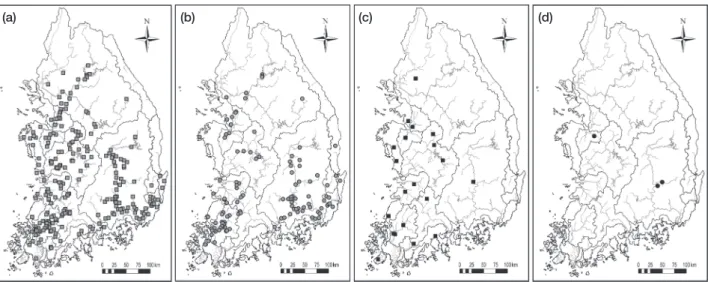
블루길(Lepomis macrochirus), 시클리드과(Cichlidae) 나 일틸라피아(Oreochromis niloticus)이다(Table 2). 배스 (M. salmoides)는 242지점(전체지점의 25.4%)에서 출현 하였고, 한강 동해쪽 하천을 제외한 국내 수계 전역에 분 포하고 있었다(Fig. 3). 블루길(L. macrochirus)의 경우 도 116지점(12.2%)에서 확인되었고, 분포지역은 배스(M.
salmoides)와 유사하였다. 떡붕어
(Carassius cuvieri)는 상 대적으로 적은 지점에서 출현하였으나 각 수계별로 출현 이 확인되어 국내 전 수계에 분포하고 있을 것으로 예상되 며, 반면 나일틸라피아(O. niloticus)는 출현지역이 겨울철 수온이 20°C 이상 유지되는 공장 방류수 배출지역이나 온 천수 유출지역으로 제한되었다. 본 4종의 외래어종은 수산 자원 증대, 양식을 목적으로 미국과 일본에서 도입되었으 며(Table 2), 2007년부터 시행된 조사에서 지속적으로 출 현하고 그 분포 범위가 넓어(나일틸라피아, O. niloticus, 제 외) 국내 하천에 토착화 된 것으로 판단된다. 이외에도 잉어과(Cyprinidae)의 이스라엘잉어(Cyprinus carpio), 연어 과(Salmonidae)의 무지개송어(Oncorhynchus mykiss)가 간 헐적으로 채집되고 있다.
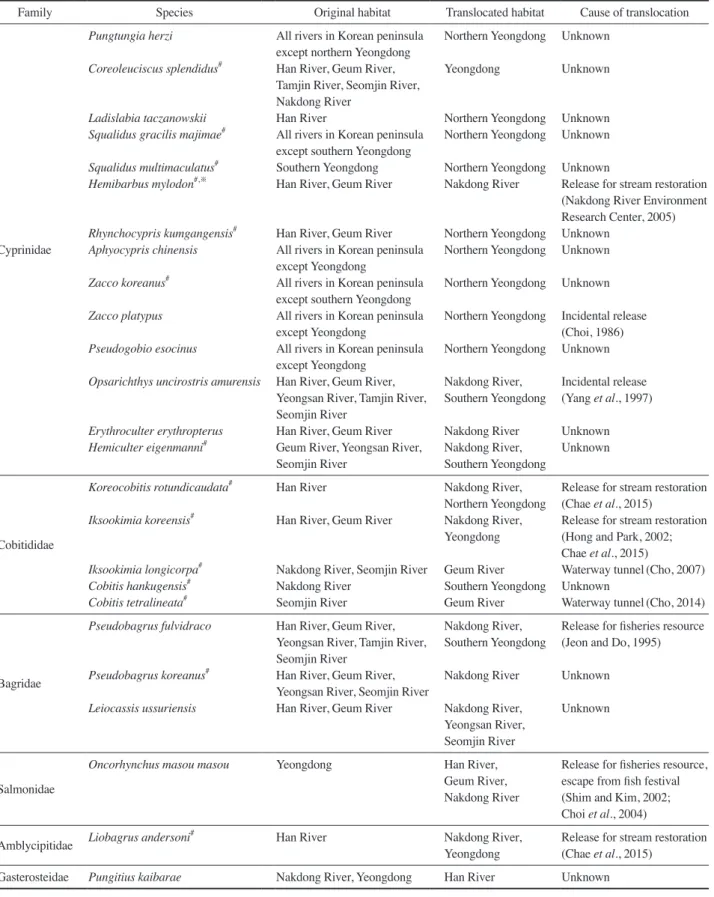
이입종은 국내에 토착으로 서식하던 어류가 원 서식처 에서 서식하고 있지 않은 지역으로 이동한 경우를 말하 며(e.g., 한강수계에는 서식하였으나 낙동강수계에는 서식 하지 않았던 종이 낙동강으로 이주된 경우), translocation of native species라고 표현하기도 한다. 국내에 현재까지 기록된 이입어종은 28종이며 이입의 주요 원인으로는 하 천 복원을 위한 대량 방류, 개별 방류, 도수 터널을 통한 이동, 축제 준비 과정에서의 탈출 등으로 구분할 수 있다 (Table 3). 일부 어종만이 한강 또는 금강으로의 이입을 나 타냈으며, 돌고기(Pungtungia herzi), 쉬리(Coreoleuciscus
splendidus), 새미
(Ladislabia taczanowskii), 긴몰개 (Squalidus gracilis majimae) 등을 포함한 24종의 이입종은 주로 낙동강 또는 영동지방으로 이입되었다.Table 2. Information of four exotic species introduced in Korean peninsula.
Family Species Original habitat Date of
introduction First release site
Distribution in 2014
(sites/frequency)
Cause of introduction Cyprinidae Carassius cuvieri Lake Biwa in Japan 1972 Whole streams 22/2.3% Fisheries resource,
aquaculture Centrarchidae Micropterus salmoides
#Southeastern United States 1975 Lake Paldang 242/25.4% Fisheries resources
Lepomis macrochirus
#Southeastern United States 1969 Lake Paldang 116/12.2% Fisheries resources Cichlidae Oreochromis niloticus South Africa 1955 Aquaculture 3/0.3% Aquaculture
#
invasive alien species
Fig. 3. Distribution map of four exotic species introduced in Korean peninsula. (a) Micropterus salmoides, (b) Lepomis macrochirus, (c) Carassius cuvieri, and (d) Oreochromis niloticus.
(a) (b) (c) (d)
Table 3. Continued.
Family Species Original habitat Translocated habitat Cause of translocation
Cyprinidae
Pungtungia herzi All rivers in Korean peninsula
except northern Yeongdong Northern Yeongdong Unknown Coreoleuciscus splendidus
#Han River, Geum River,
Tamjin River, Seomjin River, Nakdong River
Yeongdong Unknown
Ladislabia taczanowskii Han River Northern Yeongdong Unknown
Squalidus gracilis majimae
#All rivers in Korean peninsula
except southern Yeongdong Northern Yeongdong Unknown Squalidus multimaculatus
#Southern Yeongdong Northern Yeongdong Unknown
Hemibarbus mylodon
#,※Han River, Geum River Nakdong River Release for stream restoration (Nakdong River Environment Research Center, 2005) Rhynchocypris kumgangensis
#Han River, Geum River Northern Yeongdong Unknown
Aphyocypris chinensis All rivers in Korean peninsula
except Yeongdong Northern Yeongdong Unknown Zacco koreanus
#All rivers in Korean peninsula
except southern Yeongdong Northern Yeongdong Unknown Zacco platypus All rivers in Korean peninsula
except Yeongdong Northern Yeongdong Incidental release
(Choi, 1986) Pseudogobio esocinus All rivers in Korean peninsula
except Yeongdong Northern Yeongdong Unknown Opsarichthys uncirostris amurensis Han River, Geum River,
Yeongsan River, Tamjin River, Seomjin River
Nakdong River,
Southern Yeongdong Incidental release
(Yang et al., 1997) Erythroculter erythropterus Han River, Geum River Nakdong River Unknown Hemiculter eigenmanni
#Geum River, Yeongsan River,
Seomjin River Nakdong River,
Southern Yeongdong Unknown
Cobitididae
Koreocobitis rotundicaudata
#Han River Nakdong River,
Northern Yeongdong Release for stream restoration (Chae et al., 2015)
Iksookimia koreensis
#Han River, Geum River Nakdong River,
Yeongdong Release for stream restoration (Hong and Park, 2002;
Chae et al., 2015)
Iksookimia longicorpa
#Nakdong River, Seomjin River Geum River Waterway tunnel (Cho, 2007) Cobitis hankugensis
#Nakdong River Southern Yeongdong Unknown
Cobitis tetralineata
#Seomjin River Geum River Waterway tunnel (Cho, 2014)
Bagridae
Pseudobagrus fulvidraco Han River, Geum River, Yeongsan River, Tamjin River, Seomjin River
Nakdong River,
Southern Yeongdong Release for fisheries resource (Jeon and Do, 1995) Pseudobagrus koreanus
#Han River, Geum River,
Yeongsan River, Seomjin River Nakdong River Unknown Leiocassis ussuriensis Han River, Geum River Nakdong River,
Yeongsan River, Seomjin River
Unknown
Salmonidae
Oncorhynchus masou masou Yeongdong Han River,
Geum River, Nakdong River
Release for fisheries resource, escape from fish festival
(Shim and Kim, 2002;
Choi et al., 2004)
Amblycipitidae Liobagrus andersoni
#Han River Nakdong River,
Yeongdong Release for stream restoration (Chae et al., 2015)
Gasterosteidae Pungitius kaibarae Nakdong River, Yeongdong Han River Unknown
Table 3. Information of Original habitat, translocated habitat, and cause of translocation of 28 translocated species in Korean peninsula.
Data source from the Survey and Evaluation of Aquatic Ecosystem Health project conducted in 2014.
Introduced species의 유입은 자연 생태계에서 토착종 에 대해서 개체 및 개체군 수준에서의 변화를 유발하고 또 한 유전적 및 생태계 전반에서 영향을 미치는 것으로 연구 되어 있다(Parker et al., 1999). 세부적으로 영향을 확인하 면 이입으로 인한 새로운 경쟁자와 포식자의 출현은 개체 의 성장률, 번식, 서식처 활용을 변화시키고 형태 변이 발 생시키는 등 개체 수준의 변화를 유발하고, 개체군에 있어 서도 성장 및 밀도에 영향을 미치며 타 종과의 포식 및 경 쟁을 통해 군집수준에서의 변화를 통해 전반적인 생태계 구조가 달라지게 된다(Bruton, 1995; Moyle, 1997; Cowx, 1998, Gido and Brown, 1999, Elvira and Almodóvar, 2001).
이와 더불어 유전적 다양성이 감소됨에 따라서 절멸의 위 험성이 증가하게 된다(Roman and Darling, 2007).
국내에서 Introduced species의 부정적 영향은 외래종인 배스(M. salmoides)와 블루길(L. macrochirus)의 확산이 대표적으로 미국 남동부가 원산지인 배스(M. salmoides)와 블루길(L. macrochirus)은 국내 하천에 유입된 이후 빠른 증식과 대량 포식으로 인해 생태계 구조를 단순화시키고 고유종 개체군 안정성을 파괴하였으며(Jang et al., 2006;
Lee et al., 2013; Jo et al., 2014), 이에 대해 환경부는 두 종 을 생태계교란생물(invasive alien species)로 지정(환경부 고시 제 2017-265호)하여, 수입, 반입, 사육, 재배, 방사, 이 식, 양도, 양수, 보관, 운반, 유통 등을 하지 못하도록 법으 로 제정(“생물다양성 보전 및 이용에 관한 법률, 제24조 1 항”)하여 관리하고 있다. 한국과 유사한 문제를 겪고 있는 일본(e.g. 홋카이도)의 경우 수면어업조정규칙을 통해 배 스(M. salmoides)와 블루길(L. macrochirus)의 이동과 방 류를 법적으로 금지하여 확산을 방지하고, 추가로 다양한 어구를 통한 포획, 인공 산란장 설치, 산란장 파괴, 댐 수위 조작을 통한 수정란 제거 등의 노력을 통해 외래종을 관리 하고 있다. 국내에서도 외래어종 저감을 위해 일본과 유사 한 연구(포획 어구개발, 산란장 제거, 포획사업 실시 등)들 이 진행되고 있지만 이미 장기간 토착화가 진행되어있는 상황에서 소규모 관리는 가능하지만 국내하천에서 완전히 제거하는 것은 어려울 것으로 사료된다.
외래종은 국내의 자연생태계에 미치는 영향에 대한 부 정적 인식이 확산되면서 많은 관심을 받고 있는 반면 이 입종의 경우 토착종이라는 개념이 퍼져있어 대부분 이입 종의 문제점에 대해서 인지하지 못하고 있다. 국내의 경우 과거부터 내수면 어족자원이 식량자원으로서 중요한 역할 을 하였으며, 이에 따라 종묘의 생산 및 방류가 지속적으 로 이루어졌다. 또한 양식 개체의 탈출, 종교적 의식에 따 른 방류 등의 과정에서 일부 종들이 타수계로 이주 되는 현상이 발생하였으나 외래종과는 달리 국내 환경의 적응 에 문제가 되지 않아 대부분 안정적으로 정착하여 서식하 고 있다(Geum River Watershed Management Committee, 2016). 토착종임에도 불구하고 다른 수계로 이주 되는 이 입종도 외래종과 마찬가지로 자연 하천 생태계의 혼란을 야기한다. 대표적인 사례로 낙동강에 유입된 이입종인 끄 리와 강준치를 통해서 확인할 수 있으며, 강한 육식성 어 종인 두 종은 낙동강 수계에 원래 서식하지 않았으나(Kim and Park, 2002; Okazaki et al., 2002), 낙동강 수계에 이입 된 이후 현재 낙동강 본류 및 주요 지류에서 우점적으로 나타날 만큼 어류군집을 변화시켰다(Jeon, 1999; Jang et
al., 2001). 이러한 결과를 통해서 확인할 수 있듯이 이입
종이 토착종이라는 특성상 우리가 인식하지 못했을 뿐 배 스(M. salmoides)와 블루길(L. macrochirus)의 유입과 동 일한 영향을 나타내는 것이다. 영국과 호주 등의 국가에서 는 이입종에 대해서도 이동규제, 영향평가와 관련한 법령 및 법규를 제정하여 관리하고 있으며. 또한 이입종의 환 경적(유전, 기생충, 경쟁, 질병 등), 사회 경제적 영향에 대 한 많은 연구를 실시하여 관리 전략과 방안들을 마련하고 있다(Bullock et al., 1997; Department of the Environment and Energy, 2008). 반면, 한국의 경우 아직 외래종과 비교 하여 이입종의 현황 및 영향에 대한 관심과 연구가 상대적 으로 제한적이고, 이입종의 확산은 장기적으로 어류 군집 의 균질화(homogenization)에 영향을 미칠 수 있기 때문에 (Rahel, 2000), 국내 이입종의 관리와 영향파악을 위한 연 구가 필요하다.Table 3. Continued.
Family Species Original habitat Translocated habitat Cause of translocation
Odontobutidae Odontobutis interrupta
#Han River, Geum River Nakdong River,
Southern Yeongdong Unknown Centropomidae Coreoperca kawamebari* Tamjin River, Nakdong River Geum River Unknown
Coreoperca herzi
#All rivers in Korean peninsula
except northern Yeongdong Northern Yeongdong Unknown
#
endemic species;
※natural monument; *endangered species
3. 4대강 사업으로 인한 어류 군집 변화
4대강 사업으로 인한 물리적인 교란이 어류군집에 어떠 한 영향을 나타내는지를 분석하기 위해서 4대강 사업 전/
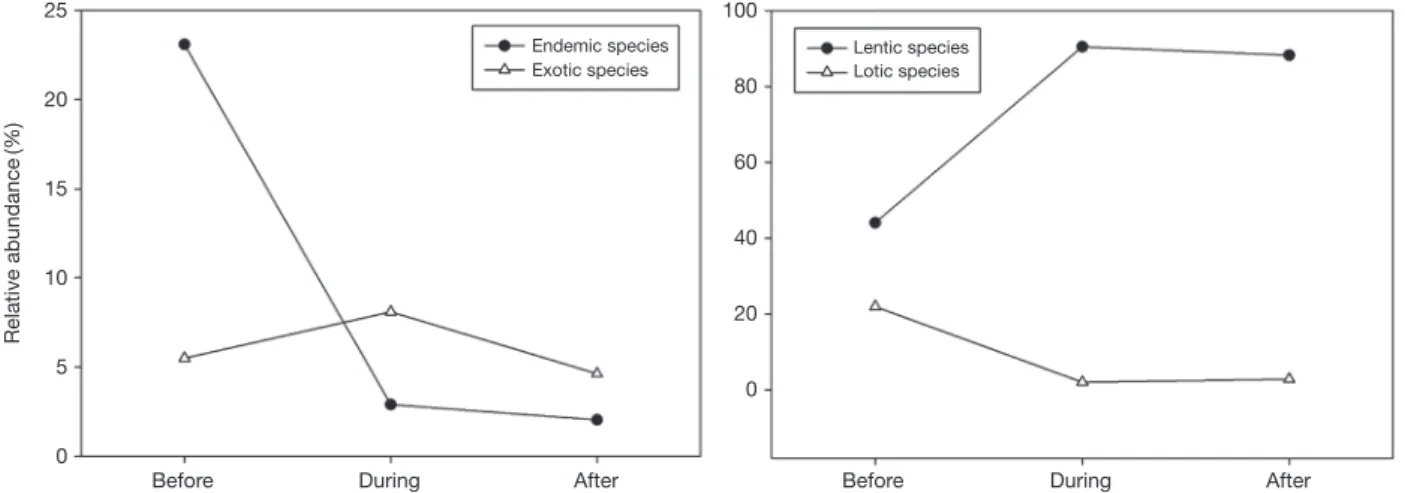
중/후 낙동강 본류의 어류군집을 비교한 결과 공사 전/중/후 어류군집이 차이가 있는 것이 확인되었다(PERMANOVA, p=0.001). 공사 이전의 경우 조사 지점들의 어류군집이 유집되지 않아 지점별 차이를 나타냈으나, 공사 중과 공사 후의 조사지점들의 어류군집은 유사하게 유집되어 단순화 가 진행됨을 확인하였다(Fig. 4). 보 설치 공사가 진행되면 서 외래종의 상대풍부도는 공사와 무관하게 큰 변화가 없 었으나 고유종의 상대풍부도는 건설 전 23.1%에서 건설
중 2.3%로 급격하게 감소하였고, 이는 공사 완료 후 2.0%
까지 낮아졌다(Fig. 5). 또한 유수성 어종의 비율이 공사 전 21.9%를 유지하고 있었으나 공사 후 2.8%로 감소하였 으며, 이와 상반된 결과로 정수성 어종의 비율은 공사 전 44.0%에서 공사 완료 후 88.2%까지 증가하였다. 공사 전 낙동강 중·하류의 어류군집은 서식처 유형에 따라서 차 이를 보였으나, 전 낙동강 수계를 대상으로 동시다발적으 로 공사가 진행되면서 물리적인 교란이 전 지점을 대상으 로 동일하게 영향을 미쳐 공사 중 어류군집의 유사성이 크 게 증가하였다. 또한 공사 후 역시 전 지점이 정수역으로 변화되면서 정수성 환경을 선호하는 정수성종들이 기존의 유수성 종들을 대체하였고, 이를 통해 전반적인 어류 군집 이 유사하게 변화된 것으로 사료된다.
4. 우리나라의 어류 군집 및 분포 변화 요인
Choi(1973)의 연구가 수행된 시기에 한국산 담수어류의 종 수는 150종으로 북한에 분포하는 종과 기수성 및 회유 성 종을 제외한 일차담수어는 84종이었다. 약 35년이 지난 현재는 Kim et al.(2005) 기준 담수어류는 213종으로 북한 분포종, 기수성 및 회유성 어류, 멸종된 종을 제외하면 120 종이 일차담수어로 30종 이상 증가하였다. 종수의 증가 원 인은 과학적 기술의 발달로 인한 신종의 발굴이 큰 역할 을 하였지만, 외래종의 도입(2005년 기준 10종의 외래종 이 목록에 기재됨) 또한 중요한 원인이었다. 또한 많은 종 들이 하천쟁탈과 같은 일부 자연적인 현상을 제외하고 대 부분 인위적인 요인에 의해 타수계로 이동되어 생물지리 학적 구분이 향후에는 모호해질 가능성도 있다.
하천을 대상으로 한 댐이나 보의 건설로 인한 흐름의 변형은 전 세계적으로 발생하는 현상이다(Nilsson et al.,
Fig. 5. Changes of relative abundance (%) before, during and after the weirs construction. Left graph shows changes of endemic and exotic species by the construction, and right graph indicates lentic and lotic species.
25
20
15
10
5
0
100 80 60 40 20 0 Endemic species Exotic species
Lentic species Lotic species
Relative abundance (%)
Before During After Before During After
Fig. 4. Non-metric multidimensional scaling ordination of fish assemblages at the weir construction sites in the Nakdong River. Fish assemblages are classified as three categories:
before (open triangle), during (reverse-solid triangle), after
(grey square) the weirs construction. The groups are made
based on a cluster analysis at the similarity level 40.
2005). 특히, 하천의 직강화 및 도시화로 인한 하천의 정비 는 하천에 서식하는 담수어에 대해서 일반적인 자연하천 에서 주로 나타나는 여울을 제거하고 물이 빨리 흘러 내려 갈 수 있도록 흐름(run)의 비율을 증가시켜 서식처를 단순 화시키고(Riley et al., 2005), 아울러 수변의 단순화 역시 수생생물의 서식지 감소를 유발하여 담수어 군집 및 다양 성 변화에 중요한 요인이 될 수 있다(Argent, 2004). 국내 에는 이미 30,000여 개가 넘는 보(weir)가 건설되어 있지 만 4대강 공사를 비롯하여 지속적으로 하천내 구조물을 건 설하고 있다. 뿐만 아니라 수량 부족을 원인으로 독립적인 두 하천을 연결하는 도수관로 사업도 빈번하게 시행되고 있는데 이런 인간의 활동들이 생물의 인위적 이동, 교잡종 형성, 서식처 교란을 통한 담수어류 다양성 감소에 주요한 역할을 하고 있다. 그럼에도 불구하고 현재까지는 국민의 관심 부족과 국내 생물종에 대한 기초자료의 부족으로 관 리 방안 수립이 미흡한 실정이다.
외래종이나 이입종의 도입으로 인해 어류상이 전반적으 로 균일해지는 현상은 국내에서만 발생하는 문제가 아니 다. 미국에서도 식량자원과 유어용(game fishing)으로 도입 된 종들로 인해 미국내 수계의 어류상이 대부분 획일화 되 는 현상이 발생하고 있다(Rahel, 2000). 도입종의 확산은 서식처의 변화와 동반하여 가속화되고 토착종과 고유종의 감소를 초래하기 때문에(Rahel, 2002), 도입종의 제거와 함 께 토착종이 선호하는 서식처의 제공이 필요하다. 도입종 의 확산으로 인해 토착 생물군이 지속적으로 변화하고 대 체되는 현상은 새로운 현상이 아닐뿐더러 전 세계적으로 일반적으로 발생하는 현상이다(Olden et al., 2004). 앞으로 는 유전적, 기능적, 분류적인 측면에서 종의 균일화로 인한 다양성 변화에 어떻게 대응할지 논의해야 될 것이며, 이는 단순히 생태학적인 측면이 아닌 경제적, 사회적인 측면을 포함하여 고려해야 될 것으로 사료된다.
지구온난화는 수온 상승을 유발하여 담수환경의 변화를 초래하고 어류를 비롯한 수생태계 내의 생물들의 다양성 및 분포 변화를 야기한다(Poff et al., 2002). 최근 IPCC의 예측모델 결과에 의하면 수온 상승 시 냉수성 어종은 줄 어들고 온대성 어종 및 열대성 어종의 분포역이 증가하는 경향이 확인되었다(Eaton and Scheller, 1996; Mohseni et
al., 2003; Buisson et al., 2008). 또한 열대성 관상어를 포함
하여 냉수에서 적응하지 못했던 외래종들의 적응이 가능 하게 되어 토착종과의 경쟁이 유발되고(Rahel and Olden, 2008), 이는 장기적으로 국내 고유종 및 토착종의 감소 를 초래할 수 있다(Joo et al., 2008). 특히 산간 계류에 서 식하고 있는 냉수성 어종의 경우, 온난화로 인한 수온 상 승 시 지속적으로 고도가 높은 지역으로 이동한다(Isaaket al., 2010). 국내 서식하는 멸종위기 II급 종인 열목어
(Brachymystax lenok tsinlingensis)와 과거 멸종위기종이었 던 둑중개(Cottus koreanus)도 유사한 상황에 직면해 있다.열목어(B. l. tsinlingensis)와 둑중개(C. koreanus)의 경우 낙동강이 한반도 최남단 서식지역으로 온난화로 인한 수 온 상승 현상이 발생하면 생육에 적절한 온도를 위하여 지 속적으로 상류로 이동하게 되며 단절된 수계로 인하여 결 과적으로 절멸하게 될 가능성을 배제할 수 없다. 이들 종 뿐만 아니라 다른 냉수성 종들의 경우도 남쪽에 위치한 하 천인 낙동강, 금강, 영산강 수계에 서식하는 개체들의 경우 북쪽으로 북쪽에 위치한 한강 이북 수계로 이동하지 못하 기 때문에 산간 계류에 고립될 가능성이 높다. 반면 겨울 철 동면 시 낮은 수온으로 국내 수계에 정착하지 못한 나 일틸라피아(O. niloticus)는 온난화로 인한 수온 상승 시 국 내에 정착할 수 있을 것으로 판단된다(Joo et al., 2008). 뿐 만 아니라 다른 열대성 관상어종들의 국내 유입이 가능할 것으로 사료되어 집중적인 관리가 필요할 것으로 판단된 다. 이러한 문제는 온도에 대한 내성 범위가 넓지 않고 서 식처가 제한적인 고유종에서도 집중적으로 발생할 것으로 예상되며 장기적으로는 국내 담수어류의 종다양성 감소 및 단순화를 야기시킬 것으로 판단된다(Joo et al., 2008).
하지만 이와 같은 변화는 단기간에 지역적으로 수행되는 연구에서는 파악되기 힘들기 때문에, 전 수계를 대상으로 하는 장기적 연구인 수생태계 건강성 연구와 같은 연구를 통해 변화를 지속적으로 모니터링하고 관리방안을 수립할 필요가 있다.
5. 어류 다양성 및 보전
생물 다양성은 생태계 기능을 유지하는 데 있어서 중요 한 요소이고 실제 인간이 살아가는 환경에 생태계 서비스 를 제공하는 역할을 한다(Duffy, 2009; Naeem et al., 2012).
따라서, 생물다양성을 높게 유지하여 인간의 생활 환경에 실질적인 이득을 얻을 수 있도록 생태계를 관리하는 것 이 중요하다(Balvanera et al., 2006; Cardinale et al., 2006;
Gamfeldt et al., 2008; Duffy, 2009). 담수생물 다양성 또한 인간사회에 대체 불가능한 다양한 상품과 서비스를 직접 적, 간접적으로 제공한다(Covich et al., 2004a, b; Dudgeon
et al., 2006). 대한민국의 경제가 과거에 비해 발전됨에 따
라 환경에 대한 국민의 눈높이가 함께 높아지게 되었다. 현 재는 자연, 생태계, 환경에 대한 의미가 인간 중심에서 공 존으로 변화되었고, 이는 인간의 삶을 안정적으로 유지하 는데 중요한 요인으로 변화되었다. 따라서 자연스럽게 생 물의 보전, 보호와 생물다양성의 가치를 논하고 있다. 담수생태계 및 담수어류도 마찬가지의 상황이다. 이를 위해서 수생태계 건강성 조사와 같이 기초적으로 수행되는 다양성 에 대한 과학적이고 정량적인 연구결과를 바탕으로 국내 환경에 적합한 보전 방안을 수립하여야 하며, 더불어 민간 과 정부, 학계를 포함한 공동의 노력이 이루어져야(Strayer and Dudgeon, 2010) 실질적이며 효과적인 담수어류의 관 리 및 보호 방안을 제시할 수 있을 것으로 사료된다.
적 요
최근 생물 다양성이 생태계의 기능과 서비스 측면에서 강조되면서 생물 분류군별 다양성 및 분포 파악에 대한 연 구가 중요한 이슈가 되고 있다. 국내 담수어류의 분포 및 다양성에 관한 연구는 2000년대에 들어서서 본격적으로 수 행되고 있으나 아직까지도 전국적인 분포 및 다양성에 대 한 분석은 이루어지지 않고 있다. 이에 본 연구는 한반도 남 한지역 전 수계를 대상으로 동시에 모니터링하는 “수생태 계 현황 조사 및 건강성 평가”의 자료를 활용하여 국내에 서식하는 담수어류의 분포 및 다양성을 파악하고, 더불어 국내 담수어류의 다양성에 영향을 줄 수 있는 주요 요인 들을 제시하였다. 전국 953개 지점에 대한 수생태계 건강 성 조사(2014년 결과 활용) 결과 총 28과 130종의 담수어 류가 서식하는 것으로 확인되었다. 전체 지점에서 우점종 은 피라미(Zacco platypus, 상대풍부도, 28.2%)와 참갈겨니 (Zacco koreanus, 19.3%)였으며, 20종의 멸종위기종, 51종의 고유종, 4종의 외래종이 출현하였다. 대권역별 비교 시 한 강 대권역에서 가장 많은 96종이 확인되어 다양성이 높았 으며, 영산/섬진강 대권역에서 가장 적은 72종이 확인되어 다양성이 낮게 나타났다. 본 연구에서 파악된 수계별 평 균 고유화 빈도는 32.7%였고 이는 과거 결과와 비교하여 증가한 수치였다. 외래종인 배스(Micropterus salmoides), 블루길(Lepomis macrochirus), 떡붕어(Carassius cuvieri) 는 동해안 수계를 제외한 전역에 확산되어 분포하는 것으 로 나타났으며, 나일틸라피아(Oreochromis niloticus)는 3 지점에서만 출현하여 현재까지 국내 수계에 적응하지 못 한 것으로 파악되었다. 또한 28종의 이입종이 확인되었고 이들의 대부분은 낙동강 및 영동지역 수계로의 이입이었 다. 이 중 끄리(Opsa riichthys uncirostris amurensis), 강준 치(Erythroculter erythropterus)는 낙동강 중·하류에서 우 점적으로 출현할 만큼 확산이 이루어졌으며, 이들은 외래 종 못지 않은 포식압으로 이입된 수계에 영향을 미치고 있 을 것으로 판단된다. 또한 4대강 공사로 인해 공사 전/중/
후의 어류군집이 달라진 것이 확인되었는데, 특히 물리적
인 서식 환경의 변화로 인해 고유종의 감소와 정수성 어종 의 증가가 확인되었다. 인간의 직접적인 영향과 더불어 간 접영향으로 나타나는 지구온난화는 장기적으로 국내 수계 에 현재까지 적응하지 못한 외래종들의 정착을 가능하게 하면서 담수어류 다양성 및 분포 변화를 가속화 시킬 것으 로 예상된다. 따라서 국내 상황에 맞는 실질적이면서 효과 적인 담수어류의 관리 및 보호 방안 수립이 이루어져야 하 며, 이러한 측면에서 전국을 토대로 기초적이고 정량적인 자료가 도출되는 “수생태계 현황 조사 및 건강성 평가”와 같은 연구가 중요하게 활용될 수 있을 것이다.
사 사
본 연구는 수생태계 건강성 사업의 일환으로 수행되었 습니다.