• 검색 결과가 없습니다.

Review on the Fire Resistance and Pumpability Performance of Fiber Reinforced High Strength Concrete

N/A
N/A
Protected

Academic year: 2021

Share "Review on the Fire Resistance and Pumpability Performance of Fiber Reinforced High Strength Concrete"

Copied!
8
0
0

로드 중.... (전체 텍스트 보기)

전체 글

(1)

pISSN 1598-2033 eISSN 2233-5706 Journal of the Korea Institute of Building Construction, Vol. 13, No. 1

http://dx.doi.org/10.5345/JKIBC.2013.13.1.058 www.jkibc.org

Review on the Fire Resistance and Pumpability Performance of Fiber Reinforced High Strength Concrete

Kwon, Hae-Won * Kim, Young-Su

1)

Department of Architectural Engineering, Pusan National University, Geumjeong-Gu, Busan, 609-735, Korea

Abstract

Currently, many high-rise buildings are built in Korea for land-efficient utilization and vista. In high-rise buildings this tall, the use of high-strength concrete is essential to reduce the cross-section of structure members and secure axial load. However, this high strength concrete is vulnerable to spalling by fire, due to the water vapor pressure caused by the very high temperature in fire. To prevent this, the main method used is to reinforce the concrete with fiber. However, there has been little research on the pumpability of fiber reinforced high strength concrete. For this reason, this study features a performance review based on the properties and pumpability of fiber reinforced high strength concrete. In addition, the parameter of rheology was measured by extracting mortar from the concrete, and friction factor was measured through a 400 m horizontal pipe pumping test using the fiber reinforced high strength concrete. The basic information on fiber reinforced high strength concrete that we obtain through the experiments and review will contribute to the field.

Keywords : fire resistance, fiber reinforced high strength concrete, pumpability

1. Introduction

To effectively utilize Korea ’s limited land and secure a fine view, a number of high -rise buildings have been built. High strength concrete has been widely applied to high -rise buildings to reduce the section of structural members and secure axial load.

However, with the section of structural members lost by spalling resulting from the fire, high strength concrete can have a seriously adverse impact on the safety of structures. For this reason, the Ministry of Land, Transport, and Maritime Affairs announced the

“Fire Resistance Performance Management Criteria for High Strength Concrete Columns and Beams (No.

Received : October 10, 2012

Revision received : December 7, 2012 Accepted : December 24, 2012

* Corresponding author : Kwon, Hae-Won [Tel: 010-9798-8325, E-mail: [email protected]]

ⓒ2013 The Korea Institute of Building Construction, All rights reserved.

2008 -334),” and the domestic construction industry has made efforts to develop diverse technologies to secure the fire resistance performance of high strength concrete[1,2.3].

On the other hand, according to previous studies, as a technology to secure fire resistance performance of high strength concrete, adding synthetic fiber was found to be effective for preventing spalling as it reduced the vapor pressure within concrete during fire[4,5,6,]. But there have been few studies on the pumpability and basic physical properties of polylon fiber, a synthetic fiber of polypropylene and nylon that is currently in wide use.

Therefore, the basic physical properties of fiber

reinforced high strength concrete and fire resistance

performance were reviewed, the plastic viscosity of

mortar extracted from the concrete was compared,

and the friction factor of high strength concrete

using horizontal pumping pipes was verified. This

paper aims to provide fundamental data on the

(2)

Series

No. Classification of experiment Compressive

strength(MPa) Factors Variable(%) Measuring items

I Mechanical properties of high strength

concrete with fiber 50

60

Polylon fiber

1)

contents

0.000, 0.025, 0.050, 0.075

Slump flow Air contents Compressive strength (3 day, 7day, 28 day) II Fire resistance performance of high

strength concrete with fiber 60 0.025, 0.050,

0.075 Fire test (KS F 2257)

III Plastic viscosity of high strength

concrete with fiber 50

60 0.000, 0.050 Shear rate of mortar

Stress of mortar

IV Horizontal pipe pumping test of high

strength concrete with fiber 50

60 0.000, 0.050 Pumping Press

Recovery time(s/㎥) of concrete 1) Polylon fiber : Volume ratio 1:1 of Poly propylene(length: 19 ㎜) and Nylon(length: 12 ㎜) Fiber

Table 1. Experimental scheme

application of fiber reinforced high strength concrete to construction sites[7,8].

2. Experiment plan and method

2.1 Experiment plan

The experiment scheme is indicated in Table 1.

The basic physical properties of 50MPa and 60MPa high strength concrete are examined in Series I, and the fire resistance of fiber reinforced high strength concrete set based on the basic physical properties examined in Series I is assessed in Series II.

In addition, to examine and compare the pumpability performance of fiber reinforced concrete and Plain in Series III and IV, the plastic viscosity of the mortar extracted from each concrete is compared based on shear rate and shear stress in Series III.

0.05% of fiber is added to the 50MPa and 60MPa high strength concrete to make fiber reinforced concrete. In addition, in Series IV the friction factor is calculated by measuring pumpability pressure and concrete discharge velocity, in order to understand the friction factor of the concrete.

Through Series I, II, III, and IV, this paper aims to secure fundamental data on the application of fiber reinforced high strength concrete to construction sites.

2.2 Experiment method

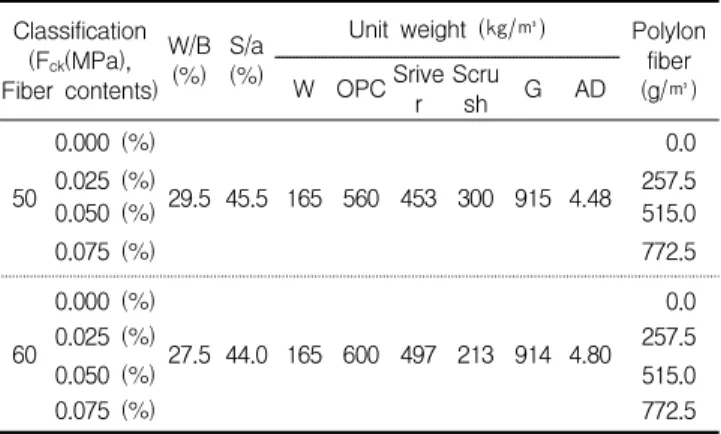
To examine performance in Series I, the fiber reinforced high strength concrete is tested to assess basic physical properties in compliance with the evaluation items stipulated in KS, and the test materials used are indicated in Table 2.

Table 2. Physical properties of high strength concrete Classification

(F

ck

(MPa), Fiber contents)

W/B (%) S/a

(%)

Unit weight (㎏/㎥) Polylon fiber (g/㎥) W OPC Srive r Scru

sh G AD

50

0.000 (%)

29.5 45.5 165 560 453 300 915 4.48 0.0

0.025 (%) 257.5

0.050 (%) 515.0

0.075 (%) 772.5

60

0.000 (%)

27.5 44.0 165 600 497 213 914 4.80 0.0

0.025 (%) 257.5

0.050 (%) 515.0

0.075 (%) 772.5

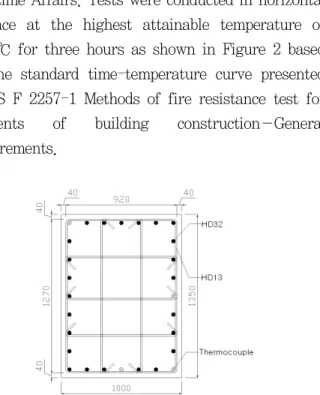
In addition, to perform fire resistance performance

test in Series II, fiber reinforced specimens (by

adding polylon fiber by volume ratio (0.023%,

0.050%, 0.075%)) were manufactured at the

dimensions of 1000x1350x1500mm with 40mm of

cover concrete thickness, where sensors were

embedded on the main reinforced bar as shown in

Figure 1 in compliance with No. 2008 -334 Fire

Resistance Performance Management Criteria for

High Strength Concrete Columns and Beams

announced by the Ministry of Land, Transport and

(3)

Review on the Fire Resistance and Pumpability Performance of Fiber Reinforced High Strength Concrete

Maritime Affairs. Tests were conducted in horizontal furnace at the highest attainable temperature of 1100℃ for three hours as shown in Figure 2 based on the standard time -temperature curve presented in KS F 2257 -1 Methods of fire resistance test for elements of building construction-General requirements.

Figure 1. Cross section of fire resistance test specimen

Figure 2. Fire test of high strength concrete

To examine pumpability performance of fiber reinforced high strength concrete in Series III, of the rheological properties, plastic viscosity was verified by measuring shear rate and shear stress using a rheometer shown in Figure 4 under the assumption that mortar extracted from high strength concrete is fluid, as shown in Bingham model equation (1) and Figure 3.

     ---- (1)

Here,

 : shear stress(Pa)

: yield stress(Pa)

 : plastic viscosity(Pa.s)

 : shear rate(1/s)

Figure 3. Shear rate and stress

Figure 4. Rheometer(Brookfield DV-III)

Unlike the assumption set in Series III, since concrete is three - or more-phase composites and a heterogeneous mixture, the pressure loss caused by concrete itself at the pipe should be examined.

Therefore, in Series IV, pumping time of concrete discharged to a container was measured using a 400m -long horizontal pipe and a fixed pumping car.

The horizontal pipe was planned as shown in Figure 5. The pipe pressure was measured in a cycle of 60 Hz through a dynamic logger at every 100m interval from the pumping car.

At this time, the friction factor was calculated by

applying given pressures to a discharging velocity in

Equation (2) derived through Beroulli’s principle

and force equilibrium theory, through which the

(4)

Figure 5. Experimental plan of concrete pumpability Classification

(F

ck

(MPa), Fiber contents)

Fresh concrete

properties Compressive

strength(MPa) Slump

flow(mm) Air

Contents(%) 3 day 7 day 28 day

50

0.000 (%) 700/680 4.3 41.6 46.2 61.1

0.025 (%) 680/670 4.3 42.3 46.9 62.2

0.050 (%) 690/690 4.3 41.1 47.7 61.9

0.075 (%) 690/680 4.5 40.8 46.5 60.6

60

0.000 (%) 700/680 4.5 51.7 59.6 72.4

0.025 (%) 680/680 4.3 51.2 61.0 71.8

0.050 (%) 690/680 4.7 50.7 57.8 71.5

0.075 (%) 690/670 4.7 50.9 58.5 70.3

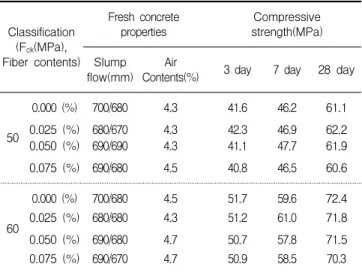
Table 3. Physical properties of high strength concrete

strength concrete was examined[8,9,10].

       

   

 ×  

×      

×    ×  --- (2)

Here

  : pressure of the pump(kgf/㎡)

: friction loss within the pipe (kgf/㎡)  : local pressure loss(kgf/㎡)

: pressure loss by height (kgf/㎡)  : friction factor

 : vertical length of the pump(m)  : diameter of the pipe(m)  : flow velocity(m/s)

 : gravity acceleration(9.8 m/s2)  : specific weight(kgf/㎥ )

 : local friction resistance factor  : vertical height of the pipe(m)

3. Review of test results and analysis

3.1 Test results of basic physical properties of concrete

Through the tests of the basic physical properties

reinforced concrete was found to have a similar slump flow, air content, and compressive strength to Plain, from which it was verified that fiber had no great impact on the physical performance of concrete.

3.2 Results of fire resistance performance test of concrete

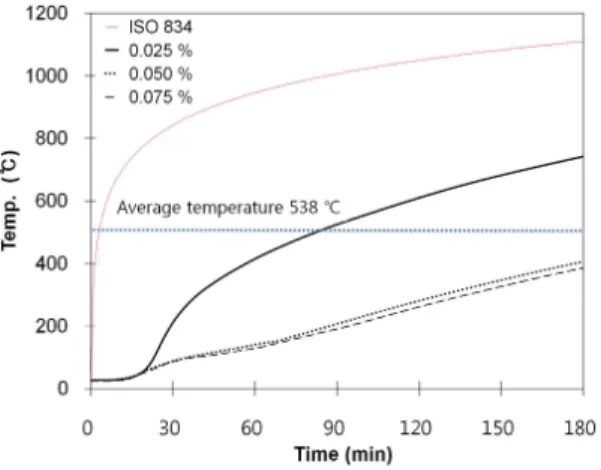
Through the fire resistance performance tests of

high strength concrete according to mix proportion

of fiber, it was verified that the more fiber was

mixed, the lower the average and highest

(5)

Review on the Fire Resistance and Pumpability Performance of Fiber Reinforced High Strength Concrete

temperature of the main reinforced bar, as shown in Figures 6 and 7.

Figure 6. Fire test result by fiber content(%) I (Average temperature)

Figure 7. Fire test result by fiber content(%) II (Maximum temperature)

Temperature was observed to start to rise gradually at 20 minutes in the specimens with 0.05%

and 0.075% of fiber; however, the temperature rise of the main reinforced bar was observed to be slow at 100℃. It is believed the moisture within the concrete was discharged through the channel generated by the fusion of polypropylene and nylon fiber consisting of the polylon fiber, which slowed the temperature rise [4,5].

In addition, the specimens with 0.05% and 0.075% of fiber met the fire resistance criteria at

the completion of the 3 -hour fire resistance test.

However, the specimen with 0.025% of fiber showed a drastic temperature rise at around 20 minutes, and exceeded the standard average temperature at around 90 minutes, and the standard highest temperature at around 30 minutes. It is believed that spalling took place, and the main reinforced bar was heated more based on the internal temperature.

3.3 Test results of plastic viscosity of concrete To compare the pumpability performance of fiber reinforced concrete and Plain, mortar was collected by sifting it through a 5mm sieve to measure shear stress and shear rate, and based on this the plastic viscosity was calculated, as shown in Figures 8 and 9 and Table 4.

Through the results the plastic viscosity of Plain was found to range between 0.858Pa.s and 0.873Pa.s, while the plastic viscosity of fiber reinforced concrete ranged between 0.863Pa.s and 0.881Pa.s, approximately 1~3% higher, from which it was verified that plastic viscosity was slightly increased by the mix of fiber. The friction force between paste, fiber and mortar is believed to have been increased according to the mix of fiber.

Figure 8. Correlation of Shear Rate and Stress I

(Fiber Contents 0.00 %)

(6)

Figure 9. Correlation of Shear Rate and Stress II (Fiber Contents 0.05 %)

Table 4. Plastic viscosity of fiber reinforced and basic concrete Classification

(Fiber contents, F

ck

(MPa))

Correlation

(R

2

) Tendency

equation Plastic viscosity (Pa.s)

0.00 (%) 50

60 0.9917

0.9955

y = 0.858x + y = 0.873x + 12.6

13.5

0.858 0.873

0.05 (%) 50

60 0.9902

0.9890

y = 0.863x + y = 0.881x + 14.6

15.5

0.863 0.881

3.4 Results of pumpability test

It is difficult to obtain a homogeneous plastic viscosity from fresh concrete since concrete is a heterogeneous mixture. In particular, it is difficult to secure homogeneity due to its internal aggregate.

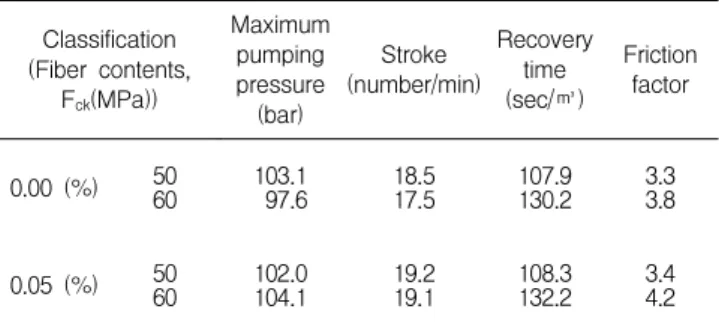
For this reason, the highest pressure and the number of cylinder strokes were measured when the cement was pumped through the 400m -long horizontal pipe for the pumping test, and the cement pumping time was measured while the cement was discharged to a certain volume of tank through an end hose. Through the test results, the friction factors of Plain and fiber reinforced concrete were calculated, and the results are indicated in Table 5.

In the test results of Series III, the plastic viscosity was found to increase by about 1~3%

horizontal pipe tests, the plastic viscosity was found to increase by at least 3% and up to 10%, based on which it is believed that the plastic viscosity was increased, the internal stress was increased by the more frequent collision and contact between particles, and the friction factor became greater as a result.

Table 5. Maximum pumping pressure and friction factor Classification

(Fiber contents, F

ck

(MPa))

Maximum pumping pressure (bar)

Stroke (number/min)

Recovery (sec/㎥) time

Friction factor

0.00 (%) 50

60 103.1

97.6 18.5

17.5 107.9

130.2 3.3

3.8

0.05 (%) 50

60 102.0

104.1 19.2

19.1 108.3

132.2 3.4

4.2

Figure 10. Horizontal pipe pumping test

4. Conclusion

In this study, the basic physical properties and

fire resistance performance of fiber reinforced high

strength concrete were examined, and the plastic

viscosity properties of mortar collected from the

concrete were also compared. In addition, the

friction factor of high strength concrete was verified

using a 400m -long horizontal pipe. The findings of

this research are as below:

(7)

Review on the Fire Resistance and Pumpability Performance of Fiber Reinforced High Strength Concrete

1) In terms of slump flow, air content, and compressive strength, the fiber reinforced concrete showed a similar tendency to Plain, and polylon fiber had little impact on the basic physical properties of the concrete.

2) As the mix proportion of fiber increased, the average temperature and the highest temperature of the main reinforced bar was observed to be relatively low. The specimens with 0.05% and 0.075% fiber met the criteria announced by the Ministry of Land, Transport, and Maritime Affairs; however, the specimen with 0.025% fiber exceeded the standard temperature due to spalling. Thus, considering performance and economic feasibility, 0.05 % fiber is believed to be advantageous.

3) In terms of plastic viscosity, the fiber reinforced concrete had 1 -3% higher plastic viscosity than Plain. The fiber is believed to have affected the friction factor of concrete, which led to a slight increase in plastic viscosity.

4) Through a 400m -long pipe pumping test, the friction factor was calculated as between 3.8 and 4.2 in fiber reinforced concrete, and as between 3.3 and 3.4 in Plain. The friction factor increased by about 3~10% in fiber reinforced concrete, and the fiber mix had an effect on friction factor and pumpability.

In a nutshell, the fiber mix had little effect on the basic physical properties of high strength concrete, but rather highly affected plastic viscosity and pumpability performance. Diverse data should be accumulated through subsequent and further studies in the future to apply fiber reinforced high strength concrete to construction sites.

References

11. Kim YR, Song YC, Jung YH, Kim OJ, Lee DB. An

experimental study on the fire resistance properties of high strength concrete using fibre for field application.

Proceedings of the 15th Autumn of Korea Institute of Building Construction; 2008 November 14; Pusan (Korea).

Seoul (Korea): Korea Institute of Building Construction;

2008. p. 187-91.

12. Song YC, Kim YR, Kim OJ, Lee DB. Evaluation of fire performance for high strength concrete mock-up column with fiber by unloaded fire test. Proceedings of the 17th Autumn of Korea Institute of Building Construction. 2009 November 14; Cheongiu (Korea). Seoul (Korea): Korea Institute of Building Construction; 2009. p. 97-100.

13. Song YC, Kim YR, Oh JK, Kim OJ, Lee DB, Ko CH. An experimental study on fire resistance performance of high strength concrete by fiber contents and depth of concrete cover. Proceedings of Architectural Institute of Korea. 2009 October 23; Kangwon (Korea). Seoul (Korea): Architectural Institute of Korea; 2009. p. 583-6.

14. Han CG, Han MC, Heo YS. New proposal for spalling mechanism in high strength concrete. Journal of Architectural Institute of Korea. 2007 November;

23(11):109-17.

15. Son HJ, Han CG. Fire resistance performance review of high strength concrete structure mixing with the polylon fiber. Journal of Architectural Institute of Korea. 2010 April;54(6):46-8.

16. Pierre K, Gregoire C, Christophe G. High temperature behaviour of HPC with polypropylene fibers from spalling to microstructure. Cement and Concrete Research. 2001 October;31:1487-99.

17. Seo I, Lee HS, Park HG, Kim WJ. An experimental study on correlation between rheological parameter of picked mortar and fluidity of concrete from 30 to 150 MPa.

Journal of Architectural Institute of Korea. 2009 September;25(9):93-100.

18. Kwon HW, Bae YK, Lee JS, Kim SI, Kim HS, Lee JS. The experimental study on the coefficient of friction change tendency which it follows in kinds of concrete strength and pumping pressure grade. Proceedings of the 16th Spring of Korea Institute of Building Construction. 2009 May 23;

Seoul (Korea). Seoul (Korea): Korea Institute of Building Construction; 2009. p. 69-73.

19. American Concrete Institute Committee. ACI manual of

concrete practice. American Concrete Institute; 2012. ACI

304.2R-96. Farmington Hills Michigan U.S.A

(8)

integrated risk control technology development. Korean

Journal of Construction Engineering and Management 2010

August;11(4):30-3.

수치

Table 1. Experimental scheme
Figure 2. Fire test of high strength concrete
Figure 5. Experimental plan of concrete pumpabilityClassification(Fck(MPa),Fiber contents) Fresh concreteproperties Compressive strength(MPa)Slumpflow(mm)Air
Figure 7. Fire test result by fiber content(%) II (Maximum temperature)
+2

참조

관련 문서

In addition, uni-axial compression strength tests of concrete filled fiber reinforced plastic circular tube (CFFT) except PFRP members were conducted.. The test variable in the test

A numerical model that can simulate the nonlinear behavior of ultra high strength fiber reinforced concrete (UHSFRC) struc- tures subjected to monotonic loading is

J., “Influence of Number of Twist on Tensile Behavior of High Performance Fiber Reinforced Cementitious Composites with Twisted Steel Fibers,” Journal of the Korea

Keywords : steel fiber-reinforced concrete, impact resistance, penetration, high velocity impact-load, steel fiber volume fraction.. 외부의 충격으로부터 피해를 최소화하 기

Mechanical and drying shrinkage properties of polypropylene fiber reinforced high flow concrete, Journal of the Korean Society of Agricultural Engineers 46(5): 79-85 (in

Therefore, the purpose of this research is to estimate the compressive strength, long term drying shrinkage, and resistance to freezing and thawing of hybrid fiber

In this research, in order to examine the fatigue behavior of hybrid fiber reinforced high strength concrete, the static and fatigue tests were carried out.. And from these results,

The Effect of Fiber Volume Fraction on the Tension Softening Behavior of Steel Fiber-Reinforced Ultra High Strength Concrete.. Su-Tae Kang, 1) * Ki-Nam Hong, 2) Sang-Hoon Han, 2)