JESK
http://jesk.or.kr eISSN:2093-8462System Thinking Perspective on the Dynamic Relationship between Organizational Characteristics of Nuclear
Safety Culture
Byung Suk Kim1, Youngmin Oh2
1Center of Excellence for Safety Culture, The State University of New York-Korea, Incheon, 406-840
2Department of Technology & Society, The State University of New York-Korea, Incheon, 406-840
Corresponding Author Byung Suk Kim
119 SongDo Moonwha-ro, Yeonsu-gu, Incheon, 406-840
Mobile : +82-10-3705-0715 Email : [email protected]
Received : December 19, 2013 Revised : March 14, 2014 Accepted : March 31, 2014
Objective: The purpose of this study is to grasp the fundamental structure of incident occurrence in nuclear organizations based on system thinking, and analyze how various causes are interrelated in terms of the causal loop diagram.
Background: The recent domestic and overseas nuclear power plant-related incidents and accidents are directly or indirectly associated with safety culture, and thus effective plans for the improvement of safety culture are being called for. While the safety of a nuclear power plant is highly dependent upon technology and equipment, the utilization, maintenance and inspection of the technology and equipment are conducted by workers of the nuclear power plant.
Method: Methodology of system thinking perspective using causal loop analysis.
Results: As a result of the analysis, first, it turned out that the fundamental cause of incident occurrence in nuclear organizations is time constraint. Second, if a workload of workers increases, their adherence to regulations and procedures comes to be reduced due to time constraint. Third, it is needed, through organizational learning education, to increase actions made from thoughts considering safety as the utmost priority in advance. Fourth, it is necessary to improve professionalism by enhancing educational programs for new workers, and to develop various scenarios with which they can cope with certain situations.
Application: This paper provides a base for system dynamics simulation model for future study.
Keywords: Nuclear safety culture, Organizational safety culture, System thinking, Causal lop diagram
Copyright@2014 by Ergonomics Society of Korea. All right reserved.
○cc This is an open-access article distributed under the terms of the Creative Commons Attribution Non-Commercial License (http://
creativecommons.org/licenses/by-nc/3.0/), which permits unrestricted non-commercial use, distribution, and reproduction in any medium, provided the original work is properly cited.
1. Introduction
Recognition on nuclear power plants at overall society level has been rapidly changing, since the Fukushima Nuclear Power Plant incident on March 11, 2011. As a questionnaire survey result targeting 1,000 male and female adults aged 19 and older nationwide through a public opinion poll agency by Korea Federation for Environmental Movement on November 28, 2013, 77.8% of the respondents had negative opinion on the nuclear power plant safety. This actually implies that public concern on the safety of nuclear power plants is at a serious level. The nuclear power
industry and academia have made great efforts to secure safety equipment and minimize human errors through facility and equipment improvement and technology development for nuclear safety improvement. Despite such efforts, the issue on the safety of nuclear power plants is continuously raised. The reason is that the securing of nuclear safety depends on relevant technologies and devices; however, the use, maintenance, and inspection activities of technologies and equipment are conducted by workers engaged in the nuclear power plants. In this regard, interest in these workers has been lacking. From an organizational aspect, management on the policy, system, operating technology, and work environment to establish and enhance safety culture has been also insufficient. Especially, For safety culture enhancement, not only constant interest and efforts of all relevant organizations including government, regulatory agencies, companies, and worksites, and each nuclear power plant worker, but the establishment of learning organization for reporting culture improvement and learning, are necessary. However, no reports on relevant fundamental efforts are available. Instead, serious irregularities and corruption such as concealing power failure accidents or quality verification certificate forgery within nuclear power plants are criticized socially. Also, the lack of nuclear safety culture including the violation of procedures, or omission or delay of reporting to regulatory agencies in the nuclear power plant operation process has been revealed.
To identify the background why problems in nuclear organizations are not exterminated, but continue to occur, and why nuclear safety culture cannot improve, despite so many actions and self-examination, it is very important to investigate what underlying structure of the problems is within a nuclear power plant, and analyze how various causes to incidents are interrelated from an organizational aspect. This paper aims to present policy implications by identifying the underlying structure in which incidents occur in nuclear power plant organizations, based on system thinking, and to analyze how various causes are interrelated from a causal loop diagram perspective.
2. Theoretical Study
2.1 Literature review of nuclear safety culture
The concept of nuclear safety culture was used from NSAG-1 (1986), a report of INSAG of IAEA, after the Chernobyl Nuclear Power Plant incident in 1986. Safety culture is organization members' shared value considering safety as the utmost priority.
Also, safety culture means each organization member's attitude; belief, understanding, and value cognition are internalized into individual words and behaviors, or organizational safety management system. Safety culture is formed over a long time, since it has the characteristics of the formation and change of culture in essence, but, safety culture can also be formed or changed within short-term by organization's internal and external shock. A sub-concept of safety culture, the organizational safety culture of a nuclear power plant is that workers engaged in operations of nuclear power plant facilities and equipment consider safety as the utmost priority in their work. The organizational safety culture includes the mechanism of safety policy, system, operating technology, and work environment to establish and heighten robust safety culture.
HSC (1993) defined safety culture as the product of behavior type, skill, individual and group values, attitude, perception, and ability enabling workers to dedicate themselves to organizational health and safety management. An organization having positive safety culture has broad understanding on the importance of safety culture, based on mutual reliability, and actively takes actions to prevent safety accidents.
Clarke (2000) presented safety culture models into three levels as indication on basic value, conviction, and premise on safety internalized into an organization. First level is to understand safety as the foremost value as the most important premise. Second level is organization members' (top management, managers, workers) attitude to safety as conviction and value. Third level is policy, artificial product, and activity related to safety as discipline, and artificial object.
INSAG-4 (1991) classifies factors to consolidate safety culture as the missions at organizational (policy) level, manager's missions, and employee's missions. First, missions at organizational level include safety policy establishment, safety policy management organization, the securing of manpower budget, and in-house regulatory activities. Second, manager's missions include safety responsibility assignment, safety practice policy, training and qualification management, compensation and encouragement, and audit/review/comparison. Lastly, employee's missions include work attitude with problem consciousness, rigorous and prudent work approach, and safety information exchange.
INPO (2004) present the following eight principles as principles for robust nuclear safety culture: First, all workers have their own responsibility on nuclear safety. Second, leaders should be a model in implementing safety. Third, reliability should be based in the organization. Fourth, decision making (conservative decision making) considering safety as the utmost priority should be conducted.
Fifth, nuclear power technology needs to be recognized as special and unique technology. Sixth, an attitude to have questions needs to be encouraged. Seventh, organizational learning should be adopted. Lastly, nuclear safety needs to be constantly reviewed.
In summary, all relevant organizations including the government, regulatory agencies, companies, and worksites, and each worker should show constant interest, and make more efforts. Also, reporting culture needs to be fortified and learning organization should be established for safety culture enhancement. Especially, reporting culture should offer strong motivation by reporting all potential incidents and investigating root causes. Learning organization can promote organizational development and improvement by creating new ideas, and better implementation methods through exploration and benchmarking (IAEA ASCOT, 1996; INSAG- 15, 2002; KEPRI, 2005; IAEA, 2006; PMI, 2007).
Meanwhile, Leveson (2005) analyzed risk evaluation, measures to cope with risks, and potential impacts on policy decision to draw improvements on risk management and safety culture through simulation targeting NASA as a study on safety culture using system dynamics. Also, Lyneis & Madnick (2008) studied the impacts of organizational characteristics factors and members' behaviors on safety culture. In addition, studies on the impacts of nuclear power plant organizations and manpower characteristic factors on safety (Ahn, et al., 2002; Yu, et al., 2001), a study on organizational safety culture, according to natural disasters (Rudolph
& Repening, 2002), and a study on safety culture concerning accident prevention (Cooke & Rohleder, 2006) were carried out.
2.2 System dynamics
System dynamics is the perspective and frame of reference to view phenomena composed of complex causal relationship by understanding and explaining phenomena with dynamic and circular dynamic feedback perspective, or by building simulation model based on such an understanding (Moon, 2007). The characteristics of system dynamics are that all phenomena are understood from a circular feedback system perspective, and that basic interest lies in how dynamically specific variables to study change, according to time, rather than precise measurement of parameters (Richardson, 1991; Meadows, 1980; Kim, et al., 1999;
Moon, 2007). The focus of system dynamics modeling process is to draw up a causal loop diagram on research tasks, which has the characteristics that the causal interaction relationship of system's entire composition and the variables composing the system is demonstrated with feedback loop through theoretical approach, and actual observation. In the casual loop diagram, positive relationship (+) between two variables means that the two variables change in the same direction. If it is negative relationship (-), it means the two variables change in the opposite direction. The feedback loop is divided into a positive loop and negative loop. The phenomena composed of the positive loop have self-reinforcing characteristics to constantly increase and decrease. Those of the negative loop exhibits self-restraining, goal seeking, and stabilizing characteristics. Researchers can explain the basic type of system by identifying the characteristics of the feedback loops included in the causal loop diagram (Kim, et al., 1999; Moon, 2007; Kim, 2013).
3. Analysis Results of Causal Loop Diagram
3.1 Causal loop diagram of organizational learning sector
This study identifies underlying structure in which safety-hindering incidents continually occur in nuclear power plant organizations, and analyzes how various causes to those incidents are interrelated through the causal loop diagram. Based on all these, this study seeks measures for necessary actions to operate nuclear power plants in a safe manner.
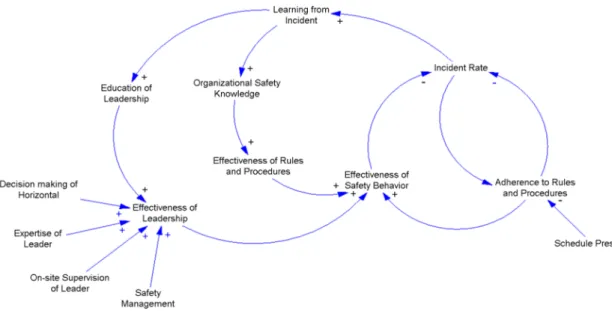
From organizational learning perspective, the fundamental cause to safety-hindering incidents can be viewed as time-constraint on work handling. If information volume and workload to handle by nuclear power plant workers increase simultaneously, workers' productivity, and work quality can decline, since those function as hindrance factors to carry out work handling, and the consciousness to adhere to regulations and procedures decreases. As a result, nuclear safety is reduced (Rudolph & Repening, 2002; Lyneis & Madnick, 2008; Jae, 2000). The reason why safety-hindering incidents repeatedly occur in nuclear power plants is that systematic efforts, and leadership to cope with risks through organizational learning from the past incidents are insufficient (IAEA, 2012). Consequently, it is important to make the behavior considering safety as the utmost priority in advance increase through organizational learning before an incident occurs. Also, education/training to exert leadership, when unexpected situation is faced with should be bolstered (Lyneis & Madnick, 2008; IAEA, 2012).
Figure 1 shows a casual loop diagram, based on the explanation above. When adherence to regulations and procedures on work by nuclear power plant workers is high, no incident occurs; however, if workers' time constraint on work increases, recognition on the adherence to regulations and procedures diminishes, which operates as a factor to increase incident occurrence. Meanwhile, if accident rate goes up, learning on incidents increases, and thus, organizational safety knowledge ascends, and regulations and procedures are consolidated. All these positively affect safety behavior effect in turn. In addition, if horizontal decision making, leader's professionalism, safety-oriented management, and leader's onsite management supervision are bolstered, the safety behavior effect increases, and therefore, incident rate drops.
3.2 Causal loop diagram of management safety action sector
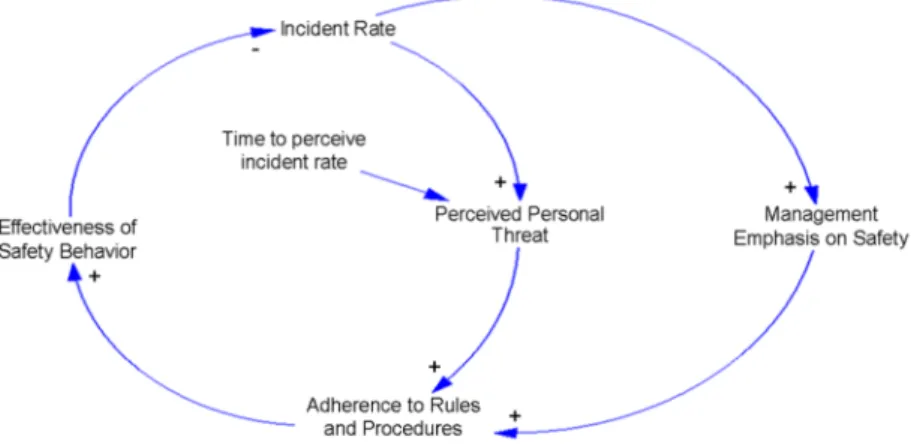
When a safety-hindering incident occurs in a nuclear power plant, an individual increases alert himself to safety in order to maintain his/her own safety, and try to adhere to regulations and procedures furthermore. Consequently, as workers' safety behavior changes effectively, the frequency of incident occurrence diminishes. If workers receive education/training on specific situations, the possibility of their participation in safety-related programs becomes higher, and they immediately implement safety behavior (Goldberg, et al., 1991; Huang, et al., 2004; Lyneis & Madnick, 2008). Many researchers show a common view that safety management actions play a pivotal role in preventing incidents (Zohar, 2000; Gershon, 2000; Lyneis & Madnick, 2008; IAEA, 2012). Safety management is highly linked with organizational learning. The reason is that management actions like leadership behavior, safety policy establishment, accident management, root cause analysis, and work load management have positive impacts on reducing incident occurrence (INSAG-4, 1991; Barling, 2002; INPO, 2004; Lyneis & Madnick, 2008; IAEA, 2012).
Based on the studies mentioned above, a causal loop diagram is drawn up as exhibited in Figure 2. If incident rate increases in a nuclear power plant, individual risk perception goes up, and adherence to regulations and procedures is fortified. All these affect workers' safety behavior effect positively, and the incident rate drops. In addition, as management on safety increases, adherence to regulations and procedures is consolidated and incident rate declines.
3.3 Causal loop diagram of work sector
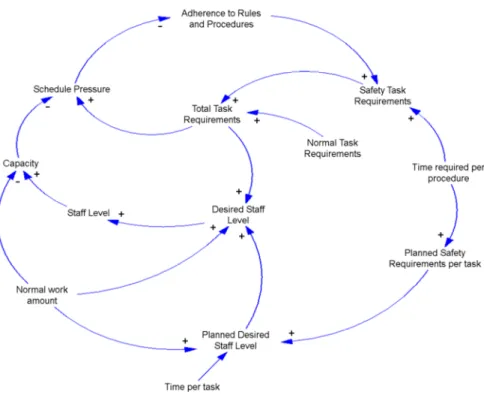
Figure 3 demonstrates the causal loop diagram of the work and relevant details carried out by nuclear power plant workers. As discussed above, the fundamental cause of incident occurrence in nuclear organizations can be time constraint on workers (Rudolph & Repening, 2002; Lyneis & Madnick, 2008; Jae, 2000). As safety task requirements are added to normal task requirements, total task requirements increase, which augments time constraint. Therefore, the time constraint functions as a factor reducing adherence to regulations and procedures. Although, production capability can differ, according to worker's competency, if average workload increases, production capability is reduced, and time constraint is augmented. Consequently, time constraint augmentation functions as a factor to decrease adherence to regulations and procedures. However, if a desired staff (workers) level plan is established, and adequate staff (workers) are secured, their average workload decreases. In turn, time constraint is reduced, and then adherence to regulations and procedures goes up.
3.4 Causal loop diagram of integration
Figure 4 shows the integrated summary of each sector's casual loop diagram examined above. The integrated casual loop diagram consists of sector A (Organizational Learning Sector), sector B (Management Safety Sector), and sector C (Work Sector).
Each sector is interrelated one another, and forms a total system. To reduce incidents in nuclear power plants, let workers respect regulations and procedures by removing time constraint on the tasks to be handled by workers. To this end, appropriate schedule management on worker's tasks is required, and the system needs to be improved so that organizational learning can be conducted through education/training system. In addition, offering education/training opportunities suitable for tasks is needed to maximize education/training effect, and also, the application of what is learned to onsite work is necessary. All these operate as a factor to bolster workers' adherence to regulations and procedures, and reduce incidents. To reduce incidents in a nuclear power plant, it is implied that diversified efforts are necessary.
4. Discussion and Conclusion
This study identifies the fundamental structure of incident occurrence in nuclear organizations, based on system thinking, and examines how various causes are interrelated from a circular casual loop diagram. The study findings and policy suggestions are summarized as follows:
First, if regulations and procedures are complied with well, the incident occurrence frequency can be reduced. However, when workers' time constraint increases, the subjective perception on adherence to regulations and procedures declines, which functions as a factor increasing incident occurrence. Namely, if workload limit that workers can handle exceeds, an incident may occur, due to psychological pressure. If the period of planned preventive maintenance (overhaul) is reduced by force, time constraint is caused, which can be connected to a safety accident. This actually implies that safety-oriented reexamination on schedule
management is required.
Second, as safety task requirements increase on top of worker's normal task requirements, total task requirements increase, which increases time constraint in turn. Time constraint increase functions as a factor reducing the adherence to regulations and procedures. When average workload is augmented, production capability drops, and then time constraint goes up. As a result, time constraint increase operates as a factor to weaken adherence to regulations and procedures. However, if desired staff (workers) level plan is established, and appropriate number of staff (workers) is secured, their average workload decreases. In turn, production capability goes up, time constraint falls. Time constraint decrease positively affects workers' adherence to regulations and procedures. Consequently, it is implied that proper plan for manpower supply and demand and fostering should be established, through which human resources are secured, and job and authority allocation are conducted suitable for each workers' capability and competency.
Third, when an incident occurs, learning on the incident is carried out, and regulations and procedures are consolidated to prevent the recurrence of such an incident, which has a positive effect on safety behavior. Also, if horizontal decision making, leader's
professionalism, safety-oriented management, and leader's onsite management supervision are fortified through leadership education/training, the safety behavior effect increases. Consequently, incident occurrence frequency drops. However, it is necessary to improve the system for behavior considering safety as the utmost priority in advance to increase with education/training through organizational learning, before an incident occurs, rather than consolidating the regulations and procedures, after an incident occurs. Especially, reporting all potential incidents, investigating root causes, exploring solutions, and seeking new implementation methods through benchmarking are needed. If who is responsible for an incident is not clarified, the fundamental cause needs to be thoroughly investigated by composing a sort of accident cause investigation organization. Also, although, a potential incident is reported, outright reexamination on the system not to harm the reporting person, and an incentive system is necessary.
Fourth, professionalism needs to be enhanced by strengthening new workers education/training program, and various scenarios development to cope with specific situations is necessary. Scenarios should be developed through in-depth analysis of various incident cases, and the education/training programs to enhance understanding on facilities are important, and the offering of practical and direct operation and maintenance experiences to new workers is needed by bolstering a mentoring system. The revision of operational procedures reflecting new facility characteristics is required, since the operational procedures for the main control room (MCR) of existing and new nuclear power plants are different. In addition, rigorous education/training on the procedures is necessary so that workers do not make errors or mistakes.
This study identifies the fundamental structure in which an incident occurs in nuclear power plant organizations, and analyzes dynamic relations from a circular causal loop diagram perspective. This paper also describes incident occurrence background from various perspectives. However, this study did not conduct an empirical analysis using the system dynamics model, since nuclear energy-related statistical data collection was not easy, and only access from a conceptual aspect was possible. More realistic analysis is considered possible for further study, if a simulation model is built, based on enough statistical data.
Acknowledgements
This work was supported by the Nuclear Power Core Technology Development Program of the Korea Institute of Energy Technology Evaluation and Planning (KETEP) grated financial resource from Ministry of Trade, Industry & Energy, Republic of Korea (No. 20131510101690).
References
Assessment of Safety Culture in Organization Team (ASCOT)., ASCOT Guidelines. 1996.
Ahn, N.S., Kwak, S.M. and Yu, J.K., A System dynamics model for assessment of organizational and human factor in nuclear power plant, Korean System Dynamics Review, 3(2), 49-68, 2002.
Choi, N.H., A System dynamics approach in analyzing the dynamics of Seoul metropolitan and finding policy leverages, Korean Public Administration Review, 37(4), 329-358, 2003.
Clarke, S.G., Safety Culture: underspecified and overrated?, International Journal of Management Reviews, 2(1), 65-90, 2000.
Cooke, D.L. and Rohleder, T.R., Learning from incidents: from normal accidents to high reliability, System Dynamics Review, 22(3), 213-239, 2006.
Health and Safety Commission., Organizing for Safety. 1993.
Institute of Nuclear Power Operations (INPO)., Principles for a Strong Nuclear Safety Culture. 2004.
International Atomic Energy Agency (IAEA)., Application of the Management System for Facilities and Activities. 2006.
International Atomic Energy Agency (IAEA)., Report of the expert mission to review the station blackout event that happened at Kori 1 NPP on 9 February 2012 Republic of Korea. 2012.
International Nuclear Safety Advisory Group (INSAG)., Summary Report on the Post-accident Review Meeting on the Chernobyl Accident. 1986.
International Nuclear Safety Advisory Group (INSAG)., Safety Culture. 1991.
International Nuclear Safety Advisory Group (INSAG)., Key Practical Issues in Strengthening Safety Culture. 2002.
Jae, M.S., A Study on the effect of organizational safety culture on safety, The Korean Society of Safety, 2000.
Kim, B.S., A Study on the effect of urban spatial structure characteristics on co2 emission, Doctoral Dissertation, University of Chung-Ang, 2013.
Kim, D.H., Moon, T.H. and Kim, D.H., System Dynamics. Seoul: Daeyoung Munhwasa, 1999.
Leveson, N.G., Barrett, B., et al., Modeling, Analyzing and Engineering NASA's Safety Culture: Phase 1 Final Report. Cambridge, MA, Massachusetts Institute of Technology, 2005.
Lyneis, J. and Madnick, S., Preventing Accidents and Building a Culture of Safety: Insights from a Simulation Model, Working Paper, Composite Information Systems Laboratory, Sloan School of Management, Massachusetts Institute of Technology, 2008.
Ministry of Science and Technology., A Study on the Promotion of Safety Culture in Nuclear Power Plants. 2001.
Moon, T.H., Issues and methodological status of system dynamics, Korean System Dynamics Review, 3(1), 61-77, 2002.
Moon, T.H., Sustainable city from system thinking perspective. Seoul:Jipmundang, 2007.
Meadows, D.H., The Unavoidable A Priori, in Jorgen Randers. (ed.,), Elements of the System Dynamics Method, Massachusetts: The MIT Press, 1980.
Minami, N. and Madnick, S., Reducing combat vehicle accidents via improved organizational processes. MIT Working Paper, 2007.
Project Management Institute (PMI)., Construction Extension to The PMBOK Guide Third Edition. 2007.
Richardson, G.P., Feedback Thought in Social Science and System Theory. Philadelphia, University of Pennsylvania Press, 1991.
Richardson, G.P. and Pugh, A.L., Introduction to System Dynamics Modeling with Dynamo. Cambridge, MA: The MIT Press, 1981.
Rudolph, J.W. and Repening, N.P., Disaster Dynamics: Understanding the role of quantity in organizational collapse, Administrative Science Quarterly, 47(1), 1-30, 2002.
Senge, P., The fifth Discipline: The Art & Practice of The Learning Organization. Doubleday: NY, 1990.
Yu, J.K., Ahn, N.S. and Kwak, S.M., The causal diagram for organizational and human factors in nuclear power plant, KoreanSystem Dynamics Review, 2(2), 65-83, 2001.
Weijia, C., The impact of safety culture on safety performance: A case study of a construction company, Doctoral Dissertation, Indiana University, 2005.
Author listings
Byung Suk Kim: [email protected]
Highest degree: Ph.d. Department of Urban and Regional Planning, Chung-Ang University
Position title: Senior Researcher, Center of Excellence for Safety Culture, State University of New York-Korea Areas of interest: Sustainable City, Environmental Policy, Climate Change & Energy, System Dynamics
Youngmin Oh: [email protected]
Highest degree: Ph.d. Department of Public Administration, Seoul National University
Position title: Research Professor, Department of Technology & Society, State University of New York-Korea Areas of interest: Nuclear Policy, System Dynamics