http://dx.doi.org/10.7236/JIWIT.2012.12.5.25
JIWIT 2012-5-4
무선 고해상도 영상 전송 기술에 기반한 영상 감시 시스템의 설계
Design of Visual Surveillance System based on Wireless High Definition Image Transmission Technology
김 원
*Won Kim
*요 약 공공장소에서 의도적으로 유기하는 위험 물체를 감지하는 것은 사회 안전 목적에서 중요하다
.
오늘날 영상 감시 시스템은 고해상도와 무선 연결 능력의 측면에서의 성능 향상이 요구되고 있다.
이 연구에서는 무선 고해상도 영상 전송 기술을 기반으로 사회 안전 목적의 유기물 감지를 위하여 영상 감시 시스템의 설계를 제안하고 있다.
또한 탐지 성능인PED, PAT
지수를 향상시키기 위하여 이전의 영상 감시 소프트웨어 구조에 추적 알고리즘이 포함되도록 하였다.
실제 무선 고해상도 영상 전송 시스템 위에 제안된 설계 구조를 구현함으로써, 4.0 Gbps
속도의 전송 성능으 로서 전체 시스템의 유효성을 보인다.
Abstract It is important to detect dangerous objects which are intentionally abandoned in public places.
Nowadays visual surveillance system is required to enhance the performance in two ways : high resolution and wireless linking ability. In this study the design of visual surveillance system is newly proposed to detect abandoned objects for social security purpose based on wireless high resolution image transmission technology.
Also, to enhance PED, PAT performance, the tracking algorithm is included in the previous visual surveillance software scheme. By implementing proposed design scheme on the real wireless high resolution image transmission system, the effectiveness of the overall system is shown with the transmission performance of 4.0 Gbps speed.
Key Words : visual surveillance, abandoned object, wireless link, high definition, millimeter wave
*정회원 : 우송대학교 컴퓨터정보학과
접수일자 2012년 9월 4일, 수정완료 2012년 10월 2일 게재확정일자 2012년 10월 12일
Received: 4 September 2012 / Revised: 2 October, 2012 / Accepted: 12 October, 2012
*Corresponding Author: [email protected]
Dept. of Computer Science, Woosong University, Korea
Ⅰ. Introduction
It is important to detect dangerous objects which are intentionally abandoned in the public places such as airports, hotel lobbies, schools and so on because they are always crowded with people and possibly easy
targets by hostile terrorists. For the purpose of
security, there are a few previous researches to design
visual surveillance systems to automatically detect
abandoned objects such as
[1]-[4]. Recently W. Kim
designed an automatic detection system for dangerous
abandoned objects based on vision technology in
[5]and
그림 2. HDMI 전선 연결 방식의 기존 영상 감시 시스템
Fig 2. Conventional video surveillance system on wired HDMI linking method
그림 3. 무선 HD 영상 전송에 기반한 제안된 영상 감시 시스템
Fig 3. Proposed video surveillance system based on wireless HD image transmission
also proposed an enhanced system which discriminates
motionless people from abandoned objects by using the human recognition technique in
[6].
Nowadays visual surveillance system is required to enhance the performance in two ways : high resolution and wireless linking ability.
그림 1. 영상 감시에서 HD 해상도의 필요성
Fig 1. Necessity of HD resolution in visual surveillance
It is necessary to enhance the image resolution to HD(High-Definition) level to identify the abandoned object appearing in small portion of current interesting image region as illustrated in Fig. 1. Meanwhile HDMI cables are generally utilized to connect camera system to video surveillance computing server as illustrated in
Fig. 2. The problem of conventional hard-wired method reduces the flexibility of the overall system in connectivity. Therefore, in this study the visual surveillance system is newly proposed to increase the linking flexibility and the image resolution to HD level based on wireless HD image transmission technology in millimeter wave.
Ⅱ. Design of Visual Surveillance System
The conceptual design is proposed to cover the two needs explained earlier in the illustration of Fig. 3. In the configuration a wireless link is proposed to connect a HD camera system to the video surveillance software in a computing server. The wireless system is comprised of Tx(Transmit) and Rx(Receive) links which are running in the bandwidth of over 3.0 Gbps(bits per second) to cover full HD image transmission in real-time.
Apparently, in Fig. 3 the visual surveillance software
has a function of detecting abandoned object
automatically in image streams captured by camera
그림 4. 영상 감시 소프트웨어의 제안된 구조
Fig 4. Proposed structure of visual surveillance software
systems. In the previous study of
[5], there are four steps for abandoned object detection such as background segmentation, noise filtering, pattern analysis and decision logic. Foreground objects are obtained by subtracting background image from current importing image. Here, the background image means the stationary pure background image without the objects such as people and moving things.
Therefore, extracting the background image is the essential process to obtain foreground objects stably.
One of the useful background extraction technique is Dynamic Background Extraction(DBE) method proposed by Kong et al.
[7]. After obtaining the background image, foreground objects are easily obtained by subtracting this from the current importing image at each step. After obtaining foreground objects, it is necessary to discriminate human shapes to increase PED and PAT performances which are discussed in Chapter Ⅳ. Mohan et al. tried to detect humans with Harr wavelets and SVM(Support Vector Machine) classifier in
[8]. Also Viola et al. used adaBoost classifier to detect pedestrians in streets in
[9]. Moreover, Mikolajczyk utilized adaBoost classifier to robustly detect human part in
[10]. To detect the human shapes in foreground objects HOG(Histogram of Oriented Gradient) is utilized in the base of the approach of Dalal and B. Triggs in
[11]. The decision logic can be designed to determine whether the detected objects from the previous stages are short-term or long-term thing. The robust decision logic is proposed in
[12]by using fuzzy logic algorithm.
One of the problem of the previous study in
[5]is that the detection performance is unsatisfactory to apply the
system to real world. To solve this problem, a new design structure is proposed in Fig. 4 to make the visual surveillance software more reliable. In this new design, a Kalman filter logic is included in the previous research of
[6]to track human objects in image stream to improve detection rates when considering human occlusion for abandoned objects behind because Kalman filter can give the information of human positions by tracking them from the initial points obtained from the previous HOG stage.
Ⅲ. Implementation of the proposed design
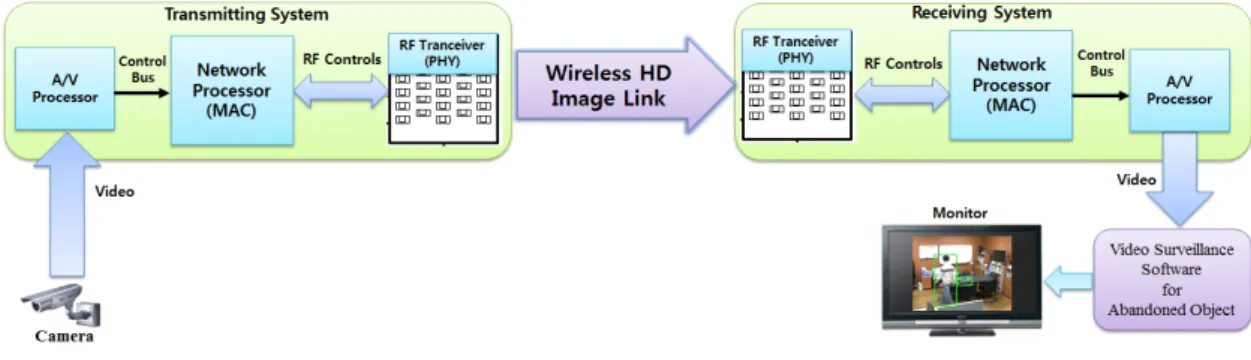
The overall system is proposed to construct the configuration which integrates the visual surveillance system with wireless HD image transmission system as illustrated in Fig. 5. HD video signal captured by a camera system is transferred to the video surveillance system explained in Chapter Ⅱ in air by a wireless HD image link. A wireless link was proposed to cover HD image transmission in the previous study of
[13], in which the hardware system is implemented by the generation 1 chipset of Sibeam corporation. The performance is unsatisfactory in the phase of transmission distance and power consumption.
In this study new wireless HD image link is proposed on the results of the previous researches in
[14]and
[15], in which the wireless link is designed and
implemented on the generation 2 chipset of Sibeam
corporation. In the link, there are two subsystems :
Transmitting system and Receiving system as
그림 5. 제안된 설계 구조에 대한 구현 시스템의 구성
Fig 5. Configuration of implemented system for the proposed design scheme
illustrated in Fig. 5. Each subsystem is comprised of A/V processor, Network Processor and RF Tranceiver(PHY). In transmitting system, the A/V processor delivers video signal to the network processor which functions as MAC and the RF tranceiver actually transmits the video signal in digital format on 60 GHz millimeter band. Meanwhile, in the receiving system A/V processor, Network Processor and RF Tranceiver(PHY) function in reverse way compared with the transmitting system.
In real hardware, SB9220 and SB9210 chips of Sibeam corporation are used for the network processor and the RF tranceiver, respectively in the transmitting system, while SiI9135 of Silicon Image corporation is chosen as the AV processor. Similarly for the receiving system SB9221 and SB9211 chips of the Sibeam corporation are used for the network processor and the RF tranceiver, respectively while SiI9134 of Silicon Image corporation is selected as the AV processor.
Ⅳ. Experimental Results
The overall system is evaluated on the test image stream of which feature is summarized in Table 1.
Image streams for a meeting room was captured to include 6 essential situations which include the image scenes in which an object is intentionally abandoned on a table by a person and occlusions happen by multiple persons who are entering the meeting room. The
details on the image streams is described in
[6]as a testing condition.
Evaluation Item Image Stream for Experiment
Detection performance for abandoned object
o Image stream obtained in a meeting room
o 6 situations to test the visual surveillance system
o Indoor environment test 표 1. 실험을 위한 영상 입력 조건
Table 1. Image stream condition for the experiment
그림 6. 유기물의 탐지 과정
Fig 6. Detection process of an abandoned object
Detection process is illustrated in Fig. 6 in which a
person is tracked and marked with the green rectangle
and the abandoned bag is detected and marked with the
red rectangle automatically by the proposed visual
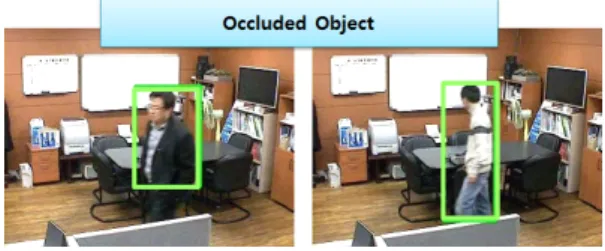
surveillance system. Because occlusion problem is one
of the major factors in false alarms to the entire
detections, it is necessary to design a robust visual
surveillance system which is insensitive to occlusion
situations as illustrated in Fig. 7.
그림 7. 실험에서 유기물의 가려짐 현상
Fig 7. Occlusion of the abandoned object in the experiment
As an important performance index, Percent Events Detected(PED) in
[1]is evaluated for visual surveillance systems because it measures the sensitivity for real alarm events even though there may be false alarms in the results. Generally, PED is defined as follows :
⌗
⌗
(1)
Meanwhile, as an accurate performance index, Percent Alarms True(PAT) should be evaluated according to the following equation,
⌗
⌗
(2)
Evaluation Items Unit
Performance indices Previous design based on [6]+[10]
configuration
Proposed design PED(Percent
Events Detected) % 90 95 PAT(Percent
Alarm True) % 75 79
Transmission
distance meters 10 30
Consuming power Watt 20 10 Transmission
bandwidth Gbps 3.0 4.0
표 2. 이전 설계과 제안된 설계간의 성능 지수 비교 Table 2. Comparison of the performance indices
between the previous design and the proposed design
Finally the experimental results in this study are summarized in Table 2. The results of the proposed
system in this study is compared with the previous design configuration in which the visual surveillance algorithm of
[6]and the wireless HD link of
[13]are combined as a reference system to show the enhancement of the proposed system in performance.
PED and PAT in this study are better than the previous design and the wireless transmission performances are also improved.
Ⅴ. Conclusion
In this study the design of visual surveillance system is newly proposed to detect abandoned objects for social security purpose based on wireless high resolution image transmission technology in millimeter wave. To enhance PED, PAT performance, the tracking algorithm is included in the previous visual surveillance software scheme. By implementing proposed design scheme on the real wireless high resolution image transmission system, the effectiveness of the overall system is shown with the transmission performance of 4.0 Gbps speed.
References
[1] N. Bird, S. Atev, N. Caramelli, R. Martin, O.
Masoud, and N. Papanikolopulos, "Real Time, Online Detection of Abandoned Objects in Public Areas," Proceedings of the IEEE International Conference on Robotics and Automation, Orlando, Florida, May 2006.
[2] F. Porikli, Y. Lvanov and T. Haga, "Robust Abandoned Object Detection Using Dual Foregrounds," EURASIP Journal on Advanced in Signal Processing, 2008.
[3] I. Haritaoglu, D. Harwood, and L. S. Davis, "W4 :
Real-Time Surveillance of People and Their
Activities," IEEE Trans. on Pattern Analysis and
Machine Intelligence, vol. 22, no. 8, August 2000.
※ 본 논문은 2012년도 정부(교육과학기술부)의 재원으로 한국연구재단의 기초연구사업 지원을 받아 수행되었 음(과제번호: 2012-0007742)
[4] W. Hu, T. Tan, L. Wang, and S. Maybank, "A Survey on Visual Surveillance of Object Motion and Behaviors," IEEE Trans. on Systems, Man, and Cybernetics-Part C, vol. 34, no. 3, August 2004.
[5] W. Kim, "Automatic Detection System for Dangerous Abandoned Objects based on Vision Technology," Journal of The Institute of Webcasting, Internet and Telecommunication, vol.
9, no. 4, pp.1-6, August 2009.
[6] W. Kim, "A Smart Visual Surveillance System with Human Recognition for Enhanced Detection of Abandoned Objects", Journal of Korean Institute of Information Technology, vol. 8, no. 10, pp. 209-214, October 2010.
[7] J. Kong, Y. Zheng, Y. Lu, and B. Zhang, "A Novel Background Extraction and Updating Algorithm for Vehicle Detection and Tracking," Fourth International Conference on Fuzzy Systems and Knowledge Discovery, 2007.
[8] A. Mohan, C. Papageorgiou, and T. Poggio,
“Example-based object detection in images by components,” IEEE PAMI, pp. 349–361, April 2001.
[9] P. Viola, M. J. Jones, and D. Snow, “Detecting pedestrians using patterns of motion and appearance,” The 9th ICCV, vol. 1, pp. 734-741, 2003.
[10] K. Mikolajczyk, C. Schmid, and A. Zisserman,
"Human detection based on a probabilistic assembly of robust part detectors," The 8th ECCV, vol. I, pp.
69-81, 2004.
[11] N. Dalal and B. Triggs, "Histograms of oriented gradients for human detection," CVPR 2005, vol. 1, pp. 886-893, 2005.
[12] Won Kim, “Robust detection technique for abandoned objects to overcome visual occlusion,”
Journal of The Institute of Webcasting, Internet and
Telecommunication, vol. 10, no. 4, pp.23-29, December 2010.
[13] Won Kim, "Design and Implementation of Wireless HD Transmission System Based on Millimeter Wave Technology for Visual Surveillance", Journal of the Korean Institute and Information Technology, Vol. 8, No. 11, pp. 1-8, November 2010.
[14] Won Kim, "Enhanced Design of Wireless HD Image Transmission System Based on Millimeter Wave Technology for Visual Surveillance", Journal of the Korean Institute and Information Technology, Vol. 9, No. 10, pp. 21-28, October 2011.
[15] S. Jeong, T. An, B. Kim, W. M. Nam, Y. Lee and M. Oh, “Development of Wireless Image Transmission System in Subway at 18GHz,”
Journal of the Korea Academia-Industrial cooperation Society, vol. 11, no. 6, pp.2196-2201, June 2010.
저자 소개
김 원(정회원)