• 검색 결과가 없습니다.

A Prospective Investigation into the Effects of Workplace Stress and Working Postures on Work-related Neck Pain in Office Workers

N/A
N/A
Protected

Academic year: 2021

Share "A Prospective Investigation into the Effects of Workplace Stress and Working Postures on Work-related Neck Pain in Office Workers"

Copied!
9
0
0

로드 중.... (전체 텍스트 보기)

전체 글

(1)

| Abstract |

Purpose: The purpose of this study was to identify the causal relationship between workplace stress and working posture and the development of work-related neck pain in office workers.

Methods: The study participants included 62 office workers who had not experienced neck pain in the previous 12 months.

A battery of measures to evaluate potential workplace risk factors in an office setting were conducted at baseline, and the 12-month incidence of work-related neck pain was reported via monthly questionnaires. Survival analysis was used to evaluate the longitudinal relationship between the workplace risk factors and the development of work-related neck pain.

Results: The incidence of work-related neck pain was 1.91 (95% CI: 1.06–3.45) per 100 person months. The incidence of neck pain was predicted to be less likely to happen when workers had a more upright thorax posture during computer work (hazard ratio, 0.94; 95% CI: 0.89–0.99). However, stress may deteriorate the preventative effects of other risk factors on neck pain and showed a positive relationship with episodes of neck pain (hazard ratio, 1.37; 95% CI: 1.03–1.84).

Conclusion: Understanding the psychophysiological effects of neck pain may explain the development of neck pain in office workers. Our interest in prevention plans and treatments should therefore involve a multifactorial pathology of neck pain in the workplace.

Key Words: Neck pain, Risk factors, Stress, Working posture

†Corresponding Author : Deok-Hoon Jun ([email protected]) PNF and Movement, 2019; 17(2): 253-261

https://doi.org/10.21598/JKPNFA.2019.17.2.253

Print ISSN: 2508-6227 Online ISSN: 2508-6472

Original Article Open Access

사무직 근로자들에게 나타나는 직업 관련 목 통증에 관한 직장 내 스트레스와 작업자세의 전향적 조사
전덕훈

1)

경성대학교 물리치료학과

A Prospective Investigation into the Effects of Workplace Stress and Working Postures on Work-related Neck Pain in Office Workers

Deok-Hoon Jun

Department of Physical therapy at Kyungsung University Received: April 26, 2019 / Revised: May 28, 2019 / Accepted: May 28, 2019

ⓒ 2019 Journal of Korea Proprioceptive Neuromuscular Facilitation Association

This is an Open Access article distributed under the terms of the Creative Commons Attribution Non-Commercial License

(http://creativecommons.org/licenses/by-nc/3.0) which permits unrestricted non-commercial use, distribution, and reproduction

in any medium, provided the original work is properly cited.

(2)

ԺԽԼ ք ՘ՖՎԨթնլԨՕշվխյխնռԨ՞շմԶԨԹԿԴԨՖշԶԨԺ

Ⅰ. 서 론

목 통증은 재발성 질환으로 70% 이상의 사람들이 일생에 한번쯤 겪게 되는 통증이다(Cote et al., 2004;

Manchikanti et al., 2009). 그 특이성으로 인하여, 목 통증은 개인 뿐 아니라, 가족, 직업사회, 그리고 나아가 건강관리 체계에도 악영향을 미친다(Guzman et al., 2008a). 특히 직장 내 근로자의 장기부재, 그로 인한 감소된 생산력과 직업복귀를 위한 치료비용 등은 산업 사회에 막대한 손실을 초래한다(Van eerd et al., 2011).

직업별간 목 통증의 유병률과 발병률은 사무직 근 로자들 사이에서 가장 높게 보고 되고 있다(Cote et al., 2009). 사무직 근로자들의 장시간 컴퓨터 사용과 좌식 근무 형태는 신체의 먼 쪽 관절의 반복적인 움직 임과 몸쪽 자세 유지근들의 지속적인 수축을 일으킨 다(Punnett & Bergqvist, 1997). 이런 비대칭적인 움직임 은 컴퓨터 업무 동안 척추만곡 유지를 힘들게 하여 근골 격계 질환을 유발할 수 있다(Gerr et al., 2006; Kotani et al., 2007). 또한, 물리적 원인을 넘어 사무직 근로자들 은 높은 강도의 심리적 근무 스트레스를 경험하게 된다 . 주목할 점은 , 심리학적 부담이 역학적 스트레스가 일으 키는 목 통증 병리현상을 가속화 시키는 역할을 하게 된다 (Griffiths et al., 2011; Sjogaard et al., 2000).

이렇듯 목 통증은 재발성 특성을 가지고 물리적, 심리적 요인이 복합적으로 작용하는 다인성 질환 (multifactorial disorder)이다. 이런 특이성이 목 통증과 위험인자(risk factors)의 인과관계에 대한 연구 실행을 어렵게 만든다 . 예를 들어, 비교적 수행하기 쉬운 횡단 면 연구를 통한 목 통증 위험인자 조사는 단적 상관관 계를 나타낼 뿐, 종적 인과 관계를 설명하지 못한다 (Jun et al., 2017). 종적 연구의 실행을 어렵게 만드는 시간과 경제적 이유로 인하여 (Toledano et al., 2015), 지금까지 종적 연구를 통한 목 통증 위험인자에 대한 물리적, 심리적 요인의 복합적인 국내 조사는 보고된 바 없다 . 따라서 직업관련 목 통증과 위험인자의 인과 관계를 이해하기 위한 종적 연구의 필요성은 크다.

그러므로, 이 연구의 목적은 전향적 조사를 통해 직장

내에 존재하는 다양한 물리적, 심리적 위험 인자들을 평가하고 그 인자들과 직업관련 목 통증 발생률 (incidence) 과의 인과관계를 밝히는 것이다.

Ⅱ. 연구 방법

1. 연구 설계 및 대상자 선정

본 연구는 12 개월 전향적 연구(prospective design study) 로 경산시 D 대학교의 사무직 근로자를 대상으 로 하였다. 대상자 모집은 사내 공지, 건물 내 광고지 등을 통하여 진행하였다 . 모든 대상자는 참여 동의서 를 읽고 실험 내용을 충분히 인지한 후 참여의사를 밝혔다 . 본 실험은 연구 관리 위원회의 승인아래 시행 되었다 (Human Research Ethics Committee in University of Queensland; Approval number-2014000308). 두 달간 진행된 대상자 모집에서 총81 명의 자발적 참여의사 를 받았으며, 그 중 62명의 지원자만이 연구 대상자 자격조건을 만족하였다.

2. 대상자 자격 조건

연구 대상자 자격 조건은 다음과 같다 . 1) 18세 이상 성인, 2) 정규직 근로자로 주간 30시간 이상 근무, 3) 주간 20 이상의 컴퓨터 사용, 4) 지난 1년간 근골격계 질환을 가지지 않은 자 . 목 통증은 성인기 이전에 발병 을 할 수 있으며(Hogg-Johnson et al., 2008), 재발성이기 때문에 , 목 통증 병력은 현 대상자의 목 통증 병리에 영향을 미친다(Guzman et al., 2008b). 따라서, 최근 1년 간 근골격계 질환을 가진 지원자는 제외되었다.

3. 대상자 위험인자 측정

직장 내 존재하는 위험인자와 개인적 요소 평가는

설문지와 피실험자의 직장 내 직접 방문을 통해 이루

어졌다.

(3)

ᶪᠲ⚿Ԩૺᕚ⒎ᇢ⋎ঊԨඖⶾඖྒԨ⚿⋃Ԩ৾ᔦԨឧԨ⺳⚛⋎Ԩ৾㉚Ԩ⚿⒣Ԩ඲Ԩᾢ⾶ᔆᾢ⌾Ԩ⒏⋃⒎Ḷ⑖Ԩ│㊣⓿Ԩ╮ᶪ ք ԺԽԽ

1) 설문지 조사

설문지는 대상자의 일반적 특성(나이, 키, 몸무게, 직위, 흡연 유무, 음주량), 과 근무조건(근무 시간, 컴퓨 터 사용량, 근무간 휴식 시간), 그리고 근로자가 가지 는 심리적 인자(우울, 불안, 스트레스), 그리고 신체활 동 수준으로 구성되었다 . 심리적 인자 측정을 위하여 한국형으로 번역된 Depression, Anxiety, and Stress Scale (DASS-21)을 사용하였다. 이 평가지는 각 증상 평가를 위해7개의 항목으로 구성되어 있으며, 높은 수준의 신뢰성과 타당도를 가진다(Jun et al., 2018).

근로자의 신체활동 수준을 평가하기 위하여 신뢰성 과 타당도를 갖춘the International Physical Activity Questionnaire (IPAQ-SF)를 사용하였다(Oh et al., 2007).

2) 직장 내 방문

직장 내 방문을 통하여 대상자의 근무자세, 사무책 상 환경을 평가하였다.

대상자의 근무자세를 평가하기 위해 흉곽의 움직 임을 실시간으로 조사하였다. 흉곽의 움직임은 가속 도 센서(3-space-data logger USB, YOST Labs product, USA)를 복장패임 아래 1cm 부근에 부착하여, 정중면 내의 흉곽의 굽힙/폄 각도를 통해 해석하였다(50Hz).

측정시간은 1시간을 기준으로 하였으며, 역학적인 부 하가 없는 중립적 자세를 평가 기준으로 정하였다 (Teschke et al., 2009). 중립적 자세는 중력 수직선을 기준으로 흉곽의 굽힘/폄 10° extension∼10° flexion 구간으로 정의하였다. 최종 분석을 위한 자료해석은 대상자가 중립적 자세를 취한 누적시간을 총 측정시 간 대비 백분위로 나타내었다. 이 측정도구의 신뢰성 과 측정방법은 본 연구자의 지난 연구에 자세히 보고 되고 있다(Jun et al., 2019). 대상자의 사무책상 환경 요소인 모니터의 높이(눈높이/눈높이 이하/눈높이 이 상 ), 마우스와 키보드의 위치(책상 끝에서부터 입력장 치 끝부분 까지의 거리(cm), 책상의 높이(cm), 종이 문서의 위치(몸 쪽 가깝게/몸쪽과 멀게), 의자의 높이

(바른 앉은자세에서 대상자의 팔꿉관절 높이가 책상 높이와 일치/팔꿉관절 높이가 책상 높이보다 낮음/팔 꿉관절 높이가 책상 높이보다 높음).

4. 목 통증 추적 조사

대상자의 목 통증 발병 유무와 기간을 조사하기 위해 실험참여 날짜를 기준으로 매 다가오는 30일째 추적검사를 하였다. 목 통증의 유무는 Bone and Joint Decade 2000-2010 Task Force 의 목 통증 정의를 기준으 로 판별하였다 (Guzman et al., 2008b). 목 통증의 정의는 다음과 같다; 1) 일상생활을 방해할 정도의 통증(잠, 독서, 컴퓨터 활동, 운전, 사회생활 등), 2) 결근이나 의학적 처치(마사지, 재활, 통증약)를 초래한 정도의 통증, 3) 통증의 범위는 견갑골의 극상(spine of scapular) 부위와 목 아래 패임(supra sternal notch)을 연결하는 부위부터 목 덜미선(superial nuchal line)까지 로 정함. 직업관련 목 통증과 외상성 목 통증을 구별하 기 위하여 운동이나 불편한 잠자리 등 특정한 신체활 동 중 발생한 목 통증은 제외시켰다.

5. 통계 분석

직업관련 목 통증의 발병률과 생존분석(survival

analysis)를 위해 Stata version 13를 사용하였다. 목 통증

발병률은 Kaplan-Meier survival estimates를 통해 분석

하였다 (Kaplan & Meier, 1958). 위험인자들과 목 통증

발병률의 인과관계를 분석하기 위하여 Multivariate

Cox Proportional Hazard Analyses를 적용하여 목 통증

발생 위험비(Hazard Ratio)를 분석하였다 (Shahidi et

al. 2015). 다인자 분석(multivariable analysis)에서 필요

한 분석 인자들 선택에 대한 오류를 최소화 하기 위해

least absolute shrinkage and selection operator (lasso) 회

귀분석 모형을 적용하였다(Tibshirani, 1996). 모델의

최적화 판단을 위해 Akaike’s information criteri 검증을

실시하였다(Akaike, 1974).

(4)

ԺԽԾ ք ՘ՖՎԨթնլԨՕշվխյխնռԨ՞շմԶԨԹԿԴԨՖշԶԨԺ

Ⅲ. 연구 결과

1. 연구 대상자의 일반적인 특성

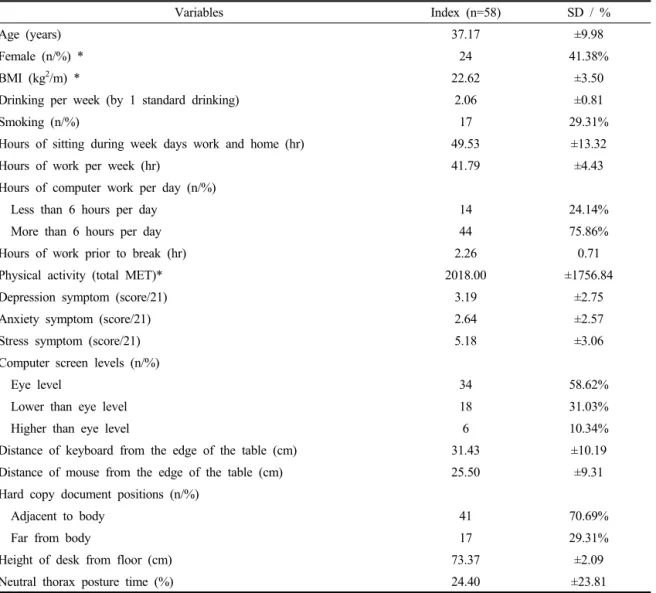
62명의 초대된 대상자중 4명의 대상자는 실험을 완료하지 못하였다. 남은 58명은 1년간 추적조사를 모두 완료하였다. 대상자의 기본 정보와 위험인자에 대한 정보는 Table 1에 기술하였다.

2. 목 통증 발병률

1년 직업관련 목 통증의 평균 발병률(incidence rate) 은 1.91(95% CI: 1.06 – 3.45) per 100 person months로 나타났다 (Fig. 1). 본 연구 대상자들의1년간 누적 발병 률(cumulative incidence)은19.0%로 총 11명이 직업관 련 목 통증을 호소하였다 . 발병률에서 남녀간 유의한 차이는 나타나지 않았다 (p=0.73).

Variables Index (n=58) SD / %

Age (years) 37.17 ±9.98

Female (n/%) * 24 41.38%

BMI (kg

2

/m) * 22.62 ±3.50

Drinking per week (by 1 standard drinking) 2.06 ±0.81

Smoking (n/%) 17 29.31%

Hours of sitting during week days work and home (hr) 49.53 ±13.32

Hours of work per week (hr) 41.79 ±4.43

Hours of computer work per day (n/%)

Less than 6 hours per day 14 24.14%

More than 6 hours per day 44 75.86%

Hours of work prior to break (hr) 2.26 0.71

Physical activity (total MET)* 2018.00 ±1756.84

Depression symptom (score/21) 3.19 ±2.75

Anxiety symptom (score/21) 2.64 ±2.57

Stress symptom (score/21) 5.18 ±3.06

Computer screen levels (n/%)

Eye level 34 58.62%

Lower than eye level 18 31.03%

Higher than eye level 6 10.34%

Distance of keyboard from the edge of the table (cm) 31.43 ±10.19

Distance of mouse from the edge of the table (cm) 25.50 ±9.31

Hard copy document positions (n/%)

Adjacent to body 41 70.69%

Far from body 17 29.31%

Height of desk from floor (cm) 73.37 ±2.09

Neutral thorax posture time (%) 24.40 ±23.81

MET: Metabolic equivalent minutes. Neutral thorax posture were defined as the angular range between 10° extension and 10° flexion.

Table 1. Distribution of risk factors included in the survival analysis

(5)

ᶪᠲ⚿Ԩૺᕚ⒎ᇢ⋎ঊԨඖⶾඖྒԨ⚿⋃Ԩ৾ᔦԨឧԨ⺳⚛⋎Ԩ৾㉚Ԩ⚿⒣Ԩ඲Ԩᾢ⾶ᔆᾢ⌾Ԩ⒏⋃⒎Ḷ⑖Ԩ│㊣⓿Ԩ╮ᶪ ք ԺԽԿ

3. 직업관련 목 통증과 위험인자간의 인과관계

다변량 생존 분석시 대상자의 기본 정보인 나이, 성별 , BMI는 인자간 상관관계에 관련없이 분석에 포 함되었다. Lasso 회귀분석을 통해 선택된 위험인자는 흉곽자세 , 신체활동 수준(total MET score), 키보드 위 치 , 스트레스 증상, 근무시간, 휴식 시간 형태로 정해졌

다 (Table 2). 대상자의 연령, 성별, BMI 등의 기본 인자 는 목 통증과의 유의한 인과관계를 나타내지 않았다 . 또한 직장 내 존재하는 사무실 책상의 환경과 신체활 동 또한 유의한 인과관계를 보이지 않았다. 흉곽의 중립적 자세는 직업관련 목 통증 발생을 막는 예방적 효과를 보였다 (Hazard Ratio: 0.94, 95% CI: 0.89–0.99).

하지만 개인이 가지는 스트레스 증상은 목 통증 발생 Fig. 1. Kaplan-Meier survival curves for the incidence of work-related neck pain during the

12 month follow-up. The Y-axis describes the percent of participants each month of the follow-up period who did not report an episode of work-related neck pain.

Risk factors Adjusted HR p 95% CI

Age (decades) 0.37 0.08 0.12 – 1.13

Female 2.32 0.41 0.32 – 16.88

BMI (kg/m2) 1.24 0.12 0.94 – 1.64

Neutral thorax posture (%) 0.94 0.05 0.89 – 0.99

Stress symptom (score) 1.37 0.03 1.03 – 1.84

Physical activity (total MET) 1.00 0.24 0.99 – 1.00

Hours of work per week (hr) 1.13 0.14 0.96 – 1.33

Hours of work prior to break (hr) 2.92 0.13 0.73 – 11.65

Keyboard located in front of and close to the body (yes/no) 0.91 0.07 0.83 – 1.01 Table 2. Multivariate Cox Proportional Hazard models indicating the calculated Hazard Ratio and significant association

for risk factors and development of neck pain in office workers (n=58)

(6)

ԺԽՀ ք ՘ՖՎԨթնլԨՕշվխյխնռԨ՞շմԶԨԹԿԴԨՖշԶԨԺ

을 일으키는 위험 인자로 나타났다(Hazard Ratio: 1.37, 95% CI: 1.03–1.84).

Ⅳ. 고 찰

본 연구결과는 개인이 가지는 기본 인자와 직장내 의 존재하는 위험인자들과의 상관관계와 목 통증 위 험률과의 인과관계를 조사하여 사무직 근로자들을 위 한 목 통증 예방법과 치료방법에 근거가 될 수 있는 위험인자들을 보고하고 있다. 현재까지 한국 내 사무 직 근로자들을 대상으로 다변량 생존분석을 통한 목 통증 발생률과 위험인자의 인과관계 분석연구는 보고 되고 있지 않다 . 본 연구결과는 위험인자들의 분석을 넘어 목 통증의 임상적 예방 방향과 연구방향을 제시 하는데 있어 중요한 연구가 될 것이다.

본 연구의 생존분석에서 나타난 위험비와 흉곽의 자세는 서로 유의한 인과관계를 보여주었다. 위험비 0.94는 사무직 근로자의 흉곽 중립자세 유지가 1% 증 가할때마다 6%의 목 통증 발생 위험비 감소를 나타낸 다. 근로자의 흉곽 중립자세 유지가 10%가 증가한다 면 환자의 목 통증 발생 위험비는 86%까지 감소 할 수 있다는 것으로 해석된다. 흉곽 자세의 중립은 앉은 자세에서 임상적으로 권고되는 자세이며 그 역학적 이점은 지난 연구들에서 보고 되고 있다(Caneiro et al., 2010; Edmondston et al., 2007). 중력선의 수직축에 서 벗어난 척추자세는 척추근육들의 과도한 활성과 변화된 근육 활성 패턴을 야기 시키며, 습관적으로 유지된 자세는 잠재적인 목 통증을 유발할 수 있다 (Edmondston et al., 2011; Straker et al., 2009). 이 연구에 서 밝혀낸 흉곽의 중립자세와 목 통증과의 인과관계 는 사무직 근로자의 흉곽자세평가의 중요성을 보여준 것이다. 이는 근로자의 목 통증 발생여부를 예측하는 데 큰 도움이 될 것이다.

근로자의 인체역학적 위험성뿐 아니라, 심리적 요 인들 또한 주요한 위험인자로 나타났다. 본 연구에서 측정한 심리적 인자들인 우울 증상, 불안 증상, 스트레

스 증상 중 목 통증 발생과 스트레스 증상이 가장 유의 한 인과관계를 보였다 . 특히 본 연구의 스트레스 증상 은 설문지 각 항목의 점수를 합하여 총점을 통해 나타 낸 점수로 , 그 증상의 범위는 0 점부터 21 점까지 넓은 범위로 나타난다. 본 연구에서 유의하게 나타난 위험 비 1.37은 스트레스 증상 점수의 각 1점 증가에 대한 위험비이다. 스트레스 증상 점수가 2점 증가 시 그 위험도는 1.88로 증가하며, 5점 증가 시 그 위험비는 4.82로 다섯배에 가까운 목 통증 발생 위험을 경고할 수 있다. 목 통증 발생과 스트레스 및 심리적 요인들의 인과관계는 체계적 문헌 고찰 등에서 많이 보고되었 다 (Kraatz et al., 2013; McLean et al., 2010). 사무직 근로자의 특징적인 위험성은 바로 장시간의 컴퓨터 근무와 함께 상당한 수준의 정신적 요구 (mental demand)에 있다(Sjogaard & Jensen, 2000). 지속된 정신 적 요구는 목 통증으로 이어지는 근골격계 부상을 초 래할 수 있다(Lundberg & Johansson, 2000; Waersted et al., 1996). 예를 들어 마감시간의 압박과 늘어난 업무 량은 반복적이고 증가된 키보드와 마우스 활동을 초 래한다(Birch et al., 2000; Eijckelhof et al., 2013). 또한 평소와 다른 근무활동은 근육의 활동 변화와 컴퓨터 사용 및 근무 휴식의 다른 패턴을 유발할 수 있다 (Bongers et al., 2006; Potvin, 2012). 그러므로, 근무자의 스트레스 증상은 목 통증 예방 치료에 있어 꼭 평가되 어야 할 중요한 인자로 여겨져야 할 것이다.

본 연구에서 사무책상 환경 인자들과 목 통증 발생 과의 유의한 인과관계는 나타나지 않았다. 사무책상 환경의 영향은 흉곽자세와 목 통증 발생과의 인과관 계에 의해 그 효과가 감소된 것으로 예측된다 . 흉곽자 세를 결정하는 많은 인자들 중 하나는 사무책상의 높 이 , 컴퓨터 입력장치의 위치, 그리고 모니터의 높낮이 들이다(Kotani et al., 2007). 복합적인 사무책상환경 인 자들에 의해 결정된 근로자의 흉곽자세가 다변량 생 존분석에서 더 강한 예측인자로 작용하였을 것이다.

흉곽자세와 스트레스 증상의 위험성은 환자들이 갖는 기본인자들과 달리 수정이 가능한 인자들이다.

본 연구 결과는 목 통증 예방에 있어 실질적으로 적용

(7)

ᶪᠲ⚿Ԩૺᕚ⒎ᇢ⋎ঊԨඖⶾඖྒԨ⚿⋃Ԩ৾ᔦԨឧԨ⺳⚛⋎Ԩ৾㉚Ԩ⚿⒣Ԩ඲Ԩᾢ⾶ᔆᾢ⌾Ԩ⒏⋃⒎Ḷ⑖Ԩ│㊣⓿Ԩ╮ᶪ ք ԺԽՁ

가능한 치료계획들을 제공할 수 있을 것이다. 특히, 한가지 특징적 인자들만을 위한 치료계획이 아닌 다 인자 목표성(multi-oriented plan) 접근이 필요할 것이 다 . 목 통증의 병인은 다인성 질병으로 보고되고 있다 (Cote et al., 2009). 그럼으로, 목 통증 예방 및 치료 계획 시 , 환자들의 기본적 인자, 심리학적 인자, 신체 생리학적 인자, 직업적 인자 등 다양한 인자들의 중재 가 필요하다. 본 연구에서 다양한 위험인자들을 평가 하였지만, 대상자의 신체적 능력, 근무지에서 존재하 는 사회심리적 인자들과 대상자의 스트레스 대처방 안 등 다른 잠재적 위험 인자들의 평가가 이루어 지지 못하였다. 또한 흉곽 자세와 사무책상환경을 제외한 다른 인자들의 평가는 대상자의 주관적 평가에 기댄 설문지를 통하여 이루어졌다. 후속 연구에서는 다름 잠재적 인자를 포함하는 평가를 통해 목 통증의 위험 성과 그 인과관계를 밝히고, 또한 더 객관적인 평가도 구들을 사용하여 연구결과의 질을 높일 수 있기를 기대한다.

Ⅴ. 결 론

본 연구 결과는 사무직 근로자의 컴퓨터 작업 시 흉곽의 자세와 스트레스 증상이 목 통증 발생에 미치 는 영향과 인과관계를 설명하였다 . 두 위험인자는 수 정 가능한 인자들이며, 또한 목 통증 발병의 인과관계 는 다인자 병인론에 근거함을 뒷받침 해주었다 . 특히 본 연구 결과가 자세와 근무 환경과 같은 물리적 인자 들뿐만 아니라 , 개인의 스트레스 수준이 목통증 발병 률에 주요한 위험인자로 작용한다는 인과관계를 나타 내었다 . 그럼으로, 목 통증 예방 및 치료계획은 포괄적 인 위험인자 평가를 기반으로 실행되어야 하며 , 근무 환경이나 개개인의 근무 자세 그리고 스트레스 증상 같은 수정 가능한 위험인자들의 개선을 목표로 하여 야 할 것이다.

Acknowledgements

이 연구는 Office Ergonomic Research Committee지 원아래 연구 되었음을 알립니다.

References

Akaike H. A new look at the statistical model identification.

IEEE Transactions on Automatic Control. 1974;

19(6):716-723.

Birch L, Juul-Kristensen B, Jensen C, et al. Acute response to precision, time pressure and mental demand during simulated computer work. Scandinavian journal of work, environment & health. 2000;26(4):299-305.

Bongers PM, Ijmker S, van den Heuvel S, et al. Epidemiology of work related neck and upper limb problems:

psychosocial and personal risk factors (part I) and effective interventions from a bio behavioural perspective (part II). Journal of occupational rehabilitation. 2006;16(3):279-302.

Caneiro JP, O’Sullivan P, Burnett A, et al. The influence of different sitting postures on head/neck posture and muscle activity. Manual therapy. 2010;15(1):54-60.

Cote P, Cassidy JD, Carroll LJ, et al. The annual incidence and course of neck pain in the general population:

a population-based cohort study. Pain. 2004;

112(3):267-273.

Cote P, van der Velde G, Cassidy JD, et al. The burden and determinants of neck pain in workers: results of the bone and joint decade 2000-2010 task force on neck pain and its associated disorders. Journal of manipulative and physiological therapeutics. 2009;

32(2 Suppl):S70-86.

Edmondston SJ, Chan HY, Ngai GC, et al. Postural neck

pain: an investigation of habitual sitting posture,

perception of ‘good’ posture and cervicothoracic

(8)

ԺԾԸ ք ՘ՖՎԨթնլԨՕշվխյխնռԨ՞շմԶԨԹԿԴԨՖշԶԨԺ

kinaesthesia. Manual therapy. 2007;12(4):363-371.

Edmondston SJ, Sharp M, Symes A, et al. Changes in mechanical load and extensor muscle activity in the cervico-thoracic spine induced by sitting posture modification. Ergonomics. 2011;54(2):179-186.

Eijckelhof BH, Huysmans MA, Bruno Garza JL, et al. The effects of workplace stressors on muscle activity in the neck-shoulder and forearm muscles during computer work: a systematic review and meta-analysis. European journal of applied physiology. 2013;113(12):2897-2912.

Gerr F, Monteilh CP, Marcus M. Keyboard use and musculoskeletal outcomes among computer users.

Journal of occupational rehabilitation. 2006;

16(3):265-277.

Griffiths KL, Mackey MG, Adamson BJ. Behavioral and psychophysiological responses to job demands and association with musculoskeletal symptoms in computer work. Journal of occupational rehabilitation. 2011;21(4):482-492.

Guzman J, Haldeman S, Carroll LJ, et al. Clinical practice implications of the bone and Joint decade 2000-2010 task force on neck pain and its associated disorders:

from concepts and findings to recommendations.

Spine. 2008a;33(4 Suppl):S199-213.

Guzman J, Hurwitz EL, Carroll LJ, et al. A new conceptual model of neck pain: linking onset, course, and care:

the bone and joint decade 2000-2010 task force on neck pain and its associated disorders. Spine.

2008b;33(4 Suppl):S14-23.

Hansson EK, Hansson TH. The costs for persons sick-listed more than one month because of low back or neck problems. A two-year prospective study of Swedish patients. European spine journal : official publication of the European Spine Society, the European Spinal Deformity Society, and the European Section of the Cervical Spine Research Society. 2005; 14(4):

337-345.

Hogg-Johnson S, van der Velde G, Carroll LJ, et al. The burden and determinants of neck pain in the general population: results of the bone and joint decade 2000-2010 task force on neck pain and its associated disorders. Spine. 2008;33(4 Suppl):S39-51.

Jun D, Johnston V, Kim JM, et al. Cross-cultural adaptation and validation of the depression, anxiety and stress scale-21 (DASS-21) in the Korean working population. Work (Reading, Mass). 2018; 59(1):

93-102.

Jun D, Johnston V, McPhail SM, et al. Are measures of postural behavior using motion sensors in seated office workers reliable? Human factors. 2019;Online published..

Jun D, Zoe M, Johnston V, et al. Physical risk factors for developing non-specific neck pain in office workers:

a systematic review and meta-analysis. International archives of occupational and environmental health.

2017;90(5):373-410.

Kaplan EL, Meier P. Nonparametric estimation from incomplete observations. Journal of the American Statistical Association. 1958;53(282):457-481.

Kotani K, Barrero LH, Lee DL, et al. Effect of horizontal position of the computer keyboard on upper extremity posture and muscular load during computer work.

Ergonomics. 2007; 50(9):1419-1432.

Kraatz S, Lang J, Kraus T, et al. The incremental effect of psychosocial workplace factors on the development of neck and shoulder disorders: a systematic review of longitudinal studies. International archives of occupational and environmental health. 2013;

86(4):375-395.

Lundberg U, Johansson G. Stress and health risks in repetitive work and supervisory monitoring work. Erlbaum.

New Jersey. 2000.

Manchikanti L, Singh V, Datta S, et al. Comprehensive review

of epidemiology, scope, and impact of spinal pain.

(9)

ᶪᠲ⚿Ԩૺᕚ⒎ᇢ⋎ঊԨඖⶾඖྒԨ⚿⋃Ԩ৾ᔦԨឧԨ⺳⚛⋎Ԩ৾㉚Ԩ⚿⒣Ԩ඲Ԩᾢ⾶ᔆᾢ⌾Ԩ⒏⋃⒎Ḷ⑖Ԩ│㊣⓿Ԩ╮ᶪ ք ԺԾԹ

Pain physician. 2009;12(4):E35-70.

McLean SM, May S, Klaber-Moffett J, et al. Risk factors for the onset of non-specific neck pain: a systematic review. Journal of epidemiology and community health. 2010;64(7):565-572.

Oh JY, Yang YJ, Kang JH. Validity and reliablity of Korean version of international physical activity questionnaire (IPAQ) short form. Journal of the Korean Academy Family Medicine. 2007;28:532-541.

Potvin JR. Predicting maximum acceptable efforts for repetitive tasks: an equation based on duty cycle. Human factors.

2012;54(2):175-188.

Punnett L, Bergqvist U. Visual display unit work and upper extremity musculoskeletal disorders: a review of epidemiological findings; in Life NIfW (ed). Sweden.

Ergonomic Expert Committee Document No 1. 1997.

Shahidi B, Curran-Everett D, Maluf, KS. Psychosocial, physical, and neurophysiological risk factors for chronic neck pain: a prospective inception cohort study. The journal of pain: official journal of the American Pain Society.

2016;16:1288-1299.

Sjogaard G, Jensen BR. Low-level static exertions. Boca Raton.

CRC. 2000.

Sjogaard G, Lundberg U, Kadefors R. The role of muscle activity and mental load in the development of pain and degenerative processes at the muscle cell level during computer work. European journal of applied physiology. 2000;83(2-3):99-105.

Straker L, Skoss R, Burnett A, et al. Effect of visual display height on modelled upper and lower cervical gravitational moment, muscle capacity and relative strain. Ergonomics. 2009;52(2):204-221.

Teschke K, Trask C, Johnson P, et al. Measuring posture for epidemiology: comparing inclinometry, observations and self-reports. Ergonomics. 2009;

52(9):1067-1078.

Tibshirani R. Regression shrinkage and selection via the Lasso.

Journal of the Royal Statistical Society. 1996;

58(1):267-288.

Waersted M, Eken T, Westgaard RH. Activity of single motor units in attention-demanding tasks: firing pattern in the human trapezius muscle. European journal of applied physiology and occupational physiology.

1996;72(4):323-329.

수치

Table 1. Distribution of risk factors included in the survival analysis

참조

관련 문서

  Investigation of turnover comes from the job itself and in this study worked in a care facility for the elderly, Caregiver Stress, Burnout comes from

Therefore, this study aims to analyze the effects of Soru massage therapy on the following variables: fatigue, stress, and obesity-related indexes including weight, waist girth

Results after 4 weeks showed that both deep neck bending muscle exercise+general neck strengthening exercise group showed decreased pain and improved functional status

Effects of Sports Massage on Office Workers' Body Heat and Fatiguev.

The Effects of Inhaling Rosa Rugosa Aroma Essential Oil on Brain Function Quotient by EEG Analysis

Sports Massage Using Thumb Pressure on the Effects on Subjective Neck

O.(2011) The Effects of Aroma Self-Foot Reflex Massage on Stress and Immune Responses and Fatingue on Middle-Aged Women in Rural Areas Department of Nursing, Graduate School

Statistical