구성원의 보상과 직무만족의 관계: 상사의 지원과 지각된 내적 공정성의 역할 탐색
The Relationship between Compensation and Job Satisfaction: Exploring the Role of Supervisor Support and Perceived Internal Equity
장옥진, 이정언 배재대학교 경영학과
Yit Chin Teo([email protected]), Jeong Eon Lee([email protected]) 요약
본 연구는 기업 조직구성원에 대한 보상이 내적공정성과 직무만족에 미치는 영향을 분석하는 것을 목적 으로 하였다. 보상의 요인은 내적 보상과 외적 보상의 두 하위차원으로, 내적 공정성은 분배공정성과 상호 작용 공정성으로 구분하였다. 이와 더불어 기업 구성원에 대한 보상이 상사의 지원에 따라 지각된 내적 공 정성이 달라질 수 있는지 그 조절 효과를 분석하였다. 실증연구는 다양한 기업의 157명으로부터 획득된 자 료를 활용하여 이루어졌다. 실증자료의 분석 결과, 외적 및 내적 보상은 직무만족, 지각된 내적 공정성, 상사 의 지원에 정(+)의 영향을 미쳤으며, 보상과 직무만족의 관계는 구성원의 심리적 영역인 내적 공정성의 지 각을 통해 영향관계가 형성되고 있음이 나타났다. 한편 구성원에 대한 보상과 지각된 내적 공정성의 관계에 서 상사의 지원은 조절역할을 하지 않는 것으로 밝혀졌다. 본 연구에서는 보상관리의 중요성에 대한 인식을 바탕으로 보상의 공정성에 주목하여 개인간 상대적인 보상 차이에 대한 합리적인 논리와 메커니즘을 제공 하여야 한다는 관리적ㆍ실천적 시사점을 제공하였다.
■ 중심어 :∣보상∣지각된 내적 공정성∣상사 지원∣직무만족∣
Abstract
The main purpose of this research is to investigate the impact of compensation on job satisfaction. The study is designed to determine whether perceived internal equity acts as a mediation role in affecting the relationship between compensation and job satisfaction. This study also aims to explore the role of supervisor support in affecting employees’ perception of equity toward the compensation. A total of 157 samples was obtained for the data analysis as a quantitative approach. The results of the data analyses revealed that both extrinsic and intrinsic rewards are positively correlated with job satisfaction. The results also showed that perceived internal equity acts as a mediating role in predicting variables of compensation and job satisfaction. The supervisor support does not moderate the relationship between compensation and perceived internal equity. It is suggested that management’s efforts must be made in compensation management in order to increase employees’ job satisfaction and to improve employees’ perception of equity.
■ keyword :∣Compensation∣Perceived Internal Equity∣Supervisor Support∣Job Satisfaction∣
* 본 논문은 2017학년도 배재대학교 교내학술연구비 지원에 의하여 수행된 것임.
접수일자 : 2017년 03월 20일 수정일자 : 2017년 05월 17일
심사완료일 : 2017년 05월 17일
교신저자 : 이정언, e-mail : [email protected]
I. Introduction
Compensation management sends clear messages to all employees of the organization informing them about expected attitudes and behaviors[1]. Motivated employees work more efficiently, thus help to provide more profit to the organization. It makes an organization more value added, profitable and competitive. Studies have looked into the motivation of increased employees’ performance as well as job satisfaction in the organization through compensation[2][3]. It is believed that providing compensations to the employees, employees will feel satisfied and fully committed to the job thus increase their performance in the organization. Gomez-Mejia et al. (2010) showed that compensation is the most critical cost in most organizations and how an employee looks into these compensations hold an intimate relationship with the behavior of employees toward the organization. In the other words, how much is paid and who gets paid are crucial strategic issues for the organizations[4]. It means that the effectiveness of which compensation is distributed will make a meaningful difference in obtaining or losing a competitiveness.
According to Asia Business Outlook Survey (2015), the average total turnover rate in Korea has been reported since 2014 was 6.5 percent, that’s up slightly from 6.1 percent reported the year 2013[5]. This indicates that recruiting and retaining staff is a perennial problem in the high-growth parts in Korea.
Consequently, high rates of turnover among employees could have an intimate relationship with job satisfaction[6]. Job satisfaction tends to be a significant factor that determines employee to work in the long term position. Incidentally, supervisors also play an essential management role in the organization since they have broad information on job
specifications and also a sufficient opportunity to observe their employees. Regarding the discussion, this research is performed to investigate the impact of the compensation system on employees’ job satisfaction in Korea. An important aspect of any employment is a feeling of self-worth. Employees undergo higher levels of morale when they recognize that their contributions are appreciated. Employees view the firm as a career dead end or a depressing place to work when a firm has a high level of turnover rate and a low level of staff morale.
This can also affect productivity and overall performance of the organization[3]. The following research questions are proposed: Does compensation have any effects on job satisfaction? How perceived internal equity affects the relationship between compensation and job satisfaction? Is there any relationship between supervisor support and perceived internal equity? The aims of this research are as follows: To examine the relationship between compensation and job satisfaction. To investigate how perceived internal equity affects the relationship between compensation and job satisfaction. To explain how supervisor support affects the relationship between compensation and perceived internal equity. This study aims to measure the compensation system that have an effect on the employee’s job satisfaction in firms. This research investigates knowledge about the importance of compensation for the development of belief in employees or concept among employees about the perception of the internal equity of compensation in order to engage them in their work effectively and retain them in satisfied with their job. More particularly, the proposed study also explores the role of supervisor support in affecting employees’
perception of equity toward the compensation offered by the organization.
Ⅱ. Theoretical Background
1. Structure of Compensation
Compensation practices are mostly classified into intrinsic and extrinsic rewards[7]. Compensations include all types of benefits given to employees;
extrinsic rewards include both financial and non-financial rewards. Extrinsic rewards are usually financial in nature, a reward that is tangible or having a physical existence, given after accomplishing the goal[7][8]. It is proposed that extrinsic rewards can also be as simple as getting the better office space, verbal praise, public recognition or awards, promotions, and additional responsibility. In contrast, the intrinsic or psychological rewards are linked to the work task and do not contains of monetary value such as personal achievement, variety of tasks, challenging work, recognition, personal satisfaction, professional growth, a sense of pleasure, responsibility, and feelings of self esteem, career advancement, decision making authority. Intrinsic rewards come from the content of the job itself and it is self administered[7][9].
Financial or extrinsic compensations such as wage, salary, incentive, and other benefits are more oriented towards rewarding efficiency, short-term objectives, and past performance, and to encourage routine and less risky behavior[10]. Extrinsic rewards motivate employees to sacrifice more time to the given work, put more efforts on it, and increase their outcome. In comparison, non-financial rewards are very different in terms of their motivational attributes. Employees are motivated to work hard to produce desirable results when they have pride in their work. They believe that their efforts are crucial to the success of the organization, and their jobs are rewarding[9].
Intrinsic rewards improve a continuous motivation and mutual benefit to employees and firms. In order
to boost up the motivation of employees to work at a higher level of productivity and performance, organizations are ultimately used intrinsic and extrinsic rewards to reinforce positive employee’s behavior.
H1a: Extrinsic rewards are positively related to job satisfaction.
H1b: Intrinsic rewards are positively related to job satisfaction.
2. Employees’ Perception: Equity Theory Internal equity known as organizational justice describes the role of fairness in the workplace. It is observed when an employer compensates correlated with the internal worth of any job performed.
Organizational justice is theorized as a mix of different components. Three of the most commonly studied facets of organizational justice include distributive, procedural, and interactional justice[11].
Distributive justice concerns the nature of a socially just allocation of compensations in an organization.
Robbins and Judge (2011) described distributive justice as the justice evaluation of the allocation outcome which the employee’s perceived fairness of the compensations among employees. Procedural justice refers to whether the decision-making processes ensure consistency across individuals and whether recipients of those decisions have the opportunity to influence the process[12]. In addition to formal processes and outcomes, researchers developed the concept of interactional justice. They defined it as the quality of interpersonal treatment received during the establishment of organizational procedures[13]. Interactional justice refers to employee’s perceptions of the fairness. It concerns the behavior of the supervisors or managers in carrying out their decisions, for instance, how they treat those
who are subject to their authority and decisions It is proposed that these sorts of justice perceptions are crucial determinants of meaningful firm’s outcomes[14]. It is found that the employees’
perception of equity affects employee satisfaction and work outcomes, organizational commitment, withdrawal, and organizational citizenship behavior[15]. On the whole, equity perception is an important prerequisite for the effectiveness of organizations. Understanding equity theory is very important as it pertains to compensations. At the heart of the sense of the equity is the concept of what a person puts into a certain situation and what he gets in return[16].
H2a: Extrinsic rewards are positively related to perceived internal equity.
H2b: Intrinsic rewards are positively related to perceived internal equity.
H3: Perceived internal equity is positively related to job satisfaction.
3. Supervisor Support
Supervisor support is defined as a structure of general impressions that their supervisors recognize the value of their contributions, admire their commitment, concern about their employees’
well-being, and patronizing. Supervisors hold an important role as an intermediary between management and operational employees. According to Shanock and Eisenberger(2006), supervisors tend to play a larger role of individualized treatments such as informal feedback concerning job performance[17].
Therefore, it is normal for employees to interpret their interactions with their supervisors as indicators of the organization’s judgment of their work and career promise[18].
It has been shown that supervisor support affects
employees in several ways. Strong supervisor support improves the quality of employment and is associated with increased job satisfaction, perceptions of a better fit between the employee and the organization, and reduced turnover[19]. In contrast, low levels of supervisor support are associated with high turnover.
Support from the supervisor is extremely important in helping the employees attain job satisfaction and to prevent depression. Based on the existing literature, the perceived supervisor support is out to help employees' positive emotional perceptions and expand the level of satisfaction from the job.
H4: Supervisor support moderates the relationship between compensation and perceived internal equity.
Ⅲ. Methods and Analysis
1. Sample and Measures
Data were collected through anonymous self-report questionnaires between July 2016 and August 2016 among a convenience sample of 200 employees who are currently working in both private and public sectors located in Korea. A total of 200 employees was randomly selected through electronic online questionnaire and hard copy distribution of the survey questionnaire. To gather data for this study, a convenience sampling method was applied, and yielded 157 completed questionnaires. A response rate of 87.5% was obtained and only fully completed questionnaire records were used for the data analysis.
Primary data were collected through the questionnaire which was based on the objectives and hypotheses of this research. The questionnaire consists of five sections, namely compensation, perceived internal equity, supervisor support, job satisfaction, and
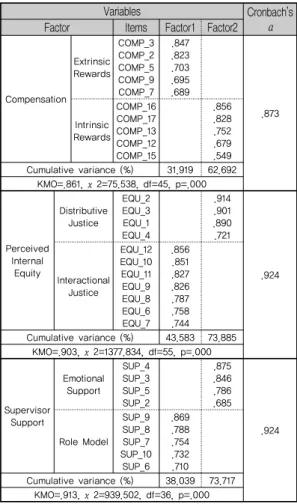
Variables Cronbach’s Factor Items Factor1 Factor2 α
Compensation Extrinsic Rewards
COMP_3 COMP_2 COMP_5 COMP_9 COMP_7
.847 .823 .703 .695 .689
.873 Intrinsic
Rewards COMP_16 COMP_17 COMP_13 COMP_12 COMP_15
.856 .828 .752 .679 .549 Cumulative variance (%) 31.919 62.692
KMO=.861, χ2=75.538, df=45, p=.000
Perceived Internal Equity
Distributive Justice
EQU_2 EQU_3 EQU_1 EQU_4
.914 .901 .890 .721
Interactional .924 Justice
EQU_12 EQU_10 EQU_11 EQU_9 EQU_8 EQU_6 EQU_7
.856 .851 .827 .826 .787 .758 .744 Cumulative variance (%) 43.583 73.885
KMO=.903, χ2=1377.834, df=55, p=.000
Supervisor Support
Emotional Support
SUP_4 SUP_3 SUP_5 SUP_2
.875 .846 .786 .685
.924 Role Model
SUP_9 SUP_8 SUP_7 SUP_10
SUP_6 .869 .788 .754 .732 .710 Cumulative variance (%) 38.039 73.717
KMO=.913, χ2=939.502, df=36, p=.000 Table 1. Validity and Reliability of Measures demographic information. Five points Likert Scale
was used for these purposes.
Compensation is classified into two categories:
extrinsic rewards and intrinsic rewards. The compensation is the independent variable in this study, and it measures by 4 items of extrinsic rewards and 4 items of intrinsic rewards, which are derived and modified from Aktar et al. (2012)[20].
Perceived internal equity consists of two subcategories: distributive justice and interactional justice. This section aims to determine the extent of perceived internal equity of the employee. Supervisor support is assessed by two subcategories. The sub-scales are 4 items from emotional support and 6 items from role model which derives from Hammer et al. (2009)[21]. Job satisfaction is measured by 9 items derive from the Job Satisfaction Survey.
Compensation -Intrinsic Rewards -Extrinsic Rewards
Perceived Internal Equity
Job Satisfaction
Supervisor Support
Figure 1. Research Model
PCA(principal component analysis) was adapted for the factor extraction and the Varimax method for the rotation method. A total of 10 items from compensation scale yielded a two factor structure after eliminating deficient items. Two sub-scales of compensation produced by factor analysis were extrinsic rewards and intrinsic rewards. This result is consistent with the scale’s theoretical suggestions. A total of 11 items from the perceived internal equity scale yielded a two factor structure after eliminating poor performer items. Two sub-scales of perceived internal equity were distributive justice and interactional justice. A total of 9 items from
supervisor support scale yielded a two factor structure. Two sub-scales of supervisor support produced were emotional support and role model.
Reliability stands for the accuracy or precision of a measuring instrument. For measuring an internal consistency, Cronbach’s alpha value was calculated for the variables. The findings showed that all measurement scales are found to be reliable and usable for the study.
2. Hypotheses Testing
A simple and multiple linear regression analysis was conducted for testing the proposed hypotheses.
Job Satisfaction
B SE β t Sig.
Constant 1.023 .767 1.334 .184
Ex_Comp .729 .058 .613** 12.558 .000
In_Comp .366 .050 .358** 7.334 .000
R²=.725, adj R²=.721, F=202.949** (p<.01**) Perceived Internal Equity
B SE β t Sig.
Constant 11.081 2.093 5.295 .000
Ex_Comp 1.460 .158 .601** 9.222 .000
In_Comp .396 .136 .189* 2.906 .004
R²=.511, adj R²=.504, F=80.396** (p<.01**) Job Satisfaction
B SE β t Sig.
Constant 2.424 .778 3.117 .002
Equ_Dis .819 .062 .701** 13.277 .000
Equ_Int .141 .036 .201** 3.928 .000
R²=.683, adj R²=.679, F=165.838** (p<.01**)
Table 2. The Effect of Compensation on Job Satisfaction and Perceived Internal Equity, and Perceived Internal Equity on Job Satisfaction
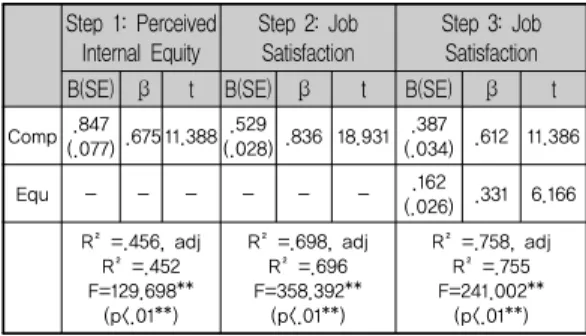
Step 1: Perceived Internal Equity
Step 2: Job Satisfaction
Step 3: Job Satisfaction
B(SE) β t B(SE) β t B(SE) β t
Comp .847
(.077) .675 11.388 .529
(.028) .836 18.931 .387
(.034) .612 11.386
Equ - - - - - - .162
(.026) .331 6.166 R²=.456, adj
R²=.452 F=129.698**
(p<.01**)
R²=.698, adj R²=.696 F=358.392**
(p<.01**)
R²=.758, adj R²=.755 F=241.002**
(p<.01**)
Also, a hierarchical regression analysis was used for analyzing the moderating effect. A post-hoc test was conducted through the Sobel-Test as well.
The regression analysis results indicate that the results provide support for the hypothesis H1a and H1b. The result showed that there is a significant positive relationship between extrinsic rewards and job satisfaction as well as intrinsic rewards and job satisfaction. The regression model of perceived internal equity and job satisfaction was suggested as significant through F-value verification (F=80.396, p<.01). The results imply that there is a significant association between independent and dependent variables. Additionally, the regression coefficient regarding extrinsic rewards and perceived internal equity is .601 (p<.01), thus indicating a significant positive (+) effect. Besides, the regression coefficient regarding intrinsic rewards and perceived internal equity is .189 (p<.01), however, a significant positive relationship between two variables has been found.
Thus, hypothesis H2a and H2b were supported.
The regression coefficient regarding job satisfaction and perceived internal equity, which has been categorized into distributive justice and interactional justice is .701 and .207 (p<.01), thus presenting a significant positive (+) effect between two variables.
Hence, the hypothesis H3 that there is a relationship between perceived internal equity and job satisfaction was supported.
The result of testing Hypothesis 3 through the three-step hierarchical regression analysis indicated that perceived internal equity acts as a mediating role between compensation and job satisfaction. The β value decreased from .836 in step 2 to .612 in step 3.
Therefore, perceived internal equity is viewed that it has a mediating role of compensation and job satisfaction.
Table 3. Mediating Effect of Perceived Internal Equity
A Sobel Test was used for a post-hoc test to identify whether the indirect effect of perceived internal equity is significant. The result of testing B=.874 and SE=.077 from step 1, and B=.387 and SE=.034 from step 3, indicates that Z=8.037, p<.01.
Here, the Z value is larger than 1.96 and, thus, signifies that the indirect effect of perceived internal equity that mediates the relationship between compensation and job satisfaction is statistically significant.
Step 1 Step 2 Step 3 B(SE) β t B(SE) β t B(SE) β t Comp .847
(.077).675 11.388 .411
(.073) .317 5.648 .417
(.072) .322 5.757
Super - - - .670
(.063).600 10.677 .649
(.064) .582 10.224 Comp x
Super - - - - - - -.011
(.007) -.077 -1.675 R²=.456, adj
R²=.452 F=129.698**
R²=.687, adj R²=.683 F=169.118**
R²=.693, adj R²=.687 F =115.002 Figure 2. Test of Mediation Effect by Sobel Test Table 4. Moderating Effect of Supervisor Support
To test hypothesis 4, the interaction term of compensation and supervisor support was input into the effect of compensation on perceived internal equity to analyze its moderating effects. The input of interaction terms of compensation and supervisor support indicated an F-value of 115.002 (p=.096), which is larger than the .05 significance level and was not significant. Therefore, the results of Hypothesis 4 appear to be not statistically significant. Hence, the hypothesis 4 that supervisor support moderates the relationship between compensation and perceived internal equity was not supported.
Ⅳ. Conclusion
The Research on the relationships of compensation, perceived equity, and employees’ performance has important implications for organizations. From a managerial point of view, the finding of this study could increase management’s understanding of employees’ performance, such as job satisfaction in order to operate efficiently. It indicates that
management should pay attention to compensation strategies to prevent employee dissatisfaction.
Management should enhance internal equity by integrating this concept into their management practice strategic and actions so as to improve the level of employee satisfaction and performance.
Hence, human resource management practices, should not dismiss an employee’s view as unfounded, but should instead address the employee’s perceptions and provide hard facts and data to change inaccurate perceptions. Theoretically and practically, this study will help an organization to have a better knowledge of how to retain valuable employees, increases employees' satisfaction with their job, reduces turnover rate, and improve employees’ overall performance.
This study sought to investigate compensation as a source of employee job satisfaction with a mediating effect of perceived internal equity as well as the moderating effect of supervisor support. It has been shown that one of the ways of getting employees to perform to achieve organizational goals is to make them feel they are valuable and fairly treated so that they are comfortable and happy with their jobs. As a conclusion, in order to increase positive attitudes and behaviors of employees such as job satisfaction, efforts must be made in compensation management to improve employees’ perception of equity so that satisfied and committed employees would stay longer position in the organization.
참 고 문 헌
[1] M. S. Schell and C. M. Solomon, Capital on global workforce, NY: McGraw Hill, 1997.
[2] A. Aamir, K. Jehanzeb, A. Rashed, and O. M.
Malik, “Compensation methods and employees’
motivation (With reference to employees of National Commercial Bank Riyadh),” International Journal of Human Resource Studies, Vol.2, No.3, pp.221-230, 2012.
[3] A. Kulchmanov and M. Kaliannan, “Does money motivate employees? empirical study of private and public financial sector in Kazakhstan,”
International Journal of Business and Management, Vol.9, No.11, pp.214-223, 2014.
[4] L. R. Gomez-Mejia, D. B. Balkin, and R. L.
Cardy, Managing human resource, Upper Saddle River, NJ: Prentice Hall, 2010.
[5] Asia Business Outlook Survey 2015, Investing into Asia’s reform landscape, The Economist Corporate Network, 2015.
[6] R. W. Griffeth, P. W. Hom, and S. Gaertner, “A meta-analysis of antecedents and correlates of employee turnover: Update, moderator tests, and research implications for the next millennium,”
Journal of Management, Vol.26, No.3, pp.463-488, 2000.
[7] H. Ozutku, “The influence of intrinsic and extrinsic rewards on employee results: An empirical analysis in Turkish manufacturing industry,” Business and Economics Research Journal, Vol.3, No.3, pp.29-48, 2012.
[8] S. Afzal, A. Ali, and S. Saleem, “Impact of reward systems on employee attitudes: The moderating role of perceived supervisory support,” Public Policy and Administration Research, Vol.5, No.8, pp.69-80, 2015.
[9] R. C. Mahaney and A. L. Lederer, “The effect of intrinsic and extrinsic rewards for developers on information systems project success,” Project Management Journal, Vol.37, No.4, pp.42-54, 2006.
[10] C. S. Galbraith and G. B. Merrill, “The effect of compensation program and structure on SBU
competitive strategy: A study of technology-intensive firms,” Strategic Management Journal, Vol.12, No.5, pp.353-370, 1991.
[11] P. Muzumdar, “Influence of interactional justice on the turnover behavioral decision in an organization,” Journal of Behavioral Studies in Business, Vol.3, No.2, pp.1-13, 2015.
[12] J. W. Thibaut, Procedural justice: A psychological analysis, Hillsdale, NJ: Erlbaum, 1975.
[13] R. J. Bies and J. F. Moag, Interactional justice:
Communication criteria of fairness, In: R. J.
Lewicki, B. H. Sheppard, and M. H. Bazerman (Eds.), Research on negotiations in organizations, Greenwich, CT: JAI, 1986.
[14] R. Folger and M. A. Konovsky, “Effects of procedural and distributive justice on reactions to pay raise decisions,” Academy of Management Journal, Vol.32, No.1, pp.115-130, 1989.
[15] T. G. Brashear, C. Manolis, and C. M. Brooks,
“The effects of control, trust, and justice on salesperson turnover,” Journal of Business Research, Vol.58, pp.241-249, 2005.
[16] A. Nahavandi and A. R. Malekzadeh, Organizational behavior: The person- organization fit, Upper Saddle River, NJ:
Prentice Hall, 1999.
[17] L. R. Shanock and R. Eisenberger, “When supervisors feel supported: Relationships with subordinates’ perceived supervisor support, perceived organizational support, and performance,”
Journal of Applied Psychology, Vol.91, No.3, pp.689-695, 2006.
[18] A. Ismail, R. A. Bakar, D. Abdullah, and S.
Segaran, “Supervisor’s role and its impact on job performance,” Jurnal Pengurusan Awam,
Vol.7, No.1, pp.109-122, 2008.
[19] T. J. Kalliah and A. Beck, “Is the path to burnout and turnover paved by a lack of supervisory support? A structural equations test,” New Zealand Journal of Psychology, Vol.30, pp.72-78, 2001.
[20] S. Aktar, M. K. Sachu, and E. Ali, “The impact of rewards on employee performance in Commercial Banks of Bangladesh: An empirical study,” Journal of Business and Management, Vol.6, No.2, pp.9-15, 2012.
[21] L. B. Hammer, E. E. Kossek, N. L. Yragui, T.
E. Bodner, and G. C. Hanson, “Development and validation of a multidimensional measure of family supportive supervisor behaviors (FSSB),”
Journal of Management, Vol.35, No.4, pp.837-856, 2009.
저 자 소 개
장 옥 진(Yit Chin Teo) 준회원
▪2015년 9월 ~ 현재 : 배재대학 교 대학원 경영학과 석사과정
<관심분야> : 보상관리, 조직공정성, 조직성과
이 정 언(Jeong Eon Lee) 종신회원
▪2008년 4월 : 독일 하노버대학교 경영학부(경영학박사)
▪1996년 3월 ~ 2001년 4월 : 한 국국방연구원 연구원
▪2010년 9월 ~ 현재 : 배재대학 교 경영학과 교수
<관심분야> : 인적자원관리, 역량, 보상관리제도