1. Introduction
The UV scanning spectrometer technique has been used for aerosol information retrieval in the previous studies (Wagner et al. 2004 and 2009; Sinreich et al.
2005; Irie et al., 2008; Lee et al., 2009a, 2009b, 2011).
Wagner et al. (2004) reported the effects of aerosol scattering on measurements of oxygen dimmers (O4) Slant Column Densities (SCDs) using the UV scanning spectrometer technique. It demonstrated high sensitivity of O4 SCDs to aerosol at the ground level. In the atmospheric condition without the presence of aerosol,
the direct sunlight penetrates deeply towards the ground surface and the light path length on telescope’s line of sight could be long. If aerosol scattering takes place, the light path length on the direct line of sight of the telescope decreases due to light scattering effects due to aerosols. Since the majority of the atmospheric O4is distributed uniformly near the ground surface, the observed O4 absorption is then also significantly decreased. It suggested that O4 observations using UV scanning spectrometer are sensitive enough to detect aerosol extinction below 0.001 km-1. Sinreich et al.
(2005) introduced an algorithm to determine the
Derivation of aerosol vertical profiles in Seoul based on O
4measurements using UV scanning spectrometer
Hanlim Lee*, JungBae Hwang**, ***†and Yoonhee Son*
* Department of Atmospheric Sciences, Yonsei University, Republic of Korea
** Spectro, Gwangju, Republic of Korea
*** School of Electronics and Computer Engineering, Chonnam National University, Republic of Korea
Abstract :This present study describes an application of UV scanning spectrometer O4data for retrieval of aerosol vertical profiles in Seoul during the measurement period that includes two Asian dust event days.
The results show large variations of aerosol load in vertical and temporal scales. Large variations in aerosol were observed at 1 km in height during the daytime in the measurement period when the Asian dust events took place. The aerosol load, however, was found to be largest at the surface compared to those retrieved at the higher atmospheric layers. The results also clearly identified the diurnal patterns of aerosol vertical distributions. The aerosol load was high in the morning and noon whereas it was low in the afternoon. This study demonstrates that UV scanning spectrometer observations of the oxygen dimer can serve as a potential method for determination of atmospheric aerosol vertical distributions and optical properties.
Key Words :O4, Air Mass Factor, Aerosol profile, Radiative Transfer
Received June 13, 2013; Accepted June 24, 2013.
†Corresponding Author: JungBae Hwang ([email protected])
This is an Open-Access article distributed under the terms of the Creative Commons Attribution Non-Commercial License (http://creativecommons.org/ licenses/
by-nc/3.0) which permits unrestricted non-commercial use, distribution, and reproduction in any medium, provided the original work is properly cited
vertical distribution of aerosol extinction utilizing O4
SCD data measured at different Elevation Angles (EAs). The authors used the proportionality of the concentration of the oxygen dimer to the square of the standard O2 concentration at atmospheric layers in determining O4Vertical Column Density (VCD). It was then possible to derive the O4Air Mass Factor (AMF) by dividing the measured SCD by O4VCD. In this present study, the vertical distributions of Aerosol Extinction Coefficients (AECs) are derived for the first time using the UV scanning measurement data at a site in Seoul.
2. Derivation of O
4Air Mass Factor
The UV scanning spectrometer measurements took place in Seoul for 6 consecutive days from April 1 to 6, 2009. The spectrometer measurements were carried out at four EAs of 3˚, 5˚, 10˚, 20˚, and zenith) during the daytime when sunlight is available. For the spectral analysis of the UV scanning spectrometer data for O4
SCD retrieval, we focus on a measurement period of Asian dust days in the spring season at the
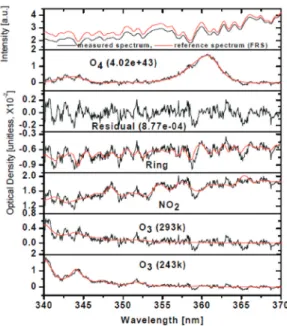
measurement site. Fig. 1 shows spectral fit for O4SCD derivation using the UV scanning spectrometer data obtained on April 2, 2009. During the event period, the aerosol load in the atmosphere can be significantly increased. Fig. 2 shows diurnal variations of measured O4SCDs at four elevation angles. The diurnal variation of the O4absorptions is not smooth and asymmetric, indicating that there could be atmospheric constituents in the sky such as cloud at low atmospheric layers or aerosols throughout most of the measurement period.
Aerosol extinction reduces the direct light path along the line of sight of the telescopes. The higher the aerosol load is, the shorter the distance between the last scattering point and the detector can be on the line of detector’s sight. Especially, for the enhanced aerosol conditions at the low atmospheric layer, the O4
absorptions for telescopes with low elevation angles are strongly reduced due to the aerosol scattering effect that leads to shortened absorption light path lengths.
This aerosol scattering effect was identified in the retrieved O4 SCD observations as shown in Fig. 2.
Thus, the observation of the O4slant columns can be effectively utilized to determine the aerosol load of the atmosphere. The atmospheric O4concentration profile is already known. The O4concentration at a certain layer is proportional to the square of the O2
concentration at the layer when the air density is dependent on temperature and barometric pressure. Fig.
Fig. 2. Diurnal variations of measured O4Differential Slant Column Densities (DSCDs).
Fig. 1. An example of a spectral fit for O4 SCD retrieval.
3 describes the method used to obtain aerosol profile information using UV scanning spectrometer data. The measured set of O4SCDs (for a series of elevation angles e.g. from 2° to 90°) can then be converted to AMF via dividing the measured O4SCDs by a known O4VCD.
Until the best agreement is reached simultaneously at all elevation angles, the measured O4AMFs at a series of elevation angles are compared to a series of the O4SCDs in Look Up Table (LUT), which was produced through radiative transfer calculations with variables such as various aerosol profiles, aerosol optical properties, and geometries.
3. Retrieval of Aerosol Vertical Profiles
Assuming a ground pressure and temperature of 1013 hPa and 293 K, respectively, we calculated an O4
VCD of 1.09·1043molec2/cm-5using an O2density profile. We used this O4VCD of 1.09·1043molec2/cm-5, which was further used to obtain the measured O4
AMFs as shown in Fig. 3. The measured AMFs allow the direct comparison between the measured AMFs and the modeled AMFs. For radiative transfer calculations, the simulations are carried out with the Monte Carlo model ‘TRACY-II,’ which takes into account a multiple scattering, and full sphericity (von
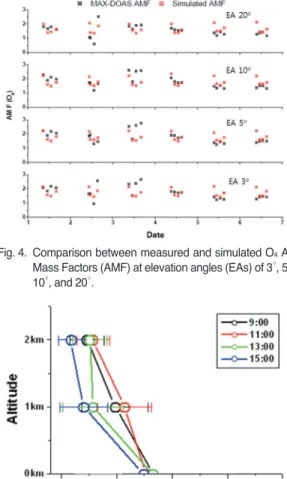
Friedeburg, 2003; Honninger et al., 2004). The LUT used in this present study contains 162 aerosol profiles, which reflect various vertical extent up to 3 km. Fig. 4 shows comparison between measured and simulated O4 AMF at EAs of 3˚, 5˚, 10˚, and 20˚ when the best fit was found. Though the magnitude between the measured and simulated AMFs was a bit large, the comparison shows good agreement in terms of diurnal tendency. A certain difference between the measured and simulated O4AMFs is thought to be attributed to a deficiency in the number of aerosol profiles as well as inaccuracy in aerosol optical properties used for radiative transfer calculations. In order to reduce the difference between the measured and simulated O4
AMFs, proper aerosol optical parameters such as single Fig. 5. Diurnal patterns in derived mean Aerosol Extinction
Coefficient (AECs) profiles.
Fig. 4. Comparison between measured and simulated O4Air Mass Factors (AMF) at elevation angles (EAs) of 3˚, 5˚, 10˚, and 20˚.
Fig. 3. The flowchart of aerosol profile retrieval using O4slant column density data.
scattering albedo and asymmetric factor need to be used. In addition, the number of aerosol vertical profiles need to be increased to produce the better fit between simulated and measured AMFs. Fig. 5 shows the retrieved mean aerosol profiles at 9:00, 11:00, 13:00, and 15:00 in local time (LT) during the measurement period.
The aerosol lead is high at 9:00 LT compared to those at other time, which is mainly due to enhanced traffic emissions in the city. The high aerosol lead decreases from the morning to 15:00 LT. The variation in aerosol lead at the surface was not large compared to that at 1 km in Fig. 5, which is thought to be due to the contribution of long range transported Asian dust that took place on April 5 and 6 at the measurement site while the variation in aerosol load at 1 km in height was largest.
4. Conclusion
The aerosol extinction coefficient varied largely at 1 km in height during the daytime in the measurement period when the Asian dust events took place for two days out of 6 measurement days. However, the mean aerosol load was largest at the surface compared to those at the elevated layers. In terms of diurnal patterns of aerosol load, the aerosol load was high in the morning and noon and decreased in the afternoon. The aerosol extinction profiles are subject to validations via comparison with other types of measurement data such as lidar. Moreover, the current retrieval technique needs to be improved to increase the accuracy of the retrieved quantity and also enhance vertical resolution.
Acknowledgments
This work was supported by the Korean Ministry of Environment as part of the Eco-Innovation Project.
References
Irie, H., Y. Kanaya, H. Akimoto, H. Iwabuchi, A.
Shimizu, and K. Aoki, 2008. First retrieval of tropospheric aerosol profiles using MAX- DOAS and comparison with lidar and sky radiometer measurements, Atmospheric Chemistry and Physics, 8: 341-350.
Lee, H., H. Irie, Y. J. Kim, Y. Noh, C. Lee, Y. Kim, and K. J. Chun, 2009a. Retrieval of aerosol extinction in the lower Troposphere based on UV MAX-DOAS measurements, Aerosol Science and Technology, 43: 502-509.
Lee, H., H. Irie, J. Ryu, Y. Kanaya, Y. Noh, Y. J. Kim, S. Kwon, M. Trail, and A. G. Russell, 2009b.
Lower tropospheric aerosol measurements by MAX-DOAS during Severe Asian dust period, Aerosol Science and Technology, 43: 1208- 1217.
Lee, H., H. Irie, M. Gu, J. Kim, and J. Hwang, 2011.
Remote sensing of tropospheric aerosol using UV MAX-DOAS during hazy conditions in winter: Utilization of O4 Absorption bands at wavelength intervals of 338-368 and 367-393 nm, Atmospheric Environment, 45: 5760-5769.
Sinreich, R., U. Frieß, T. Wagner, and U. Platt, 2005.
Multi axis differential optical absorption spectroscopy (MAX-DOAS) of gas and aerosol distributions, Faraday Discussions, 130: 153-164.
Wagner, T., B. Dix, C. von Friedeburg, U. Frieß, S.
Sanghavi, R. Sinreich, and U. Platt, 2004.
MAX-DOAS O4 measurements: a new technique to derive information on atmospheric aerosols e principles and information content, Journal of Geophysical Research, 109(D22):
doi:10.1029/2004JD004904.
Wagner, T., T. Deutschmann, and U. Platt, 2009.
Determination of aerosol properties from
MAX-DOAS observations of the ring effect, Atmospheric Measurement Techniques, 2(2):
495-512.