17
KISEP Review Sleep Medicine and Psychophysiology
•••••••••••••••••••••••••••••••••••••••••••••••••••••••••••••••••••••••••
수면·정신생리 12(1): 17-22, 2005
수면호흡장애와 대사적 기능장애
Sleep-Disordered Breathing and Metabolic Dysfunction
주 순 재
1·신 철
2Soonjae Joo,1 Chol Shin2
■ABSTRACT
Sleep-disordered breathing (SDB) is associated with increased cardiovascular and cerebrovascular morbidity. Epidemiological and clinic-based studies have shown that SDB is related to impaired glucose tolerance and increased insulin resistance, independent of obesity. Despite of a consistent association between SDB and impaired glucose-insulin metabolism, the mechanism underlying this relationship has not been fully elucidated. It is recognized that hypoxemia and hypercapnia that occur in SDB provoke sympathetic nervous activity and catecholamine, epinephrine and norepinephrine, and cortisol are released. Sympathetic hyperactivity and increased catecholamines can impair glucose homeostasis by increasing glycogenolysis and gluconeogenesis, which can result in increased circulating insulin levels and increased risk of insulin resistance. A prospective study is needed to investigate the causal relationship between SDB and impaired glucose-insulin metabolism in a healthy population without diabetes, hypertension and obesity as etiologic risk factors. Sleep Medicine and Psychophysiology 2005;12(1):17-22
Key words: Glucose tolerance·Insulin resistance·Sleep disorders.
서 론
수면호흡장애는 수면 중 상기도의 반복적인 폐쇄로 인해 수면 중 빈번히 발생되는 현상으로 일반 인구집단에서 성 인 남자의 24% 및 여자의 9%가 만성적인 수면호흡장애 (apnea-hypopnea index, AHI ≥5로 정의)를 겪고 있는 것으로 보고되고 있다(1). 이러한 수면호흡장애는 수면 중 저산소증 및 고이산화탄소증을 초래할 뿐만 아니라 야간에 지속적인 수면을 방해하기 때문에 수면호흡장애 환자들은 피곤함과 주간 졸림증을 자주 호소하고 있다. 또한 많은 임상 연구 및 Wisconsin Sleep Cohort Study와 Sleep
Heart Health Study 등 역학 연구 결과, 폐쇄성 수면무호흡 증, 코골이 등 수면호흡장애가 고혈압(2-7), 심혈관(8-13) 및 뇌혈관 질환(10,14,15) 등 만성 질환의 발병 및 진전 에 독립적인 위험인자임이 밝혀지고 있어 최근 수면호흡 장애의 조기 진단 및 치료의 중요성이 새롭게 인식되고 있다.
본 론
수면무호흡은 고혈압, 고지혈증, 당뇨병, 내당능 장애, 비 만 등으로 구성된 대사증후군(16-19)의 발생과 밀접한 관련이 있으며 인슐린 저항성이 이들 질환의 공통된 발병 인자로 보고되고 있다. 특히, 최근 들어 전 세계적으로 비 만 인구가 꾸준히 증가하면서 일반 인구 집단에서도 내당 능 장애 및 인슐린 저항성이 증가하고 있다. 미국의 제 3차 National Health and Nutrition Examination Survey 결과 에 의하면 미국인 성인의 5.1%가 의사로 부터 진단받은 당 뇨 환자였으며, 의사로 부터 진단받지는 않았으나 당뇨의 진단 기준을 충족시키는 인구 비율이 2.7%였다(20). 또한 공복시 혈당 농도가 110 mg/dl 이상(impaired fasting glu-
••••••••••••••••••••••••••••••••••••••••••••••••••••••••••••••••••••••••••••••••••••••••••••••••••••••••••••••••••••
1고려대학교 의과학연구원 인간유전체연구소
Institute of Human Genomic Study, Korea University Medical Science Research Center, Seoul, Korea
2고려대학교 안산병원 수면호흡장애센터
Pulmonary and Sleep Disorder Center, Department of Internal Me- dicine, Korea University Ansan Hospital, Ansan, Korea
Corresponding author: Chol Shin, Pulmonary and Sleep Disorder Center, Department of Internal Medicine, Korea University Ansan Hospital, #516 Gojan-1-dong, Danwon-gu, Ansan 425-707, Korea Tel: 031) 412-5603, Fax: 031) 412-5604
E-mail: [email protected]
18
cose levels)인 비율이 성인의 6.9%였으며 15.6%가 내당 능 이상(glucose intolerance)을 나타내었다(20).
1. 수면호흡장애의 증상과 대사적 기능장애
모집단을 토대로 한 연구(population-based study)에 서 대상자들의 코골이나 목격된 무호흡(witnessed apnea) 이 내당능 손상 및 인슐린 저항성 등 대사적 기능장애(me- tabolic dysfunction)와 관련이 있음이 보고되었다. Jennum 등(21)은 70세 일반인 남녀 804명을 대상으로 한 단면연 구(cross-sectional study)에서 체질량지수, 신체활동, 음 주 및 흡연 요인들을 보정한 후에도 코골이가 경구 당 부 하검사 2시간 후 포도당 농도와 유의적인 연관성이 있음을 보고하였고, Grunstein 등(22)이 병원에 내원한 37~57세 의 남녀 1,190명을 대상으로 실시한 또 다른 단면연구에서 도 코골이나 목격된 무호흡이 나이, 체지방, 흡연, 음주, 약 복용(여자의 경우 폐경상태) 등 관련 요인들을 보정한 후 에도 공복시 혈장 인슐린 농도와 유의한 관련성이 있었다.
또한 Cardiovascular Health Study에 참여한 65세 이상 5,201명을 대상으로 한 단면연구(23)에서 여자의 경우 체 질량지수를 보정한 후에도 코골이가 당뇨와 독립적으로 관 련이 있었다고 하였다. 그러나 이러한 모집단을 토대로 한 연구들의 경우, 임상 연구나 동물모델을 이용한 연구보다 대체로 연구 대상자들의 수(표본의 크기)가 크기 때문에 수 면호흡장애를 진단함에 있어서 수면다원검사 등 객관적 방 법을 사용하기 어렵다는 제한점이 있다. 한편, 30~69세의 일반 인구집단의 30~69세 성인 남자 2,504명을 대상으로 실시한 10년간의 전향적 코호트 연구(prospective cohort study)(24)에서 체질량지수, 신체활동 정도, 흡연 및 음주 등 혼재 요인(confounding factor)들을 보정한 후에도 비 만인 코골이군(obese snorers)의 10년에 걸친 당뇨병 발병 가능성이 비만하지 않은 비코골이군(non-obese snorers) 에 비해 유의하게 높았다(OR=7.0;95% CI:2.9~16.9).
또한 미국의 40~65세 여자 간호사 69,852명을 대상으로 실시한 전향적 코호트 연구인 Nurses’ Health Study(25) 에서도 정기적인 코골이 환자군의 당뇨에 대한 상대 위험 도가 비코골이군에 비해 유의하게 높았다(Relative risk=
2.12;95% CI:1.55~2.83). 이와 같이 수면호흡장애의 증상들과 대사적 기능장애간에 독립적인 연관성이 있음이 단면연구들을 통하여 밝혀졌지만 이들 간의 원인·결과적 관계를 규명하기 위해서는 전향적 연구가 필요하며 이러한 측면에서 모집단을 토대로 한 두 개의 연구들(24,25)이 이 미 수행되었으나 이들 연구에서는 대상자들의 당뇨 진단이 의사에 의해 이루어진 것이 아니라 대상자들 스스로가 당
뇨를 자가 진단하여 보고하였다는 연구 방법상의 제한점이 있었다.
2. 수면호흡장애와 대사적 기능장애
Oximetry나 수면다원검사 등 객관적 방법을 이용하여 수면호흡장애를 진단한 많은 연구들에서도 수면호흡장애와 포도당 및 인슐린 대사간의 유의한 연관성이 있음을 보고 하였으며 이러한 연구들의 대부분은 병원에 내원한 수면호 흡장애 환자들을 대상으로 하였다. Apnea-Hypopnea In- dex(AHI) 48.7 n/hr인 14명의 남자들(평균 연령:41.6세, 평균 체질량지수:38.4 kg/m2)을 대상으로 한 Vgontzas 등(26)의 연구에서 수면호흡장애 환자의 경구 당 부하검 사 1시간 후 포도당 및 인슐린 농도가 나이, 성별 및 체질 량지수를 조화시킨 대조군에 비해 유의하게 높게 나타났다.
Ip 등(27)의 연구에서도 당뇨가 없는 270명의 병원에 내 원한 대상자들 중 AHI≥5인 수면무호흡 환자에서 공복시 혈청 인슐린 수준 및 the homeostasis model assessment of insulin resistance(HOMA-IR) 값이 높아 인슐린 저항 성이 더 컸음을 알 수 있었다. 또한 당뇨와 심장호흡기계 질 환이 없는 건강한 지역사회 주민 155명(평균 연령:58.7 세, 평균 체질량지수:30.5 kg/m2)을 대상자로 선정하여 이들 중 AHI≥5 이상인 대상자들은 내당능 이상의 위험도 가 약 2배(OR=2.15;95% CI:1.05~4.38) 정도 높았고 이러한 내당능의 손상은 산소 불포화도와 관련이 있었음을 보고하였다(28). 수면무호흡의 심한 정도(severity of sleep apnoea)와 당뇨의 유병률 및 내당능 손상과의 연관성을 조사하기 위하여 494명의 폐쇄성 수면무호흡 환자와 수면 무호흡은 없이 코만 고는 101명을 대상으로 단면적 임상 연구를 실시한 결과, 수면무호흡 환자들에서 당뇨 유병률 과 내당능 이상의 비율이 유의하게 높았다(29). 또한 공복 시와 경구 당 부하검사 2시간 후에서의 혈당농도는 수면무 호흡의 심한 정도가 증가함에 따라 증가한 반면 인슐린 예 민도는 감소하였다(29). Sleep Heart Health Study에 참 여한 지역사회 거주자들 중 경증(mild) 수면호흡장애자 [호흡방해지수(respiratory disturbance index)=5~14.9 events/hour]와 중증 및 심한 정도(moderate to severe) 의 수면호흡장애자 [호흡방해지수≥15 events/hour] 들의 내당능에 대한 오즈비는 참조군(호흡방해지수<5 events/
hour) 대상자들과 비교했을 때 각각 1.27(95% CI:0.98~
1.64) 및 1.46(95% CI:1.09~1.97) 였다(30). 연구대상 자들의 성별, 연령 등 특성과 연구 방법 등이 연구자에 따 라 서로 다르기 때문에 이러한 연구결과들을 상호 완벽하 게 비교하기는 어렵다 할지라도 수면호흡장애가 나이 및 비
19 만과 무관하게 독립적으로 내당능 이상 및 인슐린 저항성
의 증가와 관련 있을 뿐 아니라 나아가 제 2형 당뇨를 초래 할 수 있다고 보고되고 있다. 그러나 이러한 연구들의 대부 분이 비만 요인을 통제하기 위하여 통계학적 방법으로만 보 정을 하였기 때문에 비만이 혼재 요인으로 여전히 작용할 수 있으며 비만 정도에 따라 수면호흡장애가 포도당 대사 에 미치는 영향이 다를 수 있다. 이러한 점에 착안하여 신 등(31)은 혈당과 혈압이 정상이며 비만하지 않은(허리둘레
≤90 cm 또는 체질량지수<27.5 kg/m2) 40~69세의 남자 2,719명을 대상으로 수면호흡장애가 포도당 및 인슐린 대 사와 연관성이 있는지 조사하였다. 연구 결과 습관성 코골 이군(≥4days/week)의 1시간 및 2시간에서의 혈당과 2 시간에서의 인슐린 농도가 비습관성 코골이군에 비해 각각 유의하게 높았다고 보고하였다. 한편, 평균 연령 10.9세의 비만한 아동들(평균 체질량지수:31.2 kg/m2) 62명을 대 상으로 실시한 연구에서도 AHI가 연령과 체질량지수와 독립적으로 공복시 인슐린 농도와 연관되어 있음을 보여주 었다(32).
3. 병태·생리학적 기전
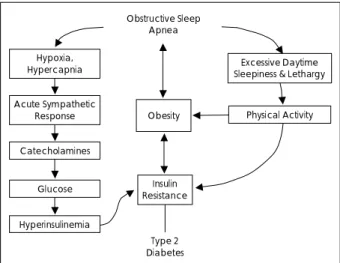
수면호흡장애와 내당능 및 인슐린 저항성간에 유의한 연 관성이 있다는 연구 결과들이 꾸준히 보고되고 있으나 이러 한 연관성을 설명할 수 있는 병태·생리학적 기전들에 관해 서는 현재까지 명확히 밝혀지지 않았으며 이제까지 알려진 몇 가지 가설들은 다음과 같다. 수면호흡장애와 증가된 인 슐린 저항성을 지닌 사람들 또는 당뇨 환자들이 공통적으로 지니고 있는 요인은 비만으로, 비만은 몸통과 상체에 체지 방을 축적시켜 기도 크기(airway size)와 환기 능력에 직접 적으로 영향을 미치게 된다. 즉, 상기도의 반경을 좁게 만들 어 호흡구조(respiratory structures)에 기계적 압력(me- chanical pressure)을 가할 뿐 아니라 상기도 구조를 붕괴 시키는데 기여한다(33). 한편, 수면 호흡 장애와 인슐린 저 항성간의 상호작용에 관한 모델을 그림 1에 나타내었다(34).
수면무호흡증에서 발생되는 저산소증과 고이산화탄소증은 교감신경을 활성화시켜(35-37) catecholamines, epine- phrine과 norepinephrine 및 cortisol의 분비를 증가시키 며(38,39) 이들 호르몬들은 글리코겐 분해(glycogenolysis) 와 포도당 신생(gluconeogenesis)을 증가시킴으로써 포도 당의 항상성을 손상시키고(40,41) 순환하는 인슐린 수준을 증가시켜 고혈당증(hyperglycemia)과 고인슐린혈증(hy- perinsulinemia)을 초래한다. 따라서 이러한 일련의 생리 학적 반응들은 인슐린 저항성을 증가시켜 제 2형 당뇨를 유 발시킨다(40). 또한 수면호흡장애시 일어나는 저산소혈증
(hypoxemia)은 재산소화(reoxygenation)를 일으키며 수 면 중 혈중 산소 농도 감소와 이에 따른 재산소화의 반복 과정(repetitive cycles)은 반응력이 큰 산소 화합물(re- active oxygen species)의 형성을 자극하며(42,43) 이는 차례로 tumor necrosis factor-alpha(TNF-α) 및 inter- leukin-6(IL-6)와 같은 inflammatory cytokines의 분비 를 유도하게 된다. Inflammatory cytokines은 지방과 근 육에 의한 포도당 흡수를 억제함으로써, 조절 호르몬과 반 대 역할을 하는 호르몬(counter-regulatory hormone)의 농도를 증가시킴으로써, 그리고 지방 분해(lipolysis)를 촉 진시켜 유리 지방산의 분비를 증가시킴으로써 인슐린 저항 성을 조정하는데 중요한 역할을 한다(44,45). Vgontzas 등(26)과 Liu 등(46)은 수면호흡장애 환자들의 혈장 TNF- α 및 IL-6 수준이 수면호흡장애가 없는 체중을 조화시킨 (weight-matched) 대조군에 비해 유의하게 높았다고 보 고하였다. 더불어 수면호흡장애는 intercellular adhesion molecule-1 및 C-reactive protein 등 다른 감염 매개자들 (mediators of inflammation)을 증가시킨다고 하였다(47).
한편, 수면호흡장애와 인슐린 저항성과의 연관성에 관한 기전에 대한 증거들이 동물 모델에 의해서도 제시되었다.
Davidson과 Aoki(48)는 수 시간에서 수 일간 지속적으로 저산소증에 노출시킨 쥐들에서 공복시 혈당과 인슐린 수준 이 감소하였고 인슐린 예민도는 증가하였음을 보고하였다.
이는 수면으로 인한 저산소혈증이 인슐린 저항성 상태를 초래한다는 예상과 반대되는 결과로서, 저산소증에 노출된 기간에 따라 포도당 항상성 유지를 위해 서로 다른 반응을 유발시켰을 가능성이 있다. Polotsky 등(49)은 비만인 생 쥐에서 간헐적인 저산소혈증은 대조군 생쥐에 비해 인슐린 수준이 5~7배 높았으며 이는 점차적으로 인슐린 저항성의
Fig. 1. Obstructive sleep apnea-diabetes interaction model (Chasens et al., 2003).
Obstructive Sleep Apnea
Hypoxia, Hypercapnia
Acute Sympathetic Response Catecholamines
Glucose Hyperinsulinemia
Obesity
Insulin Resistance
Type 2 Diabetes
Excessive Daytime Sleepiness & Lethargy
Physical Activity
20
상태를 유발시킴을 보여주었다.
수면호흡장애시 일어나는 저산소증에 대한 생존을 위한 정상적인 반응은 화학수용체를 매개체로 하여 기도 근육의 톤(tone)을 회복시키고 기도 폐쇄를 막기 위하여 수면 중 각성(arousals)을 유발시킨다. 심각한 수면 무호흡증 환자 의 경우, 수면 중 이러한 무호흡과 각성이 밤새도록 반복되 어 심각한 수면 분열(sleep disruption)을 일으키며 이로 인하여 충분한 수면시간을 유지할 수 없기 때문에 피곤을 자주 느끼고 주간 졸림증을 유발하게 된다. 만성적인 질이 낮은(poor quality) 수면은 활동 수준(activity level)을 저 하시키고 이로 인해 체중이 증가하므로 비만으로 발전될 수 있고, 이러한 비만은 차례로 인슐린 저항성을 악화시켜 포 도당 대사 이상을 초래함으로써 비만과 인슐린 저항성의 증 가는 제 2형 당뇨를 일으키게 된다(34). 역으로, 제 2형 당 뇨 환자에서 인슐린 저항성의 증가는 추가적인 체중 증가 를 유발시킬 수 있으며 이는 수면무호흡증을 악화시킨다.
즉, 수면무호흡증은 인슐린에 의한 포도당 조절 및 관리를 방해함으로써 비만을 초래하게 된다.
수면호흡장애와 내당능 이상 또는 인슐린 저항성간의 인 과관계를 설명해 줄 수 있는 명확한 증거는 아직 부족하지 만 수면호흡장애가 내당능 이상 또는 인슐린 저항성에 독 립적인 위험 요인으로 작용할 수 있다는 몇 가지 간접적인 증거들이 있다. 첫째, 수면호흡장애가 교감신경의 활성도를 증가시키며(35-37), 이러한 교감신경의 고활성도(hyper- activity)는 글리코겐 분해와 포도당 신생을 증가시킴으로 써(40,41) 포도당의 항상성을 손상시킬 수 있다. 둘째, 동 물 모델에서 저산소증에의 노출이 인슐린 저항성의 상태를 유발시킬 수 있다(50,51) 셋째, 수면시간 감소와 수면호흡 장애시 흔히 일어나는 이차적 수면 부채(sleep debt)가 정 상적인 대상자들에서 내당능의 이상을 초래하였다(52).
4. 수면호흡장애의 치료와 대사적 기능 장애
수면호흡장애의 치료가 포도당 및 인슐린 대사에 미치는 영향을 조사하기 위하여 수면무호흡 환자에게 continuous positive airway pressure(CPAP, 지속적인 양압 보조기) 치료를 함으로써 치료 전후의 포도당 및 인슐린 농도를 측 정하여 내당능 및 인슐린 저항성을 비교하였다. Brooks 등(53)은 수면호흡장애가 있는 당뇨환자들(평균 체질량지 수:42.7 kg/m2)에게 4개월 동안 CPAP 치료를 실시한 결과 인슐린 반응성이 향상되었음을 보고하였고, Harsch 등(54)의 연구에서도 수면무호흡 환자(AHI>20) 40명에 게 2일간 CPAP 치료를 한 후 인슐린 예민도가 증가하였으 며 이는 3개월간의 지속적인 CPAP 치료기간 동안에도 유
지되었다고 하였다. 그러나 이밖에 대부분의 연구들(55-60) 에서는 CPAP 치료가 수면무호흡 환자들의 내당능이나 인 슐린 저항성을 호전시키지 못한 것으로 나타났다. 이와 같 이 연구들 간에 일치된 결과를 보이지 않은 것은 몇 가지 요인들에 기인하는 것 같다. 첫째, CPAP 치료에 대한 순응 도가 연구들에서 객관적으로 측정되지 않았다는 점이다(27).
결과적으로, 내당능이나 인슐린 예민도가 개선되지 않았다 는 것은 CPAP 치료에 대한 순응도가 낮았음을 뜻한다. 둘 째, 수면호흡장애가 저산소혈증과 주기적인 수면 분열에 미 치는 영향이 내당능이나 인슐린 예민도에 있어서 비가역적 변화를 초래할 수 있다(61). 셋째, 비교적 적은 표본수와 대 조군의 결여가 연구 결과들을 일반화시키는데 한계가 있다.
결 론
수면호흡장애는 고혈압, 심혈관 및 뇌혈관 질환 등 만성 질환의 발병과 밀접히 관련되어 있으며 내당능 장애나 인 슐린 저항성의 증가와도 유의한 연관성이 있음이 밝혀졌다.
따라서 수면호흡장애를 조기 진단하여 치료함으로써 이러 한 질환의 발병 위험성을 감소시킬 수 있을 것으로 사료된 다. 또한 수면호흡장애와 대사 장애간에 명확한 원인·결 과의 상관성을 규명하기 위해서 장기간에 걸친 대규모의 전 향적 역학 연구가 필요한 실정이다.
중심 단어:수면호흡장애·내당능·인슐린 저항성.
R
EFERENCES1. Young T, Palta M, Dempsey J, Skatrud J, Weber S, Badr S. The occ- urrence of sleep-disordered breathing among middle-aged adults. N Engl J Med 1993;328:1230-1235
2. Young T, Peppard P, Palta M, Hla KM, Finn L, Morgan B, Skatrud J.
Population- based study of sleep-disordered breathing as a risk factor for hypertension Arch Intern Med 1997;157:1746-1752
3. Nieto FJ, Young TB, Lind BK, Shahar E, Samet JM, Redline S, D’Agostino RB, Newman AB, Lebowitz MD, Pickering TG. Ass- ociation of sleep-disordered breathing, sleep apnea, and hypertension in a large community-based study. Sleep Heart Health Study. JAMA 2000;283:1829-1836
4. Peppard PE, Young YB, Palta M, Skatrud J. Prospective study of the association between sleep-disordered breathing and hypertension, N Engl J Med 2000;342:1378-1384
5. Hla KM, Young TB, Bidwell T, Palta M, Skatrud JB, Dempsey J.
Sleep apnea and hypertension. A population-based study. Ann Intern Med 1994;120:382-388
6. Rauscher H, Popp W, Zwick H. Systemic hypertension in snorers with and without sleep apnea. Chest 1992;102:367-371
7. Schmidt-Nowara WW, Coultas DB, Wiggins C, Skipper BE, Samet JM. Snoring in a Hispanic-American population: risk factors and association with hypertension and other morbidity. Arch Intern Med 1990;150:597-601
21
8. Shahar E, Whitney CW, Redline S, Lee ET, Newman AB, Javier Nieto F, O’Connor GT, Boland LL, Schwartz JE, Samet JM. Sleep-dis- ordered breathing and cardiovascular disease: cross-sectional results of the Sleep Heart Health Study. Am J Respir Crit Care Med 2001;
163:19-25
9. Lugaresi E, Cirignotta F, Coccagna G, Piana C. Some epidemiologi- cal data on snoring and cardiocirculatory disturbances. Sleep 1980;3:
221-224
10. Jennum P, Sjol A. Snoring, sleep apnoea and cardiovascular risk factors: the MONICA II Study. Int J Epidemiol 1993;23:439-444 11. Jennum P, Schultz-Larsen K, Davidsen M, Christensen NJ. Snoring
and risk of stroke and ischemic heart disease in a 70 year old popula- tion. A 6-year follow-up study. Int J Epidemiol 1994;23:1159-1164 12. Jennum P, Hein HO, Suadicani P, Gyntelberg F. Risk of ischemic
heart disease in self-reported snorers. A prospective study of 2,937 men aged 54-74 years: the Copenhagen Male Study. Chest 1995;108:
138-142
13. Zanineli A, Fariello R, Boni E, Corda L, Alicandri C, Grassi V. Sno- ring and risk of cardiovascular disease. Int J Cardiol 1991;32:347-351 14. Neau JP, Meurice JC, Paquereau J, Chavagnat JJ, Ingrand P, Gil R.
Habitual snoring as a risk factor for brain infarction. Acta Neurol Scand 1995;92:63-68
15. Palomaki H. Snoring and the risk of ischemic brain infraction. Stroke 1991;22:1021-1025
16. Levinson PD, McGarvey ST, Carlisle CC, Eveloff SE, Herbert PN, Millman RP. Adiposity and cardiovascular risk factors in men with obstructive sleep apnea. Chest 1993;103:1336-1342
17. Grunstein R, Wilcox I, Yang TS, Gould Y, Hedner J. Snoring and sleep apnoea in men: association with central obesity and hypertension.
Int J Obes Relat Metab Disord 1993;17:533-540
18. Wilcox I, McNamara SG, Collins FL, Grunstein RR, Sullivan CE.
Syndrome Z”: the interaction of sleep apnoea, vascular risk factors and heart disease. Thorax 1998;53 Suppl 3:S25-S28
19. Reaven GM. Banting lecture 1988. Role of insulin resistance in human disease. Diabetes 1988;37:1595-1607
20. Harris MI, Flegal KM, Cowie CC, Eberhardt MS, Goldstein DE, Little RR, Wiedmeyer HM, Byrd-Holt DD. Prevalence of diabetes, impaired fasting glucose, and impaired glucose tolerance in U.S.
adults. The Third National Health and Nutrition Examination Survey, 1988-1994. Diabetes Care 1998;21:518-524
21. Jennum P, Schultz-Larsen K, Christensen NJ. Snoring, sympathetic activity and cardiovascular risk factors in a 70 year old population. Eur J Epidemiol 1993;9:477-482
22. Grunstein RR, Stenlof K, Hedner J, Sjostrom L. Impact of obstructive sleep apnea and sleepiness on metabolic and cardiovascular risk factors in the Swedish Obese Subjects (SOS) Study. Int J Obes Relat Metab Disord 1995;19:410-418
23. Enright PL, Newman AB, Wahl PW, Manolio TA, Haponik EF, Boyle PJ. Prevalence and correlates of snoring and observed apneas in 5,201 older adults. Sleep 1996;19:531-538
24. Elmasry A, Janson C, Lindberg E, Gislason T, Tageldin MA, Boman G..The role of habitual snoring and obesity in the development of diabetes: a 10-year follow-up study in a male population. J Intern Med 2000;248:13-20
25. Al-Delaimy WK, Manson JE, Willett WC, Stampfer MJ, Hu FB.
Snoring as a risk factor for type II diabetes mellitus: A prospective study. Am J Epidemiol 2002;155:387-393
26. Vgontzas AN, Papanicolaou DA, Bixler EO, Hopper K, Lotsikas A, Lin HM, Kales A, Chrousos GP. Sleep apnea and daytime sleepiness and fatigue: relation to visceral obesity, insulin resistance, and hy- percytokinemia. J Clin Endocrinol Metab 2000;85:1151-1158 27. Ip MS, Lam B, Ng MM, Lam WK, Tsang KW, Lam KS. Obstructive
sleep apnea is independently associated with insulin resistance. Am J
Respir Crit Care Med 2002;165:670-676
28. Punjabi NM, Sorkin JD, Katzel LI, Goldberg AP, Schwartz AR, Smith PL.Sleep-disordered breathing and insulin resistance in middle- aged and overweight men. Am J Respir Crit Care Med 2002;165:
677-682
29. Meslier N, Gagnadoux F, Giraud P, Person C, Ouksel H, Urban T, Racineux JL. Impaired glucose-insulin metabolism in males with obstructive sleep apnoea syndrome. Eur Respir J 2003;22:156-160 30. Punjabi NM, Shahar E, Redline S, Gottlieb DJ, Givelber R, Resnick
HE; Sleep Heart Health Study Investigators. Sleep-disordered brea- thing, glucose intolerance, and insulin resistance: the Sleep Heart Health Study. Am J Epidemiol 2004;160:521-530
31. Shin C, Kim J, Kim J, Lee S, Shim J, In K, Kang K, Yoo S, Cho N, Kimm K, Joo S. Association of habitual snoring with glucose and insulin metabolism in nonobese Korean adult men. Am J Respir Crit Care Med 2005;171:287-291
32. de la Eva RC, Baur LA, Donaghue KC, Waters KA. Metabolic correlates with obstructive sleep apnea in obese subjects. J Pediatr 2002;140:654-659
33. Grunstein RR. Endocrine disorders. In: Kryger MH, Roth T, Dement WC, editors. Principles and practice of sleep medicine. 3rd ed. Phila- delphia: W.B. Saunders;2000. p.1103-1112
34. Chasens ER, Weaver TE, Umlauf MG. Insulin resistance and obstru- ctive sleep apnea: is increased sympathetic stimulation the link? Biol Res Nurs 2003;5:87-96
35. Fletcher EC. Sympathetic activity and blood pressure in the sleep apnea syndrome. Respiration 1997;64 Suppl 1:22-28
36. Somers VK, Dyken ME, Clary MP, Abboud FM. Sympathetic neural mechanisms in obstructive sleep apnea. J Clin Invest 1995;96:
1897-1904
37. Fletcher EC. Sympathetic over activity in the etiology of hypertension of obstructive sleep apnea. Sleep 2003;26:15-19
38. Fletcher EC, Miller J, Schaaf JW, Fletcher JG. Urinary catecholamines before and after tracheostomy in patients with obstructive sleep apnea and hypertension. Sleep 1987;10:35-44
39. Strohl KP, Boehm KD, Denko CW, Novak RD, Decker MJ. Bioche- mical morbidity in sleep apnea. Ear Nose Throat J 1993;72:34, 39-41 40. Marshall S, Garvey WT, Traxinger RR. New insights into the me-
tabolic regulation of insulin action and insulin resistance: role of glucose and amino acids. FASEB J 1991;5:3031-3036
41. Hjalmarsen A, Aasebo U, Birkeland K, Sager G, Jorde R. Impaired glucose tolerance in patients with chronic hypoxic pulmonary disease.
Diabetes Metab 1996;22:37-42
42. Schulz R, Mahmoudi S, Hattar K, Sibelius U, Olschewski H, Mayer K, Seeger W, Grimminger F. Enhanced release of superoxide from polymorphonuclear neutrophils in obstructive sleep apnea. Impact of continuous positive airway pressure therapy. Am J Respir Crit Care Med 2000;162(2 Pt 1):566-570
43. Dyugovskaya L, Lavie P, Lavie L. Increased adhesion molecules ex- pression and production of reactive oxygen species in leukocytes of sleep apnea patients. Am J Respir Crit Care Med 2002;165:934-939 44. Hotamisligil GS, Shargill NS, Spiegelman BM. Adipose expression
of tumor necrosis factor-alpha: direct role in obesity-linked insulin resistance. Science 1993;259:87-91
45. Stumvoll M, Haring H. Insulin resistance and insulin sensitizers. Horm Res 2001;55 Suppl 2:3-13
46. Liu H, Liu J, Xiong S, Shen G, Zhang Z, Xu Y. The change of interleukin-6 and tumor necrosis factor in patients with obstructive sleep apnea syndrome. J Tongji Med Univ 2000;20:200-202 47. Mills PJ, Dimsdale JE. Sleep apnea: a model for studying cytokines,
sleep, and sleep disruption. Brain Behav Immun 2004;18:298-303 48. Davidson MB, Aoki VS. Fasting glucose homeostasis in rats after
chronic exposure to hypoxia. Am J Physiol 1970;219:378-383
22
49. Polotsky VY, Li J, Punjabi NM, Rubin AE, Smith PL, Schwartz AR, O’Donnell CP. Intermittent hypoxia increases insulin resistance in genetically obese mice. J Physiol 2003;552(Pt 1):253-264
50. Cheng N, Cai W, Jiang M, Wu S. Effect of hypoxia on blood glucose, hormones, and insulin receptor functions in newborn calves. Pediatr Res 1997;41:852-856
51. Raff H, Bruder ED, Jankowski BM. The effect of hypoxia on plasma leptin and insulin in newborn and juvenile rats. Endocrine 1999;11:
37-39
52. Spiegel K, Leproult R, Van Cauter E. Impact of sleep debt on meta- bolic and endocrine function. Lancet 1999;354:1435-1439 53. Brooks B, Cistulli PA, Borkman M, Ross G, McGhee S, Grunstein RR,
Sullivan CE, Yue DK. Obstructive sleep apnea in obese noninsulin- dependent diabetic patients: effect of continuous positive airway pressure treatment on insulin responsiveness. J Clin Endocrinol Metab 1994;79:1681-1685
54. Harsch IA, Schahin SP, Radespiel-Troger M, Weintz O, Jahreiss H, Fuchs FS, Wiest GH, Hahn EG, Lohmann T, Konturek PC, Ficker JH.
Continuous positive airway pressure treatment rapidly improves insulin sensitivity in patients with obstructive sleep apnea syndrome.
Am J Respir Crit Care Med 2004;169:156-162
55. Stoohs RA, Facchini FS, Philip P, Valencia-Flores M, Guilleminault
C. Selected cardiovascular risk factors in patients with obstructive sleep apnea: effect of nasal continuous positive airway pressure (n- CPAP). Sleep 1993;16(8 Suppl):S141-S142
56. Davies RJ, Turner R, Crosby J, Stradling JR. Plasma insulin and lipid levels in untreated obstructive sleep apnoea and snoring; their comparison with matched controls and response to treatment. J Sleep Res 1994;3:180-185
57. Saarelainen S, Lahtela J, Kallonen E. Effect of nasal CPAP treatment on insulin sensitivity and plasma leptin. J Sleep Res 1997;6:146-147 58. Chin K, Shimizu K, Nakamura T, Narai N, Masuzaki H, Ogawa Y,
Mishima M, Nakamura T, Nakao K, Ohi M. Changes in intra-abdo- minal visceral fat and serum leptin levels in patients with obstructive sleep apnea syndrome following nasal continuous positive airway pressure therapy. Circulation 1999;100:706-712
59. Ip MS, Lam KS, Ho C, Tsang KW, Lam W. Serum leptin and va- scular risk factors in obstructive sleep apnea. Chest 2000;118:580-586 60. Smurra M, Philip P, Taillard J, Guilleminault C, Bioulac B, Gin H.
CPAP treatment does not affect glucose-insulin metabolism in sleep apneic patients. Sleep Med 2001;2:207-213
61. Punjabi NM, Ahmed MM, Polotsky VY, Beamer BA, O’Donnell CP.
Sleep-disordered breathing, glucose intolerance, and insulin resistance.
Respir Physiol Neurobiol 2003;136:167-178