Tuberc Respir Dis 2009;66:267-273
CopyrightⒸ2009. The Korean Academy of Tuberculosis and Respiratory Diseases. All rights reserved.
수면호흡장애의 내과적 치료
가톨릭대학교 의과대학 내과학교실 문 화 식
Medical Treatment of Sleep Disordered Breathing
Hwa Sik Moon, M.D.
Department of Internal Medicine, The Catholic University of Korea College of Medicine, Seoul, Korea
Address for correspondence: Hwa Sik Moon, M.D.
Department of Internal Medicine, St. Paul's Hospital, The Catholic University of Korea College of Medicine, 620-56, Jeonnong 2-dong, Dongdaemun-gu, Seoul 130-709, Korea Phone: 82-2-958-2463, Fax: 82-2-968-7250
E-mail: [email protected]
서 론
수면호흡장애(sleep disordered breathing)에는 다양한 형태가 있으나 주로 수면 무호흡(sleep apnea)의 치료에 대하여 간략히 기술한다. 정확한 진단은 효과적인 치료를 위해 필수적이며, 진단된 환자에서 치료의 필요성 여부를 결정하고 적절한 치료방법을 선택하기 위해서는 중증도 판정 및 발병요인에 대한 고려가 필요하다.
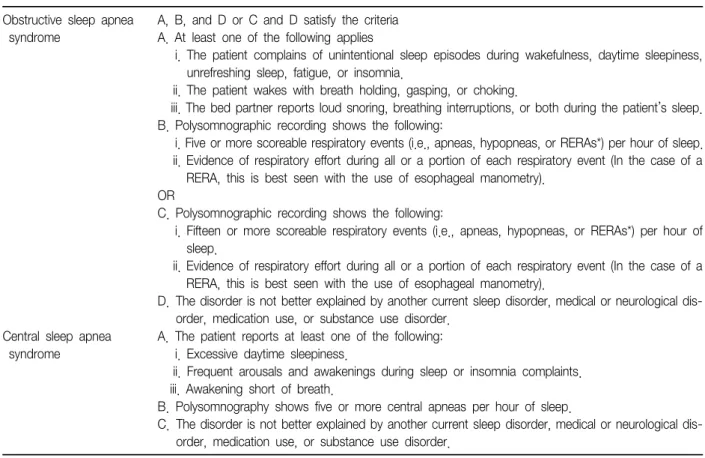
수면호흡장애, 특히 수면 무호흡은 모든 사람에서 발생 할 수 있으며 일정범위를 초과하지 않는 경우에는 임상적 으로 문제가 되지 않는다. 수면 무호흡 증후군의 진단기 준은 연구기관에 따라 다소 차이가 있으며, 최근 미국수면 의학회(American Academy of Sleep Medicine)는 Table 1과 같은 진단기준을 제시한 바 있다1,2.
중증도 판정에는 무호흡-저호흡지수, 저산소증의 정도, 고탄산증의 발생 여부, 주간 졸음증의 정도, 심혈관계질환 의 동반 여부 등이 종합적으로 고려되어야 할 것으로 생각 되고 있다. 그러나 현재까지 세계적으로 공인된 중증도 판정기준은 없는 실정이다. 미국수면의학회는 무호흡-저 호흡지수(AHI)를 기준으로 다음과 같은 중증도 판정기준 을 제시한 바 있다1,2. 경증(mild), 5≤AHI≤15; 중등도 (moderate), 15<AHI≤30; 중증(severe), AHI>30.
폐쇄성 수면 무호흡의 치료
연구보고에 의하면 중등도 이상의 환자에서 수면 무호 흡을 적절히 치료하지 않을 경우에는 정상인에 비해 장기 사망률이 현저히 증가하나, 단순 코골음 혹은 경증 환자의 경우에는 정상인과 비교하여 장기사망률이 큰 차이가 없 는 것으로 알려져 있다3. 따라서 치료방침을 결정할 경우 에는 중등도 이상의 환자와 경증 환자를 구분하여야 한다.
환자의 임상적 문제점은 대부분 무호흡에 의한 빈번한 각 성, 저산소증 혹은 고탄산증에 의해 발생하므로 중등도 이상의 환자는 진단 즉시 무호흡 자체가 발생되지 않도록 하는 적극적인 치료법을 검토하여야 한다. 반면에 경증 환자의 경우에는 행동요법과 더불어 수면 무호흡의 발생 요인에 대한 치료를 먼저 고려하고(Table 2), 치료효과가 불확실하지만 약물요법도 시도해 볼 수 있다4,5. 그러나 경 증인 경우에도 주간 졸음증이 심하여 일상생활이 어렵거 나 심혈관계질환이 동반된 환자에서는 적극적인 치료를 고려하여야 한다(Table 3)4,5.
1. 행동요법(behavioral therapy)
진단된 모든 환자는 치료개시 시점부터 체중감량, 금 주, 코의 개통성(nasal patency)을 개선시키고, 수면 무호 흡을 유발하거나 악화시킬 수 있는 약제의 투약을 금지하 며, 잠을 잘 때는 특정 체위를 유지하도록 하는 등의 행동 요법을 시행하도록 한다6.
수면 무호흡 환자는 비만인 경우가 많으며 비만 자체가 수면 무호흡의 위험 요인으로 작용하기도 한다7. 경증 환 자의 경우에는 체중감량만으로도 코골음과 수면 무호흡 이 현저히 호전된다. 체중감량을 위해 식이요법, 운동, 식
Obstructive sleep apnea Central sleep apnea Obesity
Nasal obstruction Nasal septal deviation Nasal polyp
Sinusitis Allergic rhinitis
Pharyngeal airway stenosis Uvular hypertrophy Adenotonsillar hypertrophy Retrognathia
Micrognathia Macroglossia Endocrine disorders Hypothyroidism Acromegaly Drugs Alcohol
Sedative, hypnotics, narcotics, anesthetics Sex hormone (progesterone) imbalance Hereditory factors
Defect of metabolic respiratory control system Central alveolar hypoventilation syndrome Brain stem infarction
Encephalitis
Defect of respiratory neuromuscular apparatus Muscular dystrophy
Spinal atrophy
Amyotrophic lateral sclerosis
Transient instability of respiratory control system Sleep onset
Hypocapnea due to hyperventilation Idiopathic
Hypoxia (altitude, pulmonary disease) Cardiovascular disease, pulmonary congestion Central nervous system disease
Inhibition of respiratory drive due to upper airway reflux Upper airway collapse
Aspiration
Gastroesophageal reflux Table 2. Risk factors of sleep apnea syndrome
Obstructive sleep apnea syndrome
A, B, and D or C and D satisfy the criteria A. At least one of the following applies
i. The patient complains of unintentional sleep episodes during wakefulness, daytime sleepiness, unrefreshing sleep, fatigue, or insomnia.
ii. The patient wakes with breath holding, gasping, or choking.
iii. The bed partner reports loud snoring, breathing interruptions, or both during the patient’s sleep.
B. Polysomnographic recording shows the following:
i. Five or more scoreable respiratory events (i.e., apneas, hypopneas, or RERAs*) per hour of sleep.
ii. Evidence of respiratory effort during all or a portion of each respiratory event (In the case of a RERA, this is best seen with the use of esophageal manometry).
OR
C. Polysomnographic recording shows the following:
i. Fifteen or more scoreable respiratory events (i.e., apneas, hypopneas, or RERAs*) per hour of sleep.
ii. Evidence of respiratory effort during all or a portion of each respiratory event (In the case of a RERA, this is best seen with the use of esophageal manometry).
D. The disorder is not better explained by another current sleep disorder, medical or neurological dis- order, medication use, or substance use disorder.
Central sleep apnea syndrome
A. The patient reports at least one of the following:
i. Excessive daytime sleepiness.
ii. Frequent arousals and awakenings during sleep or insomnia complaints.
iii. Awakening short of breath.
B. Polysomnography shows five or more central apneas per hour of sleep.
C. The disorder is not better explained by another current sleep disorder, medical or neurological dis- order, medication use, or substance use disorder.
*RERAs: respiratory effort related arousals.
Table 1. Diagnostic criteria of sleep apnea syndrome
Category Strategies Behavioral
therapy
Weight reduction Alcohol avoidance
Specific position avoidance during sleep Apnea aggravating drug withdrawl :sedative, hypnotics, narcotics, anesthetics Mechenical
devices
CPAP* therapy BiPAP† Auto PAP‡ Oral appliances Surgical
therapy
Bypass of upper airway obstructions Tracheostomy
Upper airway reconstruction UPPP§
LAUP∥
Mandibular advancement Hyoid ostotomy
Drug therapy Tricyclic antidepressants: protriptyline Medroxyprogesterone
Modafinil
*continuous positive airway pressure, †bilevel positive airway pressure, ‡autotitrating positive airway pressure, §uvuloplala- topharyngoplasty, ∥laser-assisted uvuloplasty.
Table 3. Treatment of obstructive sleep apnea syndrome
시도되고 있다. 체중을 10% 감량하면 AHI가 26% 감소하 고, 1%의 체중변화는 3%의 AHI 변화를 유발한다는 연구 결과가 보고 된 바 있다8.
수면 중의 체위 특히 앙와위(supine position)에서는 중 력에 의해 턱, 혀, 구개수(uvula) 및 연구개(soft palate)가 후방으로 이동하여 상기도 내경을 감소시키기 때문에 코 골음과 수면 무호흡이 악화될 수 있다9. 따라서 측와위 (lateral decubitus position) 혹은 반입위(semiupright posture) 상태로 잠자는 것이 좋으며10, 앙와위를 방지하 기 위해 특별히 고안된 베개를 사용하거나 잠옷의 등 쪽에 공을 넣은 주머니를 부착하기도 한다11. 그러나 체위에 큰 영향을 받지 않는 수면 무호흡의 경우 체위 변경을 통한 치료는 제한점이 있다.
음주12, 진정제13, 수면제14, 마약15, 마취제, 베타차단제 와 같은 항고혈압제, 남성호르몬16 등은 수면중 호흡중추 를 억제하거나 상기도근육 긴장도를 저하시킬 수 있으므 로 이들 약제의 복용을 금해야 한다. 특히 취침 전 음주는 반드시 금하여야 한다. 음주는 중추성 호흡 중추의 자극 을 억제하고 인두 근육의 활동성을 저해하여 상기도 저항
단거대증(acromegaly)과 같이 수면 무호흡 발생 가능성이 높은 환자를 수술하는 경우에는 수술 전에 진정제 혹은 마약의 사용을 가급적 금하는 것이 좋고, 수술 후 발관 (extubation) 시에는 수술 후에도 지속될 수 있는 마취제 나 근육이완제의 작용으로 수면 무호흡이 악화될 수 있으 므로 주의를 요한다.
2. CPAP치료
폐쇄성 수면 무호흡 발생을 가장 완벽하게 예방할 수 있는 치료법은 폐쇄부위를 우회하는 기관절개술(trache- ostomy)이며 극히 위중한 환자에서만 드물게 시행된다.
기관절개술 다음으로 효과가 입증된 치료법은 지속적 기 도 양압(continuous positive airway pressure, CPAP)치료 로서, 코 마스크를 통해 상기도에 지속적으로 양압을 공급 함으로써 상기도 폐쇄를 예방하며, 이 치료법을 흔히 na- sal CPAP이라고 한다17. CPAP치료는 특히 허혈성 심질환 혹은 울혈성심부전이 동반된 환자에서는 가장 탁월한 치 료법이라는 사실이 연구결과 밝혀져 있으며18, 상기도 저 항 증후군의 치료에도 매우 효과적이다. CPAP치료는 주 로 중등도 이상의 환자에서 시행되지만, 경증의 경우에도 고혈압, 뇌졸중, 과도한 주간 졸음증, 허혈성 심질환, 불면 증, 우울증 등이 있는 경우에 시행될 수 있다19. CPAP치료를 적용하고자 할 경우에는 수면다원검사를 다시 시행하면서 CPAP치료를 시도하여 적정압력을 결정 해야 한다. 적정압력이란 모든 수면단계에서 코골음, 무 호흡, 저호흡, 저산소증 및 각성을 방지할 수 있는 최소 압력을 의미한다. 또한 검사를 시행하면서 환자에게 어떤 마스크가 가장 적합한지를 결정하고20, 마스크의 안면 접 촉면에서 공기가 새는지(air leak) 여부를 관찰한다21. 적 정압력이 결정되면 CPAP기계에 압력을 고정시키고 매일 전체 수면기간동안 지속적으로 사용하도록 한다. CPAP치 료의 필요성, 예측되는 문제점과 대처방안, 마스크 착용법 등을 충분히 교육시키고 처방 후 적절히 시행하는지 여부 를 지속적으로 관찰함으로써 CPAP치료에 대한 불안감을 줄이고 향후 치료 순응도를 높일 수 있다22.
CPAP치료를 실시하면 처음에는 렘수면이 증가하지만 약 1주일이 경과하면 대부분의 환자가 정상 수면구조를 보인다. CPAP치료 시행중에는 비충혈, 비점막의 건조감 이나 자극증상이 나타날 수 있으며 이러한 경우에는 습도 조절장치를 CPAP기계에 부착하거나 비충혈완화제, 항히
할 수 있으나 최근에는 마스크 소재가 새로이 개발되어 이러한 부작용이 많이 감소하였다. 또한 이비인후과와의 협진을 통해 상기도의 합병증을 조절할 수 있다23. CPAP치료의 적용에도 불구하고 주간 졸음증이 호전되 지 않는 경우에는 수면 무호흡 증후군 진단이 정확히 이루 어진 것인지, CPAP치료가 적절히 시행되었는지 혹은 다 른 수면장애가 있는지 여부를 살펴볼 필요가 있다.
일반적인 CPAP치료에 잘 적응하지 못하는 환자의 경 우에는 흡기압과 호기압을 보다 유연성 있게 조정할 수 있는 장비(bilevel positive airway pressure, BiPAP) 혹은 기도저항의 변화에 따라 압력이 변동되도록 고안된 장비 (autotitrating positive airway pressure, Auto PAP)가 시 도될 수 있다. BiPAP은 높은 압력으로 인해 CPAP치료를 견디지 못하는 환자24, 제한성 폐질환이나 저환기 증후군 환자에서 이용될 수 있다16. Auto PAP의 경우에는 음주, 수면제 복용, 체위 변동 등에 따라 자동적으로 압력을 변 화시켜 CPAP치료보다 낮은 평균 압력을 유지할 수 있다25. 그러나 마스크로부터 공기가 새는 경우(air leak)와 같은 압력 변화에도 민감하게 반응하여 필요 이상으로 압력을 높일 수 있다. 또한 울혈성심부전, COPD, 저환기 증후군 등이 동반된 환자에서의 사용은 권장되고 있지 않다26. 따라서 현재까지는 CPAP치료가 일차적 치료로 간주되고 있다.
일부 환자들은 안면밀폐공포증 혹은 마스크 착용의 불 편함을 이유로 이 치료법의 적용을 거부하기도 한다.
CPAP치료를 시행한 환자들 중에서 전체 수면기간의 70%
이상 혹은 4시간 이상 실제로 CPAP치료를 시행하는 환자 의 비율은 보고에 따라 46 내지 80%로 큰 차이를 보이고 있으며27, 장기간 지속적으로 사용하는 비율, 즉 유순도 (compliance)는 대략 60 내지 70% 정도를 기대할 수 있는 것으로 알려져 있다28.
CPAP치료를 지속적으로 시행할 경우에는 주간 졸음증 이 호전되어 삶의 질이 향상될 뿐만 아니라29 혈압 강하 및 좌심실 기능 향상에도 효과가 있으며30 심혈관질환의 빈도를 줄여주어 중등도 이상의 환자에서 장기사망률이 현저히 감소하는 것으로 알려져 있다3.
3. 구강내장치(oral appliances)
수면 중 구강 내에 장착함으로써 상기도 내강을 넓혀주 는 장치이며, 치과영역에서 제작하여 사용한다. 다양한 형태의 구강내장치가 개발되어 있으며, 혀의 후방 이동을 억제하는 장치(tongue retaining device)와 하악을 전방으
로 이동시키는 장치(mandibular advancement device)가 가장 많이 사용되고 있다. 연구 자료에서는 경증 및 중등 도 환자의 경우 약 80%, 중증의 경우에도 약 60%의 환자 에서 효과가 있는 것으로 보고하고 있다31.
구강내장치의 적응증이 되는 환자를 선별하고, 각각의 환자에게 가장 효과적인 장치를 선택함으로서 효과를 높 이고 부작용을 최소화할 수 있다. 경증 혹은 중등도 폐쇄 성 수면 무호흡 증후군 환자 혹은 CPAP치료를 견디지 못 하는 모든 중증도의 환자들이 적응증이 될 수 있다32. 치 료효과는 나이가 어릴수록, 비만도(BMI)가 낮고 목둘레가 작을수록, AHI가 낮을수록 좋다. 수면다원검사를 통해 치 료효과를 평가할 수 있으며, 결과에 따라 구강내장치를 조정할 수도 있다. 그러나 중추성 수면 무호흡이나 저환 기 증후군의 경우에는 효과가 없고 치통이나 턱관절의 통 증, 구강 건조나 잇몸자극 등의 부작용이 있을 수 있다33. 4. 수면 무호흡 발생요인에 대한 치료
수면 무호흡의 발생요인은 매우 다양하며 원인을 정확 히 규명하지 못하는 경우가 적지 않다(Table 2)4,5. 갑상선 기능저하증, 선단거대증, 편도비대증 등과 같이 발생요인 이 명확하고 치료가 가능한 경우에는 이를 치료한다. 또 한 수면 무호흡 발생 혹은 호흡조절계통에 영향을 미칠 수 있는 여러 가지 전신질환을 치료한다. 특히 비폐쇄 (nasal obstruction)는 무호흡을 유발하거나 악화시킬 수 있으므로 알레르기성 비염, 비중격만곡증, 비용종, 부비동 염 등과 같은 이비인후과 질환을 철저히 치료한다.
5. 약물요법
여러 가지 약제에 대한 연구가 진행되었으나 치료효과 가 입증된 약제는 매우 제한적이다. 또한 약물요법의 효 과는 환자에 따라 차이가 있기 때문에 모든 환자에게 공통 적으로 적용할 수 있는 약제를 제시하기는 어려운 실정이 다. 따라서 경증 환자의 경우에 주로 시도될 수 있으며, 약물요법을 시행하는 경우에는 치료효과와 장기간 약물 투여로 인한 부작용을 면밀히 관찰하여야 한다. 약물투여 후 효과발현까지는 대개 수일이 경과하여야 하며, 1 내지 2주 투여 후 효과가 없거나 부작용이 심한 경우에는 투약 을 중지하고 다른 치료법을 고려한다.
Protriptyline은 진정작용이 없는 삼환계 항우울제(tri- cyclic antidepressant)로 특히 렘수면을 감소시키는 약리 작용에 의해 수면 무호흡과 저산소증을 개선한다. 부작용 으로 구내건조와 변비가 생길 수 있으며 특히 남자에서는
요축척과 발기부전이 나타날 수 있다34. Protriptyline 이외 의 다른 삼환계 항우울제 역시 유사한 효과를 나타내는 것으로 알려져 있다.
Medroxyprogesterone은 고탄산증에 대한 중추성 환기 반응을 촉진하고 상기도근육 긴장도를 증가시키는 작용 이 있다. 따라서 이산화탄소저류를 보이는 폐쇄성 수면 무호흡 증후군 환자에서 특히 효과적이며, 비만-저환기 증 후군(obesity-hypoventilation syndrome) 환자에서도 효 과가 있다. 부작용으로 성기능장애, 유방 불쾌감, 혈전색 전증 등이 발생할 수 있다35.
Modafinil은 각성을 촉진하는 약제로 CPAP치료 등을 시행하였음에도 불구하고 지속되는 주간 졸음증의 치료 에 사용될 수 있는 것으로 최근 FDA 공인을 받았다. 주관 적 혹은 객관적으로 주간 졸음증이 개선되며 삶의 질이 향상되는 것으로 알려져 있다. 그러나 수면 무호흡 자체 를 치료하는 효과가 없으므로 약제만을 단독으로 사용하 는 것은 금기이며, 부작용으로 두통, 비염, 혈압이나 맥박 상승 등이 발생할 수 있다36.
6. 상기도근육의 전기자극요법
상기도의 확장근육에 직접 전기적 자극을 가함으로써 이들 근육의 활성도를 증가시켜 폐쇄성 수면 무호흡을 치 료하고자 하는 실험적 연구가 보고 된 바 있다37. 그러나 신경손상이나 심부정맥 등의 부작용이 발생할 수 있는 것 으로 알려져 있어 앞으로 많은 연구가 필요하며, 임상영역 에서 실제 적용되지는 못하고 있다.
중추성 수면 무호흡의 치료
일반적으로 중추성 수면 무호흡의 치료효과는 만족스 럽지 못하다. 중추성 호흡구동의 일시적 불안정으로 인 한 중추성 수면 무호흡의 치료에는 보다 어려움이 많다.
만성폐포저환기증후군의 성격을 띠는 중추성 수면 무호 흡의 치료는 다른 저환기장애의 치료와 본질적으로 동일 하다.
저산소증이 동반된 환자에서는 야간 산소투여가 좋은 반응을 보이는 경우가 있다38. 일부 환자에서는 acetazola- mide 투여가 좋은 반응을 보이는데, 이것은 산성화(acidi- fication)가 중추성 호흡구동을 촉진하기 때문이다. 환자 에 따라서는 CPAP치료가 효과적이라는 보고가 있다39.
chanical load)로 인한 소량의 동맥혈이산화탄소분압 상 승과 관련이 있을 것으로 추측되고 있다40. 중추성 수면 무호흡이 울혈성심부전으로 인해 이차적으로 발생된 환 자에서는 특히 CPAP치료가 수면의 질과 심기능을 향상시 키는 효과가 있다.
중추성 수면 무호흡은 발생요인을 규명하기 어려운 경 우가 많으나, 발생요인이 명확하고 치료가 가능한 경우에 는 이에 대한 치료를 병행한다(Table 2)4,5. 예를 들어 상 기도허탈에 의한 상기도반사로 인해 중추성 수면 무호흡 이 발생한 경우에는 상기도폐쇄 요인을 치료하거나 CPAP 치료를 시행하면 효과적이며, 울혈성심부전에 기인하는 경우에는 CPAP치료와 더불어 심질환에 대한 내과적 치료 를 병행하는 것이 효과적이다.
결 론
수면호흡장애의 치료에 앞서 가장 중요한 것은 정확한 진단이다. 특히 수면 무호흡 증후군 환자의 경우 다른 유 형의 수면장애와 정확한 감별진단이 필요하며, 수면 무호 흡과 더불어 다른 수면장애가 동반되어 있는지 여부 또한 매우 중요하다.
수면호흡장애 특히 수면 무호흡 증후군으로 진단된 환 자에서 행동요법만을 권장할 것인지 혹은 보다 적극적인 치료를 시행할 것인지 여부는 환자의 임상적 문제점 및 수면 무호흡의 중증도를 고려하여 결정한다. 적극적인 치료가 필요한 환자에게 실제로 적용할 효과적인 치료법 을 선택하는 것은 매우 중요하고도 어려운 문제이며, 이 를 위해서는 여러 분야의 수면의학 전문의와 협진이 필 요하다.
수면 무호흡의 개선을 위해 선택할 수 있는 치료방법은 현재까지 매우 제한적이라고 저자는 생각한다. 특히 중추 성 수면 무호흡의 치료에는 많은 어려움이 따른다. 앞으 로 모든 환자에게 용이하게 적용될 수 있는 효과적인 치료 법이 연구 개발되기를 기대한다.
참 고 문 헌
1. Iber C, Ancoli-Israel S, Chesson A, Quan SF. The AASM manual for the scoring of sleep and associated events:
rules, terminology and technical specifications. 1st ed.
Westchester: American Academy of Sleep Medicine;
tional classification of sleep disorders: diagnostic &
coding manual. 2nd ed. Westchester: American Acade- my of Sleep Medicine; 2005.
3. Marin JM, Carrizo SJ, Vicente E, Agusti AG. Long-term cardiovascular outcomes in men with obstructive sleep apnoea-hypopnoea with or without treatment with continuous positive airway pressure: an observational study. Lancet 2005;365:1046-53.
4. Moon HS. Sleep apnea. In: The Korean Academy of Tuberculosis and Respiratory Disease. Respiratory Di- sease. 1st ed. Seoul: Koon Ja Publishing, Inc.; 2004.
p. 993-1007.
5. Moon HS. Sleep apnea syndrome. In: The Korean Association of Internal Medicine. Prescription guide for the primary care physician (medical part). 2nd ed.
Seoul: Korean Institute of Medicine; 2004. p. 779-85.
6. Veasey SC, Guilleminault C, Strohl KP, Sanders MH, Ballard RD, Magalang UJ. Medical therapy for ob- structive sleep apnea: a review by the Medical Therapy for obstructive sleep apnea task force of the standards of practice committee of the American Academy of Sleep Medicine. Sleep 2006;29:1036-44.
7. Strohl KP, Redline S. Recognition of obstructive sleep apnea. Am J Respir Crit Care Med 1996;154:279-89.
8. Peppard PE, Young T, Palta M, Dempsey J, Skatrud J.
Longitudinal study of moderate weight change and sleep-disordered breathing. JAMA 2000;284:3015-21.
9. George CF, Millar TW, Kryger MH. Sleep apnea and body position during sleep. Sleep 1988;11:90-9.
10. Jokic R, Klimaszewski A, Crossley M, Sridhar G, Fitzpatrick MF. Positional treatment vs continuous pos- itive airway pressure in patients with positional ob- structive sleep apnea syndrome. Chest 1999;115:771- 81.
11. Skinner MA, Kingshott RN, Filsell S, Taylor DR. Efficacy of the 'tennis ball technique' versus nCPAP in the man- agement of position-dependent obstructive sleep ap- noea syndrome. Respirology 2008;13:708-15.
12. Taasan VC, Block AJ, Boysen PG, Wynne JW. Alcohol increases sleep apnea and oxygen desaturation in asymptomatic men. Am J Med 1981;71:240-5.
13. Höijer U, Hedner J, Ejnell H, Grunstein R, Odelberg E, Elam M. Nitrazepam in patients with sleep apnoea: a double-blind placebo-controlled study. Eur Respir J 1994;7:2011-5.
14. Lofaso F, Goldenberg F, Thebault C, Janus C, Harf A.
Effect of zopiclone on sleep, night-time ventilation, and daytime vigilance in upper airway resistance syndrome. Eur Respir J 1997;10:2573-7.
15. Robinson RW, Zwillich CW, Bixler EO, Cadieux RJ, Kales A, White DP. Effects of oral narcotics on sleep- disordered breathing in healthy adults. Chest 1987;91:
197-203.
16. Liu PY, Yee B, Wishart SM, Jimenez M, Jung DG, Grunstein RR, et al. The short-term effects of high-dose testosterone on sleep, breathing, and function in older men. J Clin Endocrinol Metab 2003;88:3605-13.
17. Sullivan CE, Issa FG, Berthon-Jones M, Eves L. Reversal of obstructive sleep apnoea by continuous positive air- way pressure applied through the nares. Lancet 1981;
1:862-5.
18. Kaneko Y, Floras JS, Usui K, Plante J, Tkacova R, Kubo T, et al. Cardiovascular effects of continuous positive airway pressure in patients with heart failure and ob- structive sleep apnea. N Engl J Med 2003;348:1233-41.
19. Kushida CA, Littner MR, Hirshkowitz M, Morgenthaler TI, Alessi CA, Bailey D, et al. Practice parameters for the use of continuous and bilevel positive airway pres- sure devices to treat adult patients with sleep-related breathing disorders. Sleep 2006;29:375-80.
20. Pépin JL, Leger P, Veale D, Langevin B, Robert D, Lévy P. Side effects of nasal continuous positive airway pressure in sleep apnea syndrome. Study of 193 pa- tients in two French sleep centers. Chest 1995;107:375- 81.
21. Massie CA, Hart RW, Peralez K, Richards GN. Effects of humidification on nasal symptoms and compliance in sleep apnea patients using continuous positive air- way pressure. Chest 1999;116:403-8.
22. McArdle N, Devereux G, Heidarnejad H, Engleman HM, Mackay TW, Douglas NJ. Long-term use of CPAP therapy for sleep apnea/hypopnea syndrome. Am J Respir Crit Care Med 1999;159:1108-14.
23. Hirshkowitz M, Sharafkhaneh A. Positive airway pres- sure therapy of OSA. Semin Respir Crit Care Med 2005;
26:68-79.
24. Ballard RD, Gay PC, Strollo PJ. Interventions to im- prove compliance in sleep apnea patients previously non-compliant with continuous positive airway pre- ssure. J Clin Sleep Med 2007;3:706-12.
25. Ayas NT, Patel SR, Malhotra A, Schulzer M, Malhotra M, Jung D, et al. Auto-titrating versus standard con- tinuous positive airway pressure for the treatment of obstructive sleep apnea: results of a meta-analysis.
Sleep 2004;27:249-53.
26. Berry RB, Parish JM, Hartse KM. The use of auto-titrat- ing continuous positive airway pressure for treatment of adult obstructive sleep apnea. An American
Academy of Sleep Medicine review. Sleep 2002;25:
148-73.
27. Kribbs NB, Pack AI, Kline LR, Smith PL, Schwartz AR, Schubert NM, et al. Objective measurement of patterns of nasal CPAP use by patients with obstructive sleep apnea. Am Rev Respir Dis 1993;147:887-95.
28. Sin DD, Mayers I, Man GC, Pawluk L. Long-term com- pliance rates to continuous positive airway pressure in obstructive sleep apnea: a population-based study.
Chest 2002;121;430-5.
29. Marshall NS, Barnes M, Travier N, Campbell AJ, Pierce RJ, McEvoy RD, et al. Continuous positive airway pres- sure reduces daytime sleepiness in mild to moderate obstructive sleep apnoea: a meta-analysis. Thorax 2006;61:430-4.
30. Campos-Rodriguez F, Perez-Ronchel J, Grilo-Reina A, Lima-Alvarez J, Benitez MA, Almeida-Gonzalez C.
Long-term effect of continuous positive airway pressure on BP in patients with hypertension and sleep apnea.
Chest 2007;132:1847-52.
31. Chan AS, Lee RW, Cistulli PA. Dental appliance treat- ment for obstructive sleep apnea. Chest 2007;132:
693-9.
32. Kushida CA, Morgenthaler TI, Littner MR, Alessi CA, Bailey D, Coleman J Jr, et al. Practice parameters for the treatment of snoring and Obstructive Sleep Apnea with oral appliances: an update for 2005. Sleep 2006;29:240-3.
33. Gotsopoulos H, Chen C, Qian J, Cistulli PA. Oral appli- ance therapy improves symptoms in obstructive sleep apnea: a randomized, controlled trial. Am J Respir Crit
Care Med 2002;166:743-8.
34. Brownell LG, West P, Sweatman P, Acres JC, Kryger MH. Protriptyline in obstructive sleep apnea: a dou- ble-blind trial. N Engl J Med 1982;307:1037-42.
35. Hannhart B, Pickett CK, Moore LG. Effects of estrogen and progesterone on carotid body neural output re- sponsiveness to hypoxia. J Appl Physiol 1990;68:1909- 16.
36. Schwartz JR, Hirshkowitz M, Erman MK, Schmidt- Nowara W. Modafinil as adjunct therapy for daytime sleepiness in obstructive sleep apnea: a 12-week, open-label study. Chest 2003;124:2192-9.
37. Oliven A, Tov N, Geitini L, Steinfeld U, Oliven R, Schwartz AR, et al. Effect of genioglossus contraction on pharyngeal lumen and airflow in sleep apnoea patients. Eur Respir J 2007;30:748-58.
38. Staniforth AD, Kinnear WJ, Starling R, Hetmanski DJ, Cowley AJ. Effect of oxygen on sleep quality, cognitive function and sympathetic activity in patients with chronic heart failure and Cheyne-Stokes respiration.
Eur Heart J 1998;19:922-8.
39. Okin PM, Devereux RB, Howard BV, Fabsitz RR, Lee ET, Welty TK. Assessment of QT interval and QT dis- persion for prediction of all-cause and cardiovascular mortality in American Indians: The Strong Heart Study.
Circulation 2000;101:61-6.
40. Thomas RJ, Daly RW, Weiss JW. Low-concentration carbon dioxide is an effective adjunct to positive air- way pressure in the treatment of refractory mixed cen- tral and obstructive sleep-disordered breathing. Sleep 2005; 28;69-77.