• 검색 결과가 없습니다.

Improvement of indirect enzyme-linked immunosorbent assay for detection of Japanese encephalitis virus antibodies in swine sera

N/A
N/A
Protected

Academic year: 2021

Share "Improvement of indirect enzyme-linked immunosorbent assay for detection of Japanese encephalitis virus antibodies in swine sera"

Copied!
6
0
0

로드 중.... (전체 텍스트 보기)

전체 글

(1)

Korean J Vet Res(2017) 57(1) : 31~36 https://doi.org/10.14405/kjvr.2017.57.1.31

31

<Original Article>

Improvement of indirect enzyme-linked immunosorbent assay for detection of Japanese encephalitis virus antibodies in swine sera

Dong-Kun Yang

1,

*, Ha-Hyun Kim

1

, Hyun-Ye Jo

1

, Seung Heon Lee

1

, Sang-Ho Jang

2

, Sang-Oh Lee

2

, Sung-Suk Choi

1

, In-Soo Cho

1

1

Viral Disease Division, Animal and Plant Quarantine Agency, Gimcheon 39660, Korea

2

R&D Center, MEDIAN Diagnostics, Chuncheon 24399, Korea

(Received: October 26, 2016; Revised: February 14, 2017; Accepted: February 23, 2017)

Abstract: Japanese encephalitis (JE) is an important zoonosis caused by the mosquito-transmitted JE virus (JEV), which is a causative agent of reproductive failure in pregnant sows. Detection of JEV antibodies in swine is performed by hemagglutination inhibition (HI), virus neutralization (VN), and the plaque reduction neutralization test (PRNT). The most stringent PRNT is the 90% endpoint PRNT (PRNT

90

). These conventional assays are difficult to carry out in diagnostic laboratories with insufficient instruments or cell culture systems. An alternative assay that is easily conducted and time efficient is required. In this study, we improved the indirect enzyme-linked immunosorbent assay (I-ELISA) with clarified antigen for the detection of JEV antibodies. The I-ELISA results obtained from 175 swine serum samples were compared with HI, VN, and PRNT

90

results. The sensitivity of I-ELISA was 91.8%, 95.0%, and 94.7% compared with HI, VN, and PRNT

90

results, respectively. The specificity of I-ELISA was 92.2%, 94.7%, and 94.7% compared with HI, VN, and PRNT

90

results, respectively. Moreover, the I-ELISA results were significantly correlated with the HI ( r = 0.93), VN (r = 0.95), and PRNT

90

( r = 0.92) results. These results suggest that the improved I-ELISA is useful for serosurveillance of JEV in swine.

Keywords: Japanese encephalitis virus, indirect enzyme-linked immunosorbent assay, surveillance, swine

Introduction

Japanese encephalitis (JE) is caused by JE virus (JEV), a member of the genus Flavivirus in the family Flaviviridae.

The first case of JE in a human was reported in American soldiers stationed in South Korea in 1946 [16]. In the veteri- nary field, JEV was first isolated from piglets in Gyeonggi province of South Korea in 1969 [21]. JEV has been divided into five genotypes (G1–G5) based on the nucleotide sequence of its envelope gene [2, 5]. JEV G3 was the main genotype reported in most Asian countries until 1990 [6]. Since the 1990s, however, the predominant JEV genotype has shifted from G3 to G1 in Japan, Korea, and China [13, 14]. JEV G1 continues to be identified in Culex mosquitoes, swine blood, and cerebrospinal fluid from Korean patients, indicating that JEV G1 is the chief genotype circulating in Korea [2, 7, 14, 23].

Since the establishment of an extensive JE vaccination pro- gram for children in the mid-1960s, the number of human cases of JE has significantly decreased nationwide from 12,055 in 1961–1967 to 3,783 in 1968–1983 [9]. According to recent data obtained from the Korean Center for Disease

Control and Prevention, 122 cases of JE infection in humans were reported during 2001–2014 and 40 cases in 2015 [9]. In the veterinary field, only nine cases of JE in pigs have been reported since 2002 [4]. It is important to monitor the immune status of the pig population and implement appropriate mea- sures, such as booster immunization of pigs in at-risk areas.

The veterinary authorities in South Korea have conducted serosurveillance of immunity to JE in pig farms. A nation- wide investigation on the prevalence of JEV antibodies is performed using the hemagglutination inhibition (HI) test in approximately 8,000 pig serum samples every year.

Several methods are used to detect JEV antibodies induced by vaccination or natural infection in pig serum samples.

These include HI, virus neutralization (VN), the plaque reduc- tion neutralization test (PRNT), enzyme-linked immunosor- bent assay (ELISA), complement fixation, and the indirect immunofluorescence assay [1, 20]. HI has been considered the standard method to detect JEV antibodies. However, the complicated test procedures that need to use goose erythro- cytes have limited the use of HI in the laboratory. VN and the PRNT have been considered the most reliable methods

*Corresponding author

Tel: +82-54-912-0785, Fax: +82-54-912-0812

E-mail: [email protected]

(2)

for the evaluation of JEV vaccine efficacy. Although the PRNT can be useful for differential diagnoses in regions of West Nile virus infection, both VN and the PRNT require one week to obtain results [11]. ELISA is the preferable method to detect JEV antibodies, because it does not require live JEV but only a small amount of serum; additionally, the proce- dure is simple [18]. Several ELISA kits specific for the JEV antigen or antibody (antigen capture ELISA, immunoglobu- lin [Ig]M capture ELISA, and IgG ELISA) have been com- mercialized in the human field, but commercially available ELISA kits in the veterinary field, especially those for pigs, are rare [12, 15].

In a previous study, we reported the development and eval- uation of indirect ELISA (I-ELISA) for the detection of JEV antibodies in swine [22]. In the present study, we improved the specificity and sensitivity of I-ELISA by applying highly purified JEV antigen, and the specificity and sensitivity were compared with those of HI, VN, and the PRNT.

Materials and Methods

Viruses and serum samples

Vero cells (African green monkey kidney cell line: ATCC CCL81) were maintained in alpha minimal essential medium ( α-MEM; Gibco-BRL, USA) containing 5% (v/v) fetal bovine serum (Gibco-BRL), penicillin (100 IU/mL), streptomycin (100 µg/mL), and amphotericin B (0.25 µg/mL) at 37

o

C under 5% (v/v) CO

2

. The KV1899 strain of JEV G1, which had undergone 120 serial passages in Vero cell culture, was used for I-ELISA, HI, and the 90% endpoint PRNT (PRNT

90

). A K87 strain obtained from KCDC (NCCP No. 41305) was used for VN. In total, 175 swine serum samples collected from a slaughterhouse located in Gyeonggi province in 2015 were subjected to serological assays.

HI

Before conducting HI, all serum samples were inactivated in a water bath at 56

o

C for 30 min. HI was performed in 96- well U-bottom microplates using a slight modification of the standard method used to detect the JEV antibody in pig sera.

Viral antigens for HI were prepared using a sucrose–acetone extraction method from the brains of 3-day-old mice infected with the Korean isolate of JEV strain KV1899. HI was per- formed as follows: 10 μL pig serum and 50 μL 4% bovine albumin were mixed with 40 μL 25% kaolin (Sigma, USA) to remove nonspecific inhibitors, and the mixture was agi- tated by vibration every 5 min and incubated at room temper- ature for 30 min. After strong mixing, the kaolin was removed by centrifugation at 8,000 × g for 5 min and the supernatant was transferred to a new tube. The resultant clear superna- tant was mixed with 5 μL packed goose erythrocytes to remove any natural agglutinins. After incubation at 37

o

C for 1 h, the goose erythrocytes were also removed as described above. The supernatant was then ready for HI (1/10 dilu- tion). The treated serum samples (25 μL) were diluted two-

fold from 1:10 to 1:20,480 in the U-bottom microplates and reacted with 8 HA units of JEV. After incubation of the plate sealed with vinyl tape at 37

o

C for 1 h, 50 μL 0.33% goose erythrocytes were added to the microplates and incubated at 37

o

C for 30 min. To confirm test reliability, positive and neg- ative JEV infection pig control sera were used in all HI tests.

The HI titer was expressed as the reciprocal of the highest dilution of serum showing complete HI. An HI titer of 1:10 or higher was considered positive.

VN

VN was performed in 96-well microplates using Vero cells. Each serum sample, including the positive and nega- tive controls, was evaluated in duplicate and serial two-fold dilutions. JEV (K87 strain; 100 TCID

50

/50 μL) was added to each well. After incubation at 37

o

C for 1 h, 0.1 mL Vero cell suspension (5.0 × 10

4

cells/mL) was added to each well. The microplates were incubated for 72 h in a humidified incuba- tor under 5% (v/v) CO

2

at 37

o

C, and the virus-induced cyto- pathic effect was evaluated microscopically. Each titer was the reciprocal of the highest serum dilution that completely inhibited the cytopathic effect. Each serum sample was diluted from 1:2 to 1:256. A VN titer ≥ 1:2 was considered positive.

PRNT

90

The PRNT

90

was performed using monolayers of Vero cells seeded at 1.0 to 5.0 × 10

4

/well of 24-well plates in α- MEM (Gibco-BRL). Cells were incubated for 2 days at 37

o

C.

Test sera were heat-inactivated at 56

o

C for 30 min. The same volume (200 μL) of the test sera in two-fold dilutions (from 1:10 to 1:320) and KV1899 virus diluent (200 pfu/mL) were mixed and incubated for 60 min at 37

o

C. The virus-serum mixture was inoculated (0.1 mL/well) and absorbed for 1 h at 37

o

C, at which point the inoculums were removed. The emp- tied wells were replaced with 0.5 mL 1.0% low-melting-point agarose in α-MEM containing 2.5% heat-inactivated fetal bovine serum. The agarose overlay was allowed to harden for 1 h at room temperature, and the plates were incubated upside down to minimize water condensation in the wells in a CO

2

incubator at 37

o

C for 48 h to allow virus plaques to develop. The second overlay containing 1.0% low-melting- point agarose in α-MEM with 0.1% neutral red was added to all wells, and the plates were incubated upside down in a CO

2

incubator at 37

o

C for 48 h to allow maximal staining of the cells. Plaques in the serum-free control wells were counted after 2 days of the second overlay by gross examina- tion. The antibody titer in the serum was calculated as the antibody count that reduced the number of plaques by 90%

of the control without serum. A PRNT

90

titer ≥ 1:20 was con- sidered positive.

I-ELISA

JEV was propagated in Vero cells, and to remove cell

debris, approximately 1 L viral suspension was harvested and

(3)

filtered through a membrane filter (0.2 μm pore size) [21].

The clarified antigen was concentrated using the Bio-max 100 of the Pellicon XL device (Millipore, USA). The con- centrated JEV antigen was purified by discontinuous sucrose gradient centrifugation in an ultracentrifuge. For this proce- dure, 10 to 50% sucrose solution in GTNE buffer (200 mM glycine, 100 mM Tris-Cl, 100 mM NaCl, and 1 mM EDTA;

pH 7.6) was prepared. The JEV antigen was layered on top of the 20% sucrose solution and centrifuged at 100,000 × g for 3 h in a SW 41 Ti rotor (Beckman Coulter, USA). The band in the sucrose gradient representing the virus was col- lected and dialyzed with phosphate buffered saline (PBS) (pH 7.2) to eliminate the residual sucrose overnight at 4

o

C.

The virus protein concentration was determined using a bicinchoninic protein assay kit (Pierce, USA) and character- ized by western blot analysis to verify the presence of anti- genic proteins associated with purified JEV using an antibody specific to the JEV E protein.

Optimal coating antigen concentrations and dilutions of serum, conjugate, and substrate were determined by a check- erboard titration test. The JEV protein was used at concentra- tions of 1, 2, 3, and 4 μg/mL, and the serum samples were tested at dilutions of 1:10 to 1,280. The optimal antigen and conjugate concentrations and the serum dilution used for I- ELISA, each with a 450 nm absorbance value of 1.3, were determined. Each 100 μL serum in dilution buffer were placed in a 96-well microplate (Maxisorp; NUNC, Denmark) coated with JEV antigen. After incubation at 37

o

C for 1 h, the plate was washed with PBS containing 0.05% Tween 20 and incu- bated with 100 μL anti-swine IgG HRP conjugate (KPL, USA) for 1 h at 37

o

C. After washing, 100 μL 3,3’,5,5’-tetra methylbenzidine substrate solution were added to all wells of the microplate, which was then incubated for 10 min at room temperature. Fifty microliters of 0.5 M sulfuric acid were added to stop the reaction. The absorbance at 450 nm was measured in a spectrophotometer (Sunrise ELISA reader;

Tecan, Switzerland). Serum samples were evaluated as posi-

tive if the absorbance value was higher than the cutoff value (0.25). The specificity, sensitivity, and accuracy were calcu- lated using the following formula: sensitivity (%) = (number of positives in both tests / total number of positives in the ref- erence test) × 100; specificity (%) = (number of negatives in both tests / total number of negatives in the reference test) × 100; and accuracy (%) = (real number of both positives and negatives / total number of samples) × 100.

Statistical analysis

Linear regression analysis (least-squares method) was used to determine the correlations between the ELISA data and the HI, VN, or PRNT

90

data. The correlation coefficient (r value) was computed using SigmaPlot statistical software (ver. 10.0 for Windows; SYSTAT, USA). A P value < 0.05 was consid- ered to be statistically significant.

Results

Determination of the JEV antibody titer

Four antibody detection assays (HI, VN, PRNT

90

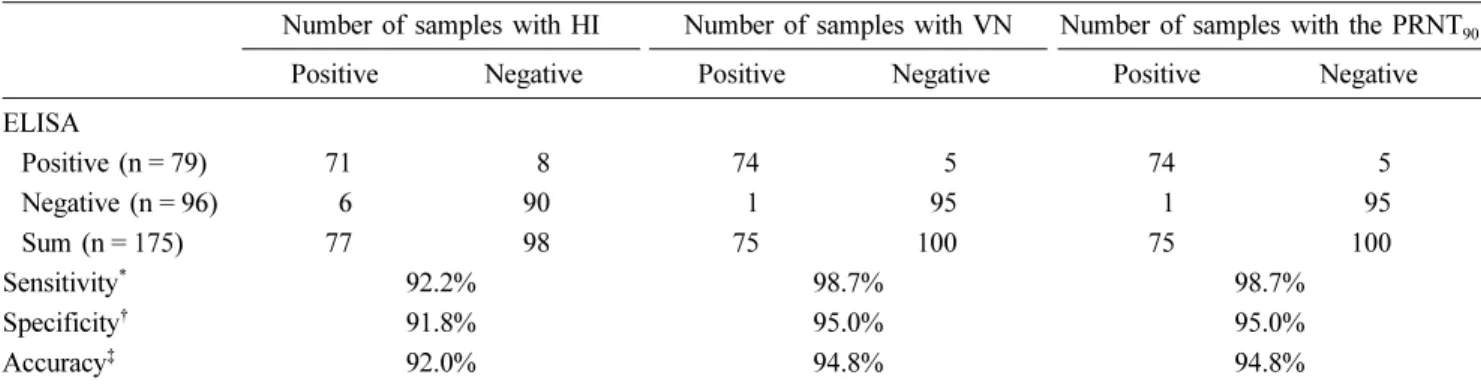
, and I- ELISA) were carried to detect JEV antibodies out in 175 sow serum samples. Table 1 shows that 77, 75, 75, and 79 serum samples were positive in HI titers of 1:10 to 1:2,560, VN titers of 1:2 to 1:256, PRNT

90

titers of 1:20 to 1:640, and I- ELISA absorbance values > 0.25, respectively. The numbers of JEV-negative serum samples were 98, 100, 100, and 96 with the HI, VN, PRNT

90

, and I-ELISA, respectively.

Optimization of I-ELISA

JEV antigen (15 mg) was harvested from several purifica- tions, and the major protein from the purified JEV antigen was identified by western blotting as a 54 kDa band using a monoclonal antibody to the JEV E protein (Fig. 1). We deter- mined the optimal antigen concentration (2 μg/mL), conju- gate concentration (10 ng/mL), and serum dilution (1:100).

The most suitable blocking and serum dilution buffer was

Table 1. Determination of the sensitivity, specificity, and accuracy of the indirect enzyme-linked immunosorbent assay (I-ELISA) for the detection of Japanese encephalitis virus (JEV) antibodies in comparison with those of hemagglutination inhibition (HI), virus neutralization (VN), and the 90% endpoint plaque reduction neutralization test (PRNT

90

)

Number of samples with HI Number of samples with VN Number of samples with the PRNT

90

Positive Negative Positive Negative Positive Negative

ELISA

Positive (n = 79) 71 8 74 5 74 5

Negative (n = 96) 6 90 1 95 1 95

Sum (n = 175) 77 98 75 100 75 100

Sensitivity

*

92.2% 98.7% 98.7%

Specificity

91.8% 95.0% 95.0%

Accuracy

92.0% 94.8% 94.8%

*Sensitivity (%) = (number of positive results in both tests / total number of positive results in the reference test) × 100.

Specificity

(%) = (number of negative results in both tests / total number of negative results in the reference test) × 100.

Accuracy (%) = (actual number

of both positive and negative results / total number of samples) × 100.

(4)

1% casein in PBS (data not shown). In addition, an absor- bance value of 0.25 was set as the threshold (cutoff value).

Therefore, an absorbance value of > 0.25 in I-ELISA was considered positive. Based on these results, the commercial I-ELISA kit was prepared, and evaluated with 175 swine serum samples.

Comparison of serological assays

The absorbance value from I-ELISA was compared with titers of the HI, VN, or PRNT

90

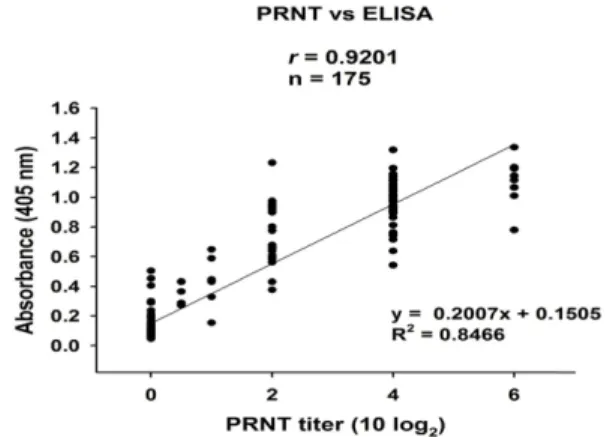
using 175 serum samples to evaluate its diagnostic reliability. As shown in Figures 2–4, correlations between I-ELISA and HI, between I-ELISA and VN, and between I-ELISA and PRNT

90

were indicated by regression lines and correlation coefficients (r). The r-values for HI, VN, and the PRNT

90

were 0.93 (p < 0.05), 0.95 (p <

0.05), and 0.92 (p < 0.05), respectively. The diagnostic sensi-

tivity, specificity, and accuracy of I-ELISA were calculated from the JEV positive/negative sera measured by standard diagnostic assays such as HI, VN, and the PRNT

90

. Table 1 shows that 71 or 74 serum samples were positive but 90 or 95 serum samples were negative according to a traditional assay, which represented 92.0% to 94.8% accuracy in the total samples. In contrast, the four tests yielded different results for 6 to 14 serum samples. Among these test results, one or six that were positive according to traditional stan- dard assays was negative by I-ELISA, indicating specificities of 91.8%, 95.0%, and 95.0% for I-ELISA compared with HI, VN, and the PRNT

90

, respectively. The five or eight serum samples that were negative by the three assays were positive by I-ELISA, indicating sensitivities of 92.2%, 98.7%, and 98.7% for I-ELISA compared with HI, VN, and the PRNT

90

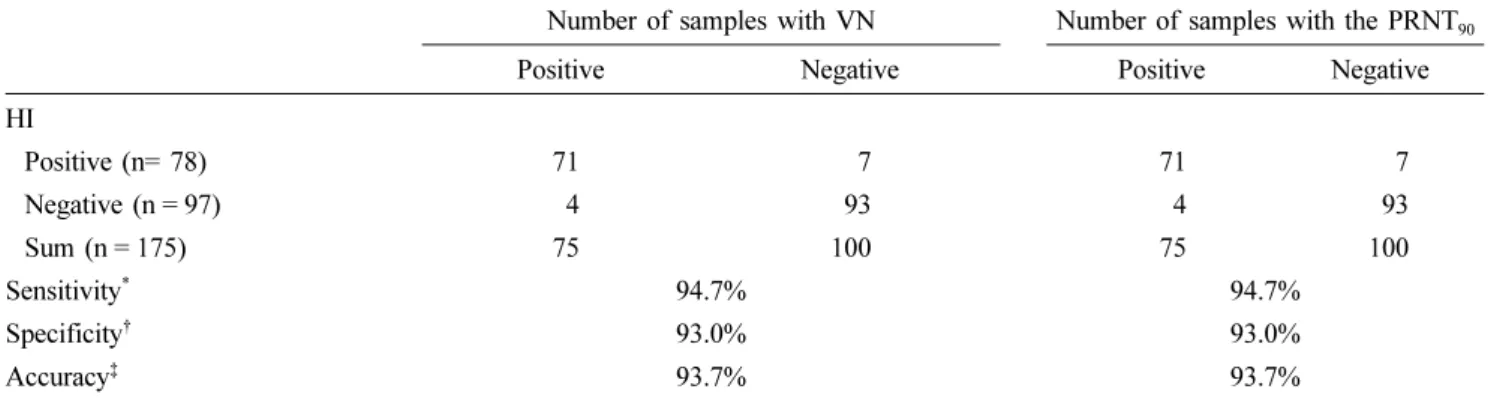
, respectively. In Table 2, the sensitivity, specificity, and accu- racy among HI, VN, and the PRNT

90

were calculated using JEV positive/negative sera. The sensitivity, specificity, and accuracy of HI were 94.7%, 93.0%, and 93.7%, respectively, with VN and the PRNT

90

. The number of JEV positive/nega- Fig. 1. Identification of the JEV envelope protein by western

blotting using monoclonal antibodies specific to JEV. The molecular weight was 54 kDa. M, protein ladder; Lane 1, puri- fied JEV antigen.

Fig. 2. Comparison of the abilities of the HI titer and I-ELISA to detect JEV antibodies in 175 swine serum samples. The cor- relation between HI and I-ELISA is indicated by the linear regression line and r-value.

Fig. 3. Comparison of the abilities of the VN titer and I-ELISA to detect JEV antibodies in 175 swine serum samples. The cor- relation between VN and I-ELISA is indicated by the linear regression line and r-value.

Fig. 4. Comparison of the abilities of the PRNT

90

titer and I- ELISA to detect JEV antibodies in 175 swine serum samples.

The correlation between PRNT

90

and I-ELISA is indicated by

the linear regression line and r-value.

(5)

tive serum samples was equal between VN and the PRNT

90

, indicating that both assays are involved in virus neutralization.

Discussion

JEV infection in humans can be prevented by vaccination, a reduction in mosquito numbers, and immunization of pigs [3]. Previous studies have shown that pigs amplify JEV and that sows infected with JEV develop fever and experience reproductive failure (e.g., abortion) [10]. Because vaccina- tion failure or missed vaccination can result in the develop- ment of JE in humans and pigs and can provide an opportunity for pigs to amplify the virus, preventive mea- sures such as issuing warnings and performing revaccination have been implemented in association with seromonitoring of the JEV antibody in South Korea. Serological surveys of JEV are useful to determine the infection rate in pigs and the JEV antibody level in vaccinated animals. Although HI has been used as a serological method, regional veterinary insti- tutes have begun replacing HI with ELISA, which is suitable for large numbers of serum samples and is simple and rapid.

For this reason, we focused on improving I-ELISA as an alternative to HI in pigs and compared it with HI, VN, and the PRNT

90

.

Because of the shift in the predominant JEV genotype from G3 to G1 in South Korea in the 1990s [14], the JEV G1 KV1899 strain was selected as the antigen for evaluation by I-ELISA, HI, and the PRNT

90

. The JEV G3 K87 strain has been routinely used for VN in our laboratory. One of the most important factors affecting the sensitivity and specific- ity of ELISA is the use of purified antigen [17]. In our previ- ous study, I-ELISA microplates were coated with JEV antigen, which was purified by PEG-8000 precipitation and sucrose gradient centrifugation [22]. To improve both the sensi- tivity and specificity, an antigen purified by filtration using the Pellicon XL Ultrafiltration Module Bio-max 100 kDa and discontinuous sucrose ultracentrifugation were used for the I- ELISA. These processes facilitate large-scale production of

whole JEV antigens by biologic companies.

The sensitivity, specificity, and accuracy of the new I- ELISA as well as their correlations with those of HI, VN, and the PRNT

90

were determined using 175 pig serum sam- ples. The sensitivity of the I-ELISA compared with HI (92.2%) was slightly lower than that in previous results (94.3%), but the sensitivity compared with VN (98.7%) was higher (93.7%) [22]. Shimoda et al. [18] reported that the specificity of ELISA is the first priority to avoid false-positive reactions when developing IgG ELISAs. Compared with previous results regarding the specificity of I-ELISA compared with HI (81.4%) and VN (80.9%), the specificity of the new I-ELISA compared with both HI (91.8%) and VN (95.0%) was signif- icantly improved. Our results also showed that the absor- bance result of the I-ELISA was significantly correlated with those of the HI titer (r = 0.93), VN titer (r = 0.95), and PRNT

90

(r = 0.92). Moreover, these I-ELISA correlations are consis- tent with the results of previous studies that used rapid ELISA for detection of JEV antibodies in human and swine sera [8, 19], suggesting that the new I-ELISA is suitable for serosurveillance of JEV in swine. Further studies using other types of ELISA such as an IgM-capture or blocking ELISA are needed for the assessment of recent JEV infections in pigs or anti-JEV IgG from many susceptible animals, includ- ing horses.

In conclusion, we showed that the improved I-ELISA had a significant correlation with three serological tests in terms of the detection of JEV antibodies in pig serum samples, indicating that this new I-ELISA assay can be used as a fairly simple and efficient tool for examining a large number of serum samples at once.

Acknowledgments

This work was supported financially by a grant (N1543083-2014-18-01) from the Animal, and Plant Quaran- tine Agency, Ministry of Agriculture, Food and Rural Affairs, Republic of Korea.

Table 2. Comparison among HI, VN, and the PRNT

90

for the detection of JEV antibodies in swine sera

Number of samples with VN Number of samples with the PRNT

90

Positive Negative Positive Negative

HI

Positive (n= 78) 71 7 71 7

Negative (n = 97) 4 93 4 93

Sum (n = 175) 75 100 75 100

Sensitivity

*

94.7% 94.7%

Specificity

93.0% 93.0%

Accuracy

93.7% 93.7%

*Sensitivity (%) = (number of positive results in both tests / total number of positive results in the reference test) × 100.

Specificity

(%) = (number of negative results in both tests / total number of negative results in the reference test) × 100.

Accuracy (%) = (real number

of both positive and negative results / total number of samples) × 100.

(6)

References

1. Cha GW, Cho JE, Ju YR, Hong YJ, Han MG, Lee WJ, Choi EY, Jeong YE. Comparison of four serological tests for detecting antibodies to Japanese encephalitis virus after vaccination in children. Osong Public Health Res Perspect 2014, 5, 286-291.

2. Chen WR, Tesh RB, Rico-Hesse R. Genetic variation of Japanese encephalitis virus in nature. J Gen Virol 1990, 71, 2915-2922.

3. Ding D, Kilgore PE, Clemens JD, Wei L, Zhi-Yi X. Cost- effectiveness of routine immunization to control Japanese encephalitis in Shanghai, China. Bull World Health Organ 2003, 81, 334-342.

4. Forman S, Hungerford N, Yamakawa M, Yanase T, Tsai HJ, Joo YS, Yang DK, Nha JJ. Climate change impacts and risks for animal health in Asia. Rev Sci Tech 2008, 27, 581-597.

5. Hasegawa H, Yoshida M, Fujita S, Kobayashi Y.

Comparison of structural proteins among antigenically different Japanese encephalitis virus strains. Vaccine 1994, 12, 841-844.

6. Kang BK, Hwang JM, Moon H, Han SY, Kim JM, Yang DK, Park BK, Song D. Comparison of the antigenic relationship between Japanese encephalitis virus genotypes 1 and 3. Clin Exp Vaccine Res 2016, 5, 26-30.

7. Kim HC, Takhampunya R, Tippayachai B, Chong ST, Park JY, Kim MS, Seo HJ, Yeh JY, Lee WJ, Lee DK, Klein TA. Japanese encephalitis virus in culicine mosquitoes (Diptera: Culicidae) of the republic of Korea, 2008-2010. Mil Med 2015, 180, 158-167.

8. Konishi E, Yamaoka M. Rapid enzyme-linked immunosorbent assay of whole blood for detection of antibodies to Japanese encephalitis virus. J Virol Methods 1983, 7, 21-28.

9. Lee EJ, Cha GW, Ju YR, Han MG, Lee WJ, Jeong YE.

Prevalence of neutralizing antibodies to Japanese encephalitis virus among high-risk age groups in South Korea, 2010.

PLoS One 2016, 11, e0147841.

10. Lindahl J, Boqvist S, Ståhl K, Thu HT, Magnusson U.

Reproductive performance in sows in relation to Japanese encephalitis virus seropositivity in an endemic area. Trop Anim Health Prod 2012, 44, 239-245.

11. Mansfield KL, Horton DL, Johnson N, Li L, Barrett ADT, Smith DJ, Galbraith SE, Solomon T, Fooks AR.

Flavivirus-induced antibody cross-reactivity. J Gen Virol 2011, 92, 2821-2829.

12. Mei L, Wu P, Ye J, Gao G, Shao L, Huang S, Li Y, Yang X, Chen H, Cao S. Development and application of

an antigen capture ELISA assay for diagnosis of Japanese encephalitis virus in swine, human and mosquito. Virol J 2012, 9, 4.

13. Morita K, Nabeshima T, Buerano CC. Japanese encephalitis.

Rev Sci Tech 2015, 34, 441-452.

14. Nah JJ, Yang DK, Kim HH, Song JY. The present and future of veterinary vaccines for Japanese encephalitis in Korea. Clin Exp Vaccine Res 2015, 4, 130-136.

15. Ravi V, Desai A, Balaji M, Apte MP, Lakshman L, Subbakrishna DK, Sridharan G, Dhole TN, Ravikumar BV. Development and evaluation of a rapid IgM capture ELISA (JEV-Chex) for the diagnosis of Japanese encephalitis.

J Clin Virol 2006, 35, 429-434.

16. Sabin AB, Schlesinger RW, Ginder DR, Matsumoto M.

Japanese B encephalitis in American soldiers in Korea. Am J Hyg 1947, 46, 356-375.

17. Schrijver RS, Kramps JA. Critical factors affecting the diagnostic reliability of enzyme-linked immunosorbent assay formats. Rev Sci Tech 1998, 17, 550-561.

18. Shimoda H, Inthong N, Noguchi K, Terada Y, Nagao Y, Shimojima M, Takasaki T, Rerkamnuaychoke W, Maeda K. Development and application of an indirect enzyme-linked immunosorbent assay for serological survey of Japanese encephalitis virus infection in dogs. J Virol Methods 2013, 187, 85-89.

19. Xinglin J, Huanchun C, Xiang W, Changming Q.

Quantitative and qualitative study of enzyme-linked immuno- sorbent assay to detect IgG against Japanese encephalitis virus in swine sera. Vet Res Commun 2005, 29, 159-169.

20. Yamamoto A, Nakayama M, Tashiro M, Ogawa T, Kurane I. Hydroxyapatite-coated nylon beads as a new reagent to develop a particle agglutination assay system for detecting Japanese encephalitis virus-specific human antibodies. J Clin Virol 2000, 19, 195-204.

21. Yang DK, Kim BH, Kweon CH, Kwon JH, Lim SI, Han HR. Biophysical characterization of Japanese encephalitis virus (KV1899) isolated from pigs in Korea. J Vet Sci 2004, 5, 125-130.

22. Yang DK, Kim BH, Lim SI, Kwon JH, Lee KW, Choi CU, Kweon CH. Development and evaluation of indirect ELISA for the detection of antibodies against Japanese encephalitis virus in swine. J Vet Sci 2006, 7, 271-275.

23. Yun SM, Cho JE, Ju YR, Kim SY, Ryou J, Han MG, Choi WY, Jeong YE. Molecular epidemiology of Japanese encephalitis virus circulating in South Korea, 1983-2005.

Virol J 2010, 7, 127.

수치

Table 1. Determination of the sensitivity, specificity, and accuracy of the indirect enzyme-linked immunosorbent assay (I-ELISA) for the detection of Japanese encephalitis virus (JEV) antibodies in comparison with those of hemagglutination inhibition (HI),
Fig. 4. Comparison of the abilities of the PRNT 90  titer and I- I-ELISA to detect JEV antibodies in 175 swine serum samples.
Table 2. Comparison among HI, VN, and the PRNT 90  for the detection of JEV antibodies in swine sera

참조

관련 문서

As a result of the systematic strength training for six sports climbing speed athletes, there were positive changes due to the improvement of

이 를 위해 cell proliferation assay (MTT), cytochrome C ELISA assay, caspase―3 enzyme activity assay, fluorescence microscopy에 의한 apoptosis 관찰,

Fresh samples were immediately tested for antioxidant activity, and antioxidant activity was compared according to gestational age and measured the difference

TABLE 1.ANTI PROLI FERATI VE EFFECT OF EEAD I N C6CELLS ---7.. Caspase-3/-7 activity

Kids or children aged between five to eight years old were determined as an available participant for the program because children aged between five and

Above all, I think it is desirable that national assembly resolves the problems of the privilege of speech for itself by strengthening stature and function of

The measured values for benzene in DMF were compared with the The measured values for benzene in DMF were compared with the reference data, and

The most common reasons for hesitancy by group were as follows: For the group who vaccinated on time with hesitancy, the reasons were in the order of concerns and