Interventional Cardiology
Six-Month Versus 12-Month Dual Antiplatelet Therapy After Implantation of Drug-Eluting Stents
The Efficacy of Xience/Promus Versus Cypher to Reduce Late Loss After Stenting (EXCELLENT) Randomized, Multicenter Study
Hyeon-Cheol Gwon, MD*; Joo-Yong Hahn, MD*; Kyung Woo Park, MD; Young Bin Song, MD;
In-Ho Chae, MD; Do-Sun Lim, MD; Kyoo-Rok Han, MD; Jin-Ho Choi, MD; Seung-Hyuk Choi, MD;
Hyun-Jae Kang, MD; Bon-Kwon Koo, MD; Taehoon Ahn, MD; Jung-Han Yoon, MD;
Myung-Ho Jeong, MD; Taek-Jong Hong, MD; Woo-Young Chung, MD; Young-Jin Choi, MD;
Seung-Ho Hur, MD; Hyuck-Moon Kwon, MD; Dong-Woon Jeon, MD; Byung-Ok Kim, MD;
Si-Hoon Park, MD; Nam-Ho Lee, MD; Hui-Kyung Jeon, MD; Yangsoo Jang, MD; Hyo-Soo Kim, MD
Background—The optimal duration of dual antiplatelet therapy (DAPT) after implantation of drug-eluting coronary stents remains undetermined. We aimed to test whether 6-month DAPT would be noninferior to 12-month DAPT after implantation of drug-eluting stents.
Methods and Results—We randomly assigned 1443 patients undergoing implantation of drug-eluting stents to receive 6- or 12-month DAPT (in a 1:1 ratio). The primary end point was a target vessel failure, defined as the composite of cardiac death, myocardial infarction, or ischemia-driven target vessel revascularization at 12 months. Rates of target vessel failure at 12 months were 4.8% in the 6-month DAPT group and 4.3% in the 12-month DAPT group (the upper limit of 1-sided 95%
confidence interval, 2.4%; P⫽0.001 for noninferiority with a predefined noninferiority margin of 4.0%). Although stent thrombosis tended to occur more frequently in the 6-month DAPT group than in the 12-month group (0.9% versus 0.1%;
hazard ratio, 6.02; 95% confidence interval, 0.72– 49.96; P⫽0.10), the risk of death or myocardial infarction did not differ in the 2 groups (2.4% versus 1.9%; hazard ratio, 1.21; 95% confidence interval, 0.60 –2.47; P⫽0.58). In the prespecified subgroup analysis, target vessel failure occurred more frequently in the 6-month DAPT group than in the 12-month group (hazard ratio, 3.16; 95% confidence interval, 1.42–7.03; P⫽0.005) among diabetic patients.
Conclusions—Six-month DAPT did not increase the risk of target vessel failure at 12 months after implantation of drug-eluting stents compared with 12-month DAPT. However, the noninferiority margin was wide, and the study was underpowered for death or myocardial infarction. Our results need to be confirmed in larger trials.
Clinical Trial Registration—URL: http://www.clinicaltrials.gov. Unique identifier: NCT00698607.
(Circulation. 2012;125:505-513.)
Key Words: drug-eluting stents 䡲 platelet aggregation inhibitors 䡲 stents 䡲 thrombosis
S
everal randomized trials have demonstrated that drug- eluting coronary stents reduce angiographic restenosis and target lesion revascularization compared with bare metal stents.1–3 However, some long-term observational studieshave reported that the risk of death or myocardial infarction was higher after drug-eluting stents than after bare metal stents, which may be due to the different incidences of late or very late stent thrombosis.4,5 Previous observational studies
Received July 29, 2011; accepted November 8, 2011.
From the Division of Cardiology, Department of Medicine, Samsung Medical Center, Sungkyunkwan University School of Medicine, Seoul (H.-C.G., J.-Y.H., Y.B.S., J.-H.C., S.-H.C.); Cardiovascular Center, Seoul National University Main Hospital, Seoul (K.W.P., H.-J.K., B.-K.K., H.-S.K.); Seoul National University Bundang Hospital, Sungnam (I.-H.C.); Korea University Anam Hospital, Seoul (D.-S.L.); Kangdong Sacred Heart Hospital, Seoul (K.-R.H.); Gachon University Gil Medical Center, Incheon (T.A.); Yonsei University Wonju Severance Hospital, Wonju (J.-H.Y.); Chonnam National University Hospital, Gwangju (M.-H.J.); Busan National University Hospital, Busan (T.-J.H.); Seoul National University Boramae Hospital, Seoul (W.-Y.C.); Hallym University Sacred Heart Hospital, Anyang (Y.-J.C.); Keimyung University Dongsan Hospital, Daegu (S.-H.H.); Gangnam Severance Hospital, Seoul (H.-M.K.); NHIC Ilsan Hospital, Goyang (D.-W.J.); Inje University Sanggye Paik Hospital, Seoul (B.-O.K.); Ewha Women’s University Mokdong Hospital, Seoul (S.-H.P.); Kangnam Sacred Heart Hospital, Seoul (N.-H.L.); Catholic University Uijeongbu St. Mary’s Hospital, Uijeongbu (H.-K.J.); and Yonsei University Severance Hospital, Seoul (Y.J.), Korea.
*Drs Gwon and Hahn contributed equally to this article.
The online-only Data Supplement is available with this article at http://circ.ahajournals.org/lookup/suppl/doi:10.1161/CIRCULATIONAHA.111.059022/-/
DC1.
Correspondence to Hyo-Soo Kim, MD, Department of Internal Medicine, Cardiovascular Center, Seoul National University Hospital, 101 DaeHak-ro, JongRo-gu, Seoul, 110 –744, Korea. E-mail [email protected]
© 2011 American Heart Association, Inc.
Circulation is available at http://circ.ahajournals.org DOI: 10.1161/CIRCULATIONAHA.111.059022
505
by guest on January 10, 2017http://circ.ahajournals.org/Downloaded from by guest on January 10, 2017http://circ.ahajournals.org/Downloaded from by guest on January 10, 2017http://circ.ahajournals.org/Downloaded from by guest on January 10, 2017http://circ.ahajournals.org/Downloaded from by guest on January 10, 2017http://circ.ahajournals.org/Downloaded from by guest on January 10, 2017http://circ.ahajournals.org/Downloaded from by guest on January 10, 2017http://circ.ahajournals.org/Downloaded from by guest on January 10, 2017http://circ.ahajournals.org/Downloaded from by guest on January 10, 2017http://circ.ahajournals.org/Downloaded from by guest on January 10, 2017http://circ.ahajournals.org/Downloaded from by guest on January 10, 2017http://circ.ahajournals.org/Downloaded from by guest on January 10, 2017http://circ.ahajournals.org/Downloaded from by guest on January 10, 2017http://circ.ahajournals.org/Downloaded from by guest on January 10, 2017http://circ.ahajournals.org/Downloaded from by guest on January 10, 2017http://circ.ahajournals.org/Downloaded from by guest on January 10, 2017http://circ.ahajournals.org/Downloaded from by guest on January 10, 2017http://circ.ahajournals.org/Downloaded from by guest on January 10, 2017http://circ.ahajournals.org/Downloaded from by guest on January 10, 2017http://circ.ahajournals.org/Downloaded from by guest on January 10, 2017http://circ.ahajournals.org/Downloaded from by guest on January 10, 2017http://circ.ahajournals.org/Downloaded from by guest on January 10, 2017http://circ.ahajournals.org/Downloaded from by guest on January 10, 2017http://circ.ahajournals.org/Downloaded from by guest on January 10, 2017http://circ.ahajournals.org/Downloaded from by guest on January 10, 2017http://circ.ahajournals.org/Downloaded from
reported that premature discontinuation of thienopyridine therapy was the major determinant of stent thrombosis after implantation of drug-eluting stents6and that the extended use of clopidogrel in patients with drug-eluting stents may be associated with a reduced risk of death or myocardial infarc- tion.7 From the results of these reports, prolonged dual antiplatelet therapy (DAPT; aspirin plus thienopyridine) of at least 12 months is currently recommended after percutaneous coronary intervention (PCI) with drug-eluting stents unless patients are at high risk for bleeding.8
Editorial see p 471 Clinical Perspective on p 513
However, the optimal or minimal necessary duration of DAPT remains undetermined. A randomized trial showed that the use of DAPT for a period ⬎12 months in patients who had received drug-eluting stents was not significantly more effective than aspirin monotherapy.9 Moreover, some registry studies suggest that DAPT lasting⬍12 months after PCI with drug-eluting stents does not increase major adverse cardiac events and that there is no apparent clinical benefit from DAPT for ⬎6 months.10 –12 To date, no randomized trials have been performed to compare a shorter duration of DAPT with 12-month DAPT. In the Efficacy of Xience/
Promus Versus Cypher to Reduce Late Loss After Stenting (EXCELLENT) trial, we compared 6-month DAPT with 12-month DAPT in patients receiving drug-eluting stents.
Methods
Study Design and PatientsThe EXCELLENT trial was a prospective, open-label, randomized trial conducted at 19 sites in Korea. The authors designed the study, and the institutional review board at each participating center approved the trial protocol. The study design has previously been described.13Patients were eligible for inclusion in the study if they had at least 1 lesion in a native coronary vessel with a reference diameter of 2.25 to 4.25 mm, stenosis of⬎50% by visual estimation, and evidence of myocardial ischemia such as stable angina, unstable angina, recent myocardial infarction, silent ischemia, a positive functional study, or reversible changes on ECG consistent with ischemia. Documentation of ischemia was not mandatory for lesions with⬎75% stenosis. There were no limitations on the number of lesions or the length of the lesions in efforts to reflect real-life clinical practice. Exclusion criteria were myocardial infarction within 72 hours; severely compromised ventricular dysfunction (ejection fraction⬍25%) or cardiogenic shock; any stent implanta- tion in the target vessel before enrollment; hemoglobin⬍10 g/dL or platelet count⬍100 000 per 1L; serum creatinine ⱖ265.2 mol/L (3.0 mg/dL) or dependence on dialysis; serious hepatic disease;
major bleeding within 3 months or major surgery within 2 months;
allergy to antiplatelet drugs, heparin, stainless steel, contrast agents, everolimus, or sirolimus; elective surgical procedure planned within
⬍12 months; life expectancy ⬍1 year; significant left main disease defined as stenosis of⬎50%; chronic total occlusion; true bifurca- tion lesions requiring a planned 2-stent strategy; or active participa- tion in another clinical study. All patients provided written informed consent.
Study Procedures and Follow-Up
Patients were randomly assigned in a 1:1 ratio to receive either 6-month DAPT (aspirin 100 –200 mg/d plus clopidogrel 75 mg/d for 6 months and thereafter aspirin alone) or 12-month DAPT (aspirin 100 –200 mg/d plus clopidogrel 75 mg/d for 12 months). Random- ization was performed with a Web-based response system after
diagnostic angiography and before PCI. Randomization was strati- fied by the site of enrollment, presence of diabetes mellitus, and lesion length. In addition, patients were randomly assigned to receive everolimus- or sirolimus-eluting stents. The results of the drug- eluting stent arm of the trial are not reported here.
PCI was performed according to standard techniques. Before the index procedure, all patients received at least 300 mg aspirin and a 300- to 600-mg loading dose of clopidogrel unless they had previously received these antiplatelet medications. Unfractionated heparin was administered throughout the procedure to maintain an activated clotting time ofⱖ250 seconds. Administration of glyco- protein IIb/IIIa inhibitors was at the discretion of the operator. After the procedure, all patients were recommended to receive optimal pharmacological therapy, including statins,-blockers, or angioten- sin-converting enzyme inhibitors at the discretion of the responsible clinicians. Any P2Y12 receptor antagonist other than clopidogrel was not used. Additionally, each investigator was advised to empha- size the importance of cardiovascular risk factor modification to patients.
Clinical follow-up was performed at 1, 3, 6, 9, and 12 months after the index PCI. At follow-up, patient data, including clinical status, all interventions, outcome events, and adverse events, were recorded. In particular, information on the use of aspirin or clopidogrel was assessed at each follow-up.
Study End Points
The primary end point was target vessel failure defined as a composite of cardiac death, myocardial infarction, or target vessel revascularization during the 12-month period after randomization.
Secondary end points included the individual components of the primary end point; death resulting from any cause; death or myo- cardial infarction; stent thrombosis; major bleeding according to the Thrombolysis in Myocardial Infarction criteria14; major adverse cardiocerebral events, which were a composite of death, myocar- dial infarction, stroke, or any revascularization; and a safety end point, which was a composite of death, myocardial infarction, stroke, stent thrombosis, or Thrombolysis in Myocardial Infarc- tion major bleeding.
Clinical events were defined on the basis of the recommendations of the Academic Research Consortium.15All deaths were considered cardiac unless a definite noncardiac cause could be established.
During the first 48 hours after PCI, myocardial infarction was defined as an increase of cardiac enzyme (creatine kinase-MB fraction or troponin T/troponin I) 3 times above the upper limit of normal in stable patients.15In patients with elevated baseline levels of cardiac enzyme, myocardial infarction was defined as a subse- quent increase of⬎2-fold from baseline values.16After the first 48 hours, myocardial infarction was defined as the presence of clinical signs of myocardial infarction combined with a creatine kinase-MB fraction or troponin T/troponin I increase higher than the upper limit of normal.15Target lesion revascularization was defined as either a repeat PCI of the lesion within 5 mm of the deployed stent or bypass graft surgery of the target vessel. Target vessel revascularization was defined as repeat revascularization of the treated vessel by PCI or bypass graft surgery. Stent thrombosis was defined as definite or probable stent thrombosis according to the Academic Research Consortium classification.15Stroke, as detected by the occurrence of a new neurological deficit, was confirmed by a neurologist and on imaging. Device success was defined as the attainment at the target site of a final residual diameter stenosis of⬍50% using only the assigned study device. Lesion success was defined as the attainment of a final residual diameter stenosis of⬍50% using any percutaneous method. Procedure success was defined as the attainment at the target site of a final residual diameter stenosis of⬍50%, together with the absence of any in-hospital major adverse cardiac events.
The independent clinical event adjudication committee (Table I in the online-only Data Supplement), the members of which were unaware of the study group assignments, assessed all of the clinical end points.
506 Circulation January 24, 2012
by guest on January 10, 2017http://circ.ahajournals.org/Downloaded from
Statistical Analysis
The primary analysis was a noninferiority comparison of 6- and 12-month DAPT for the primary end point of target vessel failure according to the intention-to-treat principle. Using data from large, randomized clinical trials evaluating the efficacy of drug-eluting stents, we estimated that the incidence of the primary end point with 12-month DAPT 1 year after the procedure would be 10%.17,18The noninferiority margin of 4.0 percentage points was chosen on the basis of historical data,7clinically acceptable relevance, and the feasibility of study recruitment. We estimated that with a total of 1372 patients (686 per group), the power of the study would be 80%
to show noninferiority with a 1-sided type I error rate of 0.05.
Assuming that 5% of patients would be lost to follow-up, we determined the final sample size to be 1440 patients (720 per group).
Continuous variables were presented as mean⫾SD and compared by use of the Student t test. Categorical variables were presented as counts and percentages and compared by use of the2 or Fisher exact test as appropriate. Cumulative event rates were estimated with the Kaplan-Meier method. If the upper limit of the 1-sided 95%
confidence interval (CI) of the difference were less than the prespecified noninferiority margin, 6-month DAPT would be con- sidered to be noninferior to 12-month DAPT. Survival curves were compared by use of the log-rank tests. Hazard ratios with 95% CIs were estimated by use of the Cox proportional-hazards method.
Landmark analysis19was performed with a landmark of clopidogrel discontinuation at 6 months among patients who were event free at 6 months. We also performed per-protocol analysis among patients who adhered to the study protocol. The consistency of treatment effects in prespecified subgroups was assessed by use of Cox regression models with tests for interaction. P values and CIs were 2 tailed except those for noninferiority testing of the primary end point.
All analyses were performed with SAS version 9.1 (SAS Institute, Inc, Cary, NC).
The authors had full access to and take full responsibility for the integrity of the data. All authors have read and agree to the manuscript as written.
Results
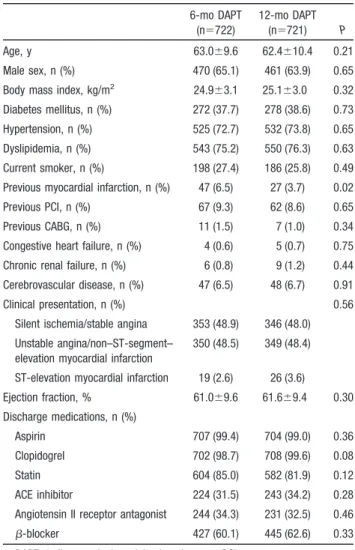
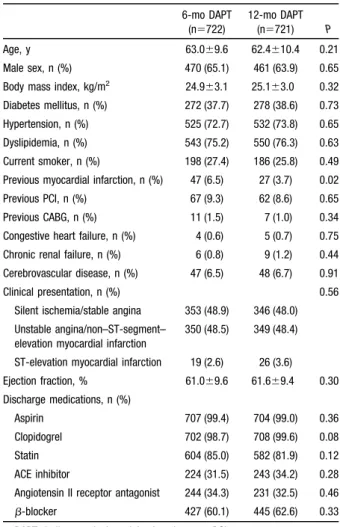
Study ParticipantsBetween June 2008 and July 2009, a total of 1443 patients were enrolled. Of these patients, 722 were assigned to receive 6-month DAPT and 721 were assigned to receive 12-month DAPT (Figure 1). Patients in the 2 groups were well balanced with regard to most baseline demographic and clinical char- acteristics (Table 1). However, patients with a history of previous myocardial infarction were more common in the 6-month DAPT group compared with the 12-month group (6.5% versus 3.7%; P⫽0.02). Medications at discharge from the index PCI were similar in the 6- and 12-month DAPT groups. Angiographic and procedural data were also similar
in the 2 groups (Table 2). Everolimus-eluting stents were used in three quarters of patients and sirolimus-eluting stents were used in one quarter of patients as a result of 3:1 randomization of stents.
Study Outcomes
At 12 months, aspirin was continued in 99.9% of the 6-month DAPT group and 99.3% of the 12-month DAPT group. The median duration of DAPT was 190 days (interquartile range, 181–260 days) in the 6-month DAPT group and 375 days (interquartile range, 364 –395 days) in the 12-month DAPT group. Adherence to the study protocol was 71.2% of the 6-month DAPT group and 93.2% of the 12-month DAPT group at 12 months.
Follow-up regarding the primary end point was complete in 99.1% of patients in the 6-month DAPT group and 98.8%
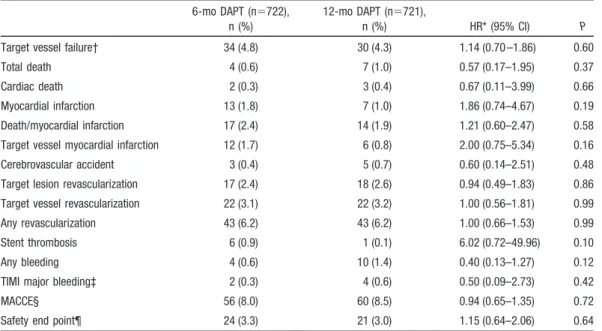
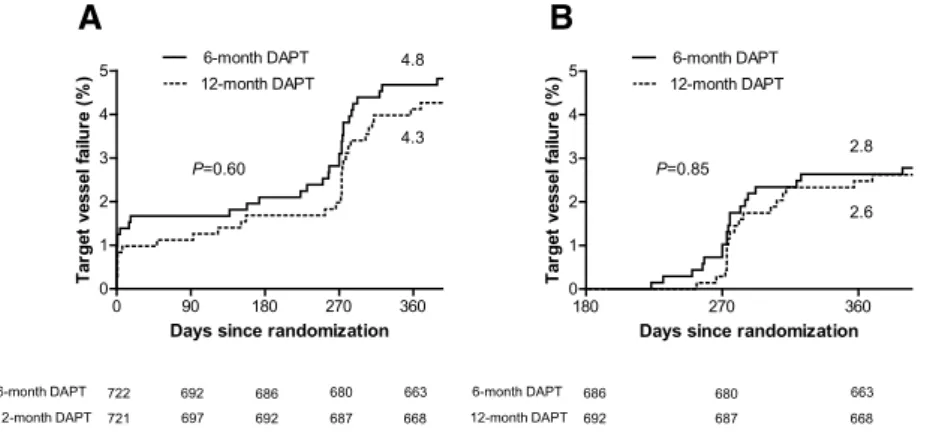
in the 12-month group. At 12 months, the primary end point of target vessel failure was noted in 34 patients in the 6-month DAPT group and 30 patients in the 12-month group. Cumu- lative rates of target vessel failure at 1 year were 4.8% for the 6-month and 4.3% for the 12-month DAPT group. The noninferiority of the 6-month DAPT to 12-month DAPT was Figure 1. Trial profile. DAPT indicates dual antiplatelet therapy.
Table 1. Baseline Patient Characteristics 6-mo DAPT
(n⫽722)
12-mo DAPT (n⫽721) P
Age, y 63.0⫾9.6 62.4⫾10.4 0.21
Male sex, n (%) 470 (65.1) 461 (63.9) 0.65
Body mass index, kg/m2 24.9⫾3.1 25.1⫾3.0 0.32 Diabetes mellitus, n (%) 272 (37.7) 278 (38.6) 0.73 Hypertension, n (%) 525 (72.7) 532 (73.8) 0.65 Dyslipidemia, n (%) 543 (75.2) 550 (76.3) 0.63 Current smoker, n (%) 198 (27.4) 186 (25.8) 0.49 Previous myocardial infarction, n (%) 47 (6.5) 27 (3.7) 0.02
Previous PCI, n (%) 67 (9.3) 62 (8.6) 0.65
Previous CABG, n (%) 11 (1.5) 7 (1.0) 0.34
Congestive heart failure, n (%) 4 (0.6) 5 (0.7) 0.75 Chronic renal failure, n (%) 6 (0.8) 9 (1.2) 0.44 Cerebrovascular disease, n (%) 47 (6.5) 48 (6.7) 0.91
Clinical presentation, n (%) 0.56
Silent ischemia/stable angina 353 (48.9) 346 (48.0) Unstable angina/non–ST-segment–
elevation myocardial infarction
350 (48.5) 349 (48.4)
ST-elevation myocardial infarction 19 (2.6) 26 (3.6) Ejection fraction, % 61.0⫾9.6 61.6⫾9.4 0.30 Discharge medications, n (%)
Aspirin 707 (99.4) 704 (99.0) 0.36
Clopidogrel 702 (98.7) 708 (99.6) 0.08
Statin 604 (85.0) 582 (81.9) 0.12
ACE inhibitor 224 (31.5) 243 (34.2) 0.28
Angiotensin II receptor antagonist 244 (34.3) 231 (32.5) 0.46
-blocker 427 (60.1) 445 (62.6) 0.33
DAPT indicates dual antiplatelet therapy; PCI, percutaneous coronary intervention; CABG, coronary artery bypass grafting; and ACE, angiotensin- converting enzyme. Data are mean⫾SD when appropriate. Data are given for the intention-to-treat population.
Gwon et al Duration of Clopidogrel After DES 507
by guest on January 10, 2017http://circ.ahajournals.org/Downloaded from
statistically significant (absolute risk difference, 0.5 percent- age points; upper limit of 1-sided 95% CI, 2.4%; P⫽0.001 for noninferiority; Table 3 and Figure 2A). Six-month landmark analysis showed that the risk of target vessel failure at 12 months was not significantly higher in the 6-month DAPT group than in the 12-month group (hazard ratio, 1.06; 95%
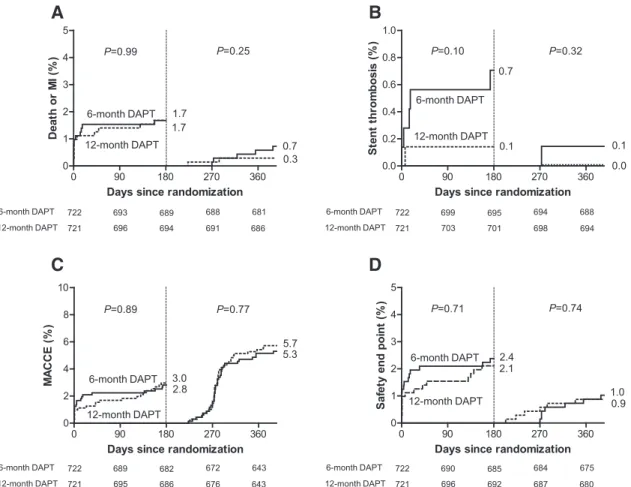
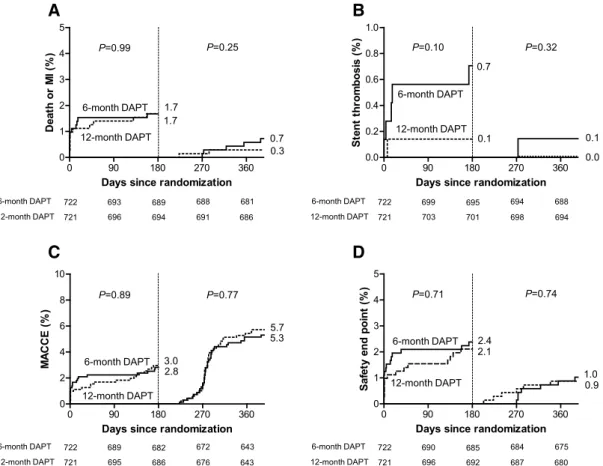
CI, 0.56 –2.03; P⫽0.85; Figure 2B). No significant differ- ences were observed between the 2 groups in the secondary end points (Table 3 and Figure 3). Although stent thrombosis tended to occur more frequently in the 6-month DAPT group than in the 12-month group (0.9% versus 0.1%; hazard ratio, 6.02; 95% CI, 0.72– 49.96; P⫽0.10), the risk of death or myocardial infarction did not differ between the 2 groups (2.4% versus 1.9%; hazard ratio, 1.21; 95% CI, 0.60 –2.47; P⫽0.58). Five of 6 stent thrombosis cases in the 6-month DAPT group occurred before 6 months when patients were taking both aspirin and clopidogrel. In the remaining 1 patient who developed it after 6 months, stent thrombosis occurred 89 days after discontinuation of clopidogrel. In the 12-month DAPT group, there was only 1 case of stent thrombosis, which developed at 7 days after the index procedure (Table 4).
The results from the per-protocol analysis were similar to those from the intention-to-treat analysis. Target vessel fail- ure occurred in 24 of 514 patients in the 6-month DAPT group and 29 of 672 patients in the 12-month DAPT group.
Cumulative rates of target vessel failure at 1 year were 4.7%
for the 6-month DAPT group and 4.4% for the 12-month DAPT group. The noninferiority of the 6-month DAPT to the 12-month DAPT was also statistically significant (absolute risk difference, 0.3 percentage points; the upper limit of 1-sided 95% CI, 2.3%; P⬍0.001 for noninferiority; Table II and Figure I in the online-only Data Supplement). Although stent thrombosis tended to occur more frequently in the 6-month DAPT group than in 12-month group (1.2% versus 0.2%; hazard ratio, 7.88; 95% CI, 0.95– 65.44; P⫽0.06), the risk of death or myocardial infarction did not differ signifi- cantly in the 2 groups (2.7% versus 2.1%; hazard ratio, 1.31;
95% CI, 0.63–2.75; P⫽0.47; Table II and Figure II in the online-only Data Supplement).
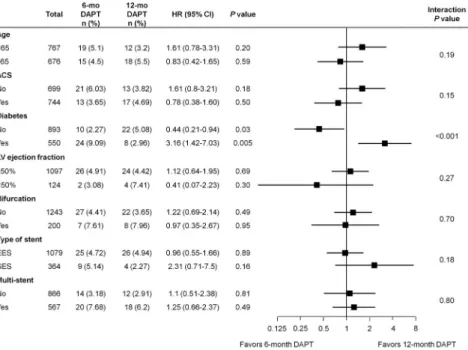
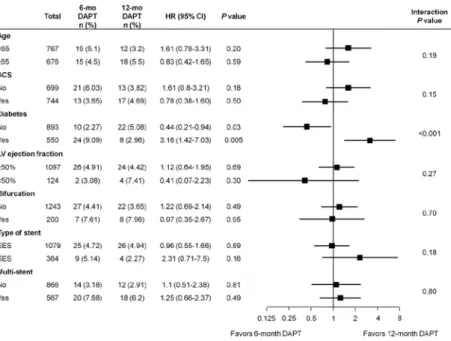
In prespecified subgroup analysis, the results of compari- son between the 2 regimens were consistent across various subgroups (Figure 4). However, there was significant inter- action between diabetes mellitus and outcomes (interaction P⬍0.001). Target vessel failure occurred more frequently in the 6-month DAPT group than in the 12-month group among diabetic patients (hazard ratio, 3.16; 95% CI, 1.42–7.03;
P⫽0.005), whereas it occurred less frequently in the 6-month DAPT group than in the 12-month group among patients without diabetes mellitus (hazard ratio, 0.44; 95% CI, 0.21–
0.94; P⫽0.03). Results of detailed subgroup analysis accord- ing to diabetic status are presented in Tables III and IV and Figure IIIA and IIIB in the online-only Data Supplement.
Among diabetic patients, rates of myocardial infarction and target vessel revascularization were significantly higher in the 6-month DAPT group than in the 12-month DAPT group (4.5% versus 1.1%; hazard ratio, 4.14; 95% CI, 1.17–14.68;
P⫽0.03; and 5.3% versus 1.9%; hazard ratio, 2.91; 95% CI, 1.05– 8.08; P⫽0.04, respectively). Stent thrombosis occurred in 4 patients (1.5%) in the 6-month DAPT group compared with none in the 12-month DAPT group among diabetic patients. Although statistical significance was not achieved, the risk of target vessel failure tended to be higher in the 6-month DAPT group than in the 12-month group among patients receiving sirolimus-eluting stents, whereas such a tendency was not observed in those receiving everolimus- eluting stents (P for interaction⫽0.18). We compared clinical outcomes of 6-month and 12-month DAPT in detail accord- ing to the type of stents (Tables V and VI and Figure IIIC and IIID in the online-only Data Supplement). No significant differences were observed in clinical outcomes between the 6- and 12-month DAPT groups among patients receiving everolimus-eluting stents and patients receiving sirolimus- eluting stents.
Discussion
In this prospective, randomized trial, 6-month DAPT was noninferior to 12-month DAPT for the primary end point, the rate of target vessel failure at 12 months. The 6-month landmark analysis and per-protocol analysis showed consis- tent results. However, target vessel failure occurred more Table 2. Lesion and Procedural Characteristics
6-mo DAPT 12-mo DAPT P
Patients, n 722 721
Angiographic disease extent, n (%) 0.90
1-Vessel disease 347 (48.1) 346 (48.0) 2-Vessel disease 226 (31.3) 232 (32.2) 3-Vessel disease 149 (20.6) 143 (19.8) Left anterior descending artery
treated, n (%)
452 (63.0) 447 (62.2) 0.73
Use of glycoprotein IIb/IIIa inhibitors, n (%)
12 (1.7) 12 (1.7) 0.99
Use of intravascular ultrasound, n (%) 315 (43.6) 312 (43.3) 0.89 Treated lesions per patient, n 1.3⫾0.6 1.4⫾0.5 0.58
Stents per patient, n 1.6⫾1.0 1.6⫾0.9 0.39
Type of drug-eluting stents, n (%) 0.99
Everolimus 540 (74.8) 539 (74.8)
Sirolimus 182 (25.2) 182 (25.2)
Treated lesions, n 957 970
Left anterior descending artery, n (%) 482 (50.6) 474 (49.0) 0.51 ACC/AHA lesion class B2/C, n (%) 486 (52.8) 505 (53.8) 0.67 Long lesion (ⱖ20 mm), n (%) 355 (40.3) 374 (41.2) 0.73 Total occlusion, n (%) 39 (4.2) 27 (2.9) 0.11 Thrombotic lesion, n (%) 74 (8.0) 73 (7.8) 0.84 Ulcerative lesion, n (%) 23 (2⫻4) 16 (1.6) 0.23 Bifurcation lesion, n (%) 98 (10.2) 111 (11.4) 0.42
Stents per lesion, n 1.2⫾0.5 1.2⫾0.5 0.41
Stent length per lesion, mm 27.8⫾13.0 28.3⫾13.7 0.31 Lesion success, n (%) 941 (99.7) 964 (99.8) 0.64 Device success, n (%) 941 (99.7) 963 (99.7) 0.98 Procedural success, n (%) 935 (99.0) 956 (99.0) 0.66 DAPT indicates dual antiplatelet therapy; ACC, American College of Cardi- ology; and AHA, American Heart Association. Data are mean⫾SD when appropriate. Data are given for the intention-to-treat population.
508 Circulation January 24, 2012
by guest on January 10, 2017http://circ.ahajournals.org/Downloaded from
frequently with 6-month DAPT than with 12-month DAPT among diabetic patients.
Prolonged DAPT of at least 12 months is currently recom- mended after PCI with drug-eluting stents. Supporting this guideline, several observational studies reported that the risk of death or myocardial infarction increased after drug-eluting stents compared with bare metal stents4,5 and that the ex- tended use of clopidogrel in patients with drug-eluting stents reduced the risk of death or myocardial infarction.7However, DAPT increases bleeding risk20,21 and costs compared with aspirin alone. Endoscopic, dental, and surgical procedures are often delayed because of prolonged DAPT, which may affect the patient’s quality of life.22 Therefore, determining the optimal or minimal necessary duration of DAPT is very important.
Until now, the premature results of only 1 randomized trial have been reported comparing the clinical outcomes of DAPT
versus aspirin alone beyond 12 months, and those results did not support the use of DAPT for a period ⬎12 months in patients receiving drug-eluting stents.9 The study, however, was not a dedicated randomized trial but a mixture of different cohorts limited by the wide range of the duration of antiplatelet therapy at the time of inclusion, and it was underpowered mainly because of lower rate of primary end point than expected. There has been no prospective random- ized trial comparing 12 months and shorter durations of DAPT after drug-eluting stent implantation. Several observa- tional studies reported that discontinuation of thienopyridine therapy beyond 6 months after implantation of drug-eluting stents was not associated with an increased risk of stent thrombosis.10,11However, these studies were not randomized trials and were limited by selection bias. In other words, there have been no systematic studies to assess the optimal duration of DAPT. Therefore, we performed a prospective, random-
A B
P=0.60 P=0.85
6-month DAPT 12-month DAPT
722 721
692 697
686 692
680 687
663 668
6-month DAPT 12-month DAPT
686 692
680 687
663 668 4.8
4.3 2.8
2.6
0 90 180 270 360
0 1 2 3 4
5 6-month DAPT 12-month DAPT
Days since randomization
Target vessel failure (%)
180 270 360
0 1 2 3 4
5 6-month DAPT 12-month DAPT
Days since randomization
Target vessel failure (%)
Figure 2. Kaplan-Meier curves for the pri- mary end point of target vessel failure. P values were calculated with the log-rank test. A, A composite of cardiac death, myocardial infarction, or target vessel re- vascularization by intention-to-treat analy- sis. B, Six-month landmark analysis among patients who were event-free at 6 months. DAPT indicates dual antiplatelet therapy.
Table 3. Clinical Outcomes
6-mo DAPT (n⫽722), n (%)
12-mo DAPT (n⫽721),
n (%) HR* (95% CI) P
Target vessel failure† 34 (4.8) 30 (4.3) 1.14 (0.70 –1.86) 0.60
Total death 4 (0.6) 7 (1.0) 0.57 (0.17–1.95) 0.37
Cardiac death 2 (0.3) 3 (0.4) 0.67 (0.11–3.99) 0.66
Myocardial infarction 13 (1.8) 7 (1.0) 1.86 (0.74–4.67) 0.19
Death/myocardial infarction 17 (2.4) 14 (1.9) 1.21 (0.60–2.47) 0.58
Target vessel myocardial infarction 12 (1.7) 6 (0.8) 2.00 (0.75–5.34) 0.16
Cerebrovascular accident 3 (0.4) 5 (0.7) 0.60 (0.14–2.51) 0.48
Target lesion revascularization 17 (2.4) 18 (2.6) 0.94 (0.49–1.83) 0.86
Target vessel revascularization 22 (3.1) 22 (3.2) 1.00 (0.56–1.81) 0.99
Any revascularization 43 (6.2) 43 (6.2) 1.00 (0.66–1.53) 0.99
Stent thrombosis 6 (0.9) 1 (0.1) 6.02 (0.72–49.96) 0.10
Any bleeding 4 (0.6) 10 (1.4) 0.40 (0.13–1.27) 0.12
TIMI major bleeding‡ 2 (0.3) 4 (0.6) 0.50 (0.09–2.73) 0.42
MACCE§ 56 (8.0) 60 (8.5) 0.94 (0.65–1.35) 0.72
Safety end point¶ 24 (3.3) 21 (3.0) 1.15 (0.64–2.06) 0.64
DAPT indicates dual antiplatelet therapy; HR, hazard ratio; CI, confidence interval; TIMI, Thrombolysis in Myocardial Infarction; and MACCE, major cardiocerebral event. The percentages shown are Kaplan-Meier estimates from the intention-to-treat analysis.
*HRs are for the 6- versus 12-month DAPT group.
†Target vessel failure was a composite of cardiac death, myocardial infarction, or target vessel revascularization.
‡TIMI major bleeding refers to adjudicated events in accordance with previously used TIMI criteria.14
§MACCE was a composite of death, myocardial infarction, stroke, or any revascularization.
¶Safety end point was a composite of death, myocardial infarction, stroke, stent thrombosis, or TIMI major bleeding.
Gwon et al Duration of Clopidogrel After DES 509
by guest on January 10, 2017http://circ.ahajournals.org/Downloaded from
ized study to compare 6- and 12-month DAPT in patients receiving drug-eluting stents.
The main finding of our study was that the cumulative incidences of target vessel failure did not differ significantly between 6-month and 12-month DAPT. In addition, there were no significant differences in the secondary end points such as death/myocardial infarction, revascularization, or
major adverse cardiocerebral events. Our results confirm the results of previous registry data that there were no apparent clinical benefits from DAPT for⬎6 months.10 –12However, stent thrombosis tended to occur more frequently in the 6-month DAPT group than in the 12-month group. The power of our study was insufficient to reach conclusions regarding the relationship between stent thrombosis and duration of
0 90 180 270 360
0 1 2 3 4 5
Days since randomization
Death or MI (%)
12-month DAPT
A B
C D
6-month DAPT 12-month DAPT
722 721
693 696
689 694
688 691
681 686
6-month DAPT 12-month DAPT
722 721
699 703
695 701
694 698
688 694
6-month DAPT 12-month DAPT
722 721
689 695
682 686
672 676
643 643
6-month DAPT 12-month DAPT
722 721
690 696
685 692
684 687
675 680 P=0.10
P=0.89 P=0.71
0.7
0.1
3.02.8
2.12.4 P=0.99
1.7 1.7
0.70.3 P=0.25
0.1
0.0
5.75.3
1.00.9
P=0.77 P=0.74
P=0.32
6-month DAPT 12-month DAPT
6-month DAPT 12-month DAPT
6-month DAPT
6-month DAPT 12-month DAPT
0 90 180 270 360
0.0 0.2 0.4 0.6 0.8 1.0
Days since randomization
Stent thrombosis (%)
0 90 180 270 360
0 2 4 6 8 10
Days since randomization
MACCE (%)
0 90 180 270 360
0 1 2 3 4 5
Days since randomization
Safety end point (%)
Figure 3. Six-month landmark analysis for the key secondary end points. P values were calculated with the log-rank test. A, A com- posite of death or myocardial infarction (MI). B, Stent thrombosis. C, Major adverse cardiocerebral events (MACCE; a composite of death, MI, stroke, or any revascularization). D, Safety end point (a composite of death, MI, stroke, stent thrombosis, or Thrombolysis in Myocardial Infarction major bleeding). DAPT indicates dual antiplatelet therapy.
Table 4. Detailed Information on Stent Thrombosis Time to Stent
Thrombosis, d Classification Group Clinical Presentation Diabetic Status
Ejection Fraction, %
Stent
Type Aspirin Clopidogrel Outcome
0 Definite 6-mo DAPT ST-segment– elevation
myocardial infarction
No 55 EES Continued Continued TLR
4 Definite 6-mo DAPT Stable angina Yes (OHA treated) 58 SES Continued Continued Myocardial
infarction
7 Probable 12-mo DAPT Unstable angina No 74 EES Continued Continued Death
15 Definite 6-mo DAPT Non–ST-segment–elevation myocardial infarction
Yes (OHA treated) 62 EES Continued Continued Myocardial infarction
17 Definite 6-mo DAPT Stable angina Yes (OHA treated) 70 SES Continued Continued Myocardial
infarction 173 Definite 6-mo DAPT Stable angina Yes (OHA treated) Not available EES Continued Continued TLR
273 Definite 6-mo DAPT Stable angina No 70 SES Continued Discontinued
at day 184 TLR
DAPT indicates dual antiplatelet therapy; EES, everolimus-eluting stent; TLR, target lesion revascularization; OHA, oral hypoglycemic agents; and SES, sirolimus-eluting stent.
510 Circulation January 24, 2012
by guest on January 10, 2017http://circ.ahajournals.org/Downloaded from
DAPT. Prolonged DAPT for⬎6 months might be needed to prevent late stent thrombosis because of delayed vascular healing and inflammatory reaction after implantation of drug-eluting stents.23,24 However, the majority of patients were taking both aspirin and clopidogrel at the time of stent thrombosis. Moreover, the timing of discontinuation of clopi- dogrel and stent thrombosis in our study called into question the temporal and causal relationship between discontinuation and thrombosis.
The interesting result in this study is that the treatment effect varied depending on the presence of diabetes mellitus.
Among diabetic patients, target vessel failure occurred more frequently with 6-month DAPT than with 12-month DAPT.
Although these results might have occurred by chance, several lines of evidences support our result. Diabetes melli- tus is regarded as a proinflammatory and prothrombotic condition,25,26 and patients with diabetes mellitus are more frequently resistant to aspirin than those without diabetes mellitus.27 In an observational study of diabetes mellitus, longer use of clopidogrel was associated with a lower incidence of death or myocardial infarction after implantation of drug-eluting stents.28The minimum necessary duration of DAPT may be longer in diabetic than in nondiabetic patients.
Although a significant interaction between other conditions and outcomes was not found, results from diabetic patients can suggest that longer DAPT may be needed in high-risk patients. These findings, however, should be interpreted with caution, although they were derived from the prespecified subgroup analysis.
There were several limitations to our study. First, the primary end point was target vessel failure rather than hard end points such as death or myocardial infarction. Consider- ing the low rate of death or myocardial infarction in the present study, tens of thousands of patients need to be enrolled to compare death or myocardial infarction as the primary end point. However, we do not think that including revascularization could have biased our findings toward a
neutral effect on outcomes because it is unlikely that a shorter duration of DAPT is superior to a longer one in terms of revascularization. Revascularization is also one of the impor- tant outcomes and might be included in the primary end point to test noninferiority of 6-month DAPT more rigorously.
Second, the event rate was lower than expected, although estimates of the event rate were based on data from previous studies.17,18 As a result, the noninferiority margin of 4.0 percentage points was quite wide, considering that the rate of target vessel failure was 4.3% with 12-month antiplatelet therapy. The low event rate might be explained by several possible factors. Our study was not an all-comer study, and patients with high risk such as those with myocardial infarc- tion within 72 hours, left main lesions, or severe left ventric- ular dysfunction were excluded. Differences in interventional practice such as frequent use of intravascular ultrasound may play a role. Ethnic differences between our study and previ- ous ones may be another potential contributor. Third, our study was an open-label trial and was not placebo controlled.
This can affect study outcomes, including target vessel revascularization, which was 1 component of the primary end point, target vessel failure. Although all clinical end points were assessed by members of independent clinical event adjudication committee and statistical analyses were per- formed by independent statisticians, operators were not blinded to duration of clopidogrel. Fourth, apart from the American College of Cardiology/American Heart Associa- tion guideline for PCI,8clopidogrel is recommended for at least 12 months in patients receiving stent during PCI for acute coronary syndromes.29Patients who initially presented with acute coronary syndromes and were allocated to the 6-month DAPT group might be at higher risk of events than those whose initial presentation was stable angina. Finally, a considerable proportion of patients in the 6-month DAPT group received clopidogrel for ⬎6 months. However, 6-month DAPT was also noninferior to 12-month DAPT in the per-protocol analysis. Larger ongoing randomized trial
Figure 4. Subgroup analyses of the pri- mary end point. DAPT indicates dual anti- platelet therapy; HR, hazard ratio; CI, confidence interval; ACS, acute coronary syndrome; LV, left ventricular; EES, everolimus-eluting stent; and SES, sirolimus-eluting stent.
Gwon et al Duration of Clopidogrel After DES 511
by guest on January 10, 2017http://circ.ahajournals.org/Downloaded from
such as the Safety and Efficacy of Six Months DAPT After Drug-Eluting Stenting (ISAR-SAFE) trial (NCT00661206) can provide more evidence regarding the safety of 6-month DAPT. Until more confirmative evidence of the safety of 6-month DAPT is obtained, 6-month DAPT cannot be rec- ommended in the general population undergoing PCI. Mean- while, our results may be helpful for physicians to decide the duration of DAPT case by case in real-world practice, eg, in patients with increased bleeding risk or undergoing elective surgery.
Conclusions
Our trial showed that the rate of target vessel failure was not significantly different between the 6- and 12-month DAPT groups after PCI with drug-eluting stents and that 6-month DAPT was noninferior to 12-month DAPT in the risk of target vessel failure. However, the noninferiority margin was wide, and the study was underpowered for hard end points such as death or myocardial infarction. The safety of a short duration of DAPT in terms of stent thrombosis or in diabetic patients should be studied in larger randomized trials.
Sources of Funding
This study was supported by a grant (A040152) from the Ministry of Health, Welfare, and Family Affairs, Korea; Abbott Vascular Korea;
and Boston Scientific Korea. The sponsors had no access to the study data and had no role in the design, conduct, analysis, or reporting of the study.
Disclosures
None.
References
1. Moses JW, Leon MB, Popma JJ, Fitzgerald PJ, Holmes DR, O’Shaughnessy C, Caputo RP, Kereiakes DJ, Williams DO, Teirstein PS, Jaeger JL, Kuntz RE. Sirolimus-eluting stents versus standard stents in patients with stenosis in a native coronary artery. N Engl J Med. 2003;
349:1315–1323.
2. Stone GW, Ellis SG, Cox DA, Hermiller J, O’Shaughnessy C, Mann JT, Turco M, Caputo R, Bergin P, Greenberg J, Popma JJ, Russell ME. A polymer-based, paclitaxel-eluting stent in patients with coronary artery disease. N Engl J Med. 2004;350:221–231.
3. Fajadet J, Wijns W, Laarman GJ, Kuck KH, Ormiston J, Munzel T, Popma JJ, Fitzgerald PJ, Bonan R, Kuntz RE. Randomized, double- blind, multicenter study of the Endeavor zotarolimus-eluting phosphorylcholine-encapsulated stent for treatment of native coronary artery lesions: clinical and angiographic results of the ENDEAVOR II trial. Circulation. 2006;114:798 – 806.
4. Pfisterer M, Brunner-La Rocca HP, Buser PT, Rickenbacher P, Hunziker P, Mueller C, Jeger R, Bader F, Osswald S, Kaiser C. Late clinical events after clopidogrel discontinuation may limit the benefit of drug-eluting stents: an observational study of drug-eluting versus bare-metal stents.
J Am Coll Cardiol. 2006;48:2584 –2591.
5. Daemen J, Wenaweser P, Tsuchida K, Abrecht L, Vaina S, Morger C, Kukreja N, Juni P, Sianos G, Hellige G, van Domburg RT, Hess OM, Boersma E, Meier B, Windecker S, Serruys PW. Early and late coronary stent thrombosis of sirolimus-eluting and paclitaxel-eluting stents in routine clinical practice: data from a large two-institutional cohort study.
Lancet. 2007;369:667– 678.
6. Iakovou I, Schmidt T, Bonizzoni E, Ge L, Sangiorgi GM, Stankovic G, Airoldi F, Chieffo A, Montorfano M, Carlino M, Michev I, Corvaja N, Briguori C, Gerckens U, Grube E, Colombo A. Incidence, predictors, and outcome of thrombosis after successful implantation of drug-eluting stents. JAMA. 2005;293:2126 –2130.
7. Eisenstein EL, Anstrom KJ, Kong DF, Shaw LK, Tuttle RH, Mark DB, Kramer JM, Harrington RA, Matchar DB, Kandzari DE, Peterson ED, Schulman KA, Califf RM. Clopidogrel use and long-term clinical
outcomes after drug-eluting stent implantation. JAMA. 2007;297:
159 –168.
8. King SB 3rd, Smith SC Jr, Hirshfeld JW Jr, Jacobs AK, Morrison DA, Williams DO, Feldman TE, Kern MJ, O’Neill WW, Schaff HV, Whitlow PL, Adams CD, Anderson JL, Buller CE, Creager MA, Ettinger SM, Halperin JL, Hunt SA, Krumholz HM, Kushner FG, Lytle BW, Nishimura R, Page RL, Riegel B, Tarkington LG, Yancy CW. 2007 Focused update of the ACC/AHA/SCAI 2005 guideline update for percutaneous coronary intervention: a report of the American College of Cardiology/American Heart Association Task Force on Practice Guidelines: 2007 Writing Group to Review New Evidence and Update the ACC/AHA/SCAI 2005 Guideline Update for Percutaneous Coronary Intervention, writing on behalf of the 2005 writing com- mittee. Circulation. 2008;117:261–295.
9. Park SJ, Park DW, Kim YH, Kang SJ, Lee SW, Lee CW, Han KH, Park SW, Yun SC, Lee SG, Rha SW, Seong IW, Jeong MH, Hur SH, Lee NH, Yoon J, Yang JY, Lee BK, Choi YJ, Chung WS, Lim DS, Cheong SS, Kim KS, Chae JK, Nah DY, Jeon DS, Seung KB, Jang JS, Park HS, Lee K. Duration of dual antiplatelet therapy after implantation of drug-eluting stents. N Engl J Med. 2010;362:1374 –1382.
10. Airoldi F, Colombo A, Morici N, Latib A, Cosgrave J, Buellesfeld L, Bonizzoni E, Carlino M, Gerckens U, Godino C, Melzi G, Michev I, Montorfano M, Sangiorgi GM, Qasim A, Chieffo A, Briguori C, Grube E.
Incidence and predictors of drug-eluting stent thrombosis during and after discontinuation of thienopyridine treatment. Circulation. 2007;116:
745–754.
11. Kimura T, Morimoto T, Nakagawa Y, Tamura T, Kadota K, Yasumoto H, Nishikawa H, Hiasa Y, Muramatsu T, Meguro T, Inoue N, Honda H, Hayashi Y, Miyazaki S, Oshima S, Honda T, Shiode N, Namura M, Sone T, Nobuyoshi M, Kita T, Mitsudo K. Antiplatelet therapy and stent thrombosis after sirolimus-eluting stent implantation. Circulation. 2009;
119:987–995.
12. Hahn JY, Song YB, Choi JH, Choi SH, Lee SY, Park HS, Hur SH, Lee S, Han KR, Rha SW, Cho BR, Park JS, Yoon J, Lim do S, Lee SH, Gwon HC. Three-month dual antiplatelet therapy after implantation of zotarolimus-eluting stents: the DATE (Duration of Dual Antiplatelet Therapy After Implantation of Endeavor Stent) registry. Circ J. 2010;74:
2314 –2321.
13. Park KW, Yoon JH, Kim JS, Hahn JY, Cho YS, Chae IH, Gwon HC, Ahn T, Oh BH, Park JE, Shim WH, Shin EK, Jang YS, Kim HS. Efficacy of Xience/promus versus Cypher in rEducing Late Loss after stENTing (EXCELLENT) trial: study design and rationale of a Korean multicenter prospective randomized trial. Am Heart J. 2009;157:811– 817.e1.
14. Bovill EG, Terrin ML, Stump DC, Berke AD, Frederick M, Collen D, Feit F, Gore JM, Hillis LD, Lambrew CT, et al. Hemorrhagic events during therapy with recombinant tissue-type plasminogen activator, heparin, and aspirin for acute myocardial infarction: results of the Throm- bolysis in Myocardial Infarction (TIMI), phase II trial. Ann Intern Med.
1991;115:256 –265.
15. Cutlip DE, Windecker S, Mehran R, Boam A, Cohen DJ, van Es GA, Steg PG, Morel MA, Mauri L, Vranckx P, McFadden E, Lansky A, Hamon M, Krucoff MW, Serruys PW. Clinical end points in coronary stent trials: a case for standardized definitions. Circulation. 2007;115:2344 –2351.
16. Fox KA, Poole-Wilson PA, Henderson RA, Clayton TC, Chamberlain DA, Shaw TR, Wheatley DJ, Pocock SJ. Interventional versus conser- vative treatment for patients with unstable angina or non-ST-elevation myocardial infarction: the British Heart Foundation RITA 3 randomised trial: Randomized Intervention Trial of unstable Angina. Lancet. 2002;
360:743–751.
17. Windecker S, Remondino A, Eberli FR, Juni P, Raber L, Wenaweser P, Togni M, Billinger M, Tuller D, Seiler C, Roffi M, Corti R, Sutsch G, Maier W, Luscher T, Hess OM, Egger M, Meier B. Sirolimus-eluting and paclitaxel-eluting stents for coronary revascularization. N Engl J Med.
2005;353:653– 662.
18. Morice MC, Colombo A, Meier B, Serruys P, Tamburino C, Guagliumi G, Sousa E, Stoll HP. Sirolimus- vs paclitaxel-eluting stents in de novo coronary artery lesions: the REALITY trial: a randomized controlled trial.
JAMA. 2006;295:895–904.
19. Anderson JR, Cain KC, Gelber RD. Analysis of survival by tumor response. J Clin Oncol. 1983;1:710 –719.
20. Yusuf S, Zhao F, Mehta SR, Chrolavicius S, Tognoni G, Fox KK. Effects of clopidogrel in addition to aspirin in patients with acute coronary syndromes without ST-segment elevation. N Engl J Med. 2001;345:
494 –502.
512 Circulation January 24, 2012
by guest on January 10, 2017http://circ.ahajournals.org/Downloaded from
21. Hallas J, Dall M, Andries A, Andersen BS, Aalykke C, Hansen JM, Andersen M, Lassen AT. Use of single and combined antithrombotic therapy and risk of serious upper gastrointestinal bleeding: population based case-control study. BMJ. 2006;333:726.
22. Iwata Y, Kobayashi Y, Fukushima K, Kitahara H, Asano T, Ishio N, Nakayama T, Kuroda N, Komuro I. Incidence of premature discontin- uation of antiplatelet therapy after sirolimus-eluting stent implantation.
Circ J. 2008;72:340 –341.
23. Finn AV, Joner M, Nakazawa G, Kolodgie F, Newell J, John MC, Gold HK, Virmani R. Pathological correlates of late drug-eluting stent throm- bosis: strut coverage as a marker of endothelialization. Circulation. 2007;
115:2435–2441.
24. Farb A, Burke AP, Kolodgie FD, Virmani R. Pathological mechanisms of fatal late coronary stent thrombosis in humans. Circulation. 2003;108:
1701–1706.
25. Dichiara J, Bliden KP, Tantry US, Chaganti SK, Kreutz RP, Gesheff TB, Kreutz Y, Gurbel PA. Platelet function measured by VerifyNow identifies generalized high platelet reactivity in aspirin treated patients. Platelets.
2007;18:414 – 423.
26. DiChiara J, Bliden KP, Tantry US, Hamed MS, Antonino MJ, Suarez TA, Bailon O, Singla A, Gurbel PA. The effect of aspirin dosing on platelet function in diabetic and nondiabetic patients: an analysis from the
Aspirin-Induced Platelet Effect (ASPECT) study. Diabetes. 2007;56:
3014 –3019.
27. Angiolillo DJ, Fernandez-Ortiz A, Bernardo E, Ramirez C, Sabate M, Jimenez-Quevedo P, Hernandez R, Moreno R, Escaned J, Alfonso F, Banuelos C, Costa MA, Bass TA, Macaya C. Influence of aspirin resistance on platelet function profiles in patients on long-term aspirin and clopidogrel after percutaneous coronary intervention. Am J Cardiol.
2006;97:38 – 43.
28. Brar SS, Kim J, Brar SK, Zadegan R, Ree M, Liu IL, Mansukhani P, Aharonian V, Hyett R, Shen AY. Long-term outcomes by clopidogrel duration and stent type in a diabetic population with de novo coronary artery lesions. J Am Coll Cardiol. 2008;51:2220 –2227.
29. Kushner FG, Hand M, Smith SC Jr, King SB 3rd, Anderson JL, Antman EM, Bailey SR, Bates ER, Blankenship JC, Casey DE Jr, Green LA, Hochman JS, Jacobs AK, Krumholz HM, Morrison DA, Ornato JP, Pearle DL, Peterson ED, Sloan MA, Whitlow PL, Williams DO. 2009 Focused updates: ACC/AHA guidelines for the management of patients with ST-elevation myocardial infarction (updating the 2004 guideline and 2007 focused update) and ACC/AHA/SCAI guidelines on percutaneous coronary intervention (updating the 2005 guideline and 2007 focused update): a report of the American College of Cardiology Foundation/American Heart Association Task Force on Practice Guidelines. Circulation. 2009;120:2271–2306.
CLINICAL PERSPECTIVE
The optimal duration of dual antiplatelet therapy (DAPT) after implantation of drug-eluting coronary stents remains undetermined. Although premature discontinuation of thienopyridine therapy was reported to be the major determinant of stent thrombosis after implantation of drug-eluting stents, some studies suggest that there is no apparent clinical benefit from DAPT for ⬎6 months. In the Efficacy of Xience/Promus Versus Cypher to Reduce Late Loss After Stenting (EXCELLENT) trial, we compared 6-month DAPT with 12-month DAPT in patients receiving drug-eluting stents. Our trial showed that the rate of target vessel failure was not significantly different between the 6- and 12-month DAPT groups after percutaneous coronary intervention with drug-eluting stents (4.8% versus 4.3%) and that 6-month DAPT was noninferior to 12-month DAPT in the risk of target vessel failure. However, stent thrombosis tended to occur more frequently in the 6-month DAPT group than in the 12-month group (0.9% versus 0.1%). In subgroup analysis, target vessel failure occurred more frequently in the 6-month DAPT group than in the 12-month group among diabetic patients (hazard ratio, 3.16; 95% confidence interval, 1.42–7.03). Although 6-month DAPT cannot be recommended in the general population on the basis of our trial, these data may be helpful for physicians to decide the duration of DAPT case by case in real-world practice, eg, in patients with increased bleeding risk or undergoing elective surgery.
Gwon et al Duration of Clopidogrel After DES 513
by guest on January 10, 2017http://circ.ahajournals.org/Downloaded from
Si-Hoon Park, Nam-Ho Lee, Hui-Kyung Jeon, Yangsoo Jang and Hyo-Soo Kim Young-Jin Choi, Seung-Ho Hur, Hyuck-Moon Kwon, Dong-Woon Jeon, Byung-Ok Kim,
Taehoon Ahn, Jung-Han Yoon, Myung-Ho Jeong, Taek-Jong Hong, Woo-Young Chung, Lim, Kyoo-Rok Han, Jin-Ho Choi, Seung-Hyuk Choi, Hyun-Jae Kang, Bon-Kwon Koo, Hyeon-Cheol Gwon, Joo-Yong Hahn, Kyung Woo Park, Young Bin Song, In-Ho Chae, Do-Sun
After Stenting (EXCELLENT) Randomized, Multicenter Study
Drug-Eluting Stents: The Efficacy of Xience/Promus Versus Cypher to Reduce Late Loss Six-Month Versus 12-Month Dual Antiplatelet Therapy After Implantation of
Print ISSN: 0009-7322. Online ISSN: 1524-4539
Copyright © 2011 American Heart Association, Inc. All rights reserved.
is published by the American Heart Association, 7272 Greenville Avenue, Dallas, TX 75231 Circulation
doi: 10.1161/CIRCULATIONAHA.111.059022
2012;125:505-513; originally published online December 16, 2011;
Circulation.
http://circ.ahajournals.org/content/125/3/505
World Wide Web at:
The online version of this article, along with updated information and services, is located on the
http://circ.ahajournals.org/content/suppl/2013/10/14/CIRCULATIONAHA.111.059022.DC2.html http://circ.ahajournals.org/content/suppl/2011/12/16/CIRCULATIONAHA.111.059022.DC1.html
Data Supplement (unedited) at:
http://circ.ahajournals.org//subscriptions/
is online at:
Circulation Information about subscribing to
Subscriptions:
http://www.lww.com/reprints
Information about reprints can be found online at:
Reprints:
document.
Permissions and Rights Question and Answer this process is available in the
click Request Permissions in the middle column of the Web page under Services. Further information about Office. Once the online version of the published article for which permission is being requested is located,
can be obtained via RightsLink, a service of the Copyright Clearance Center, not the Editorial Circulation
in
Requests for permissions to reproduce figures, tables, or portions of articles originally published Permissions:
by guest on January 10, 2017http://circ.ahajournals.org/Downloaded from
CIRCULATIONA HA/2011/059022/ R1
1