Design of Smart Device Assistive Emergency WayFinder Using Vision Based Emergency Exit Sign Detection
Minwoo Lee*, Vinayagam Mariappan*, Joseph Mfitumukiza**, Junghoon Lee***, Juphil Cho****, Jaesang Cha*ⓒ Regular Members
ABSTRACT
In this paper, we present Emergency exit signs are installed to provide escape routes or ways in buildings like shopping malls, hospitals, industry, and government complex, etc. and various other places for safety purpose to aid people to escape easily during emergency situations. In case of an emergency situation like smoke, fire, bad lightings and crowded stamped condition at emergency situations, it’s difficult for people to recognize the emergency exit signs and emergency doors to exit from the emergency building areas. This paper propose an automatic emergency exit sing recognition to find exit direction using a smart device. The proposed approach aims to develop an computer vision based smart phone application to detect emergency exit signs using the smart device camera and guide the direction to escape in the visible and audible output format. In this research, a CAMShift object tracking approach is used to detect the emergency exit sign and the direction information extracted using template matching method. The direction information of the exit sign is stored in a text format and then using text-to-speech the text synthesized to audible acoustic signal. The synthesized acoustic signal render on smart device speaker as an escape guide information to the user. This research result is analyzed and concluded from the views of visual elements selecting, EXIT appearance design and EXIT’s placement in the building, which is very valuable and can be commonly referred in wayfinder system.
Key Words : Emergency Exit Signs, LED, CAMShift Object Tracking, WayFinder, Computer Vision, OCR, Image Processing, Template Matching, Text-to-Speech
※This work was supported by the National Research Foundation of Korea(NRF) grant funded by the Korea government(MOTIE) (No. 10052197)."
*서울과학기술대학교 나노IT디자인융합대학원 정보통신미디어공학전공, **서울과학기술대학교 미디어IT공학과,
***동서울대학교 전기정보제어과, ****군산대학교 IT융합통신공학전공
ⓒ교신저자 : [email protected]
접수일자 : 2017년 02월 03일, 최종게재확정일자 : 2017년 02월 24일
I. Introduction
Emergency Exit signs are installed in building to facilitate occupants within a facility to localize the locations within a building where they can exit in case of a fire or other emergency. The emergency exit signs are a perfect application for the use of Light Emitting Diodes (LED’s) technology, which are excellent for exit sign illumination in a fire or other emergency situations.
The Exit signs and emergency lightings are used in almost every buildings and are intended to convey a clear and immediate message. Finding the escape points and routes or ways is important in emergency situation to save lives and avoid or reduce the chance of serious injury because an evacuation that takes place inside a confined space, such as a building, is a complex situation. Finding the best evacuation path during an emergency situation
inside a building is a challenging task, due to the dynamically changing conditions and the strict time constraints.
The occupants have to quickly decide which path to follow in order to exit the building safely. This, however, is not an easy task, especially if there is an ongoing hazard present. In this case, conditions can change rapidly as the state of paths may deteriorate with time.
Information systems can benefit the evacuation process by providing directions to the evacuees in an efficient and timely manner. So the escape points and routes or ways finding is important part of smart building management system development.
This paper propose a self-assistive emergency WayFinder using computer vision based approach on personal smart devices. The smart device based self-assistive emergency exit application with robust and efficient indoor exit sign object detection can help people
with severe independently access unfamiliar indoor environments and avoid dangers. The smart device camera act as third eye to human being to find the exit sign using computer vision based object detection methodologies and identify the exit sign objects. The exit sign direction informations are extracted using optical character recognition (OCR) from detected emergency exit sign and convert the direction information into text format.
The OCR recognized texture part of emergency exit signs informations are rendered on smart devices using text-to-speech algorithms.
Creating a dedicated device for emergency exit sign detection alone might not interest for people as it would be expensive for them to buy a separate device for one activity. So this research aim to provide emergency WayFinder smart device application on android or iOS platform which will ease the task of performing exit sign identification using object detection and object tracking principles. Since everybody uses smart phones, the WayFinder application can installed and used on everyone’s mobile phones. In this proposed research, present a smart device software system that detects emergency exit sign and provides the direction of escape route on an android or iOS based smart devices.
This research development helps the people who want to escape from emergency condition by themselves by getting the exit information on smart device application and those information assist the people to escape route with direction informations in any critical situations.
Ⅱ. Related Work
The traditional object detection and identification methods does not include research on emergency exit sign board, even though the emergency exit sign board object of very high importance [1]. In few years before, Symbian OS based emergency exit sign detection application developed only detection of emergency exit sign, but now Symbian OS based phone is outdated and not used by many people [2].
This paper proposed to develop the WayFinder application recent smart device platforms like android and iOS platform which is the most popular smart device choice in present day’s usage. The object detection and recognition involves blurred image to filter the noise and then the edges in the image are detected using the
morphological operator [3]. In this approach, uses canny edge detection due to take advantages like edge thinning and provides sharp edges provided by canny edge detection techniques.
The object tracking is efficient method to detect object using high level computer vision algorithm. The recent advances in smart device technology, in particular, the low cost with built-in high-resolution camera, has opened a new research direction in object tracking technique. The object Tracking algorithm have been used in many applications such as face and head tracking, video surveillance system, traffic monitoring system, human-computer-interaction, document retrieval system etc. [4].
The enhanced CAMShift tracking algorithm utilize the skin colour and contour information to respectively detect and track human ear [5]. To improve object tracking with CAMShift, The combine colour and texture features to track object and a shape feature especially in occlusion [6].
The proposed a frame-differencing approach for moving object detection and further utilized the hue and edge orientation histogram of the target object to improve the CAMShift tracking algorithm [7].
There are many feature extraction techniques developed in order to recognize the objects and most highly used feature extraction techniques use the scale invariant feature extraction. The invariants feature extraction lead to form a feature vector of the object which is used for image matching [8]. The standard emergency exit signs developed using dark green or red background with white color text along with a symbol of running man and a direction arrow as shown in Figure 1. The most prepared text used in the emergency exit sign boards are emergency exit, fire exit, exit, etc. The running man symbol might not be present in all emergency exit sign board cases and the direction indication arrows present at any corner side of the emergency exit sign board.
Figure 1. Standard Emergency Exit Sign
Ⅲ. Smart Device as Assistive Device
In this paper proposed approach uses the word and
direction sign based object information identification and extraction. The emergency exit sign board cab identify by finding the presence of ‘EXIT’ word in exit sign boards and the methodology used to perform localization of text involves a segmentation method using combination of MSER and local adaptive threshold segmentation method [9]. The OCR is the one of the most successful subsets of pattern recognition techniques used to detect the text on the signboards [10, 11] on static and moving objects.
The smart devices provide a platform for a wide range of applications in the modern technology trend as a phone device to latest trend device an IoT device. The user-friendly interaction feature of the smart devices is made possible by a screen-reader that outputs the displayed text via text-to-speech as shown in Figure 2.
The smart devices include text processing applications that make use of a built-in camera, navigation software and audio players. The applications do not need to implement their own text-to-speech solutions, but only ensure accessibility by the screen-reader due to the existence of a screen-reader on the device.
Figure 2. Smart Device as Assistive Device
The benefits of smart devices as assistive devices lie in the convenience of using an out-of-the-box platform with additional software, rather than a hardware-based implementation that was designed for a single purpose.
This includes lower costs of an “all-in-one” tool, as opposed to multiple devices, the relatively small size of modern phones and the comfort of not having to carry several devices.
Ⅳ. Vision Based Exit Sign Detection
The detection and recognition of building indoor signage model can help the people to find their destinations and localize their position in unfamiliar environments inside the building. This paper propose a
new method to detect indoor emergency exit signage using computer vision principles on smart device platform to find the escape route in the building at emergency situation. This proposed smart device application captures an image using the smart device camera. This captured image is then processed using computer vision based object detection method to find the direction of escape route in the building. The proposed emergency exit sign board should be detected irrespective of condition and registration parameters of the algorithm and should be detected in complex images too.
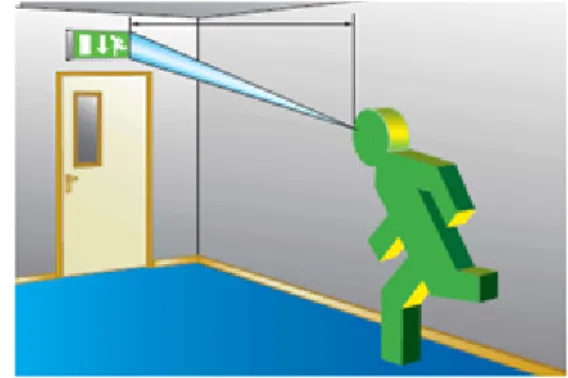
In order to produce a correctly and efficiently working piece of object detection, it is important to analyze the basic requirements for the given environmental condition with respect to the underlying principles of computer vision. The proper emergency exit sign perceivable view point is shown in Figure 3. This paper basically focus on the area of object detection is of particular importance for the task of recognizing emergency exit signs in indoor building environments. The detection terms describes the process of finding and identifying an object of interest in a captured image in this case, a rectangular plate in a room or corridor. In order to recognize the object as an emergency exit sign as opposed to other signs, and the direction it points at, the object has to be classified.
Figure 3. Emergency Exit Sign perceivable View Point
The vision based object detection and recognition follow the set of image processing methods shown in Figure 4. The capture image frame fetches an image by accessing the camera API provided for smart device platform. The image pre-processing takes the captured image and filter the image to remove the noise on image.
The image segmentation use edge detection or thresholding method to separate the object regions. In the finding object, the segmented object region is grouped and extracted similar connected region of object. The object recognition applies the chosen object recognition method
Figure 6. Proposed Emergency Exit System Emulation model to the image in order to determine the presence of a sign
and returns the results to the core module
Figure 4. Vision Based Object Detection Method
This paper uses the object finding and tracking using CAMShift algorithm for detecting emergency exit sign.
The CAMShift performs better in a given background where lighting changes and object occlusion are absent. In this paper proposed approach, need to consider text extraction from exit sign and find direction information from exit sign arrow as part of vision based exit sign detection.
The text extracted from exit sign can be recognized using optical character recognition technique. The recognizing of the text in images is useful in many computer vision applications such as image search, document analysis, and robot navigation. The OCR function provides a way to add text recognition functionality to a wide range of applications and making use of this information it is easy to identify the location of misclassified text within the image.
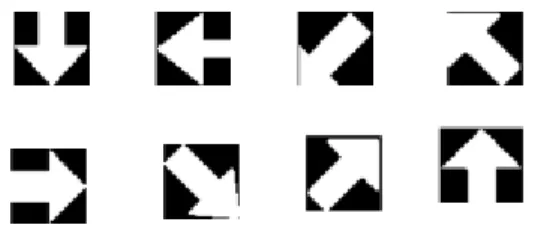
The direction information from exit sign is extracted template matching method. There are eight possible arrow directions that could be present in the exit sign board as shown in Figure 5. The arrow region of the exit sign image is cropped and is resized to the predefined template image size. The runtime captured input image and the template images are given as input to find the correlation coefficient between both images. The template which matches the input arrow image gives the maximum correlation value and maximum correlated ar arrow is recognized as a matched direction.
Figure 5. Exit Sign Direction Arrow Templates
The detection direction arrow is converted into text form to give direction to user and the decoded text converted as synthetic audible information using text to speech (TTS) conversion. The TTS is a speech synthesis method that converts text into audible trained voice output and developed to aid the visually impaired by offering a computer-generated spoken voice that would "read" text to the user.
V. System Implementation and Results Analysis
The android based LG smart phone is used to implement the evaluation application of the proposed WayFinder to find escape path using emergency exit sign system. For the purpose of evaluation, the test application used real time image capture using a mobile phone camera. A real-time RGB image is captured using the mobile phone camera and the phone sizes can vary, this implementation resize the captured image to a predefined size (300 X 300), for ease and real-time processing
The RGB image is converted into grayscale, and blur the image using median filter to removes salt and pepper noise which eliminates small dark spots present in the image, if any. The CAMShift tracking algorithm used to detect the exit sign board object and then applied OCR to detect the texture information on the exit sign board. The direction information are extracted from exit sign board using template matching principles. The WayFinder implementation system block diagram is shown in Figure 6.
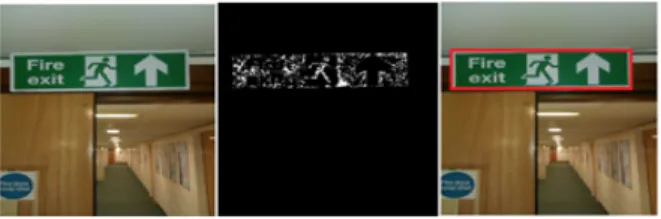
The Android Application uses the OpenCV android library to implement computer vision algorithms like RGB to Gray conversion, Image Noise Removal, CAMShift Object tracking, Edge detection, OCR, and Template matching. The resultant object tracking and exit sign object detection emulation result on Android based smartphone application result is shown in Figure 7. The text extraction from exit sign board image using OCR and the recognized text information shown in Figure 8. The extracted direction arrow sign using template matching is shown in Figure 9.
Figure 7. Emulated Object Detection Result Using CAMShift Algorithm
Figure 8. Extracted text Region and OCR Recognized Text Information
Figure 9. Extracted Sign Direction Arrow Using Template Matching
Thee real time exit sign images were captured at malls, public buildings, offices and outside the buildings and evaluated with proposed implementation. In this proposed approach implementation tested with exit sign board some which contain text and without text, etc. The exit sign board in these evaluation contained different text such as EXIT, FIRE EXIT, EMERGENCY EXIT, etc. are used and verified. Also some exit sign images had the symbol of man running, staircase, and captured in different lighting conditions. The arrow positions were either in the extreme
right or in the extreme left kind of exit sign board captured images also used in this evaluation. The emergency exit sign was detected and the direction was identified correctly in about 95% of the above cases.
VI. Conclusion
The recent advancements in smart devices technology have always been beneficial to the mankind in real life usage scenario. This proposed smartphone based WayFinder using computer vision technology takes an initiative in attainment of a goal that would help the people to live in this society safely and aid them to protect themselves in critical emergency condition when they are in inside the building. The smart devices are handy with less weight that anyone can carry in hand in any condition and it won’t burden them while moving. This proposed smart device assistive emergency WayFinder system if developed with zeal would surely serve as a best alternative to many already existing systems making use of advanced and invasive technologies to help the people on emergency situation without being panic and no need to wait for evacuation team support to save life in fire kind of emergency situations. In this research, the future works that can be incorporated into the this approach includes upgrading it so that the person using this particular system can be intimated with the distance information as to how far he/she is from the exit door/window apart from the direction information. Also building environmental sensors can be incorporated in the mobile device and also in the exit sign board so that instead of having to capture an image, sensors can easily identify the exit sign board and provide the necessary information with a greater efficiency.
References
[1] K.Matusiak, P.Skulimowski, P.Strumillo, “Object recognition in a mobile phone application for visually impaired users”, The 6th International Conference on Human System Interaction (HSI), IEEE, 2013.
[2] Samantha Patricia Bail, “Image Processing on a Mobile Platform”, University of Manchester, 2009.
[3] Bari, Neha, Nilesh Kamble, and Parnavi Tamhankar,
“Android based object recognition and motion detection to aid visually impaired”, International Journal of Advances in Computer Science and Technology, 2014.
[4] Yilmaz, A., Javed, O., Shah, M, “Object Tracking: A Survey”, ACM Computing Survey 38, 1–45 2006
[5] Yuan, L., Mu, Z.-C, “Ear Detection Based on Skin-Color and Contour Information”, 6th International Conference on Machine Learning and Cybernetics, vol. 4, pp. 2213–2217.
IEEE, Hong Kong 2007
[6] Yilmaz, A., Li, X., Shah, M, “Contour-Based Object Tracking with Occlusion Handling in Video Acquired Using Mobile Cameras”, IEEE Transaction on Pattern Analysis and Machine Intelligence, vol. 26, pp. 1531–1536. IEEE Computer Society 2004.
[7] Yue, Y., Gao, Y., Zhang, X, “An Improved CAMShift Algorithm Based on Dynamic Background”, 1st International Conference on Information Science and Engineering, pp.
1141–1144. IEEE, 2009.
[8] Ive Billiauws, Kristiaan Boniean, “Image recognition on an android mobile phone”, 2008.
[9] Alvaro Gonzalez, Luis M. Bergasa, J. JavierYebes, Sebastian Bronte, “Text Location in Complex Images”, 21st International Conference on Pattern Recognition, 2012.
[10] Xilin Chen, Jie Yang, Jing Zhang, Alex Waibel, “Automatic detection and recognition of signs from natural scenes”, Image Processing, IEEE Transactions on 13.1, 2004.
[11] Erich Bruns and Oliver Bimber, “Adaptive training of video sets for image recognition on mobile phones”, Journal of Personal and Ubiquitous Computing, 2008.
저자
이 민 우(Minwoo Lee) 정회원
․2013년 3월 ~ 2015년 8월:서울과학 기술대학교 나노IT디자인융합대학원 공학석사
․2015년 9월 ~ 현재:서울과학기술대 학교 나노IT디자인융합대학원 박사과 정
<관심분야> : LED-IT 응용기술, 무선통신기술, UWB, 영상 전송기술
비나야감 마리아판(Vinayagam Mariappan) 정회원
․2008년 6월: Director in VENMSOL TECHNOLOGY & ESILICON LABS
․2014년 3월:MS in Media IT Eng., Seoul National Univ., of Science &
Tech., Seoul, Korea
<관심분야> : IP Video Surveillance, IoT, LED-IT, Network Multimedia, Video Analystic, VLC
비투무키자 조셉(Joseph MFITUMUKIZA) 정회원
․2010년 ~ 2015년:Kigali Institute Of Science and Technology (KIST) 전자 통신공학 대학교졸업
․2015년∼현재:서울과학기술대학교 미디어 IT공학과 석사과정
<관심분야> : 방송통신, IoT, 안드로이드
이 정 훈(Junghoon Lee) 정회원
․2001년:성균관대학교 전기전자 및 컴 퓨터공학과 석사졸업
․2012년:서울과학기술대학교 IT정책 전문대학원 박사졸업
․2015년 ~ 현재:동서울대학교 전기정 보제어과 교수
<관심분야> : 디지털통신, 무선통신, LED-IT 응용기술, 차 세대 이동통신 기술
조 주 필(Juphil Cho) 정회원
․2001년 : 전북대학교 전자공학과 박사
․2000년 ∼ 2005년 : ETRI 이동통신연 구단 선임연구원
․2006년 ∼ 2007년 : ETRI 초빙연구원
․2011년 : 미국 USF, Visiting Researcher
․2005년 ∼ 현재 : 군산대학교 IT융합통신공학전공 교수
<관심분야> : Cognitive-Radio, 주파수 융합기술, LTE
차 재 상(Jaesang Cha) 정회원
․2000년:일본 東北(Tohoku)대학교 전 자공학과 공학박사
․2002년:한국전자통신연구원(ETRI) 무선방송 기술연구소 선임연구원
․2008년:미국 플로리다 대학교 방문교 수
․2005년 ~ 현재:서울과학기술대학교 전자IT미디어공학과 교수
<관심분야> : LED-ID, 조명IT융합신기술, LBS, ITS, UWB, 무선 홈 네트워크, IoT응용기술 등