http://bxdoi.org/10.7783/KJMCS.2012.20.4.308
산벚나무 잎 추출물 및 분획물의 항균활성과 Nitric Oxide 생성억제 활성
양선아*·표병식*·김선민*·이경인**,***†
*동신대학교 한약재산업학과, **동신대학교 생물자원산업화지원센터, ***조선대학교 바이오신약개발학과
Antibacterial Activity and Nitric Oxide Production Inhibitory Activity of the Extract and its Fractions from the Leaves of Prunus sargentii
Sun A Yang*, Byoung Sik Pyo*, Sun Min Kim* and Kyoung In Lee**,***†
*Department of Oriental Medicine Materials, Dongshin University, Naju 520-811, Korea.
**Biotechnology Industrialization Center, Dongshin University, Naju 520-811, Korea.
***Department of Bio New Drug Development, Chosun University, Gwangju 501-759, Korea.
ABSTRACT : This study was carried out to investigate the antibacterial activity against pathogens of acne and the anti- inflammatory effect of 75% ethanol extract and its fractions from the leaves of Prunus sargentii. In the antibacterial activity by the disc diffusion assay, the extract showed the highest effect against Propionibacterium acnes, Staphylococcus aureus and Staphylococcus epidermidis in 5㎎/disc. However, the ethyl acetate fraction showed the highest antibacterial activity in 1 ㎎/
disc. On the other hand, the hexane and chloroform fraction showed strong nitric oxide (NO) production inhibitory effect in lipopolysaccharide (LPS)-stimulated Raw 264.7 cell. In the cell viability of Raw 264.7 by MTT assay, the extract and all frac- tions were exhibited normal viabilities as nontoxic result. Consequently, the extract from the leaves of P. sargentii and its ethyl acetate fraction could be applicable to functional materials for antibacterial activity related fields. Moreover, the hex- ane and chloroform fraction could be applicable to candidate materials as anti-inflammatory agent.
Key Words : Prunus sargentii, Antibacterial Activity, Antioxidative Activity, Anti-inflammatory, Cytotoxicity
서 언
산벚나무 (Prunus sargentii)는 장미과 (Rosaceae) 벚나무속 (Prunus)에 속하는 식물로, 산벚나무의 수피는 벚나무 (Prunus serrulata), 왕벚나무 (Prunus yedoensis)의 수피와 함께 화피 (樺皮) 또는 앵피 (櫻皮)라는 생약재로 사용되고 있다. 효능으 로는 청열 (靑熱), 해독 (解毒), 거담 (去痰) 등이 알려져 있으 며, 이와 같은 효능을 바탕으로 염증성 질환이나 피부 관련 질환에 빈번히 이용되어 왔다 (Shin, 2006; Kam, 1981; Park et al., 1998). 지금까지 밝혀진 주요성분으로는 벚나무 수피에 서 분리되어 현재 기침약으로 사용되고 있는 sakuranin을 포 함하여 naringenin, taxifolin, pinostobin 등이 있으며, 관련된 활성으로는 항산화 활성과 면역억제 활성, 아토피성 염증 억 제, tyrosinase 저해 활성 등이 연구되어 왔다 (Lee et al., 2001, 2003; An et al., 2006; Han and Han, 1978; Park et al., 2008a, b; Kang, 2007). 벚나무의 열매는 식용되고 심 장마비, 부종, 유산염과 치통에 대한 민간약으로 사용되었으며
(Kim, 1996), 풍부한 anthocyanin 함량을 바탕으로 벚나무 열 매가 우수한 천연 적색 색소자원임을 보고한 바 있다 (Kim, 1999). 또한 벚나무 꽃은 예로부터 소금물에 침지 건조하여 차 로 이용하였으며 (Kim, 2005), 위장과 폐 기능이 좋아진다고 하였다 (Jung, 2002). 최근에는 벚나무 꽃의 차 개발을 위하여 항균성, 항산화성 및 항염증 효과, 성분분석 및 무기성분 등에 관한 실험을 실시하여 벚나무가 차의 재료로 우수한 자원이 될 수 있다 하였고 (Park et al., 2007; Kim et al., 2006a, b), 또한 벚나무 심재 추출물에는 안전하고 활성이 우수한 항 균 및 항산화 활성물질이 포함되어 있다는 연구결과가 보고되 는 등 (Choi et al., 2003) 다양하게 이용되어 왔기 때문에 개발가능성이 매우 높은 식물이라 할 수 있다. 이와 같이 산 벚나무를 포함한 벚나무류의 다양한 부위가 여러 가지 생리활 성을 바탕으로 그 활용가능성이 연구되고 있으나 아직까지 잎 에 대한 연구는 부위별 활성을 추출물 수준에서 비교한 연구 (Yang et al., 2012) 외에는 전무한 실정이다. 따라서 본 연구 에서는 산벚나무의 잎의 75% ethanol 추출물과 용매 분획별
†Corresponding author: (Phone) +82-61-336-3104 (E-mail) [email protected] Received 2012 August 6 / 1st Revised 2012 August 22 / Accepted 2012 August 31
시료의 여드름 원인균에 대한 항균활성과 nitric oxide (NO) 생성 억제 및 소거능 그리고 항산화 활성 등을 조사하여 피부 관련 약용 식물 소재로서의 개발 가능성을 살펴보고자 한다.
재료 및 방법
1. 재료 및 추출
본 실험에 사용된 산벚나무 잎 2011년 6월 전라남도 나주시의 야산에 자생하는 산벚나무에서 분리한 것으로 수세 후 40℃에서 건조시킨 후 4℃ 이하로 냉장보관하면서 실험에 사용하였다.
2. 추출 및 분획
건조된 산벚나무 잎 시료를 blender를 사용하여 마쇄한 후 75% ethanol을 추출 용매로 80℃에서 2시간씩 3회 반복하여 환류추출을 실시하였다. 추출액은 여과와 농축 및 동결건조를 실시하여 분말화한 결과 26.77%의 수율로 추출물을 얻었다.
이중 일부를 증류수에 분산시킨 후 hexane, chloroform, ethylacetate, n-butanol을 사용하여 순차적으로 용매분획을 실 시하였다. 분획된 시료는 여과와 농축 및 동결건조 후 추출물과 함께 4℃ 이하로 냉장보관하면서 실험에 사용하였으며, 분획 수 율은 hexane, chloroform, ethylacetate, n-butanol, aqueous 층에 서 각각 11.48%, 6.39%, 4.28%, 22.62%, 55.24%로 나타났다.
3. 총 polyphenol 및 flavonoid 함량 측정
Folin-Denis법을 이용하여 산벚나무 잎의 추출물 및 분획물 의 polyphenol 함량을 측정하였다 (Otto and Denis, 1912).
Methanol에 1 ㎎/㎖농도로 용해시킨 시료액 80 ㎕와 Folin- Denis reagent 80㎕ 를 혼합하여 3분간 반응시킨 뒤 10%
Na2CO3 80㎕를 혼합하여 1시간동안 암실에서 반응시킨 후 700㎚에서 상등액의 흡광도를 측정하였다. 표준물질로 tannic acid를 0~500 ㎍/㎖의 농도로 제조하여 시료와 동일한 방법으 로 표준 검량선을 작성하고 총 polyphenol 함량을 ㎎/g로 나 타내었다. 한편, 페놀성 화합물중 특히 여러 가지 기능성을 나 타내는 것으로 알려진 flavonoid 함량을 알아보기 위해 Moreno 등 (2000)의 방법을 변형하여 측정하였다. 1 ㎎/㎖ 농 도로 methanol에 용해시킨 시료액 100 ㎕와 10% aluminium nitrate 20㎕, 1M potassium acetate 20 ㎕, methanol 860 ㎕ 를 차례로 혼합하여 40분간 반응시킨 후 415 ㎚에서 흡광도 를 측정하였다. 표준물질로 rutin 0~500 ㎍/㎖의 농도로 제조 하여 시료와 동일한 방법으로 표준 검량선을 작성하고 flavonoid 함량을 ㎎/g으로 나타내었다.
4. Disc diffusion assay에 의한 항균활성 측정
산벚나무 잎 추출물과 분획물의 항균활성을 비교하기 위하 여 각 균주를 대상으로 disc diffusion assay로 측정하였다
(Collins et al., 1995). 항균활성 실험에 사용된 미생물 균주인 Propionibacterium acnes (KCTC3314), Staphylococcus epdermidis (KCTC1917), Staphylococcus aureus (KCTC3881) 는 한국생명공학연구원 생물자원센터 (BRC)에서 분양 받은 것 을 실험에 사용하였다. P. acnes 균주는 Reinforced Clostridial Medium (RCM)을 사용하였으며, S. epidermidis와 S. aureus 균주는 Nutrient agar 및 broth를 사용하였다. 항균시험용 평판 배지는 계대 배양된 각 균주 배양액을 100 ㎕씩 분주한 후 멸 균 면봉을 이용하여 도말하여 준비하였고, 시료를 disc당 1.0, 5.0㎎이 되도록 직경 6 ㎜의 paper disc에 천천히 흡수시킨 뒤 건조과정을 거쳐 용매를 휘발시킨 후 평판배지 위에 밀착 시킨 상태로 37℃에서 24시간 배양한 후 disc를 중심으로 생 성된 저해환 (clear zone, ㎜)을 측정하여 항균활성을 비교하 였다. P. acnes 균주의 배양에는 5% CO2가 공급되는 incubator를 활용하였다.
5. DPPH radical 소거능 측정
산벚나무 잎 추출물과 분획물의 항산화활성을 비교하기 위 해 1,1-diphenyl-2-picrylhydrazyl (DPPH)을 사용하여 radical 소거능을 측정하였다 (Blois, 1958). 각 시료를 methanol에 0.1~5㎎/㎖ 의 다양한 농도로 용해시킨 시료액 20 ㎕ 와 200 µM로 용해시킨 DPPH 용액 180 ㎕를 혼합하여 15분간 암실에서 반응시킨 후 microplate reader (BIO-TEK, USA)를 사용하여 517 ㎚ 에서 흡광도를 측정하였다. 측정된 흡광도를 바탕으로 50%의 DPPH radical을 소거하는데 필요한 농도 (SC50)를 계산하였다. Positive control로 ascorbic acid (vitamin C)를 사용하였다.
6. Nitric oxide 소거능 측정
Nitric oxide (NO) 소거능은 Marcocci 등 (1994)의 방법을 변형하여 다음과 같이 측정하였다. 10mM sodium nitroferricyanide(III) dihydrate 50㎕ 와 증류수에 일정농도로 용해시킨 시료액 30 ㎕를 혼합한 후 25℃에서 150분 동안 반 응시켰다. 1% sulfanilamide (in 30% acetic acid) 60 ㎕ 를 혼합하고 5분후 다시 0.1% N-(naphtyl)ethylenediamine dihydrochloride (in 60% acetic acid) 60㎕를 혼합하여 30분 간 실온에서 반응시킨 후 520 ㎚에서 흡광도를 측정하였다.
대조군으로 ascorbic acid (vitamin C)를 사용하였으며, 시료액 대신 증류수를 사용한 대조군의 결과를 기준으로 소거능을 계 산하였다.
7. NO 생성량 및 세포생존율 측정
NO 생성량 측정과 세포생존율 측정에 사용된 동물세포주인 Raw 264.7은 BRC에서 분양 받은 것을 실험에 사용하였으며, 10% FBS와 1% penicillin-streptomycin을 혼합한 Dulbecco’s
Modified Eagle Medium (DMEM, WelGENE, Korea) 배지 를 사용하였다. Raw 264.7 세포를 96 well-plate에 1 × 10⁵ cells/well이 되도록 분주하고 24시간 동안 배양한 후, 농도별 시료액과 lipopolysaccharide (LPS, 2 ㎍/㎖)를 혼합하여 24시 간 동안 배양하였다. 세포 배양액을 각 well에서 50 ㎕씩 회 수하여 새로운 96 well-plate에 옮기고 50 ㎕ 의 1%
sulfanilamide (in 5% H3PO4)를 첨가한 다음 10분간 혼합한 후, 다시 50 ㎕의 0.1% naphtyl-ethylendiamine dihydrochloride (in H2O)를 첨가하여 상온에서 10분간 반응시켜 micro-plate reader를 이용하여 540 ㎚에서 흡광도를 측정하였다. 표준물질 로 sodium nitrite를 농도별로 조제하여 동일한 방법으로 측정 한 흡광도를 바탕으로 작성한 검량선을 이용하여 NO 생성량 을 산출하였다 (Ding et al., 1988). 세포독성을 확인하기 위 한 세포생존율의 측정을 위해 MTT assay를 실시하였다. NO 생성량 측정을 위해 상등액 50 ㎕를 회수한 후 남은 96 well- plate에 5 ㎎/㎖ 의 농도로 제조한 MTT용액을 각 well에 10㎕씩 가하고, 37, 5% CO2 조건에서 4시간 동안 반응시켜 MTT가 환원되도록 하였다. 배지를 제거한 후, 각 well에 100㎕의 DMSO를 첨가하여 생성된 formazan 결정을 용해시 켜 540 ㎚에서 흡광도를 측정하였으며, 시료액 대신 PBS를 사용한 blank의 흡광도를 기준으로 세포 생존율 산출하였다.
8. 통계분석
모든 측정값은 3회 이상 반복 실험한 결과의 평균값과 표준 편차 (mean ± SD)로 표시하였고, 각 실험군 간의 통계학적 분 석은 windows용 SPSS 12.0 (SPSS Inc., Chicago, USA)을 이용하였다. 각 군 간의 측정치 비교는 one-way analysis of variance(ANOVA)를 시행하였으며, 유의성은 신뢰구간 p < 0.05에서 의미를 부여하였다.
결과 및 고찰
1. 총 polyphenol 및 flavonoid 함량
약용 자원식물 중에 존재하는 polyphenol 화합물은 hydroxyl기를 가지는 방향족 화합물로서 항산화 활성이나 항 암 활성 등 다양한 생리활성에 관여하는 것으로 알려져 있다 (Liu, 2004; Manach et al., 2005). 한편, 플라보노이드는 전 형적인 페놀성 화합물로서 C6-C3-C6의 기본구조를 가지며, flavonoid의 polyphenolic한 성질은 superoxide, hydroxy radical 과 같은 세포손상을 초래하는 free radical을 없애주는 항산화 활성을 비롯하여 항암, 항균 등 다양한 생리활성을 가지는 것 으로 알려져 있다 (Dewick, 2002). 산벚나무 잎의 추출물과 분획 용매별 시료의 polyphenol과 flavonoid 함량을 측정한 결과를 Table 1에 제시하였다. 추출물 중 polyphenol 함량이 175.72㎎/g으로 나타났고, 용매 분획별 시료에서 ethyl acetate
와 butanol 분획의 함량이 각각 312.19 ㎎/g과 313.33 ㎎/g으로 추출물보다 높게 나타났으며, hexane, chloroform, aqueous 분획 의 함량은 각각 38.16 ㎎/g, 43.97 ㎎/g, 79.05 ㎎/g으로 추출물 보다 낮게 나타났다. Flavonoid 함량도 이와 유사한 양상으로 나타났는데, 추출물의 flavonoid 함량이 26.50 ㎎/g이었으나, ethyl acetate와 butanol 분획의 flavonoid 함량이 각각 56.11㎎/g, 54.30 ㎎/g으로 높게 나타났다.
2. 여드름 원인균에 대한 항균활성
피부질환 중 대표적인 여드름의 발생은 일반적으로 피지생 산의 증가, P. acnes의 모낭 증식 및 유전적 소질 등의 주요 인자가 복합적으로 작용하여 나타나는 것으로 알려져 있다 (Burton and Shuster, 1971; Cunliffe et al., 2004). 물론 미 생물학적인 원인균도 단순히 P. acnes 뿐만이 아니라 S.
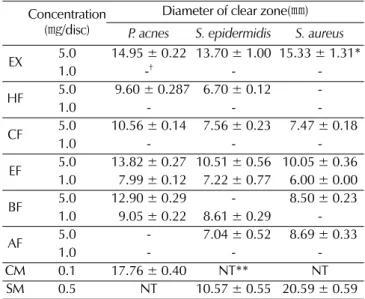
aureus, S. epidermidis 등과 같은 피부 상재균들이 관여하는 것이 일반적이다 (Ahn et al., 2002; Ki et al., 2005). 항균 활성 비교를 위해 disc diffusion assay를 활용한 실험을 실시 하여 그 결과를 Table 2에 나타내었다. P. acnes에 대한 항균 활성 결과에서 positive control로 사용된 clindamycin보다 낮 은 활성이기는 하였으나 5 ㎎/disc 농도로 처리하였을 경우 추 출물은 14.95 ㎜의 생육 저해환을 형성하였으며, ethyl acetate 와 butanol 분획이 각각 13.82 ㎜와 12.90 ㎜ 의 생육 저해환 을 형성하였다. 하지만 1 ㎎/disc로 처리하였을 때에는 ethyl acetate와 butanol 분획에서만 생육저해환을 생성하였다. S.
aureus, S. epidermidis에 대해서도 동일하게 5 ㎎/disc 농도로 처리하였을 경우 추출물에서 가장 큰 활성을 보여주었으나 1㎎/disc로 처리하였을 때에는 ethyl acetate 분획물에서만 생 육저해환을 생성하였다. 이와 같은 항균활성은 산벚나무의 다 Table 1. Total phenolic compound and flavonoid content of the extract and fractions from leaves of Prunus sargentii.
Total phenolic
compound(㎎/g TAE†) Flavonoid(㎎/g RE‡) EX 175.72 ± 6.64b 26.50 ± 5.63*b**
HF 38.16 ± 1.66d ND§c
CF 43.97 ± 0.58d 5.92 ± 5.34c
EF 312.19 ± 10.26a 56.11 ± 3.25a
BF 313.33 ± 6.73a 54.30 ± 5.97a
AF 79.05 ± 1.80c 22.17 ± 2.98b
EX; 75% ethanol extract of P. sargentii, HF; hexane fraction, CF;
chloroform fraction, EF; ethyl acetate fraction, BF; butanol fraction, AF; aqueous fraction.
†TAE : tannic acid equivalent.
‡RE : rutin equivalent.
§Not detected.
*Values are mean ± SD (n = 3).
**Different superscript letters in the same column show significant differences at p < 0.05 by one-way ANOVA.
른 부위인 수피의 추출물이나 용매별 분획의 항균활성보다는 다소 낮은 수준이었으나 활용가능성은 충분히 있는 것으로 판 단되었다 (Lee et al., 2011a).
3. DPPH radical 소거능
산벚나무 잎의 추출물과 용매별 분획의 항산화 활성을 확인 하기 위해 실시한 DPPH radiacl 소거능 측정에서 50%의 DPPH radical을 소거하는데 필요한 시료의 농도를 산출한 SC50 값을 Table 3에 나타내었다. Ethyl acetate 분획과 butanol 분획의 SC50값이 각각 29.57 ㎍/㎖과 26.36 ㎍/㎖로 55.02 ㎍/㎖
인 추출물보다 높은 활성을 보여주었다. 이와 같은 SC50 수치는 positive control로 사용된 ascorbic acid의 SC50 값을 기준으로 비교한 relative activity에 나타난 바와 같이 ethyl acetate 분획 과 butanol 분획의 활성이 각각 90.24%와 101.21% 수준으로 positive control과 동일한 수준의 항산화 효과를 보여주었다. 이 와 같은 결과는 Table 1의 polyphenol 함량 측정의 결과와 유 사한 양상임을 확인할 수 있는데, 이는 기존의 연구들에서 제시 한 것과 마찬가지로 DPPH radical 소거능과 같은 항산화 활성 이 polyphenol 화합물의 함량과 밀접한 연관관계가 있음을 확인 할 수 있었다 (Oh et al., 2010; Im and Lee, 2011).
4. NO 소거능
NO는 혈액응고 및 혈압조절 기능, 암세포에 대한 면역기능
등의 역할을 하는 물질이지만, 과량이 존재하면 인체에 유해 한 영향을 미치게 되어 세포손상뿐만 아니라 염증 반응을 비 롯한 뇌막염, 알츠하이머병과 파킨슨병 같은 퇴행성 질환에 중 요한 요인으로 작용한다 (Lin et al., 2008). 또한 superoxide 음이온 (O2-)과 쉽게 반응하여 매우 반응성이 높고 독성이 강 한 산화제인 peroxynitrite (ONOO-)를 생성하게 된다.
Peroxynitrite는 단백질 및 지질의 과산화를 유도하고 세포독성 을 일으키는 것으로 알려져 있고 반응 속도는 H2O2의 수천 배에 이르며 신경세포에서 짧은 시간 동안 급속한 손상을 유 Table 2. Antibacterial activities of the extract and fractions from
leaves of Prunus sargentii.
Concentration (㎎/disc)
Diameter of clear zone(㎜) P. acnes S. epidermidis S. aureus EX 5.0 14.95 ± 0.22 13.70 ± 1.00 15.33 ± 1.31*
1.0 -† - -
HF 5.0 09.60 ± 0.28706.70 ± 0.12 -
1.0 - - -
CF 5.0 10.56 ± 0.14 07.56 ± 0.23 07.47 ± 0.18
1.0 - - -
EF 5.0 13.82 ± 0.27 10.51 ± 0.56 10.05 ± 0.36 1.0 07.99 ± 0.12 07.22 ± 0.77 06.00 ± 0.00
BF 5.0 12.90 ± 0.29 - 08.50 ± 0.23
1.0 09.05 ± 0.22 08.61 ± 0.29 - AF 5.0 - 07.04 ± 0.52 08.69 ± 0.33
1.0 - - -
CM 0.1 17.76 ± 0.40 NT** NT
SM 0.5 NT 10.57 ± 0.55 20.59 ± 0.59
EX; 75% ethanol extract of P. sargentii, HF; hexane fraction, CF;
chloroform fraction, EF; ethyl acetate fraction, BF; butanol fraction, AF; aqueous fraction, CM; clindamycin, SM; streptomycin.
Clindamycin and streptomycin were used as a positive control.
†No inhibition.
*Values are mean ± SD (n = 3).
**Not tested.
Table 3. SC50 values in DPPH radical scavenging ability of the extract and fractions from leaves of Prunus sargentii.
SC50†(㎍/㎖) Relative activity‡(%) EX 00055.02 ± 1.70*b** 048.49
HF 239.54 ± 7.51d 011.14
CF 236.76 ± 5.28d 011.27
EF 029.57 ± 1.10a 090.24
BF 026.36 ± 0.24a 101.21
AF 144.91 ± 8.53c 018.41
AA 026.68 ± 0.34a 100.00
EX; 75% ethanol extract of P. sargentii, HF; hexane fraction, CF;
chloroform fraction, EF; ethy lacetate fraction, BF; butanol fraction, AF; aqueous fraction, AA; ascorbic acid. Ascorbic acid was used as a positive control.
†SC50: concentration of each samples for scavenging 50% of DPPH radical.
‡Relative activity: ratio of SC50 value compared to positive control (ascorbic acid).
*Values are mean ± SD (n = 3) without relative activity.
**Different superscript letters in the sam
Fig. 1. Nitric oxide scavenging ability of the extract and fractions from leaves of Prunus sargentii. EX; 75%
ethanol extract of P. sargentii, HF; hexane fraction, CF;
chloroform fraction, EF; ethyl acetate fraction, BF;
butanol fraction, AF; aqueous fraction, AA; ascorbic acid. Ascorbic acid was used as a positive control.
*Values are mean ± SD (n = 3). **Different superscript letters in the same concentration show significant differences at p < 0.05 by one-way ANOVA.
발하는 것으로 보고되고 있다 (Chung et al., 2001; Radi et al., 1991; Haenen et al., 1997). 산벚나무 잎 추출물과 용매 별 분획의 NO 소거능을 측정한 결과, Fig. 1에 나타난 바와 같이 150 ㎍/㎖의 농도에서 추출물의 경우에 49.67%을 소거 하였으며, ethyl acetate와 butanol 분획이 각각 69.49%과 67.25%로 높은 활성을 나타내었다. hexane과 chloroform 분획 의 경우에도 각각 52.35%, 49.96%로 ethyl acetate와 butanol 분획보다는 활성이 떨어지지만 추출물보다 높은 활성을 보였 다. Aqueous 분획은 27.55%의 소거능을 보여줌으로써 추출물 과 다른 용매 분획보다 낮은 활성을 보였다.
5. NO 생성 억제 활성과 세포독성
LPS는 그람 음성 세균의 세포외막에 존재하는 독소로서 Raw 264.7 세포와 같은 macrophage에 작용하여 tumor necrosis factor-α(TNF-α)나 interleukin-6(IL-6) 등과 같은 여 러 가지 inflammatory cytokine의 발현과 함께 NO의 생성을 촉진하는 것으로 알려져 있다 (Lee et al., 2004). 이로 인해 항염증활성 연구에 있어서 LPS로 관련 세포를 자극하여 생성 되는 NO의 양을 측정하여 비교하는 방법이 빈번히 사용되고 있다(Jeoung et al., 2009; Yoon et al., 2010; Lee et al., 2011b). 산벚나무 잎의 추출물과 용매별 분획 시료가 LPS로 염증을 유발시킨 조건에서 NO 생성량에 미치는 영향을 측정 하여 Fig. 2에 나타내었다. 100 ㎍/㎖농도에서 추출물의 경우 에는 1257.48 pg/㎖의 NO를 생성하였으며, hexane과 chloroform 분획은 각각 748.69 pg/㎖, 659.61 pg/㎖의 NO를 생성함으로 써 추출물과 다른 분획에 비해 낮은 NO 생성량을 보여주었다.
NO 소거 활성과 NO 생성량을 통하여 ethyl acetate와
butanol 분획의 경우에는 생성되어있는 NO를 소거하는 활성 은 높지만, NO의 생성 자체를 억제하는 효과는 높지 못한 것 으로 판단되었다. 반면, hexane과 chloroform 분획은 이미 생 성되어있는 NO를 소거하는 활성은 낮았으나 염증을 유발시킨 조건에서 NO의 생성을 억제하는 활성은 높은 것으로 나타났 다. 이와 같은 결과는 기존에 화피라는 생약재로 사용되고 있 는 벚나무의 수피부위 뿐만 아니라 수목의 생장에 영향을 적 게 줄 수 있는 잎 부위의 활용 가능성을 높일 수 있다는 점 에서 주목할 만한 것이라고 판단된다.
한편, LPS로 염증반응을 유발시킨 상태에서 산벚나무 잎의 추출물과 용매별 분획의 Raw 264.7 세포에 대한 세포생존율 을 측정한 결과, Fig. 3에서와 같이 실험이 실시된 농도에서 82.30~122.65%의 양호한 세포생존율을 나타내었다. 다만 ethyl acetate 분획은 가장 높은 농도인 500 ㎍/㎖에서 64.47%의 비 교적 낮은 세포생존율을 보였는데 이는 ethyl acetate 분획 시 료가 세포의 증식을 억제하는 성분을 가지고 있음을 보여주는 결과이다. 따라서 추가적인 연구를 통하여 구체적인 독성의 수 준을 확인할 필요가 있을 것으로 판단된다.
이상의 결과에서 산벚나무 잎의 75% ethanol 추출물의 ethyl acetate 분획이 상대적으로 높은 polyphenol과 flavonoid 함량을 바탕으로 여드름 원인균에 대해 높은 항균활성을 가지 는 것으로 확인되었다. 다만 높은 농도에서는 오히려 추출물 의 항균활성이 더 높게 나타남으로써 분획들 간의 병합효과가 일정 농도 이상에서는 나타날 수 있음이 확인되었다. Ethyl acetate 분획과 butanol 분획이 상대적으로 높은 polyphenol 함량을 바탕으로 높은 항산화 활성을 가지는 것으로 확인되었 으며, 염증 억제 활성을 평가하기 위해 실시된 NO 소거능과 Fig. 2. Nitric oxide production inhibitory activity of the extract
and fractions from leaves of Prunus sargentii in Raw 264.7 cell. EX; 75% ethanol extract of P. sargentii, HF;
hexane fraction, CF; chloroform fraction, EF; ethyl acetate fraction, BF; butanol fraction, AF; aqueous fraction.
*Values are mean ± SD (n = 3). **Different superscript letters show significant differences at p < 0.05 by one- way ANOVA.
Fig. 3. Raw 264.7 cell viabilities of the extract and fractions from leaves of Prunus sargentii by MTT assay. EX; 75%
ethanol extract of P. sargentii, HF; hexane fraction, CF;
chloroform fraction, EF; ethyl acetate fraction, BF; butanol fraction, AF; aqueous fraction. *Values are mean ± SD (n = 3). **Different superscript letters in the same concentration show significant differences at p < 0.05 by one-way ANOVA.
NO 생성량 측정에서 ethyl acetate 분획과 butanol 분획이 생 성되어있는 NO를 소거하는 활성은 높지만, NO의 생성 자체 를 억제하는 효과는 높지 않은 것으로 확인되었다. 반면, hexane분획과 chloroform 분획은 NO의 생성을 억제하는 활 성은 높지만 이미 생성되어있는 NO를 소거하는 활성은 낮은 것으로 판단되었다. 따라서 추가적인 연구를 진행한다면 산벚 나무 잎 추출물과 ethyl acetate 분획의 경우 항균 및 항산화 활성을 바탕으로 한 기능성 소재로서 그리고 hexane과 chloroform 분획의 경우 항염증 관련 활성을 가지는 소재로서 의 개발이 가능할 것으로 판단되었다.
LITERATURE CITED
Ahn YG, Kim SK, Shin CS and Min JH. (2002). Inhibitory effects of wax gourd extract on melanin formation and acne- forming bacterial growth. The Korean Journal of Food and Nutrition. 15:137-143.
An BJ, Cho YJ, Son JH, Park JM, Lee JY and Park TS.
(2006). Antioxidant effects and tyrosinase inhibition activity of extract of Prunus sargentii Rehder. Journal of the Korean Society for Applied Biological Chemistry. 49:145-148.
Blois MS. (1958). Antioxidant determinations by the use of a stable free radical. Nature. 181:1199-1200.
Burton JL and Shuster S. (1971). The relationship between seborrhea and acne vulgaris. British Journal of Dermatology.
84:600-601.
Choi DH, Lee HJ and Lee SS. (2003). Studies on biological activity of wood extractives (7)-antimicrobial and antioxidation activities of extractives from the heartwood of Prunus sargentii.
Mokche Konghak. 31:16-23.
Chung HT, Pae HO, Choi BM, Billiar TR and Kim YM.
(2001). Nitric oxide as a bioregulator of apoptosis. Biochemical and Biophysical Research Communications. 282:1075-1079.
Collins CH, Lyne PM and Grange JM. (1995). Collins and Lyne's microbiological methods. Butterworth-Heinemann Ltd.
Jordan Hill, England. p.178-205.
Cunliffe WJ, Holland DB and Jeremy A. (2004). comedone formation: etiology, clinical presentation and treatment. Clinics in Dermatology. 22:367-374.
Dewick PM. (2002). Medicinal natural products. Wiley & Sons.
Chichester, England. p.149-151.
Ding AH, Nathan CF and Stuehr DJ. (1988). Release of reactive nitrogen intermediates and reactive oxygen intermediates from mouse peritoneal macrophages. Comparison of activating cytokines and evidence for independent production. The Journal of Immunology. 141:2407-2412.
Haenen GR, Paquay JB, Korthhouwer RE and Bast A. (1997).
Peroxynitrite scavenging by flavonoids. Biochemical and Biophysical Research Communications. 236:591-593.
Han BH and Han YN. (1978). Immunosuppressant activity of cherry bark extract. Korean Journal of Pharmacognosy. 9:173- 175.
Im DY and Lee KI. (2011). Antioxidative, antibacterial activity and tyrosinase inhibitory activity of the extract and fractions
from Taraxacum coreanum Nakai. Korean Journal of Medicinal Crop Science. 19:238-245.
Jeoung YJ, Choi SY, An CS, Jeon YH, Park DK and Lim BO.
(2009). Comparative effect on anti-inflammatory activity of the Phellinus linteus and Phellinus linteus grown germinated brown rice extracts in murine macrophage RAW 264.7 cells. Korean Journal of Medicinal Crop Science. 17:97-101.
Jung HA. (2002). Antioxidant constituents from the leaves of Prunus serrurata var. spontanea. Ph. D. Thesis. Pukyung National Universty. p.6-16.
Kam WS. (1981). Pharmaceutical botany. National Chinese Medicine Institute. p.305-306.
Kang GJ. (2007). Inhibitory effect of organic extracts from Prunus yedoensis Matsum barks on the atopic dermatitis-like inflammation. Master Thesis. Cheju National University. p.56-60.
Ki HG, Yun SJ, Lee JB, Kim SJ, Lee SC and Won YH. (2005).
Microorganism isolated from acne and their antibiotic susceptibility. Korean Journal of Dermatology. 43:871-875.
Kim HJ. (2005). Development of tea using flower and young leaf of oriental cherry(Prunus serrurata var. spontanea). Master Thesis. Wonkwang University. p.11-12.
Kim HJ, Heo BK, Baek SH, Park YS and Park YJ. (2006a).
Effects of the tea manufacture method on mineral contents and sensory evaluation in flower and young leaf of Prunus serrulata lindl. var. spontanea Max. People, Plants and Environment. 9:26-33.
Kim HJ, Park YJ, Bea KS and Heo BG. (2006b). Component analysis of petals and young leaves for oriental cherry plants.
People, Plants and Environment. 9:20-25.
Kim TJ. (1996). Korean resources plants-II. Seoul University Press.
Seoul, Korea. p.168-169.
Kim YH. (1999). The characterization of anthocyanin pigments prepared from cherry(Prunus serrulata L. var. spontanea Max.
wils.) for the potential sources of red colorant. Journal of the Korean Society for Applied Biological Chemistry. 42:134-139.
Lee ES, Ju HK, Moon TC, Lee E, Jang Y, Lee SH, Son JK, Baek SH and Chang HW. (2004). Inhibition of nitric oxide and tumor necrosis factor-a(TNF-a) production by propenone compound through blockade of nuclear factor(NF)-B activation in cultured murine macrophage. Biological & Pharmaceutical Bulletin. 27:617-620.
Lee HJ, Lee SS, Choi DH and Atsushi K. (2001). Studies on biological activity of wood extractives(VI)-flavonoids in heartwood of Prunus sargentii. Mokchae Konghak. 29:133-139.
Lee HJ, Lee SS and Choi DH. (2003). Studies on biological activity of wood extractives(VII)-Antimicrobial and anti- oxidative activities of extractives from the heartwood of Prunus sargentii. Mokchae Konghak. 31:16-23.
Lee KI, Yang SA, Pyo BS and Kim SM. (2011a). Antibacterial activity against pathogens of acne and tyrosinase inhibitory activity of extract and fractions from bark of Prunus sargentii.
Korean Journal of Pharmacognosy. 42:155-160.
Lee SE, Lee JH, Kim JK, Kim KS, Kim YO, Soe JS, Choi JH, Lee ES, Noh HJ and Kim SY. (2011b). Anti-inflammatory activity of medicinal plant extracts. Korean Journal of Medicinal Crop Science. 19:217-226.
Lin JY, Li CY and Hwang IF. (2008). Characterization of the
pigment components in red cabbage(Brassica oleracea L. var.) juice and their anti-inflammatory effects on LPS-stimulated murine splenocytes. Food Chemistry. 109:771-781.
Liu RH. (2004). Potential synergy of phytochemicals in cancer prevention : mechanism of action. Journal of Nutrition.
134:3479S-3485S.
Manach C, Williamson G, Morand C, Scalbert A and Remesy C. (2005). Bioavailability and bioefficacy of polyphenols in humans. American Journal of Clinical Nutrition. 81:230S-242S.
Marcocci L, Maguire JJ, Droy-Lefaix MT and Packer L.
(1994). The nitric oxide-scavenging properties of Ginkgo biloba extract EGb 761. Biochemical and Biophysical Research Communications. 201:748-755.
Moreno MI, Isla MI, Sampietro AR and Vattuone MA. (2000).
Comparison of the free radical-scavenging activity of propolis from several region of Argentina. Journal of Ethnopharmacology.
71:109-114.
Oh YJ, Seo HR, Choi TM and Jung DS. (2010). Evaluation of antioxidant activity of the extracts from the aerial parts of Cnidium officinale Makino. Korean Journal of Medicinal Crop Science. 18:373-378.
Otto F and Denis W. (1912). On phosphotungstic- phosphomolybdic compounds as color reagents. Journal of Biological Chemistry. 12:239-243.
Park ES, Shin MK and Song HJ. (1998). A study on the antiallergic effect of Cortex Betula Platyphyllae or Cortex Pruni Serrulatae extract. Korean Journal of Herbology. 13:57-68.
Park JM, Lee JY, Park TS, Hyun SJ, Kim HH, Cho YJ, Kwon OJ, Son AR, Kim DS and An BJ. (2008a). A study on the cosmeceutical activities of Prunus sargentii R. Journal of the Korean Society for Applied Biological Chemistry. 51:70-78.
Park JM, Lee JY, Park TS, Park GH, Park KS, Kim TH, Cho YJ, Kwon OJ, Choi KI and An BJ. (2008b). Biological activity investigation, and phenol compounds isolation from barks of Prunus sargentii R. Korean Journal of Medicinal Crop Science. 16:173-182.
Park YJ, Kim HJ and Heo BG. (2007). Anti-microbial, anti- oxidant and anti-inflammation effects with of the flower and the young leaf extracts in oriental cherry plants. People, Plants and Environment. 10:43-49.
Radi R, Beckman JS, Bush KM and Freeman BA. (1991).
Peroxynitrite oxidation of sulfhydryls, the cytotoxic potential of superoxide and nitric oxide. Journal of Biological Chemistry.
266:4244-4250.
Shin MK. (2006). Clinical traditional herbalogy. Younglimsa.
Seoul, Korea. p.399-400.
Yang SA, Cho JH, Pyo BS, Kim SM and Lee KI. (2012).
Comparison of the physiological activities of extracts from different parts of Prunus sargentii. Korean Journal of Medicinal Crop Science. 20:159-164.
Yoon TS, Cheon MS, Kim SJ, Lee AY, Moon BC, Chun JM, Choo BK and Kim HK. (2010). Evaluation of solvent extraction on the anti-inflammatory efficacy of Glycyrrhiza uralensis. Korean Journal of Medicinal Crop Science. 18:28-33.